REVIEW 3 major objections 6 minor 33 references
Large Language Models for Token-Efficient and Semantic-Preserving Opinion Summarization
T0 review · 3 major / 6 minor · reviewed 2026-07-14 · grok-4.5
Pith's one-line read Stratified sampling of opinion facets lets LLMs summarize huge review corpora with ~97% fewer tokens while keeping viewpoint diversity.
desk verdict Solid journal extension of their ECML work: three formalized stratified samplers cut tokens ~97% and beat random on multi-domain opinion corpora, with public code; evaluation gold standards are LLM-derived and baselines thinner than the abstract claims. read the letter →
The pith
A machine-rendered reading of the paper's core claim, the machinery that carries it, and where it could break.
The reading
What carries the argument
Multidimensional stratified sampling: each opinion is first given probabilistic labels on sentiment, topics, emotion (and optional domain facets); three strategies (relevance-constrained Knapsack, KL-regularized Knapsack-KL, and density-based KDE) then select a fixed-size subset that preserves those class distributions under a hard token budget.
What would settle it
If, on the same three datasets, random samples of equal size matched or beat the stratified methods on both topic-coverage F1 and ModernBERT cosine similarity to a carefully constructed human or multi-model reference summary, the claimed advantage of distribution-aware selection would collapse.
Extended reading notes
Core claim
A compact subset of opinions selected by multidimensional stratified sampling (Knapsack, Knapsack-KL, or KDE) can be summarized by an LLM so that topic coverage and summary-level cosine similarity stay close to the full-corpus summary, while token usage falls by roughly two orders of magnitude.
Load-bearing premise
The evaluation treats the LLM summary of the entire unfiltered corpus as a reliable semantic gold standard, even though very large contexts can themselves degrade quality.
Editorial analysis
A structured set of objections, weighed in public.
Referee Report
Summary. The paper proposes a corpus-level framework for LLM-based opinion summarization that first annotates opinions with multidimensional probabilistic facets (sentiment, emotion, BERTopic topics, and optional domain facets) and then selects a compact subset under a fixed size N via three stratified samplers—relevance-constrained Knapsack, KL-regularized Knapsack-KL (Eqs. 1–2, Algorithms 1–2), and KDE—before facet-aware prompting. The central claim is that these distribution-aligned subsets (N≈20) preserve topical structure and yield summaries whose ModernBERT cosine similarity to full-corpus GPT-5 summaries substantially exceeds random sampling, while cutting input tokens by roughly 97% on Amazon product reviews, Tripadvisor hotel reviews, and X/Twitter political posts. An ablation on semantic dimensions and a public implementation are provided.
Significance. If the semantic-preservation claim holds under stronger evaluation, the work is practically significant: it offers a clear, implementable alternative to brute-force long-context ingestion or query-specific RAG for large opinion corpora, with explicit multi-facet balance and documented token savings. Strengths include formalized sampling algorithms with pseudocode, three heterogeneous domains, a dimension ablation (Table 2), efficiency trade-off discussion, and a public GitHub release. These elements make the contribution reproducible and useful for applied opinion mining even if some evaluation choices need tightening. The advance over the authors’ prior conference version (broader samplers, multi-domain protocol, token-focused metrics) is real but incremental.
major comments (3)
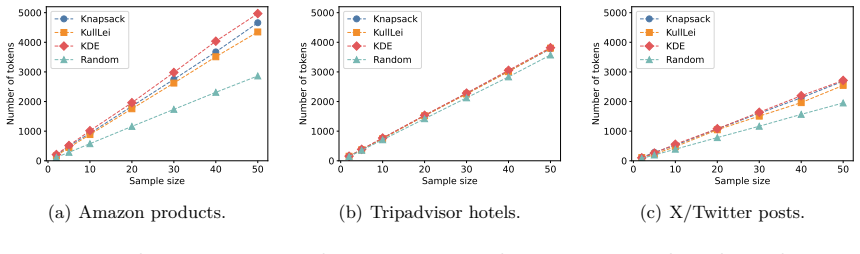
- Section 4.2.2 and Figures 4(a)–4(c): the primary semantic-preservation metric is cosine similarity of sample-based summaries to full-corpus GPT-5 summaries. The paper itself cites evidence that very large contexts can degrade summary quality [29] and reports full sets of 28k–100k+ tokens. Treating the full-context output as the gold standard therefore risks measuring fidelity to a potentially biased or incomplete reference rather than to the true opinion distribution. This is load-bearing for the abstract’s “semantic preservation” claim and should be addressed by (i) human preference or aspect-coverage judgments, (ii) an independent reference (e.g., extractive multi-document baselines or human-written summaries on a subset), or (iii) explicit analysis showing that full-context quality does not degrade on these corpora.
- Abstract and Section 4: the abstract states that the method “consistently outperform[s] traditional AI-based and standard LLM summarization baselines,” yet the reported experiments compare mainly against random sampling and full-context LLM input (plus internal sampler variants). No classical multi-document summarizers (e.g., LexRank, MMR, clustering-based selection), no sentiment-only or single-facet filters, and no standard long-context or map-reduce LLM pipelines appear as quantitative baselines. The claim as written is not supported by the experimental section and should either be narrowed or backed by those comparisons.
- Section 4.2.1: ground-truth topics for coverage F1 are free-form themes extracted by ChatGPT-Thinking and matched via ModernBERT embeddings. Without human topic labels or inter-annotator agreement on a sample, both the absolute F1 numbers and the ranking of samplers remain LLM-dependent. A modest human-validated topic set (or at least a sensitivity check against an alternative topic model) is needed to underwrite the “topic coverage” half of the main claim.
minor comments (6)
- Section 3.2: the relevance score (top-k BERTopic term counts, normalized) is simple; a short sensitivity analysis on k, or comparison to embedding-based relevance, would strengthen the design justification.
- Algorithm 2 / Eq. (1): the linear schedule for α(i) is stated but not ablated; reporting results for fixed α or alternative schedules would clarify robustness of Knapsack-KL and KDE.
- Figure 2 and the hotel walkthrough are helpful; adding analogous distribution plots for Amazon and X/Twitter (even in appendix) would make multi-domain balance more transparent.
- Table 1 averages across domains; per-domain rows (or appendix tables) would show whether KDE’s edge is consistent or driven by one corpus.
- Related work: coverage of recent long-context and opinion-summarization LLM papers is thin; a few additional 2024–2025 citations would better situate the contribution.
- Minor typos/notation: “KullLei” in figure legends vs “Knapsack-KL” in text; “T opic” spacing artifacts in subsection titles; ensure consistent N vs sample size wording.
Circularity Check
No derivation-by-construction circularity in sampling or claims; mild evaluative self-reference from using full-context LLM summaries and ChatGPT topics as gold standards.
-
other
[Section 4.2.2 (Content similarity) and 4.2.1 (Topic coverage); also citation to [29]]
"For each instance, we first generate a reference summary using all available opinions, then create sample-based summaries of increasing size using each sampling strategy. Both summaries are embedded with ModernBERT, and cosine similarity is computed between their embeddings. ... Although modern LLMs support increasingly wider context windows, using very large inputs can still degrade summary quality as the context grows [29]"
The quantitative backbone of the strongest claim (high semantic fidelity at ~97% token reduction) treats the full-context GPT-5 summary itself as the gold reference that N≈20 stratified samples approach (0.83–0.88 cosine). Topic F1 likewise uses ChatGPT-Thinking free-form topics extracted from the full corpus. Because the paper simultaneously flags large-context degradation, high similarity primarily shows that the sample reproduces the LLM's own full-input output rather than an independent external ground truth; the evaluation loop is therefore partially self-referential. This is not definitional equivalence of method to input (random still scores lower), so it is only mild.
full rationale
The paper's core chain is methodological and empirical, not a mathematical derivation of a forced result: multidimensional probabilistic classification (sentiment/emotion/topics via transformers + BERTopic) produces facet distributions; stratified samplers (Knapsack feasibility on target counts, Knapsack-KL with scheduled KL+relevance score, KDE density matching) then select a fixed-size subset under token budget to approximate those distributions while maximizing relevance; an LLM is prompted on the subset. None of these steps defines the output summary or the reported metrics in terms of themselves. Outperformance vs random on topic F1 and ModernBERT cosine is an empirical observation, not an identity. Self-citation to the authors' conference precursor [2] is explicit extension (new samplers, formalization, multi-domain eval, token-focused protocol) and is not load-bearing uniqueness or an ansatz that forbids alternatives. The only mild circularity is evaluative: full-corpus GPT-5 summaries are treated as the semantic reference for cosine (Sec. 4.2.2) and ChatGPT-Thinking free-form topics as ground truth for coverage (Sec. 4.2.1), even while the paper cites evidence that large contexts degrade quality. This makes 'semantic preservation' partly self-referential to LLM behavior under the very conditions flagged as problematic, but it does not collapse the method or the comparative claims into tautology by construction. Score remains low because the sampling objective and the random baseline comparison stand independently.
Assumptions & free parameters
free parameters (4)
- sample size N
- α(i) scheduling coefficient in Knapsack-KL / KDE score
- top-k BERTopic terms for relevance_score
- histogram / density estimation settings for KDE
assumptions (4)
- domain assumption Transformer classifiers and BERTopic produce probabilistic facet labels that adequately represent the semantic structure needed for balanced selection.
- domain assumption Preserving empirical class distributions across sentiment/topic/emotion under a fixed token budget improves LLM summary fidelity versus random selection.
- ad hoc to paper Full-corpus LLM summaries are a suitable reference for measuring semantic preservation via embedding cosine similarity.
- standard math Standard optimization and information-theoretic tools (multi-constraint knapsack-style selection, KL divergence, kernel/histogram density estimation) are valid selection criteria.
invented entities (3)
-
Knapsack stratified sampler for multi-facet opinion selection
-
Knapsack-KL stratified sampler
-
KDE stratified sampler for opinion subsets
Cite this review
Pith. "Pith review of Large Language Models for Token-Efficient and Semantic-Preserving Opinion Summarization." pith.science (2026). https://pith.science/paper/V6HYVGLN
@misc{pith2026260710825,
  author       = {Pith},
  title        = {Pith review of: Large Language Models for Token-Efficient and Semantic-Preserving Opinion Summarization},
  year         = {2026},
  howpublished = {\url{https://pith.science/paper/V6HYVGLN}},
  note         = {Machine review of arXiv:2607.10825}
}
read the original abstract
Opinionated text - spanning product reviews, hotel feedback, and social posts - captures rich signals about user experiences, preferences, and concerns. However, the scale, redundancy, and imbalance of such corpora make it challenging to analyze opinions effectively, particularly when the goal is to generate summaries that remain faithful to the diversity of viewpoints expressed. This paper presents a framework that preserves semantics in LLM-based opinion summarization while minimizing token usage. We combine multidimensional classification (e.g., sentiment, topics) with a family of stratified sampling strategies to select compact yet representative subsets of opinions before prompting the LLM. Tailored prompts then produce balanced summaries that surface the salient aspects expressed in the opinions (e.g., strengths and weaknesses of products/hotels). Experiments on Amazon product reviews, Tripadvisor hotel reviews, and X/Twitter posts demonstrate that our method significantly reduces token usage and computational cost while consistently outperforming traditional AI-based and standard LLM summarization baselines in terms of content coverage, balance, and semantic preservation.
Figures


Figures from the paper (2 more)

Reference graph
Works this paper leans on
-
[29]
Tao Yuan, Xuefei Ning, Dong Zhou, Zhijie Yang, Shiyao Li, Minghui Zhuang, Zheyue Tan, Zhuyu Yao, Dahua Lin, Boxun Li, et al. Lv-eval: A balanced long-context benchmark with 5 length levels up to 256k.arXiv preprint arXiv:2402.05136, 2024
arXiv 2024
-
[1]
Enhancing sentiment analysis classification for amazon product reviews using cnn-sigtan-beta activation function.Multimedia Tools and Applications, 83(19):56719–56736, 2024
P Anbumani and K Selvaraj. Enhancing sentiment analysis classification for amazon product reviews using cnn-sigtan-beta activation function.Multimedia Tools and Applications, 83(19):56719–56736, 2024
2024
-
[2]
Balanced and token-efficient summarization of user reviews via stratified sampling and large language models
Loris Belcastro and et al. Balanced and token-efficient summarization of user reviews via stratified sampling and large language models. InEuropean Conference on Machine Learning and Principles and Practice of Knowledge Discovery in Databases (ECML PKDD), page 290–306, 2025. 13
2025
-
[3]
A literature survey of recent advances in chatbots.Information, 13(1), 2022
Guendalina Caldarini, Sardar Jaf, and Kenneth McGarry. A literature survey of recent advances in chatbots.Information, 13(1), 2022
2022
-
[4]
Harnessing prompt-based large language models for disaster monitoring and automated reporting from social media feedback.Online Social Networks and Media, 45:100295, 2025
Riccardo Cantini and et al. Harnessing prompt-based large language models for disaster monitoring and automated reporting from social media feedback.Online Social Networks and Media, 45:100295, 2025
2025
-
[5]
Multi-dimensional classification on social media data for detailed reporting with large language models
Riccardo Cantini, Cristian Cosentino, and Fabrizio Marozzo. Multi-dimensional classification on social media data for detailed reporting with large language models. InInt. Conf. on Artificial Intelligence Applications and Innovations, pages 100–114, 2024
2024
-
[6]
The use of mmr, diversity-based reranking for reordering documents and producing summaries
Jaime Carbonell and Jade Goldstein. The use of mmr, diversity-based reranking for reordering documents and producing summaries. InProceedings of the 21st annual international ACM SIGIR conference on Research and development in information retrieval, pages 335–336, 1998
1998
-
[7]
Topically diversified summarization of customer reviews
Florian Carichon and Gilles Caporossi. Topically diversified summarization of customer reviews. In Proceedings of the 6th International Conference on Natural Language and Speech Processing (ICNLSP 2023), pages 178–191, 2023
2023
Show all 33 references
-
[8]
From reviews to results: Generative ai for review-driven product and service comparisons
Cristian Cosentino, Merve Gunduz-Cure, Fabrizio Marozzo, and Sule Ozturk-Birim. From reviews to results: Generative ai for review-driven product and service comparisons. In28th International Conference on Discovery Science (DS2025), page 78–93, 2025
2025
-
[9]
A topic modeling comparison between lda, nmf, top2vec, and bertopic to demystify twitter posts.Frontiers in sociology, 7, 2022
Roman Egger and Joanne Yu. A topic modeling comparison between lda, nmf, top2vec, and bertopic to demystify twitter posts.Frontiers in sociology, 7, 2022
2022
-
[10]
Retrieval-augmented generation for large language models: A survey.arXiv preprint arXiv:2312.10997, 2023
Yunfan Gao and et al. Retrieval-augmented generation for large language models: A survey.arXiv preprint arXiv:2312.10997, 2023. URLhttps://arxiv.org/abs/2312.10997
2023 arXiv
-
[11]
Bertopic: Neural topic modeling with a class-based tf-idf procedure
Maarten Grootendorst. Bertopic: Neural topic modeling with a class-based tf-idf procedure. arXiv:2203.05794, 2022
2022 arXiv
-
[12]
Mining customer product reviews for product development: A summarization process.Expert Systems with Applications, 132:141–150, October 2019
Tianjun Hou, Bernard Yannou, Yann Leroy, and Emilie Poirson. Mining customer product reviews for product development: A summarization process.Expert Systems with Applications, 132:141–150, October 2019. ISSN 0957-4174. doi: 10.1016/j.eswa.2019.04.069. URL http://dx.doi.org/10....
2019 doi
-
[13]
Mo, and Hai Liu
Shaoqin Huang, Yue Wang, Daniel Y. Mo, and Hai Liu. Mining novel customer needs from online product review. InProceedings of the International Conference on Decision Science & Management, ICDSM ’24, page 168–172, New York, NY, USA, 2024. Association for Computing Machinery. IS...
2024 doi
-
[14]
Large-scale and multi-perspective opinion summarization with diverse review subsets
Han Jiang, Rui Wang, Zhihua Wei, Yu Li, and Xinpeng Wang. Large-scale and multi-perspective opinion summarization with diverse review subsets. InFindings of the Association for Computational Linguistics: EMNLP 2023, pages 5641–5656, 2023
2023
-
[15]
Beyond opinion mining: Summarizing opinions of customer reviews
Reinald Kim Amplayo, Arthur Brazinskas, Yoshi Suhara, Xiaolan Wang, and Bing Liu. Beyond opinion mining: Summarizing opinions of customer reviews. InProceedings of the 45th International ACM SIGIR Conference on Research and Development in Information Retrieval, SIGIR ’22, page...
2022 doi
-
[16]
Retrieval-augmented generation for knowledge-intensive nlp tasks
Patrick Lewis and et al. Retrieval-augmented generation for knowledge-intensive nlp tasks. In Advances in Neural Information Processing Systems (NeurIPS), 2020. URLhttps://arxiv.org/ abs/2005.11401
2020 arXiv
-
[17]
Coverage-based fairness in multi- document summarization.arXiv preprint arXiv:2412.08795, 2025
Haoyuan Li, Yusen Zhang, Rui Zhang, and Snigdha Chaturvedi. Coverage-based fairness in multi- document summarization.arXiv preprint arXiv:2412.08795, 2025. URLhttps://arxiv.org/abs/ 2412.08795
2025 arXiv
-
[18]
Rouge: A package for automatic evaluation of summaries
Chin-Yew Lin. Rouge: A package for automatic evaluation of summaries. InText summarization branches out, pages 74–81, 2004
2004
-
[19]
Opinion observer: analyzing and comparing opinions on the web
Bing Liu, Minqing Hu, and Junsheng Cheng. Opinion observer: analyzing and comparing opinions on the web. In14th Int. Conf. on World Wide Web, pages 342–351, 2005
2005
-
[20]
A survey of automatic text summarization: concepts, advances and future prospects.International Journal of Speech Technology, 28:801–824, 10 2025
Chengyao Lv, Yiwen Tang, Lian Ao, Yanxia Huang, Simin Zhang, Junqing Fan, and Wei Han. A survey of automatic text summarization: concepts, advances and future prospects.International Journal of Speech Technology, 28:801–824, 10 2025. doi: 10.1007/s10772-025-10215-y
2025 doi
-
[21]
Chatbots applications in education: A systematic review.Computers and Education: Artificial Intelligence, 2:100033, 2021
Chinedu Wilfred Okonkwo and Abejide Ade-Ibijola. Chatbots applications in education: A systematic review.Computers and Education: Artificial Intelligence, 2:100033, 2021
2021
-
[22]
Thumbs up? sentiment classification using machine learning techniques.cs/0205070, 2002
Bo Pang, Lillian Lee, and Shivakumar Vaithyanathan. Thumbs up? sentiment classification using machine learning techniques.cs/0205070, 2002
2002
-
[23]
Cognitive hybrid deep learning-based multi-modal sentiment analysis for online product reviews.ACM Trans
Ashwin Perti, Amit Sinha, and Ankit Vidyarthi. Cognitive hybrid deep learning-based multi-modal sentiment analysis for online product reviews.ACM Trans. Asian Low-Resour. Lang. Inf. Process., 14 23(8), aug 2024. ISSN 2375-4699. doi: 10.1145/3615356. URLhttps://doi.org/10.1145/3615356
2024 doi
-
[24]
Roumeliotis, Nikolaos D
Konstantinos I. Roumeliotis, Nikolaos D. Tselikas, and Dimitrios K. Nasiopoulos. Llms in e-commerce: A comparative analysis of gpt and llama models in product review evaluation.Natural Language Processing Journal, 6:100056, 2024. ISSN 2949-7191. doi: https://doi.org/10.1016/j....
2024 doi
-
[25]
Llms in e-commerce: a comparative analysis of gpt and llama models in product review evaluation.Natural Language Processing Journal, 6:100056, 2024
Konstantinos I Roumeliotis, Nikolaos D Tselikas, and Dimitrios K Nasiopoulos. Llms in e-commerce: a comparative analysis of gpt and llama models in product review evaluation.Natural Language Processing Journal, 6:100056, 2024
2024
-
[26]
Automatic text summarization methods: A comprehensive review.SN Computer Science, 4(1):33, 2022
Grishma Sharma and Deepak Sharma. Automatic text summarization methods: A comprehensive review.SN Computer Science, 4(1):33, 2022
2022
-
[27]
Text classification via large language models.arXiv:2305.08377, 2023
Xiaofei Sun, Xiaoya Li, Jiwei Li, Fei Wu, Shangwei Guo, Tianwei Zhang, and Guoyin Wang. Text classification via large language models.arXiv:2305.08377, 2023
2023 arXiv
-
[28]
Exploiting user experience from online customer reviews for product design.Int
Bai Yang and et al. Exploiting user experience from online customer reviews for product design.Int. J. of Information Management, 46:173–186, 2019
2019
-
[30]
Survey of transformers and towards ensemble learning using transformers for natural language processing.Journal of big Data, 11(1):25, 2024
Hongzhi Zhang and M Omair Shafiq. Survey of transformers and towards ensemble learning using transformers for natural language processing.Journal of big Data, 11(1):25, 2024
2024
-
[31]
Examining the influence of online reviews on consumers’ decision-making: A heuristic–systematic model.Decision support systems, 67:78–89, 2014
Kem ZK Zhang, Sesia J Zhao, Christy MK Cheung, and Matthew KO Lee. Examining the influence of online reviews on consumers’ decision-making: A heuristic–systematic model.Decision support systems, 67:78–89, 2014
2014
-
[32]
Weinberger, and Yoav Artzi
Tianyi Zhang, Varsha Kishore, Felix Wu, Kilian Q. Weinberger, and Yoav Artzi. Bertscore: Evaluating text generation with bert. InICLR, 2020. URLhttps://arxiv.org/abs/1904.09675
2020 arXiv
-
[33]
Clustering sentences with density peaks for multi-document summarization
Yang Zhang, Yunqing Xia, Yi Liu, and Wenmin Wang. Clustering sentences with density peaks for multi-document summarization. InProceedings of the 2015 conference of the north american chapter of the association for computational linguistics: Human language technologies, pages 1...
2015
Reviewed July 14, 2026 · model on record in the stance chip above.
Discussion (0). Sign in to comment.