REVIEW 2 major objections 5 minor 2 cited by
For initially unpolarized photons crossing a random magnetic field, axion-photon conversion makes all Stokes-parameter statistics expressible through two magnetic-field power spectra, including new consistency relations that hold for any sp
Reviewed by Pith at T0; open to challenge. T0 means a machine referee read the full paper against a public rubric. the ladder, T0–T4 →
T0 review · deepseek-v4-flash
2026-08-03 14:12 UTC pith:V7YUYWEH
load-bearing objection Useful new formalism for polarization statistics in axion-photon conversion, but a sign error in the phase Π flips the headline circular-polarization prediction for m_a < m_pl; the fix is small and the core results survive. the 2 major comments →
Axion-photon conversion in stochastic magnetic fields
The pith
A machine-rendered reading of the paper's core claim, the machinery that carries it, and where it could break.
Core claim
For unpolarized photons in a Gaussian stochastic magnetic field, the ensemble mean and variance of every Stokes parameter are fully determined by the power spectra P_B(k) and P_aB(k) through the three integrals α, β, and γ (with a fourth integral δ vanishing identically). Explicitly, the expectation of fractional intensity loss is α, the expectation of circular polarization is −β, the linear-polarization means vanish, and the variances are given by ½(α²+β²+γ²), ½(α²−β²+γ²), and ½(α²+β²−γ²) for I, Q/U, and V respectively. These expressions lead to the spectrum-independent identities Var[Q]=Var[U], Var[1−I]=Var[Q]+Exp[V]², and Exp[1−I]²=Var[Q]+Var[V]. The paper also shows that a helical magnet
What carries the argument
The central object is the statistically homogeneous, isotropic Gaussian magnetic field, characterized by its two-point correlator in terms of a symmetric spectrum P_B(k) and an antisymmetric helical spectrum P_aB(k). The argument combines the Schrödinger-like mixing equation of axion-photon propagation with a first-order Born approximation, so the photon fields after propagation are linear in the magnetic field and the Stokes parameters become quadratic products. The ensemble statistics then reduce, via Wick-contracted four-point functions, to products of these two spectra weighted by two convolution kernels I(k_z;ω) and J(k_z;ω) — sinc-like integrals over the propagation path. The four inte
Load-bearing premise
The entire closed-form statistical machinery rests on the assumptions that the magnetic field is a Gaussian random field and that the conversion is weak enough for the first-order Born approximation to hold; if the real field is strongly non-Gaussian or the coupling is not perturbative, the formulas and the consistency relations lose their validity.
What would settle it
Take a set of many observed photon sources whose lines of sight traverse the same statistical magnetic-field region, measure their Stokes parameters, and compute the ensemble variance of Q and U; if the variances are unequal, or if the combination Var[1−I] − Var[Q] − Exp[V]² is measurably nonzero, the Gaussian-Born prediction is ruled out. Alternatively, a direct measurement of the four-point magnetic-field correlator would reveal non-Gaussianity and invalidate the Wick factorization at the heart of the derivation.
If this is right
- Observations of many equivalent photon sources behind the same magnetized region should show Var[Q] = Var[U], providing a direct test that requires no knowledge of the magnetic-field spectrum.
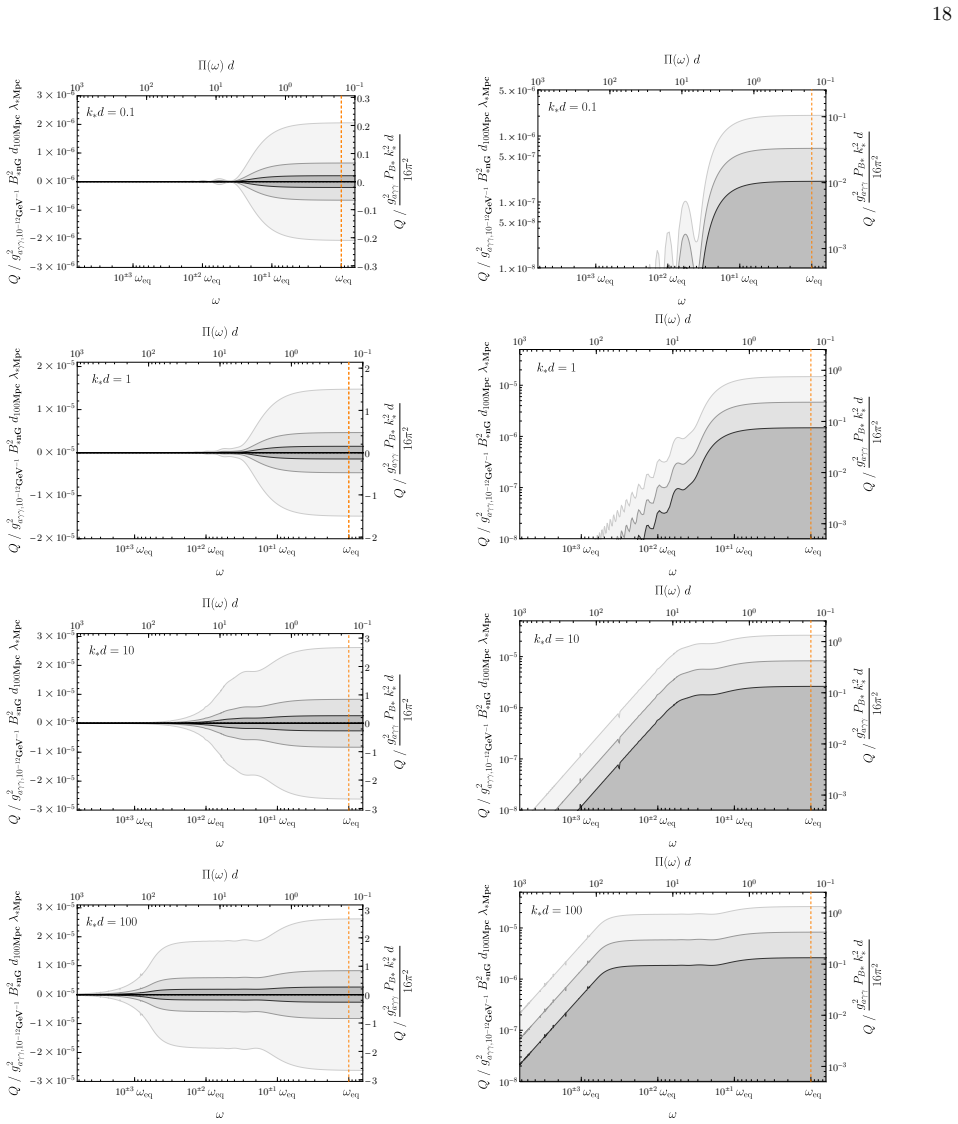
- A statistically helical magnetic field generates a circular-polarization signal whose mean is proportional to the helical power spectrum, with a peak whose location in frequency encodes the axion mass or the field correlation length.
- In the frequency window where the dimensionless combination Π(ω)d lies between O(1) and k_*d, the variance of the conversion probability is suppressed relative to its expectation value, making this window advantageous for axion searches.
- The three consistency relations give a falsifiable set of equalities that any Gaussian-Born axion-photon conversion signal must satisfy; deviations would point to non-Gaussian magnetic fields, stronger coupling, or additional physics.
- Because the same integral kernels appear in graviton-photon conversion, the statistical structure derived here transfers to other weakly coupled particle-mixing scenarios.
Where Pith is reading between the lines
- The spectrum-independent relations could be turned into a null test for claims of axion-induced polarization from extragalactic sources: if the measured ensemble statistics do not satisfy these identities, the source of the signal lies elsewhere.
- If real cosmological magnetic fields are intermittent or shock-dominated, their non-Gaussianity would generically break the closed-form variance formulas; comparing observed variances with the Gaussian prediction could therefore diagnose field statistics as well as axion physics.
- The single-domain assumption is likely the main obstacle to direct cosmological application; a multi-domain generalization would effectively replace the model spectra here with a direction-dependent superposition, possibly smearing the distinctive peak structures.
- The helicity-dependent circular polarization may provide a way to measure the handedness of primordial magnetic fields using gamma-ray observations, independent of Faraday rotation measurements.
Editorial analysis
A structured set of objections, weighed in public.
Referee Report
Summary. The manuscript develops a statistical treatment of axion-photon conversion in stochastic magnetic fields. It considers a photon propagating through a statistically homogeneous, isotropic Gaussian magnetic field, treats the axion-photon mixing in the Born approximation, and derives the ensemble mean and variance of the Stokes parameters after propagation. For initially unpolarized photons, the mean conversion probability and mean circular polarization are expressed in terms of two spectral integrals α and β, while the variances are quadratic forms in α, β, and γ. The paper also derives spectrum-independent consistency relations among these statistical moments and illustrates the frequency dependence with broken power-law spectra, finding a peak in the mean circular polarization for helical fields.
Significance. The strength of the paper is its analytic control: the Wick-contraction calculation in Appendix A is explicit, the convolution kernels are given in closed form in Appendix B, and the consistency relations are parameter-free consequences of the Gaussian and Born assumptions. If correct, the formalism provides a useful tool for estimating polarization signatures of axion-photon conversion in cosmic magnetic fields and gives falsifiable relations that can be checked in simulations or observations. The helical-field extension goes beyond existing domain-like and statistical treatments. However, a sign error in the definition of the oscillation frequency affects the predicted circular polarization on part of the parameter space, which is one of the paper's headline claims.
major comments (2)
- [Eq. (3.26), Secs. III B, IV B, V C] The absolute value in Eq. (3.26) is not equivalent to the physical phase difference. From Eqs. (3.13)–(3.14), Π_a−Π_γ = (m_a^2−m_pl^2)/(2ω)+χ_CMBω, which is negative for m_a<m_pl and small ω. Since I(k_z;ω) in Eq. (4.6) is even in Π−k_z, replacing Π by −Π is equivalent to k_z→−k_z, and the angular integral defining β in Eq. (4.5) changes sign. Hence Exp[V]=−β flips sign on this branch. The variances and consistency relations involve only α², β², γ² and are unaffected. The numerical figures in Sec. V use only |m_a^2−m_pl^2| and do not specify the sign; the statement in Sec. V C that V is opposite to the magnetic helicity is therefore not generally valid. Please use the signed Π throughout and qualify the circular-polarization predictions by the sign of m_a^2−m_pl^2, or explicitly restrict to m_a>m_pl.
- [Sec. V] The numerical illustrations use representative parameters B_*∼nG, d∼100 Mpc, g_aγγ∼10^−12 GeV^−1, for which the first-order Born amplitude gBd is of order 0.1 and the truncation of the perturbation series is not obviously justified. Since the analytic results are explicitly leading order, the paper should either state the weak-coupling regime in which they apply or quantify the expected size of the next-order correction. This is not a problem for the formal derivation, but it is relevant for the observational conclusions drawn from the figures.
minor comments (5)
- [Sec. VI] The phrase "statically unpolarized" should be "statistically unpolarized" (or "initially unpolarized").
- [Abstract and Sec. V C] The claim that the circular polarization is opposite to the magnetic helicity needs a qualifier specifying the sign of m_a^2−m_pl^2; see Major Comment 1.
- [Eq. (4.4)] The δ² terms are displayed and then immediately set to zero; consider removing the intermediate equalities to avoid confusing the reader about a potentially nonvanishing quantity.
- [Fig. 2 caption] The definition of ω_eq uses |m_a^2−m_pl^2|; the caption should state this explicitly so that the folding of the frequency axis is not misinterpreted as a physical symmetry.
- [Sec. IV C] The consistency relations are clearly derived; it would be helpful to state once more that they hold only under Gaussian statistics and the Born approximation, as these are the assumptions that enter through Eq. (4.4).
Circularity Check
No significant circularity: the Stokes statistics are derived from the stated Gaussian correlator by explicit Wick contractions; the only self-citation is a comparative remark, not a load-bearing input.
full rationale
The central derivation is self-contained. Starting from the Born-approximation transfer matrix (Eqs. 3.23–3.25), the paper obtains Stokes-parameter expressions (Eqs. 3.31–3.34) in terms of path integrals of the magnetic field. It then assumes the Gaussian, statistically homogeneous and isotropic correlator (Eq. 4.1) and computes the expectation values and variances in Appendix A using explicit Wick contractions. The resulting α, β, γ are convolutions of the input power spectra P_B(k) and P_aB(k) with kernels I, J defined by the same path integrals; they are not fitted parameters renamed as predictions. In particular, Exp[V] = −β follows directly from the parity-odd part of Eq. (4.1) in Eq. (A7). The consistency relations (Eq. 4.18) are algebraic consequences of Eq. (4.4), and the paper also notes they are equivalent to ensemble-averaging the exact identity (Eq. 3.35). The citations to the authors' earlier work, especially Ref. [43], are used only to remark that the same convolution kernels appear in graviton-photon conversion; that remark is made after the derivation and supplies no formula or assumption to the present calculation. Thus no prediction reduces by construction to an input, and no load-bearing assertion is justified by self-citation. The sign of the absolute value in Eq. (3.26) may raise a physics/correctness question for m_a < m_pl, but that is not a circularity issue and does not affect this assessment.
Axiom & Free-Parameter Ledger
free parameters (2)
- Power-spectrum spectral indices (n_l=2, n_h=-11/3, n_al=3, n_ah=-11/3) =
illustrative values from Ref [41]
- Helicity amplitude ratio P_aB*/P_B* =
1 (maximally helical)
axioms (7)
- domain assumption Magnetic field is a Gaussian random field with two-point function (4.1)
- domain assumption Statistical homogeneity and isotropy of the magnetic field
- domain assumption Born approximation: axion-photon mixing treated to first order in g_aγγ B
- domain assumption Relativistic photons with ω ≫ m_pl; background field varies on scales much longer than the photon wavelength
- domain assumption Initially unpolarized photons, I0=1, Q0=U0=V0=0
- standard math Euler-Heisenberg effective Lagrangian and axion-photon coupling Lagrangian from Raffelt-Stodolsky
- domain assumption Broken power-law form of P_B and P_aB (5.1)-(5.2)
read the original abstract
We investigate axion-photon conversion in stochastic magnetic fields, focusing on the evolution of the photon intensity and polarizations induced by conversion into axions. Assuming Gaussian magnetic fields characterized by the power spectra of their helical/non-helical components, we express the expectation values and variances of the photon intensity and linear/circular polarizations after conversion in terms of these spectra. We find nontrivial dependencies of these statistical quantities on the characteristic magnetic field correlation length, the propagation distance, and the axion mass. Moreover, we find that nontrivial polarizations emerge even if the photons are initially unpolarized, that the variances of these observables become suppressed in specific frequency regions, and that a peak structure arises in the expectation value of the circular polarization in the presence of statistically helical magnetic fields. We also point out consistency relations among these statistical quantities that hold independently of the specific forms of the magnetic field power spectra.
Figures




Forward citations
Cited by 2 Pith papers
-
Circular polarization effects induced by photon-axion mixing in astrophysical environments
Photon-axion mixing in magnetic fields induces circular polarization that constrains the axion-photon coupling to g_aγγ ≤ 5×10^{-12} GeV^{-1} for m_a ~10^{-16}--10^{-10} eV using blazar data, with peak sensitivity in ...
-
Circular polarization effects induced by photon-axion mixing in astrophysical environments
The paper derives analytic circular-polarization signals from photon-axion mixing and uses the blazar S4 0954+65 optical circular-polarization limit to bound g_aγγ around 10^-12 to 10^-11 GeV^-1 for ultralight axion masses.
Reference graph
Works this paper leans on
-
[1]
Using Eq
Calculations of the expectation values We first compute the expectation value ofa. Using Eq. (4.1), it is evaluated as ⟨a⟩= gaγγ 2 2 Z s,s′ e−iΠ(s−s′)⟨Bx(s)Bx(s′) +B y(s)By(s′)⟩ = gaγγ 2 2 Z s,s′ e−iΠ(s−s′) Z k eikz(s−s′)(2− ˆk2 x − ˆk2 y)PB(k) = 2 gaγγ 2 2 Z k Z s,s′ e−i(Π−kz)(s−s′) 1 + ˆk2 z 2 PB(k) = 2 gaγγ 2 2 Z k I(k z;ω) 1 + ˆk2 z 2 PB(k)≡2α .(A3) I...
-
[2]
10-5 2.5 10-5 10-1100101102103 0.5 1. 1.5 2. 2.5 3. 10±110±210±3 10-8 10-7 10-6 10-5 10-4 10-1100101102103 10-3 10-2 10-1 100 10±110±210±3 -1. 10-5 -0.5 10-5
-
[3]
10-5 3.5 10-5 10-1100101102103 0.5 1. 1.5 2. 2.5 3. 3.5 10±110±210±3 10-7 10-6 10-5 10-4 10-1100101102103 10-2 10-1 100 10±110±210±3 0.5 10-5
-
[4]
10-5 2.5 10-5 10-1100101102103 -1. -0.5 0. 0.5 1. 1.5 2. 2.5 3. 10±110±210±3 10-8 10-7 10-6 10-5 10-4 10-1100101102103 10-3 10-2 10-1 100 FIG. 2. Integralsα(top),β(middle), andγ(bottom) with the magnetic field power spectra (5.1) and (5.2) are plotted. The black, red, green, and blue curves correspond to the case ofk ∗d= 0.1, 1, 10, and 100, respectively....
-
[5]
The variance of the intensityIis given by Var[I] = ⟨I 2⟩ − ⟨I⟩2 = (⟨a2⟩ − ⟨a⟩2)/4
Calculations of the variances Next, we compute the variances of the Stokes parameters. The variance of the intensityIis given by Var[I] = ⟨I 2⟩ − ⟨I⟩2 = (⟨a2⟩ − ⟨a⟩2)/4. Using the definition ofain Eq. (A2), we can compute⟨a 2⟩as ⟨a2⟩= gaγγ 2 4 Z s,s′ e−iΠ(s−s′)[Bx(s)Bx(s′) +B y(s)By(s′)] 2 = gaγγ 2 4 Z s,s′ e−iΠ(s−s′)Bx(s)Bx(s′) Z s,s′ e−iΠ(s−s′)Bx(s)Bx(s...
-
[6]
R. D. Peccei and H. R. Quinn, CP conservation in the presence of pseudoparticles, Phys. Rev. Lett.38, 1440 (1977)
1977
-
[7]
Weinberg, A new light boson?, Phys
S. Weinberg, A new light boson?, Phys. Rev. Lett.40, 223 (1978)
1978
-
[8]
Wilczek, Problem of strongpandtinvariance in the presence of instantons, Phys
F. Wilczek, Problem of strongpandtinvariance in the presence of instantons, Phys. Rev. Lett.40, 279 (1978)
1978
-
[9]
J. E. Kim, Weak-interaction singlet and strong CP invariance, Phys. Rev. Lett.43, 103 (1979)
1979
-
[10]
Shifman, A
M. Shifman, A. Vainshtein, and V. Zakharov, Can confinement ensure natural cp invariance of strong interactions?, Nuclear Physics B166, 493 (1980)
1980
-
[11]
M. Dine, W. Fischler, and M. Srednicki, A simple solution to the strong cp problem with a harmless axion, Physics Letters B104, 199 (1981)
1981
-
[12]
A. R. Zhitnitsky, On Possible Suppression of the Axion Hadron Interactions. (In Russian), Sov. J. Nucl. Phys.31, 260 (1980)
1980
-
[13]
P. Svrcek and E. Witten, Axions In String Theory, JHEP06, 051, arXiv:hep-th/0605206
-
[14]
D. J. E. Marsh, Axion Cosmology, Phys. Rept.643, 1 (2016), arXiv:1510.07633 [astro-ph.CO]
Pith/arXiv arXiv 2016
-
[15]
P. Carenza, M. Giannotti, J. Isern, A. Mirizzi, and O. Straniero, Axion astrophysics, Phys. Rept.1117, 1 (2025), arXiv:2411.02492 [hep-ph]
Pith/arXiv arXiv 2025
-
[16]
Preskill, M
J. Preskill, M. B. Wise, and F. Wilczek, Cosmology of the invisible axion, Physics Letters B120, 127 (1983)
1983
-
[17]
Freese, J
K. Freese, J. A. Frieman, and A. V. Olinto, Natural inflation with pseudo nambu-goldstone bosons, Phys. Rev. Lett.65, 3233 (1990)
1990
-
[18]
J. E. Kim, H. P. Nilles, and M. Peloso, Completing natural inflation, JCAP01, 005, arXiv:hep-ph/0409138
-
[19]
S. Dimopoulos, S. Kachru, J. McGreevy, and J. G. Wacker, N-flation, JCAP08, 003, arXiv:hep-th/0507205
-
[20]
J. Isern, S. Catalan, E. Garcia-Berro, M. Salaris, and S. Torres, Axion cooling of white dwarfs (2013), arXiv:1304.7652 [astro-ph.SR]
Pith/arXiv arXiv 2013
-
[21]
Carenza, Axion emission from supernovae: a cheatsheet, Eur
P. Carenza, Axion emission from supernovae: a cheatsheet, Eur. Phys. J. Plus138, 836 (2023), arXiv:2309.14798 [hep-ph]
Pith/arXiv arXiv 2023
-
[22]
Maiani, R
L. Maiani, R. Petronzio, and E. Zavattini, Effects of nearly massless, spin-zero particles on light propagation in a magnetic field, Physics Letters B175, 359 (1986)
1986
-
[23]
Raffelt and L
G. Raffelt and L. Stodolsky, Mixing of the photon with low-mass particles, Phys. Rev. D37, 1237 (1988)
1988
-
[24]
Sikivie, Experimental tests of the ”invisible” axion, Phys
P. Sikivie, Experimental tests of the ”invisible” axion, Phys. Rev. Lett.51, 1415 (1983)
1983
-
[25]
I. G. Irastorza and J. Redondo, New experimental approaches in the search for axion-like particles, Prog. Part. Nucl. Phys. 102, 89 (2018), arXiv:1801.08127 [hep-ph]
Pith/arXiv arXiv 2018
-
[26]
V. Anastassopouloset al.(CAST), New CAST Limit on the Axion-Photon Interaction, Nature Phys.13, 584 (2017), arXiv:1705.02290 [hep-ex]
Pith/arXiv arXiv 2017
-
[27]
E. Armengaudet al., Conceptual Design of the International Axion Observatory (IAXO), JINST9, T05002, arXiv:1401.3233 [physics.ins-det]
-
[28]
S. J. Asztalos, G. Carosi, C. Hagmann, D. Kinion, K. van Bibber, M. Hotz, L. J. Rosenberg, G. Rybka, J. Hoskins, J. Hwang, P. Sikivie, D. B. Tanner, R. Bradley, and J. Clarke, Squid-based microwave cavity search for dark-matter axions, Physical Review Letters104, 10.1103/physrevlett.104.041301 (2010)
-
[29]
Navaset al.(Particle Data Group), Review of particle physics, Phys
S. Navaset al.(Particle Data Group), Review of particle physics, Phys. Rev. D110, 030001 (2024)
2024
-
[30]
K. Nomura, K. Saito, and J. Soda, Observing axions through photon ring dimming of black holes, Phys. Rev. D107, 123505 (2023), arXiv:2212.03020 [hep-ph]
Pith/arXiv arXiv 2023
-
[31]
D. Hooper and P. D. Serpico, Detecting Axion-Like Particles With Gamma Ray Telescopes, Phys. Rev. Lett.99, 231102 (2007), arXiv:0706.3203 [hep-ph]
Pith/arXiv arXiv 2007
-
[32]
K. A. Hochmuth and G. Sigl, Effects of Axion-Photon Mixing on Gamma-Ray Spectra from Magnetized Astrophysical Sources, Phys. Rev. D76, 123011 (2007), arXiv:0708.1144 [astro-ph]
Pith/arXiv arXiv 2007
-
[33]
J. Ballet, P. Bruel, T. H. Burnett, B. Lott, and T. F.-L. collaboration, Fermi large area telescope fourth source catalog data release 4 (4fgl-dr4) (2024), arXiv:2307.12546 [astro-ph.HE]
Pith/arXiv arXiv 2024
-
[34]
V. A. Acciariet al.(MAGIC), MAGIC very large zenith angle observations of the Crab Nebula up to 100 TeV, Astron. Astrophys.635, A158 (2020), arXiv:2001.09566 [astro-ph.HE]
Pith/arXiv arXiv 2020
-
[35]
Caoet al.(LHAASO), The First LHAASO Catalog of Gamma-Ray Sources, Astrophys
Z. Caoet al.(LHAASO), The First LHAASO Catalog of Gamma-Ray Sources, Astrophys. J. Suppl.271, 25 (2024), arXiv:2305.17030 [astro-ph.HE]
arXiv 2024
-
[36]
D. Dzhappuev, I. Dzaparova, T. Dzhatdoev, E. Gorbacheva, I. Karpikov, M. Khadzhiev, N. Klimenko, A. Kudzhaev, A. Kurenya, A. Lidvansky, O. Mikhailova, V. Petkov, E. Podlesnyi, N. Pozdnukhov, V. Romanenko, G. Rubtsov, S. Troit- sky, I. Unatlokov, N. Vasiliev, A. Yanin, and K. Zhuravleva, Carpet-3 detection of a photonlike air shower with esti- mated primar...
-
[37]
A. Mirizzi and D. Montanino, Stochastic conversions of TeV photons into axion-like particles in extragalactic magnetic fields, JCAP12, 004, arXiv:0911.0015 [astro-ph.HE]
-
[38]
Masaki, A
E. Masaki, A. Aoki, and J. Soda, Photon-axion conversion, magnetic field configuration, and polarization of photons, Phys. Rev. D96, 043519 (2017)
2017
-
[39]
Galanti and M
G. Galanti and M. Roncadelli, Behavior of axionlike particles in smoothed out domainlike magnetic fields, Phys. Rev. D 98, 043018 (2018)
2018
-
[40]
H.-J. Li, Primordial black holes induced stochastic axion-photon oscillations in primordial magnetic field, JCAP11, 045, arXiv:2208.04605 [astro-ph.CO]. 31
-
[41]
Setabuddin, M. R. Haque, R. Karmakar, and S. Pal, Axion-photon conversion in flrw with primordial magnetic fields: Explaining the radio excess (2025), arXiv:2509.09472 [astro-ph.CO]
Pith/arXiv arXiv 2025
-
[42]
A. Dobrynina, A. Kartavtsev, and G. Raffelt, Photon-photon dispersion of TeV gamma rays and its role for photon-ALP conversion, Phys. Rev. D91, 083003 (2015), [Erratum: Phys.Rev.D 95, 109905 (2017)], arXiv:1412.4777 [astro-ph.HE]
Pith/arXiv arXiv 2015
-
[43]
G. Galanti, Axion-like Particle Effects on Photon Polarization in High-Energy Astrophysics, Universe10, 312 (2024), arXiv:2407.21421 [hep-ph]
Pith/arXiv arXiv 2024
-
[44]
G. Galanti, L. Nava, M. Roncadelli, F. Tavecchio, and G. Bonnoli, Observability of the Very-High-Energy Emission from GRB 221009A, Phys. Rev. Lett.131, 251001 (2023), arXiv:2210.05659 [astro-ph.HE]
Pith/arXiv arXiv 2023
-
[45]
H.-J. Li, W. Chao, X.-H. Tan, and Y.-F. Zhou, Axion effects on gamma-ray spectral irregularities. II: Implications of EBL absorption, Phys. Lett. B862, 139334 (2025), arXiv:2410.14791 [hep-ph]
Pith/arXiv arXiv 2025
-
[46]
R. Durrer and A. Neronov, Cosmological Magnetic Fields: Their Generation, Evolution and Observation, Astron. Astro- phys. Rev.21, 62 (2013), arXiv:1303.7121 [astro-ph.CO]
Pith/arXiv arXiv 2013
-
[47]
A. Brandenburg, R. Durrer, T. Kahniashvili, S. Mandal, and W. W. Yin, Statistical Properties of Scale-Invariant Helical Magnetic Fields and Applications to Cosmology, JCAP08, 034, arXiv:1804.01177 [astro-ph.CO]
- [48]
-
[49]
C. D. Dermer and B. Giebels, Active galactic nuclei at gamma-ray energies, Comptes Rendus. Physique17, 594 (2016)
2016
-
[50]
O. Luongo and M. Muccino, A roadmap to gamma-ray bursts: new developments and applications to cosmology (2021), arXiv:2110.14408 [astro-ph.HE]
Pith/arXiv arXiv 2021
-
[51]
Kargaltsev, B
O. Kargaltsev, B. Cerutti, Y. Lyubarsky, and E. Striani, Pulsar-wind nebulae: Recent progress in observations and theory, Space Science Reviews191, 391 (2015)
2015
-
[52]
J. Vink, Supernova remnants: the x-ray perspective, The Astronomy and Astrophysics Review20, 10.1007/s00159-011- 0049-1 (2011)
-
[53]
L. J. Tacconi, R. Genzel, and A. Sternberg, The evolution of the star-forming interstellar medium across cosmic time, Annual Review of Astronomy and Astrophysics58, 157 (2020)
2020
-
[54]
Bhattacharjee and G
P. Bhattacharjee and G. Sigl, Origin and propagation of extremely high-energy cosmic rays, Physics Reports327, 109 (2000)
2000
-
[55]
F. Massaro, D. J. Thompson, and E. C. Ferrara, The extragalactic gamma-ray sky in the fermi era, The Astronomy and Astrophysics Review24, 10.1007/s00159-015-0090-6 (2015)
discussion (0)
Sign in with ORCID, Apple, or X to comment. Anyone can read and Pith papers without signing in.