REVIEW 3 major objections 4 minor 6 references
Exploring Topological and Localization Phenomena in SSH Chains under Generalized AAH Modulation: A Computational Approach
T0 review · 3 major / 4 minor · reviewed 2026-08-07 · deepseek-v4-flash
Pith's one-line read Under strong Aubry-André-Harper modulation, SSH edge states are destroyed by a localization transition; non-Hermitian hopping gives the skin effect, and a periodic drive creates anomalous Floquet edge states.
desk verdict A clean numerical reproduction of known SSH-family effects with a thin PCA add-on; the 'universal' transition and Floquet claims are under-supported as written. read the letter →
The pith
A machine-rendered reading of the paper's core claim, the machinery that carries it, and where it could break.
The reading
What carries the argument
The argument is carried by three generalizations of the SSH tight-binding Hamiltonian: an added on-site AAH potential $V_n=\lambda\cos(2\pi\alpha n+\phi)$, a non-reciprocal splitting $(v\pm\delta)$ of the intracell hopping, and a five-step periodic drive in which $H_{\mathrm{drive}}$ is described only as modifying the intracell hopping. The numerical workhorse is the inverse participation ratio (IPR), which marks an eigenstate as localized when it approaches 1, and principal component analysis (PCA) of the eigenstate probability densities, which separates localized from delocalized states along its first component. The Floquet part of the argument rests on quasi-energies computed with the paper's five-step protocol, with the two states at $E=0$ and two at $E\approx\pm\omega/2$ serving as the signature of the induced topological phase.
What would settle it
Rerun the Floquet simulation with $H_{\mathrm{drive}}$ written explicitly as a term that multiplies the intracell hopping by the piecewise coefficient $f(t)$ from Eq. (4); the claimed anomalous states at $E=0$ and $E\approx\pm\omega/2$ should appear. If a different valid choice of $H_{\mathrm{drive}}$ removes them, the result depends on an unspecified modelling choice rather than on the physics.
Extended reading notes
Core claim
On its own terms, the central discovery is that the standard SSH edge states are not robust against strong quasiperiodic modulation: as the AAH strength $\lambda/w$ approaches 2, the full spectrum becomes localized and the zero-energy edge states disappear, in both the topological ($v/w=0.5$) and trivial ($v/w=1.8$) dimerization regimes. The same numerics identify two further effects: an asymmetric intracell hopping $(v\pm\delta)$ forces all bulk eigenstates to accumulate at one boundary, the non-Hermitian skin effect, and a piecewise five-step Floquet protocol applied to a trivial chain produces localized quasi-energy states at $E=0$ and at $E\approx\pm\omega/2$, which the paper reads as anomalous Floquet edge states with no static counterpart.
Load-bearing premise
The Floquet result stands on the exact form of the drive operator $H_{\mathrm{drive}}$, which the paper never writes explicitly; if a different but equally plausible $H_{\mathrm{drive}}$ changes the quasi-energy spectrum, the claimed anomalous edge states are not well defined.
Editorial extensions
If this is right
- Strong AAH modulation at $\lambda/w \approx 2$ should localize every eigenstate of an SSH chain, so the topologically protected edge states cease to exist in that regime.
- An unsupervised classifier based on eigenstate densities will separate localized from delocalized states first, while topological and trivial states can be separated only in the delocalized regime.
- Introducing non-reciprocal intracell hopping concentrates all bulk states at one boundary, and flipping the sign of $\delta$ moves the accumulation to the opposite edge.
- A carefully chosen periodic drive can turn a topologically trivial SSH chain into a Floquet topological insulator, with anomalous edge states at the Floquet zone boundaries.
Reading between the lines
- The paper demonstrates the localization transition for one value of the AAH phase offset ($\phi=0$) and one frequency (the inverse golden ratio); whether the transition is universal across other incommensurate offsets and frequencies is a testable extension.
- The PCA result suggests that in strongly localized regimes, topological information may be hidden in features other than the eigenstate density, such as winding numbers or real-space entanglement, so classifiers trained on densities alone will mislabel the phase.
- The Floquet protocol's edge states, if confirmed with an explicit drive Hamiltonian, would be a natural platform for Floquet pumping experiments in cold atoms or photonic lattices, since the paper stops at the quasi-energy spectrum and does not compute a transport response.
- Because the statement that topological protection 'succumbs' is inferred from spectra of 100-site chains, finite-size scaling to larger $N$ would test whether the transition sharpens or broadens.
Editorial analysis
A structured set of objections, weighed in public.
Referee Report
Summary. The paper numerically studies four generalizations of the one-dimensional SSH chain: the clean SSH model, the SSH model with Aubry-André-Harper (AAH) quasiperiodic on-site potential, a non-Hermitian SSH model with non-reciprocal intracell hopping, and a Floquet-driven trivial SSH chain. Using exact diagonalization and the inverse participation ratio (IPR), it claims a universal disorder-induced localization transition at lambda/w about 2, a non-Hermitian skin effect for nonzero delta, and Floquet-induced anomalous edge states at quasi-energies E=0 and E about +/-omega/2. A PCA of eigenstate densities is used to argue that strong localization masks topological signatures.
Significance. If the central claims were fully established, the universal localization transition would be a notable result; however, the current evidence is insufficient. The paper is best understood as a computational demonstration of known phenomena in 1D topological systems, with the clean SSH edge states and the non-Hermitian skin effect qualitatively reproducing established physics. The exact-diagonalization methodology is appropriate for the system sizes considered, and the IPR is a standard localization measure. The paper's main value lies in bringing together several extensions of the SSH model in one numerical study, rather than in discovering qualitatively new physics. The lack of code availability and the absence of finite-size or convergence analyses limit the reproducibility, although the Hamiltonians are simple enough that the main spectral features can be reproduced independently.
major comments (3)
- [4.2 and Fig. 2] The claim of a universal localization transition at lambda/w approximately 2 is not supported by the presented data. Only two values of v/w are shown (0.5 and 1.8), and the assertion rests entirely on the visual crossing of IPR-colored spectra. The Aubry-André duality argument that gives lambda_c = 2t for uniform hopping does not apply unchanged to the dimerized SSH-AAH model of Eq. (2), and the critical point is expected to depend on v/w; for v to 0 the conducting backbone has hopping w, while for v = w the relevant scale is v = w. With only N=50, the apparent common transition can be a finite-size crossover. To make the universal claim quantitative, the authors should compute IPR versus lambda for several system sizes, extract a finite-size scaling or crossing, and compare the result with an analytic estimate; otherwise they should soften or remove the word 'universal'.
- [2.4 and Fig. 5] The Floquet Hamiltonian is not fully specified. Equation (4) defines the time-dependent coefficient f(t), and the text states that H_drive modifies only the intracell hopping, but the explicit form of H_drive is never given. The quasi-energy spectrum, the number of edge states, and their location at E=0 and E approximately +/-omega/2 all depend on the precise operator content of H_drive and on the discretization of the five-step protocol. As written, the Floquet result cannot be reproduced or falsified from the manuscript. Please provide the explicit matrix representation of H_drive, state the time-step used in the Floquet solver, and show that the quasi-energy spectrum is converged with respect to the time discretization.
- [4.3 and Fig. 3] The description of the PCA analysis as 'autonomous classification' overstates what was done. PCA is an unsupervised dimensionality-reduction technique; the colors used in Fig. 3 are assigned from the known v/w values and therefore the separation of 'topological' and 'trivial' states is post hoc, not discovered by the algorithm. The claim that strong localization masks topological signatures is inferred from the overlap of colored point clouds, not from an unsupervised clustering outcome. Please either perform an actual unsupervised clustering step and then compare labels, or explicitly describe PCA as a visualization tool for eigenstate densities.
minor comments (4)
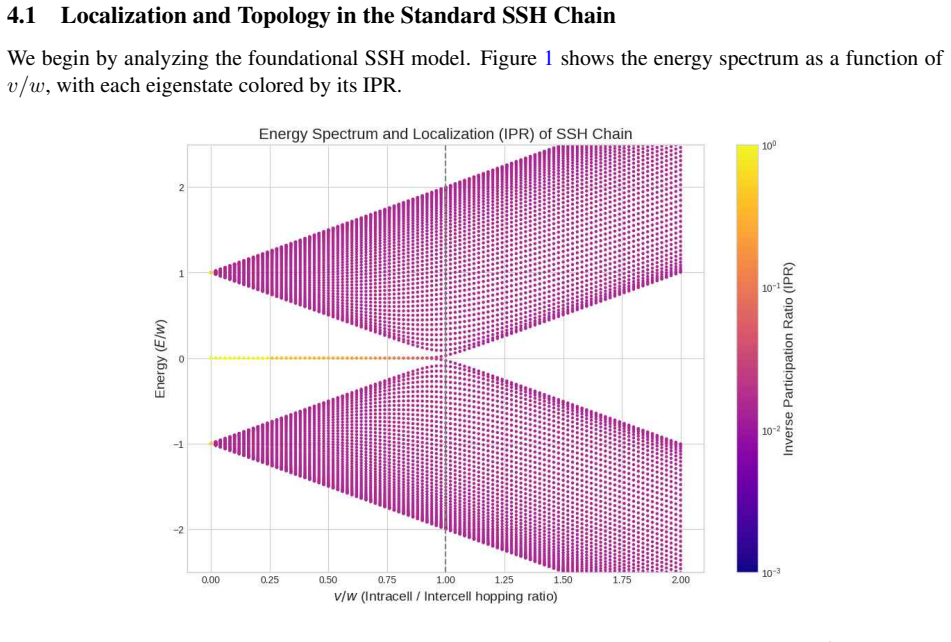
- [4.1] The text refers to 'a zero-energy state' in the topological SSH phase, but for a chain of N unit cells under open boundary conditions there are two zero-energy edge states, one at each end; the wording should be plural or should specify that the two states are nearly degenerate for large N.
- [4.2] The spectrum is described as evolving into a 'Hofstadter butterfly pattern'; this terminology is standard for the Harper equation in a magnetic field, whereas here the spectrum is that of the AAH model with an irrational modulation frequency. Please clarify the usage or replace the term.
- [3] The non-Hermitian solver is not described; for a non-Hermitian eigenvalue problem under open boundary conditions, the authors should state whether right eigenvectors were used for the IPR and confirm that the skin-effect accumulation is independent of the diagonalization routine.
- [4.4] The skin effect is demonstrated for a single value of delta=0.4 and a single system size; a brief finite-size check (e.g., N=25, 50, 100) would strengthen the claim that all bulk states localize at the boundary.
Circularity Check
No significant circularity: the paper's results are direct numerical demonstrations from defined Hamiltonians, with no fitted parameters or self-citation chains used as load-bearing evidence.
full rationale
The paper's derivation chain is self-contained in the sense required by the circularity check. The SSH, SSH-AAH, non-Hermitian SSH, and Floquet SSH Hamiltonians are explicitly defined in Eqs. (1)–(4), and the reported spectra, IPR values, PCA projections, and quasi-energy plots are computed by exact diagonalization or QuTiP Floquet solvers from those definitions. No parameter is fitted to a target output, and no 'prediction' is obtained by construction from a fitted quantity. The skin-effect observation follows directly from choosing δ = 0.4 in the non-reciprocal hopping Hamiltonian; the direction of accumulation is even stated to reverse with the sign of δ, showing the effect is a property of the model rather than an imported assumption. The Floquet section contains an unsupported assertion that the five-step protocol 'is known to be capable of inducing a topological phase,' and the operator H_drive is not written explicitly, which is a reproducibility or completeness problem rather than circularity: the claim is not justified by citing the authors' own prior work, nor does the protocol's output reduce to its input by definition. The 'universal localization transition' claim is a numerical observation from two finite-size IPR plots; it may be overgeneralized or under-supported, but that is a correctness/evidence-weight concern, not a circular reasoning concern. There are no self-citations at all in the paper, and no uniqueness theorem is imported from the authors' prior work. Accordingly, no circular step can be quoted, and the honest finding is no significant circularity.
Assumptions & free parameters
free parameters (6)
- v/w = 0.5 (topological case) =
0.5
- v/w = 1.8 (trivial case) =
1.8
- non-Hermitian strength delta =
0.4
- AAH phase phi =
0
- AAH frequency alpha =
inverse golden ratio (sqrt(5)-1)/2
- drive protocol coefficients =
pi/(2T) * (+1,+1,-2,+1,+1)
assumptions (5)
- standard math Floquet theorem: a periodic time-dependent Hamiltonian has quasi-energy eigenstates periodic in quasi-energy with period hbar*omega.
- domain assumption Open-boundary exact diagonalization at N=50 is sufficient to distinguish bulk from edge states.
- ad hoc to paper The H_drive operator in the Floquet model is a Hermitian intracell hopping modulation with the five-step amplitudes given in Eq. (4).
- domain assumption The dimerized SSH-AAH chain has a localization threshold near lambda/w=2 regardless of v/w.
- ad hoc to paper PCA on eigenstate probability densities separates localized from extended and topological from trivial states.
Cite this review
Pith. "Pith review of Exploring Topological and Localization Phenomena in SSH Chains under Generalized AAH Modulation: A Computational Approach." pith.science (2026). https://pith.science/paper/VBNKNSK4
@misc{pith2026250610195,
  author       = {Pith},
  title        = {Pith review of: Exploring Topological and Localization Phenomena in SSH Chains under Generalized AAH Modulation: A Computational Approach},
  year         = {2026},
  howpublished = {\url{https://pith.science/paper/VBNKNSK4}},
  note         = {Machine review of arXiv:2506.10195}
}
read the original abstract
The Su-Schrieffer-Heeger (SSH) model serves as a canonical example of a one-dimensional topological insulator, yet its behavior under more complex, realistic conditions remains a fertile ground for research. This paper presents a comprehensive computational investigation into generalized SSH models, exploring the interplay between topology, quasi-periodic disorder, non-Hermiticity, and time-dependent driving. Using exact diagonalization and specialized numerical solvers, we map the system's phase space through its spectral properties and localization characteristics, quantified by the Inverse Participation Ratio (IPR). We demonstrate that while the standard SSH model exhibits topologically protected edge states, these are destroyed by a localization transition induced by strong Aubry-Andr\'e-Harper (AAH) modulation. Further, we employ unsupervised machine learning (PCA) to autonomously classify the system's phases, revealing that strong localization can obscure underlying topological signatures. Extending the model beyond Hermiticity, we uncover the non-Hermitian skin effect, a dramatic localization of all bulk states at a boundary. Finally, we apply a periodic Floquet drive to a topologically trivial chain, successfully engineering a Floquet topological insulator characterized by the emergence of anomalous edge states at the boundaries of the quasi-energy zone. These findings collectively provide a multi-faceted view of the rich phenomena hosted in generalized 1D topological systems.
Figures


Figures from the paper (2 more)


Reference graph
Works this paper leans on
-
[1]
M. Z. Hasan and C. L. Kane, Rev. Mod. Phys. 82, 3045 (2010)
2010
-
[2]
Qi and S.-C
X.-L. Qi and S.-C. Zhang, Rev. Mod. Phys. 83, 1057 (2011)
2011
-
[3]
W. P. Su, J. R. Schrieffer, and A. J. Heeger, Phys. Rev. Lett. 42, 1698 (1979)
1979
- [4]
-
[5]
Yao and Z
S. Yao and Z. Wang, Phys. Rev. Lett. 121, 086803 (2018)
2018
- [6]
Reviewed August 7, 2026 · model on record in the stance chip above.
Discussion (0). Continue with ORCID to comment.