REVIEW 3 major objections
Message Passing Enables Efficient Reasoning
T0 review · 3 major / 0 minor · reviewed 2026-07-02 · grok-4.3
Pith's one-line read Message passing between LLM threads cuts context size and solves 25x25 Sudoku puzzles that defeat standard chain-of-thought and fork-join methods.
desk verdict MPLMs add explicit send/receive and preemption between LLM threads, which looks like a workable new primitive for parallel reasoning, but the Sudoku context savings rest on unverified protocol reliability. read the letter →
The pith
A machine-rendered reading of the paper's core claim, the machinery that carries it, and where it could break.
The reading
What carries the argument
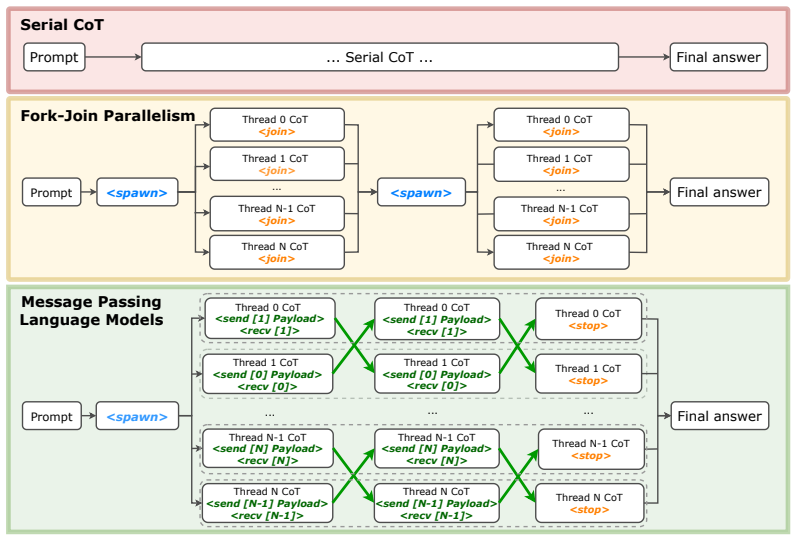
Send and receive primitives that let transient LLM threads exchange only the minimal messages needed for coordination instead of broadcasting full context.
What would settle it
A controlled run in which fine-tuned MPLMs on 25x25 Sudoku produce solution rates no better than standard CoT on 9x9 grids would show the claimed scaling does not hold.
Extended reading notes
Core claim
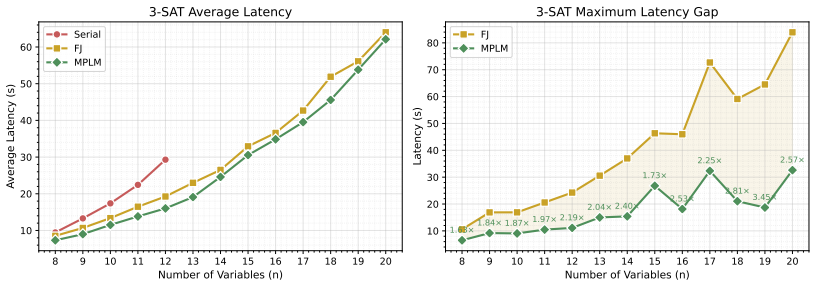
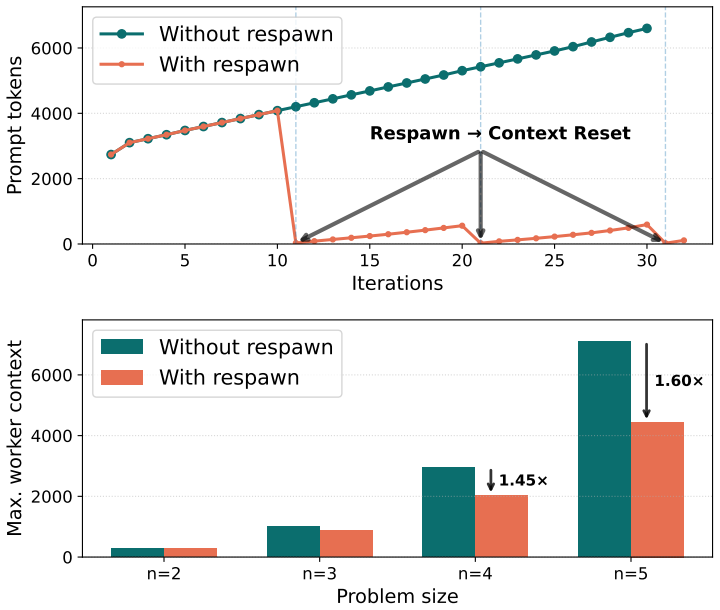
MPLMs let LLM threads communicate pointwise via lightweight send and receive primitives. The resulting framework achieves reduced communication costs by avoiding redundant context sharing and supports preemption that terminates unpromising threads once sufficient information arrives from peers. On Sudoku the method requires asymptotically smaller context than serial CoT or parallel FJ; fine-tuning one model enables solution of 25x25 instances that standard approaches and untuned frontier models cannot handle. On 3-SAT preemption improves efficiency by discarding failing branches early. Appropriately prompted large models follow the protocol and match popular fork-join baselines on long-conte
Load-bearing premise
Large pre-trained LLMs can be prompted or fine-tuned to follow the send/receive protocol reliably and to interpret incoming messages without introducing substantial errors or extra context bloat.
Editorial extensions
If this is right
- Threads share only the messages required for the next step instead of duplicating full histories.
- Preemption lets a thread halt once peer messages render its branch unnecessary, cutting wasted computation on 3-SAT.
- A single fine-tuned model reaches 25x25 Sudoku grids that remain out of reach for CoT, FJ, and frontier models without tools.
- Prompted base models achieve competitive long-context QA accuracy while following the same send/receive rules.
Reading between the lines
- The protocol could be extended to multi-model ensembles where different specialized models exchange partial solutions.
- Early termination might compound across many parallel threads, producing larger savings on problems with high branching factors.
- Message passing might allow modular reuse of intermediate results across unrelated queries without reloading full context each time.
Signed reviews
Editorial analysis
A structured set of objections, weighed in public.
Referee Report
Summary. The paper introduces Message Passing Language Models (MPLMs), a framework in which LLM threads communicate directly via lightweight send/receive primitives rather than relying on transient fork-join or serial CoT. It claims two efficiency mechanisms—reduced redundant context sharing and preemption based on partial peer information—and reports that MPLMs achieve asymptotically smaller context on Sudoku puzzles, that a single fine-tuned model solves 25x25 Sudoku instances that defeat standard CoT, FJ, and frontier models, that preemption improves efficiency on 3-SAT, and that prompted pre-trained models follow the protocol competitively on long-context QA.
Significance. If the empirical claims hold with verifiable context-length scaling and protocol adherence, the work would offer a concrete alternative to existing parallel scaling methods by enabling pointwise thread communication and early termination, potentially lowering inference cost for structured reasoning tasks. The absence of quantitative tables, error bars, or scaling plots in the available text, however, leaves the magnitude of any advantage unassessable.
major comments (3)
- [Abstract] Abstract: the central claim that MPLMs require an asymptotically smaller context than serial CoT and parallel FJ on Sudoku is stated without any reported token counts, scaling curves, or per-puzzle-size measurements; without these data the asymptotic reduction cannot be evaluated.
- [Abstract] Abstract: the assertion that a single fine-tuned model solves 25x25 Sudoku puzzles that remain challenging for CoT, FJ, and frontier models lacks success rates, baseline comparisons, or any description of how message interpretation errors or context bloat were measured or controlled.
- [Abstract] Abstract: the preemption mechanism on 3-SAT is described only qualitatively; no termination rates, branch-pruning statistics, or efficiency metrics relative to non-preemptive FJ are supplied, leaving the efficiency gain unsubstantiated.
Simulated Author's Rebuttal
Thank you for the constructive feedback. We agree the abstract would benefit from quantitative details supporting the claims and will revise it to include key metrics from the experiments. We address each major comment below.
read point-by-point responses
-
Referee: [Abstract] Abstract: the central claim that MPLMs require an asymptotically smaller context than serial CoT and parallel FJ on Sudoku is stated without any reported token counts, scaling curves, or per-puzzle-size measurements; without these data the asymptotic reduction cannot be evaluated.
Authors: We acknowledge that the abstract states the asymptotic claim without supporting numbers. The full manuscript contains scaling curves, per-puzzle-size token counts, and context-length measurements in the Sudoku experiments demonstrating the reduction relative to CoT and FJ. We will revise the abstract to report these key quantitative results. revision: yes
-
Referee: [Abstract] Abstract: the assertion that a single fine-tuned model solves 25x25 Sudoku puzzles that remain challenging for CoT, FJ, and frontier models lacks success rates, baseline comparisons, or any description of how message interpretation errors or context bloat were measured or controlled.
Authors: The manuscript reports success rates, baseline comparisons, and controls for message errors and context in the experimental results. The abstract summarizes without these specifics. We will update the abstract to include the success rates for 25x25 puzzles along with brief mention of the evaluation controls. revision: yes
-
Referee: [Abstract] Abstract: the preemption mechanism on 3-SAT is described only qualitatively; no termination rates, branch-pruning statistics, or efficiency metrics relative to non-preemptive FJ are supplied, leaving the efficiency gain unsubstantiated.
Authors: We agree the abstract presents preemption qualitatively. The full paper supplies termination rates, branch-pruning statistics, and efficiency comparisons to non-preemptive FJ. We will incorporate these metrics into the revised abstract. revision: yes
Circularity Check
No circularity; new protocol introduced and evaluated empirically
full rationale
The paper presents MPLMs as a new framework using send/receive primitives, with claims about context reduction and puzzle-solving performance supported by direct experiments on Sudoku, 3-SAT, and QA tasks rather than any mathematical derivation. No equations, predictions, or central results reduce to fitted parameters, self-citations, or prior ansatzes by construction. The protocol is defined independently and tested against external benchmarks (CoT, FJ, frontier models), making the work self-contained without load-bearing circular steps.
Assumptions & free parameters
assumptions (1)
- domain assumption Large pre-trained LLMs can be prompted or fine-tuned to follow the MPLM send/receive protocol without substantial errors
invented entities (1)
-
Message Passing Language Model (MPLM)
Cite this review
Pith. "Pith review of Message Passing Enables Efficient Reasoning." pith.science (2026). https://pith.science/paper/VDZFECI5
@misc{pith2026260701077,
  author       = {Pith},
  title        = {Pith review of: Message Passing Enables Efficient Reasoning},
  year         = {2026},
  howpublished = {\url{https://pith.science/paper/VDZFECI5}},
  note         = {Machine review of arXiv:2607.01077}
}
read the original abstract
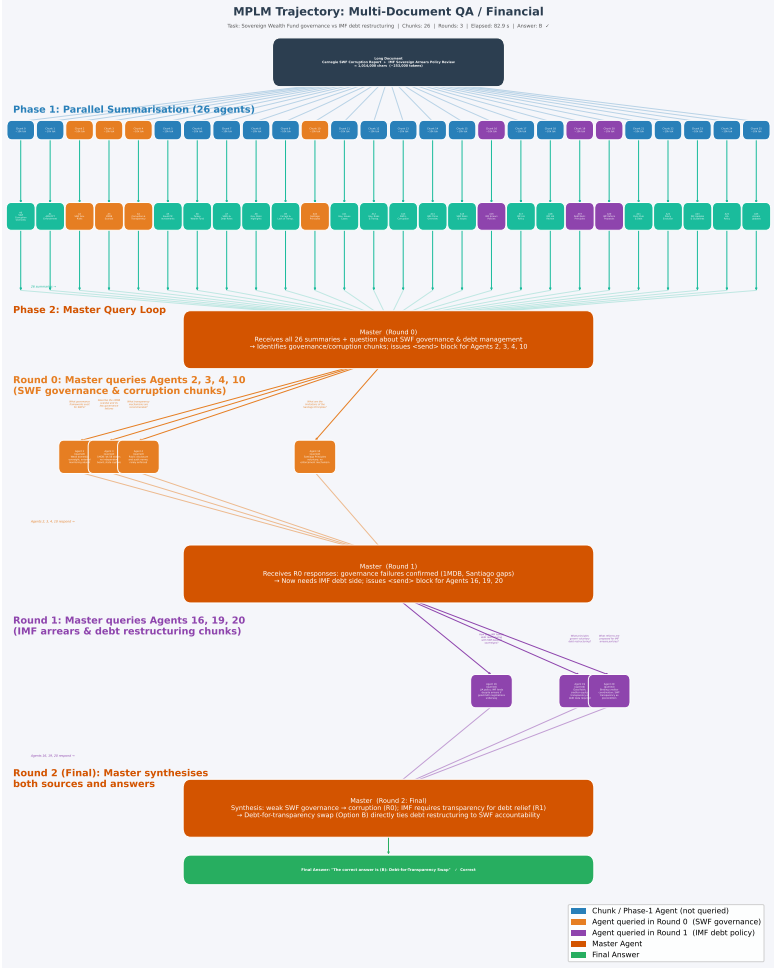
While inference-time scaling has improved the reasoning abilities of large language models (LLMs), the need to generate long chains-of-thought (CoTs) is a computational bottleneck. Thus, in contrast to sequential scaling methods like CoT, recent parallel scaling techniques instead use fork and join (FJ) primitives to divide work across multiple LLM threads. However, in the fork-join paradigm, threads are typically transient and do not communicate pointwise with one another which limits scalability. To tackle this, we introduce Message Passing Language Models (MPLMs), a framework for LLM reasoning in which threads communicate directly via lightweight send and receive primitives. MPLMs enable efficient scaling through two key mechanisms: (1) reduced communication costs, achieved by avoiding redundant context sharing, and (2) preemption, which allows threads to terminate early based on partial information from their peers. We demonstrate the promise of MPLMs on 3 classes of tasks. First, on Sudoku puzzles, we show that MPLMs require an asymptotically smaller context than both serial CoT and parallel FJ. We then fine-tune a single model to solve 25 x 25 puzzles that remain challenging for standard CoT and FJ approaches, as well as frontier reasoning models without tools. Second, on 3-SAT puzzles, the capability of preemption allows termination of unpromising branches, which results in improved efficiency. Finally, we show that appropriately prompted large pre-trained models follow the MPLM protocol, achieving competitive results on long-context question answering relative to popular fork-join approaches.
Figures


Figures from the paper (5 more)

Reviewed July 2, 2026 · model on record in the stance chip above.
Discussion (0). Continue with ORCID to comment.