REVIEW 2 major objections 6 minor 2 cited by
HIV rebound after treatment stop is a first threshold crossing, not the moment a latent cell reactivates, and that delay grows only with the log of the assay threshold.
Reviewed by Pith at T0; open to challenge. T0 means a machine referee read the full paper against a public rubric. the ladder, T0–T4 →
T0 review · grok-4.5
2026-07-14 16:18 UTC pith:VFB5KKQO
load-bearing objection Clean first-passage reformulation of the ATI endpoint with usable closed forms and a quantified single-founder error; solid enough to send to referees. the 2 major comments →
Stochastic First-Passage Theory of HIV Viral Rebound Following Latent Reservoir Reactivation
The pith
A machine-rendered reading of the paper's core claim, the machinery that carries it, and where it could break.
Core claim
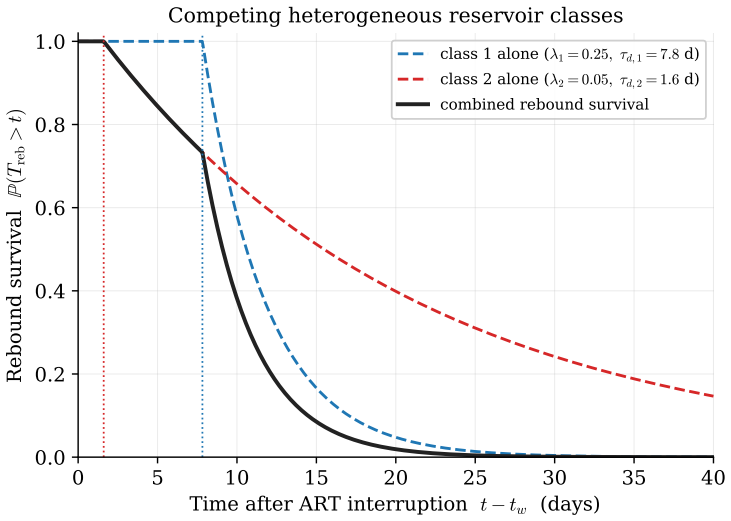
In the rare-reactivation regime the first successful expanding lineage dominates the threshold crossing, so the observed rebound time separates as T_reb ≈ T_1 + τ_det with τ_det = τ_e + r^{-1} log(V_det / v_0). The resulting shifted-hazard survival P(T_reb > t) ≈ exp(-∫_{t_w}^{t-τ_det} λ(s) ds) supplies closed-form rebound-time laws for constant, washout-dependent, immune-periodic, Cox-process and heterogeneous-reservoir activation, and it supplies an interval-censored likelihood for ATI data that predicts logarithmic dependence of median rebound on detection threshold.
What carries the argument
The single-founder first-passage decomposition of the Poisson shot-noise viral load: rebound is identified with the first successful reactivation time delayed by the deterministic growth-to-detection lag τ_det, converting any successful-reactivation intensity λ(t) into a shifted cumulative-hazard survival law.
Load-bearing premise
That the earliest successful lineage alone drives the crossing, so the chance that several still-undetectable lineages add up and cross the threshold first can be neglected.
What would settle it
In an ATI cohort with frequent viral-load sampling, test whether the median time to rebound rises linearly with log of the detection threshold at slope near 1/0.33 day; a clear departure from that slope, or systematic multi-lineage cooperative crossings that advance rebound beyond the single-founder prediction, would refute the central separation.
Editorial analysis
A structured set of objections, weighed in public.
Referee Report
Summary. The manuscript reformulates post-ART HIV rebound as a first-passage problem for a Poisson shot-noise viral load, T_reb = inf{t ≥ t_w : V(t) ≥ V_det}, rather than as the hidden first reactivation time. In the rare-reactivation regime it invokes a single-founder approximation T_reb ≈ T_1 + τ_det with τ_det = τ_e + r^{-1} log(V_det/v_0), yielding the shifted-hazard survival P(T_reb > t) ≈ exp(-∫_{t_w}^{t-τ_det} λ(s) ds) and closed-form rebound laws for constant, ART-washout, periodic, Cox-process, and heterogeneous-reservoir intensities. It supplies an interval-censored ATI likelihood and predicts logarithmic dependence of median rebound on V_det; a three-median consistency check against Gunst et al. gives an effective growth rate r ≈ 0.33 day^{-1}.
Significance. If the first-passage separation and shifted-hazard laws hold, the paper cleanly bridges activation-survival models to the endpoint ATI trials actually measure, and it does so with standard, correctly executed Poisson and Laplace-transform machinery (Props. 1–2, Appendices A–F). Strengths include explicit quantification of single-founder error against full cooperative Monte Carlo (Table 2, Fig. 3), closed forms across several biologically motivated intensities, a likelihood that respects interval censoring, and a falsifiable logarithmic-threshold prediction. These are useful analytical tools for ATI design and for interpreting why maximal early-infection growth rates underpredict observed rebound times.
major comments (2)
- §4.2 and Table 2 quantify single-founder median error at r = 0.69 day^{-1} (τ_d ≈ 5.7 d), where baseline λτ_d ≈ 1.7 already yields ~5% overestimation and λτ_d ≈ 3 yields ~10%. The ATI-calibrated regime of §6 uses r ≈ 0.33 day^{-1}, which roughly doubles τ_d (≈ 11–12 d at V_det = 50) and therefore λτ_det at the same λ. The paper does not recompute the cooperative error or survival bias under those calibrated parameters, yet the abstract and §6 present the shifted-hazard laws as the working description of ATI rebound. Please either (i) re-run the Table 2 comparison at r ≈ 0.33 (and at the 400 and 10,000 thresholds) or (ii) restrict the quantitative claims and the likelihood in §6 to the regime where λτ_det is shown to keep the bias small, and state the cooperative correction of Appendix F as the default when that condition fails.
- §6 and Fig. 6 fit Q_{0.5} = C + r^{-1} log V_det to three cohort-level medians (50, 400, 10,000 copies/mL), obtaining r ≈ 0.33 day^{-1} and R^{2} ≈ 0.99. With two free parameters and three points this is a consistency check, as the text notes, but the abstract states that the medians “support this dependence” and “imply” r ≈ 0.33. That language overstates what three aggregated medians can identify: C absorbs the free combination t_w + τ_e + (log 2)/λ - r^{-1} log v_0, and no individual-level or interval-censored fit is shown. Please temper the abstract and §6 wording to “consistent with” rather than “imply,” report sensitivity of r to plausible v_0 and assay-unit choices, and, if space allows, illustrate the §6 likelihood on a small published ATI interval-censored sample so that the inference claim is demonstrated rather than only derived.
minor comments (6)
- Eq. (1) and Eq. (22) omit the eclipse phase in one place and include it in another; a single consistent expression for E[T_reb] early in the introduction would help.
- Figure 2 caption and main text use V_det = 50 with r = 0.69; consider adding a panel or note at the calibrated r ≈ 0.33 so the visual matches the ATI discussion in §6.
- Notation: λ(t) is redefined as successful (establishment-weighted) intensity relative to the earlier activation-survival paper; a short explicit mapping λ = p_est λ_act in the introduction (beyond §3) would reduce confusion for readers of both papers.
- Table 1 lists λ baseline 0.30 day^{-1} while the ATI discussion prefers λ_eff ≈ 0.17–0.20; flag which column is used in each figure to avoid mixing regimes.
- Appendix D quantile formula with the Lambert W function is useful; a one-line numerical check against the series mean (Eq. 71) would reassure readers implementing the washout law.
- References [28]–[117] include many items only loosely related to HIV rebound; trimming to works that are actually cited in the argument would improve focus.
Circularity Check
No significant circularity: shifted-hazard first-passage laws follow from Poisson + exponential-growth axioms; Gunst calibration is an explicit consistency check, not a forced prediction; self-citation of prior activation paper is contextual only.
full rationale
The core derivation (T_reb ≈ T_1 + τ_det with τ_det = τ_e + r^{-1} log(V_det/v_0), yielding the shifted cumulative-hazard survival of Prop. 2 / Eq. (44) and the closed forms of §§5.1–5.5) is obtained directly from the model axioms of inhomogeneous Poisson successful-reactivation events and monotone exponential lineage growth; the single-founder approximation is stated as an upper bound whose error is quantified by simulation (Table 2) rather than hidden. The logarithmic threshold dependence is likewise a model consequence (Eq. (95)); the three Gunst medians are used only to extract an effective r ≈ 0.33 day^{-1} and are labeled a “consistency check rather than full parameter validation,” so the fit is not re-presented as an independent prediction. The sole self-citation of the author’s 2025 activation-survival paper supplies the earlier Poisson intensity constructions that are re-derived and re-interpreted here; it is not load-bearing for the first-passage claim. No uniqueness theorem, ansatz smuggling, or definitional tautology appears. Score 1 reflects only the minor, non-load-bearing self-citation.
Axiom & Free-Parameter Ledger
free parameters (6)
- successful reactivation rate λ (or λ0) =
0.30 day^{-1} (baseline); effective 0.17–0.20 for ATI calibration
- net growth rate r =
0.33 day^{-1} (ATI fit); 0.69 (baseline examples)
- founder output v0 =
1 cp/mL
- eclipse delay τe =
1 day
- washout parameters A0, k_drug =
A0=1, k_drug=0.3 day^{-1}
- Cox fluctuation intensity D (or σ) =
0.10 day^{-1} (example)
axioms (4)
- domain assumption Successful established reactivations form an inhomogeneous Poisson process with intensity λ(t) = pest(t) λ_act(t).
- domain assumption Each established lineage contributes v0 exp(r(t-Ti)) with constant net growth r>0, rendering V(t) monotone.
- ad hoc to paper In the rare-reactivation regime the earliest founder dominates, so cooperative multi-lineage crossing may be neglected (single-founder approximation).
- standard math Laplace functional of a Poisson random measure yields the closed-form transform of the shot-noise viral load.
read the original abstract
In our earlier work, we modeled the stochastic initiation of HIV rebound by treating latent-cell reactivation as a Poisson-driven process during antiretroviral-therapy (ART) washout, immune modulation, and therapeutic perturbation~\cite{Taye2025CM}. That framework characterized activation survival, cumulative hazards, waiting-time laws, and expected viral-load trajectories. However, the endpoint observed in analytical treatment interruption (ATI) studies is not the hidden time of first successful reactivation. It is the first time at which plasma virus exceeds an assay-defined detection threshold. Here we reformulate post-treatment rebound as a stochastic first-passage problem, with $T_{\rm reb}=\inf\{t\ge t_w:V(t)\ge V_{\rm det}\}$. Successful reactivation events arrive with a time-dependent intensity, and each event seeds an exponentially expanding viral lineage. The total plasma viral load is therefore a Poisson shot-noise process, and rebound corresponds to its first threshold crossing. In the rare-reactivation regime, this crossing is dominated by the earliest successful lineage. Rebound timing then separates into two components: a stochastic waiting time for reservoir reactivation and a deterministic growth delay to detectability. This separation gives a shifted-hazard survival law and yields closed-form rebound-time distributions for constant activation, ART-washout-dependent activation, immune-periodic activation, Cox-process activation, and heterogeneous-reservoir activation. The same formulation also provides a likelihood suitable for the interval-censored sampling structure of ATI trials.
Figures



Forward citations
Cited by 2 Pith papers
-
Force--Torque Reciprocity and the Inference of Concealed Dissipation in a Geared Brownian Machine
In a reciprocal Brownian motor, the hidden entropy production at mechanical stall is exactly reconstructable from the observed coordinate's fluctuation-response violation when the reciprocal mobility factor K is calibrated.
-
Force--Torque Reciprocity and the Inference of Concealed Dissipation in a Geared Brownian Machine
In a reciprocal geared Brownian motor, force–torque reciprocity yields an exact reconstruction of full stall entropy production from the observed coordinate’s Harada–Sasa violation once the mobility factor K is known.
Reference graph
Works this paper leans on
-
[1]
Stochastic modeling of HIV reactivation under ART washout and immune fluctuations,
M. A. Taye, “Stochastic modeling of HIV reactivation under ART washout and immune fluctuations,”Contemporary Mathematics6(5), 5708–5739 (2025). https://doi.org/10. 37256/cm.6520256801
2025
-
[2]
Dynamics of HIV infection of CD4+ T cells,
A. S. Perelson, D. E. Kirschner, and R. De Boer, “Dynamics of HIV infection of CD4+ T cells,”Mathematical Biosciences114, 81–125 (1993)
1993
-
[3]
HIV-1 dynamics in vivo: virion clearance rate, infected cell life-span, and viral generation time,
A. S. Perelson, A. U. Neumann, M. Markowitz, J. M. Leonard, and D. D. Ho, “HIV-1 dynamics in vivo: virion clearance rate, infected cell life-span, and viral generation time,”Science271, 1582–1586 (1996)
1996
-
[4]
Rapid turnover of plasma virions and CD4 lymphocytes in HIV-1 infection,
D. D. Ho, A. U. Neumann, A. S. Perelson, W. Chen, J. M. Leonard, and M. Markowitz, “Rapid turnover of plasma virions and CD4 lymphocytes in HIV-1 infection,”Nature373, 123–126 (1995)
1995
-
[5]
Viral dynamics in human immunodeficiency virus type 1 infection,
X. Wei, S. K. Ghosh, M. E. Taylor, V. A. Johnson, E. A. Emini, P. Deutsch, et al., “Viral dynamics in human immunodeficiency virus type 1 infection,”Nature373, 117–122 (1995)
1995
-
[6]
Presence of an inducible HIV-1 latent reservoir during highly active antiretroviral therapy,
T. W. Chun, L. Stuyver, S. B. Mizell, L. A. Ehler, J. A. Mican, M. Baseler, et al., “Presence of an inducible HIV-1 latent reservoir during highly active antiretroviral therapy,”Proceedings of the National Academy of Sciences USA94, 13193–13197 (1997)
1997
-
[7]
Long-term follow-up studies confirm the stability of the latent reservoir for HIV-1 in resting CD4+ T cells,
J. D. Siliciano, J. Kajdas, D. Finzi, T. C. Quinn, K. Chadwick, J. B. Margolick, et al., “Long-term follow-up studies confirm the stability of the latent reservoir for HIV-1 in resting CD4+ T cells,”Nature Medicine9, 727–728 (2003)
2003
-
[8]
The latent reservoir for HIV-1: how immunologic memory and clonal expansion contribute to HIV-1 persistence,
A. J. Murray, K. J. Kwon, D. L. Farber, and R. F. Siliciano, “The latent reservoir for HIV-1: how immunologic memory and clonal expansion contribute to HIV-1 persistence,”Journal of Immunology197, 407–417 (2016)
2016
-
[9]
Proviruses with identical sequences comprise a large fraction of the replication- competent HIV reservoir,
J. Z. Li, et al., “Proviruses with identical sequences comprise a large fraction of the replication- competent HIV reservoir,”Proceedings of the National Academy of Sciences USA117, 3886– 3893 (2020)
2020
-
[10]
Predicting the outcomes of treatment to eradicate the latent reservoir for HIV-1,
A. L. Hill, D. I. S. Rosenbloom, F. Fu, M. A. Nowak, and R. F. Siliciano, “Predicting the outcomes of treatment to eradicate the latent reservoir for HIV-1,”Proceedings of the National Academy of Sciences USA111, 13475–13480 (2014)
2014
-
[11]
Real-time predictions of reservoir size and rebound time during antiretroviral therapy interruption trials for HIV,
A. L. Hill, D. I. S. Rosenbloom, E. Goldberg, E. Hanhauser, D. R. Kuritzkes, R. F. Siliciano, et al., “Real-time predictions of reservoir size and rebound time during antiretroviral therapy interruption trials for HIV,”PLoS Pathogens14, e1007333 (2018)
2018
-
[12]
M. Pinkevych, D. Cromer, M. Tolstrup, A. J. Grimm, D. A. Cooper, S. R. Lewin, O. S. Søgaard, T. A. Rasmussen, S. J. Kent, A. D. Kelleher, and M. P. Davenport, “HIV reactivation from latency after treatment interruption occurs on average every 5–8 days: implications for HIV remission,”PLoS Pathogens11(7), e1005000 (2015). doi:10.1371/journal.ppat.1005000. 35
-
[13]
J. M. Conway, A. S. Perelson, and J. Z. Li, “Predictions of time to HIV viral rebound following ART suspension that incorporate personal biomarkers,”PLoS Computational Biology15(7), e1007229 (2019). doi:10.1371/journal.pcbi.1007229
-
[14]
Population dynamics of immune responses to persistent viruses,
M. A. Nowak and C. R. M. Bangham, “Population dynamics of immune responses to persistent viruses,”Science272, 74–79 (1996)
1996
-
[15]
Modelling viral and immune system dynamics,
A. S. Perelson, “Modelling viral and immune system dynamics,”Nature Reviews Immunology 2, 28–36 (2002)
2002
-
[16]
Mathematical models of HIV pathogenesis and treatment,
D. Wodarz and M. A. Nowak, “Mathematical models of HIV pathogenesis and treatment,” BioEssays24, 1178–1187 (2002)
2002
-
[17]
J. D. Gunst, J. Gohil, J. Z. Li, R. J. Bosch, et al., “Time to HIV viral rebound and frequency of post-treatment control after analytical interruption of antiretroviral therapy: an individual data-based meta-analysis of 24 prospective studies,”Nature Communications16, 906 (2025). doi:10.1038/s41467-025-56116-1
-
[18]
C. M. Fennessey, M. Pinkevych, T. T. Immonen, A. Reynaldi, V. Venturi, P. Nadella, C. Reid, L. Newman, L. Lipkey, K. Oswald, et al., “Genetically-barcoded SIV facilitates enumeration of rebound variants and estimation of reactivation rates in nonhuman primates following interruption of suppressive antiretroviral therapy,”PLoS Pathogens13(5), e1006359 (201...
-
[19]
Models of SIV rebound after treatment interruption that involve multiple reactivation events,
C. H. Van Dorp, J. M. Conway, D. H. Barouch, J. B. Whitney, and A. S. Perelson, “Models of SIV rebound after treatment interruption that involve multiple reactivation events,”PLoS Computational Biology16, e1008241 (2020)
2020
-
[20]
J. Z. Li, B. Etemad, H. Ahmed, E. Aga, R. J. Bosch, J. W. Mellors, D. R. Kuritzkes, M. M. Lederman, M. Para, and R. T. Gandhi, “The size of the expressed HIV reservoir predicts timing of viral rebound after treatment interruption,”AIDS30(3), 343–353 (2016). doi:10.1097/QAD.0000000000000953
-
[21]
A. O. Pasternak, S. DeMaster, et al., “Cell-associated HIV-1 RNA predicts viral rebound and disease progression after discontinuation of temporary early ART,”JCI Insight5(6), e134196 (2020). doi:10.1172/jci.insight.134196
-
[22]
Kinetics of plasma HIV rebound in the era of modern antiretroviral therapy,
M. C. Sneller, E. D. Huiting, K. E. Clarridge, C. Seamon, J. Blazkova, J. S. Justement, et al., “Kinetics of plasma HIV rebound in the era of modern antiretroviral therapy,”Journal of Infectious Diseases222(10), 1655–1659 (2020). doi:10.1093/infdis/jiaa270
-
[23]
Modeling of experimental data supports HIV reactivation from latency after treatment interruption at high but variable rates,
M. Pinkevych, D. Cromer, M. P. Davenport, et al., “Modeling of experimental data supports HIV reactivation from latency after treatment interruption at high but variable rates,”eLife 8, e49022 (2019)
2019
-
[24]
Impact of fluctuation in frequency of human immunodeficiency virus/simian immunodeficiency virus 36 reactivation during antiretroviral therapy interruption,
Y. Wu, M. Pinkevych, Z. Xu, B. F. Keele, M. P. Davenport, and D. Cromer, “Impact of fluctuation in frequency of human immunodeficiency virus/simian immunodeficiency virus 36 reactivation during antiretroviral therapy interruption,”Proceedings of the Royal Society B 287, 20200354 (2020)
2020
-
[25]
J. F. C. Kingman,Poisson Processes(Oxford University Press, Oxford, 1993)
1993
-
[26]
Feller,An Introduction to Probability Theory and Its Applications, Vol
W. Feller,An Introduction to Probability Theory and Its Applications, Vol. II, 2nd ed. (Wiley, New York, 1971)
1971
-
[27]
D. R. Cox and H. D. Miller,The Theory of Stochastic Processes(Chapman and Hall, London, 1965)
1965
-
[28]
M. A. Taye,Stochastic First-Passage Theory of HIV Viral Rebound Following Latent Reservoir Reactivation, arXiv:2607.04910 (2026)
Pith/arXiv arXiv 2026
-
[29]
M. A. Taye,Biological Time, Evolutionary Optimization, and Gauge Coherence: A Thermo- dynamic Synthesis of the Principle of Biological Time Equivalence, arXiv:2607.04827 (2026)
Pith/arXiv arXiv 2026
-
[30]
M. A. Taye,Relativistic PBTE: Biological Proper Time Along the Worldline, arXiv:2607.04849 (2026)
Pith/arXiv arXiv 2026
-
[31]
M. Taye,A Nonequilibrium Internal-Time Model of Aging: Entropy-Normalized Biological Proper Time and Repair Bifurcations, arXiv:2606.23279 (2026)
Pith/arXiv arXiv 2026
-
[32]
M. A. Taye, Int. J. Sci. Res. Publ.16, 17417 (2026)
2026
-
[33]
M. A. Taye,The Principle of Biological Time Equivalence:(2026) [Metadata incomplete in Google Scholar export]
2026
-
[34]
M. A. Taye,Nonequilibrium Thermodynamics in Stochastic Processes(2026) [Metadata incomplete in Google Scholar export]
2026
-
[35]
M. A. Taye,Brownian Motors and Brownian Heat Engines: From Classical Thermodynamics to Fluctuation-Driven Machines(Independently published, 2026), 539 pp
2026
-
[36]
M. A. Taye,Exact Thermodynamic Analysis of a Hybrid Molecular Motor Switching Between Active and Passive Modes(2026) [Metadata incomplete in Google Scholar export]
2026
-
[37]
M. A. Taye,Noise-Activated Dopant Dynamics in Two-Dimensional Thermal Landscapes with Localized Cold Spots(2026) [International Journal of Scientific and Research Publications (IJSRP) 16 (5)]
2026
-
[38]
M. A. Taye,A Universal Thermodynamic Inequality: Scaling Relations Between Current, Activity, and Entropy Production(2026) [Metadata incomplete in Google Scholar export]
2026
-
[39]
M. A. Taye, Int. J. Sci. Res. Publ.16, 2250 (2026)
2026
-
[40]
M. Taye,Neural Investment as an Entropy-Budget Strategy: A Thermodynamic Derivation of Primate Longevity from the Principle of Biological Time Equivalence, arXiv:2604.27937 (2026). 37
Pith/arXiv arXiv 2026
-
[41]
M. Taye,The Lifetime Cardiac-Cycle Invariant in Endothermic Vertebrates: A 230- Species Comparative Dataset, Statistical Validation, and Explicit Falsifiability Criteria, arXiv:2604.27856 (2026)
Pith/arXiv arXiv 2026
-
[42]
M. Taye,Biological Time Equivalence in Vertebrates: Thermodynamic Framework, Compara- tive Tests, and Clade-Specific Deviations, arXiv:2603.26377 (2026)
arXiv 2026
-
[43]
M. A. Taye, Mod. Math. Phys.2, 1 (2026)
2026
-
[44]
M. A. Taye, Physica A, 131214 (2025)
2025
-
[45]
M. A. Taye, Phys. Rev. E112, 044122 (2025)
2025
-
[46]
M. A. Taye, Phys. Rev. E112, 044101 (2025)
2025
-
[47]
M. Taye,A Unified Nonequilibrium Framework: Thermodynamic Distance, Dissipation, and Stationary Laws via Effective State Count, Variational Stationarity, and Thermodynamic Bounds, arXiv:2509.09041 (2025)
Pith/arXiv arXiv 2025
-
[48]
M. A. Taye, Contemp. Math.6, 4101 (2025)
2025
-
[49]
M. Taye,Thermodynamic Features of a Heat Engine Coupled with Exponentially Decreasing Temperature Across the Reaction Coordinate, as well as Perspectives on Nonequilibrium Thermodynamics, arXiv:2503.24317 (2025)
Pith/arXiv arXiv 2025
-
[50]
M. A. Taye, bioRxiv, 2025.03. 22.644757 (2025)
2025
-
[51]
Taye, arXiv e-prints, arXiv: 2503.20812 (2025)
M. Taye, arXiv e-prints, arXiv: 2503.20812 (2025)
Pith/arXiv arXiv 2025
-
[52]
M. A. Taye,Entropy Production and Thermodynamic Dynamics in Active and Passive Brownian Systems Driven by Time-Dependent Forces and Temperatures(2025) [Metadata incomplete in Google Scholar export]
2025
-
[53]
M. A. Taye,Directed Transport of a Short Polymer Chain on a Temperature-Dependent Ratchet Potential(2025) [Metadata incomplete in Google Scholar export]
2025
-
[54]
M. A. Taye,Thermodynamic Features of a Heat Engine with an Exponentially Decreasing Temperature Profile(2025) [Metadata incomplete in Google Scholar export]
2025
-
[55]
M. A. Taye, Phys. Rev. E110, 054105 (2024)
2024
-
[56]
M. A. Taye, Contemp. Math., 5113-5149 (2024)
2024
-
[57]
M. A. Taye, bioRxiv, 2023.12. 06.570486 (2023)
2023
-
[58]
Mahmud, M
M. Mahmud, M. Bekele, and N. Behera, Theory Biosci.142, 151-165 (2023)
2023
-
[59]
Ashagre, A
S. Ashagre, A. K. Ogundele, J. N. Ike, B. Gebremichael, M. Bekele, G. D. Sharma, and ..., Journal of Physics and Chemistry of Solids 177, 111290 (2023)
2023
-
[60]
M. A. Taye, Eur. Phys. J. B96, 65 (2023). 38
2023
-
[61]
Taye,Transporting a short polymer along a reaction coordinate that coupled with a spatially varying temperature(2023) [Metadata incomplete in Google Scholar export]
M. Taye,Transporting a short polymer along a reaction coordinate that coupled with a spatially varying temperature(2023) [Metadata incomplete in Google Scholar export]
2023
-
[62]
M. A. Taye, bioRxiv, 2023.01. 21.525013 (2023)
2023
-
[63]
M. A. Taye, Contemp. Math4, 392-410 (2023)
2023
-
[64]
Mahmud, M
M. Mahmud, M. Bekele, and Y. Bassie, Condens. Matter7, 62 (2022)
2022
-
[65]
M. Taye,Exact time-dependent analytical solutions for entropy production rate for a system that operates in a heat bath where its temperature varies linearly in space, arXiv:2205.10322 (2022)
Pith/arXiv arXiv 2022
-
[66]
M. A. Taye, Phys. Rev. E105, 054126 (2022)
2022
-
[67]
Aragie, M
B. Aragie, M. Bekele, and G. Pellicane, Pramana96, 59 (2022)
2022
-
[68]
Abebe, T
Y. Abebe, T. Birhanu, L. Demeyu, M. Taye, M. Bekele, and Y. Bassie, Eur. Phys. J. B95, 9 (2022)
2022
-
[69]
Birhanu, Y
T. Birhanu, Y. Abebe, L. Demeyu, M. Taye, and M. Bekele, Int. J. Mod. Phys. B35, 2150284 (2021)
2021
-
[70]
M. A. Taye, Eur. Phys. J. B94, 124 (2021)
2021
-
[71]
M. A. Taye, Phys. Rev. E103, 042132 (2021)
2021
-
[72]
S. Y. Zhang and M. A. Taye,The efficacy of antiviral drug, HIV viral load and the immune response, arXiv:2101.10413 (2021)
Pith/arXiv arXiv 2021
-
[73]
S. Y. Zhang and M. A. Taye,HIV viral load and the efficacy of antiviral drug(2020) [Metadata incomplete in Google Scholar export]
2020
-
[74]
M. A. Taye, bioRxiv, 2020.11. 06.372094 (2020)
2020
-
[75]
M. A. Taye, Eur. Phys. J. E43, 19 (2020)
2020
-
[76]
M. A. Taye, Phys. Rev. E101, 012131 (2020)
2020
-
[77]
M. A. Taye,The physics of Erythrocyte Sedimentation Rate, arXiv:1907.12148 (2019)
Pith/arXiv arXiv 1907
-
[78]
S. F. Duki and M. A. Taye,Stochastic resonance and first passage time for excitable system exposed to underdamped medium, arXiv:1809.10017 (2018)
Pith/arXiv arXiv 2018
-
[79]
S. F. Duki and M. A. Taye, J. Stat. Phys.171, 878-896 (2018)
2018
-
[80]
M. A. Taye, J. Stat. Phys.169, 423-440 (2017)
2017
discussion (0)
Sign in with ORCID, Apple, or X to comment. Anyone can read and Pith papers without signing in.