REVIEW 5 major objections 5 minor 59 references
Learning to Forget using Hypernetworks
T0 review · 5 major / 5 minor · reviewed 2026-08-12 · deepseek-v4-flash
Pith's one-line read Machine unlearning can be reframed as generative modelling: a diffusion hypernetwork samples parameters that score zero on forget classes and preserve retain accuracy.
desk verdict Genuinely new idea but the zero-forget headline is best-of-N selection, so the claims need major revision before the result can be trusted. read the letter →
The pith
A machine-rendered reading of the paper's core claim, the machinery that carries it, and where it could break.
The reading
What carries the argument
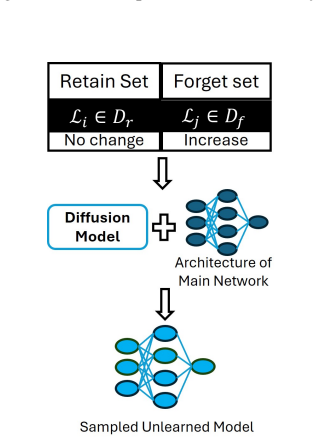
The load-bearing object is the diffusion hypernetwork: a diffusion transformer (DiT) that generates the parameters of a small MLP classifier. A hypernetwork is a neural network whose output is the parameter vector of another network; here it is trained on checkpoints from many MLP training runs, with each checkpoint labelled by per-class losses on the classification task. DiHyFo-1 tokenises layers and predicts parameter updates conditioned on current parameters, current losses, target losses, and a diffusion time step, learning both to optimise and to 'deoptimise' (increase loss on forget classes). DiHyFo-2 conditions directly on desired class losses and denoises Gaussian noise into parameters. A pivot-class mechanism fixes a subset of classes that must always stay high-performing, simplifying the learning problem, and the same trained network can be reprompted with different forget sets at inference.
What would settle it
Take a trained DiHyFo, prompt it to forget class 2 of MNIST, and fit a linear probe on the penultimate-layer activations of the sampled model using forget-class labels. If the probe can decode class-2 structure well above chance while the model's output accuracy on class 2 is zero, the claimed equivalence to a retrained model fails: the network has zeroed the output without removing the information. A complementary check is to compare the sampled model's full output distribution on forget-class inputs with that of a model retrained without class 2; if the sampled model collapses to a single constant vector while the retrained model retains a spread of near-random but structured probabilities, the 'unlearned' model is not behaviourally mimicking retraining.
Extended reading notes
Core claim
The paper's central claim, stated in Section 5, is that sampled unlearned models effectively achieve zero performance on forget sets while maintaining high accuracy on retain sets and closely mimic a retrained model. This is offered as the first use of hypernetworks for machine unlearning: instead of updating a trained model's weights, HyperForget learns a conditional distribution over weight configurations and samples from it at inference time. The two implementations, DiHyFo-1 and DiHyFo-2, differ in conditioning—the former is a learned optimizer-deoptimizer that takes current parameters, current losses, and target losses, while the latter is a generator conditioned directly on target losses—but both produce parameters that are evaluated against retrained baselines using accuracy, membership-inference score, output overlap, and the unlearning score. The paper also claims that a single DiHyFo can sample unlearned models for all tested forget sets, and it acknowledges in Section 6 that the generator retains knowledge of the forget sets, making the approach unsuitable for strict unlearning-for-privacy applications.
Load-bearing premise
The load-bearing premise is that a model whose loss is high on forget-set classes and low on retain-set classes is behaviourally equivalent to a model that was never trained on the forgotten data; if that proxy is wrong, the reported zero accuracy could describe a degenerate classifier rather than genuine unlearning.
Editorial extensions
If this is right
- A single trained DiHyFo can serve many forget requests at inference time, without retraining or per-request gradient updates.
- Sampled models reach zero accuracy on forget classes while keeping retain-set accuracy close to retrained baselines, so class-level unlearning can be verified behaviourally.
- MIA scores of sampled models are close to those of retrained models, suggesting the unlearned models do not leak forget-set membership more than a model that never saw the data.
- Because unlearning is a forward pass through a conditional generative model, the marginal cost of a new forget set is small once checkpoint data and training are done.
- The proof-of-concept results are limited to small MLPs on MNIST variants, with scalability and other unlearning tasks left open by the paper.
Reading between the lines
- My reading: the zero-forget headline depends on the Appendix A.1 selection procedure, which keeps the sampled model with the lowest forget accuracy; a deployed system would likely need an additional selection or verification step rather than trusting any single sample.
- The paper's admitted retention of forget knowledge in the generator implies that the framework removes behaviour, not information; a natural test is to probe sampled parameters with linear classifiers or attempt reconstruction from the generator to quantify what remains.
- If the approach scales, the same conditioning machinery could be applied to continual learning and model editing, where a single generator would replace task-specific fine-tuning by prompting which capabilities to keep and which to drop.
- The pivot-class simplification means the user must decide in advance which classes will never be forgotten, a practical constraint that may not hold in open-ended deployment.
Editorial analysis
A structured set of objections, weighed in public.
Referee Report
Summary. The paper proposes HyperForget, a framework for machine unlearning in which a diffusion-based hypernetwork generates parameters for a classifier conditioned on per-class target losses. Two implementations, DiHyFo-1 and DiHyFo-2, are trained on checkpoints from MLPs trained on MNIST and are used to sample models intended to achieve high accuracy on retain classes and low accuracy on forget classes. The authors report that the sampled models achieve zero accuracy on the forget sets while maintaining retain accuracy close to retrained models, and claim this demonstrates a promising approach for adaptive unlearning.
Significance. If the results were supported, the idea of amortizing unlearning through a trained hypernetwork that can sample unlearned models for multiple forget sets without further gradient updates would be a novel contribution to the machine unlearning literature. The paper is honest about several limitations, including the generative model retaining forget-set knowledge, and it provides a detailed appendix on data collection and evaluation. However, the central empirical claim is compromised by the selection procedure and circular evaluation, as detailed below.
major comments (5)
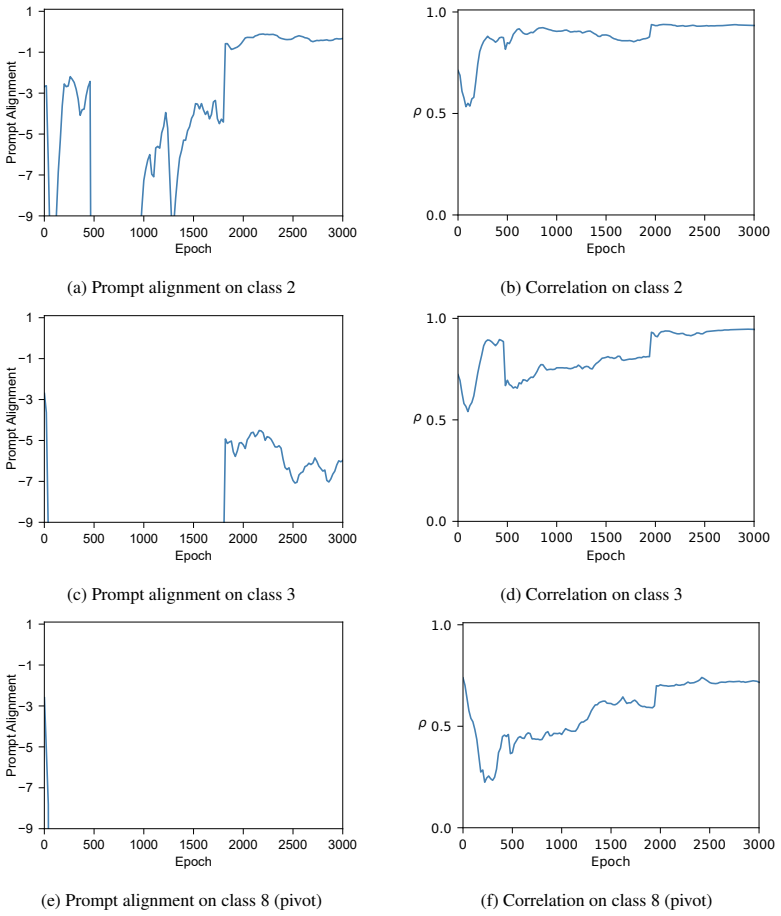
- [Section 5 and Appendix A.1] The claim that 'the sampled unlearned models effectively achieve zero performance on forget sets' is not supported by the sampling distribution. Appendix A.1 states that the authors save the model with the lowest forget accuracy and highest retain accuracy among all sampled models, and only those selected models are reported in Tables 1–4. Figures 3–4 show that non-selected samples span 0–100% forget accuracy, and Table 5 reports prompt alignment values as low as −10.7378. The paper does not report the number of samples drawn per forget set or the mean/median forget accuracy of the sampler, so the reported zero accuracy is a property of the selection rule, not of typical samples.
- [Appendix A.1 and Section 5] The evaluation is circular: the reported success metric (zero forget accuracy, high retain accuracy) is exactly the criterion used to select the 'best unlearned model.' Because the selection step is part of the evaluation pipeline, the Tables 1–4 results are not an independent test of the generator's unlearning capability. The paper should report the distribution of forget/retain accuracies over all sampled models, and specify how many samples were drawn, before claiming that the method 'samples unlearned models.'
- [Section 5 and Table 3] The statement that 'the obtained MIA scores for all sampled unlearned models are very close to the retrained models' is contradicted by Table 3. For MNIST-4 with Df={2}, DiHyFo-1 samples have MIA 0.6260, versus 0.4171 for the retrained model; for Df={2,3}, the gap is 0.6484 versus 0.3398. These are large gaps on a scale where lower is better, indicating that the selected models may leak more information about the forget set than retraining would, which is a central privacy claim of the paper.
- [Section 6 and Abstract] The paper's own limitation statement that 'the generative model retains the knowledge of forget sets' is in direct tension with the abstract's claim of 'targeted data removal' and Section 5's assertion that the sampled models 'no longer rely on the associated data to make predictions.' At best, the method achieves a behavioral state at the level of the sampled classifier parameters, not removal of data influence from the generative model. The claims should be narrowed accordingly to avoid overstating the unlearning guarantee.
- [Sections 4–5] The evaluation does not compare against any existing approximate unlearning method (e.g., fine-tuning on retain set, gradient ascent on forget set, or a competent-teacher baseline). The only baseline is retraining from scratch. Without such comparisons, the claimed benefits of HyperForget—such as speed, adaptability, and robustness relative to the state of the art—are not established. Adding at least one such baseline is necessary to support the positioning of the method.
minor comments (5)
- [Figure 2 captions] The captions use 'Dihyfo-1' and 'Dihyfo-2'; for consistency with the text, these should be 'DiHyFo-1' and 'DiHyFo-2'.
- [Equation 3] The notation C_increase and C_minimize is used without a formal definition; please define these as subsets of classes in the text.
- [Abstract] The sentence 'we implement two Diffusion HyperForget Networks and used them to sample...' mixes tenses; consider revising to 'use them' for a methods description.
- [Appendix A.2, Table 5] Table 5 reports prompt alignment and correlation for 24 models, but the paper does not state how many models were sampled in total or the selection pool size; including this context would help interpret the averages.
- [Appendix A.1] The phrase 'with zeros across all entries' in the discussion of confusion matrices is ambiguous; clarify that these are zero rows/columns corresponding to the forgotten classes.
Circularity Check
Zero-forget claim is the best-of-N selection criterion from Appendix A.1, not a property of the sampler; Tables 1-4 inherit that selection.
-
fitted input called prediction
[Appendix A.1 (selection procedure); Section 5 'Unlearning Performance' and Tables 1-4]
"We save the sampled model that obtains the lowest average accuracy on the forget set while obtaining the highest possible average accuracy on the retain set (best unlearned model). ... Table 1 shows that all the sampled unlearned models achieved zero accuracy on the forget sets and maintain a good accuracy on the retain sets, comparable to the retrained models."
The central reported result (zero accuracy on Df) is the exact selection objective used to pick the 'best unlearned model' from a pool of samples. Choosing the sample with the lowest forget-set accuracy forces, or at least strongly biases, the reported minimum; Figures 3-4 show the underlying sampled models span roughly 0-100% forget accuracy, so zero is the lower envelope of the sampling distribution, not a typical outcome. The subsequent output-overlap, JSD, and MIA numbers are also computed only on this selected model, so they inherit the selection. Thus the headline claim that 'sampled unlearned models effectively achieve zero performance' reduces, by construction, to the Appendix A.1 selection rule rather than being an independent property of the sampler.
full rationale
The paper's core unlearning evaluation is partially circular: Appendix A.1 explicitly saves the sampled model with the lowest forget accuracy, and Section 5 reports zero forget accuracy as the method's achievement. Since the success metric equals the selection criterion, the zero-forget table values are forced by selection rather than independently established. The retain-accuracy, MIA, and JSD comparisons retain some independent content but are computed only on the selected model, so they do not rescue the typical-sample claim; Section 6's concession that the generative model retains forget-set knowledge further separates the behavioral zero-accuracy state from actual removal. I found no load-bearing self-citation or uniqueness-import circularity: G.pt and diffusion methods are cited from external authors, and the diffusion-hypernetwork design is a genuine architectural contribution. Score 6 reflects one central 'prediction' that reduces by construction, while the framework itself is not purely definitional.
Assumptions & free parameters
free parameters (4)
- pivot accuracy threshold gamma =
80
- number of pivot classes r =
2 (MNIST-4), 5 (MNIST)
- checkpoint bin capacities and loss bin edges =
unspecified
- checkpoint random selection rate =
unspecified
assumptions (3)
- domain assumption High loss on a class is a valid stand-in for forgetting that class; low loss on a class preserves its capabilities.
- domain assumption A diffusion model trained on checkpoints of models that saw the forget classes can generate parameters that behave like a model trained without the forget classes.
- domain assumption The checkpoint dataset covers the target loss space well enough that conditioning on arbitrary target loss vectors yields valid parameters.
invented entities (1)
-
Diffusion HyperForget Networks (DiHyFo-1 and DiHyFo-2)
Cite this review
Pith. "Pith review of Learning to Forget using Hypernetworks." pith.science (2026). https://pith.science/paper/VFDETN47
@misc{pith2026241200761,
  author       = {Pith},
  title        = {Pith review of: Learning to Forget using Hypernetworks},
  year         = {2026},
  howpublished = {\url{https://pith.science/paper/VFDETN47}},
  note         = {Machine review of arXiv:2412.00761}
}
read the original abstract
Machine unlearning is gaining increasing attention as a way to remove adversarial data poisoning attacks from already trained models and to comply with privacy and AI regulations. The objective is to unlearn the effect of undesired data from a trained model while maintaining performance on the remaining data. This paper introduces HyperForget, a novel machine unlearning framework that leverages hypernetworks - neural networks that generate parameters for other networks - to dynamically sample models that lack knowledge of targeted data while preserving essential capabilities. Leveraging diffusion models, we implement two Diffusion HyperForget Networks and used them to sample unlearned models in Proof-of-Concept experiments. The unlearned models obtained zero accuracy on the forget set, while preserving good accuracy on the retain sets, highlighting the potential of HyperForget for dynamic targeted data removal and a promising direction for developing adaptive machine unlearning algorithms.
Figures


Figures from the paper (28 more)






Reference graph
Works this paper leans on
-
[1]
Machine unlearning: Linear filtration for logit-based classifiers
Thomas Baumhauer, Pascal Schöttle, and Matthias Zeppelzauer. Machine unlearning: Linear filtration for logit-based classifiers. Machine Learning, 111(9):3203–3226, 2022
work page 2022
-
[2]
Choquette-Choo, Hengrui Jia, Adelin Travers, Baiwu Zhang, David Lie, and Nicolas Papernot
Lucas Bourtoule, Varun Chandrasekaran, Christopher A. Choquette-Choo, Hengrui Jia, Adelin Travers, Baiwu Zhang, David Lie, and Nicolas Papernot. Machine unlearning. In Proceedings - 2021 IEEE Symposium on Security and Privacy, SP 2021, Proceedings - IEEE Symposium on Security and Privacy, pages 141–159. Institute of Electrical and Electronics Engineers Inc., 2021
work page 2021
-
[3]
Machine unlearning for random forests
Jonathan Brophy and Daniel Lowd. Machine unlearning for random forests. In International Conference on Machine Learning, pages 1092–1104. PMLR, 2021
work page 2021
-
[4]
Towards making systems forget with machine unlearning
Yinzhi Cao and Junfeng Yang. Towards making systems forget with machine unlearning. In 2015 IEEE symposium on security and privacy, pages 463–480. IEEE, 2015
2015
-
[5]
Poisoning web-scale training datasets is practical
Nicholas Carlini, Matthew Jagielski, Christopher A Choquette-Choo, Daniel Paleka, Will Pearce, Hyrum Anderson, Andreas Terzis, Kurt Thomas, and Florian Tramèr. Poisoning web-scale training datasets is practical. In 2024 IEEE Symposium on Security and Privacy (SP), pages 175–175. IEEE Computer Society, 2024
work page 2024
-
[6]
A brief review of hypernetworks in deep learning
Vinod Kumar Chauhan, Jiandong Zhou, Ping Lu, Soheila Molaei, and David A Clifton. A brief review of hypernetworks in deep learning. arXiv preprint arXiv:2306.06955, 2023
arXiv 2023
-
[7]
Can bad teaching induce forgetting? unlearning in deep networks using an incompetent teacher
Vikram S Chundawat, Ayush K Tarun, Murari Mandal, and Mohan Kankanhalli. Can bad teaching induce forgetting? unlearning in deep networks using an incompetent teacher. In Proceedings of the AAAI Conference on Artificial Intelligence, 2023
work page 2023
-
[8]
Zero-shot machine unlearning
Vikram S Chundawat, Ayush K Tarun, Murari Mandal, and Mohan Kankanhalli. Zero-shot machine unlearning. IEEE Transactions on Information Forensics and Security, 18:2345–2354, 2023
2023
Show all 59 references
-
[9]
Davis and Yi Zhong
Ronald L. Davis and Yi Zhong. The biology of forgetting—a perspective. Neuron, 95(3):490–503, 2017
2017
-
[10]
Hyperdiffusion: Generating implicit neural fields with weight-space diffusion
Ziya Erkoç, Fangchang Ma, Qi Shan, Matthias Nießner, and Angela Dai. Hyperdiffusion: Generating implicit neural fields with weight-space diffusion. InProceedings of the IEEE/CVF international conference on computer vision, pages 14300–14310, 2023
2023
-
[11]
European Commission. Regulation of the european parliament and of the council laying down harmonised rules on artificial intelligence, amending regulations and directives (artificial intelligence act), 2024. Accessed: 2024-08-11
2024
-
[12]
An information theoretic approach to machine unlearning, 2024
Jack Foster, Kyle Fogarty, Stefan Schoepf, Cengiz Öztireli, and Alexandra Brintrup. An information theoretic approach to machine unlearning, 2024
2024
-
[13]
Fast machine unlearning without retraining through selective synaptic dampening
Jack Foster, Stefan Schoepf, and Alexandra Brintrup. Fast machine unlearning without retraining through selective synaptic dampening. In Proceedings of the AAAI Conference on Artificial Intelligence, 2024
2024
-
[14]
Making ai forget you: Data deletion in machine learning
Antonio Ginart, Melody Guan, Gregory Valiant, and James Y Zou. Making ai forget you: Data deletion in machine learning. Advances in neural information processing systems, 32, 2019
2019
-
[15]
Evaluating inexact unlearning requires revisiting forgetting
Shashwat Goel, Ameya Prabhu, and Ponnurangam Kumaraguru. Evaluating inexact unlearning requires revisiting forgetting. CoRR abs/2201.06640, 2022
2022 arXiv
-
[16]
Corrective machine unlearning
Shashwat Goel, Ameya Prabhu, Philip Torr, Ponnurangam Kumaraguru, and Amartya Sanyal. Corrective machine unlearning. Transactions on Machine Learning Research, 2024
2024
-
[17]
Eternal sunshine of the spotless net: Selective forgetting in deep networks
Aditya Golatkar, Alessandro Achille, and Stefano Soatto. Eternal sunshine of the spotless net: Selective forgetting in deep networks. In Proceedings of the IEEE/CVF Conference on Computer Vision and Pattern Recognition, pages 9304–9312, 2020
2020
-
[18]
Amnesiac machine learning
Laura Graves, Vineel Nagisetty, and Vijay Ganesh. Amnesiac machine learning. In Proceedings of the AAAI Conference on Artificial Intelligence, 2021
2021
-
[19]
Certified data removal from machine learning models
Chuan Guo, Tom Goldstein, Awni Hannun, and Laurens Van Der Maaten. Certified data removal from machine learning models. arXiv preprint arXiv:1911.03030, 2019
1911 arXiv
-
[20]
Hypernetworks
David Ha, Andrew Dai, and Quoc V Le. Hypernetworks. arXiv preprint arXiv:1609.09106, 2016
2016 arXiv
-
[21]
Deepobliviate: a powerful charm for erasing data residual memory in deep neural networks
Yingzhe He, Guozhu Meng, Kai Chen, Jinwen He, and Xingbo Hu. Deepobliviate: a powerful charm for erasing data residual memory in deep neural networks. arXiv preprint arXiv:2105.06209, 2021. 7
2021 arXiv
-
[22]
Denoising diffusion probabilistic models
Jonathan Ho, Ajay Jain, and Pieter Abbeel. Denoising diffusion probabilistic models. Advances in neural information processing systems, 33:6840–6851, 2020
2020
-
[23]
Predictive uncertainty quantification with compound density networks
Agustinus Kristiadi, Sina Däubener, and Asja Fischer. Predictive uncertainty quantification with compound density networks. arXiv preprint arXiv:1902.01080, 2019
1902 arXiv
-
[24]
Towards unbounded machine unlearning
Meghdad Kurmanji, Peter Triantafillou, Jamie Hayes, and Eleni Triantafillou. Towards unbounded machine unlearning. Advances in neural information processing systems, 36, 2024
2024
-
[25]
Dhp: Differentiable meta pruning via hypernetworks
Yawei Li, Shuhang Gu, Kai Zhang, Luc Van Gool, and Radu Timofte. Dhp: Differentiable meta pruning via hypernetworks. In Computer Vision–ECCV 2020: 16th European Conference, Glasgow, UK, August 23–28, 2020, Proceedings, Part VIII 16, pages 608–624. Springer, 2020
2020
-
[26]
The heterogeneity hypothesis: Finding layer-wise differentiated network architectures
Yawei Li, Wen Li, Martin Danelljan, Kai Zhang, Shuhang Gu, Luc Van Gool, and Radu Timofte. The heterogeneity hypothesis: Finding layer-wise differentiated network architectures. In Proceedings of the IEEE/CVF Conference on Computer Vision and Pattern Recognition, pages 2144–2153, 2021
2021
-
[27]
Text-to-model: Text-conditioned neural network diffusion for train-once-for-all personalization
Zexi Li, Lingzhi Gao, and Chao Wu. Text-to-model: Text-conditioned neural network diffusion for train-once-for-all personalization. arXiv preprint arXiv:2405.14132, 2024
2024 arXiv
-
[28]
Rethinking machine unlearning for large language models
Sijia Liu, Yuanshun Yao, Jinghan Jia, Stephen Casper, Nathalie Baracaldo, Peter Hase, Xiaojun Xu, Yuguang Yao, Hang Li, Kush R Varshney, et al. Rethinking machine unlearning for large language models. arXiv preprint arXiv:2402.08787, 2024
2024 arXiv
-
[29]
Decoupled weight decay regularization
Ilya Loshchilov and Frank Hutter. Decoupled weight decay regularization. arXiv preprint arXiv:1711.05101, 2017
2017 arXiv
-
[30]
Parameter-efficient multi-task fine-tuning for transformers via shared hypernetworks
Rabeeh Karimi Mahabadi, Sebastian Ruder, Mostafa Dehghani, and James Henderson. Parameter-efficient multi-task fine-tuning for transformers via shared hypernetworks. arXiv preprint arXiv:2106.04489, 2021
2021 arXiv
-
[31]
Hard to forget: Poisoning attacks on certified machine unlearning
Neil G Marchant, Benjamin IP Rubinstein, and Scott Alfeld. Hard to forget: Poisoning attacks on certified machine unlearning. In Proceedings of the AAAI Conference on Artificial Intelligence, 2022
2022
-
[32]
Zero-shot knowledge transfer via adversarial belief matching.Advances in Neural Information Processing Systems, 32, 2019
Paul Micaelli and Amos J Storkey. Zero-shot knowledge transfer via adversarial belief matching.Advances in Neural Information Processing Systems, 32, 2019
2019
-
[33]
Forgetting as a consequence of retrieval: a meta-analytic review of retrieval-induced forgetting
Kou Murayama, Toshiya Miyatsu, Dorothy Buchli, and Benjamin C Storm. Forgetting as a consequence of retrieval: a meta-analytic review of retrieval-induced forgetting. Psychological bulletin, 140(5):1383, 2014
2014
-
[34]
Feder Cooper, Daphne Ippolito, Christopher A
Milad Nasr, Nicholas Carlini, Jonathan Hayase, Matthew Jagielski, A. Feder Cooper, Daphne Ippolito, Christopher A. Choquette-Choo, Eric Wallace, Florian Tramèr, and Katherine Lee. Scalable extraction of training data from (production) language models. ArXiv, 2023
2023
-
[35]
A survey of machine unlearning
Thanh Tam Nguyen, Thanh Trung Huynh, Phi Le Nguyen, Alan Wee-Chung Liew, Hongzhi Yin, and Quoc Viet Hung Nguyen. A survey of machine unlearning. arXiv preprint arXiv:2209.02299, 2022
2022 arXiv
-
[36]
Cvae-h: Conditionalizing variational autoencoders via hypernetworks and trajectory forecasting for autonomous driving
Geunseob Oh and Huei Peng. Cvae-h: Conditionalizing variational autoencoders via hypernetworks and trajectory forecasting for autonomous driving. arXiv preprint arXiv:2201.09874, 2022
2022 arXiv
-
[37]
Learning to learn with generative models of neural network checkpoints
William Peebles, Ilija Radosavovic, Tim Brooks, Alexei Efros, and Jitendra Malik. Learning to learn with generative models of neural network checkpoints. ArXiv, 2022
2022
-
[38]
Scalable diffusion models with transformers
William Peebles and Saining Xie. Scalable diffusion models with transformers. In Proceedings of the IEEE/CVF International Conference on Computer Vision, pages 4195–4205, 2023
2023
-
[39]
Adversarial attacks and defenses in deep learning
Kui Ren, Tianhang Zheng, Zhan Qin, and Xue Liu. Adversarial attacks and defenses in deep learning. Engineering, 6(3):346–360, 2020
2020
-
[40]
On linear identifiability of learned representations
Geoffrey Roeder, Luke Metz, and Durk Kingma. On linear identifiability of learned representations. In International Conference on Machine Learning, pages 9030–9039. PMLR, 2021
2021
-
[41]
Potion: Towards poison unlearning
Stefan Schoepf, Jack Foster, and Alexandra Brintrup. Potion: Towards poison unlearning. arXiv preprint arXiv:2406.09173, 2024
2024 arXiv
-
[42]
Self-supervised representation learning on neural network weights for model characteristic prediction
Konstantin Schürholt, Dimche Kostadinov, and Damian Borth. Self-supervised representation learning on neural network weights for model characteristic prediction. Advances in Neural Information Processing Systems, 34:16481–16493, 2021. 8
2021
-
[43]
Remember what you want to forget: Algorithms for machine unlearning
Ayush Sekhari, Jayadev Acharya, Gautam Kamath, and Ananda Theertha Suresh. Remember what you want to forget: Algorithms for machine unlearning. Advances in Neural Information Processing Systems, 34:18075–18086, 2021
2021
-
[44]
The seven sins of Personal-Data processing systems under GDPR
Supreeth Shastri, Melissa Wasserman, and Vijay Chidambaram. The seven sins of Personal-Data processing systems under GDPR. In 11th USENIX Workshop on Hot Topics in Cloud Computing (HotCloud 19) , Renton, W A, 2019. USENIX Association
2019
-
[45]
forgetting
Alyssa Shuang Sha, Bernardo Pereira Nunes, and Armin Haller. " forgetting" in machine learning and beyond: A survey. arXiv e-prints, pages arXiv–2405, 2024
2024
-
[46]
Deep unsupervised learning using nonequilibrium thermodynamics
Jascha Sohl-Dickstein, Eric Weiss, Niru Maheswaranathan, and Surya Ganguli. Deep unsupervised learning using nonequilibrium thermodynamics. In International conference on machine learning, pages 2256–2265. PMLR, 2015
2015
-
[47]
Score-based generative modeling through stochastic differential equations
Yang Song, Jascha Sohl-Dickstein, Diederik P Kingma, Abhishek Kumar, Stefano Ermon, and Ben Poole. Score-based generative modeling through stochastic differential equations. arXiv preprint arXiv:2011.13456, 2020
2011 arXiv
-
[48]
Fast yet effective machine unlearning
Ayush K Tarun, Vikram S Chundawat, Murari Mandal, and Mohan Kankanhalli. Fast yet effective machine unlearning. IEEE Transactions on Neural Networks and Learning Systems, 2023
2023
-
[49]
Unrolling sgd: Understanding factors influencing machine unlearning
Anvith Thudi, Gabriel Deza, Varun Chandrasekaran, and Nicolas Papernot. Unrolling sgd: Understanding factors influencing machine unlearning. 2022 IEEE 7th European Symposium on Security and Privacy (EuroS&P), pages 303–319, 2021
2022
-
[50]
Unrolling sgd: Understanding factors influencing machine unlearning
Anvith Thudi, Gabriel Deza, Varun Chandrasekaran, and Nicolas Papernot. Unrolling sgd: Understanding factors influencing machine unlearning. In 2022 IEEE 7th European Symposium on Security and Privacy (EuroS&P), pages 303–319. IEEE, 2022
2022
-
[51]
The eu general data protection regulation (gdpr)
Paul V oigt and Axel V on dem Bussche. The eu general data protection regulation (gdpr). A Practical Guide, 1st Ed., Cham: Springer International Publishing, 10(3152676):10–5555, 2017
2017
-
[52]
Example-based hypernetworks for out-of-distribution generalization
Tomer V olk, Eyal Ben-David, Ohad Amosy, Gal Chechik, and Roi Reichart. Example-based hypernetworks for out-of-distribution generalization. arXiv preprint arXiv:2203.14276, 2022
2022 arXiv
-
[53]
Continual learning with hypernetworks
Johannes V on Oswald, Christian Henning, Benjamin F Grewe, and João Sacramento. Continual learning with hypernetworks. arXiv preprint arXiv:1906.00695, 2019
1906 arXiv
-
[54]
Neural network diffusion
Kaili Wang, Zhaopan Xu, Yukun Zhou, Zelin Zang, Trevor Darrell, Zhuang Liu, and Yang You. Neural network diffusion. ArXiv, 2024
2024
-
[55]
Machine unlearning: A comprehensive survey
Weiqi Wang, Zhiyi Tian, and Shui Yu. Machine unlearning: A comprehensive survey. arXiv preprint arXiv:2405.07406, 2024
2024 arXiv
-
[56]
Few-shot unlearning by model inversion
Youngsik Yoon, Jinhwan Nam, Hyojeong Yun, Jaeho Lee, Dongwoo Kim, and Jungseul Ok. Few-shot unlearning by model inversion. arXiv preprint arXiv:2205.15567, 2022
2022 arXiv
-
[57]
Right to be forgotten in the era of large language models: Implications, challenges, and solutions
Dawen Zhang, Pamela Finckenberg-Broman, Thong Hoang, Shidong Pan, Zhenchang Xing, Mark Staples, and Xiwei Xu. Right to be forgotten in the era of large language models: Implications, challenges, and solutions. arXiv preprint arXiv:2307.03941, 2023
2023 arXiv
-
[58]
A review on machine unlearning
Haibo Zhang, Toru Nakamura, Takamasa Isohara, and Kouichi Sakurai. A review on machine unlearning. SN Computer Science, 4(4):337, 2023. 9 A Appendix / supplemental material This appendix provides additional information on the technical details and methods behind the proposed h...
2023
-
[59]
A.4 Additional details on evaluation metrics Each model must be evaluated on two key aspects
(5) The task of DiHyFo-2 is to predict the distribution of parameters that achieve the desired losses conditioned directly on them, reducing all previous expressions to this simpler conditioning. A.4 Additional details on evaluation metrics Each model must be evaluated on two ...
2000
Reviewed August 12, 2026 · model on record in the stance chip above.
Discussion (0). Continue with ORCID to comment.