Frankenstein in the Pipeline: Computational Epistemicide in Facial Recognition
Pith reviewed 2026-06-28 17:57 UTC · model grok-4.3
The pith
Facial recognition pipelines enact computational epistemicide by replacing living faces with numerical proxies.
A machine-rendered reading of the paper's core claim, the machinery that carries it, and where it could break.
Core claim
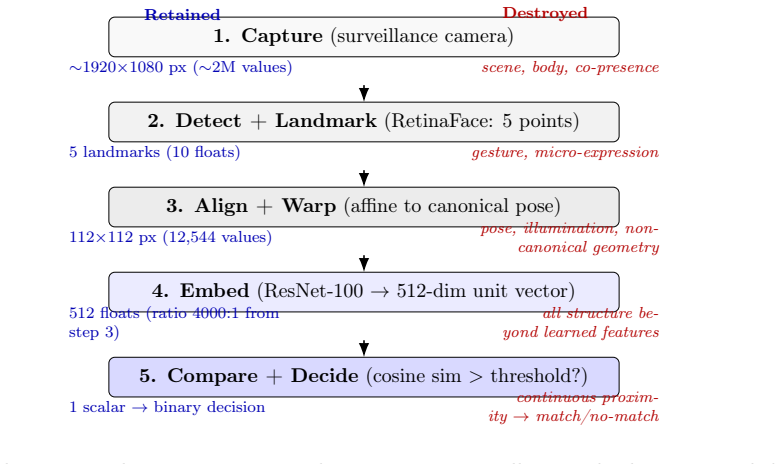
Embedding-based facial recognition enacts computational epistemicide by destroying the face as a living, relational surface and authorizing a numerical proxy as the privileged site of identity. Across detection/cropping, landmarking, alignment/frontalization, and embedding, the face is progressively narrowed to what can be stabilized as data, producing a canonical face as the condition of legibility and a corresponding form-subject as the condition of recognition. Vectorization completes the Frankensteinian stitching by reassembling the dissected face into a fixed-dimensional artifact designed to circulate across databases and institutions, while distance-based similarity and thresholding op
What carries the argument
computational epistemicide: the extension of epistemicide to the computational domain through progressive pipeline stages that destroy the living face and authorize a numerical proxy.
If this is right
- Recognition becomes inseparable from standardization through distance-based similarity and thresholding.
- Reformist ethical AI optimizations are structurally insufficient because they operate within the same reduction process.
- Abolition is required as a normative stance that refuses vectorized identity as a basis for rights and access.
- Institutional governance of human life through dissectible data points must be dismantled.
Where Pith is reading between the lines
- The same narrowing mechanism may apply to other biometric pipelines that convert bodies into embeddable vectors.
- If the claim holds, technical interventions that keep the pipeline intact cannot restore the relational face.
- The Frankenstein framing suggests examining other AI systems for analogous disassembly-reconstruction patterns that create governable artifacts.
Load-bearing premise
The operational stages of the facial recognition pipeline inherently perform epistemic violence by reducing the face to data rather than serving as neutral technical steps.
What would settle it
Showing that any pipeline stage can maintain the living relational surface of the face without narrowing it to a stabilized canonical data form would falsify the claim.
Figures
read the original abstract
While the eugenic roots of computer vision are well-documented in critical technology studies, less attention has been paid to the operational mechanisms through which this violence is enacted at the level of the pipeline. This paper employs Mary Shelley's Frankenstein not as a metaphor for unintended consequences, but as a diagnostic framework for method: disassembly, reconstruction, and the production of a creature whose legitimacy is asserted by the procedure that made it. I argue that embedding-based facial recognition enacts what I call computational epistemicide, an extension of Sueli Carneiro's concept of epistemicide to the computational domain - by destroying the face as a living, relational surface and authorizing a numerical proxy as the privileged site of identity. Across detection/cropping, landmarking, alignment/frontalization, and embedding, the face is progressively narrowed to what can be stabilized as data, producing a canonical face as the condition of legibility and a corresponding form-subject as the condition of recognition. Vectorization completes the Frankensteinian "stitching": the dissected face is reassembled into a fixed-dimensional artifact designed to circulate across databases and institutions. I then show how distance-based similarity and thresholding operationalize a norm of "close enough," making recognition inseparable from standardization and rendering reformist "ethical AI" optimization structurally insufficient. The paper concludes by arguing for abolition as a normative stance: refusing vectorized identity as a legitimate basis for rights and access, and dismantling the institutional impulse to govern human life through dissectible data points.
Editorial analysis
A structured set of objections, weighed in public.
Referee Report
Summary. The paper claims that embedding-based facial recognition pipelines enact 'computational epistemicide'—an extension of epistemicide to computation—by progressively reducing the face from a living relational surface to a stabilized numerical proxy through stages of detection/cropping, landmarking, alignment/frontalization, embedding, and vectorization. Drawing on Mary Shelley's Frankenstein as a diagnostic method rather than metaphor, it argues that these operations produce a canonical 'form-subject' as the condition of recognition, that distance-based similarity and thresholding render recognition inseparable from standardization, and that this makes reformist 'ethical AI' approaches structurally insufficient, warranting an abolitionist stance that refuses vectorized identity as a basis for rights and access.
Significance. If the interpretive mapping holds, the paper contributes a method-focused diagnostic to critical technology studies by linking specific pipeline operations to normative claims about epistemic violence, extending existing work on eugenic roots of computer vision into operational mechanisms. It offers no empirical data, formal derivations, or falsifiable predictions, so its significance rests entirely on acceptance of its philosophical premises about the face and data reduction.
major comments (3)
- [Abstract] Abstract: the definition of computational epistemicide is constructed directly from the described pipeline operations (disassembly, reconstruction, vectorization), after which the paper concludes that the pipeline enacts epistemicide; the central claim therefore follows tautologically from the chosen framing rather than from independent evidence or derivation.
- [Abstract] Abstract and concluding sections: the claim that operational stages inherently enact epistemic violence by narrowing the face to stabilized data treats this reduction as constitutive of violence by definition, without addressing whether the same technical steps could be neutral or context-dependent; this assumption is load-bearing for the argument that reform is structurally insufficient.
- [Abstract] Abstract: the argument equates description of technical steps (detection/cropping through vectorization) with normative violence without empirical data on actual recognition outcomes, formal modeling of the pipeline, or testable predictions, leaving the mapping from Frankenstein framework to pipeline stages as an interpretive assertion rather than a demonstrated result.
minor comments (2)
- The manuscript would benefit from explicit section headings and numbered subsections to improve navigation between the Frankenstein diagnostic, the pipeline stages, and the abolitionist conclusion.
- [Abstract] Clarify whether 'computational epistemicide' is intended as a new technical term with a precise definition or as a rhetorical extension; the current presentation blends both without distinguishing them.
Simulated Author's Rebuttal
We thank the referee for their engagement with the manuscript. Our response addresses each major comment in turn, clarifying the paper's theoretical and interpretive approach within critical technology studies. The argument relies on extending established concepts of epistemicide and employing Frankenstein as a diagnostic method, rather than offering empirical claims.
read point-by-point responses
-
Referee: [Abstract] Abstract: the definition of computational epistemicide is constructed directly from the described pipeline operations (disassembly, reconstruction, vectorization), after which the paper concludes that the pipeline enacts epistemicide; the central claim therefore follows tautologically from the chosen framing rather than from independent evidence or derivation.
Authors: The definition of computational epistemicide is not derived solely from the pipeline but extends Sueli Carneiro's prior concept of epistemicide to computational processes, building on documented eugenic roots of computer vision in critical technology studies. The pipeline stages are analyzed through this pre-existing framework to identify specific mechanisms of reduction. This constitutes an application of the diagnostic method rather than circular reasoning. The central claim follows from the theoretical premises, which are stated explicitly in the introduction. revision: no
-
Referee: [Abstract] Abstract and concluding sections: the claim that operational stages inherently enact epistemic violence by narrowing the face to stabilized data treats this reduction as constitutive of violence by definition, without addressing whether the same technical steps could be neutral or context-dependent; this assumption is load-bearing for the argument that reform is structurally insufficient.
Authors: The Frankenstein diagnostic frames these operations as producing a canonical form-subject whose legitimacy derives from the procedure itself, rendering the reduction non-neutral within embedding-based pipelines. While isolated technical steps might be repurposed, the paper demonstrates that distance-based similarity and thresholding make recognition inseparable from standardization in this context. This supports the structural insufficiency of reformist approaches without claiming the steps are universally violent across all possible uses. revision: no
-
Referee: [Abstract] Abstract: the argument equates description of technical steps (detection/cropping through vectorization) with normative violence without empirical data on actual recognition outcomes, formal modeling of the pipeline, or testable predictions, leaving the mapping from Frankenstein framework to pipeline stages as an interpretive assertion rather than a demonstrated result.
Authors: The manuscript is explicitly positioned as a contribution to critical technology studies, employing an interpretive philosophical method rather than empirical testing or formal modeling. The mapping from the Frankenstein framework to pipeline stages is presented as interpretive by design, consistent with the field's reliance on conceptual analysis to diagnose normative implications. As the referee notes, the paper offers no empirical data or predictions, which aligns with its stated scope and does not require alteration. revision: no
Circularity Check
Computational epistemicide defined via pipeline reduction then applied to conclude pipeline enacts it
specific steps
-
self definitional
[Abstract]
"I argue that embedding-based facial recognition enacts what I call computational epistemicide, an extension of Sueli Carneiro's concept of epistemicide to the computational domain - by destroying the face as a living, relational surface and authorizing a numerical proxy as the privileged site of identity. Across detection/cropping, landmarking, alignment/frontalization, and embedding, the face is progressively narrowed to what can be stabilized as data, producing a canonical face as the condition of legibility and a corresponding form-subject as the condition of recognition."
Computational epistemicide is defined as the process of destroying the face and authorizing a numerical proxy; the pipeline is then described as enacting exactly this progressive narrowing to stabilized data. The claim that the pipeline enacts epistemicide therefore holds by construction of the definition rather than independent derivation.
full rationale
The paper's argument is interpretive rather than a technical derivation with equations or falsifiable predictions. Its central claim defines computational epistemicide explicitly as the destruction of the living face and authorization of a numerical proxy, then describes the pipeline stages as performing precisely that narrowing to stabilized data. This makes the conclusion that the pipeline enacts epistemicide follow directly from the framing chosen, fitting the self-definitional pattern. No equations, fitted parameters, self-citation chains, or uniqueness theorems are present. The remainder of the argument (Frankenstein diagnostic, abolition stance) is philosophical framing without additional circular reductions.
Axiom & Free-Parameter Ledger
axioms (2)
- ad hoc to paper The face functions as a living, relational surface whose reduction to stabilized data constitutes epistemic violence
- domain assumption Frankenstein's disassembly-reconstruction process serves as a valid diagnostic for the operational mechanisms of embedding-based facial recognition
invented entities (1)
-
computational epistemicide
no independent evidence
Reference graph
Works this paper leans on
-
[1]
Polity, 2019
Ruha Benjamin.Race After Technology: Abolitionist Tools for the New Jim Code. Polity, 2019
2019
-
[2]
University of Pennsylvania Press, 2020
Eileen Hunt Botting.Artificial Life After Frankenstein. University of Pennsylvania Press, 2020
2020
-
[3]
Duke University Press, 2015
Simone Browne.Dark Matters: On the Surveillance of Blackness. Duke University Press, 2015
2015
-
[4]
Gender shades: Intersectional accuracy disparities in commercial gender classification
Joy Buolamwini and Timnit Gebru. Gender shades: Intersectional accuracy disparities in commercial gender classification. InProceedings of Machine Learning Research, volume 81, pages 1–15, 2018
2018
-
[5]
PhD thesis, Universidade de São Paulo, 2005
Sueli Carneiro.A construção do outro como não-ser como fundamento do ser. PhD thesis, Universidade de São Paulo, 2005
2005
-
[6]
Fair prediction with disparate impact: A study of bias in recidivism prediction instruments
Alexandra Chouldechova. Fair prediction with disparate impact: A study of bias in recidivism prediction instruments.arXiv preprint arXiv:1610.07524, 2016. doi: 10.48550/arXiv.1610. 07524. 14
work page internal anchor Pith review Pith/arXiv arXiv doi:10.48550/arxiv.1610 2016
-
[7]
MIT Press, 2021
Wendy Hui Kyong Chun.Discriminating Data: Correlation, Neighborhoods, and the New Politics of Recognition. MIT Press, 2021
2021
-
[8]
Yale University Press, 2021
Kate Crawford.Atlas of AI: Power, Politics, and the Planetary Costs of Artificial Intelligence. Yale University Press, 2021
2021
-
[9]
Contra a métrica do mundo.Stanford Social Innovation Review Brasil, 2025
Nina da Hora. Contra a métrica do mundo.Stanford Social Innovation Review Brasil, 2025. Edição Especial: Futuros possíveis (IA)
2025
-
[10]
Nina da Hora. Imagens que a máquina lê, mundos que ela apaga: notas sobre epistemicídio computacional.Arcos Design, 19(1), 2026. doi: 10.12957/arcosdesign.2026.95285
-
[11]
University of Minnesota Press, 2007
Denise Ferreira da Silva.Toward a Global Idea of Race. University of Minnesota Press, 2007
2007
-
[12]
Rout- ledge, 2014
Boaventura de Sousa Santos.Epistemologies of the South: Justice against Epistemicide. Rout- ledge, 2014
2014
-
[13]
Arcface: Additive angular marginlossfordeepfacerecognition
Jiankang Deng, Jia Guo, Niannan Xue, and Stefanos Zafeiriou. Arcface: Additive angular marginlossfordeepfacerecognition. InProceedings of the IEEE/CVF Conference on Computer Vision and Pattern Recognition (CVPR), 2019
2019
-
[14]
Retinaface: Single-shotmulti-levelfacelocalisationinthewild
Jiankang Deng, Jia Guo, Evangelos Ververas, Irene Kotsia, and Stefanos Zafeiriou. Retinaface: Single-shotmulti-levelfacelocalisationinthewild. InProceedings of the IEEE/CVF Conference on Computer Vision and Pattern Recognition (CVPR), pages 5203–5212, 2020
2020
-
[15]
Princeton Uni- versity Press, 2004
Joseph Dumit.Picturing Personhood: Brain Scans and Biomedical Identity. Princeton Uni- versity Press, 2004
2004
-
[16]
Cynthia Dwork, Moritz Hardt, Toniann Pitassi, Omer Reingold, and Richard Zemel
Cynthia Dwork, Moritz Hardt, Toniann Pitassi, Omer Reingold, and Richard Zemel. Fairness through awareness. InProceedings of the 3rd Innovations in Theoretical Computer Science Conference (ITCS ’12), pages 214–226. ACM, 2012. doi: 10.1145/2090236.2090255
-
[17]
Virginia Eubanks.Automating Inequality: How High-Tech Tools Profile, Police, and Punish the Poor. St. Martin’s Press, 2018
2018
-
[18]
Fisher.The Genetical Theory of Natural Selection
Ronald A. Fisher.The Genetical Theory of Natural Selection. Clarendon Press, 1930
1930
-
[19]
Continuum, 1996
Paulo Freire.Pedagogy of the Oppressed. Continuum, 1996. Original work published 1970
1996
-
[20]
Macmillan, 1883
Francis Galton.Inquiries into Human Faculty and Its Development. Macmillan, 1883
-
[21]
Gandy.The Panoptic Sort: A Political Economy of Personal Information
Oscar H. Gandy.The Panoptic Sort: A Political Economy of Personal Information. Westview Press, 1993
1993
-
[22]
The perpetual line-up: Unregulated police face recognition in america
Clare Garvie, Alvaro Bedoya, and Jonathan Frankle. The perpetual line-up: Unregulated police face recognition in america. Technical report, Center on Privacy & Technology, George- town Law, 2016. URLhttps://www.perpetuallineup.org/sites/default/files/2016-12/ The%20Perpetual%20Line-Up%20-%20Center%20on%20Privacy%20and%20Technology%20at% 20Georgetown%20Law...
2016
-
[23]
Datasheets for datasets.Communications of the ACM, 64(12):86–92, 2021
Timnit Gebru, Jamie Morgenstern, Briana Vecchione, Jennifer Wortman Vaughan, Hanna Wallach, Hal Daumé III, and Kate Crawford. Datasheets for datasets.arXiv preprint arXiv:1803.09010, 2018. doi: 10.48550/arXiv.1803.09010. 15
-
[24]
University of Michigan Press, 1997
Édouard Glissant.Poetics of Relation. University of Michigan Press, 1997. doi: 10.3998/mpub. 10257. Translated by Betsy Wing
-
[25]
Face recognition vendor test (frvt) part 3: Demographic effects
Patrick Grother, Mei Ngan, and Kayee Hanaoka. Face recognition vendor test (frvt) part 3: Demographic effects. Technical Report NISTIR 8280, National Institute of Standards and Technology, 2019
2019
-
[26]
Equality of opportunity in supervised learning
Moritz Hardt, Eric Price, and Nati Srebro. Equality of opportunity in supervised learning. InAdvances in Neural Information Processing Systems 29 (NeurIPS 2016), pages 3315–3323,
2016
-
[27]
doi: 10.48550/arXiv.1610.02413
work page internal anchor Pith review Pith/arXiv arXiv doi:10.48550/arxiv.1610.02413
-
[28]
Inherent trade-offs in the fair determination of risk scores
Jon Kleinberg, Sendhil Mullainathan, and Manish Raghavan. Inherent trade-offs in the fair determination of risk scores. In8th Innovations in Theoretical Computer Science Conference (ITCS 2017), volume 67 ofLeibniz International Proceedings in Informatics (LIPIcs), pages 43:1–43:23. Schloss Dagstuhl–Leibniz-Zentrum für Informatik, 2017
2017
-
[29]
MacKenzie.Statistics in Britain, 1865–1930: The Social Construction of Scientific Knowledge
Donald A. MacKenzie.Statistics in Britain, 1865–1930: The Social Construction of Scientific Knowledge. Edinburgh University Press, 1981
1930
-
[30]
Margaret Mitchell, Simone Wu, Andrew Zaldivar, Parker Barnes, Lucy Vasserman, Ben Hutchinson, Elena Spitzer, Inioluwa Deborah Raji, and Timnit Gebru. Model cards for model reporting. InProceedings of the Conference on Fairness, Accountability, and Transparency (FAT* ’19), pages 220–229. ACM, 2019. doi: 10.1145/3287560.3287596
-
[31]
New York University Press, 2018
Safiya Umoja Noble.Algorithms of Oppression: How Search Engines Reinforce Racism. New York University Press, 2018
2018
-
[32]
National life from the standpoint of science.The Eugenics Review, 1901
Karl Pearson. National life from the standpoint of science.The Eugenics Review, 1901
1901
-
[33]
Jean-Charles Rochet and Jean Tirole
Inioluwa Deborah Raji, Andrew Smart, Rebecca N. White, Margaret Mitchell, Timnit Ge- bru, Ben Hutchinson, Jamila Smith-Loud, Daniel Theron, and Parker Barnes. Closing the ai accountability gap: Defining an end-to-end framework for internal algorithmic auditing. In Proceedings of the 2020 Conference on Fairness, Accountability, and Transparency (FAT* ’20)....
-
[34]
Facenet: A unified embedding for face recognition and clustering
Florian Schroff, Dmitry Kalenichenko, and James Philbin. Facenet: A unified embedding for face recognition and clustering. InProceedings of the IEEE Conference on Computer Vision and Pattern Recognition (CVPR), 2015
2015
-
[35]
The body and the archive.October, 39:3–64, 1986
Allan Sekula. The body and the archive.October, 39:3–64, 1986
1986
-
[36]
Andrew D. Selbst, danah boyd, Sorelle A. Friedler, Suresh Venkatasubramanian, and Janet Vertesi. Fairness and abstraction in sociotechnical systems. InProceedings of the Conference on Fairness, Accountability, and Transparency (FAT* ’19), pages 59–68. ACM, 2019. doi: 10.1145/3287560.3287598
-
[37]
Penguin Classics, 1818
Mary Shelley.Frankenstein; or, The Modern Prometheus. Penguin Classics, 1818. Original work published 1818
-
[38]
Physiognomic artificial intelligence.Fordham Intellectual Prop- erty, Media & Entertainment Law Journal, 32(4):922–978, 2022
Luke Stark and Jevan Hutson. Physiognomic artificial intelligence.Fordham Intellectual Prop- erty, Media & Entertainment Law Journal, 32(4):922–978, 2022. 16
2022
-
[39]
Deepface: Closing the gap to human-level performance in face verification
Yaniv Taigman, Ming Yang, Marc’Aurelio Ranzato, and Lior Wolf. Deepface: Closing the gap to human-level performance in face verification. InProceedings of the IEEE Conference on Computer Vision and Pattern Recognition (CVPR), 2014
2014
-
[40]
Eve Tuck and K. Wayne Yang. Unbecoming claims: Pedagogies of refusal in qualitative re- search.Qualitative Inquiry, 20(6):811–818, 2014. doi: 10.1177/1077800414530265
-
[41]
Rapid object detection using a boosted cascade of simple features
Paul Viola and Michael Jones. Rapid object detection using a boosted cascade of simple features. InProceedings of the IEEE Conference on Computer Vision and Pattern Recognition (CVPR), 2001
2001
-
[42]
Sylvia Wynter. Unsettling the coloniality of being/power/truth/freedom: Towards the human, after man, its overrepresentation—an argument.CR: The New Centennial Review, 3(3):257– 337, 2003. doi: 10.1353/ncr.2004.0015
-
[43]
Physiognomy’s new clothes
Blaise Aguera y Arcas, Margaret Mitchell, and Alexander Todorov. Physiognomy’s new clothes. Medium, 2017
2017
-
[44]
Epistemologia insubmissa feminista negra decolonial.Tempo e Argumento, 12(29):1–24, 2020
Ângela Figueiredo. Epistemologia insubmissa feminista negra decolonial.Tempo e Argumento, 12(29):1–24, 2020. Generative AI Usage Statement No generative AI tools were used in the production of this manuscript. All substantive claims, technical descriptions, theoretical framing, and final wording were authored by the human author. Ethical Considerations Th...
2020
discussion (0)
Sign in with ORCID, Apple, or X to comment. Anyone can read and Pith papers without signing in.