REVIEW 3 major objections 5 minor 38 references
Representation Learning with Mutual Influence of Modalities for Node Classification in Multi-Modal Heterogeneous Networks
T0 review · 3 major / 5 minor · reviewed 2026-08-15 · deepseek-v4-flash
Pith's one-line read HGNN-IMA puts multi-modal fusion inside graph propagation, letting the similarity of two nodes on one modality adjust the attention weight on another, and reports consistent node-classification gains over early- and late-fusion baselines…
desk verdict A genuine nested-attention idea and solid ablation, but Eq 8 inverts the stated alignment mechanism and baseline variance reporting is thin. read the letter →
The pith
A machine-rendered reading of the paper's core claim, the machinery that carries it, and where it could break.
The reading
What carries the argument
The Cross-modal Influence Unit is the central object. For each node pair $(v_i, v_j)$, it computes per-modality similarity scores $g^{(k),m'}_{ij}$ using type-dependent linear projections and edge-type-dependent matrices, converts them into inter-node attention $\alpha^{(k),m'}_{ij}$, computes a second set of scores $s^{(k),m'}_{ij}$ with separate matrices $W^{\text{MODAL}}$, softmaxes over modalities to get inter-modal attention $\lambda^{(k),m'}_{ij}$, and forms the mixed attention $\beta^{(k)}_{ij} = \operatorname{softmax}_{j\in\mathcal{N}_i}\left(\sum_{m'} \lambda^{(k),m'}_{ij} \alpha^{(k),m'}_{ij}\right)$. This nested attention lets one modality's similarity gate another modality's propagation while keeping the parameter count moderate. Two auxiliary mechanisms carry the robustness claims: alignment modulation $\bar{\beta}^{(k)}_{ij}$, which uses the absolute pairwise differences of per-modality similarity scores to down-weight misaligned neighbors, and the attention loss $\mathcal{L}_{\text{att}}$, which penalizes inter-modal attention assigned to modalities a neighbor does not actually possess.
What would settle it
A reader could rerun the five comparisons with identical hyperparameter budgets for every method and many seeds, then form paired differences; if the proposed model's edge over the strongest baseline falls inside the pooled run-to-run noise—and the paper's own reported standard deviations already show HGT's DOUBAN spread (0.1261) far exceeding its reported gain—the claim of consistent superiority fails.
Extended reading notes
Core claim
The central claim is that category-oriented representation learning on multi-modal heterogeneous networks requires modalities to influence each other during information propagation, not only before it (early fusion) or after it (late fusion). Concretely, when a node aggregates messages from a neighbor on one modality, the aggregation weight should be built from similarity scores on all modalities, with each modality's contribution itself weighted by an attention score that depends on the two nodes' features. Within the heterogeneous graph transformer framework, HGNN-IMA computes per-modality inter-node attention $\alpha^{(k),m'}_{ij}$, learns a nested inter-modal attention $\lambda^{(k),m'}_{ij}$ over modalities for each node pair, and combines them into a single propagation weight $\beta^{(k)}_{ij}$. A modulation term based on cross-modality similarity consistency amplifies neighbors whose modalities agree, and an attention loss discourages high weights from missing modalities. The paper argues these components make learned embeddings align better with class labels, and supports this with consistent Macro-F1 improvements over all compared baselines on five datasets.
Load-bearing premise
The central claim rests on the assumption that the baselines were tuned well enough and enough repeated runs were made that the reported accuracy differences, some as small as a few tenths of a percent, are not just run-to-run noise.
Editorial extensions
If this is right
- Fusion during propagation outperforms both early fusion (HetGNN) and late fusion (MHGAT) on the five tested datasets, so the design point is worth adopting in networked multi-modal classification.
- The three components are each load-bearing: removing the Cross-modal Influence Unit, the alignment modulation, or the missing-modality attention loss lowers Macro-F1 in the ablations.
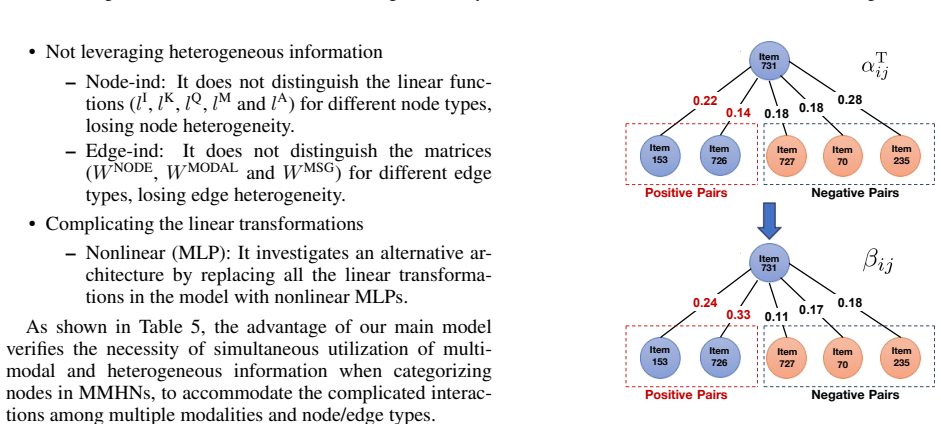
- The mixed inter-node attention $\beta$ is more category-aligned than plain modality-specific attention: on AMAZON-1 it is larger for 54.5% of same-label pairs and smaller for 55.5% of different-label pairs.
- The stated worst-case complexity of $O(|V|^2|M|^2)$, usually $O(|V| n |M|^2)$ for sparse neighborhoods, keeps the method scalable enough for the large datasets tested.
Reading between the lines
- The nested-attention pattern is not tied to heterogeneous transformers; the same gating idea could be inserted into any attention-based message-passing model, so the paper's strongest legacy may be a reusable mechanism rather than a single architecture.
- Because the inter-modal weights are computed for each node pair and layer, they provide a built-in diagnostic of which modality drives classification in which region of the graph, something the paper does not exploit.
- A natural extension the paper does not run is a missing-modality robustness test: mask modalities at test time and measure whether the attention loss alone keeps performance from degrading.
- The deliberate simplification that the mixed attention is independent of the influenced modality leaves a clear next question: does making it modality-specific help on tasks where one modality is far more informative than the others, at the cost of more parameters?
Signed reviews
Editorial analysis
A structured set of objections, weighed in public.
Referee Report
Summary. The paper proposes HGNN-IMA, a heterogeneous graph transformer-based model for node classification in multi-modal heterogeneous networks (MMHNs). The model computes modal-specific similarity scores between nodes, combines them through a nested inter-modal attention mechanism, modulates the combined attention with a term intended to encourage modality alignment, and adds an attention loss to down-weight neighbors whose node types lack certain modalities. Experiments are reported on five datasets (DOUBAN, IMDB, AMAZON, AMAZON-1, AMAZON-2) with comparisons to early-fusion, late-fusion, and other heterogeneous graph baselines, together with ablations and a t-test against the strongest baseline.
Significance. The core idea of fusing modalities inside the GNN propagation process, rather than before or after it, is timely and potentially valuable for multi-modal graph learning. The paper provides a public code repository, evaluates on five datasets, and includes a broad set of ablations that probe the contribution of each component. If the mechanism were correctly specified and the empirical claims were properly supported, this would be a useful contribution. However, the current manuscript contains a load-bearing inconsistency in the alignment-modulation equation and the statistical support for the claimed universal superiority over baselines is incomplete.
major comments (3)
- [§4.2, Eq. (8)] The alignment modulation is sign-inverted. As written, ¯β^(k)_ij = softmax_j(Σ_{m1,m2∈M} |g^(k),m1_ij − g^(k),m2_ij|) assigns larger weights to neighbors whose modality-specific similarity scores disagree the most, and Eq. (9) multiplies this into the aggregation weights. This directly contradicts the text, which states that the modulation amplifies the contribution of modality-aligned nodes, and it is also inconsistent with the ablation interpretation in §5.5, where removing this term (HGNN-IMA−align) hurts performance. If the released implementation follows Eq. (8) literally, then one of the three named contributions does not function as described; if the implementation uses exp(−|·|) or a reciprocal, then Eq. (8) is a notational error. Either way, the authors must correct the equation and clarify which form the implementation actually uses; the ablation results cannot be interpreted until this is resolved.
- [§5.4, Table 3] The claim that HGNN-IMA 'consistently outperforms all the baselines across all datasets' is not fully supported by the statistics presented. Standard deviations are reported only for HGNN-IMA and HGT; all other baselines appear as point estimates. The Macro-F1 gain over the strongest baseline on AMAZON is roughly 1.2 percentage points (0.8427 vs 0.8302), and without variance information for SeHGNN or other close baselines it is unclear whether these differences exceed run-to-run noise. A two-sample t-test is only conducted against HGT, not against all baselines. Please report standard deviations (or confidence intervals) for every baseline and either conduct significance tests against each baseline or qualify the claim of universal superiority.
- [§5.3 and Appendix B] No hyperparameter tuning procedure is described for the baselines. The authors specify their own settings (learning rate, layer count, dropout, embedding dimension, etc.) but do not state whether each baseline was tuned on the validation set or run with default parameters from its original paper. Since several reported gains over the strongest baseline are small (around one to two Macro-F1 points), undertuned baselines could account for the improvements. Please provide the configuration and tuning protocol for each baseline, including any grid search ranges.
minor comments (5)
- [Table 3] The reported standard deviation for HGT on DOUBAN is 0.1261, which is two orders of magnitude larger than the other HGT standard deviations and larger than the difference between the model means; this value should be double-checked, as it is unusual for F1 scores across five random seeds.
- [§5.4] The sentence 'there are 1.2%, 1.6%, and 0.3% gains in Macro-F1' appears inconsistent with Table 2; for example, the AMAZON gain of 0.8427 vs 0.8302 is about 1.5% relative or 1.2 percentage points, not 0.3%. Please clarify whether these are relative or absolute differences.
- [§4.2, Eq. (6)] The formal derivation uses a single attention head, but §5.3 states that multi-head attention with 8 heads is used during training. The equations should either be extended to the multi-head case or the experimental setting should be reconciled with the formal description.
- [Appendix A] The complexity statement says the worst-case cost is O(|V|^2|M|^2) and then notes that for bounded-degree graphs it is O(|V|n|M|^2); the latter is the practically relevant bound, and the two cases should be presented more clearly to avoid implying that the model is quadratic in the number of nodes in typical networks.
- [§5.1 and §4.1] The preprocessing step of completing missing visual attributes with text features is a strong modeling assumption that is only mentioned in passing; stating it earlier (in the framework description) and ideally providing an ablation over alternative imputation strategies would strengthen the paper.
Circularity Check
No circularity found; HGNN-IMA is an empirical architecture evaluated on held-out test labels, with an internal Eq. (8) sign issue that is a correctness concern, not a circular derivation.
full rationale
The paper makes no first-principles claim that reduces to its own inputs: HGNN-IMA is an architectural proposal, and its central claim is a benchmark result on held-out test labels. The nested inter-modal attention (Eqs. 4-6), the alignment modulation (Eqs. 8-9), and the missing-modality attention loss (Eq. 7) are defined from learned node features and regularize training; none of them fits a parameter to the test quantity that is then reported as a prediction. There is no load-bearing self-citation: the only overlapping-author reference (Li et al. 2023b) is background on anomaly detection and is not used to justify the model's design. The choice of K=3 and equal loss weights was made via the validation split, which is standard model selection and does not make the test-set comparison circular. A separate correctness concern, not a circularity, is that Eq. (8) as written places a softmax over the sum of absolute cross-modality differences, so it up-weights neighbors with the largest modality disagreement, opposite to the paper's stated alignment mechanism; this should be corrected or the text revised, but it does not constitute a circular derivation.
Assumptions & free parameters
free parameters (5)
- K, number of propagation layers =
3
- Embedding dimension d =
64
- Number of attention heads =
8
- Dropout rate =
0.6
- Loss weights for L_cro and L_att =
1:1
assumptions (5)
- domain assumption Semi-supervised node classification: a 20% labeled split generalizes to the 70% test split.
- domain assumption Pre-trained encoders produce useful and comparable modality features.
- ad hoc to paper Missing visual attributes can be replaced by text features.
- ad hoc to paper Modality alignment can be measured by summing absolute differences of bilinear similarity logits across modality pairs.
- domain assumption The graph structure and neighbor relations are predictive of node categories.
Cite this review
Pith. "Pith review of Representation Learning with Mutual Influence of Modalities for Node Classification in Multi-Modal Heterogeneous Networks." pith.science (2026). https://pith.science/paper/VLKBWZ5F
@misc{pith2026250507895,
  author       = {Pith},
  title        = {Pith review of: Representation Learning with Mutual Influence of Modalities for Node Classification in Multi-Modal Heterogeneous Networks},
  year         = {2026},
  howpublished = {\url{https://pith.science/paper/VLKBWZ5F}},
  note         = {Machine review of arXiv:2505.07895}
}
read the original abstract
Nowadays, numerous online platforms can be described as multi-modal heterogeneous networks (MMHNs), such as Douban's movie networks and Amazon's product review networks. Accurately categorizing nodes within these networks is crucial for analyzing the corresponding entities, which requires effective representation learning on nodes. However, existing multi-modal fusion methods often adopt either early fusion strategies which may lose the unique characteristics of individual modalities, or late fusion approaches overlooking the cross-modal guidance in GNN-based information propagation. In this paper, we propose a novel model for node classification in MMHNs, named Heterogeneous Graph Neural Network with Inter-Modal Attention (HGNN-IMA). It learns node representations by capturing the mutual influence of multiple modalities during the information propagation process, within the framework of heterogeneous graph transformer. Specifically, a nested inter-modal attention mechanism is integrated into the inter-node attention to achieve adaptive multi-modal fusion, and modality alignment is also taken into account to encourage the propagation among nodes with consistent similarities across all modalities. Moreover, an attention loss is augmented to mitigate the impact of missing modalities. Extensive experiments validate the superiority of the model in the node classification task, providing an innovative view to handle multi-modal data, especially when accompanied with network structures.
Figures


Figures from the paper (2 more)

Reference graph
Works this paper leans on
-
[1]
Multimodal graph neural architecture search under distribution shifts
Jie Cai, Xin Wang, Haoyang Li, Ziwei Zhang, and Wenwu Zhu. Multimodal graph neural architecture search under distribution shifts. In Proceedings of the AAAI Conference on Artificial Intelligence , volume 38, pages 8227--8235, 2024
work page 2024
-
[2]
Cross-modal knowledge graph contrastive learning for machine learning method recommendation
Xianshuai Cao, Yuliang Shi, Jihu Wang, Han Yu, Xinjun Wang, and Zhongmin Yan. Cross-modal knowledge graph contrastive learning for machine learning method recommendation. In Proceedings of the 30th ACM International Conference on Multimedia (MM) , pages 3694--3702. ACM , 2022
work page 2022
-
[3]
HGMF : heterogeneous graph-based fusion for multimodal data with incompleteness
Jiayi Chen and Aidong Zhang. HGMF : heterogeneous graph-based fusion for multimodal data with incompleteness. In Proceedings of the 26th ACM SIGKDD Conference on Knowledge Discovery and Data Mining ( KDD ) , pages 1295--1305, 2020
work page 2020
-
[4]
Spectral heterogeneous graph convolutions via positive noncommutative polynomials
Mingguo He, Zhewei Wei, Shikun Feng, Zhengjie Huang, Weibin Li, Yu Sun, and Dianhai Yu. Spectral heterogeneous graph convolutions via positive noncommutative polynomials. In Proceedings of the ACM on Web Conference (WWW) , pages 685--696. ACM , 2024
work page 2024
-
[5]
Heterogeneous graph attention networks for semi-supervised short text classification
Linmei Hu, Tianchi Yang, Chuan Shi, Houye Ji, and Xiaoli Li. Heterogeneous graph attention networks for semi-supervised short text classification. In Proceedings of the 2019 Conference on Empirical Methods in Natural Language Processing and the 9th International Joint Conference on Natural Language Processing (EMNLP-IJCNLP) , pages 4821--4830, 2019
work page 2019
-
[6]
Heterogeneous graph transformer
Ziniu Hu, Yuxiao Dong, Kuansan Wang, and Yizhou Sun. Heterogeneous graph transformer. In Proceedings of the Web Conference (WWW) , pages 2704--2710, 2020
work page 2020
-
[7]
Beyond Graph Convolution: Multimodal Recommendation with Topology-aware MLPs
Junjie Huang, Jiarui Qin, Yong Yu, and Weinan Zhang. Beyond graph convolution: Multimodal recommendation with topology-aware mlps. CoRR , abs/2412.11747, 2024
work page Pith review arXiv 2024
-
[8]
A survey on multi-modal summarization
Anubhav Jangra, Sourajit Mukherjee, Adam Jatowt, Sriparna Saha, and Mohammad Hasanuzzaman. A survey on multi-modal summarization. ACM Computing Surveys , 55(13s):296:1--296:36, 2023
work page 2023
Show all 38 references
-
[9]
Multimodal heterogeneous graph attention network
Xiangen Jia, Min Jiang, Yihong Dong, Feng Zhu, Haocai Lin, Yu Xin, and Huahui Chen. Multimodal heterogeneous graph attention network. Neural Comput. Appl. , 35(4):3357–3372, oct 2022
2022
-
[10]
Multimodal knowledge graph for deep learning papers and code
Amar Viswanathan Kannan, Dmitriy Fradkin, Ioannis Akrotirianakis, Tugba Kulahcioglu, Arquimedes Canedo, Aditi Roy, Shih-Yuan Yu, Malawade Arnav, and Mohammad Abdullah Al Faruque. Multimodal knowledge graph for deep learning papers and code. In Proceedings of the 29th ACM Inter...
2020
-
[11]
Heterogeneous graph learning for multi-modal medical data analysis
Sein Kim, Namkyeong Lee, Junseok Lee, Dongmin Hyun, and Chanyoung Park. Heterogeneous graph learning for multi-modal medical data analysis. In Proceedings of the AAAI Conference on Artificial Intelligence , pages 5141--5150, 2023
2023
-
[12]
Incorporating domain knowledge graph into multimodal movie genre classification with self-supervised attention and contrastive learning
Jiaqi Li, Guilin Qi, Chuanyi Zhang, Yongrui Chen, Yiming Tan, Chenlong Xia, and Ye Tian. Incorporating domain knowledge graph into multimodal movie genre classification with self-supervised attention and contrastive learning. In Proceedings of the 31st ACM International Confer...
2023
-
[13]
THGNN: an embedding-based model for anomaly detection in dynamic heterogeneous social networks
Yilin Li, Jiaqi Zhu, Congcong Zhang, Yi Yang, Jiawen Zhang, Ying Qiao, and Hongan Wang. THGNN: an embedding-based model for anomaly detection in dynamic heterogeneous social networks. In Proceedings of the 32nd ACM International Conference on Information and Knowledge Manageme...
2023
-
[14]
Reasoning over different types of knowledge graphs: Static, temporal and multi-modal
Ke Liang, Lingyuan Meng, Meng Liu, Yue Liu, Wenxuan Tu, Siwei Wang, Sihang Zhou, Xinwang Liu, and Fuchun Sun. Reasoning over different types of knowledge graphs: Static, temporal and multi-modal. 2022
2022
-
[15]
Self-supervised heterogeneous graph learning: a homophily and heterogeneity view
Yujie Mo, Feiping Nie, Ping Hu, Heng Tao Shen, Zheng Zhang, Xinchao Wang, and Xiaofeng Zhu. Self-supervised heterogeneous graph learning: a homophily and heterogeneity view. In Proceedings of the Twelfth International Conference on Learning Representations (ICLR) , 2024
2024
-
[16]
Justifying recommendations using distantly-labeled reviews and fine-grained aspects
Jianmo Ni, Jiacheng Li, and Julian McAuley. Justifying recommendations using distantly-labeled reviews and fine-grained aspects. In Proceedings of the 2019 conference on empirical methods in natural language processing and the 9th international joint conference on natural lang...
2019
-
[17]
Embedding multimodal relational data for knowledge base completion
Pouya Pezeshkpour, Liyan Chen, and Sameer Singh. Embedding multimodal relational data for knowledge base completion. In Proceedings of the 2018 Conference on Empirical Methods in Natural Language Processing(EMNLP-IJCNLP) , pages 3208--3218. Association for Computational Lingui...
2018
-
[18]
Learning transferable visual models from natural language supervision
Alec Radford, Jong Wook Kim, Chris Hallacy, Aditya Ramesh, Gabriel Goh, Sandhini Agarwal, Girish Sastry, Amanda Askell, Pamela Mishkin, Jack Clark, Gretchen Krueger, and Ilya Sutskever. Learning transferable visual models from natural language supervision. In Marina Meila and ...
2021
-
[19]
Mining Heterogeneous Information Networks: Principles and Methodologies
Yizhou Sun and Jiawei Han. Mining Heterogeneous Information Networks: Principles and Methodologies . Synthesis Lectures on Data Mining and Knowledge Discovery. Morgan & Claypool Publishers, 2012
2012
-
[20]
Multi-modal knowledge graphs for recommender systems
Rui Sun, Xuezhi Cao, Yan Zhao, Junchen Wan, Kun Zhou, Fuzheng Zhang, Zhongyuan Wang, and Kai Zheng. Multi-modal knowledge graphs for recommender systems. In Proceedings of the 29th ACM International Conference on Information & Knowledge Management (CIKM) , page 1405–1414, 2020
2020
-
[21]
Mgat: Multimodal graph attention network for recommendation
Zhulin Tao, Yinwei Wei, Xiang Wang, Xiangnan He, Xianglin Huang, and Tat-Seng Chua. Mgat: Multimodal graph attention network for recommendation. Information Processing & Management , 57(5):102277, 2020
2020
-
[22]
Visualizing data using t-sne
Laurens van der Maaten and Geoffrey Hinton. Visualizing data using t-sne. Journal of Machine Learning Research , 9(86):2579--2605, 2008
2008
-
[23]
Heterogeneous graph attention network
Xiao Wang, Houye Ji, Chuan Shi, Bai Wang, Yanfang Ye, Peng Cui, and Philip S Yu. Heterogeneous graph attention network. In The world wide web conference , pages 2022--2032, 2019
2022
-
[24]
Multimodal graph convolutional networks for high quality content recognition
Jinguang Wang, Jun Hu, Shengsheng Qian, Quan Fang, and Changsheng Xu. Multimodal graph convolutional networks for high quality content recognition. Neurocomputing , 412:42--51, 2020
2020
-
[25]
Causal-based supervision of attention in graph neural network: A better and simpler choice towards powerful attention
Hongjun Wang, Jiyuan Chen, Lun Du, Qiang Fu, Shi Han, and Xuan Song. Causal-based supervision of attention in graph neural network: A better and simpler choice towards powerful attention. In Proceedings of the Thirty-Second International Joint Conference on Artificial Intellig...
2023
-
[26]
TIVA-KG: A multimodal knowledge graph with text, image, video and audio
Xin Wang, Benyuan Meng, Hong Chen, Yuan Meng, Ke Lv, and Wenwu Zhu. TIVA-KG: A multimodal knowledge graph with text, image, video and audio. In Proceedings of the 31st ACM International Conference on Multimedia (MM) , pages 2391--2399. ACM , 2023
2023
-
[27]
Mmgcn: Multi-modal graph convolution network for personalized recommendation of micro-video
Yinwei Wei, Xiang Wang, Liqiang Nie, Xiangnan He, Richang Hong, and Tat-Seng Chua. Mmgcn: Multi-modal graph convolution network for personalized recommendation of micro-video. In Proceedings of the 27th ACM International Conference on Multimedia (MM) , pages 1437--1445, 2019
2019
-
[28]
Multimodal heterogeneous graph convolutional network for image recommendation
Weiyi Wei, Jian Wang, Mengyu Xu, and Futong Zhang. Multimodal heterogeneous graph convolutional network for image recommendation. Multimedia Systems , pages 2747--2760, 2023
2023
-
[29]
A comprehensive survey on deep multimodal learning with missing modality
Renjie Wu, Hu Wang, and Hsiang - Ting Chen. A comprehensive survey on deep multimodal learning with missing modality. CoRR , abs/2409.07825, 2024
2024 arXiv
-
[30]
Cross-modal graph attention network for entity alignment
Baogui Xu, Chengjin Xu, and Bing Su. Cross-modal graph attention network for entity alignment. In Proceedings of the 31st ACM International Conference on Multimedia (MM) , pages 3715--3723, 2023
2023
-
[31]
Self-supervised heterogeneous graph pre-training based on structural clustering
Yaming Yang, Ziyu Guan, Zhe Wang, Wei Zhao, Cai Xu, Weigang Lu, and Jianbin Huang. Self-supervised heterogeneous graph pre-training based on structural clustering. In Proceedings of Advances in Neural Information Processing Systems (NeurIPS) , pages 16962--16974, 2022
2022
-
[32]
Fusing heterogeneous information for multi-modal attributed network embedding
Jieyi Yang, Feng Zhu, Yihong Dong, and Jiangbo Qian. Fusing heterogeneous information for multi-modal attributed network embedding. Applied Intelligence , 53:1--20, 06 2023
2023
-
[33]
Simple and efficient heterogeneous graph neural network
Xiaocheng Yang, Mingyu Yan, Shirui Pan, Xiaochun Ye, and Dongrui Fan. Simple and efficient heterogeneous graph neural network. In Proceedings of the AAAI Conference on Artificial Intelligence . AAAI Press, 2023
2023
-
[34]
Chuxu Zhang, Dongjin Song, Chao Huang, Ananthram Swami, and Nitesh V. Chawla. Heterogeneous graph neural network. In Proceedings of the 25th ACM SIGKDD International Conference on Knowledge Discovery and Data Mining (KDD) , pages 793--803, 2019
2019
-
[35]
Deep multimodal data fusion
Fei Zhao, Chengcui Zhang, and Baocheng Geng. Deep multimodal data fusion. ACM Comput. Surv. , 56(9):216:1--216:36, 2024
2024
-
[36]
Multi-modal knowledge graph construction and application: A survey
Xiangru Zhu, Zhixu Li, Xiaodan Wang, Xueyao Jiang, Penglei Sun, Xuwu Wang, Yanghua Xiao, and Nicholas Jing Yuan. Multi-modal knowledge graph construction and application: A survey. IEEE Transactions on Knowledge and Data Engineering , 36(2):715--735, 2024
2024
-
[37]
Propagation is all you need: A new framework for representation learning and classifier training on graphs
Jiaming Zhuo, Can Cui, Kun Fu, Bingxin Niu, Dongxiao He, Yuanfang Guo, Zhen Wang, Chuan Wang, Xiaochun Cao, and Liang Yang. Propagation is all you need: A new framework for representation learning and classifier training on graphs. In Proceedings of the 31st ACM International ...
2023
-
[38]
write newline
" write newline "" before.all 'output.state := FUNCTION fin.entry add.period write newline FUNCTION new.block output.state before.all = 'skip after.block 'output.state := if FUNCTION new.sentence output.state after.block = 'skip output.state before.all = 'skip after.sentence '...
Reviewed August 15, 2026 · model on record in the stance chip above.
Discussion (0). Continue with ORCID to comment.