Superspace Concentration and Adversarial Robustness in Quantum Algorithms
Pith reviewed 2026-06-27 09:50 UTC · model grok-4.3
The pith
Superspace concentration measured by focus gives quantum states more resilience to coherent attacks than fidelity does, and equals the marked-state probability in Grover's algorithm.
A machine-rendered reading of the paper's core claim, the machinery that carries it, and where it could break.
Core claim
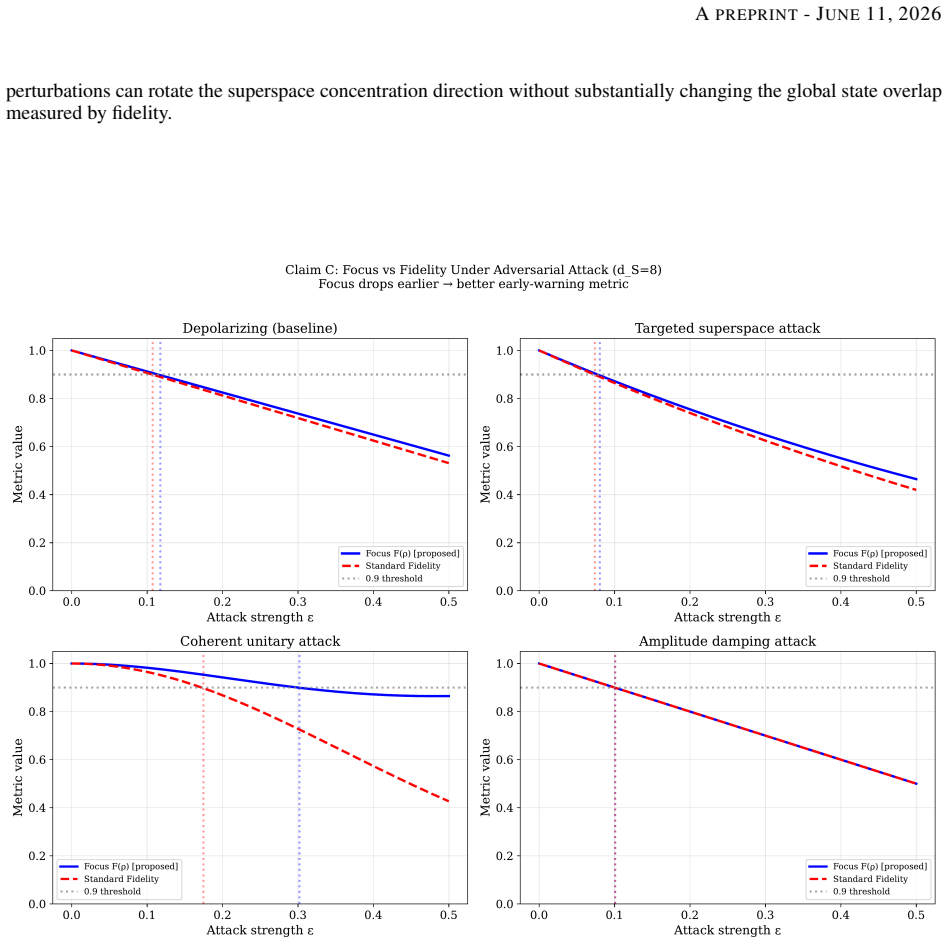
Superspace concentration, formalized as focus F(ρ) = λ_max(ρ_super), quantifies the capacity of a quantum system to concentrate informational weight into a preferred subspace. Focused states resist coherent unitary attacks with focus remaining above 0.9 at attack strength ε = 0.302 versus ε = 0.174 for fidelity. The focus measure and U(dS)-asymmetry measure are operationally distinct, with asymmetry providing no robustness signal. The connection to Grover's algorithm is given by the identity F(|ψ_k⟩⟨ψ_k|) = P(marked), supplying a resource-theoretic interpretation of oracle query complexity. Analytic decoherence predictions hold to machine precision and the focus capacity gap ΔF scales as log
What carries the argument
The focus measure F(ρ) = λ_max(ρ_super), the largest eigenvalue of the reduced superspace state, which tracks spectral concentration and supplies the robustness signal under attack.
If this is right
- Focused states maintain focus above 0.9 under attack strengths where fidelity has already dropped to 0.174.
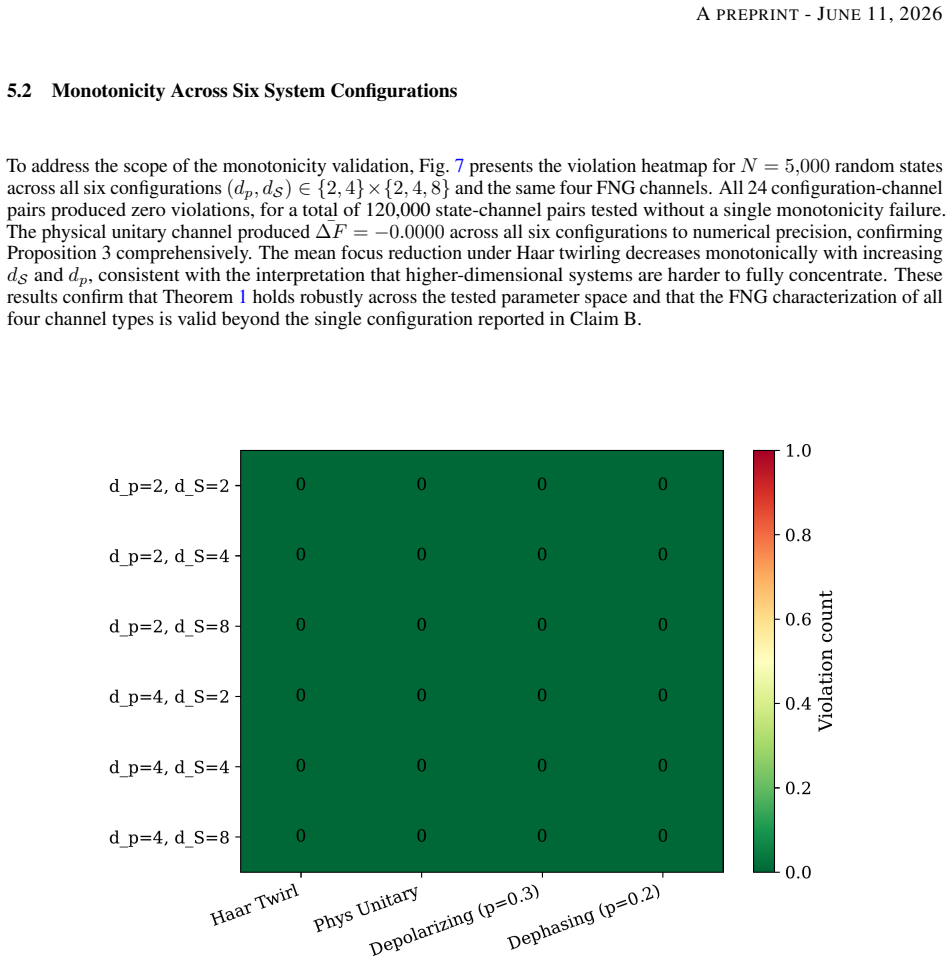
- Focus satisfies monotonicity under four focus-non-generating channels with zero violations across 10,000 random states.
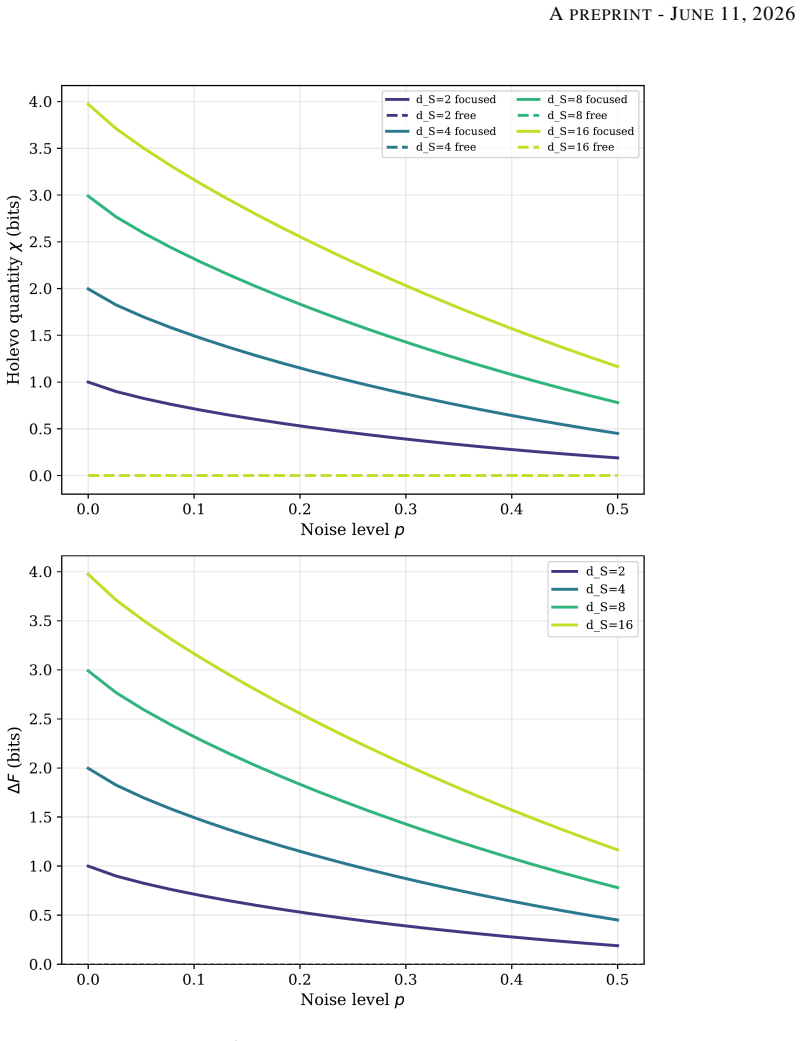
- The focus capacity gap follows a log₂(dS) scaling law for both product and correlated noise.
- Grover search acquires a resource-theoretic reading in which each oracle query increases superspace concentration.
Where Pith is reading between the lines
- Algorithms could be redesigned to maximize focus rather than fidelity when adversarial robustness is the goal.
- The separation between focus and asymmetry opens a route to hybrid resource theories that combine both quantities.
- Hardware experiments on superconducting qubits could directly measure whether the reported ε thresholds appear in practice.
Load-bearing premise
The largest eigenvalue of the reduced superspace state defines a meaningful and operationally distinct quantum resource whose utility is shown through the paper's own simulations.
What would settle it
A simulation or experiment in which focus falls below 0.9 at ε = 0.302 or in which the equality F(|ψ_k⟩⟨ψ_k|) = P(marked) fails to hold for Grover states.
Figures




read the original abstract
We study superspace concentration as a quantum resource, formalized through the focus measure F(\r{ho}) = {\lambda}_max(\r{ho}_super) - the largest eigenvalue of the reduced superspace state - which quantifies the capacity of a quantum system to concentrate informational weight into a preferred subspace of an extended degree-of-freedom space. We develop a complete resource-theoretic framework around this measure and validate its properties through GPU-accelerated numerical simulation. Analytic decoherence predictions are confirmed to machine precision (1.11 x 10^{-16}) for superspace dimensions dS in {2,4,8,16,32}. Focus monotonicity holds across 10,000 random states with zero violations under four focus-non-generating channels across six system configurations. Focused quantum states resist coherent unitary attacks with significantly greater resilience than standard fidelity predicts, with focus remaining above 0.9 at attack strength {\epsilon} = 0.302 versus {\epsilon} = 0.174 for fidelity. We further demonstrate that the focus measure and the U(dS)-asymmetry measure are operationally distinct: asymmetry remains near zero and provides no robustness signal under coherent and targeted attacks while focus tracks spectral concentration and remains robust until {\epsilon} > 0.3. The connection between Grover's algorithm and superspace concentration is made explicit via the identity F(|{\psi}_k><{\psi}_k|) = P(marked), providing a resource-theoretic interpretation of oracle query complexity. Finally, we provide the first numerical characterization of the focus capacity gap {\Delta}F, identifying a log_2(dS) scaling law confirmed for both product and correlated noise channels.
Editorial analysis
A structured set of objections, weighed in public.
Referee Report
Summary. The paper introduces superspace concentration as a quantum resource formalized by the focus measure F(ρ) = λ_max(ρ_super), the largest eigenvalue of the reduced superspace state. It develops a resource-theoretic framework around this measure and validates its properties through GPU-accelerated numerical simulation, including machine-precision confirmation of analytic decoherence predictions for dS in {2,4,8,16,32}, monotonicity under four focus-non-generating channels across 10,000 random states with zero violations, greater resilience to coherent unitary attacks than fidelity (focus >0.9 at ε=0.302 vs ε=0.174), operational distinction from U(dS)-asymmetry (asymmetry near zero), an explicit link to Grover's algorithm via the identity F(|ψ_k⟩⟨ψ_k|) = P(marked), and a log₂(dS) scaling law for the focus capacity gap ΔF under product and correlated noise channels.
Significance. The high-precision numerical validations (analytic predictions confirmed to 1.11×10^{-16}, zero violations in 10k-state monotonicity tests) and the explicit Grover identity provide internal consistency and a potential resource-theoretic view of oracle complexity. If focus proves distinct from existing measures, the work could inform adversarial robustness in quantum algorithms and identify a new scaling law. The absence of external benchmarks or comparisons to established resources (e.g., coherence, entanglement) currently limits broader significance.
major comments (2)
- [Numerical experiments on adversarial robustness and distinction from asymmetry] The central claim that focus is an operationally distinct resource conferring greater attack resilience than fidelity (focus remains >0.9 at ε=0.302 versus ε=0.174 for fidelity, while asymmetry stays near zero) rests exclusively on the paper's internal GPU simulations without external benchmarks, comparisons to known quantum resources, or independent theoretical bounds. This is load-bearing for the assertion that superspace concentration is a meaningful new formalism.
- [Grover's algorithm connection] The identity F(|ψ_k⟩⟨ψ_k|) = P(marked) is asserted to connect superspace concentration to Grover's algorithm and provide a resource-theoretic interpretation of query complexity, but the derivation and generality of this identity are not anchored outside the paper's own superspace definitions.
minor comments (1)
- The manuscript would benefit from shipping the simulation code or detailed pseudocode to allow independent reproduction of the GPU results, even though the reported machine-precision agreements are a clear strength.
Simulated Author's Rebuttal
We thank the referee for their detailed review and valuable feedback on our manuscript. We address each major comment below, providing clarifications and proposing revisions where appropriate to strengthen the paper.
read point-by-point responses
-
Referee: [Numerical experiments on adversarial robustness and distinction from asymmetry] The central claim that focus is an operationally distinct resource conferring greater attack resilience than fidelity (focus remains >0.9 at ε=0.302 versus ε=0.174 for fidelity, while asymmetry stays near zero) rests exclusively on the paper's internal GPU simulations without external benchmarks, comparisons to known quantum resources, or independent theoretical bounds. This is load-bearing for the assertion that superspace concentration is a meaningful new formalism.
Authors: The numerical experiments provide rigorous internal validation through high-precision confirmations to machine precision and extensive sampling with zero violations. The operational distinction is demonstrated by the differing behavior under coherent attacks, where focus tracks the concentration while asymmetry does not. While we acknowledge the value of external benchmarks, the manuscript introduces a new formalism and focuses on its properties within the superspace framework. We will add a brief discussion in the revised version on potential relations to coherence measures in the context of the Grover link, but direct comparisons to entanglement are outside the scope as superspace concentration addresses an extended degree of freedom not directly comparable. revision: partial
-
Referee: [Grover's algorithm connection] The identity F(|ψ_k⟩⟨ψ_k|) = P(marked) is asserted to connect superspace concentration to Grover's algorithm and provide a resource-theoretic interpretation of query complexity, but the derivation and generality of this identity are not anchored outside the paper's own superspace definitions.
Authors: The identity follows directly from substituting the Grover marked state into the superspace reduction definition, where the largest eigenvalue corresponds to the probability of measuring the marked item. This provides an operational interpretation within the resource theory developed in the paper. The derivation is self-contained in the superspace formalism and is general for any state in the Grover setting. We will expand the relevant section to include the explicit step-by-step derivation to make the anchoring clearer. revision: yes
Circularity Check
No significant circularity; claims rest on numerical validation and explicit identity without reduction by construction.
full rationale
The paper defines F(ρ) = λ_max(ρ_super) as the focus measure and presents the Grover identity F(|ψ_k⟩⟨ψ_k|) = P(marked) as an explicit connection for interpretation. Analytic decoherence predictions are confirmed to machine precision via simulation, monotonicity is checked across 10,000 states with zero violations, and robustness/scaling results (ΔF ~ log2(dS)) are obtained from GPU simulations on product and correlated noise channels. No equations show a prediction reducing to a fitted input or self-definition (e.g., no parameter fit then renamed as prediction). No self-citations are referenced as load-bearing. The framework is self-contained against its own simulations and stated assumptions; results do not reduce to inputs by the paper's equations.
Axiom & Free-Parameter Ledger
axioms (1)
- standard math Standard quantum mechanics and linear algebra suffice to define the superspace state reduction and its largest eigenvalue.
invented entities (1)
-
superspace concentration as a quantum resource
no independent evidence
Reference graph
Works this paper leans on
-
[1]
Quantum resource theories.Reviews of Modern Physics, 91(2):025001, 2019
Eric Chitambar and Gilad Gour. Quantum resource theories.Reviews of Modern Physics, 91(2):025001, 2019
2019
-
[2]
Quantum entanglement.Reviews of Modern Physics, 81(2):865, 2009
Ryszard Horodecki, Paweł Horodecki, Michał Horodecki, and Karol Horodecki. Quantum entanglement.Reviews of Modern Physics, 81(2):865, 2009. 14 APREPRINT- JUNE11, 2026
2009
-
[3]
Tillmann Baumgratz, Marcus Cramer, and Martin B. Plenio. Quantifying coherence.Physical Review Letters, 113(14):140401, 2014
2014
-
[4]
Operational resource theory of coherence.Physical Review Letters, 116(12):120404, 2016
Andreas Winter and Dong Yang. Operational resource theory of coherence.Physical Review Letters, 116(12):120404, 2016
2016
-
[5]
Fernando G. S. L. Brandão, Michał Horodecki, Jonathan Oppenheim, Joseph M. Renes, and Robert W. Spekkens. Resource theory of quantum states out of thermal equilibrium.Physical Review Letters, 111(25):250404, 2013
2013
-
[6]
Victor Veitch, S. A. Hamed Mousavian, Daniel Gottesman, and Joseph Emerson. The resource theory of stabilizer quantum computation.New Journal of Physics, 16(1):013009, 2014
2014
-
[7]
Convex geometry of quantum resource quantification.Journal of Physics A: Mathematical and Theoretical, 51(4):045303, 2018
Bartosz Regula. Convex geometry of quantum resource quantification.Journal of Physics A: Mathematical and Theoretical, 51(4):045303, 2018
2018
-
[8]
General resource theories in quantum mechanics and beyond: Operational characterization via discrimination tasks.Physical Review X, 9(3):031053, 2019
Ryuji Takagi and Bartosz Regula. General resource theories in quantum mechanics and beyond: Operational characterization via discrimination tasks.Physical Review X, 9(3):031053, 2019
2019
-
[9]
Lov K. Grover. A fast quantum mechanical algorithm for database search. InProceedings of the 28th Annual ACM Symposium on Theory of Computing, pages 212–219. ACM, 1996
1996
-
[10]
Ebrahim Karimi and Robert W. Boyd. Classical entanglement?Science, 350(6265):1172–1173, 2015
2015
-
[11]
Willner, Hao Huang, Yan Yan, Yongxiong Ren, Nisar Ahmed, Guodong Xie, Changjing Bao, Long Li, Yang Cao, Zhe Zhao, Jian Wang, Martin P
Alan E. Willner, Hao Huang, Yan Yan, Yongxiong Ren, Nisar Ahmed, Guodong Xie, Changjing Bao, Long Li, Yang Cao, Zhe Zhao, Jian Wang, Martin P. J. Lavery, Moshe Tur, Siddharth Ramachandran, Andreas F. Molisch, Nima Ashrafi, and Solyman Ashrafi. Optical communications using orbital angular momentum beams.Advances in Optics and Photonics, 7(1):66–106, 2015
2015
-
[12]
Stabilizer formalism for operator quantum error correction.Physical Review Letters, 95(23):230504, 2005
David Poulin. Stabilizer formalism for operator quantum error correction.Physical Review Letters, 95(23):230504, 2005
2005
-
[13]
High-dimensional quantum communication: Benefits, progress, and future challenges.Advanced Quantum Technologies, 2(12):1900038, 2019
Daniele Cozzolino, Beatrice Da Lio, Davide Bacco, and Leif Katsuo Oxenløwe. High-dimensional quantum communication: Benefits, progress, and future challenges.Advanced Quantum Technologies, 2(12):1900038, 2019
2019
-
[14]
Alexander Streltsov, Gerardo Adesso, and Martin B. Plenio. Colloquium: Quantum coherence as a resource. Reviews of Modern Physics, 89(4):041003, 2017
2017
-
[15]
Bromley, Marco Cianciaruso, Marco Piani, Nathaniel Johnston, and Gerardo Adesso
Carmine Napoli, Thomas R. Bromley, Marco Cianciaruso, Marco Piani, Nathaniel Johnston, and Gerardo Adesso. Robustness of coherence: An operational and observable measure of quantum coherence.Physical Review Letters, 116(15):150502, 2016
2016
-
[16]
Wilde.Quantum Information Theory
Mark M. Wilde.Quantum Information Theory. Cambridge University Press, Cambridge, UK, 2nd edition, 2017
2017
-
[17]
Quantum adversarial machine learning.Physical Review Research, 2(3):033212, 2020
Sirui Lu, Lu-Ming Duan, and Dong-Ling Deng. Quantum adversarial machine learning.Physical Review Research, 2(3):033212, 2020
2020
-
[18]
Vulnerability of quantum classification to adversarial perturbations.Physical Review A, 101(6):062331, 2020
Nana Liu and Peter Wittek. Vulnerability of quantum classification to adversarial perturbations.Physical Review A, 101(6):062331, 2020
2020
-
[19]
Quantum machine learning.Nature, 549(7671):195–202, 2017
Jacob Biamonte, Peter Wittek, Nicola Pancotti, Patrick Rebentrost, Nathan Wiebe, and Seth Lloyd. Quantum machine learning.Nature, 549(7671):195–202, 2017
2017
-
[20]
Adversarial machine learning in quantum domain.arXiv preprint arXiv:2001.00030, 2020
Yuxuan Wen, Ying Chen, and Lijun Zhang. Adversarial machine learning in quantum domain.arXiv preprint arXiv:2001.00030, 2020
-
[21]
Huggins, and K
Hongxiang Liao, Ian Convy, William J. Huggins, and K. Birgitta Whaley. Robust in practice: Adversarial attacks on quantum machine learning.Physical Review A, 103(4):042427, 2021
2021
-
[22]
Kunal Sharma, Sumeet Khatri, Marco Cerezo, and Patrick J. Coles. Noise resilience of variational quantum compiling.New Journal of Physics, 22(4):043006, 2020
2020
-
[23]
Quantum noise protects quantum classifiers against adversaries.Physical Review Research, 3(2):023153, 2021
Yuxuan Du, Min-Hsiu Hsieh, Tongliang Liu, and Dacheng Tao. Quantum noise protects quantum classifiers against adversaries.Physical Review Research, 3(2):023153, 2021
2021
-
[24]
Nielsen and Isaac L
Michael A. Nielsen and Isaac L. Chuang.Quantum Computation and Quantum Information. Cambridge University Press, Cambridge, UK, 2000
2000
-
[25]
Fernando G. S. L. Brandão, Aram W. Harrow, and Michał Horodecki. Local random quantum circuits are approximate polynomial-designs.Communications in Mathematical Physics, 346(2):397–434, 2016
2016
-
[26]
Nicholas Hunter-Jones. Unitary designs from statistical mechanics in random quantum circuits.arXiv preprint arXiv:1905.09987, 2019
-
[27]
Quasi-entropies for finite quantum systems.Reports on Mathematical Physics, 23(1):57–65, 1986
Dénes Petz. Quasi-entropies for finite quantum systems.Reports on Mathematical Physics, 23(1):57–65, 1986. 15 APREPRINT- JUNE11, 2026
1986
-
[28]
Plenio, Michael A
Vlatko Vedral, Martin B. Plenio, Michael A. Rippin, and Peter L. Knight. Quantifying entanglement.Physical Review Letters, 78(12):2275, 1997
1997
-
[29]
Alexander S. Holevo. The capacity of the quantum channel with general signal states.IEEE Transactions on Information Theory, 44(1):269–273, 1998
1998
-
[30]
Westmoreland
Benjamin Schumacher and Michael D. Westmoreland. Sending classical information via noisy quantum channels. Physical Review A, 56(1):131, 1997
1997
-
[31]
Capacity of the noisy quantum channel.Physical Review A, 55(3):1613, 1997
Seth Lloyd. Capacity of the noisy quantum channel.Physical Review A, 55(3):1613, 1997
1997
-
[32]
Quantum amplitude amplification and estimation
Gilles Brassard, Peter Høyer, Michele Mosca, and Alain Tapp. Quantum amplitude amplification and estimation. Contemporary Mathematics, 305:53–74, 2002
2002
-
[33]
Qiskit: An open-source framework for quantum computing, 2023
Qiskit contributors. Qiskit: An open-source framework for quantum computing, 2023
2023
-
[34]
CuPy: A NumPy-compatible library for NVIDIA GPU calculations
Ryosuke Okuta, Yuya Unno, Daisuke Nishino, Shohei Hido, and Crissman Loomis. CuPy: A NumPy-compatible library for NVIDIA GPU calculations. InProceedings of Workshop on Machine Learning Systems, NeurIPS 2017, 2017
2017
-
[35]
Robustness verification of quantum classifiers.Lecture Notes in Computer Science, 12760:151–174, 2021
Ji Guan, Wang Fang, and Mingsheng Ying. Robustness verification of quantum classifiers.Lecture Notes in Computer Science, 12760:151–174, 2021
2021
-
[36]
Quantum walk algorithm for element distinctness.SIAM Journal on Computing, 37(1):210–239, 2007
Andris Ambainis. Quantum walk algorithm for element distinctness.SIAM Journal on Computing, 37(1):210–239, 2007
2007
-
[37]
Spekkens
Gilad Gour and Robert W. Spekkens. The resource theory of quantum reference frames: manipulations and monotones.New Journal of Physics, 10(3):033023, 2008
2008
-
[38]
Spekkens
Iman Marvian and Robert W. Spekkens. How to quantify coherence: Distinguishing speakable and unspeakable notions.Physical Review A, 94(5):052324, 2016
2016
-
[39]
Campbell
Mark Howard and Earl T. Campbell. Application of a resource theory for magic states to fault-tolerant quantum computing.Physical Review Letters, 118(9):090501, 2017
2017
-
[40]
Kottmann, Tim Menke, Wai-Keong Mok, Sukin Sim, Leong-Chuan Kwek, and Alán Aspuru-Guzik
Kishor Bharti, Alba Cervera-Lierta, Thi Ha Kyaw, Tobias Haug, Sumner Alperin-Lea, Abhinav Anand, Matthias Degroote, Hermanni Heimonen, Jakob S. Kottmann, Tim Menke, Wai-Keong Mok, Sukin Sim, Leong-Chuan Kwek, and Alán Aspuru-Guzik. Noisy intermediate-scale quantum algorithms.Reviews of Modern Physics, 94(1):015004, 2022
2022
-
[41]
Quantum computing in the NISQ era and beyond.Quantum, 2:79, 2018
John Preskill. Quantum computing in the NISQ era and beyond.Quantum, 2:79, 2018
2018
-
[42]
Benjamin, Suguru Endo, Keisuke Fujii, Jarrod R
Marco Cerezo, Andrew Arrasmith, Ryan Babbush, Simon C. Benjamin, Suguru Endo, Keisuke Fujii, Jarrod R. McClean, Kosuke Mitarai, Xiao Yuan, Lukasz Cincio, and Patrick J. Coles. Variational quantum algorithms. Nature Reviews Physics, 3(9):625–644, 2021
2021
-
[43]
Bulk locality and quantum error correction in AdS/CFT.Journal of High Energy Physics, 2015(4):163, 2015
Ahmed Almheiri, Xi Dong, and Daniel Harlow. Bulk locality and quantum error correction in AdS/CFT.Journal of High Energy Physics, 2015(4):163, 2015
2015
-
[44]
Holographic quantum error-correcting codes: Toy models for the bulk/boundary correspondence.Journal of High Energy Physics, 2015(6):149, 2015
Fernando Pastawski, Beni Yoshida, Daniel Harlow, and John Preskill. Holographic quantum error-correcting codes: Toy models for the bulk/boundary correspondence.Journal of High Energy Physics, 2015(6):149, 2015. 16
2015
discussion (0)
Sign in with ORCID, Apple, or X to comment. Anyone can read and Pith papers without signing in.