REVIEW 3 major objections 5 minor 53 references
Dual-branch detector spots AI images by fusing semantics with noise
Reviewed by Pith at T0; open to challenge. T0 means a machine referee read the full paper against a public rubric. the ladder, T0–T4 →
T0 review · glm-5.2
2026-07-08 08:28 UTC pith:VNQ54A5X
load-bearing objection Solid empirical SOTA for synthetic image detection, but ablation can't separate architecture gains from training data gains the 3 major comments →
Generalized Synthetic Image Detection with Enhanced RGB-Noise Representation Learning
The pith
A machine-rendered reading of the paper's core claim, the machinery that carries it, and where it could break.
Core claim
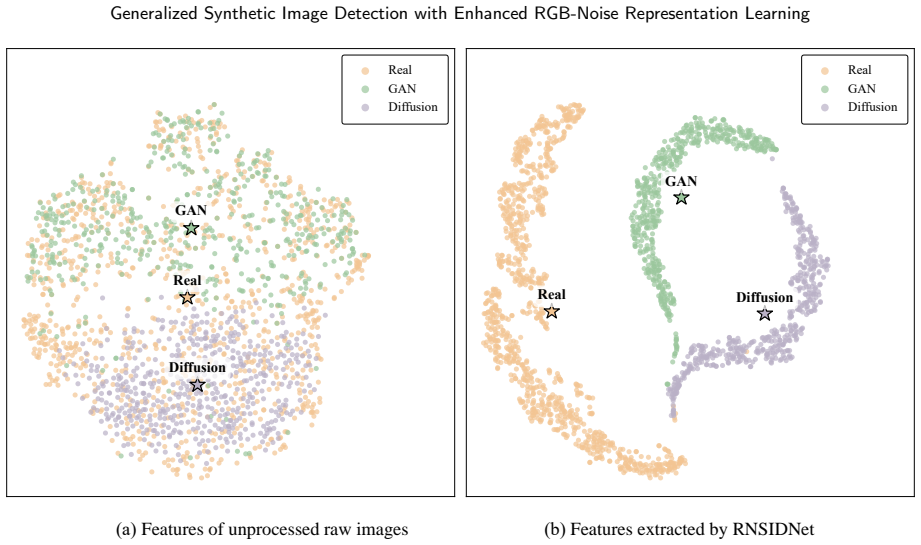
The central mechanism is the FiLM-based dynamic modulation: RGB features extracted by a CLIP encoder are passed through an MLP that produces scaling, shift, and gating parameters, which are then applied to the noise-feature vector. This means the noise branch is not simply concatenated with the RGB branch but is adaptively recalibrated by it. Combined with the HSCL strategy that concentrates optimization pressure on the hardest negative samples, the architecture produces a feature space where real, GAN-generated, and diffusion-generated images form distinct clusters. The authors demonstrate this across eight benchmark datasets covering multiple generator families, achieving an average AUC of
What carries the argument
FiLM modulation (Feature-wise Linear Modulation): RGB features generate affine parameters (scale γ, shift β, gate g) that dynamically transform noise features; HSCL (Hard Sample-aware Contrastive Learning): a contrastive loss variant that selects the top-K most similar cross-class samples and applies an extra penalty weight α to their exponentiated similarities; Bayar convolution: a constrained kernel with fixed center weight -1 and normalized non-center weights summing to 1, guaranteeing a zero-sum high-pass filter that suppresses low-frequency content and amplifies generative artifacts
Load-bearing premise
The paper assumes that the FiLM modulation and HSCL strategy are the primary causes of the performance gains, but the ablation study removes modules without isolating the effect of the new AMSID training dataset composition, which could independently account for much of the improvement.
What would settle it
Train RNSIDNet's architecture (FiLM + HSCL + Bayar conv) on a single-generator unaligned dataset (e.g., ProGAN-only without pixel alignment) and compare against a simple concatenation-fusion baseline trained on the AMSID dataset; if the latter generalizes better, the dataset composition—not the architectural innovations—is the primary driver.
If this is right
- If dynamic cross-modal modulation (FiLM) is the key driver, then any forensic task combining heterogeneous feature types—e.g., audio-visual deepfake detection or text-image consistency checking—could benefit from replacing concatenation with conditional modulation.
- The HSCL strategy's success suggests that hard-sample mining is more impactful than uniform contrastive objectives for boundary-critical classification tasks where the decision margin in ambiguous regions matters more than global separation.
- The pixel-aligned training data design (AMSID) implies that the field may be overestimating model capability when training on unaligned data: models may be learning content shortcuts rather than generator fingerprints, and aligned data is a necessary control.
- RNSIDNet's robustness to JPEG compression but vulnerability to Gaussian blur indicates that diffusion and GAN artifacts are partially encoded in mid-frequency bands that survive compression but are destroyed by low-pass filtering, narrowing the search space for universal forensic traces.
Editorial analysis
A structured set of objections, weighed in public.
Referee Report
Summary. The paper proposes RNSIDNet, a dual-branch architecture for synthetic image detection. The RGB branch uses a frozen CLIP-ViT encoder with a Balanced Attention Module (BAM), while the noise branch uses Bayar convolutions. These branches are fused via a Feature-wise Linear Modulation (FiLM) module, where RGB features condition noise features. The model is trained with a joint loss combining Binary Cross-Entropy and a proposed Hard Sample-aware Contrastive Learning (HSCL) strategy that re-weights hard negative samples. The authors also introduce AMSID, a pixel-aligned multi-source training dataset. Evaluations are conducted across eight public benchmarks, demonstrating strong cross-model generalization and robustness against degradations like JPEG compression and blur.
Significance. The paper addresses a timely and important problem in image forensics. The combination of FiLM modulation for RGB-noise fusion and hard-sample-aware contrastive learning is a reasonable architectural contribution. The release of the AMSID dataset and the promise of publicly available code are notable strengths that enhance reproducibility. The comprehensive evaluation across eight diverse benchmarks, including robustness analysis and computational complexity comparisons, provides substantial empirical backing for the claims.
major comments (3)
- Section 4.3, Table 8: The ablation study is conducted exclusively on the Synthbuster dataset. While it demonstrates the contributions of BAM, FiLM, and HSCL on this single benchmark, it does not establish whether these module-level gains hold across the diverse distribution of the other seven test sets. Evaluating the ablations on at least one or two additional benchmarks (e.g., AIGCDetectionBenchmark, DDA-COCO) would significantly strengthen the claim that these architectural components drive the overall generalization improvement.
- Section 4.1.1, Table 1, and Section 4.6, Table 10: The central claim attributes the SOTA performance to the combination of FiLM, HSCL, and the dual-branch design. However, the ablation study (Table 8) removes modules but does not isolate the effect of the new AMSID training data composition from the architectural contributions. Table 10 compares ProGAN-only vs. multi-source training, confirming data source matters, but no experiment trains a simple baseline architecture (e.g., CLIP + noise branch with naive concatenation + BCE, no FiLM, no HSCL) on the same AMSID dataset. Without this control, the attribution of the ~13% average ACC gap over baselines (Table 3) to the proposed modules rather than to the new aligned multi-source training data remains unverified. A control experiment isolating the data contribution from the architecture contribution is needed to support the central claim.
- Section 4.1.3: The model is trained for only 1 epoch using the Adam optimizer. This is an unusual protocol and is not justified. While the CLIP backbone is frozen, 1 epoch may be insufficient for the trainable components (BAM, noise branch, FiLM, HSCL) to fully converge, raising questions about result stability. The authors should either justify this choice empirically (e.g., showing convergence curves) or report results across multiple random seeds to demonstrate that the reported performance is stable and not an artifact of a single short training run.
minor comments (5)
- Section 3.1.4, Eq. (7): The MLP generates a scaling coefficient γ, a shift coefficient β, and a gating vector g. However, in Section 3.1.2, Eq. (4), γ is already used to denote a learnable gating parameter for the BAM module. Reusing γ for different quantities in closely related sections is confusing and should be clarified with distinct notation.
- Section 4.2: The text states 'RNSIDNet maintains robust discrimination (80.94% ACC, 98.00% AUC)' on the DDA-COCO dataset. However, Table 7 reports the average ACC as 85.18% and average AUC as 98.22%. The text should be corrected to match the table, or the discrepancy should be clarified.
- Table 3: The formatting of the best and second-best results is inconsistent. For instance, on GenImage, RINE's ACC (95.15) is higher than RNSIDNet's (91.70), but RNSIDNet's value is bolded. The bolding convention should be applied consistently and accurately across all columns.
- Section 3.1.5, Eq. (11): The cosine similarity formula is written as s_{i,j} = (z_i · z_j^T) / τ. Since z_i and z_j are already L2-normalized vectors in R^d, the dot product z_i · z_j^T is a scalar. The notation is slightly awkward; writing z_i^T z_j would be more standard.
- Section 4.1.1: The data augmentation pipeline mentions 'randomly alternate between OpenCV and PIL encoders' for JPEG compression. It would be helpful to briefly note why both encoders are used (e.g., to simulate different compression artifacts) for readers unfamiliar with this detail.
Simulated Author's Rebuttal
We thank the referee for the careful and constructive review. The comments are well-taken, and we address each below.
read point-by-point responses
-
Referee: Section 4.3, Table 8: The ablation study is conducted exclusively on the Synthbuster dataset. Evaluating the ablations on at least one or two additional benchmarks would significantly strengthen the claim that these architectural components drive the overall generalization improvement.
Authors: We agree that ablation on a single benchmark does not fully establish that the module-level gains generalize across diverse distributions. We will extend the ablation study to include AIGCDetectionBenchmark and DDA-COCO as additional evaluation sets. These two datasets are complementary to Synthbuster: AIGCDetectionBenchmark covers 16 generators spanning both DMs and GANs, while DDA-COCO contains pixel-aligned fakes that are among the most challenging in our test suite. Reporting the leave-one-out and replacement experiments on these additional benchmarks will allow readers to verify that the contributions of BAM, FiLM, and HSCL are not artifacts of a single test distribution. revision: yes
-
Referee: The ablation study removes modules but does not isolate the effect of the new AMSID training data composition from the architectural contributions. No experiment trains a simple baseline architecture (e.g., CLIP + noise branch with naive concatenation + BCE, no FiLM, no HSCL) on the same AMSID dataset. A control experiment isolating the data contribution from the architecture contribution is needed.
Authors: This is a fair and important point. Our current experiments do not fully disentangle the contribution of the AMSID training data from that of the proposed architectural components. We acknowledge this gap and will add a control experiment in which a stripped-down baseline—CLIP RGB branch + Bayar-conv noise branch with naive concatenation fusion and BCE-only loss, no BAM, no FiLM, no HSCL—is trained on the same AMSID dataset under identical settings. This will be evaluated on the same eight benchmarks. We expect that the aligned multi-source data will improve the baseline's generalization relative to ProGAN-only training (as Table 10 already suggests), but that the full RNSIDNet architecture will still show a meaningful margin, particularly on the harder benchmarks (Synthbuster, DDA-COCO, Chameleon). Including this control will allow us to make a properly qualified claim about the relative contributions of data and architecture. revision: yes
-
Referee: The model is trained for only 1 epoch using the Adam optimizer. This is an unusual protocol and is not justified. 1 epoch may be insufficient for the trainable components to fully converge. The authors should either justify this choice empirically or report results across multiple random seeds.
Authors: We agree that the 1-epoch protocol requires justification beyond what is currently in the manuscript. The rationale is as follows: the CLIP ViT-L/14 backbone (427M parameters) is frozen, leaving only 13.58M trainable parameters (BAM, noise branch, FiLM MLP, classification head). With approximately 200,000 training images at batch size 64, one epoch corresponds to roughly 3,125 iterations, which is comparable in iteration count to multi-epoch training on smaller datasets used by prior work (e.g., ProGAN-only training with ~100K images for 5–10 epochs). Additionally, the paired alternating sampling and aggressive data augmentation (JPEG, blur, geometric transforms) provide strong per-iteration signal diversity. However, we recognize this argument is currently implicit and should be made explicit in the paper. We will add (1) a convergence curve showing training loss and validation ACC on a held-out subset over iterations, demonstrating that the model reaches a stable plateau within one epoch, and (2) results across three random seeds on at least two benchmarks (Synthbuster and AIGCDetectionBenchmark) to confirm that the reported performance is not an artifact of a single short run. If the convergence curves reveal that the model has not fully converged, we will adjust the training protocol accordingly and re-report all results. revision: yes
Circularity Check
No circularity found: the derivation chain is self-contained, uses externally cited techniques, and evaluates on independent benchmarks.
full rationale
The paper's derivation chain is straightforward and non-circular. Each architectural component (FiLM from Perez et al. [32], Bayar convolution from [4], BAM from [31], frozen CLIP from [34]) is externally cited and independently verifiable. The HSCL loss (Eqs. 11–13) is derived from standard supervised contrastive learning [20] with a self-contained modification for hard negative re-weighting; no step reduces to its own inputs by construction. The AMSID training dataset is self-constructed but is used only for training, while all performance claims are evaluated on eight external public benchmark datasets (Table 2) that are distinct from the training data. The ablation study (Table 8) removes or replaces modules and measures performance deltas on an external test set—no prediction is forced by a fitted parameter. The self-citations ([2], [16], [26], [27], [51]) appear only in related work as examples of forensic methods and are not load-bearing for any derivation step. The concern that the ablation does not fully isolate training-data contributions from architectural contributions is a valid experimental-design critique, but it is a correctness risk, not circularity: no claim in the paper is equivalent to its inputs by definition or by a self-citation chain.
Axiom & Free-Parameter Ledger
free parameters (6)
- lambda (contrastive loss weight) =
0.8
- tau (temperature) =
0.07
- alpha (hard negative penalty) =
2.0
- K (hard negative ratio) =
10%
- gamma (gating parameter) =
learnable
- d (feature dimension) =
512
axioms (4)
- domain assumption CLIP ViT-L/14 pre-trained features provide robust generalizable semantic representations for image forensics.
- domain assumption Bayar constrained convolution captures high-frequency generative artifacts better than standard CNNs or SRM filters.
- domain assumption Pixel-level aligned training data (AMSID) eliminates content-driven distribution biases.
- ad hoc to paper Standard backpropagation with Adam optimizer for 1 epoch is sufficient to converge the model.
invented entities (2)
-
AMSID (Aligned Multi-source Synthetic Image Dataset)
independent evidence
-
HSCL (Hard Sample-aware Contrastive Learning)
independent evidence
read the original abstract
The rapid advancement of large-scale generative models has accelerated the spread of highly deceptive AI-generated images, making generalized synthetic image detection a critical imperative. Existing forensic networks often struggle with cross-model generalization and realworld degradations due to their reliance on single-domain representations and conventional binary classification optimization. To overcome these limitations, we propose RNSIDNet, a novel forensic framework that achieves robust detection through enhanced RGB-Noise representation learning. Specifically, our method employs a dual-branch architecture where global RGB semantics, extracted by an attention-refined CLIP backbone, dynamically modulate highfrequency noise artifacts captured by Bayar convolutions via a Feature-wise Linear Modulation (FiLM) module. To further enhance the learned representations, we design a Hard Sample-aware Contrastive Learning (HSCL) strategy. By explicitly penalizing challenging training samples, HSCL reshapes the latent feature space to maximize the discriminative margin between pristine and synthetic domains. Extensive experiments across eight public benchmark datasets verify that our model achieves state-of-the-art performance, delivering superior generalization ability, robustness, and computational efficiency. Code and dataset will be publicly available on https://github.com/multimediaFor/RNSIDNet.
Figures


Reference graph
Works this paper leans on
-
[1]
Agustsson, E., Timofte, R., 2017. Ntire 2017 challenge on single image super-resolution: Dataset and study, in: Proceedings of the IEEE Conference on Computer Vision and Pattern Recognition Workshops, pp. 126–135
work page 2017
-
[2]
Bai,J.,Lin,M.,Cao,G.,Lou,Z.,2024. Ai-generatedvideodetectionviaspatial-temporalanomalylearning,in:ChineseConferenceonPattern Recognition and Computer Vision (PRCV), pp. 460–470
work page 2024
-
[3]
Synthbuster: Towards detection of diffusion model generated images
Bammey, Q., 2023. Synthbuster: Towards detection of diffusion model generated images. IEEE Open Journal of Signal Processing 5, 1–9
work page 2023
-
[4]
Bayar, B., Stamm, M.C., 2016. A deep learning approach to universal image manipulation detection using a new convolutional layer, in: Proceedings of the 4th ACM Workshop on Information Hiding and Multimedia Security, pp. 5–10
work page 2016
-
[5]
Real-Time Deepfake Detection in the Real-World
Cavia, B., Horwitz, E., Reiss, T., Hoshen, Y., 2024. Real-time deepfake detection in the real-world. arXiv preprint arXiv:2406.09398
work page internal anchor Pith review Pith/arXiv arXiv 2024
-
[6]
Mmp-2k:Abenchmarkmulti-labeledmacrophotographyimagequalityassessmentdatabase
Chang,J.,Li,Z.,Lou,J.,Qiu,Z.,Lin,H.,2025. Mmp-2k:Abenchmarkmulti-labeledmacrophotographyimagequalityassessmentdatabase. arXiv preprint arXiv:2505.19065
-
[7]
Chen, B., Zeng, J., Yang, J., Yang, R., 2024. DRCT: Diffusion reconstruction contrastive training towards universal detection of diffusion generated images, in: Proceedings of the International Conference on Machine Learning, pp. 7621–7639
work page 2024
-
[8]
Chen, R.,Xi, J.,Yan, Z., Zhang,K.Y., Wu, S.,Xie, J., Chen,X., Xu,L., Guan, I.,Yao, T., Ding,S., . Dual dataalignment makes ai-generated image detector easier generalizable, in: Advances in Neural Information Processing Systems, pp. 106475–106500
-
[9]
Cozzolino, D., Poggi, G., Corvi, R., Nießner, M., Verdoliva, L., 2024. Raising the bar of AI-generated image detection with CLIP, in: Proceedings of the IEEE/CVF Conference on Computer Vision and Pattern Recognition, pp. 4356–4366
work page 2024
-
[10]
Dang-Nguyen, D.T., Pasquini, C., Conotter, V., Boato, G., 2015. Raise: A raw images dataset for digital image forensics, in: Proceedings of the ACM Multimedia Systems Conference, pp. 219–224. Zhen Li et al.:Preprint submitted to ElsevierPage 15 of 17 Generalized Synthetic Image Detection with Enhanced RGB-Noise Representation Learning
work page 2015
- [11]
-
[12]
Rich models for steganalysis of digital images
Fridrich, J., Kodovsky, J., 2012. Rich models for steganalysis of digital images. IEEE Transactions on information Forensics and Security 7, 868–882
work page 2012
-
[13]
Goodfellow, I.J., Pouget-Abadie, J., Mirza, M., Xu, B., Warde-Farley, D., Ozair, S., Courville, A., Bengio, Y., 2014. Generative adversarial nets. Advances in neural information processing systems 27
work page 2014
-
[14]
Guillaro,F.,Cozzolino,D.,Sud,A.,Dufour,N.,Verdoliva,L.,2023.Trufor:Leveragingall-roundcluesfortrustworthyimageforgerydetection and localization, in: Proceedings of the IEEE/CVF Conference on Computer Vision and Pattern Recognition, pp. 20606–20615
work page 2023
-
[15]
Guillaro,F.,Zingarini,G.,Usman,B.,Sud,A.,Cozzolino,D.,Verdoliva,L.,2025.Abias-freetrainingparadigmformoregeneralAI-generated image detection, in: Proceedings of the IEEE/CVF Conference on Computer Vision and Pattern Recognition, pp. 18685–18694
work page 2025
- [16]
-
[17]
Denoising diffusion probabilistic models, in: Advances in Neural Information Processing Systems, pp
Ho, J., Jain, A., Abbeel, P., 2020. Denoising diffusion probabilistic models, in: Advances in Neural Information Processing Systems, pp. 6840–6851
work page 2020
-
[18]
Ju, Y., Jia, S., Ke, L., Xue, H., Nagano, K., Lyu, S., 2022. Fusing global and local features for generalized ai-synthesized image detection, in: 2022 IEEE International Conference on Image Processing, pp. 3465–3469
work page 2022
-
[19]
Karras, T., Aittala, M., Aila, T., Laine, S., 2022. Elucidating the design space of diffusion-based generative models, in: Advances in Neural Information Processing Systems, pp. 26565–26577
work page 2022
-
[20]
Supervised contrastive learning, in: Advances in Neural Information Processing Systems, pp
Khosla, P., Teterwak, P., Wang, C., Sarna, A., Tian, Y., Isola, P., Maschinot, A., Liu, C., Krishnan, D., 2020. Supervised contrastive learning, in: Advances in Neural Information Processing Systems, pp. 18661–18673
work page 2020
-
[21]
Koutlis, C., Papadopoulos, S., 2024. Leveraging representations from intermediate encoder-blocks for synthetic image detection, in: Proceedings of the European Conference on Computer Vision, pp. 394–411
work page 2024
-
[22]
Lim, B., Son, S., Kim, H., Nah, S., Mu Lee, K., 2017. Enhanced deep residual networks for single image super-resolution, in: Proceedings of the IEEE Conference on Computer Vision and Pattern Recognition Workshops, pp. 136–144
work page 2017
-
[23]
Lin, T.Y., Maire, M., Belongie, S., Hays, J., Perona, P., Ramanan, D., Dollár, P., Zitnick, C.L., 2014. Microsoft COCO: Common objects in context, in: Proceedings of the European Conference on Computer Vision, pp. 740–755
work page 2014
-
[24]
Detecting generated images by real images, in: European conference on computer vision, pp
Liu, B., Yang, F., Bi, X., Xiao, B., Li, W., Gao, X., 2022. Detecting generated images by real images, in: European conference on computer vision, pp. 95–110
work page 2022
-
[25]
Liu, H., Tan, Z., Tan, C., Wei, Y., Wang, J., Zhao, Y., 2024. Forgery-aware adaptive transformer for generalizable synthetic image detection, in: Proceedings of the IEEE/CVF Conference on Computer Vision and Pattern Recognition, pp. 10770–10780
work page 2024
-
[26]
Exploring multi-view pixel contrast for general and robust image forgery localization
Lou, Z., Cao, G., Guo, K., Yu, L., Weng, S., 2025a. Exploring multi-view pixel contrast for general and robust image forgery localization. IEEE Transactions on Information Forensics and Security
-
[27]
Trustedvideoinpaintinglocalizationviadeepattentivenoiselearning
Lou,Z.,Cao,G.,Lin,M.,Yu,L.,Weng,S.,2025b. Trustedvideoinpaintinglocalizationviadeepattentivenoiselearning. IEEETransactions on Dependable and Secure Computing
-
[28]
Lu, C., Zhou, Y., Bao, F., Chen, J., Li, C., Zhu, J., 2022. Dpm-solver: A fast ode solver for diffusion probabilistic model sampling in around 10 steps, in: Advances in Neural Information Processing Systems, pp. 5775–5787
work page 2022
-
[29]
Ojha, U., Li, Y., Lee, Y.J., 2023. Towards universal fake image detectors that generalize across generative models, in: Proceedings of the IEEE/CVF Conference on Computer Vision and Pattern Recognition, pp. 24480–24489
work page 2023
-
[30]
Representation Learning with Contrastive Predictive Coding
Oord, A.v.d., Li, Y., Vinyals, O., 2018. Representation learning with contrastive predictive coding. arXiv preprint arXiv:1807.03748
work page internal anchor Pith review Pith/arXiv arXiv 2018
-
[31]
BAM: Bottleneck Attention Module
Park, J., Woo, S., Lee, J.Y., Kweon, I.S., 2018. Bam: Bottleneck attention module. arXiv preprint arXiv:1807.06514
work page internal anchor Pith review Pith/arXiv arXiv 2018
-
[32]
Perez,E.,Strub,F.,DeVries,H.,Dumoulin,V.,Courville,A.,2018. Film:Visualreasoningwithageneralconditioninglayer,in:Proceedings of the AAAI Conference on Artificial Intelligence, pp. 3942–3951
work page 2018
-
[33]
Podell, D., English, Z., Lacey, K., Blattmann, A., Dockhorn, T., Müller, J., Penna, J., Rombach, R., 2024. SDXL: Improving latent diffusion models for high-resolution image synthesis, in: Proceedings of the International Conference on Learning Representations, pp. 1862–1874
work page 2024
-
[34]
Radford, A., Kim, J.W., Hallacy, C., Ramesh, A., Goh, G., Agarwal, S., Sastry, G., Askell, A., Mishkin, P., Clark, J., et al., 2021. Learning transferable visual models from natural language supervision, in: Proceedings of the International Conference on Machine Learning, pp. 8748–8763
work page 2021
-
[35]
Rajan,A.S.,Ojha,U.,Schloesser,J.,Lee,Y.J.,2025. Aligneddatasetsimprovedetectionoflatentdiffusion-generatedimages,in:Proceedings of the International Conference on Learning Representations
work page 2025
-
[36]
Robinson, J.D., Chuang, C., Sra, S., Jegelka, S., 2021. Contrastive learning with hard negative samples, in: Proceedings of the International Conference on Learning Representations
work page 2021
-
[37]
Rombach, R., Blattmann, A., Lorenz, D., Esser, P., Ommer, B., 2022. High-resolution image synthesis with latent diffusion models, in: Proceedings of the IEEE/CVF Conference on Computer Vision and Pattern Recognition, pp. 10684–10695
work page 2022
-
[38]
Sha, Z., Li, Z., Yu, N., Zhang, Y., 2023. De-fake: Detection and attribution of fake images generated by text-to-image generation models, in: Proceedings of the 2023 ACM SIGSAC conference on computer and communications security, pp. 3418–3432
work page 2023
-
[39]
Deep Image Fingerprint: Towards Low Budget Synthetic Image Detection and Model Lineage Analysis
Sinitsa, S., Fried, O., 2023. Deep image fingerprint: Accurate and low budget synthetic image detector. arXiv preprint arXiv:2303.10762 1
work page internal anchor Pith review Pith/arXiv arXiv 2023
- [40]
-
[41]
Tan, C., Zhao, Y., Wei, S., Gu, G., Liu, P., Wei, Y., 2024. Rethinking the up-sampling operations in cnn-based generative network for generalizabledeepfakedetection,in:ProceedingsoftheIEEE/CVFconferenceoncomputervisionandpatternrecognition,pp.28130–28139
work page 2024
-
[42]
Tan, C., Zhao, Y., Wei, S., Gu, G., Wei, Y., 2023. Learning on gradients: Generalized artifacts representation for GAN-generated images detection, in: Proceedings of the IEEE/CVF Conference on Computer Vision and Pattern Recognition, pp. 12105–12114. Zhen Li et al.:Preprint submitted to ElsevierPage 16 of 17 Generalized Synthetic Image Detection with Enha...
work page 2023
-
[43]
Attention is all you need, in: Advances in Neural Information Processing Systems
Vaswani, A., Shazeer, N., Parmar, N., Uszkoreit, J., Jones, L., Gomez, A.N., Kaiser, Ł., Polosukhin, I., 2017. Attention is all you need, in: Advances in Neural Information Processing Systems
work page 2017
- [44]
-
[45]
Wang, X., Xie, L., Dong, C., Shan, Y., 2021. Real-ESRGAN: Training real-world blind super-resolution with pure synthetic data, in: Proceedings of the IEEE/CVF International Conference on Computer Vision, pp. 1905–1914
work page 2021
-
[46]
Wang, Z., Bao, J., Zhou, W., Wang, W., Hu, H., Chen, H., Li, H., 2023. DIRE for diffusion-generated image detection, in: Proceedings of the IEEE/CVF International Conference on Computer Vision, pp. 22445–22455
work page 2023
-
[47]
Yan, S., Li, O., Cai, J., Hao, Y., Jiang, X., Hu, Y., Xie, W., 2025. A sanity check for AI-generated image detection, in: Proceedings of the International Conference on Learning Representations
work page 2025
-
[48]
Yu,F.,Chen,H.,Wang,X.,Xian,W.,Chen,Y.,Liu,F.,Madhavan,V.,Darrell,T.,2020. Bdd100k:Adiversedrivingdatasetforheterogeneous multitask learning, in: Proceedings of the IEEE/CVF Conference on Computer Vision and Pattern Recognition, pp. 2636–2645
work page 2020
-
[49]
Zhang, L., Rao, A., Agrawala, M., 2023. Adding conditional control to text-to-image diffusion models, in: Proceedings of the IEEE/CVF International Conference on Computer Vision, pp. 3836–3847
work page 2023
-
[50]
Zhang,R.,2019. Makingconvolutionalnetworksshift-invariantagain,in:ProceedingsoftheInternationalConferenceonMachineLearning, pp. 7324–7334
work page 2019
-
[51]
Hybrid transformer-cnn for real image denoising
Zhao, M., Cao, G., Huang, X., Yang, L., 2022. Hybrid transformer-cnn for real image denoising. IEEE Signal Processing Letters 29, 1252– 1256
work page 2022
-
[52]
PatchCraft: Exploring Texture Patch for Efficient AI-generated Image Detection
Zhong, N., Xu, Y., Li, S., Qian, Z., Zhang, X., 2023. Patchcraft: Exploring texture patch for efficient AI-generated image detection. arXiv preprint arXiv:2311.12397
work page internal anchor Pith review Pith/arXiv arXiv 2023
-
[53]
Zhu, M., Chen, H., Yan, Q., Huang, X., Lin, G., Li, W., Tu, Z., Hu, H., Hu, J., Wang, Y., 2023. Genimage: A million-scale benchmark for detecting AI-generated image, in: Advances in Neural Information Processing Systems, pp. 77771–77782. Zhen Li et al.:Preprint submitted to ElsevierPage 17 of 17
work page 2023
discussion (0)
Sign in with ORCID, Apple, or X to comment. Anyone can read and Pith papers without signing in.