REVIEW 2 major objections 4 minor 1 cited by
Identifying lensed gravitational waves with physics-informed posterior learning
T0 review · 2 major / 4 minor · reviewed 2026-07-11 · grok-4.5
Pith's one-line read Fusing common-source mass posteriors with waveform features raises lensed gravitational-wave detection efficiency from 20.8% to 35.2% against unrelated multiple-merger events.
desk verdict Solid physics-informed fusion ranker with real held-out gains; the abstract’s 20.8%→35.2% / 45.3→33.5 numbers are measured at a nominal 1% threshold that the same section shows is not 1% under the quoted population. read the letter →
The pith
A machine-rendered reading of the paper's core claim, the machinery that carries it, and where it could break.
The reading
What carries the argument
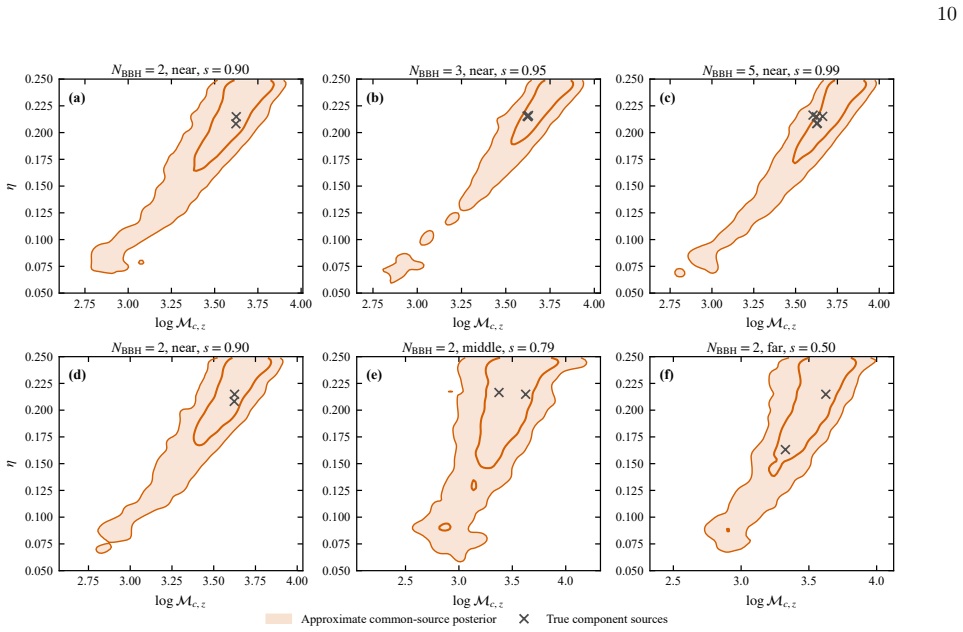
Physics-informed posterior fusion: a neural posterior estimator supplies unordered samples of the shared phase-consistency parameters (log Mc,z, η); those samples are attention-gated with frozen waveform features so source consistency can re-rank events that morphology alone leaves ambiguous.
What would settle it
Inject the same fusion and direct classifiers into a catalog-matched set whose unrelated multiple-merger population follows the observed mass and rate distribution, calibrate a true 1% empirical false-positive threshold on that population, and check whether fusion still lowers the 50%-efficiency network SNR from roughly 45 to 33.
Extended reading notes
Core claim
A fusion classifier that combines a simulation-trained approximate posterior over the common detector-frame chirp mass and symmetric mass ratio with direct waveform features improves ranking of lensed multi-image signals against unrelated multiple-merger events relative to waveform morphology alone, even though training never sees the physical lens families used at test time.
Load-bearing premise
A false-positive threshold that is 1% on the paper’s simulated unrelated-merger sample will still mean roughly 1% once the real catalog’s mass distribution, overlap rate, and noise are used.
Editorial extensions
If this is right
- At a 1% reference false-positive threshold calibrated on the matching unrelated-merger sample, detection efficiency for an observationally motivated BBH population rises from 20.8% to 35.2%.
- The network SNR needed for 50% detection efficiency falls from 45.3 to 33.5, corresponding to a 1.35 times larger SNR-equivalent distance scale.
- The ranking gain holds on held-out point-mass, SIS, SIE, and SIE-plus-shear lenses never used as training labels.
- Low false-positive performance remains controlled by loud, temporally compact, partly source-consistent unrelated overlaps, so any real search must rebuild the unrelated-merger population for its own catalog.
- Extending the same common-source idea to sky response becomes more informative as detector networks grow beyond two sites.
Reading between the lines
- Catalog pipelines that already emit mass posteriors could graft a lighter fusion head onto existing features without retraining a full residual waveform network from scratch.
- If wave-optics or substructure effects break pure geometric-optics phase preservation, the posterior target would need diffraction-aware parameters rather than mass-plane consistency alone.
- The 1.35 distance-scale gain implies that intermediate-SNR events now discarded as ambiguous overlaps may become usable for lensing cosmology once consistency ranking is applied.
- Spinning or neutron-star binaries would require enlarging the phase-consistency target to the next leading coefficients that control their frequency evolution.
Signed reviews
Editorial analysis
A structured set of objections, weighed in public.
Referee Report
Summary. The paper proposes a physics-informed ranking method for distinguishing lensed multi-image gravitational-wave signals from unrelated multiple-merger events in the same analysis window. It trains a neural posterior estimator for the common-source phase-consistency parameters (log Mc,z, η), then fuses finite posterior samples with a residual waveform classifier via attention gating. Training uses generic multi-image injections without lens-family labels; evaluation is held out on PM, SIS, SIE, and SIE+Shear lenses with O4 H1/L1 backgrounds. Averaged over held-out families the fusion model improves ROC-AUC from 0.785 to 0.844. For an observationally motivated BBH population the authors report detection efficiency rising from 20.8% to 35.2% at a nominal 1% FPR threshold, and the SNR for 50% efficiency falling from 45.3 to 33.5 (1.35× SNR-equivalent distance scale).
Significance. If the ranking gains survive proper threshold recalibration, the work is a useful methodological contribution: it encodes geometric-optics source consistency as a learnable intermediate representation and demonstrates held-out lens-family generalization without training on physical lens labels. Strengths include the explicit train/test lens-family separation, HPD/PIT posterior diagnostics, controlled mass-plane rejection maps, condition-bootstrap intervals, and an honest population-shift test that flags the calibration problem. The approach is a concrete step toward physics-guided ML searches in dense GW catalogs and is of clear interest to the lensing and multi-messenger communities.
major comments (2)
- Abstract and §III.C / Fig. 9: the headline claim that fusion raises efficiency from 20.8% to 35.2% and lowers ρ_net(50%) from 45.3 to 33.5 at a “1% reference FPR threshold” for the observationally motivated BBH population is not supported as stated. In the same section the authors show that thresholds calibrated on the original reference unrelated sample yield empirical FARs of 0.125 (direct) and 0.260 (fusion) on that population. The reported efficiencies are therefore measured at operating points that are no longer 1% FPR under the population for which they are quoted. The load-bearing quantitative claim requires re-setting the threshold so that the empirical FPR on the observationally motivated unrelated sample is truly 1% (and likewise for 0.1%), then re-reporting efficiency and D50. If the gain collapses after recalibration, the central numbers must be revised or removed from the ab
- §II.B and Table I: the unrelated multiple-merger class is constructed by superposing 2–5 independent BBHs with coalescence times drawn from the same ~0.6 s window and SNR rescaled into 8–48. The paper itself notes that for a realistic detected rate R the expected number of additional mergers in such a window is only RΔt ≪ 1. The difficult tail that controls low-FPR performance is therefore an artificial high-multiplicity, high-SNR construction. The authors should either (i) reweight or re-sample the unrelated class to a rate-consistent prior before quoting search-like FPR operating points, or (ii) clearly demote all fixed-FPR recalls to diagnostic status and lead with ROC-AUC / population-recalibrated metrics only.
minor comments (4)
- Table II vs. abstract: averaged R@1% FPR is 0.136 (direct) / 0.155 (fusion), while the abstract quotes 20.8% / 35.2% for the observationally motivated population. A short clarifying sentence in the abstract or §III.A would prevent readers from conflating the two numbers.
- Fig. 2 and Fig. 7: error bands or condition-bootstrap intervals on the SNR-dependent efficiency curves would make the intermediate-SNR gain easier to assess visually; the text already reports bootstrap intervals for the averages.
- §II.A: the Morse-phase convention (nj = 0, 1/2, 1 vs. integer Nj) is stated twice; a single consistent notation would reduce clutter.
- Data availability: the statement that processed data “will be made publicly available upon acceptance” is fine, but providing a temporary review link or DOI for the evaluation tables would aid reproducibility checks.
Circularity Check
No significant circularity: empirical ML ranking gains are measured on held-out simulations, not forced by construction from training labels or self-cited uniqueness.
full rationale
The paper is a controlled simulation study of a classifier architecture, not a first-principles derivation of a physical law. The NPE is trained solely on lensed multi-image examples to approximate q_phi(vartheta_ph|x) over (log Mc,z, eta); the fusion and posterior-set classifiers are then trained on generic multi-image injections (no physical lens-family labels) and evaluated on independently generated PM/SIS/SIE/SIE+Shear held-out sets plus an observationally motivated BBH population. Reported ROC-AUC, fixed-FPR recalls, and the 20.8%->35.2% / 45.3->33.5 numbers are ordinary operating-point measurements on those held-out samples after a threshold is set on the negative class; they are not algebraic rearrangements of the training objective or of a fitted parameter re-labeled as a prediction. Geometric-optics source consistency (Eq. 1-3) is standard external physics, not an author-derived uniqueness theorem. Self-citations to the authors' prior cosmology and ML papers appear only as background context and do not underwrite the ranking gains. The acknowledged population-shift miscalibration of the nominal 1% FPR threshold is a validity/operating-point caveat, not a circular reduction of the efficiency claim to its own inputs. Hence the derivation chain is self-contained against the paper's own benchmarks.
Assumptions & free parameters
free parameters (4)
- NPE conditioning embedding dim / spline-flow width / number of transforms
- Number of posterior samples K at train/eval
- Generic multi-image prior ranges (Nimg 2–5, |μ|^{1/2} 1–20, Δt ∈ [−0.3,0.3] s, Morse indices)
- SNR rescaling range 8–48 and 1%/0.1% FPR operating points
assumptions (4)
- domain assumption In the geometric-optics limit, lensing multiplies each image by |μ_j|^{1/2} exp(2πifΔt_j − iπ n_j) while leaving the intrinsic source waveform phase evolution unchanged (Eq. 1).
- ad hoc to paper Detector-frame chirp mass and symmetric mass ratio form a sufficient low-dimensional phase-consistency diagnostic for the controlled nonspinning BBH study on H1/L1 O4 data.
- domain assumption Unrelated multiple-merger events can be simulated by superposing 2–5 independent unlensed BBHs with coalescence times drawn inside the same analysis window.
- domain assumption Neural spline flow NPE trained by negative log-likelihood on lensed simulations yields a usable approximate posterior under the simulation model (diagnostics in Fig. 6).
invented entities (1)
-
Physics-informed posterior fusion classifier (attention-gated combination of frozen waveform ResNet features and NPE posterior tokens)
Cite this review
Pith. "Pith review of Identifying lensed gravitational waves with physics-informed posterior learning." pith.science (2026). https://pith.science/paper/VQKBK6UW
@misc{pith2026260703885,
  author       = {Pith},
  title        = {Pith review of: Identifying lensed gravitational waves with physics-informed posterior learning},
  year         = {2026},
  howpublished = {\url{https://pith.science/paper/VQKBK6UW}},
  note         = {Machine review of arXiv:2607.03885}
}
abstract
Gravitational lensing of gravitational waves can probe compact lenses, dark matter substructure, and cosmological distances, but identifying lensed events is difficult when unrelated binary mergers overlap in the same analysis window. We develop physics-informed posterior learning for ranking lensed multi-image signals against unrelated multiple-merger events. The method exploits the geometric-optics consistency that lensing can change amplitudes, arrival times, and Morse phase offsets while preserving the intrinsic phase evolution of the source. We infer a simulation-trained approximate posterior for the common detector-frame chirp mass and symmetric mass ratio, and fuse posterior samples with direct waveform features. Training uses generic multi-image simulations, while point-mass, singular-isothermal-sphere, singular-isothermal-ellipsoid, and shear-perturbed lenses are reserved for held-out lens-family evaluation. For the observationally motivated binary-black-hole population, the fusion ranking raises the detection efficiency from $20.8\%$ to $35.2\%$ at a $1\%$ reference false-positive-rate threshold calibrated on the corresponding unrelated multiple-merger sample. It lowers the network signal-to-noise ratio needed for $50\%$ detection efficiency from 45.3 to 33.5, which corresponds to a 1.35 times larger signal-to-noise-ratio-equivalent distance scale. The gain is limited by loud unrelated multiple-merger events that are partly source consistent, and by the need to calibrate the unrelated multiple-merger population. These results suggest that physical consistency can become a guiding principle for machine learning searches in dense gravitational-wave catalogs.
Figures


Figures from the paper (7 more)



Forward citations
Cited by 1 Pith paper
-
Search for strong lensing of gravitational waves in the binary black hole events from O1-O4a
Posterior Overlap 2.0 finds no lensed BBH pairs in O1–O4a (p_L < 0.6% for all pairs) and sets a 90% upper bound of 1.4% on the strong-lensing fraction.
Reference graph
Works this paper leans on
-
[1]
It is used as the primary baseline be- cause it measures the performance available from wave- form morphology alone
Direct waveform classifier The direct classifier is a one-dimensional residual net- work that maps the whitened H1–L1 time series directly to a binary label. It is used as the primary baseline be- cause it measures the performance available from wave- form morphology alone. The backbone begins with a one- dimensional convolution with kernel size 7 and str...
-
[2]
It consists of a residual waveform encoder and a neural spline flow decoder
Neural posterior estimator The posterior estimator maps the same inputx to a simulation-trained approximate common-source conditional density over the two-dimensional phase- consistency parameterϑ ph, qϕ(ϑph|x)≃p(ϑ ph|x,H common).(5) HereH common denotes the low-dimensional common- source hypothesis under the simulation prior. It consists of a residual wa...
-
[3]
,ϑ(K) ph },ϑ (k) ph ∼q ϕ(ϑph|x).(7) The posterior-set classifier treatsS K as an unordered set
Posterior-set classifier For each input waveform, the posterior estimator gen- eratesKsamples, SK(x) ={ϑ (1) ph , . . . ,ϑ(K) ph },ϑ (k) ph ∼q ϕ(ϑph|x).(7) The posterior-set classifier treatsS K as an unordered set. Each posterior sample is first passed through a point- wise multilayer perceptron 2→128→256→512, with batch normalization and ReLU activation...
-
[4]
Posterior samples are em- bedded as tokens, refined by four-head self-attention, and combined with the direct waveform feature through four- head cross-attention
Attention-gated fusion classifier The fusion classifier combines the frozen 2048- dimensional waveform feature with posterior samples from the frozen estimator. Posterior samples are em- bedded as tokens, refined by four-head self-attention, and combined with the direct waveform feature through four- head cross-attention. The projected waveform feature, c...
-
[5]
B. F. Schutz, Nature323, 310 (1986)
1986
-
[6]
B. P. Abbottet al.(LIGO Scientific, Virgo), Phys. Rev. Lett.116, 221101 (2016), [Erratum: Phys.Rev.Lett. 121, 129902 (2018)], arXiv:1602.03841 [gr-qc]
arXiv 2016
-
[7]
B. P. Abbottet al.(LIGO Scientific, Virgo, 1M2H, Dark Energy Camera GW-E, DES, DLT40, Las Cumbres Observatory, VINROUGE, MASTER), Nature551, 85 (2017), arXiv:1710.05835 [astro-ph.CO]
arXiv 2017
-
[8]
H.-Y. Chen, M. Fishbach, and D. E. Holz, Nature562, 545 (2018), arXiv:1712.06531 [astro-ph.CO]
arXiv 2018
Show all 186 references
-
[9]
B. P. Abbottet al.(LIGO Scientific, Virgo), Phys. Rev. Lett.123, 011102 (2019), arXiv:1811.00364 [gr-qc]
2019 arXiv
-
[10]
Wang, X.-N
L.-F. Wang, X.-N. Zhang, J.-F. Zhang, and X. Zhang, Phys. Lett. B782, 87 (2018), arXiv:1802.04720 [astro- ph.CO]
2018 arXiv
-
[11]
Zhang, L.-F
X.-N. Zhang, L.-F. Wang, J.-F. Zhang, and X. Zhang, Phys. Rev. D99, 063510 (2019), arXiv:1804.08379 [astro-ph.CO]
2019 arXiv
-
[12]
B. P. Abbottet al.(LIGO Scientific, Virgo), Phys. Rev. D100, 104036 (2019), arXiv:1903.04467 [gr-qc]
2019 arXiv
-
[13]
Zhang, H.-Y
J.-F. Zhang, H.-Y. Dong, J.-Z. Qi, and X. Zhang, Eur. Phys. J. C80, 217 (2020), arXiv:1906.07504 [astro- ph.CO]
2020 arXiv
-
[14]
Zhang, M
J.-F. Zhang, M. Zhang, S.-J. Jin, J.-Z. Qi, and X. Zhang, JCAP09, 068 (2019), arXiv:1907.03238 [astro-ph.CO]
2019 arXiv
-
[15]
Wang, Z.-W
L.-F. Wang, Z.-W. Zhao, J.-F. Zhang, and X. Zhang, JCAP11, 012 (2020), arXiv:1907.01838 [astro-ph.CO]
2020 arXiv
-
[16]
Zhao, L.-F
Z.-W. Zhao, L.-F. Wang, J.-F. Zhang, and X. Zhang, Sci. Bull.65, 1340 (2020), arXiv:1912.11629 [astro- ph.CO]
2020 arXiv
-
[17]
Jin, D.-Z
S.-J. Jin, D.-Z. He, Y. Xu, J.-F. Zhang, and X. Zhang, JCAP03, 051 (2020), arXiv:2001.05393 [astro-ph.CO]
2020 arXiv
-
[18]
Abbottet al.(LIGO Scientific, Virgo), Phys
R. Abbottet al.(LIGO Scientific, Virgo), Phys. Rev. D 103, 122002 (2021), arXiv:2010.14529 [gr-qc]
2021 arXiv
-
[19]
Biscoveanu, M
S. Biscoveanu, M. Isi, S. Vitale, and V. Varma, Phys. Rev. Lett.126, 171103 (2021), arXiv:2007.09156 [astro- ph.HE]
2021 arXiv
-
[20]
Roulet, H
J. Roulet, H. S. Chia, S. Olsen, L. Dai, T. Venumad- hav, B. Zackay, and M. Zaldarriaga, Phys. Rev. D104, 083010 (2021), arXiv:2105.10580 [astro-ph.HE]
2021 arXiv
-
[21]
Jin, L.-F
S.-J. Jin, L.-F. Wang, P.-J. Wu, J.-F. Zhang, and X. Zhang, Phys. Rev. D104, 103507 (2021), arXiv:2106.01859 [astro-ph.CO]
2021 arXiv
-
[22]
C. Gong, T. Zhu, R. Niu, Q. Wu, J.-L. Cui, X. Zhang, W. Zhao, and A. Wang, Phys. Rev. D105, 044034 (2022), arXiv:2112.06446 [gr-qc]
2022 arXiv
-
[23]
Biscoveanu, T
S. Biscoveanu, T. A. Callister, C.-J. Haster, K. K. Y. Ng, S. Vitale, and W. M. Farr, Astrophys. J. Lett.932, L19 (2022), arXiv:2204.01578 [astro-ph.HE]
2022 arXiv
-
[24]
Fishbach, C
M. Fishbach, C. Kimball, and V. Kalogera, Astro- phys. J. Lett.935, L26 (2022), arXiv:2207.02924 [astro- ph.HE]
2022 arXiv
-
[25]
T. A. Callister, S. J. Miller, K. Chatziioannou, and W. M. Farr, Astrophys. J. Lett.937, L13 (2022), arXiv:2205.08574 [astro-ph.HE]
2022 arXiv
-
[26]
H. Tong, S. Galaudage, and E. Thrane, Phys. Rev. D 106, 103019 (2022), arXiv:2209.02206 [astro-ph.HE]
2022 arXiv
-
[27]
Abbottet al.(KAGRA, VIRGO, LIGO Scientific), Phys
R. Abbottet al.(KAGRA, VIRGO, LIGO Scientific), Phys. Rev. X13, 011048 (2023), arXiv:2111.03634 [astro-ph.HE]
2023 arXiv
-
[28]
Abbottet al.(LIGO Scientific, Virgo, KAGRA), Astrophys
R. Abbottet al.(LIGO Scientific, Virgo, KAGRA), Astrophys. J.949, 76 (2023), arXiv:2111.03604 [astro- ph.CO]
2023 arXiv
-
[29]
Jin, T.-N
S.-J. Jin, T.-N. Li, J.-F. Zhang, and X. Zhang, JCAP 08, 070 (2023), arXiv:2202.11882 [gr-qc]
2023 arXiv
-
[30]
Song, L.-F
J.-Y. Song, L.-F. Wang, Y. Li, Z.-W. Zhao, J.-F. Zhang, W. Zhao, and X. Zhang, Sci. China Phys. Mech. Astron. 67, 230411 (2024), arXiv:2212.00531 [astro-ph.CO]
2024 arXiv
-
[31]
Jin, Y.-Z
S.-J. Jin, Y.-Z. Zhang, J.-Y. Song, J.-F. Zhang, and X. Zhang, Sci. China Phys. Mech. Astron.67, 220412 (2024), arXiv:2305.19714 [astro-ph.CO]
2024 arXiv
-
[32]
B. Sun, J. An, and Z. Cao, Phys. Lett. B848, 138350 (2024), arXiv:2308.00233 [gr-qc]
2024 arXiv
-
[33]
Abbottet al.(LIGO Scientific, VIRGO, KAGRA), Phys
R. Abbottet al.(LIGO Scientific, VIRGO, KAGRA), Phys. Rev. D112, 084080 (2025), arXiv:2112.06861 [gr- qc]
2025 arXiv
-
[34]
Song, J.-Z
J.-Y. Song, J.-Z. Qi, J.-F. Zhang, and X. Zhang, Astro- phys. J. Lett.985, L44 (2025), arXiv:2503.10346 [astro- ph.CO]
2025 arXiv
-
[35]
Jin, J.-Y
S.-J. Jin, J.-Y. Song, T.-Y. Sun, S.-R. Xiao, H. Wang, L.-F. Wang, J.-F. Zhang, and X. Zhang, Sci. China Phys. Mech. Astron.69, 220401 (2026), arXiv:2507.12965 [astro-ph.CO]
2026
-
[36]
Song, G.-H
J.-Y. Song, G.-H. Du, T.-N. Li, L.-F. Wang, J.-Z. Qi, J.-F. Zhang, and X. Zhang, Sci. China Phys. Mech. 15 Astron.69, 240413 (2026), arXiv:2511.12017 [astro- ph.CO]
2026
-
[37]
Du, J.-Y
Y.-N. Du, J.-Y. Song, Y. Li, S.-J. Jin, L.-F. Wang, J.- F. Zhang, and X. Zhang, Phys. Rev. D113, 083519 (2026), arXiv:2510.21521 [astro-ph.CO]
2026 arXiv
-
[38]
Song, Y.-Y
J.-Y. Song, Y.-Y. Dong, S.-J. Jin, S.-R. Xiao, J.-F. Zhang, and X. Zhang, (2026), arXiv:2603.13080 [astro- ph.CO]
2026
-
[39]
Xiong, J.-Y
E.-Y. Xiong, J.-Y. Song, J.-F. Zhang, and X. Zhang, (2026), arXiv:2606.03634 [astro-ph.CO]
2026 arXiv
-
[40]
Song, Y.-N
J.-Y. Song, Y.-N. Du, Y.-Y. Dong, J.-F. Zhang, and X. Zhang, (2026), arXiv:2606.15844 [astro-ph.CO]
2026
-
[41]
Du, J.-Y
Y.-N. Du, J.-Y. Song, J.-F. Zhang, and X. Zhang, (2026), arXiv:2606.17617 [astro-ph.CO]
2026 arXiv
-
[42]
Maggioreet al.(ET), JCAP03, 050 (2020), arXiv:1912.02622 [astro-ph.CO]
M. Maggioreet al.(ET), JCAP03, 050 (2020), arXiv:1912.02622 [astro-ph.CO]
2020 arXiv
-
[43]
Barausseet al., Gen
E. Barausseet al., Gen. Rel. Grav.52, 81 (2020), arXiv:2001.09793 [gr-qc]
2020 arXiv
-
[44]
Ruan, Z.-K
W.-H. Ruan, Z.-K. Guo, R.-G. Cai, and Y.-Z. Zhang, Int. J. Mod. Phys. A35, 2050075 (2020), arXiv:1807.09495 [gr-qc]
2020 arXiv
-
[45]
Evanset al., (2021), arXiv:2109.09882 [astro-ph.IM]
M. Evanset al., (2021), arXiv:2109.09882 [astro-ph.IM]
2021 arXiv
-
[46]
Luoet al., Living Rev
J. Luoet al., Living Rev. Rel.29, 1 (2026), arXiv:2502.20138 [gr-qc]
2026 arXiv
-
[47]
Sereno, A
M. Sereno, A. Sesana, A. Bleuler, P. Jetzer, M. Volon- teri, and M. C. Begelman, Phys. Rev. Lett.105, 251101 (2010), arXiv:1011.5238 [astro-ph.CO]
2010 arXiv
- [48]
-
[49]
S.-S. Li, S. Mao, Y. Zhao, and Y. Lu, Mon. Not. Roy. Astron. Soc.476, 2220 (2018), arXiv:1802.05089 [astro- ph.CO]
2018 arXiv
-
[50]
K. K. Y. Ng, K. W. K. Wong, T. Broadhurst, and T. G. F. Li, Phys. Rev. D97, 023012 (2018), arXiv:1703.06319 [astro-ph.CO]
2018 arXiv
-
[51]
K.-H. Lai, O. A. Hannuksela, A. Herrera-Mart´ ın, J. M. Diego, T. Broadhurst, and T. G. F. Li, Phys. Rev. D 98, 083005 (2018), arXiv:1801.07840 [gr-qc]
2018 arXiv
-
[52]
B. Liu, Z. Li, and Z.-H. Zhu, Mon. Not. Roy. Astron. Soc.487, 1980 (2019), arXiv:1904.11751 [astro-ph.CO]
1980 arXiv
-
[53]
S. Cao, J. Qi, Z. Cao, M. Biesiada, J. Li, Y. Pan, and Z.-H. Zhu, Sci. Rep.9, 11608 (2019), arXiv:1910.10365 [astro-ph.CO]
2019 arXiv
-
[54]
J. Gais, K. K. Y. Ng, E. Seo, K. W. K. Wong, and T. G. F. Li, Astrophys. J. Lett.932, L4 (2022), arXiv:2201.01817 [gr-qc]
2022 arXiv
-
[55]
Guo and Y
X. Guo and Y. Lu, Phys. Rev. D106, 023018 (2022), arXiv:2207.00325 [astro-ph.CO]
2022 arXiv
-
[56]
F. Xu, J. M. Ezquiaga, and D. E. Holz, Astrophys. J. 929, 9 (2022), arXiv:2105.14390 [astro-ph.CO]
2022 arXiv
-
[57]
Wang, J.-H
L.-F. Wang, J.-H. Zhang, D.-Z. He, J.-F. Zhang, and X. Zhang, Mon. Not. Roy. Astron. Soc.514, 1433 (2022), arXiv:2102.09331 [astro-ph.CO]
2022 arXiv
-
[58]
Liu, Z.-H
X.-H. Liu, Z.-H. Li, J.-Z. Qi, and X. Zhang, Astrophys. J.927, 28 (2022), arXiv:2109.02291 [astro-ph.CO]
2022 arXiv
-
[59]
S. Cao, J. Qi, Z. Cao, M. Biesiada, W. Cheng, and Z.-H. Zhu, Astron. Astrophys.659, L5 (2022), arXiv:2202.08714 [astro-ph.CO]
2022 arXiv
-
[60]
Huang, Y.-M
S.-J. Huang, Y.-M. Hu, X. Chen, J.-d. Zhang, E.-K. Li, Z. Gao, and X.-Y. Lin, JCAP08, 003 (2023), arXiv:2304.10435 [astro-ph.CO]
2023 arXiv
-
[61]
Tambalo, M
G. Tambalo, M. Zumalac´ arregui, L. Dai, and M. H.-Y. Cheung, Phys. Rev. D108, 103529 (2023), arXiv:2212.11960 [astro-ph.CO]
2023 arXiv
-
[62]
A. K. Meena, Mon. Not. Roy. Astron. Soc.532, 3568 (2024), arXiv:2305.02880 [astro-ph.CO]
2024 arXiv
-
[63]
M. H.-Y. Cheung, K. K. Y. Ng, M. Zumalac´ arregui, and E. Berti, Phys. Rev. D109, 124020 (2024), arXiv:2403.13876 [gr-qc]
2024 arXiv
-
[64]
G. P. Smithet al., Phil. Trans. Roy. Soc. Lond. A383, 20240134 (2025), arXiv:2503.19973 [astro-ph.HE]
2025 arXiv
-
[65]
Z. Chen, Q. Yu, Y. Lu, and X. Guo, Astrophys. J. Lett. 993, L57 (2025), arXiv:2510.12470 [astro-ph.CO]
2025
-
[66]
H. Wu, T. Liu, and K. Liao, (2026), arXiv:2606.12792 [astro-ph.CO]
2026 arXiv
-
[67]
Ando, (2026), arXiv:2603.04267 [astro-ph.CO]
S. Ando, (2026), arXiv:2603.04267 [astro-ph.CO]
2026
-
[68]
Ando, (2026), arXiv:2606.21519 [astro-ph.CO]
S. Ando, (2026), arXiv:2606.21519 [astro-ph.CO]
2026 arXiv
-
[69]
Haris, A
K. Haris, A. K. Mehta, S. Kumar, T. Venumadhav, and P. Ajith, (2018), arXiv:1807.07062 [gr-qc]
2018 arXiv
-
[70]
Janquart, O
J. Janquart, O. A. Hannuksela, H. K., and C. Van Den Broeck, Mon. Not. Roy. Astron. Soc.506, 5430 (2021), arXiv:2105.04536 [gr-qc]
2021 arXiv
-
[71]
Abbottet al.(LIGO Scientific, VIRGO), Astrophys
R. Abbottet al.(LIGO Scientific, VIRGO), Astrophys. J.923, 14 (2021), arXiv:2105.06384 [gr-qc]
2021 arXiv
-
[72]
R. K. L. Lo and I. Magana Hernandez, Phys. Rev. D 107, 123015 (2023), arXiv:2104.09339 [gr-qc]
2023 arXiv
-
[73]
Janquartet al., Mon
J. Janquartet al., Mon. Not. Roy. Astron. Soc.526, 3832 (2023), arXiv:2306.03827 [gr-qc]
2023 arXiv
-
[74]
C ¸ alı¸ skan, J
M. C ¸ alı¸ skan, J. M. Ezquiaga, O. A. Hannuksela, and D. E. Holz, Phys. Rev. D107, 063023 (2023), arXiv:2201.04619 [astro-ph.CO]
2023 arXiv
-
[75]
A. Liu, I. C. F. Wong, S. H. W. Leong, A. More, O. A. Hannuksela, and T. G. F. Li, Mon. Not. Roy. Astron. Soc.525, 4149 (2023), arXiv:2302.09870 [gr-qc]
2023 arXiv
-
[76]
Abbottet al.(LIGO Scientific, KAGRA, VIRGO), Astrophys
R. Abbottet al.(LIGO Scientific, KAGRA, VIRGO), Astrophys. J.970, 191 (2024), arXiv:2304.08393 [gr-qc]
2024 arXiv
-
[77]
Goyal, S
S. Goyal, S. J. Kapadia, J.-R. Cudell, A. K. Y. Li, and J. C. L. Chan, Phys. Rev. D109, 023028 (2024), arXiv:2306.04397 [gr-qc]
2024 arXiv
-
[78]
Barsode, S
A. Barsode, S. Goyal, and P. Ajith, Astrophys. J.980, 258 (2025), arXiv:2412.01278 [gr-qc]
2025 arXiv
-
[79]
X. Shan, B. Hu, X. Chen, and R.-G. Cai, Nature As- tron.9, 916 (2025), arXiv:2301.06117 [astro-ph.IM]
2025 arXiv
-
[80]
Z. Su, X. Shan, Z. Lyu, J. Zhang, Y. Liu, S. Mao, and H. Yang, (2025), arXiv:2510.17125 [gr-qc]
2025
-
[81]
A. G. Abacet al.(LIGO Scientific, VIRGO, KAGRA), (2025), arXiv:2512.16347 [gr-qc]
2025
-
[82]
J. C. L. Chan, J. M. Ezquiaga, R. K. L. Lo, J. Bow- man, L. Maga˜ na Zertuche, and L. Vujeva, (2025), arXiv:2512.16916 [gr-qc]
2025
-
[83]
O. A. Hannuksela, K. Haris, J. Janquart, H. Narola, H. Phurailatpam, J. D. E. Creighton, and C. Van Den Broeck, Astrophys. J.1002, 42 (2026), arXiv:2510.15463 [astro-ph.HE]
2026
-
[84]
Barsode, K
A. Barsode, K. N. Maity, and P. Ajith, Astrophys. J. 998, 294 (2026), arXiv:2510.23238 [gr-qc]
2026
-
[85]
X. Shan, H. Yang, S. Mao, and O. A. Hannuksela, Astrophys. J.1004, 35 (2026), arXiv:2508.21262 [astro- ph.CO]
2026 arXiv
-
[86]
Kopty, S
A. Kopty, S. Mitra, and A. More, (2026), arXiv:2601.22138 [gr-qc]
2026
-
[87]
Heynen, S
J. Heynen, S. Roy, and J. Janquart, J. Phys. Conf. Ser. 3177, 012080 (2026), arXiv:2509.06745 [gr-qc]
2026 arXiv
-
[88]
Chakraborty and S
A. Chakraborty and S. Mukherjee, Astrophys. J.1002, 149 (2026), arXiv:2510.11790 [gr-qc]
2026 arXiv
- [89]
-
[90]
Mould, (2026), arXiv:2606.30144 [astro-ph.HE]
M. Mould, (2026), arXiv:2606.30144 [astro-ph.HE]. 16
2026 arXiv
-
[91]
Chakraborty and S
A. Chakraborty and S. Mukherjee, Astrophys. J.1003, 20 (2026), arXiv:2512.19077 [gr-qc]
2026 arXiv
-
[92]
Fern´ andez-N´ u˜ nez and O
I. Fern´ andez-N´ u˜ nez and O. Bulashenko, Phys. Lett. A 380, 2897 (2016), arXiv:1605.03176 [astro-ph.CO]
2016 arXiv
-
[93]
Fern´ andez-N´ u˜ nez and O
I. Fern´ andez-N´ u˜ nez and O. Bulashenko, Phys. Lett. A 381, 1764 (2017), arXiv:1612.07218 [astro-ph.CO]
2017 arXiv
-
[94]
Dai, S.-S
L. Dai, S.-S. Li, B. Zackay, S. Mao, and Y. Lu, Phys. Rev. D98, 104029 (2018), arXiv:1810.00003 [gr-qc]
2018 arXiv
-
[95]
J. M. Diego, O. A. Hannuksela, P. L. Kelly, T. Broad- hurst, K. Kim, T. G. F. Li, G. F. Smoot, and G. Pagano, Astron. Astrophys.627, A130 (2019), arXiv:1903.04513 [astro-ph.CO]
2019 arXiv
-
[96]
Jung and C
S. Jung and C. S. Shin, Phys. Rev. Lett.122, 041103 (2019), arXiv:1712.01396 [astro-ph.CO]
2019 arXiv
-
[97]
J. M. Diego, Phys. Rev. D101, 123512 (2020), arXiv:1911.05736 [astro-ph.CO]
2020 arXiv
- [98]
-
[99]
Y. Wang, R. K. L. Lo, A. K. Y. Li, and Y. Chen, Phys. Rev. D103, 104055 (2021), arXiv:2101.08264 [gr-qc]
2021 arXiv
-
[100]
M. H. Y. Cheung, J. Gais, O. A. Hannuksela, and T. G. F. Li, Mon. Not. Roy. Astron. Soc.503, 3326 (2021), arXiv:2012.07800 [astro-ph.HE]
2021 arXiv
-
[101]
Mishra, A
A. Mishra, A. K. Meena, A. More, S. Bose, and J. S. Bagla, Mon. Not. Roy. Astron. Soc.508, 4869 (2021), arXiv:2102.03946 [astro-ph.CO]
2021 arXiv
-
[102]
H. G. Choi, C. Park, and S. Jung, Phys. Rev. D104, 063001 (2021), arXiv:2103.08618 [astro-ph.CO]
2021 arXiv
-
[103]
Urrutia and V
J. Urrutia and V. Vaskonen, Mon. Not. Roy. Astron. Soc.509, 1358 (2021), arXiv:2109.03213 [astro-ph.CO]
2021 arXiv
- [104]
-
[105]
E. Seo, O. A. Hannuksela, and T. G. F. Li, Astrophys. J.932, 50 (2022), arXiv:2110.03308 [astro-ph.HE]
2022 arXiv
-
[106]
Goyal, A
S. Goyal, A. Vijaykumar, J. M. Ezquiaga, and M. Zumalacarregui, Phys. Rev. D108, 024052 (2023), arXiv:2301.04826 [gr-qc]
2023 arXiv
-
[107]
Tambalo, M
G. Tambalo, M. Zumalac´ arregui, L. Dai, and M. H.-Y. Cheung, Phys. Rev. D108, 043527 (2023), arXiv:2210.05658 [gr-qc]
2023 arXiv
-
[108]
C ¸ alı¸ skan, N
M. C ¸ alı¸ skan, N. Anil Kumar, L. Ji, J. M. Ezquiaga, R. Cotesta, E. Berti, and M. Kamionkowski, Phys. Rev. D108, 123543 (2023), arXiv:2307.06990 [astro-ph.CO]
2023 arXiv
-
[109]
Fairbairn, J
M. Fairbairn, J. Urrutia, and V. Vaskonen, JCAP07, 007 (2023), arXiv:2210.13436 [astro-ph.CO]
2023 arXiv
-
[110]
Brando, S
G. Brando, S. Goyal, S. Savastano, H. Villarrubia-Rojo, and M. Zumalac´ arregui, Phys. Rev. D111, 024068 (2025), arXiv:2407.04052 [gr-qc]
2025 arXiv
-
[111]
S. Jana, S. J. Kapadia, T. Venumadhav, S. More, and P. Ajith, Phys. Rev. Lett.135, 111402 (2025), arXiv:2408.05290 [astro-ph.CO]
2025 arXiv
-
[112]
Relton and V
P. Relton and V. Raymond, Phys. Rev. D104, 084039 (2021), arXiv:2103.16225 [gr-qc]
2021 arXiv
-
[113]
Keitel, Phil
D. Keitel, Phil. Trans. Roy. Soc. Lond. A383, 20240128 (2025), arXiv:2407.12974 [gr-qc]
2025 arXiv
-
[114]
Q. Diao, H. Wang, M. Liang, H. Wang, Z. Luo, M. Du, and P. Xu, Phys. Rev. D113, 123057 (2026), arXiv:2504.09679 [gr-qc]
2026 arXiv
-
[115]
N. Rao, A. Mishra, A. Ganguly, and A. More, Phys. Rev. D113, 023054 (2026), arXiv:2510.17787 [gr-qc]
2026
-
[116]
Goyal, H
S. Goyal, H. Villarrubia-Rojo, and M. Zumalacarregui, (2025), arXiv:2512.17631 [astro-ph.GA]
2025
-
[117]
Q. Hu, H. Narola, J. Heynen, M. Wright, J. Veitch, J. Janquart, and C. Van Den Broeck, Astrophys. J. 1003, 187 (2026), arXiv:2512.17550 [gr-qc]
2026 arXiv
- [118]
-
[119]
K. He, X. Zhang, S. Ren, and J. Sun, in2016 IEEE Conference on Computer Vision and Pattern Recogni- tion, CVPR 2016, Las Vegas, NV, USA, June 27-30, 2016(IEEE Computer Society, 2016) pp. 770–778
2016
-
[120]
Zevinet al., Class
M. Zevinet al., Class. Quant. Grav.34, 064003 (2017), arXiv:1611.04596 [gr-qc]
2017 arXiv
-
[121]
Gabbard, M
H. Gabbard, M. Williams, F. Hayes, and C. Messenger, Phys. Rev. Lett.120, 141103 (2018), arXiv:1712.06041 [astro-ph.IM]
2018 arXiv
-
[122]
George and E
D. George and E. A. Huerta, Phys. Rev. D97, 044039 (2018), arXiv:1701.00008 [astro-ph.IM]
2018 arXiv
-
[123]
George and E
D. George and E. A. Huerta, Phys. Lett. B778, 64 (2018), arXiv:1711.03121 [gr-qc]
2018 arXiv
-
[124]
H. Xia, L. Shao, J. Zhao, and Z. Cao, Phys. Rev. D 103, 024040 (2021), arXiv:2011.04418 [astro-ph.HE]
2021 arXiv
-
[125]
Chatterjee, L
C. Chatterjee, L. Wen, F. Diakogiannis, and K. Vinsen, Phys. Rev. D104, 064046 (2021), arXiv:2105.03073 [gr- qc]
2021 arXiv
-
[126]
Whittaker, W
T. Whittaker, W. E. East, S. R. Green, L. Lehner, and H. Yang, Phys. Rev. D105, 124021 (2022), arXiv:2201.06461 [gr-qc]
2022 arXiv
-
[127]
M. B. Sch¨ aferet al., Phys. Rev. D107, 023021 (2023), arXiv:2209.11146 [astro-ph.IM]
2023 arXiv
-
[128]
T. Zhao, R. Lyu, H. Wang, Z. Cao, and Z. Ren, Com- mun. Phys.6, 212 (2023), arXiv:2207.07414 [gr-qc]
2023 arXiv
-
[129]
Sun, C.-Y
T.-Y. Sun, C.-Y. Xiong, S.-J. Jin, Y.-X. Wang, J.-F. Zhang, and X. Zhang, Chin. Phys. C48, 045108 (2024), arXiv:2312.08122 [gr-qc]
2024 arXiv
-
[130]
Wang, S.-J
Y.-X. Wang, S.-J. Jin, T.-Y. Sun, J.-F. Zhang, and X. Zhang, Chin. Phys. C48, 125107 (2024), arXiv:2305.19003 [gr-qc]
2024 arXiv
-
[131]
H. Wang, Y. Zhou, Z. Cao, Z. Guo, and Z. Ren, Mach. Learn. Sci. Tech.5, 015046 (2024), arXiv:2212.14283 [gr-qc]
2024 arXiv
-
[132]
Y. Xu, M. Du, P. Xu, B. Liang, and H. Wang, Phys. Lett. B858, 139016 (2024), arXiv:2402.13091 [gr-qc]
2024 arXiv
-
[133]
R. Shi, Y. Zhou, T. Zhao, Z. Wang, Z. Ren, and Z. Cao, Phys. Rev. D111, 044016 (2025), arXiv:2411.14893 [gr- qc]
2025 arXiv
-
[134]
Y.-X. Wang, X. Wei, C.-Y. Li, T.-Y. Sun, S.-J. Jin, H. Wang, J.-L. Cui, J.-F. Zhang, and X. Zhang, Phys. Rev. D112, 024030 (2025), arXiv:2410.20129 [gr-qc]
2025 arXiv
-
[135]
T.-Y. Sun, Y. Niu, C.-Y. Jiang, S.-J. Jin, Y. Yuan, and X. Zhang, (2026), arXiv:2605.21310 [gr-qc]
2026 arXiv
-
[136]
Goyal, H
S. Goyal, H. D., S. J. Kapadia, and P. Ajith, Phys. Rev. D104, 124057 (2021), arXiv:2106.12466 [gr-qc]
2021 arXiv
-
[137]
K. Kim, J. Lee, O. A. Hannuksela, and T. G. F. Li, Astrophys. J.938, 157 (2022), arXiv:2206.08234 [gr-qc]
2022 arXiv
-
[138]
Magare, A
S. Magare, A. More, and S. Choudhary, Mon. Not. Roy. Astron. Soc.535, 990 (2024), arXiv:2403.02994 [astro- ph.HE]
2024 arXiv
- [139]
-
[140]
T. Wang, T. Zhao, M. Du, Z. Luo, P. Dong, and P. Xu, (2025), arXiv:2512.21370 [astro-ph.IM]
2025 arXiv
-
[141]
A. Liu, T. Liu, D. Li, C. Wen, J. Wang, K. Liao, J. Cui, and H. Zhou, (2025), arXiv:2509.04538 [astro-ph.IM]
2025 arXiv
-
[142]
Campailla, M
G. Campailla, M. Raveri, W. Hu, and J. M. Ezquiaga, Phys. Rev. D113, 083510 (2026), arXiv:2509.06901 [gr- qc]
2026 arXiv
-
[143]
Zhang, Q
F. Zhang, Q. Zhang, Q. Yang, J. Huang, Y. Yuan, and 17 X. Fan, (2026), arXiv:2605.29510 [astro-ph.HE]
2026 arXiv
-
[144]
D. Li, T. Liu, A. Liu, C. Wen, J. Wang, K. Liao, and J. Cui, Astrophys. J. Suppl.283, 31 (2026), arXiv:2508.19311 [astro-ph.IM]
2026
-
[145]
D. J. Rezende and S. Mohamed, inProceedings of the 32nd International Conference on Machine Learning, ICML 2015, Lille, France, 6-11 July 2015, JMLR Work- shop and Conference Proceedings, Vol. 37, edited by F. R. Bach and D. M. Blei (JMLR.org, 2015) pp. 1530– 1538
2015
-
[146]
Papamakarios, T
G. Papamakarios, T. Pavlakou, and I. Murray, CoRR abs/1705.07057(2017), 1705.07057
2017 arXiv
-
[147]
L. Dinh, J. Sohl-Dickstein, R. Pascanu, and H. Larochelle, inDeep Generative Models for Highly Structured Data, ICLR 2019 Workshop, New Orleans, Louisiana, United States, May 6, 2019(OpenRe- view.net, 2019)
2019
-
[148]
Z. M. Ziegler and A. M. Rush, inProceedings of the 36th International Conference on Machine Learning, ICML 2019, 9-15 June 2019, Long Beach, California, USA, Proceedings of Machine Learning Research, Vol. 97, edited by K. Chaudhuri and R. Salakhutdinov (PMLR,
2019
-
[149]
Durkan, A
C. Durkan, A. Bekasov, I. Murray, and G. Papamakar- ios, inAdvances in Neural Information Processing Sys- tems 32: Annual Conference on Neural Information Processing Systems 2019, NeurIPS 2019, December 8- 14, 2019, Vancouver, BC, Canada, edited by H. M. Wallach, H. Larochelle...
2019
-
[150]
S. R. Green, C. Simpson, and J. Gair, Phys. Rev. D 102, 104057 (2020), arXiv:2002.07656 [astro-ph.IM]
2020 arXiv
-
[151]
S. R. Green and J. Gair, Mach. Learn. Sci. Tech.2, 03LT01 (2021), arXiv:2008.03312 [astro-ph.IM]
2021 arXiv
-
[152]
M. Dax, S. R. Green, J. Gair, J. H. Macke, A. Buo- nanno, and B. Sch¨ olkopf, Phys. Rev. Lett.127, 241103 (2021), arXiv:2106.12594 [gr-qc]
2021 arXiv
-
[153]
M. J. Williams, J. Veitch, and C. Messenger, Phys. Rev. D103, 103006 (2021), arXiv:2102.11056 [gr-qc]
2021 arXiv
-
[154]
Gabbard, C
H. Gabbard, C. Messenger, I. S. Heng, F. Tonolini, and R. Murray-Smith, Nature Phys.18, 112 (2022), arXiv:1909.06296 [astro-ph.IM]
2022 arXiv
-
[155]
H. Shen, E. A. Huerta, E. O’Shea, P. Kumar, and Z. Zhao, Mach. Learn. Sci. Tech.3, 015007 (2022), arXiv:1903.01998 [gr-qc]
2022 arXiv
-
[156]
M. Dax, S. R. Green, J. Gair, M. P¨ urrer, J. Wildberger, J. H. Macke, A. Buonanno, and B. Sch¨ olkopf, Phys. Rev. Lett.130, 171403 (2023), arXiv:2210.05686 [gr- qc]
2023 arXiv
-
[157]
Leyde, S
K. Leyde, S. R. Green, A. Toubiana, and J. Gair, Phys. Rev. D109, 064056 (2024), arXiv:2311.12093 [gr-qc]
2024 arXiv
-
[158]
M. Du, B. Liang, H. Wang, P. Xu, Z. Luo, and Y. Wu, Sci. China Phys. Mech. Astron.67, 230412 (2024), arXiv:2308.05510 [astro-ph.IM]
2024 arXiv
-
[159]
M. Dax, S. R. Green, J. Gair, N. Gupte, M. P¨ urrer, V. Raymond, J. Wildberger, J. H. Macke, A. Buo- nanno, and B. Sch¨ olkopf, Nature639, 49 (2025), arXiv:2407.09602 [gr-qc]
2025 arXiv
-
[160]
Bada-Nerin, O
R. Bada-Nerin, O. Bulashenko, O. Gramaxo Freitas, and J. A. Font, Phys. Rev. D111, 084067 (2025), arXiv:2412.00566 [gr-qc]
2025 arXiv
- [161]
-
[162]
Xiong, T.-Y
C.-Y. Xiong, T.-Y. Sun, J.-F. Zhang, and X. Zhang, Phys. Rev. D111, 024019 (2025), arXiv:2405.09475 [gr- qc]
2025 arXiv
-
[163]
T.-Y. Sun, Y. Shao, Y. Li, Y. Xu, H. Wang, and X. Zhang, Commun. Phys.8, 220 (2025), arXiv:2407.14298 [astro-ph.CO]
2025 arXiv
-
[164]
Sun, T.-N
T.-Y. Sun, T.-N. Li, H. Wang, J.-F. Zhang, and X. Zhang, (2025), arXiv:2510.27086 [astro-ph.CO]
2025
-
[165]
Qin, T.-Y
Z. Qin, T.-Y. Sun, B.-Y. Li, J.-F. Zhang, X. Guo, and X. Zhang, Phys. Rev. D113, 104023 (2026), arXiv:2505.20996 [gr-qc]
2026 arXiv
-
[166]
T.-Y. Sun, B. Liang, J.-Y. Song, S.-T. Liu, S.-J. Jin, H. Wang, M.-H. Du, J.-F. Zhang, and X. Zhang, (2026), arXiv:2604.13867 [gr-qc]
2026 arXiv
-
[167]
Hermans, A
J. Hermans, A. Delaunoy, F. Rozet, A. Wehenkel, and G. Louppe, CoRRabs/2110.06581(2021), 2110.06581
2021 arXiv
-
[168]
Deguchi and W
S. Deguchi and W. D. Watson, Astrophys. J.307, 30 (1986)
1986
-
[169]
Schneider, J
P. Schneider, J. Ehlers, and E. E. Falco,Gravitational Lenses(Springer, 1992)
1992
-
[170]
Takahashi and T
R. Takahashi and T. Nakamura, Astrophys. J.595, 1039 (2003), arXiv:astro-ph/0305055
2003 arXiv
-
[171]
Takahashi, Astron
R. Takahashi, Astron. Astrophys.423, 787 (2004), arXiv:astro-ph/0402165. [168]Saas-Fee Advanced Course 33: Gravitational Lensing: Strong, Weak and Micro(2006) arXiv:astro-ph/0407232 [astro-ph]
2004 arXiv
-
[172]
A. K. Meena and J. S. Bagla, Mon. Not. Roy. Astron. Soc.492, 1127 (2020), arXiv:1903.11809 [astro-ph.CO]
2020 arXiv
-
[173]
Bulashenko and H
O. Bulashenko and H. Ubach, JCAP07, 022 (2022), arXiv:2112.10773 [gr-qc]
2022 arXiv
-
[174]
Bondarescu, H
R. Bondarescu, H. Ubach, O. Bulashenko, and A. P. Lundgren, Phys. Rev. D108, 084033 (2023), arXiv:2211.13604 [gr-qc]
2023 arXiv
-
[175]
S. Ali, E. Stoikos, E. Meade, M. Kesden, and L. King, Phys. Rev. D107, 103023 (2023), arXiv:2210.01873 [gr- qc]
2023 arXiv
-
[176]
A. G. Abacet al.(LIGO Scientific, Virgo, KAGRA), Astrophys. J.1004, 232 (2026), arXiv:2508.18079 [gr- qc]
2026 arXiv
-
[177]
Ajithet al., Phys
P. Ajithet al., Phys. Rev. Lett.106, 241101 (2011), arXiv:0909.2867 [gr-qc]
2011 arXiv
-
[178]
Veitchet al., Phys
J. Veitchet al., Phys. Rev. D91, 042003 (2015), arXiv:1409.7215 [gr-qc]
2015 arXiv
-
[179]
Harry, S
I. Harry, S. Privitera, A. Boh´ e, and A. Buonanno, Phys. Rev. D94, 024012 (2016), arXiv:1603.02444 [gr-qc]
2016 arXiv
-
[180]
C. M. Biwer, C. D. Capano, S. De, M. Cabero, D. A. Brown, A. H. Nitz, and V. Raymond, Publ. Astron. Soc. Pac.131, 024503 (2019), arXiv:1807.10312 [astro- ph.IM]
2019 arXiv
-
[181]
Estell´ eset al., Astrophys
H. Estell´ eset al., Astrophys. J.924, 79 (2022), arXiv:2105.06360 [gr-qc]
2022 arXiv
-
[182]
Mateu-Lucena, S
M. Mateu-Lucena, S. Husa, M. Colleoni, H. Estell´ es, C. Garc´ ıa-Quir´ os, D. Keitel, M. d. L. Planas, and A. Ramos-Buades, Mon. Not. Roy. Astron. Soc.517, 2403 (2022), arXiv:2105.05960 [gr-qc]
2022 arXiv
-
[183]
Estell´ es, M
H. Estell´ es, M. Colleoni, C. Garc´ ıa-Quir´ os, S. Husa, D. Keitel, M. Mateu-Lucena, M. d. L. Planas, and A. Ramos-Buades, Phys. Rev. D105, 084040 (2022), arXiv:2105.05872 [gr-qc]
2022 arXiv
-
[184]
Zaheer, S
M. Zaheer, S. Kottur, S. Ravanbakhsh, B. P´ oczos, R. Salakhutdinov, and A. J. Smola, inAdvances in Neu- ral Information Processing Systems 30: Annual Confer- 18 ence on Neural Information Processing Systems 2017, December 4-9, 2017, Long Beach, CA, USA, edited by I. Guyon, U....
2017
- [185]
-
[186]
Fairhurst, Class
S. Fairhurst, Class. Quant. Grav.28, 105021 (2011), arXiv:1010.6192 [gr-qc]
2011 arXiv
Reviewed July 11, 2026 · model on record in the stance chip above.
Discussion (0). Continue with ORCID to comment.