REVIEW 4 major objections 8 minor 42 references
Optimized two-stage AI-based Neural Decoding for Enhanced Visual Stimulus Reconstruction from fMRI Data
T0 review · 4 major / 8 minor · reviewed 2026-08-11 · deepseek-v4-flash
Pith's one-line read This paper claims that a GRU-based first stage improves the structural and semantic fidelity of reconstructed visual stimuli from fMRI data by about 2% and 4% over the ridge-regression state of the art.
desk verdict Useful incremental work with a nice noise analysis, but the headline gain is a one-subject effect that disappears in the four-subject averages. read the letter →
The pith
A machine-rendered reading of the paper's core claim, the machinery that carries it, and where it could break.
The reading
What carries the argument
The load-bearing component is a two-layer bidirectional gated recurrent unit (GRU) network that reads the 15,724-dimensional beta vector and outputs a 13,334-element latent vector, hierarchically decomposed into 15 latent variables of length 16 that condition the Very Deep Variational Autoencoder decoder. This replaces the ridge linear regression used in prior work for mapping BOLD-derived betas into the latent space. The second stage is a Versatile Diffusion model, a latent diffusion model conditioned on CLIP text and vision embeddings predicted from the same betas, which refines the coarse first-stage reconstruction into a high-resolution, semantically coherent image.
What would settle it
Re-run the ridge baseline from [21] on the same NSD subjects, test split, beta estimates, and evaluation scripts; if the GRU model no longer achieves higher SSIM and CLIP scores, the paper's central improvement claim is refuted.
Extended reading notes
Core claim
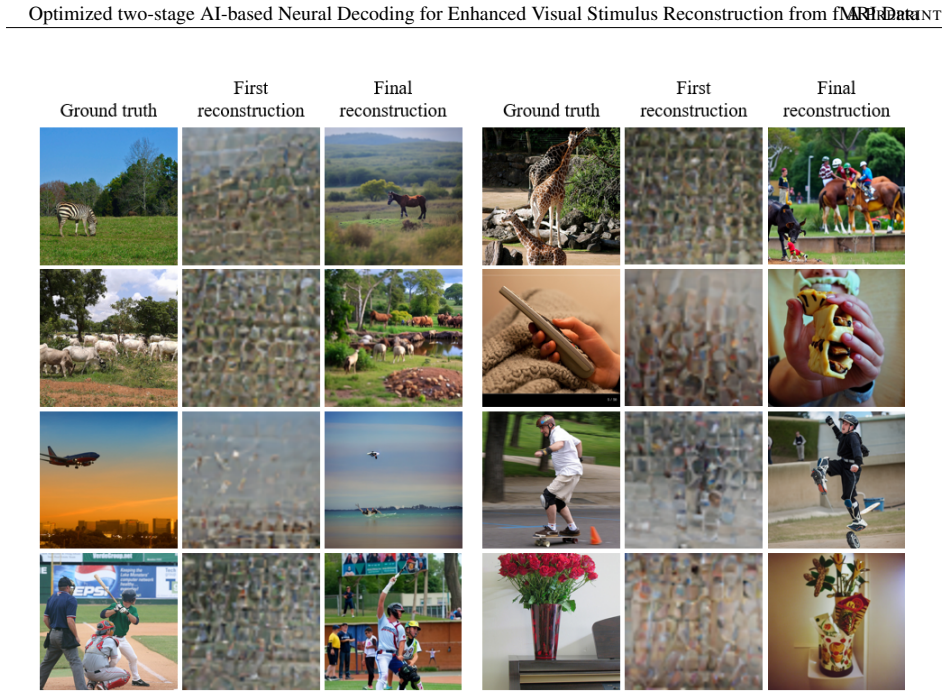
The central discovery is that a bidirectional GRU network, trained to predict 15 latent variables of a Very Deep Variational Autoencoder from single-trial beta weights, outperforms ridge regression in the same role: on subject 1 of the Natural Scenes Dataset, SSIM rises from 0.358 (ridge, 15 latents) to 0.370 (GRU, 15 latents), and CLIP similarity rises from 0.925 to 0.924 for 15 latents but to 0.958 with 31 latents; the paper summarizes this as about 2% structural and about 4% semantic improvement. The noise sensitivity analysis shows that corrupting the first-stage guess degrades SSIM sharply (from 0.361 to 0.140 at maximum noise) while high-level semantic metrics stay nearly flat, indicating that the first stage carries the structural information and the latent diffusion model carries the semantic content.
Load-bearing premise
The central claim rests on comparing the authors' implementation with published ridge-regression results, not with a re-run baseline under identical preprocessing, ROI selection, and evaluation code; if those cross-paper differences are larger than a few percent, the reported 2% and 4% improvements may not be real.
Editorial extensions
If this is right
- Nonlinear mappings from BOLD to latent space improve reconstruction fidelity, so future fMRI decoders should move beyond ridge regression in the first stage.
- The first-stage rough reconstruction is indispensable for structural fidelity; injecting noise there primarily degrades SSIM, not high-level semantics.
- Using 15 latent variables instead of 31 offers nearly the same reconstruction performance at substantially lower computational cost.
- The two-stage architecture combining a Very Deep VAE with a CLIP-conditioned latent diffusion model is an effective template for fMRI-to-image decoding.
Reading between the lines
- Editorial inference: The reported gains are small relative to typical cross-subject variability; the four-subject average in the paper shows much smaller differences than the subject-1 numbers, so the improvement may not generalize broadly.
- Editorial inference: A direct comparison that re-runs the ridge baseline under identical preprocessing, ROI selection, and evaluation code would be a stronger test; the current comparison relies on published numbers that may not be perfectly matched.
- Editorial inference: The noise sensitivity result suggests a diagnostic use: the rate of SSIM drop under first-stage noise could serve as a probe for how much structural information the diffusion model inherits from the initial guess.
- Editorial inference: Because the GRU processes a 1-D voxel vector, its temporal memory may be exploiting the spatial ordering of voxels in the ROI; an ablation that permutes voxel order would test whether the benefit comes from nonlinearity or from spatial structure.
Editorial analysis
A structured set of objections, weighed in public.
Referee Report
Summary. The paper proposes a two-stage fMRI-to-image decoding pipeline in which a bidirectional GRU-based network replaces ridge regression as the first-stage mapper from beta weights to the latent variables of a very deep variational autoencoder, followed by a latent diffusion model conditioned on CLIP embeddings. Experiments on the Natural Scenes Dataset are reported for four subjects, with an architecture ablation, a comparison to the ridge-based baseline of Ozcelik and VanRullen, and a noise-sensitivity analysis of the first-stage output. The abstract claims about 2% improvement in structural similarity and about 4% improvement in semantic similarity over the ridge-based state of the art.
Significance. If the claimed improvements were statistically robust, replacing ridge regression with a GRU in the first decoding stage would be a modest but useful contribution to the neural-decoding literature, and the noise-sensitivity analysis could inform how first-stage uncertainty propagates through latent diffusion models. The paper has clear strengths: it uses a standard public dataset (NSD), evaluates on multiple subjects, provides an architecture ablation, and reports a range of standard reconstruction metrics. However, the main quantitative claim is not supported by the paper's own four-subject averages, the baseline comparison appears to rely on numbers imported from a previous paper rather than a re-run under the present pipeline, and no error bars or significance tests accompany any of the comparisons. The significance of the claimed contribution is therefore not established as stated.
major comments (4)
- [Abstract; §4.2, Table 5] The central claim that the proposed architecture improves SSIM by about 2% and CLIP similarity by about 4% is not supported by the paper's own four-subject averages. In Table 5, Ours 31 versus Ridge 31 gives SSIM 0.360 versus 0.356 and CLIP 0.922 versus 0.915, i.e. relative improvements of about 1% and 0.8%, respectively; Ours 15 gives CLIP 0.914 versus 0.915, which is slightly worse. The GRU model is markedly worse on PixCorr (0.177 versus 0.254), AlexNet(2) (0.864 versus 0.942), and AlexNet(5) (0.923 versus 0.962). No error bars or significance tests are reported, so the abstract's unconditional numeric claims rest on the single-subject results in Table 4. The discussion's statement that the four-subject results 'confirmed' the CLIP improvement is contradicted by Table 5.
- [§4.2, Tables 3-5] The baseline numbers attributed to [21] are not stated to have been re-run under the present paper's preprocessing, ROI selection, beta estimation, CLIP embedding computation, and evaluation code. The text says results were 'compared to' [21], not reproduced in the authors' own pipeline. Because the claimed differences are only a few percent, cross-paper differences in any of these components could fully explain the reported improvements. The authors should either re-run the ridge baseline with identical preprocessing and evaluation and report those numbers, or explicitly reframe the comparison as not directly controlled.
- [§4.2, Table 3 and surrounding text] The reported MAE for the proposed model (0.1390) is higher than for the ridge baseline (0.1182), yet the text states that this higher MAE 'suggest[s] that the GRU-based model was better than state-of-the-art model in minimizing significant deviations.' This is internally inconsistent: a higher MAE indicates larger average absolute error, not better performance. Additionally, the MSE difference (0.0681 versus 0.0690) is very small, and no significance test is provided, so the first-stage comparison is not established.
- [§5, Discussion/limitations] The paper's own limitation paragraph states that 'the results across the four subjects of low-level metrics, especially SSIM, were inconclusive to support a generalization of the prediction in case of large signal to noise ratio as in the case of subject #7.' This concession directly contradicts the abstract's unconditional 2%/4% improvement claims. The authors should either provide per-subject and per-image statistics (e.g., bootstrap confidence intervals or paired tests) that justify generalized claims, or substantially temper the abstract and conclusions to a subject-specific or configuration-specific finding.
minor comments (8)
- [Introduction] There is a typo: 'categorization taksk' should be 'categorization tasks'.
- [§3.2] The z-score normalization is described as 'multiplying each sample by the mean and dividing by its standard deviation'; this should be 'subtracting the mean and dividing by its standard deviation'.
- [§3.3.1 and Table 1] The latent vector length is given as 13,334 in the text but 13,344 in Table 1, and the relationship between 15 layers, latent variables of length 16, and either of these totals is not explained; please clarify.
- [§3.5.1, Eq. (8)] The SSIM formula is not written in standard form; as typeset, '(2µxi 2µyi + C1)' should presumably be '(2µxµy + C1)', and the window-averaging notation is unclear.
- [Table 4] The row labeled 'Ours (CLIP) 15' is not defined or explained in the text, so the reader cannot determine what configuration it corresponds to.
- [§4.2, Table 4] The sentence claiming 'superior SSIM performance for both configurations' is not accurate for every row in Table 4, because the 'Ours (CLIP) 15' row (SSIM 0.357) is lower than the 'Ridge [21] 15' row (SSIM 0.358).
- [§4.3] The noise-sensitivity analysis is performed on subject #1 only, but the discussion draws general conclusions about the role of the first stage without evidence across subjects.
- [General] No code availability or data availability statement is provided, which limits the reproducibility of the reported comparisons.
Circularity Check
No circular derivation: the GRU is trained on training folds, evaluated on held-out test stimuli, and the ridge baseline is an external comparison, not an input to the method.
full rationale
The paper's central contribution is replacing the ridge linear regression in the first decoding stage with a GRU-based network. The GRU is trained on the training portion of the NSD data and evaluated on the held-out test set, so the reported SSIM/CLIP numbers are genuine out-of-sample measurements. No equation or construction defines the GRU output in terms of the final reconstruction metric, and no fitted parameter is renamed as a prediction. The ridge baseline numbers attributed to Ozcelik and VanRullen [21] are imported from external work rather than derived from this paper's own fitted quantities, so any mismatch in preprocessing or evaluation is a comparability concern, not circularity. The paper also acknowledges that low-level metrics across four subjects are inconclusive, which is inconsistent with the idea that the results are forced by construction. There are no load-bearing self-citations by the present authors, and the cited external components (VDVAE, LDM, CLIP) are used as fixed pretrained tools rather than as evidence that the GRU specifically must work. Overall, no step in the derivation reduces to its own inputs.
Assumptions & free parameters
free parameters (3)
- GRU network weights =
12,400,344 parameters
- Number of VDV AE latent variables =
15 or 31
- CLIP ridge regularization alpha =
50000
assumptions (6)
- standard math GLM and ridge equations (Eq. 7) are a valid way to estimate single-trial beta weights from BOLD signals.
- domain assumption GLMsingle beta weights from NSD reliably capture stimulus-related neural activity.
- domain assumption The pre-trained VDV AE latent space, trained on ImageNet64, is a suitable regression target for fMRI-driven reconstruction.
- domain assumption Versatile Diffusion and CLIP embeddings provide semantically meaningful conditioning for the second stage.
- domain assumption The evaluation metrics, SSIM, PixCorr, AlexNet, Inception, CLIP, EfficientNet, and SwAV, measure meaningful reconstruction fidelity.
- domain assumption Intra-subject train/test splitting with 90% training and 10% test is representative for the claims made.
Cite this review
Pith. "Pith review of Optimized two-stage AI-based Neural Decoding for Enhanced Visual Stimulus Reconstruction from fMRI Data." pith.science (2026). https://pith.science/paper/VRLXUM6J
@misc{pith2026241213237,
  author       = {Pith},
  title        = {Pith review of: Optimized two-stage AI-based Neural Decoding for Enhanced Visual Stimulus Reconstruction from fMRI Data},
  year         = {2026},
  howpublished = {\url{https://pith.science/paper/VRLXUM6J}},
  note         = {Machine review of arXiv:2412.13237}
}
read the original abstract
AI-based neural decoding reconstructs visual perception by leveraging generative models to map brain activity, measured through functional MRI (fMRI), into latent hierarchical representations. Traditionally, ridge linear models transform fMRI into a latent space, which is then decoded using latent diffusion models (LDM) via a pre-trained variational autoencoder (VAE). Due to the complexity and noisiness of fMRI data, newer approaches split the reconstruction into two sequential steps, the first one providing a rough visual approximation, the second on improving the stimulus prediction via LDM endowed by CLIP embeddings. This work proposes a non-linear deep network to improve fMRI latent space representation, optimizing the dimensionality alike. Experiments on the Natural Scenes Dataset showed that the proposed architecture improved the structural similarity of the reconstructed image by about 2\% with respect to the state-of-the-art model, based on ridge linear transform. The reconstructed image's semantics improved by about 4\%, measured by perceptual similarity, with respect to the state-of-the-art. The noise sensitivity analysis of the LDM showed that the role of the first stage was fundamental to predict the stimulus featuring high structural similarity. Conversely, providing a large noise stimulus affected less the semantics of the predicted stimulus, while the structural similarity between the ground truth and predicted stimulus was very poor. The findings underscore the importance of leveraging non-linear relationships between BOLD signal and the latent representation and two-stage generative AI for optimizing the fidelity of reconstructed visual stimuli from noisy fMRI data.
Figures


Figures from the paper (2 more)

Reference graph
Works this paper leans on
-
[21]
Natural scene reconstruction from fmri signals using generative latent diffusion
Furkan Ozcelik and Rufin VanRullen. Natural scene reconstruction from fmri signals using generative latent diffusion. Scientific Reports, 13(1), September 2023
work page 2023
-
[1]
Allen, Ghislain St-Yves, Yihan Wu, Jesse L
Emily J. Allen, Ghislain St-Yves, Yihan Wu, Jesse L. Breedlove, Jacob S. Prince, Logan T. Dowdle, Matthias Nau, Brad Caron, Franco Pestilli, Ian Charest, J. Benjamin Hutchinson, Thomas Naselaris, and Kendrick Kay. A massive 7t fmri dataset to bridge cognitive neuroscience and artificial intelligence. Nature Neuroscience, 25(1):116–126, December 2021
work page 2021
-
[2]
Unsupervised learning of visual features by contrasting cluster assignments, 2020
Mathilde Caron, Ishan Misra, Julien Mairal, Priya Goyal, Piotr Bojanowski, and Armand Joulin. Unsupervised learning of visual features by contrasting cluster assignments, 2020
work page 2020
-
[3]
Very deep vaes generalize autoregressive models and can outperform them on images
Rewon Child. Very deep vaes generalize autoregressive models and can outperform them on images. ArXiv, abs/2011.10650, 2020
arXiv 2011
-
[4]
A downsampled variant of imagenet as an alternative to the cifar datasets, 2017
Patryk Chrabaszcz, Ilya Loshchilov, and Frank Hutter. A downsampled variant of imagenet as an alternative to the cifar datasets, 2017
work page 2017
-
[5]
David D Cox and Robert L Savoy. Functional magnetic resonance imaging (fmri) “brain reading”: detecting and classifying distributed patterns of fmri activity in human visual cortex. NeuroImage, 19(2):261–270, June 2003
work page 2003
-
[6]
Guy Davidson, A. Emin Orhan, and Brenden M. Lake. Spatial relation categorization in infants and deep neural networks. Cognition, 245:105690, April 2024
work page 2024
-
[7]
Tom Dupré la Tour, Michael Eickenberg, Anwar O. Nunez-Elizalde, and Jack L. Gallant. Feature-space selection with banded ridge regression. NeuroImage, 264:119728, December 2022
work page 2022
Show all 42 references
-
[8]
Decoding visual brain representations from electroencephalography through knowledge distillation and latent diffusion models
Matteo Ferrante, Tommaso Boccato, Stefano Bargione, and Nicola Toschi. Decoding visual brain representations from electroencephalography through knowledge distillation and latent diffusion models. Computers in Biology and Medicine, page 108701, June 2024
2024
-
[9]
Zijin Gu, Keith Jamison, Amy Kuceyeski, and Mert R. Sabuncu. Decoding natural image stimuli from fmri data with a surface-based convolutional network. In Ipek Oguz, Jack Noble, Xiaoxiao Li, Martin Styner, Christian Baumgartner, Mirabela Rusu, Tobias Heinmann, Despina Kontos, B...
2024
-
[10]
Denoising diffusion probabilistic models, 2020
Jonathan Ho, Ajay Jain, and Pieter Abbeel. Denoising diffusion probabilistic models, 2020
2020
-
[11]
Decoding the visual and subjective contents of the human brain
Yukiyasu Kamitani and Frank Tong. Decoding the visual and subjective contents of the human brain. Nature Neuroscience, 8(5):679–685, April 2005
2005
-
[12]
Kay, Ariel Rokem, Jonathan Winawer, Robert F
Kendrick N. Kay, Ariel Rokem, Jonathan Winawer, Robert F. Dougherty, and Brian A. Wandell. Glmdenoise: a fast, automated technique for denoising task-based fmri data. Frontiers in Neuroscience, 7, 2013
2013
-
[13]
Multi-semantic decoding of visual perception with graph neural networks
Rong Li, Jiyi Li, Chong Wang, Haoxiang Liu, Tao Liu, Xuyang Wang, Ting Zou, Wei Huang, Hongmei Yan, and Huafu Chen. Multi-semantic decoding of visual perception with graph neural networks. International Journal of Neural Systems, 34(04), February 2024
2024
-
[14]
Mind reader: reconstructing complex images from brain activities
Sikun Lin, Thomas Sprague, and Ambuj K Singh. Mind reader: reconstructing complex images from brain activities. In Proceedings of the 36th International Conference on Neural Information Processing Systems, NIPS ’22, Red Hook, NY , USA, 2024. Curran Associates Inc
2024
-
[15]
Lawrence Zitnick
Tsung-Yi Lin, Michael Maire, Serge Belongie, James Hays, Pietro Perona, Deva Ramanan, Piotr Dollár, and C. Lawrence Zitnick. Microsoft COCO: Common Objects in Context , pages 740–755. Springer International Publishing, 2014
2014
-
[16]
Chang, Andreas S
Mackenzie Weygandt Mathis, Adriana Perez Rotondo, Edward F. Chang, Andreas S. Tolias, and Alexander Mathis. Decoding the brain: From neural representations to mechanistic models. Cell, 187(21):5814–5832, October 2024
2024
-
[17]
Dual-guided brain diffusion model: Natural image reconstruction from human visual stimulus fmri
Lu Meng and Chuanhao Yang. Dual-guided brain diffusion model: Natural image reconstruction from human visual stimulus fmri. Bioengineering, 10(10):1117, September 2023
2023
-
[18]
Tanabe, Norihiro Sadato, and Yukiyasu Kamitani
Yoichi Miyawaki, Hajime Uchida, Okito Yamashita, Masa-aki Sato, Yusuke Morito, Hiroki C. Tanabe, Norihiro Sadato, and Yukiyasu Kamitani. Visual image reconstruction from human brain activity using a combination of multiscale local image decoders. Neuron, 60(5):915–929, December 2008
2008
-
[19]
Nunez-Elizalde, Alexander G
Anwar O. Nunez-Elizalde, Alexander G. Huth, and Jack L. Gallant. V oxelwise encoding models with non-spherical multivariate normal priors. NeuroImage, 197:482–492, August 2019
2019
-
[20]
Reconstruction of perceived images from fmri patterns and semantic brain exploration using instance-conditioned gans
Furkan Ozcelik, Bhavin Choksi, Milad Mozafari, Leila Reddy, and Rufin VanRullen. Reconstruction of perceived images from fmri patterns and semantic brain exploration using instance-conditioned gans. 2022 International Joint Conference on Neural Networks (IJCNN), pages 1–8, 2022
2022
-
[22]
Automatic differentiation in pytorch
Adam Paszke, Sam Gross, Soumith Chintala, Gregory Chanan, Edward Yang, Zachary DeVito, Zeming Lin, Alban Desmaison, Luca Antiga, and Adam Lerer. Automatic differentiation in pytorch. In NIPS-W, 2017
2017
-
[23]
A Straightforward Framework for Video Retrieval Using CLIP, pages 3–12
Jesús Andrés Portillo-Quintero, José Carlos Ortiz-Bayliss, and Hugo Terashima-Marín. A Straightforward Framework for Video Retrieval Using CLIP, pages 3–12. Springer International Publishing, 2021
2021
-
[24]
Improving the accuracy of single-trial fmri response estimates using glmsingle
Jacob S Prince, Ian Charest, Jan W Kurzawski, John A Pyles, Michael J Tarr, and Kendrick N Kay. Improving the accuracy of single-trial fmri response estimates using glmsingle. eLife, 11, November 2022
2022
-
[25]
Natural image reconstruction from fmri using deep learning: A survey
Zarina Rakhimberdina, Quentin Jodelet, Xin Liu, and Tsuyoshi Murata. Natural image reconstruction from fmri using deep learning: A survey. Frontiers in Neuroscience, 15, December 2021
2021
-
[26]
Hierarchical text-conditional image generation with clip latents, 2022
Aditya Ramesh, Prafulla Dhariwal, Alex Nichol, Casey Chu, and Mark Chen. Hierarchical text-conditional image generation with clip latents, 2022
2022
-
[27]
Fractional ridge regression: a fast, interpretable reparameterization of ridge regression
Ariel Rokem and Kendrick Kay. Fractional ridge regression: a fast, interpretable reparameterization of ridge regression. GigaScience, 9(12), November 2020
2020
-
[28]
High-resolution image synthesis with latent diffusion models
Robin Rombach, Andreas Blattmann, Dominik Lorenz, Patrick Esser, and Bjorn Ommer. High-resolution image synthesis with latent diffusion models. In 2022 IEEE/CVF Conference on Computer Vision and Pattern Recognition (CVPR). IEEE, June 2022
2022
-
[29]
U-net: Convolutional networks for biomedical image segmentation, 2015
Olaf Ronneberger, Philipp Fischer, and Thomas Brox. U-net: Convolutional networks for biomedical image segmentation, 2015
2015
-
[30]
Scotti, Atmadeep Banerjee, Jimmie Goode, Stepan Shabalin, Alex Nguyen, Ethan Cohen, Aidan J
Paul S. Scotti, Atmadeep Banerjee, Jimmie Goode, Stepan Shabalin, Alex Nguyen, Ethan Cohen, Aidan J. Dempster, Nathalie Verlinde, Elad Yundler, David Weisberg, Kenneth A. Norman, and Tanishq Mathew Abraham. Reconstructing the mind’s eye: fmri-to-image with contrastive learning...
2023
-
[31]
Deep image reconstruction from human brain activity
Guohua Shen, Tomoyasu Horikawa, Kei Majima, and Yukiyasu Kamitani. Deep image reconstruction from human brain activity. PLOS Computational Biology, 15(1):e1006633, January 2019. 13 Optimized two-stage AI-based Neural Decoding for Enhanced Visual Stimulus Reconstruction from fM...
2019
-
[32]
Manning, and Andrew Y
Richard Socher, Milind Ganjoo, Hamsa Sridhar, Osbert Bastani, Christopher D. Manning, and Andrew Y . Ng. Zero-shot learning through cross-modal transfer, 2013
2013
-
[33]
Contrast, attend and diffuse to decode high-resolution images from brain activities, 2023
Jingyuan Sun, Mingxiao Li, Zijiao Chen, Yunhao Zhang, Shaonan Wang, and Marie-Francine Moens. Contrast, attend and diffuse to decode high-resolution images from brain activities, 2023
2023
-
[34]
Rethinking the inception architecture for computer vision
Christian Szegedy, Vincent Vanhoucke, Sergey Ioffe, Jon Shlens, and Zbigniew Wojna. Rethinking the inception architecture for computer vision. In 2016 IEEE Conference on Computer Vision and Pattern Recognition (CVPR). IEEE, June 2016
2016
-
[35]
High-resolution image reconstruction with latent diffusion models from human brain activity
Yu Takagi and Shinji Nishimoto. High-resolution image reconstruction with latent diffusion models from human brain activity. In 2023 IEEE/CVF Conference on Computer Vision and Pattern Recognition (CVPR). IEEE, June 2023
2023
-
[36]
EfficientNet: Rethinking model scaling for convolutional neural networks
Mingxing Tan and Quoc Le. EfficientNet: Rethinking model scaling for convolutional neural networks. In Kamalika Chaudhuri and Ruslan Salakhutdinov, editors, Proceedings of the 36th International Conference on Machine Learning, volume 97 of Proceedings of Machine Learning Resea...
2019
-
[37]
Reconstructing rapid natural vision with fmri-conditional video generative adversarial network
Chong Wang, Hongmei Yan, Wei Huang, Jiyi Li, Yuting Wang, Yun-Shuang Fan, Wei Sheng, Tao Liu, Rong Li, and Huafu Chen. Reconstructing rapid natural vision with fmri-conditional video generative adversarial network. Cerebral Cortex, 32(20):4502–4511, January 2022
2022
-
[38]
Pixrevive: Latent feature diffusion model for compressed video quality enhancement
Weiran Wang, Minge Jing, Yibo Fan, and Wei Weng. Pixrevive: Latent feature diffusion model for compressed video quality enhancement. Sensors, 24(6):1907, March 2024
1907
-
[39]
Wang, A.C
Z. Wang, A.C. Bovik, H.R. Sheikh, and E.P. Simoncelli. Image quality assessment: From error visibility to structural similarity. IEEE Transactions on Image Processing, 13(4):600–612, April 2004
2004
-
[40]
Versatile diffusion: Text, images and variations all in one diffusion model
Xingqian Xu, Zhangyang Wang, Eric Zhang, Kai Wang, and Humphrey Shi. Versatile diffusion: Text, images and variations all in one diffusion model. In 2023 IEEE/CVF International Conference on Computer Vision (ICCV). IEEE, October 2023
2023
-
[41]
Dass, Jafri M
Raheel Zafar, Aamir Saeed Malik, Nidal Kamel, Sarat C. Dass, Jafri M. Abdullah, Faruque Reza, and Ah- mad Helmy Abdul Karim. Decoding of visual information from human brain activity: A review of fmri and eeg studies. Journal of Integrative Neuroscience, 14(02):155–168, June 2015
2015
-
[42]
Manning, and Curtis P
Yuhao Zhang, Hang Jiang, Yasuhide Miura, Christopher D. Manning, and Curtis P. Langlotz. Contrastive learning of medical visual representations from paired images and text, 2020. 14
2020
Reviewed August 11, 2026 · model on record in the stance chip above.
Discussion (0). Continue with ORCID to comment.