REVIEW 2 major objections 4 minor 300 references
This thesis argues that normalization and classification can be built once on Lie groups and gyrogroups and then instantiated across the manifolds used in practice.
Reviewed by Pith at T0; open to challenge. T0 means a machine referee read the full paper against a public rubric. the ladder, T0–T4 →
T0 review · deepseek-v4-flash
2026-08-01 12:48 UTC pith:VRN2AWJF
load-bearing objection A serious, well-documented thesis that synthesizes nine peer-reviewed papers; the genuinely new value is the unified normalization/classification framework and the pseudo-reductive gyrogroup analysis, with a real but narrow caveat about the 'all known gyrogroups' claim. the 2 major comments →
Riemannian Deep Learning: Modules, Networks, and Geometries
The pith
A machine-rendered reading of the paper's core claim, the machinery that carries it, and where it could break.
Core claim
The central claim is that the algebraic structures already present on common manifolds are enough to make deep-learning modules universal. Algorithm 1 (LieBN) uses group translations for centering and biasing and tangent-space scaling at the identity, and the thesis proves that under any invariant metric this controls the Riemannian mean and variance (Props. 61–62, 65). GyroBN extends the same principle to pseudo-reductive gyrogroups—groupoids in which gyrations of left inverses are trivial—and recovers LieBN as a special case. For classification, Riemannian Multinomial Logistic Regression (RMLR) replaces the point-to-hyperplane infimum with a Riemannian-trigonometric formula, so a manifold
What carries the argument
The load-bearing object is the pseudo-reductive gyrogroup: an algebraic structure satisfying the first three gyrogroup axioms plus pseudo-reduction (gyr[a,x]=id for a a left inverse of x). This axiom restores the left cancellation law ⊖x⊕(x⊕y)=y, which makes left gyrotranslation a gyroisometry; that isometry is what lets GyroBN center a batch and provably move its mean while controlling the variance. The companion machinery for classification is Riemannian trigonometry: RMLR computes logits as Riemannian distances to geodesic hyperplanes, reducing classification to evaluating a logarithmic map and an inner product. Together the two mechanisms turn group-like structure and a logarithmic map i
Load-bearing premise
The normalization guarantee rests on the assumption that every manifold in the framework's coverage is pseudo-reductive and that its gyrations are gyroisometries; if any admitted gyrogroup violates this, the provable mean-and-variance control for that manifold fails.
What would settle it
Compute gyr[a,x]z and the left-cancellation residual ∥⊖x⊕(x⊕y)⊖y∥ on the Grassmannian's ONB representation for a=⊖x; a single pair with nonzero residual at machine precision would break the proof that left gyrotranslation is a gyroisometry, and with it GyroBN's mean-control theorem for that geometry.
If this is right
- Networks on SO(n), SPD, full-rank correlation, Grassmannian, and constant-curvature manifolds can all use the same LieBN/GyroBN layer with provable mean and variance control instead of manifold-specific recipes.
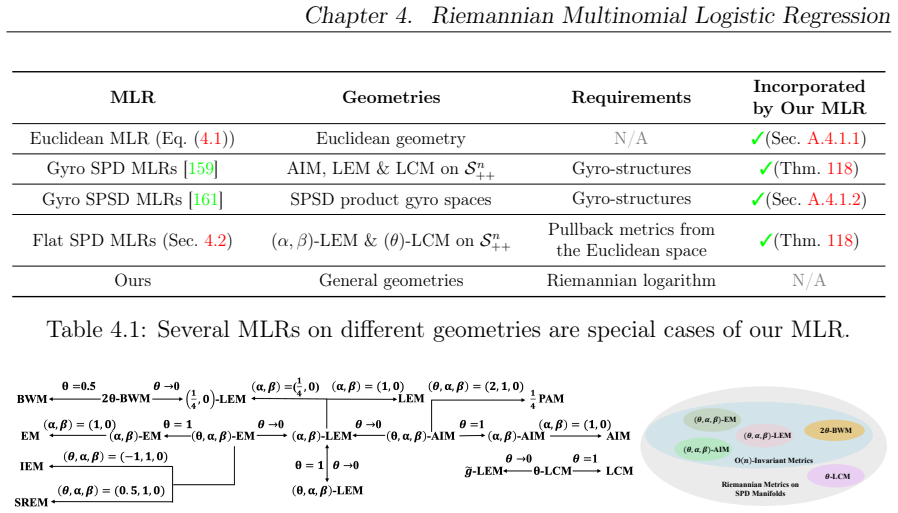
- Any manifold with an explicit geodesic distance and logarithmic map gets an intrinsic classifier; RMLR subsumes existing LogEig and hyperbolic classifiers as special cases.
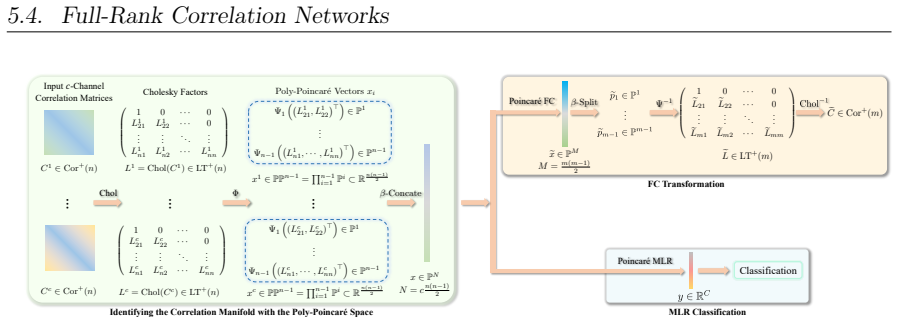
- Correlation matrices become a first-class representation: CorNets provide MLR, FC, and convolutional layers directly on Cor+(n) with accurate gradients.
- SPD geometry can be adapted to data via parameterized matrix logarithms, and Cholesky-product metrics give fast, closed-form, numerically stable operators for SPD networks.
Where Pith is reading between the lines
- If the pseudo-reductivity criterion is as general as the thesis asserts, the same normalization module should transfer to future gyrogroup-based architectures, including attention or transformer layers defined on gyrovector spaces; a clean test is to instantiate GyroBN inside a gyro-attention block and compare convergence.
- The algebraic checklist (pseudo-reductivity plus gyroisometric gyrations) gives future work a quick necessary condition: any newly proposed manifold gyro-structure must be checked for these two properties before mean-variance normalization can be claimed.
- RMLR's reliance only on a logarithmic map suggests a practical recipe for manifolds without closed-form geodesic distances: approximate the logarithmic map and plug it into the same classifier, which would extend intrinsic classification beyond the manifolds listed.
- The learnable SPD metrics blur the line between architecture search and geometry search; one could optimize the metric parameters jointly with network weights to interpolate among known SPD geometries inside a single model.
Editorial analysis
A structured set of objections, weighed in public.
Referee Report
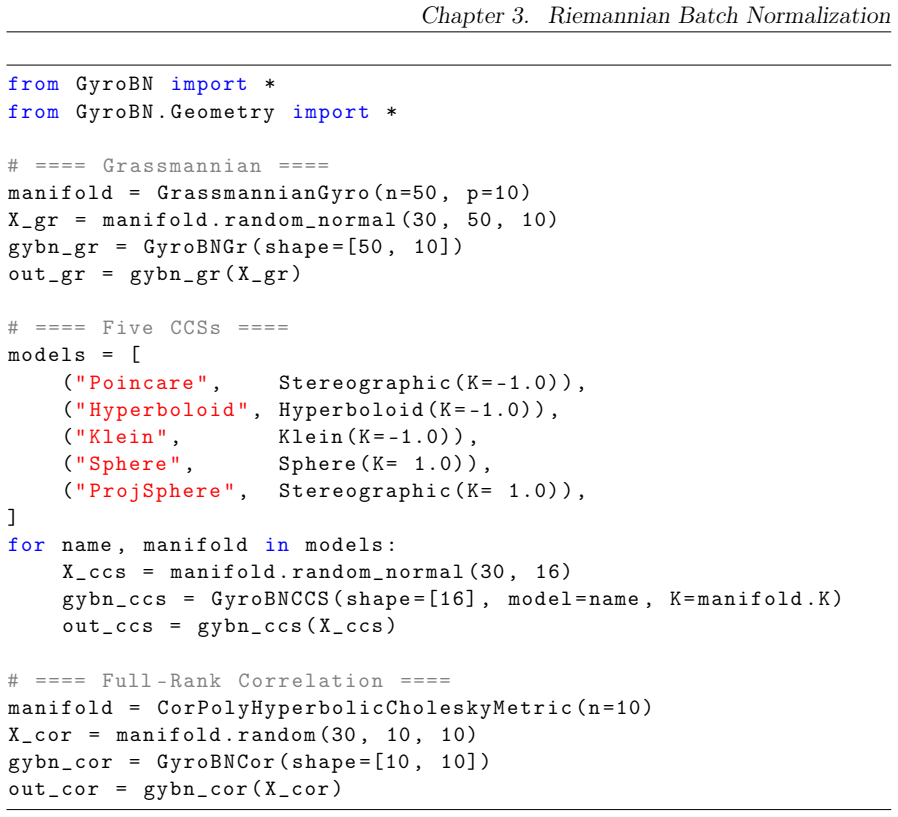
Summary. The thesis develops a unified framework for Riemannian deep learning, with three strands: reusable modules (batch normalization and multinomial logistic regression), manifold-specific network architectures (Proper Velocity hyperbolic networks, Busemann-based hyperbolic layers, full-rank correlation networks), and learnable/fast SPD geometries (ALEM and product Cholesky metrics). The central theoretical claims are that LieBN controls Riemannian sample mean and variance on Lie groups with invariant metrics (Props. 61–62, 65), that GyroBN extends this control to pseudo-reductive gyrogroups with gyroisometric gyrations (Thms. 75, 77–99), and that RMLR subsumes existing Euclidean/SPD/Lie classifiers as special cases (Sec. 4.3, Tab. 4.1). These claims are supported by proofs in Appendix B and by experiments across vision, signal processing, graph learning, and genomics. The thesis also introduces several new geometric constructions—CRIM, PV coordinates, ALEM, PCM/BWCM—and releases PyTorch toolboxes for LieBN and GyroBN.
Significance. If the results hold, the thesis delivers a genuinely general algebraic foundation for normalization: a single construction (GyroBN) covers Lie groups, the Grassmannian, constant-curvature spaces, and full-rank correlation manifolds, with provable control of first- and second-order sample statistics rather than heuristic normalization. The RMLR framework similarly unifies a dispersed set of manifold classifiers under one logarithmic-map formulation. The thesis is also strong on the practical side: closed-form operators for several geometries, explicit numerical stability and efficiency comparisons (Tabs. 6.13, 6.16, 6.17), and reproducible public code for the two normalization toolboxes. The main risk is the breadth claim attached to pseudo-reductivity: the central theorem is conditional on an algebraic property, and the universal statement about 'all known gyrogroups' is not proven as a classification theorem. However, the listed instantiations each come with proofs in Appendix B, so the conditional theorem itself is defensible. This is a scope caveat rather than a demonstrated flaw.
major comments (2)
- [Sec. 3.3.1, Def. 73] The text asserts that the GyroBN conditions (pseudo-reductivity and gyroisometric gyrations) 'are satisfied by all known gyrogroups in machine learning,' but the support is a per-manifold list (Prop. 74 for the Grassmannian; seven instantiations in Sec. 3.3.4 with proofs in App. B), not a general theorem. If any of the newly derived closed-form gyro-structures (Lorentz, projected hypersphere, row-wise correlation) failed pseudo-reductivity, the guaranteed mean/variance control would not follow for that manifold. I recommend weakening the universal claim to 'all gyrogroups considered in this thesis' or adding a summary table that explicitly verifies pseudo-reductivity and gyroisometry for each instantiation. This is a correctness-risk concern about scope, not a counterexample to the conditional theorem.
- [Secs. 2.9.5 and 3.3.4] The K-stereographic gyration formula is stated to be valid only when D_st > 0 (Eq. 2.147), and positive-curvature logarithm/parallel-transport maps are restricted away from antipodal configurations. Since GyroBN on the sphere and projected hypersphere relies on gyroisometries at arbitrary batch points, the manuscript should clarify whether the normalization guarantee extends to points where D_st = 0 or to antipodal pairs, and if not, state the domain restriction in the GyroBN theorem. Similarly, the radius-model formulas exclude singular configurations; a short paragraph on domain validity would make the coverage claim precise.
minor comments (4)
- [Tab. 3.11 (and Tab. 6.8)] NTU60 results are reported as single accuracy values, whereas other tables report mean±std (e.g., Tab. 3.9). Please report mean±std over multiple runs, or state the protocol used for these entries, so the reader can assess variance.
- [Sec. 3.2.1] The claim that CRIM is 'the first non-trivial right-invariant SPD metric' is strong. Please provide a brief literature pointer or a sentence substantiating that no other non-commutative right-invariant SPD metric appears in the prior work.
- [Sec. 3.2.5.1, Tab. 3.6] The notation ⊕_LieAI and ⊙ for the power-deformed operations is introduced only in the table; a one-sentence definition of how P^θ pulls back the group operation would improve readability for a reader who has not followed the deformation discussion.
- [Sec. 1.3] The list of excluded papers is helpful for provenance, but the phrasing 'Since Chapter X follows ...' in the final paragraph could be misread as saying the excluded papers are prerequisites. Consider moving that explanatory paragraph to an appendix or editorial preface.
Circularity Check
No significant circularity; the conditional algebraic theorems are self-contained.
full rationale
I find no load-bearing circularity. The central claims are conditional on explicitly stated algebraic hypotheses—invariant metrics for LieBN and pseudo-reductive gyrogroups with gyroisometric gyrations for GyroBN—and the proofs are carried out from the definitions in the appendix, not obtained by fitting parameters or by invoking the author's own prior papers as the proof. The statements that GyroBN recovers LieBN (Tab. 3.13) and that RMLR subsumes LogEig/Lie classifiers (Tab. 4.1) are mathematical containments visible in the equations; they are specializations, not predictions forced by fitted inputs. The only caveat worth flagging is the breadth claim in Sec. 3.3.1 that 'These conditions are satisfied by all known gyrogroups in machine learning,' which is supported case-by-case (Prop. 74, Sec. 3.3.4, App. B) rather than by a general classification theorem. That is a scope/correctness risk for the universality claim, not a circularity in the conditional GyroBN theorem. The self-citations to the author's own publications are compilation artifacts of a thesis and are not load-bearing: none of the derivations reduces to an unverified self-citation chain.
Axiom & Free-Parameter Ledger
free parameters (4)
- θ (metric deformation exponent) =
per-dataset values such as 1.5, 0.5, -0.5
- (α, β) metric-family parameters =
(1, 0)
- PHCM hemisphere weights α_i =
1 (canonical)
- Curvature K of constant-curvature models =
-1 or +1
axioms (6)
- domain assumption Intrinsic Gaussian density on Lie groups (Eq. 3.7) with MLE equal to the sample Fréchet mean.
- domain assumption Every machine-learning gyrogroup is pseudo-reductive with gyroisometric gyrations.
- standard math Weighted Fréchet means exist and are unique on the relevant geodesic balls.
- standard math Busemann functions and horospheres behave as in Hadamard spaces.
- standard math Daleckii-Krein formula and Cholesky differential identities hold as stated.
- standard math Constant-curvature spaces are classified by dimension and curvature (O'Neill Cor. 8.25).
invented entities (4)
-
Pseudo-reductive gyrogroup
independent evidence
-
CRIM (Cholesky Right-Invariant Metric)
independent evidence
-
Proper Velocity (PV) coordinate model of hyperbolic space
independent evidence
-
ALEM (Adaptive Log-Euclidean Metric)
independent evidence
Cite this review
Pith. "Pith review of Riemannian Deep Learning: Modules, Networks, and Geometries." pith.science (2026). https://pith.science/paper/VRN2AWJF
@misc{pith2026260719305,
  author       = {Pith},
  title        = {Pith review of: Riemannian Deep Learning: Modules, Networks, and Geometries},
  year         = {2026},
  howpublished = {\url{https://pith.science/paper/VRN2AWJF}},
  note         = {Machine review of arXiv:2607.19305}
}
read the original abstract
Deep neural networks on manifold-valued representations have attracted growing interest, but many basic components remain tied to specific manifolds, rely on Euclidean approximations, or require costly and numerically fragile geometric operations. This thesis develops a unified framework for Riemannian deep learning from three complementary perspectives: reusable neural modules, manifold-specific network architectures, and the design of underlying geometries. It generalizes batch normalization from Euclidean spaces and individual manifolds to broad classes of Lie groups and gyrogroups, and extends multinomial logistic regression from Euclidean space to SPD manifolds and then to general Riemannian manifolds. It further develops neural networks for several important geometric representations, including an unconstrained model of hyperbolic space, Busemann-based hyperbolic learning, and full-rank correlation matrices. Finally, it introduces adaptive and computationally efficient Riemannian metrics on SPD manifolds, including learnable Log-Euclidean geometries and fast, stable Cholesky-based geometries. The proposed methods are supported by theoretical analysis and validated through numerical experiments and applications in vision, signal processing, graph learning, and genomics.
Figures








Reference graph
Works this paper leans on
-
[1]
ICCV , year =
Is second-order information helpful for large-scale visual recognition? , author =. ICCV , year =
-
[2]
CVPR , year =
Towards faster training of global covariance pooling networks by iterative matrix square root normalization , author =. CVPR , year =
-
[3]
ICCV , year =
Matrix backpropagation for deep networks with structured layers , author =. ICCV , year =
-
[4]
arXiv preprint arXiv:1509.07838 , year=
Training deep networks with structured layers by matrix backpropagation , author=. arXiv preprint arXiv:1509.07838 , year=
-
[5]
2008 , publisher=
Functions of matrices: theory and computation , author=. 2008 , publisher=
2008
-
[6]
2007 , publisher=
Positive Definite Matrices , author=. 2007 , publisher=
2007
-
[7]
2013 , series=
Matrix analysis , author=. 2013 , series=
2013
-
[8]
BMVC , year=
Improved bilinear pooling with cnns , author=. BMVC , year=
-
[9]
NeurIPS , year =
Backpropagation-friendly eigendecomposition , author =. NeurIPS , year =
-
[10]
Essentials of Pad
George Jr, A and others , year=. Essentials of Pad
-
[11]
The theory and application of the Pad
Baker Jr, George A , year=. The theory and application of the Pad
-
[12]
Baker, George Allen and Gammel, John L , year=. The Pad
-
[13]
Van Assche, Walter , journal=. Pad
-
[14]
General theorems on the convergence of sequences of Pad
Wall, HS , journal=. General theorems on the convergence of sequences of Pad
-
[15]
An Overview , author=
On Rational Function Techniques and Pade Approximants. An Overview , author=. 2002 , publisher=
2002
-
[16]
ICCV , year =
Bilinear cnn models for fine-grained visual recognition , author =. ICCV , year =
-
[17]
CVPR , year =
Imagenet: A large-scale hierarchical image database , author =. CVPR , year =
-
[18]
CVPR , year =
G2DeNet: Global Gaussian distribution embedding network and its application to visual recognition , author =. CVPR , year =
-
[19]
CVPR , year =
Deep global generalized Gaussian networks , author =. CVPR , year =
-
[20]
IEEE TPAMI , year =
Robust Differentiable SVD , author =. IEEE TPAMI , year =
-
[21]
Dang and K
Z. Dang and K. M. Yi and Y. Hu and F. Wang and P. Fua and M. Salzmann , booktitle =
-
[22]
Dang and K.M
Z. Dang and K.M. Yi and F. Wang and Y. Hu and P. Fua and M. Salzmann , journal =
-
[23]
IEEE TPAMI , year =
Deep cnns meet global covariance pooling: Better representation and generalization , author =. IEEE TPAMI , year =
-
[24]
CVPR , year =
An investigation into the stochasticity of batch whitening , author =. CVPR , year =
-
[25]
ICCV , year =
Understanding generalized whitening and coloring transform for universal style transfer , author =. ICCV , year =
-
[26]
CVPR , year =
Image-to-image translation via group-wise deep whitening-and-coloring transformation , author =. CVPR , year =
-
[27]
ECCV , year =
Semantic segmentation with second-order pooling , author =. ECCV , year =
-
[28]
CVPR , year =
Decorrelated batch normalization , author =. CVPR , year =
-
[29]
1981 , publisher=
Approximation theory and methods , author=. 1981 , publisher=
1981
-
[30]
CVPR , year =
Deep residual learning for image recognition , author =. CVPR , year =
-
[31]
Welinder and S
P. Welinder and S. Branson and T. Mita and C. Wah and F. Schroff and S. Belongie and P. Perona , Institution =
-
[32]
arXiv preprint arXiv:1306.5151 , year=
Fine-grained visual classification of aircraft , author=. arXiv preprint arXiv:1306.5151 , year=
-
[33]
2013 , address =
3D Object Representations for Fine-Grained Categorization , booktitle =. 2013 , address =
2013
-
[34]
arXiv preprint arXiv:1409.1556 , year=
Very deep convolutional networks for large-scale image recognition , author=. arXiv preprint arXiv:1409.1556 , year=
-
[35]
Novel Dataset for Fine-Grained Image Categorization
Aditya Khosla and Nityananda Jayadevaprakash and Bangpeng Yao and Li Fei-Fei. Novel Dataset for Fine-Grained Image Categorization. First Workshop on Fine-Grained Visual Categorization, IEEE Conference on Computer Vision and Pattern Recognition. 2011
2011
-
[36]
2003 , publisher=
Introductory lectures on convex optimization: A basic course , author=. 2003 , publisher=
2003
-
[37]
ICCV , year =
Dynamic label graph matching for unsupervised video re-identification , author =. ICCV , year =
-
[38]
CVPR , year =
Compact bilinear pooling , author =. CVPR , year =
-
[39]
CVPR , year =
Low-Rank Bilinear Pooling for Fine-Grained Classification , author =. CVPR , year =
-
[40]
CVPR , year =
Monet: Moments embedding network , author =. CVPR , year =
-
[41]
CVPR , year =
Kernel Pooling for Convolutional Neural Networks , author =. CVPR , year =
-
[42]
ECCV , year =
Hierarchical Bilinear Pooling for Fine-Grained Visual Recognition , author =. ECCV , year =
-
[43]
ECCV , year =
Grassmann Pooling as Compact Homogeneous Bilinear Pooling for Fine-Grained Visual Classification , author =. ECCV , year =
-
[44]
NeurIPS , year =
Learning deep bilinear transformation for fine-grained image representation , author =. NeurIPS , year =
-
[45]
ECCV , year =
Toward Faster and Simpler Matrix Normalization via Rank-1 Update , author =. ECCV , year =
-
[46]
arXiv preprint arXiv:1211.7102 , year=
SVD based image processing applications: state of the art, contributions and research challenges , author=. arXiv preprint arXiv:1211.7102 , year=
-
[47]
2007 , publisher=
Understanding complex datasets: data mining with matrix decompositions , author=. 2007 , publisher=
2007
-
[48]
arXiv preprint arXiv:1312.6034 , year=
Deep inside convolutional networks: Visualising image classification models and saliency maps , author=. arXiv preprint arXiv:1312.6034 , year=
-
[49]
ECCV , year =
Visualizing and understanding convolutional networks , author =. ECCV , year =
-
[50]
ICCV , year =
Interpretable explanations of black boxes by meaningful perturbation , author =. ICCV , year =
-
[51]
ICCV , year =
Understanding deep networks via extremal perturbations and smooth masks , author =. ICCV , year =
-
[52]
CVPR , year =
There and back again: Revisiting backpropagation saliency methods , author =. CVPR , year =
-
[53]
arXiv preprint arXiv:1412.6806 , year=
Striving for simplicity: The all convolutional net , author=. arXiv preprint arXiv:1412.6806 , year=
-
[54]
ICCV , year =
Grad-cam: Visual explanations from deep networks via gradient-based localization , author =. ICCV , year =
-
[55]
BMVC , year=
Rise: Randomized input sampling for explanation of black-box models , author=. BMVC , year=
-
[56]
NeurIPS , year =
Real time image saliency for black box classifiers , author =. NeurIPS , year =
-
[57]
CVIU , volume=
Classifier-agnostic saliency map extraction , author=. CVIU , volume=. 2020 , publisher=
2020
-
[58]
CVPR , year =
Densely connected convolutional networks , author =. CVPR , year =
-
[59]
CVPR , year =
Rethinking the inception architecture for computer vision , author =. CVPR , year =
-
[60]
Psychometrika , volume=
The approximation of one matrix by another of lower rank , author=. Psychometrika , volume=. 1936 , publisher=
1936
-
[61]
Delving Deeper into the Whorl of Flower Segmentation
Maria-Elena Nilsback and Andrew Zisserman. Delving Deeper into the Whorl of Flower Segmentation. Image and Vision Computing. 2009
2009
-
[62]
Mathematische Nachrichten , volume=
A note on von Neumann's trace inequalitv , author=. Mathematische Nachrichten , volume=. 1991 , publisher=
1991
-
[63]
Monatshefte f
A trace inequality of John von Neumann , author=. Monatshefte f. 1975 , publisher=
1975
-
[64]
ICCV , year =
Why Approximate Matrix Square Root Outperforms Accurate SVD in Global Covariance Pooling? , author =. ICCV , year =
-
[65]
2015 , URL =
Inceptionism: Going Deeper into Neural Networks , author =. 2015 , URL =
2015
-
[66]
The Annals of Applied Statistics , volume=
Non-Euclidean statistics for covariance matrices, with applications to diffusion tensor imaging , author=. The Annals of Applied Statistics , volume=. 2009 , publisher=
2009
-
[67]
SIAM journal on matrix analysis and applications , volume=
Geometric means in a novel vector space structure on symmetric positive-definite matrices , author=. SIAM journal on matrix analysis and applications , volume=. 2007 , publisher=
2007
-
[68]
IJCV , year =
A Riemannian framework for tensor computing , author =. IJCV , year =
-
[69]
Afsari, Bijan , booktitle=
-
[70]
NeurIPS , year =
A new metric on the manifold of kernel matrices with application to matrix geometric means , author =. NeurIPS , year =
-
[71]
arXiv preprint arXiv:1708.02862 , year=
Webvision database: Visual learning and understanding from web data , author=. arXiv preprint arXiv:1708.02862 , year=
-
[72]
arXiv preprint arXiv:2006.07159 , year=
Are we done with ImageNet? , author=. arXiv preprint arXiv:2006.07159 , year=
Pith/arXiv arXiv 2006
-
[73]
Communications of the ACM , volume=
Solution of the matrix equation AX+ XB= C [F4] , author=. Communications of the ACM , volume=. 1972 , publisher=
1972
-
[74]
CVPR , year =
Iterative normalization: Beyond standardization towards efficient whitening , author =. CVPR , year =
-
[75]
NeurIPS , year =
Universal Style Transfer via Feature Transforms , author =. NeurIPS , year =
-
[76]
CVPR , year =
RobustNet: Improving Domain Generalization in Urban-Scene Segmentation via Instance Selective Whitening , author =. CVPR , year =
-
[77]
ZAMM-Journal of Applied Mathematics and Mechanics/Zeitschrift f
Iterative berechung der reziproken matrix , author=. ZAMM-Journal of Applied Mathematics and Mechanics/Zeitschrift f. 1933 , publisher=
1933
-
[78]
arXiv preprint arXiv:2104.10935 , year=
So-vit: Mind visual tokens for vision transformer , author=. arXiv preprint arXiv:2104.10935 , year=
-
[79]
ICML , year =
Batch normalization: Accelerating deep network training by reducing internal covariate shift , author =. ICML , year =
-
[80]
ICCV , year =
Switchable whitening for deep representation learning , author =. ICCV , year =
discussion (0)
Sign in with ORCID, Apple, or X to comment. Anyone can read and Pith papers without signing in.