Equilibrium and non-equilibrium phases of microwave-dressed polar molecules beyond rotational symmetries
Pith reviewed 2026-06-30 02:57 UTC · model grok-4.3
The pith
Broken rotational symmetry in microwave dressing turns predicted molecular crystals into metastable droplet arrays
A machine-rendered reading of the paper's core claim, the machinery that carries it, and where it could break.
Core claim
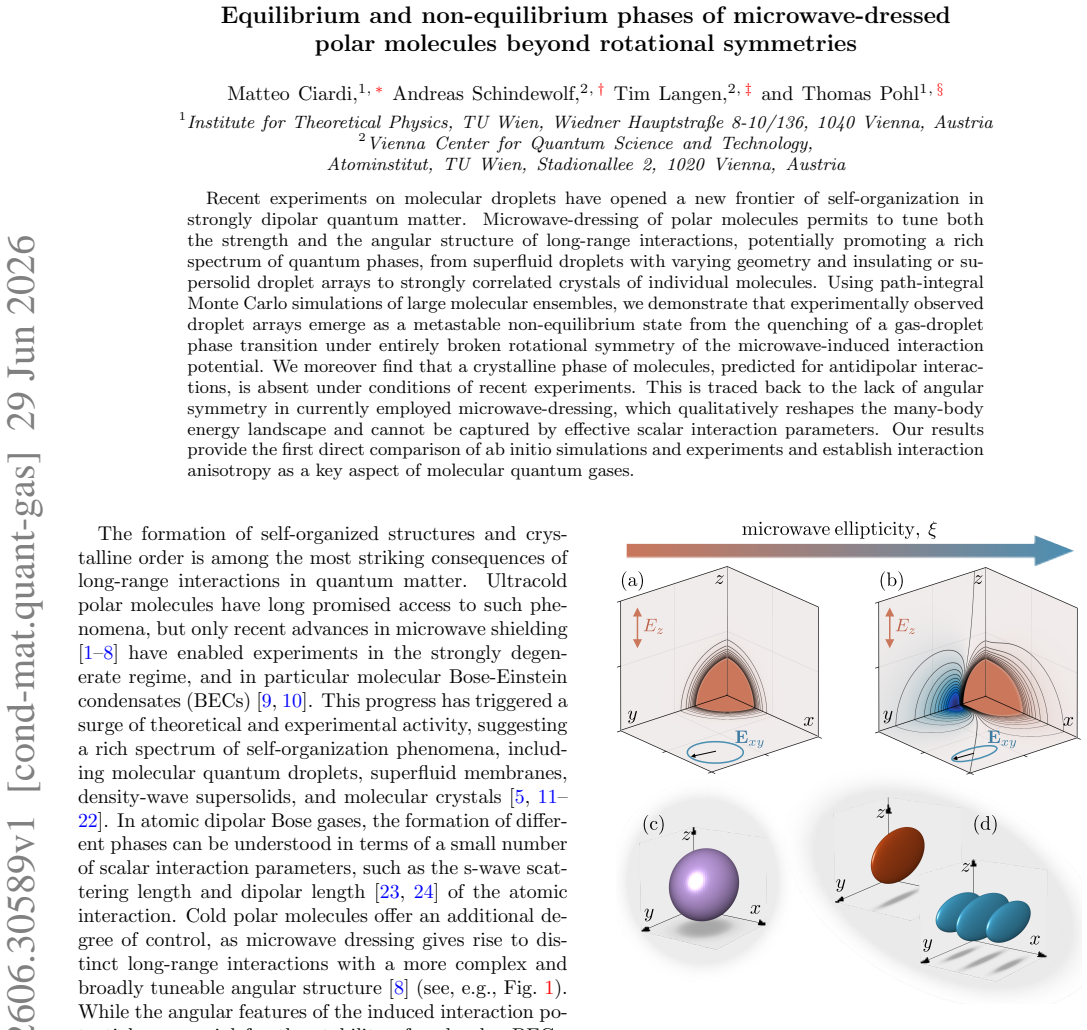
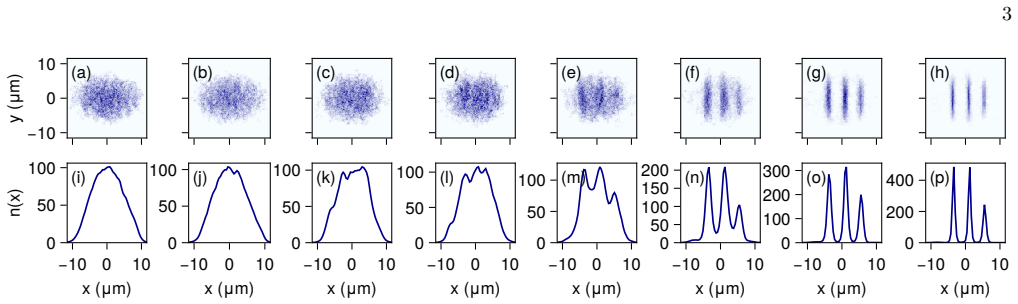
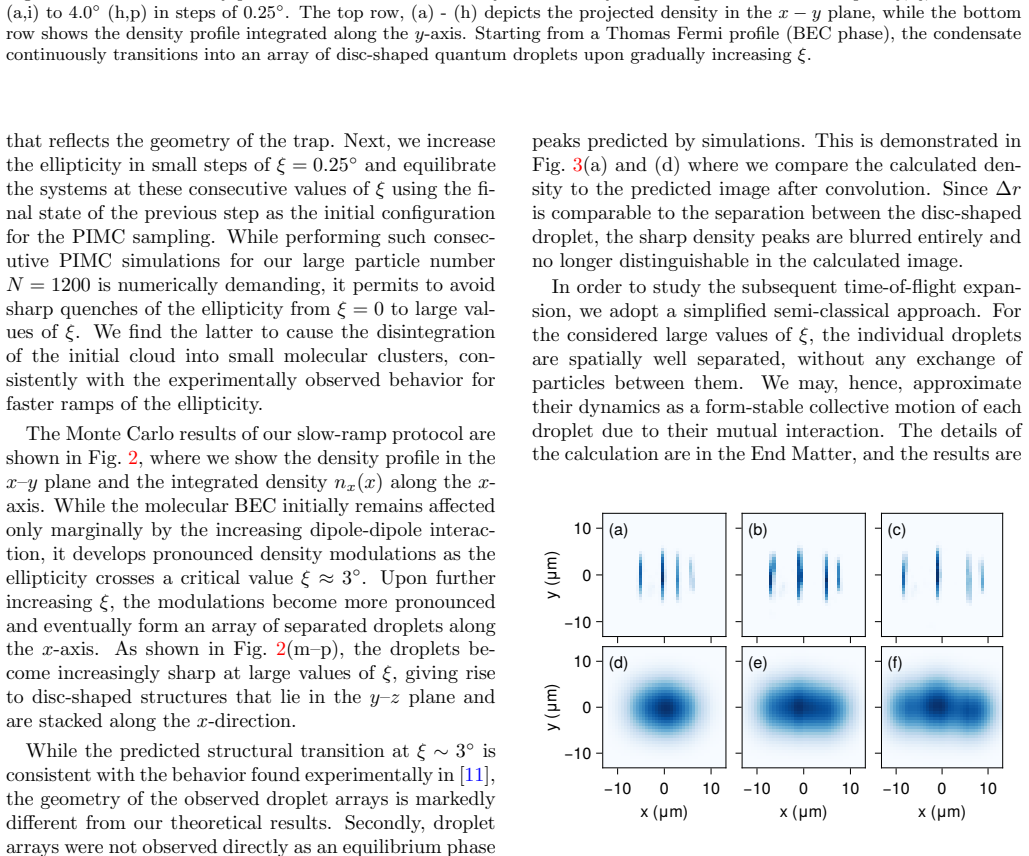
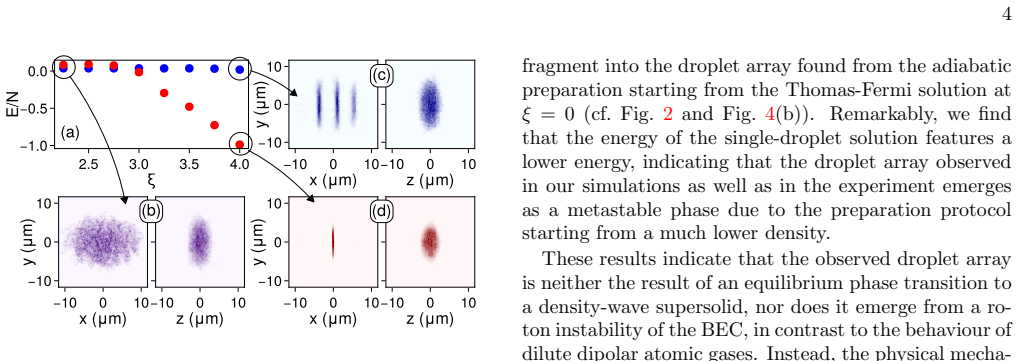
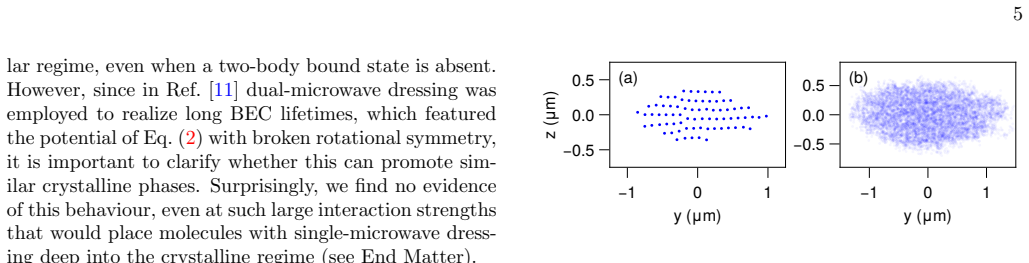
Using path-integral Monte Carlo simulations of large molecular ensembles, we demonstrate that experimentally observed droplet arrays emerge as a metastable non-equilibrium state from the quenching of a gas-droplet phase transition under entirely broken rotational symmetry of the microwave-induced interaction potential. We moreover find that a crystalline phase of molecules, predicted for antidipolar interactions, is absent under conditions of recent experiments. This is traced back to the lack of angular symmetry in currently employed microwave-dressing, which qualitatively reshapes the many-body energy landscape and cannot be captured by effective scalar interaction parameters.
What carries the argument
The microwave-induced interaction potential with entirely broken rotational symmetry, which reshapes the many-body energy landscape beyond what scalar parameters describe.
If this is right
- Droplet arrays form as metastable non-equilibrium states rather than equilibrium phases under quenched conditions.
- Crystalline phases of individual molecules require angular symmetry absent from current microwave dressing.
- Effective scalar interaction parameters fail to capture the qualitative changes from broken rotational symmetry.
- Interaction anisotropy controls which phases appear in microwave-dressed molecular gases.
Where Pith is reading between the lines
- Experiments that restore partial rotational symmetry in the dressing field could access the crystalline phase.
- Quench protocols may be tuned to favor either equilibrium or metastable states in similar long-range interacting systems.
- Models that ignore full angular dependence will systematically mispredict phases in other dressed quantum gases.
Load-bearing premise
The path-integral Monte Carlo simulations faithfully reproduce experimental conditions and the missing crystal phase results specifically from the broken angular symmetry rather than temperature, density variations, or other unmodeled effects.
What would settle it
Observation of the predicted crystalline phase in an experiment that employs microwave dressing with restored angular symmetry would show that the symmetry breaking is not responsible for its absence.
Figures
read the original abstract
Recent experiments on molecular droplets have opened a new frontier of self-organization in strongly dipolar quantum matter. Microwave-dressing of polar molecules permits to tune both the strength and the angular structure of long-range interactions, potentially promoting a rich spectrum of quantum phases, from superfluid droplets with varying geometry and insulating or supersolid droplet arrays to strongly correlated crystals of individual molecules. Using path-integral Monte Carlo simulations of large molecular ensembles, we demonstrate that experimentally observed droplet arrays emerge as a metastable non-equilibrium state from the quenching of a gas-droplet phase transition under entirely broken rotational symmetry of the microwave-induced interaction potential. We moreover find that a crystalline phase of molecules, predicted for antidipolar interactions, is absent under conditions of recent experiments. This is traced back to the lack of angular symmetry in currently employed microwave-dressing, which qualitatively reshapes the many-body energy landscape and cannot be captured by effective scalar interaction parameters. Our results provide the first direct comparison of ab initio simulations and experiments and establish interaction anisotropy as a key aspect of molecular quantum gases.
Editorial analysis
A structured set of objections, weighed in public.
Referee Report
Summary. The manuscript uses path-integral Monte Carlo (PIMC) simulations of large ensembles of microwave-dressed polar molecules to study phases under broken rotational symmetry. It claims that experimentally observed droplet arrays appear as metastable non-equilibrium states arising from quenching of a gas-droplet transition, and that a crystalline phase predicted for antidipolar interactions is absent because the anisotropy of the microwave-induced potential qualitatively reshapes the many-body landscape in a way not captured by effective scalar parameters. The work positions itself as the first direct ab initio comparison with recent experiments.
Significance. If the central claims are substantiated, the results would clarify the role of interaction anisotropy in stabilizing metastable droplet arrays and suppressing crystalline order in current microwave-dressing schemes, providing a concrete link between microscopic potentials and experimental observations that effective isotropic models miss.
major comments (2)
- [Abstract] Abstract: The central claim that droplet arrays 'emerge as a metastable non-equilibrium state from the quenching of a gas-droplet phase transition' is not directly demonstrated by the PIMC method employed. PIMC samples equilibrium or metastable configurations of the imaginary-time path integral but does not evolve the system under a time-dependent Hamiltonian or perform a controlled real-time quench; the attribution to the non-equilibrium quenching process therefore rests on an untested inference rather than on explicit dynamical evidence.
- [Abstract] Abstract: The statement that the absence of the crystalline phase 'is traced back to the lack of angular symmetry... which cannot be captured by effective scalar interaction parameters' requires a concrete demonstration (e.g., a side-by-side comparison of the many-body energy landscape or phase diagram obtained with the full anisotropic potential versus a scalar approximation) to establish that the anisotropy is the decisive factor rather than other unmodeled experimental details such as temperature or density inhomogeneity.
Simulated Author's Rebuttal
We thank the referee for the detailed and constructive report. We address each major comment below, indicating revisions where appropriate to strengthen the manuscript while remaining faithful to the capabilities of the PIMC method.
read point-by-point responses
-
Referee: [Abstract] Abstract: The central claim that droplet arrays 'emerge as a metastable non-equilibrium state from the quenching of a gas-droplet phase transition' is not directly demonstrated by the PIMC method employed. PIMC samples equilibrium or metastable configurations of the imaginary-time path integral but does not evolve the system under a time-dependent Hamiltonian or perform a controlled real-time quench; the attribution to the non-equilibrium quenching process therefore rests on an untested inference rather than on explicit dynamical evidence.
Authors: We agree that PIMC does not simulate real-time dynamics or explicit quenches. The claim in the abstract is an inference: the simulations reveal long-lived metastable droplet-array configurations under the broken rotational symmetry that are consistent with experimental observations following rapid changes in microwave dressing. To address the concern, we will revise the abstract to state that the arrays appear as metastable states arising in the context of a quenched gas-droplet transition, without implying direct dynamical simulation of the quench process. revision: yes
-
Referee: [Abstract] Abstract: The statement that the absence of the crystalline phase 'is traced back to the lack of angular symmetry... which cannot be captured by effective scalar interaction parameters' requires a concrete demonstration (e.g., a side-by-side comparison of the many-body energy landscape or phase diagram obtained with the full anisotropic potential versus a scalar approximation) to establish that the anisotropy is the decisive factor rather than other unmodeled experimental details such as temperature or density inhomogeneity.
Authors: The referee correctly notes that a direct comparison would make the argument more rigorous. Our PIMC results with the full anisotropic potential show the absence of crystalline order, in contrast to expectations for antidipolar interactions. We will add a supplementary comparison (or expanded discussion) of the many-body energetics under the full potential versus an effective scalar approximation to demonstrate the qualitative reshaping of the landscape due to anisotropy. This addition will be included in the revised manuscript. revision: yes
Circularity Check
No circularity; derivation self-contained against external benchmarks
full rationale
The paper's claims rest on path-integral Monte Carlo simulations of molecular ensembles compared directly to experimental observations of droplet arrays. No equations or steps in the provided abstract reduce a claimed result to its own inputs by construction, nor do any self-citations serve as load-bearing justifications for uniqueness or ansatzes. The distinction between equilibrium and non-equilibrium phases is presented as an inference from the simulations' identification of metastable configurations under anisotropic potentials, without any fitted-parameter renaming or self-definitional loops. This matches the default expectation of an independent comparison to external data.
Axiom & Free-Parameter Ledger
axioms (1)
- domain assumption Path-integral Monte Carlo simulations provide a faithful description of the many-body phases and metastability in microwave-dressed polar molecules.
Reference graph
Works this paper leans on
-
[1]
Karman and J
T. Karman and J. M. Hutson, Microwave Shielding of Ultracold Polar Molecules, Phys. Rev. Lett.121, 163401 (2018)
2018
-
[2]
Lassabli` ere and G
L. Lassabli` ere and G. Qu´ em´ ener, Controlling the Scat- tering Length of Ultracold Dipolar Molecules, Phys. Rev. Lett.121, 163402 (2018)
2018
-
[3]
Anderegg, S
L. Anderegg, S. Burchesky, Y. Bao, S. S. Yu, T. Karman, E. Chae, K.-K. Ni, W. Ketterle, and J. M. Doyle, Ob- servation of microwave shielding of ultracold molecules, Science373, 779 (2021)
2021
-
[4]
Schindewolf, R
A. Schindewolf, R. Bause, X.-Y. Chen, M. Duda, T. Kar- man, I. Bloch, and X.-Y. Luo, Evaporation of microwave- shielded polar molecules to quantum degeneracy, Nature 607, 677 (2022)
2022
-
[5]
F. Deng, X. Hu, W.-J. Jin, S. Yi, and T. Shi, Two- and many-body physics of ultracold molecules dressed by dual microwave fields, Nature Communications16, 11219 (2025)
2025
-
[6]
Karman, N
T. Karman, N. Bigagli, W. Yuan, S. Zhang, I. Stevenson, and S. Will, Double Microwave Shielding, PRX Quantum 6, 020358 (2025)
2025
- [7]
-
[8]
Schindewolf, J
A. Schindewolf, J. Hertkorn, I. Stevenson, M. Ciardi, P. Groß, D. Wang, T. Karman, G. Qu´ em´ ener, S. Will, T. Pohl, and T. Langen, Colloquium: Strongly dipolar molecular bose-einstein condensates: From few- to many- body physics, Rev. Mod. Phys. (2026)
2026
-
[9]
Bigagli, W
N. Bigagli, W. Yuan, S. Zhang, B. Bulatovic, T. Kar- man, I. Stevenson, and S. Will, Observation of Bose– Einstein condensation of dipolar molecules, Nature631, 289 (2024)
2024
- [10]
-
[11]
Zhang, W
S. Zhang, W. Yuan, N. Bigagli, H. Kwak, T. Karman, I. Stevenson, and S. Will, Observation of self-bound droplets of ultracold dipolar molecules, Nature651, 601 (2026)
2026
-
[12]
Langen, J
T. Langen, J. Boronat, J. S´ anchez-Baena, R. Bomb´ ın, T. Karman, and F. Mazzanti, Dipolar Droplets of Strongly Interacting Molecules, Phys. Rev. Lett.134, 053001 (2025)
2025
-
[13]
W.-J. Jin, F. Deng, S. Yi, and T. Shi, Bose-Einstein Con- densates of Microwave-Shielded Polar Molecules, Phys. Rev. Lett.134, 233003 (2025)
2025
-
[14]
Ciardi, K
M. Ciardi, K. R. Pedersen, T. Langen, and T. Pohl, Self- Bound Superfluid Membranes and Monolayer Crystals of Ultracold Polar Molecules, Phys. Rev. Lett.135, 153401 (2025)
2025
- [15]
-
[16]
Zhang, K
W. Zhang, K. Chen, S. Yi, and T. Shi, Quantum Phases for Finite-Temperature Gases of Bosonic Polar Molecules Shielded by Dual Microwaves, PRX Quantum6, 040307 (2025)
2025
-
[17]
T. Shi, H. Wang, and X. Cui, Universal Bound States with Bose-Fermi Duality in Microwave-Shielded Ultra- cold Molecules, Physical Review Letters136, 043402 (2026)
2026
-
[18]
H. Wang, T. Shi, and X. Cui, Interaction-induced dimension reduction for bound states in microwave- shielded ultracold molecules, Communications Physics 10.1038/s42005-026-02682-9 (2026)
- [19]
-
[20]
Baillie, Symmetry and self-bound droplets in dipolar molecular gases, Phys
D. Baillie, Symmetry and self-bound droplets in dipolar molecular gases, Phys. Rev. Res.8, 023219 (2026)
2026
-
[21]
Arnone Cardinale, T
T. Arnone Cardinale, T. Bland, and S. M. Reimann, Exploring supersolids of single-microwave shielded molecules via exact and mean-field theories, Communi- cations Physics9, 191 (2026)
2026
-
[22]
Bilayer crystals in a polar-molecules system
V. Zampronio, M. Ciardi, and F. Cinti, Bilayer crystals in a polar-molecules system (2026), arXiv:2605.18546 [cond- mat.quant-gas]
work page internal anchor Pith review Pith/arXiv arXiv 2026
-
[23]
B¨ ottcher, J.-N
F. B¨ ottcher, J.-N. Schmidt, J. Hertkorn, K. S. H. Ng, S. D. Graham, M. Guo, T. Langen, and T. Pfau, New states of matter with fine-tuned interactions: quantum droplets and dipolar supersolids, Rep. Prog. Phys.84, 012403 (2021)
2021
-
[24]
Chomaz, I
L. Chomaz, I. Ferrier-Barbut, F. Ferlaino, B. Laburthe- Tolra, B. L. Lev, and T. Pfau, Dipolar physics: a review of experiments with magnetic quantum gases, Rep. Prog. Phys.86, 026401 (2022)
2022
-
[25]
X.-Y. Chen, A. Schindewolf, S. Eppelt, R. Bause, M. Duda, S. Biswas, T. Karman, T. Hilker, I. Bloch, and X.-Y. Luo, Field-linked resonances of polar molecules, Nature614, 59 (2023)
2023
-
[26]
J. Lin, G. Chen, M. Jin, Z. Shi, F. Deng, W. Zhang, G. Qu´ em´ ener, T. Shi, S. Yi, and D. Wang, Microwave Shielding of Bosonic NaRb Molecules, Phys. Rev. X13, 031032 (2023)
2023
-
[27]
Bigagli, C
N. Bigagli, C. Warner, W. Yuan, S. Zhang, I. Steven- son, T. Karman, and S. Will, Collisionally stable gas of bosonic dipolar ground-state molecules, Nat. Phys.19, 1579 (2023)
2023
- [28]
-
[29]
H. P. B¨ uchler, E. Demler, M. Lukin, A. Micheli, N. Prokof’ev, G. Pupillo, and P. Zoller, Strongly cor- related 2d quantum phases with cold polar molecules: Controlling the shape of the interaction potential, Phys. Rev. Lett.98, 060404 (2007)
2007
-
[30]
Micheli, G
A. Micheli, G. Pupillo, H. P. B¨ uchler, and P. Zoller, Cold polar molecules in two-dimensional traps: Tailoring in- teractions with external fields for novel quantum phases, Phys. Rev. A76, 043604 (2007)
2007
-
[31]
A. V. Gorshkov, P. Rabl, G. Pupillo, A. Micheli, P. Zoller, M. D. Lukin, and H. P. B¨ uchler, Suppression of Inelas- tic Collisions Between Polar Molecules With a Repulsive Shield, Phys. Rev. Lett.101, 073201 (2008)
2008
-
[32]
N. R. Cooper and G. V. Shlyapnikov, Stable Topological Superfluid Phase of Ultracold Polar Fermionic Molecules, Phys. Rev. Lett.103, 155302 (2009)
2009
-
[33]
Huang, Y.-T
S.-J. Huang, Y.-T. Hsu, H. Lee, Y.-C. Chen, A. G. Volos- niev, N. T. Zinner, and D.-W. Wang, Field-induced long- lived supermolecules, Phys. Rev. A85, 055601 (2012)
2012
-
[34]
Bause, A
R. Bause, A. Christianen, A. Schindewolf, I. Bloch, and 7 X.-Y. Luo, Ultracold Sticky Collisions: Theoretical and Experimental Status, J. Phys. Chem. A127, 729 (2023)
2023
-
[35]
Deng, X.-Y
F. Deng, X.-Y. Chen, X.-Y. Luo, W. Zhang, S. Yi, and T. Shi, Effective Potential and Superfluidity of Microwave-Shielded Polar Molecules, Phys. Rev. Lett. 130, 183001 (2023)
2023
-
[36]
H. J. J´ o´ zwiak, I. Stevenson, S. Will, and T. Karman, The Map of Parameter Space in Double Microwave Shielding (2026), arXiv:2606.09636 [cond-mat.quant-gas]
work page internal anchor Pith review Pith/arXiv arXiv 2026
-
[37]
D. M. Ceperley, Path integrals in the theory of condensed helium, Rev. Mod. Phys.67, 279 (1995)
1995
-
[38]
P. Jain, F. Cinti, and M. Boninsegni, Structure, Bose-Einstein condensation, and superfluidity of two- dimensional confined dipolar assemblies, Phys. Rev. B 84, 014534 (2011)
2011
-
[39]
Macia, F
A. Macia, F. Mazzanti, J. Boronat, and R. E. Zillich, Mi- croscopic description of anisotropic low-density dipolar bose gases in two dimensions, Phys. Rev. A84, 033625 (2011)
2011
-
[40]
Saito, Path-Integral Monte Carlo Study on a Droplet of a Dipolar Bose–Einstein Condensate Stabilized by Quantum Fluctuation, J
H. Saito, Path-Integral Monte Carlo Study on a Droplet of a Dipolar Bose–Einstein Condensate Stabilized by Quantum Fluctuation, J. Phys. Soc. Jpn.85, 053001 (2016)
2016
-
[41]
B¨ ottcher, M
F. B¨ ottcher, M. Wenzel, J. Schmidt, M. Guo, T. Langen, I. Ferrier-Barbut, T. Pfau, R. Bomb´ ın, J. S´ anchez-Baena, J. Boronat, and F. Mazzanti, Dilute dipolar quantum droplets beyond the extended gross-pitaevskii equation, Phys. Rev. Res.1, 033088 (2019)
2019
-
[42]
Boninsegni, Morphology of dipolar bose droplets, Re- sults Phys.31, 104935 (2021)
M. Boninsegni, Morphology of dipolar bose droplets, Re- sults Phys.31, 104935 (2021)
2021
- [43]
-
[44]
Stuhler, A
J. Stuhler, A. Griesmaier, T. Koch, M. Fattori, T. Pfau, S. Giovanazzi, P. Pedri, and L. Santos, Observation of dipole-dipole interaction in a degenerate quantum gas, Phys. Rev. Lett.95, 150406 (2005)
2005
-
[45]
B¨ ottcher, J.-N
F. B¨ ottcher, J.-N. Schmidt, M. Wenzel, J. Hertkorn, M. Guo, T. Langen, and T. Pfau, Transient Supersolid Properties in an Array of Dipolar Quantum Droplets, Phys. Rev. X9, 011051 (2019)
2019
-
[46]
Tanzi, E
L. Tanzi, E. Lucioni, F. Fam` a, J. Catani, A. Fioretti, C. Gabbanini, R. N. Bisset, L. Santos, and G. Modugno, Observation of a Dipolar Quantum Gas with Metastable Supersolid Properties, Phys. Rev. Lett.122, 130405 (2019)
2019
-
[47]
Chomaz, D
L. Chomaz, D. Petter, P. Ilzh¨ ofer, G. Natale, A. Traut- mann, C. Politi, G. Durastante, R. M. W. van Bijnen, A. Patscheider, M. Sohmen, M. J. Mark, and F. Fer- laino, Long-Lived and Transient Supersolid Behaviors in Dipolar Quantum Gases, Phys. Rev. X9, 021012 (2019)
2019
-
[48]
M. A. Cazalilla, R. Citro, T. Giamarchi, E. Orignac, and M. Rigol, One dimensional bosons: From condensed mat- ter systems to ultracold gases, Rev. Mod. Phys.83, 1405 (2011)
2011
-
[49]
Pitaevskii and S
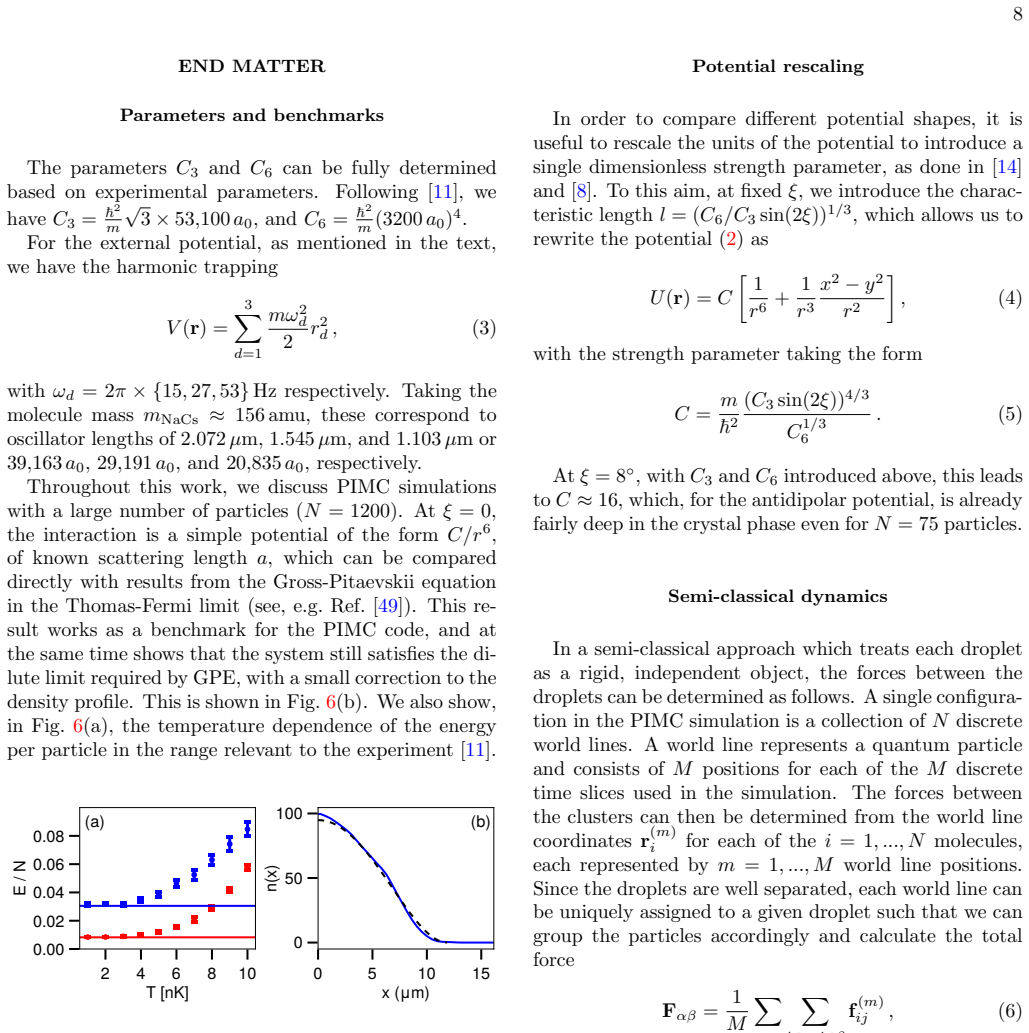
L. Pitaevskii and S. Stringari,Bose-Einstein condensa- tion and superfluidity, 765, International series of mono- graphs on physics (Oxford University Press, Oxford, 2016). 8 END MA TTER Parameters and benchmarks The parametersC 3 andC 6 can be fully determined based on experimental parameters. Following [11], we haveC 3 = ℏ2 m √ 3×53,100a 0, andC 6 = ℏ2 ...
2016
discussion (0)
Sign in with ORCID, Apple, or X to comment. Anyone can read and Pith papers without signing in.