REVIEW 3 major objections 5 minor 6 cited by
Spectral Image Tokenizer
T0 review · 3 major / 5 minor · reviewed 2026-08-11 · deepseek-v4-flash
Pith's one-line read Image tokens ordered by wavelet scale enable coarse-to-fine generation.
desk verdict A genuinely useful tokenizer with a real attribution gap: the gains over ViT-VQGAN aren't isolated to the spectral input, but the multiscale applications are novel and worth refereeing. read the letter →
The pith
A machine-rendered reading of the paper's core claim, the machinery that carries it, and where it could break.
The reading
What carries the argument
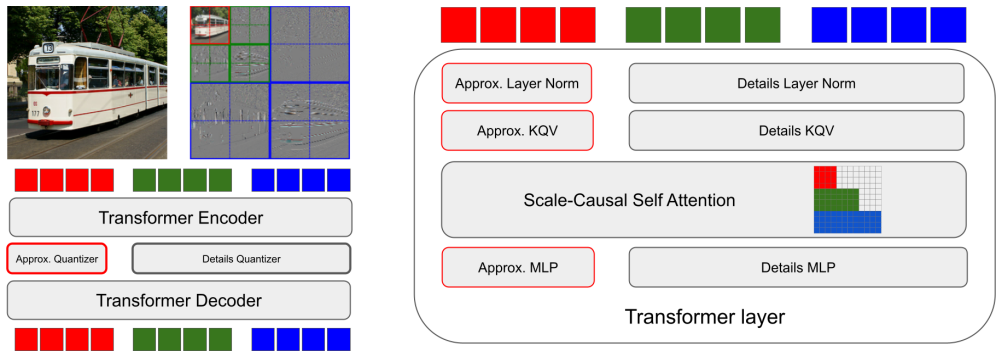
The central object is DWT coefficient patchification combined with scale-causal attention. Each wavelet scale becomes one block of tokens: the approximation coefficients form the first scale, and horizontal, vertical, and diagonal detail coefficients are concatenated spatially so every scale has the same token count. The scale-causal attention mask, applied to the encoder or decoder or both, is what endows the representation with its multiscale behavior, since it forces each scale to depend only on itself and lower scales. The Approximation-Details Transformer (ADTransformer), with separate parameters and codebooks for the approximation and detail tokens, handles the fact that the two coefficient distributions are very different.
What would settle it
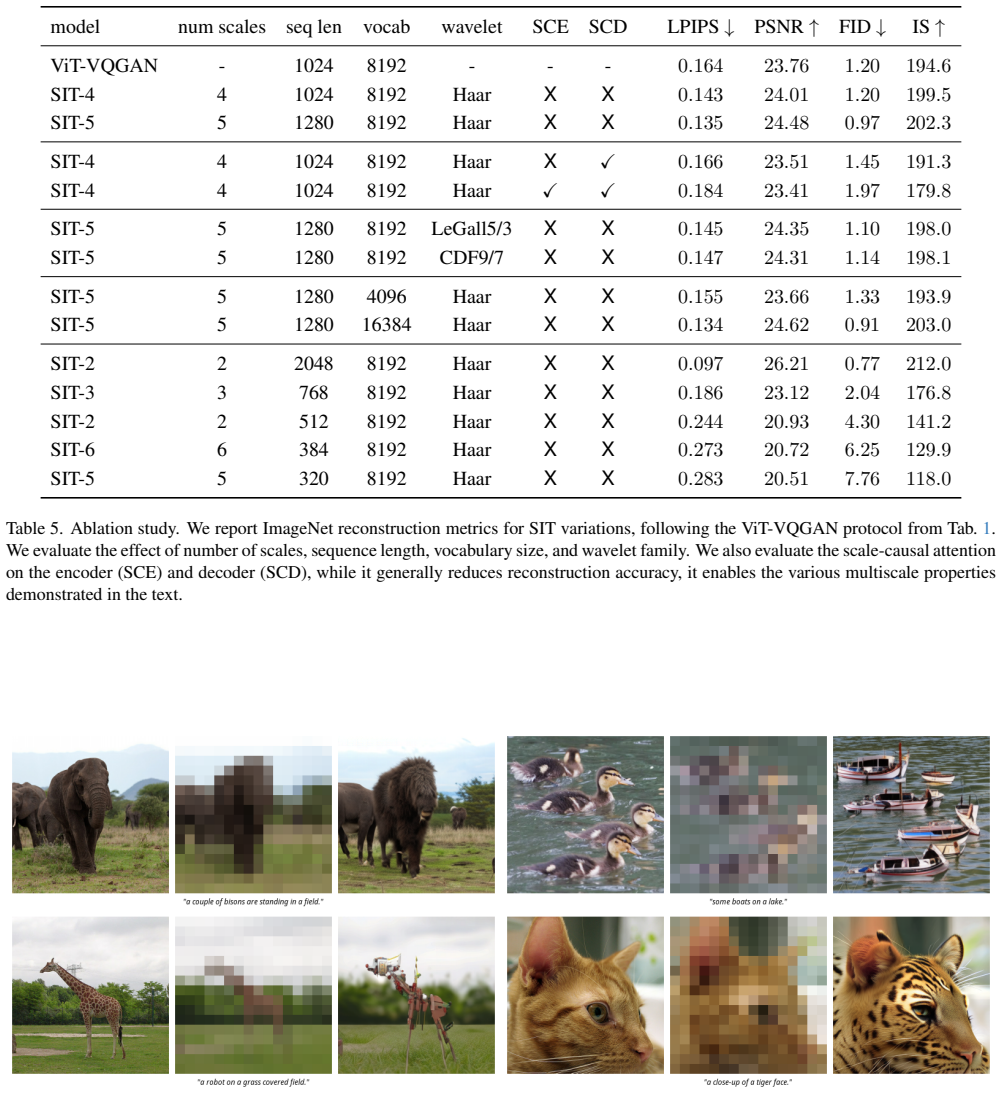
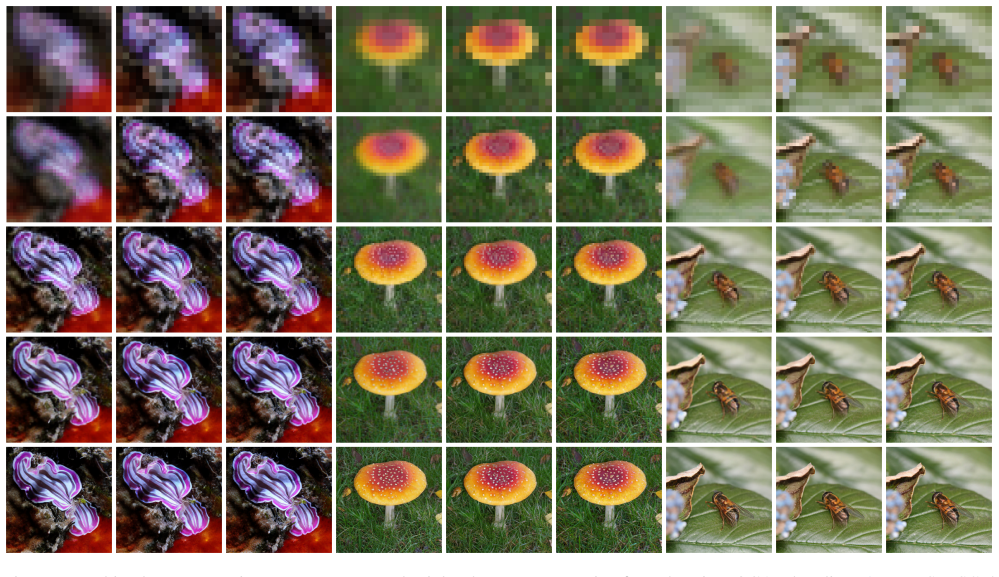
Train a SIT with scale-causal attention on both encoder and decoder at 256×256, then decode only the first-scale tokens into a full-resolution image and measure LPIPS and PSNR against ground truth. If the coarse reconstruction from the first scale alone is not a recognizable image, the claim that the representation is truly coarse-to-fine and decodable at partial scales would be falsified. The paper's own ablation, which shows LPIPS degrading from 0.143 to 0.184 when both masks are enabled, indicates the direction of the risk.
Extended reading notes
Core claim
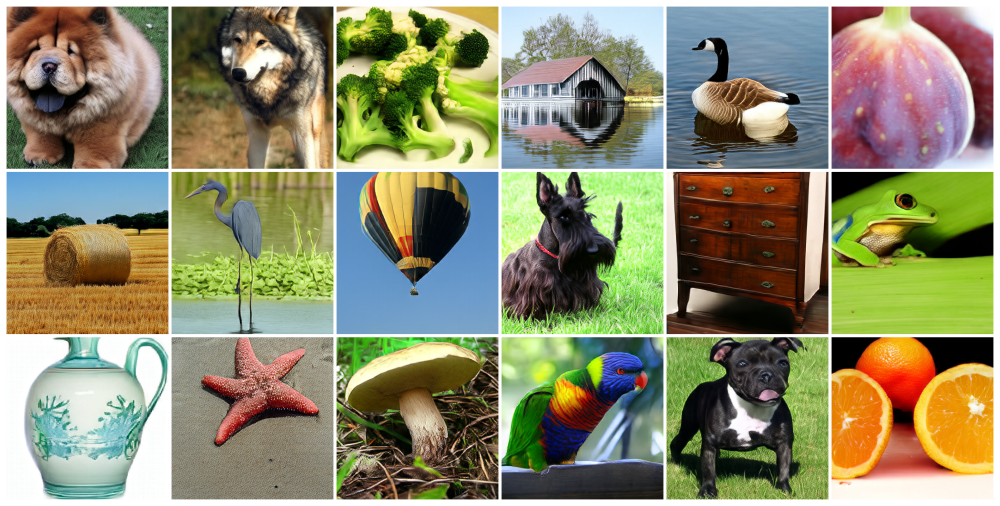
The central claim is that tokenizing the spectrum rather than the pixels is a better inductive bias for autoregressive image modeling. SIT applies a Haar DWT, patchifies each scale separately with the same number of tokens per scale (so higher scales use larger patches and are compressed more), and feeds the resulting sequence through a transformer with separate parameters and codebooks for approximation versus detail coefficients. An optional scale-causal attention mask lets each scale attend only to itself and lower scales, which makes the representation multiscale without retraining. With this tokenizer, an autoregressive transformer (AR-SIT) models the coarse-to-fine sequence; the authors report improved reconstruction over the ViT-VQGAN baseline (LPIPS 0.135 versus 0.167 at 256×256 for SIT-5), improved class-conditional generation (FID 6.95 versus 8.37), and comparable text-to-image FID while adding the ability to partially decode, upsample, and edit images.
Load-bearing premise
The load-bearing premise is that the low-scale approximation tokens contain enough information that all higher-scale detail tokens can be predicted or generated from them, so the scale-causal mask that blocks high-frequency information from influencing low-frequency tokens does not cripple reconstruction quality.
Editorial extensions
If this is right
- One model trained at a single resolution can tokenize and reconstruct images at lower and higher resolutions without retraining, because the scale-causal mask makes unused scales simply absent from the sequence.
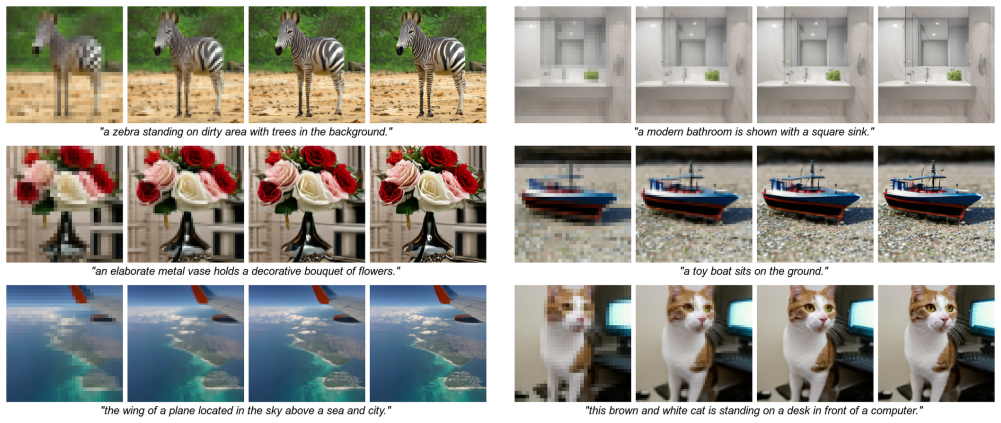
- Early termination of autoregressive generation yields a coarse image after only the first tokens, so a user can preview many drafts cheaply and refine only the selected one.
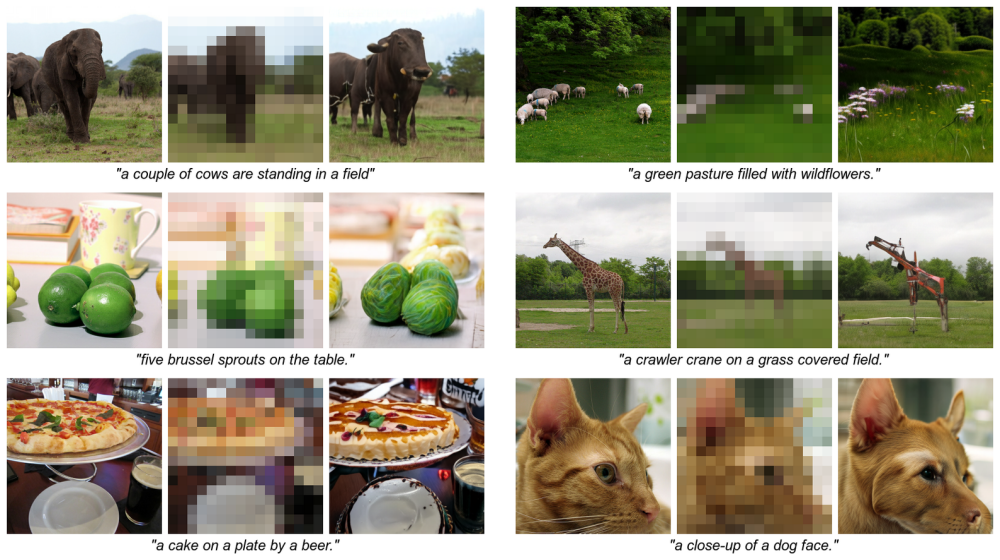
- Text-guided upsampling becomes a continuation problem: encode the low-resolution input into the first tokens and let the autoregressive model generate the rest.
- Text-guided editing becomes a freezing problem: keep the low scales of an input image and regenerate higher scales under a new caption.
- Class-conditional generation improves over the comparable raster-order baseline, supporting the claim that coarse-to-fine conditioning is better for next-token prediction.
Reading between the lines
- If the coarse-to-fine ordering is what matters, then other invertible multiscale transforms with energy compaction, such as DCT or learned filter banks, could yield similar gains; the paper only demonstrates DWT with Haar.
- The reconstruction-quality cost of scale-causal attention suggests a possible refinement: allow high-frequency information to influence low-frequency tokens during encoding but decode with strict scale-causality, or predict detail tokens conditionally with a learned prior over the approximation coefficients.
- The observation that bigger codebooks improve reconstruction but not generation hints at a compression-generation tradeoff that could be studied by varying the number of tokens per scale according to the energy of each scale.
- A natural extension is to make the number of tokens per scale adaptive to image content, using more tokens where detail is actually present, which the paper does not explore.
Signed reviews
Editorial analysis
A structured set of objections, weighed in public.
Referee Report
Summary. The paper introduces the Spectral Image Tokenizer (SIT), a ViT-VQGAN-style image tokenizer that operates on Haar discrete wavelet transform (DWT) coefficients instead of spatial pixel patches. The DWT output is organized into scales, an approximation scale followed by detail scales, and each scale is patchified with scale-specific linear embeddings, so higher-frequency scales are represented by larger patches and hence compressed more. The tokenizer transformer can use a scale-causal attention mask and separate parameters and codebooks for approximation versus detail coefficients (ADTransformer). The resulting token sequence is coarse-to-fine. The paper then trains an autoregressive transformer (AR-SIT) over SIT tokens and evaluates it for text-to-image generation, partial decoding, text-guided upsampling, text-guided editing, and class-conditional generation. Experiments report reconstruction metrics on ImageNet at multiple resolutions, text-to-image metrics on MS-COCO, and class-conditional FID on ImageNet, together with ablations over scales, sequence length, vocabulary size, wavelet family, and scale-causal attention. The authors state explicitly that text-to-image FID is similar to the Parti baseline and that the scale-causal mask reduces reconstruction accuracy.
Significance. If the central claim holds, SIT is a useful step toward making autoregressive image generation genuinely multiscale: a single tokenizer can handle multiple resolutions without retraining, supports partial decoding, and enables text-guided upsampling and editing. The paper is commendably transparent: it reproduces the ViT-VQGAN baseline, reports throughput and memory, includes ablations, and states its limitations (small AR models, similar text-to-image metrics, scale-causal tradeoff). The main weakness is attribution: SIT differs from ViT-VQGAN not only in the input representation but also in the transformer internals and quantizer, so the reported gains are not yet isolated to the spectral representation. With the missing ablation supplied, the paper would provide solid evidence for its claims.
major comments (3)
- [§4.1, Tables 1, 3, 5] The paper's central claim, stated in §1 and repeated in §2, is that tokenizing DWT coefficients rather than spatial patches is the 'crucial difference' from prior work. However, Tables 1, 3, and 5 compare SIT against ViT-VQGAN under a combined change: SIT uses DWT inputs, the ADTransformer with separate approximation/detail parameters, and two separate codebooks. No experiment isolates the input representation by ablating these components independently. For example, one could keep the ADTransformer and dual codebooks but feed a spatial multiscale representation (e.g., a Laplacian pyramid or downsampled image plus residuals), or keep the DWT input but revert to a shared transformer and single codebook. Without such a control, the reconstruction improvements (e.g., LPIPS 0.135 vs 0.167 at 256x256 in Table 1) and the class-conditional FID gain (6.95 vs 8.37 in Table 3) cannot be attributed specifically to the spectral input. This is an omitted control rather than an internal inconsistency, but it is load-bearing for the paper's stated contribution.
- [Table 5, Section 4.1] Table 5 shows that scale-causal attention is not free: for SIT-4, enabling both scale-causal encoder and decoder increases LPIPS from 0.143 to 0.184 and FID from 1.20 to 1.97 at 256x256, and enabling only the scale-causal decoder still increases LPIPS to 0.166 and FID to 1.45. Since properties P.2 and P.4-P.6 all depend on scale-causal masking, the paper should quantify the benefit side of this tradeoff with the same metrics. I would like to see, at minimum, reconstruction quality and FID as a function of the number of decoded scales for partial decoding, and a statement of how the full-resolution loss weighs against the multiscale capabilities. Without this quantification, the claim that the scale-causal attention enables different applications is supported only qualitatively.
- [Tables 1, 2, 3; Section 5.1] Most reported numbers are single-run and no error bars or significance tests are given. This matters because several headline comparisons are close (AR-SIT FID 12.6 vs Parti 12.4 in Table 2) and because the 512x512 ViT-VQGAN row in Table 1 is explicitly selected as the best checkpoint before divergence. The paper should state the number of seeds or runs used, report means and standard deviations (or an equivalent dispersion measure), and describe the checkpoint-selection protocol for the unstable baseline. This is standard practice and would materially strengthen the empirical claims in §5.1 and §5.2.
minor comments (5)
- [Section 6] The word 'realtively' in the conclusion should be 'relatively'.
- [Table 5] The SCE and SCD columns use both 'X' and '✓' without a legend; please state explicitly that '✓' means the scale-causal mask is enabled.
- [Section 1] Reference [37] appears twice in the citation list [15, 37, 37, 51, 57]; the duplicate should be removed.
- [Equation (6), Section 4.2] Equation (6) writes the categorical distribution over ⌊q^n_s⌋, but the notation ⌊q^n_s⌋ is introduced just before as 'its discrete position in the codebook'; consider using a distinct symbol such as k^n_s to avoid confusion with an integer-part or floor operation.
- [Section 5.3 and Table 4] The main text reports an FID of 6.2 for 32x32 upsampling, while the supplemental Table 4 lists 6.19; please state which number is used and confirm that the evaluation subset and ground-truth protocol are the same as in Table 2.
Circularity Check
No significant circularity; the paper's claims are empirically tested against external baselines and its design choices are ablated rather than derived from the target results.
full rationale
The paper makes no derivation that reduces to its own inputs. The central contribution, tokenizing DWT coefficients instead of spatial patches, is an architectural proposal whose benefits are evaluated through reconstruction metrics, generation quality, and downstream applications, all compared with external baselines such as ViT-VQGAN and Parti. The design choices are explicitly tested in the ablation study (Table 5), which varies the number of scales, sequence length, vocabulary size, wavelet family, and the use of scale-causal attention on the encoder and decoder. These ablations show that the scale-causal mask costs reconstruction quality, so the multiscale properties are presented as trade-offs rather than as forced consequences of the target result. The paper also acknowledges the text-to-image metrics were similar to the fair baseline and that a better tokenizer does not necessarily lead to a better generative model, which further indicates the claims are not constructed to be true by definition. There are no load-bearing self-citations: the references to prior work are external baselines and contextual methods, not prior papers by the same authors invoked to justify the central premise. No fitted parameter is renamed as a prediction; the learned codebooks and transformer weights are trained and then evaluated on held-out data in the standard manner. The strongest concern, noted by the skeptic framing, is that the empirical comparison changes both the input representation and the transformer/quantizer internals simultaneously, so the specific attribution of gains to the spectral input is not fully isolated. However, this is an omitted control and a correctness or attribution risk, not circularity: the paper does not define the input representation in terms of the outcome, nor does it import uniqueness from self-citation, nor does it present a fit as a prediction. Therefore the paper is self-contained with respect to the circularity criteria, and the appropriate score is 0.
Assumptions & free parameters
free parameters (5)
- tokens per scale N =
256 (varies 64 to 2048 in ablations)
- number of scales S =
4 or 5 (up to 6 tested)
- codebook size =
8192 per codebook (4096 and 16384 ablated)
- loss weights =
L2 1.0, perceptual 0.1, adversarial 0.1, commitment 0.25
- per-scale loss weighting in AR-SIT-4* =
each scale 4x smaller than previous
assumptions (4)
- standard math 2D DWT with Haar filters is invertible
- domain assumption Natural image power spectra concentrate energy in low frequencies
- domain assumption Approximation and detail DWT coefficients have distinct distributions that warrant separate codebooks and transformer parameters
- domain assumption A scale-causal attention mask that restricts tokens to lower scales provides sufficient context for encoding and generating higher scales
Cite this review
Pith. "Pith review of Spectral Image Tokenizer." pith.science (2026). https://pith.science/paper/VV4I4KE3
@misc{pith2026241209607,
  author       = {Pith},
  title        = {Pith review of: Spectral Image Tokenizer},
  year         = {2026},
  howpublished = {\url{https://pith.science/paper/VV4I4KE3}},
  note         = {Machine review of arXiv:2412.09607}
}
read the original abstract
Image tokenizers map images to sequences of discrete tokens, and are a crucial component of autoregressive transformer-based image generation. The tokens are typically associated with spatial locations in the input image, arranged in raster scan order, which is not ideal for autoregressive modeling. In this paper, we propose to tokenize the image spectrum instead, obtained from a discrete wavelet transform (DWT), such that the sequence of tokens represents the image in a coarse-to-fine fashion. Our tokenizer brings several advantages: 1) it leverages that natural images are more compressible at high frequencies, 2) it can take and reconstruct images of different resolutions without retraining, 3) it improves the conditioning for next-token prediction -- instead of conditioning on a partial line-by-line reconstruction of the image, it takes a coarse reconstruction of the full image, 4) it enables partial decoding where the first few generated tokens can reconstruct a coarse version of the image, 5) it enables autoregressive models to be used for image upsampling. We evaluate the tokenizer reconstruction metrics as well as multiscale image generation, text-guided image upsampling and editing.
Figures

Figures from the paper (7 more)



Forward citations
Cited by 6 Pith papers
-
StrandDesigner: Towards Practical Strand Generation with Sketch Guidance
Sketch drawings can directly control 3D hair strand generation through multi-scale latent upsampling with adaptive DINOv2 conditioning, yielding more accurate results than text- or image-guided baselines.
-
Improving Progressive Generation with Decomposable Flow Matching
DFM applies flow matching with per-stage noise schedules to Laplacian pyramid levels in one shared DiT, improving FID and FDD on ImageNet and video benchmarks over prior progressive generation baselines.
-
SpectralAR: Spectral Autoregressive Visual Generation
An autoregressive image generator that tokenizes images in the DCT frequency domain into nested 1D spectral sequences and generates them coarse-to-fine, reaching 3.02 gFID with 64 tokens on ImageNet-1K.
-
Flow Along the K-Amplitude for Generative Modeling
K-Flow trains flow-matching models with frequency scale as time, enabling competitive image and molecule generation plus scale-level control of outputs.
-
DCTdiff: Intriguing Properties of Image Generative Modeling in the DCT Space
Diffusion models trained on DCT-compressed image representations outperform pixel-based and latent (VAE) diffusion baselines at lower training cost.
-
Efficient Multi-Camera Tokenization with Triplanes for End-to-End Driving
A fixed-size triplane scene representation tokenizes any number of camera images into 45-104 tokens, enabling faster autoregressive driving policies without sacrificing planning accuracy.
Reference graph
Works this paper leans on
-
[1]
Im- proving image generation with better captions
James Betker, Gabriel Goh, Li Jing, † TimBrooks, Jian- feng Wang, Linjie Li, † LongOuyang, † JuntangZhuang, † JoyceLee, † YufeiGuo, † WesamManassra, † PrafullaDhari- wal, † CaseyChu, † YunxinJiao, and Aditya Ramesh. Im- proving image generation with better captions. 2
-
[2]
Multi-Stage Vari- ational Auto-Encoders for Coarse-to-Fine Image Genera- tion, page 630–638
Lei Cai, Hongyang Gao, and Shuiwang Ji. Multi-Stage Vari- ational Auto-Encoders for Coarse-to-Fine Image Genera- tion, page 630–638. Society for Industrial and Applied Math- ematics, 2019. 3
work page 2019
-
[3]
Huiwen Chang, Han Zhang, Lu Jiang, Ce Liu, and William T. Freeman. Maskgit: Masked generative image transformer. In CVPR, 2022. 1, 3
work page 2022
-
[4]
Freeman, Michael Ru- binstein, Yuanzhen Li, and Dilip Krishnan
Huiwen Chang, Han Zhang, Jarred Barber, Aaron Maschinot, Jose Lezama, Lu Jiang, Ming-Hsuan Yang, Kevin Patrick Murphy, William T. Freeman, Michael Ru- binstein, Yuanzhen Li, and Dilip Krishnan. Muse: Text- to-image generation via masked generative transformers. In ICML, 2023. 1, 3, 9
work page 2023
-
[5]
PixelSNAIL: An improved autoregressive genera- tive model
XI Chen, Nikhil Mishra, Mostafa Rohaninejad, and Pieter Abbeel. PixelSNAIL: An improved autoregressive genera- tive model. In ICML, 2018. 3
work page 2018
-
[6]
Pali: A jointly-scaled multilingual language-image model, 2022
Xi Chen, Xiao Wang, Soravit Changpinyo, AJ Piergiovanni, Piotr Padlewski, Daniel Salz, Sebastian Goodman, Adam Grycner, Basil Mustafa, Lucas Beyer, Alexander Kolesnikov, Joan Puigcerver, Nan Ding, Keran Rong, Hassan Akbari, Gaurav Mishra, Linting Xue, Ashish Thapliyal, James Brad- bury, Weicheng Kuo, Mojtaba Seyedhosseini, Chao Jia, Burcu Karagol Ayan, Ca...
work page 2022
-
[7]
C. A. Christopoulos, T. Ebrahimi, and A. N. Skodras. Jpeg2000: the new still picture compression standard. In Proceedings of the 2000 ACM Workshops on Multimedia , page 45–49, New York, NY , USA, 2000. Association for Computing Machinery. 4
work page 2000
-
[8]
Cohen, Ingrid Daubechies, and J.-C
A. Cohen, Ingrid Daubechies, and J.-C. Feauveau. Biorthog- onal bases of compactly supported wavelets. Communi- cations on Pure and Applied Mathematics , 45(5):485–560,
Show all 62 references
-
[9]
Ten lectures on wavelets
Ingrid Daubechies. Ten lectures on wavelets . Society for Industrial and Applied Mathematics, USA, 1992. 3
1992
-
[10]
Imagenet: A large-scale hierarchical image database
Jia Deng, Wei Dong, Richard Socher, Li-Jia Li, Kai Li, and Li Fei-Fei. Imagenet: A large-scale hierarchical image database. In CVPR, 2009. 6
2009
-
[11]
Diffusion models beat gans on image synthesis
Prafulla Dhariwal and Alex Nichol. Diffusion models beat gans on image synthesis. In NeurIPS, 2021. 1
2021
-
[12]
Diffusion is spectral autoregression, 2024
Sander Dieleman. Diffusion is spectral autoregression, 2024. 2
2024
-
[13]
An image is worth 16x16 words: Transformers for image recognition at scale
Alexey Dosovitskiy, Lucas Beyer, Alexander Kolesnikov, Dirk Weissenborn, Xiaohua Zhai, Thomas Unterthiner, Mostafa Dehghani, Matthias Minderer, Georg Heigold, Syl- vain Gelly, Jakob Uszkoreit, and Neil Houlsby. An image is worth 16x16 words: Transformers for image recognition ...
2021
-
[14]
Quantised global autoencoder: A holistic approach to representing visual data,
Tim Elsner, Paula Usinger, Victor Czech, Gregor Kobsik, Yanjiang He, Isaak Lim, and Leif Kobbelt. Quantised global autoencoder: A holistic approach to representing visual data,
-
[15]
Taming transformers for high-resolution image synthesis
Patrick Esser, Robin Rombach, and Bj ¨orn Ommer. Taming transformers for high-resolution image synthesis. In CVPR,
-
[16]
Scaling rectified flow trans- formers for high-resolution image synthesis, 2024
Patrick Esser, Sumith Kulal, Andreas Blattmann, Rahim Entezari, Jonas M ¨uller, Harry Saini, Yam Levi, Dominik Lorenz, Axel Sauer, Frederic Boesel, Dustin Podell, Tim Dockhorn, Zion English, Kyle Lacey, Alex Goodwin, Yan- nik Marek, and Robin Rombach. Scaling rectified flow tr...
2024
-
[17]
Swagan: a style-based wavelet-driven generative model
Rinon Gal, Dana Cohen Hochberg, Amit Bermano, and Daniel Cohen-Or. Swagan: a style-based wavelet-driven generative model. ACM TOG, 2021. 1
2021
-
[18]
Susskind, and Navdeep Jaitly
Jiatao Gu, Shuangfei Zhai, Yizhe Zhang, Joshua M. Susskind, and Navdeep Jaitly. Matryoshka diffusion mod- els. In ICLR, 2024. 3
2024
-
[19]
Learnings from scaling visual tokenizers for reconstruction and generation,
Philippe Hansen-Estruch, David Yan, Ching-Yao Chung, Orr Zohar, Jialiang Wang, Tingbo Hou, Tao Xu, Sriram Vish- wanath, Peter Vajda, and Xinlei Chen. Learnings from scaling visual tokenizers for reconstruction and generation,
-
[20]
Gans trained by a two time-scale update rule converge to a local nash equilib- rium
Martin Heusel, Hubert Ramsauer, Thomas Unterthiner, Bernhard Nessler, and Sepp Hochreiter. Gans trained by a two time-scale update rule converge to a local nash equilib- rium. In NeurIPS, 2017. 2
2017
-
[21]
Classifier-free diffusion guidance, 2022
Jonathan Ho and Tim Salimans. Classifier-free diffusion guidance, 2022. 1
2022
-
[22]
Towards accurate image coding: Improved au- toregressive image generation with dynamic vector quantiza- tion
Mengqi Huang, Zhendong Mao, Zhuowei Chen, and Yong- dong Zhang. Towards accurate image coding: Improved au- toregressive image generation with dynamic vector quantiza- tion. In CVPR, 2023. 2, 8
2023
-
[23]
Imagen 3, 2024
Imagen-Team-Google. Imagen 3, 2024. 2
2024
-
[24]
Progressive growing of GANs for improved quality, stability, and variation
Tero Karras, Timo Aila, Samuli Laine, and Jaakko Lehtinen. Progressive growing of GANs for improved quality, stability, and variation. In ICLR, 2018. 3
2018
-
[25]
Sinddm: A single image denoising diffusion model
Vladimir Kulikov, Shahar Yadin, Matan Kleiner, and Tomer Michaeli. Sinddm: A single image denoising diffusion model. In ICML, pages 17920–17930, 2023. 3
2023
-
[26]
Autoregressive image generation using residual quantization
Doyup Lee, Chiheon Kim, Saehoon Kim, Minsu Cho, and Wook-Shin Han. Autoregressive image generation using residual quantization. In CVPR, 2022. 2, 8
2022
-
[27]
Belongie, James Hays, Pietro Perona, Deva Ramanan, Piotr Doll ´ar, and C
Tsung-Yi Lin, Michael Maire, Serge J. Belongie, James Hays, Pietro Perona, Deva Ramanan, Piotr Doll ´ar, and C. Lawrence Zitnick. Microsoft COCO: common objects in context. In ECCV. 5, 6, 7, 8, 2, 3
-
[28]
Star: Scale-wise text-to- image generation via auto-regressive representations, 2024
Xiaoxiao Ma, Mohan Zhou, Tao Liang, Yalong Bai, Tiejun Zhao, Huaian Chen, and Yi Jin. Star: Scale-wise text-to- image generation via auto-regressive representations, 2024. 2
2024
-
[29]
A Wavelet Tour of Signal Processing, Third Edition: The Sparse Way
Stephane Mallat. A Wavelet Tour of Signal Processing, Third Edition: The Sparse Way . Academic Press, Inc., USA, 3rd edition, 2008. 3
2008
-
[30]
Wavelets are all you need for autoregressive image gener- ation, 2024
Wael Mattar, Idan Levy, Nir Sharon, and Shai Dekel. Wavelets are all you need for autoregressive image gener- ation, 2024. 3
2024
-
[31]
Spectral normalization for generative ad- versarial networks
Takeru Miyato, Toshiki Kataoka, Masanori Koyama, and Yuichi Yoshida. Spectral normalization for generative ad- versarial networks. In ICLR, 2018. 5
2018
-
[32]
Battaglia
Charlie Nash, Jacob Menick, Sander Dieleman, and Peter W. Battaglia. Generating images with sparse representations. In ICML, 2021. 3
2021
-
[33]
Gpt-4 technical report, 2023
OpenAI. Gpt-4 technical report, 2023. 1, 2
2023
-
[34]
Scalable diffusion models with transformers
William Peebles and Saining Xie. Scalable diffusion models with transformers. 2023. 8
2023
-
[35]
Wavelet diffusion models are fast and scalable image generators
Hao Phung, Quan Dao, and Anh Tran. Wavelet diffusion models are fast and scalable image generators. In CVPR,
-
[36]
When worse is better: Navigating the compression-generation tradeoff in visual to- kenization, 2024
Vivek Ramanujan, Kushal Tirumala, Armen Aghajanyan, Luke Zettlemoyer, and Ali Farhadi. When worse is better: Navigating the compression-generation tradeoff in visual to- kenization, 2024. 1
2024
-
[37]
Generat- ing diverse high-fidelity images with vq-vae-2
Ali Razavi, Aaron van den Oord, and Oriol Vinyals. Generat- ing diverse high-fidelity images with vq-vae-2. In NeurIPS,
-
[38]
Blattmann, Dominik Lorenz, Patrick Esser, and Bj ¨orn Ommer
Robin Rombach, A. Blattmann, Dominik Lorenz, Patrick Esser, and Bj ¨orn Ommer. High-resolution image synthesis with latent diffusion models. In CVPR, 2021. 1
2021
-
[39]
Sin- gan: Learning a generative model from a single natural im- age
Tamar Rott Shaham, Tali Dekel, and Tomer Michaeli. Sin- gan: Learning a generative model from a single natural im- age. In ICCV, 2019. 3
2019
-
[40]
Pyramidal denoising diffu- sion probabilistic models, 2022
Dohoon Ryu and Jong Chul Ye. Pyramidal denoising diffu- sion probabilistic models, 2022. 3
2022
-
[41]
Improved techniques for training gans
Tim Salimans, Ian Goodfellow, Wojciech Zaremba, Vicki Cheung, Alec Radford, Xi Chen, and Xi Chen. Improved techniques for training gans. In NeurIPS, 2016. 2
2016
-
[42]
Glu variants improve transformer, 2020
Noam Shazeer. Glu variants improve transformer, 2020. 8
2020
-
[43]
Deep unsupervised learning using nonequilibrium thermodynamics
Jascha Sohl-Dickstein, Eric Weiss, Niru Maheswaranathan, and Surya Ganguli. Deep unsupervised learning using nonequilibrium thermodynamics. In ICML, 2015. 1
2015
-
[44]
Roformer: Enhanced transformer with rotary position embedding, 2021
Jianlin Su, Yu Lu, Shengfeng Pan, Bo Wen, and Yunfeng Liu. Roformer: Enhanced transformer with rotary position embedding, 2021. 8
2021
-
[45]
Autoregressive model beats diffusion: Llama for scalable image generation
Peize Sun, Yi Jiang, Shoufa Chen, Shilong Zhang, Bingyue Peng, Ping Luo, and Zehuan Yuan. Autoregressive model beats diffusion: Llama for scalable image generation. arXiv preprint arXiv:2406.06525, 2024. 2, 8
2024 arXiv
-
[46]
Gemini: A family of highly capable multi- modal models, 2023
Gemini Team. Gemini: A family of highly capable multi- modal models, 2023. 1, 2
2023
-
[47]
The llama 3 herd of models, 2024
Llama team. The llama 3 herd of models, 2024. 1, 2
2024
-
[48]
Visual autoregressive modeling: Scalable image generation via next-scale prediction
Keyu Tian, Yi Jiang, Zehuan Yuan, Bingyue Peng, and Li- wei Wang. Visual autoregressive modeling: Scalable image generation via next-scale prediction. In NeurIPS, 2024. 2, 8
2024
-
[49]
Condi- tional image generation with pixelcnn decoders
Aaron van den Oord, Nal Kalchbrenner, Lasse Espeholt, ko- ray kavukcuoglu, Oriol Vinyals, and Alex Graves. Condi- tional image generation with pixelcnn decoders. In NeurIPS,
-
[50]
Pixel recurrent neural networks
A ¨aron van den Oord, Nal Kalchbrenner, and Koray Kavukcuoglu. Pixel recurrent neural networks. In ICML,
-
[51]
Neural discrete representation learning
Aaron van den Oord, Oriol Vinyals, and koray kavukcuoglu. Neural discrete representation learning. In NeurIPS, 2017. 1, 2, 3, 5
2017
-
[52]
Attention is all you need
Ashish Vaswani, Noam Shazeer, Niki Parmar, Jakob Uszko- reit, Llion Jones, Aidan N Gomez, Ł ukasz Kaiser, and Illia Polosukhin. Attention is all you need. In NeurIPS, 2017. 1
2017
-
[53]
”principal components” enable a new language of images, 2025
Xin Wen, Bingchen Zhao, Ismail Elezi, Jiankang Deng, and Xiaojuan Qi. ”principal components” enable a new language of images, 2025. 2
2025
-
[54]
Reconstruc- tion vs
Jingfeng Yao, Bin Yang, and Xinggang Wang. Reconstruc- tion vs. generation: Taming optimization dilemma in latent diffusion models. In CVPR, 2025. 1
2025
-
[55]
Wave-vit: Unifying wavelet and transformers for visual representation learning
Ting Yao, Yingwei Pan, Yehao Li, Chong-Wah Ngo, and Tao Mei. Wave-vit: Unifying wavelet and transformers for visual representation learning. In ECCV, 2022. 2
2022
-
[56]
Frequency autoregressive image generation with continuous tokens, 2025
Hu Yu, Hao Luo, Hangjie Yuan, Yu Rong, and Feng Zhao. Frequency autoregressive image generation with continuous tokens, 2025. 2
2025
-
[57]
Vector-quantized image modeling with improved VQGAN
Jiahui Yu, Xin Li, Jing Yu Koh, Han Zhang, Ruoming Pang, James Qin, Alexander Ku, Yuanzhong Xu, Jason Baldridge, and Yonghui Wu. Vector-quantized image modeling with improved VQGAN. In ICLR, 2022. 1, 2, 3, 4, 5, 6, 7
2022
-
[58]
Scaling autoregressive models for content-rich text-to-image generation
Jiahui Yu, Yuanzhong Xu, Jing Yu Koh, Thang Luong, Gun- jan Baid, Zirui Wang, Vijay Vasudevan, Alexander Ku, Yin- fei Yang, Burcu Karagol Ayan, Ben Hutchinson, Wei Han, Zarana Parekh, Xin Li, Han Zhang, Jason Baldridge, and Yonghui Wu. Scaling autoregressive models for content...
2022
-
[59]
Language model beats diffusion - tokenizer is key to visual generation
Lijun Yu, Jose Lezama, Nitesh Bharadwaj Gundavarapu, Luca Versari, Kihyuk Sohn, David Minnen, Yong Cheng, Agrim Gupta, Xiuye Gu, Alexander G Hauptmann, Boqing Gong, Ming-Hsuan Yang, Irfan Essa, David A Ross, and Lu Jiang. Language model beats diffusion - tokenizer is key to vi...
2024
-
[60]
An image is worth 32 tokens for reconstruction and generation
Qihang Yu, Mark Weber, Xueqing Deng, Xiaohui Shen, Daniel Cremers, and Liang-Chieh Chen. An image is worth 32 tokens for reconstruction and generation. In NeurIPS,
-
[61]
The unreasonable effectiveness of deep features as a perceptual metric
Richard Zhang, Phillip Isola, Alexei A Efros, Eli Shechtman, and Oliver Wang. The unreasonable effectiveness of deep features as a perceptual metric. In CVPR, 2018. 2
2018
-
[62]
small” encoder and “small
Zhenhai Zhu and Radu Soricut. Wavelet-based image tok- enizer for vision transformers, 2024. 2 Spectral Image Tokenizer Supplementary Material A. Ablation study We conduct an ablation study to evaluate the effects of our design decisions. Starting from the model denoted “SIT- ...
2024
Reviewed August 11, 2026 · model on record in the stance chip above.
Discussion (0). Continue with ORCID to comment.