REVIEW 3 major objections 5 minor 163 references
Fraudulent White Noise: Flat power spectra belie arbitrarily complex processes
T0 review · 3 major / 5 minor · reviewed 2026-08-14 · deepseek-v4-flash
Pith's one-line read The paper proves that every finite-state hidden Markov process whose states share a common mean output has a perfectly flat power spectrum, so flat spectra cannot certify randomness.
desk verdict The core theorem is correct and the toolkit is useful; the manuscript needs cleanup before it is final, but it deserves a serious referee. read the letter →
The pith
A machine-rendered reading of the paper's core claim, the machinery that carries it, and where it could break.
The reading
What carries the argument
The load-bearing object is the average-observation matrix $\Omega=\sum_{s\in S}\langle X\rangle_{p(X|s)}|s\rangle\langle s|$, a diagonal matrix that records the conditional mean output of each hidden state. The argument runs by writing the autocorrelation as $\gamma(\tau)=\langle\pi|\Omega T^{|\tau|}\Omega|1\rangle$ and then Fourier-transforming it; all frequency structure enters through the resolvent $(e^{i\omega}I-T)^{-1}$, filtered by $\Omega$ on both sides. Because $\Omega$ contains only means, replacing each state's distribution by a delta function at its mean leaves the spectrum unchanged up to a constant offset. The companion concept of fraudulent white noise names processes whose spectrum is flat while their generative structure is arbitrarily complex.
What would settle it
Take any finite-state HMM whose state-conditioned distributions all have mean zero, simulate a single long realization, and compute the ensemble-averaged periodogram with Welch's method: if any systematic frequency-dependent structure appears beyond sampling noise, the theorem's prediction is violated. A decisive laboratory version is to build the content-preserving whitened crystal of Sec. IV B and measure its diffraction; a diffraction pattern that deviates from the predicted flat background plus two Bragg reflections would falsify the degeneracy claim.
Extended reading notes
Core claim
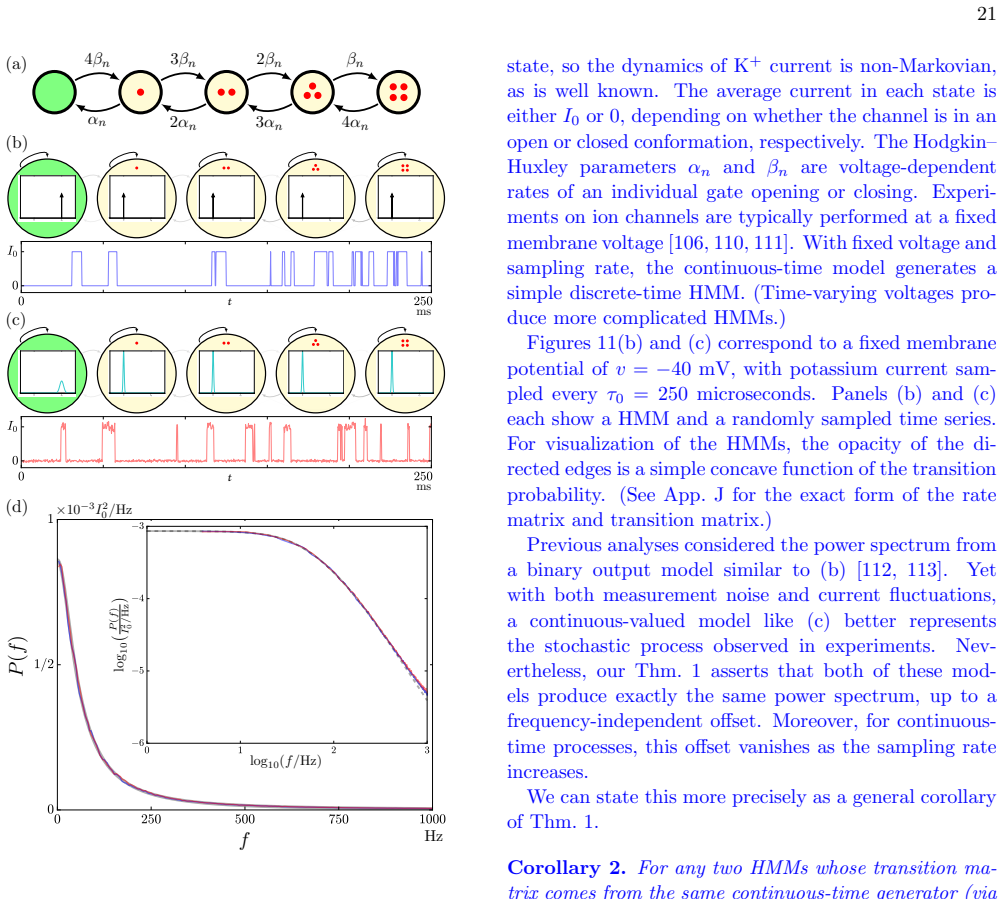
The central discovery is Theorem 1 and its Corollary 1: every finite-state hidden Markov chain with state-conditioned output distributions all sharing the same mean generates a flat power spectrum indistinguishable from genuine white noise. More generally, the power spectrum of an HMM is insensitive to the shape, support, or higher moments of each state's output distribution; only the per-state averages matter. The paper also gives a closed-form expression for the continuous part of the power spectrum, $P_c(\omega)=\langle |x|^2\rangle + 2\,\mathrm{Re}\langle\pi|\Omega T(e^{i\omega}I-T)^{-1}\Omega|1\rangle$, and shows the spectrum is a filtered image of the transition matrix's resolvent on the unit circle. It then demonstrates the same blindness afflicts polyspectra in certain cases, and introduces the dependence function as a tool for detecting $L$-way correlations that spectra cannot see.
Load-bearing premise
The flatness results assume a finite-state hidden Markov model with a stationary distribution and conditionally independent outputs given the hidden state; a real system with nonstationary statistics or memory in the measurement apparatus need not show a flat spectrum even if its hidden dynamics are complex.
Editorial extensions
If this is right
- A flat power spectrum is necessary but not sufficient for genuine white noise; any empirical claim of 'no structure' based on a flat spectrum is now formally incomplete.
- The number of resolvable peaks in a power spectrum lower-bounds the number of hidden states of any generative model, since each peak emanates from an eigenvalue of the transition matrix.
- For a broad class of stochastic generators, power spectra of different mechanisms coincide whenever the joint statistics of state-averaged outputs agree, so diffraction patterns cannot uniquely determine stacking structure.
- Sequential measurements of entangled quantum states can produce fraudulent white noise, so pairwise tests on measurement records can fail to certify quantum randomness.
- Polyspectra inherit some of these blind spots; the cumulant bispectrum is flat for processes with equal per-state means, pointing to information-theoretic probes like myopic entropy rates and the dependence function.
Reading between the lines
- A direct practical extension the authors leave implicit: spectral flatness alone should never be used to certify a random-number generator; a block-entropy or dependence-function test would be cheap to add.
- The construction is testable in the lab: encode a known binary message via content-preserving whitening into a physical stacking process or photonic sequence, then confirm that the measured spectrum matches the predicted flat background while a nonlinear decoder recovers the message.
- The same logic applies to biomedical signal analysis: EEG or neural spike-train 'white noise' bands could conceal functionally relevant high-order correlations that current pairwise diagnostics ignore.
Signed reviews
Editorial analysis
A structured set of objections, weighed in public.
Referee Report
Summary. The paper introduces the notion of 'fraudulent white noise': stochastic processes whose power spectral density is exactly flat although the generating mechanism carries arbitrarily complex temporal structure. The central analytical results are closed-form expressions for the autocorrelation and power spectrum of finite-state hidden Markov models (Eqs. (4)-(11)), Theorem 1 (the spectrum depends on state-conditioned emission distributions only through their means), Corollary 1 (any HMM whose state emissions all have zero mean has a flat spectrum), and Theorem 2 (a general sufficient condition for flat spectra in input-dependent and time-varying hidden-state models). The paper further derives a closed form for general polyspectra (Eq. (26)), gives spectral-degeneracy results (Theorem 3), and illustrates the claims with examples from entangled quantum measurements, close-packed chaotic crystals with encoded messages, and potassium ion-channel fluctuations. The central conclusion is that flat spectra are not evidence of structureless randomness and that higher-order or information-theoretic measures are needed to detect the hidden structure.
Significance. If the results are taken as stated, the message is important and broad: pairwise spectral measures are blind to arbitrarily high-order generative structure, even when that structure is entirely predictable. The core derivation, in particular Eq. (6) and Corollary 1, is sound and self-contained: it follows from the HMM definitions, conditional independence, and standard linear algebra, and the numerical examples match the analytic curves rather than being fitted. The constructive examples (zero-mean state emissions, RRXOR, content-preserving whitening, close-packed crystals carrying binary text) make the claim concrete and effectively falsifiable. The paper also gives a genuinely useful spectral framework connecting transition-matrix eigen-spectra, resolvents, and line shapes, and it extends the same machinery to polyspectra. These strengths justify serious consideration, provided the manuscript is brought to a complete and internally consistent state.
major comments (3)
- [Sec. II C, Eqs. (4)-(6) and (10)-(11)] For complex alphabets (explicitly allowed since A is a subset of C), the autocorrelation is gamma(tau) = E[conj(X_t) X_{t+tau}], so the left average-observation matrix in Eqs. (4) and (6) should be the conjugate matrix, not Omega. As written, the formulas are incorrect for complex-valued state means; for instance, the right-hand side of Eq. (6) is not guaranteed to be real. This is a load-bearing gap in the claimed closed-form solution for the whole stated class of processes. The correction is local (replace the left Omega by its conjugate), and Appendix I already uses the correct conjugates, but the main-text equations and the statements that follow from them must be corrected.
- [Appendix O, before Eq. (O9)] The derivation of the general polyspectrum assumes that the transition matrix T is non-singular and then leaves the singular case with the unfinished sentence '... which we out.' Since Section V A claims a closed-form expression for the polyspectra of HMMs without excluding singular transition matrices, the treatment of the zero-eigenspace is part of the claimed result. The authors must either complete the derivation for singular T or explicitly restrict the theorem's statement and state the restriction in the main text.
- [Sec. II C and Fig. 1 caption] The manuscript contains multiple explicit editorial notes and unfinished instructions: 'The technical level of results here is bouncing around...', 'Give the (flat) power spectrum for each. The reader needs this.', and 'Need cites to HMM literature: [27-33].' These are not merely stylistic; they show that the text as submitted is incomplete. All such notes must be removed or resolved, and the missing HMM literature citations must be supplied, before the paper can be published.
minor comments (5)
- [Sec. II E] The sentence 'And, the eigenvalues of T_tau0 and G are simply related by ... [74]' is missing a period and runs into the following paragraph; please fix the punctuation and sentence boundary.
- [Sec. III, Corollary 1] The phrase 'indistinguishable from white noise' should be qualified as 'indistinguishable by power-spectral (second-order) measures alone', since the paper itself later shows that pairwise mutual information or higher-order measures can reveal the structure.
- [Sec. IV B, Fig. 10] The construction that encodes arbitrary binary text into a crystal with the same diffraction pattern is striking, but the text should state more explicitly how the concatenated six-layer blocks satisfy the pairwise joint-probability condition of Theorem 3, especially at block boundaries; a one-sentence justification matching the figure panels (a)-(d) would help the reader.
- [Eqs. (20)-(26)] The notation F(kappa)_K for the set of surjective functions is used in the main text but defined only in Appendix O; please add a definition or forward reference at first use.
- [Overall manuscript] There are duplicated passages and placeholder figure captions (for example, the repeated text in the Fig. 1 block and the overlapping insets in Fig. 5). A careful editorial pass is needed to remove these artifacts.
Circularity Check
No significant circularity: the flat-spectrum theorems are derived from the HMM definition by direct linear algebra, not from fitted inputs or self-citation chains.
full rationale
The central derivation chain is self-contained. App. B computes γ(τ)=⟨π|ΩT^{|τ|}Ω|1⟩ for |τ|≥1 directly from the HMM definition and the Bayesian-network conditional independence, with Ω diagonal in the state-conditioned means (Eqs. (4)–(5)). App. C sums the autocorrelation series to obtain the closed-form power spectrum (Eq. (6)) and the discrete part (Eq. (11)); Theorem 1 then follows by inspection of these expressions, and Corollary 1 follows immediately because Ω=0 for zero-mean state distributions. No parameter is fitted to data and then relabeled as a prediction; the physical examples are constructions governed by the proved theorems, not empirical validations of a fit. The paper's self-citations—Ref. [63] for the spectral decomposition of nonnormal T^τ, and Refs. [62]/[65] for coronal spectrograms and the RRXOR/POPI vocabulary—are to standard linear algebra or to examples that the paper redefines and proves directly; none is a load-bearing uniqueness or ansatz citation. The flagged presentation gaps are genuine but non-circular: App. O explicitly defers the singular-T case ('...which we out'), Sec. II.C retains editorial notes ('Need cites to HMM literature: [27–33]'), and Eqs. (4)/(6) omit complex conjugation in Ω for complex alphabets. These affect completeness and polish, not the integrity of Theorem 1/Corollary 1, which are derived rather than assumed.
Assumptions & free parameters
assumptions (5)
- standard math Wiener-Khinchin theorem and standard Fourier transform properties
- standard math Spectral decomposition of nonnormal and possibly nondiagonalizable transition matrices
- domain assumption Finite-state HMM with a unique stationary distribution and conditionally independent outputs given the hidden state
- domain assumption Wide-sense stationarity, or at least stationary pairwise statistics, is required for the autocorrelation and power spectrum to be well-defined
- domain assumption Observables take values in a subset of the complex numbers and have finite first and second moments
Cite this review
Pith. "Pith review of Fraudulent White Noise: Flat power spectra belie arbitrarily complex processes." pith.science (2026). https://pith.science/paper/VXR67DIN
@misc{pith2026190811405,
  author       = {Pith},
  title        = {Pith review of: Fraudulent White Noise: Flat power spectra belie arbitrarily complex processes},
  year         = {2026},
  howpublished = {\url{https://pith.science/paper/VXR67DIN}},
  note         = {Machine review of arXiv:1908.11405}
}
read the original abstract
Power spectral densities are a common, convenient, and powerful way to analyze signals. So much so that they are now broadly deployed across the sciences and engineering---from quantum physics to cosmology, and from crystallography to neuroscience to speech recognition. The features they reveal not only identify prominent signal-frequencies but also hint at mechanisms that generate correlation and lead to resonance. Despite their near-centuries-long run of successes in signal analysis, here we show that flat power spectra can be generated by highly complex processes, effectively hiding all inherent structure in complex signals. Historically, this circumstance has been widely misinterpreted, being taken as the renowned signature of "structureless" white noise---the benchmark of randomness. We argue, in contrast, to the extent that most real-world complex systems exhibit correlations beyond pairwise statistics their structures evade power spectra and other pairwise statistical measures. As concrete physical examples, we demonstrate that fraudulent white noise hides the predictable structure of both entangled quantum systems and chaotic crystals. To make these words of warning operational, we present constructive results that explore how this situation comes about and the high toll it takes in understanding complex mechanisms. First, we give the closed-form solution for the power spectrum of a very broad class of structurally-complex signal generators. Second, we demonstrate the close relationship between eigen-spectra of evolution operators and power spectra. Third, we characterize the minimal generative structure implied by any power spectrum. Fourth, we show how to construct arbitrarily complex processes with flat power spectra. Finally, leveraging this diagnosis of the problem, we point the way to developing more incisive tools for discovering structure in complex signals.
Figures


Figures from the paper (9 more)






Reference graph
Works this paper leans on
-
[1]
its generator of time evolution G is diagonalizable and has N + 1 evenly spaced eigenvalues along the real line ΛG ={−na}N n=0 for some a> 0, and
-
[2]
We will show that any process with doubly harmonic diminution produces 1 /f noise over a frequency band- width proportional to N
its spectral intensity fades with increasing frequency according toc−na =c/n forn≥ 1 and some c∈ R. We will show that any process with doubly harmonic diminution produces 1 /f noise over a frequency band- width proportional to N. For a process with doubly harmonic diminution, the power spectrum simplifies considerably to: Pc(f) = ∑ λ∈ΛG 2 Re cλ i2πf−λ = N∑...
-
[3]
Accord- ingly: P (f) = 2c a N∑ n=1 1 n2 [ 1 + ( 2πf na )2] ≈ 2c a N∑ n=1 1 n2 = 2c aHN,2 → cπ2 3a as N→∞ , where HN,2 =∑N n=1 1 n2 is a generalized harmonic num- ber
Constant spectrum for f≪a/2π If 2πf≪a, then 1 + ( 2πf na )2 ≈ 1 for alln≥ 1. Accord- ingly: P (f) = 2c a N∑ n=1 1 n2 [ 1 + ( 2πf na )2] ≈ 2c a N∑ n=1 1 n2 = 2c aHN,2 → cπ2 3a as N→∞ , where HN,2 =∑N n=1 1 n2 is a generalized harmonic num- ber. Notably, HN,2→π2/6 as N→∞ . 34
-
[4]
Accordingly: P (f) = 2c a N∑ n=1 1 ( 2πf a )2[ 1 + ( na 2πf )2] ≈ ac 2π2f2 N∑ n=1 1 = caN 2π2f2
1/f 2 spectrum for f≫Na/2π If 2πf≫Na, then 2πf≫na and 1 + ( na 2πf )2 ≈ 1 for all n≤N. Accordingly: P (f) = 2c a N∑ n=1 1 ( 2πf a )2[ 1 + ( na 2πf )2] ≈ ac 2π2f2 N∑ n=1 1 = caN 2π2f2
-
[5]
1/f spectrum for a 2π≪f≪ Na 2π If 2πf≪Na, then 2πf≪na and 1 + ( 2πf na )2 ≈ 1 for anyn≥N. Then: P (f) = 2c a [(∞∑ n=1 1 n2+ ( 2πf a )2 ) − ( ∞∑ n=N+1 1 n2 [ 1+ ( 2πf na )2 ] )] ≈ 2c a [(∞∑ n=1 1 n2 + ( 2πf a )2 ) − ( ∞∑ n=N+1 1 n2 )] = 2c a [(∞∑ n=1 1 n2 + ( 2πf a )2 ) − (π2 6 −HN,2 ) ] . With the identity ∞∑ n=1 1 n2 + ( 2πf a )2 = a coth(2π2f/a) 4f − 1 ...
-
[6]
Combining the regimes We showed that any process with doubly harmonic diminution has three distinctive regimes in its power spectrum: nearly constant for very low frequency, 1 /f decay over a broad bandwidth, and 1 /f2 decay at very large frequencies. The transition frequencies between these three behav- ior regimes is found more specifically by looking fo...
-
[7]
corrected
Example One Consider a p-parametrized stochastic process for the stacking of layers of a close-packed structure. The stochastic stacking process is described by a HMM, where the transition matrix and average-observation matrix are: T = 0 1 0 p 0 1 −p 1 0 0 and Ω = A 0 0 0 B 0 0 0 C , respectively. For p = 1, we recover the deterministic pe...
-
[8]
white noise
Example Two Here, we analyze a generalization of the second chaotic crystal discussed in the main body. For any q, the tran- sition matrix and average-observation matrix are: T = 0 1 −q q 1 0 0 1 0 0 and Ω = A 0 0 0 B 0 0 0 C , respectively. The transition matrix eigenvalues are ΛT ={ 0,±1 } , independent of q. Each spectral projection ope...
2000
Show all 163 references
-
[9]
experiments
Measurement Feedback Models Here we introduce Measurement Feedback Models (MFMs)MMFM(⃗ m), which are input-dependent gener- ators of an observable output process {Xt}t∈T . As be- fore, the lengths and alphabets of the inputs and outputs need not be commensurate. The output is ...
-
[10]
Notably, they are no longer diagonal in the hidden-state basis
Theorem 2 for Measurement Feedback The MFM’s average-observation matrices are: Ωt = ∫ x∈A xT (x) t (⃗ m)dx . Notably, they are no longer diagonal in the hidden-state basis. Rather, they assign to each matrix element the av- erage observation associated with that transition, mu...
-
[11]
(Eigen)Spectral expansion of polyspectra Using Eq. (9) to express the resolvent ( I/z(α) 𝓁:κ−T )−1 in terms of the transition-matrix eigenvalues and spectral projection operators: (I/z(α) 𝓁:κ−T )−1 = ∑ λ∈ΛT νλ−1∑ m=0 1 (1/z(α) 𝓁:κ−λ)m+1 Tλ,m , (O11) we again see that the time-...
-
[12]
To aid in this, we explicitly construct the surjective function sets F(0) 1 , F(1) 1 , F(0) 2 , F(1) 2 , and F(2) 2 , shown in Fig
Polyspectra examples It is instructive to explore several special cases of the ( g0,...,g K)-polyspectrum. To aid in this, we explicitly construct the surjective function sets F(0) 1 , F(1) 1 , F(0) 2 , F(1) 2 , and F(2) 2 , shown in Fig. 17. 50 F(0) 1 0 1 0 F(1) 1 0 1 0 1 0 1...
-
[13]
R. K. Pathria and P. D. Beale. Statistical Mechanics. Elsevier Science, 2011. 2
2011
-
[14]
R. Kubo. The fluctuation–dissipation theorem. Reports on progress in physics , 29(1):255, 1966. 2
1966
-
[15]
M. Planck. Zur Theorie des Gesetzes der Energiev- erteilung im Normalspectrum. Verhandl. Dtsc. Phys. Ges., 2:237, 1900. 2
1900
-
[16]
Einstein
A. Einstein. ¨Uber einen die Erzeugung und Verwand- lung des Lichtes betreffenden heuristischen Gesicht- spunkt. Annalen der physik , 322(6):132–148, 1905
1905
-
[17]
M. J. Klein. Max Planck and the beginnings of the quantum theory. Archive for History of Exact Sciences , 1(5):459–479, Oct 1961. 2
1961
-
[18]
Akrami, F
Y. Akrami, F. Arroja, M. Ashdown, J. Aumont, C. Bac- cigalupi, M. Ballardini, A. J. Banday, R. B. Bar- reiro, N. Bartolo, and S. Basak. Planck 2018 results. I. Overview and the cosmological legacy of planck. arXiv:1807.06205. 2
2018 arXiv
-
[19]
P. Holmes. ‘Strange’ phenomena in dynamical systems and their physical implications. Applied Mathematical Modelling, 1(7):362–366, 1977. 2, 26
1977
-
[20]
J. D. Farmer, J. P. Crutchfield, H. Froehling, N. H. Packard, and R. S. Shaw. Power spectra and mixing properties of strange attractors. Ann. New York Acad. Sci., 357:453, 1980. 2, 10, 26
1980
-
[21]
Pollicott
M. Pollicott. On the rate of mixing of Axiom A flows. Inventiones mathematicae, 81(3):413–426, 1985. 2, 10, 26
1985
-
[22]
D. Ruelle. Resonances of chaotic dynamical systems. Phys. Rev. Let., 56(5):405, 1986
1986
-
[23]
P. Gaspard. Chaos, scattering and statistical mechanics, volume 9. Cambridge University Press, 2005. 2, 10, 26
2005
-
[24]
Pance, W
K. Pance, W. Lu, and S. Sridhar. Quantum fingerprints of classical Ruelle-Pollicott resonances. Phys. Rev. Lett., 85:2737–2740, Sep 2000. 2, 26
2000
-
[25]
Garc´ ıa-Mata and M
I. Garc´ ıa-Mata and M. Saraceno. Spectral properties and classical decays in quantum open systems. Physical Review E, 69(5):056211, 2004. 2, 26
2004
-
[26]
M. D. Chekroun, J. D. Neelin, D. Kondrashov, J. C. McWilliams, and M. Ghil. Rough parameter depen- dence in climate models and the role of Ruelle-Pollicott resonances. Proc. Natl. Acad. Sci. USA , 111(5):1684– 1690, 2014. 2, 26
2014
-
[27]
W. H. Press. Flicker noises in astronomy and elsewhere. Comments on Astrophysics , 7(4):103–119, 1978. 2
1978
-
[28]
B. B. Mandelbrot. Multifractals and 1/f Noise: Wild Self-Affinity in Physics (1963–1976) . Springer, 1999
1963
-
[29]
Graves, R
T. Graves, R. Gramacy, N. Watkins, and C. Franzke. A brief history of long memory: Hurst, mandelbrot and the road to ARFIMA, 1951–1980. Entropy, 19(9):437,
1951
-
[30]
P. Bak, C. Tang, and K. Wiesenfeld. Self-organized criticality: An explanation of the 1/f noise. Phys. Rev. Lett., 59(4):381, 1987. 2
1987
-
[31]
Krapf, E
D. Krapf, E. Marinari, R. Metzler, G. Oshanin, X. Xu, and A. Squarcini. Power spectral density of a single brownian trajectory: what one can and cannot learn from it. New Journal of Physics , 20(2):023029, 2018. 2
2018
-
[32]
Krapf, N
D. Krapf, N. Lukat, E. Marinari, R. Metzler, G. Os- hanin, C. Selhuber-Unkel, A. Squarcini, L. Stadler, M. Weiss, and X. Xu. Spectral content of a single non- brownian trajectory. Phys. Rev. X , 9(1):011019, 2019. 2
2019
-
[33]
Sadegh, E
S. Sadegh, E. Barkai, and D. Krapf. 1/f noise for in- termittent quantum dots exhibits non-stationarity and critical exponents. New J. Physics , 16(11):113054, Nov
-
[34]
Dechant and E
A. Dechant and E. Lutz. Wiener-Khinchin theorem for nonstationary scale-invariant processes. Phys. Rev. Lett., 115:080603, Aug 2015
2015
-
[35]
Leibovich and E
N. Leibovich and E. Barkai. Aging Wiener-Khinchin theorem. Phys. Rev. Lett., 115:080602, Aug 2015. 2
2015
-
[36]
J. D. Watson and F. H. C. Crick. A structure for de- oxyribose nucleic acid. Nature, 171(3):737–738, 1953. 2, 20
1953
-
[37]
M. H. F. Wilkins, H. R. Wilson, and A. R. Stokes. Molecular structure of deoxypentose nucleic acids. Na- ture, 171(3):738–740, 1953
1953
-
[38]
R. E. Franklin and R. G. Gosling. Molecular configura- tion in sodium thymonucleate. Nature, 171(3):740–741, 1953
1953
-
[39]
J. D. Watson and F. H. C. Crick. Genetical implica- tions of the structure of deoxyribonucleic acid. Nature, 171(4361):964–967, 1953. 2, 20
1953
-
[40]
W. Bair, C. Koch, W. Newsome, and K. Britten. Power spectrum analysis of bursting cells in area mt in the behaving monkey. J. Neurosci., 14(5):2870–2892, 1994. 3
1994
-
[41]
Farkhooi, M
F. Farkhooi, M. F. Strube-Bloss, and M. P. Nawrot. Serial correlation in neural spike trains: Experimental evidence, stochastic modeling, and single neuron vari- ability. Phys. Rev. E , 79(2):021905, 2009
2009
-
[42]
Dummer, S
B. Dummer, S. Wieland, and B. Lindner. Self-consistent determination of the spike-train power spectrum in a neural network with sparse connectivity. Front. Comp. Neurosci., 8:104, 2014
2014
-
[43]
R. F. O. Pena, S. Vellmer, D. Bernardi, A. C. Roque, and B. Lindner. Self-consistent scheme for spike-train power spectra in heterogeneous sparse networks. Front. Comp. Neurosci., 12:9, 2018. 3
2018
-
[44]
M. J. Chacron, L. Maler, and J. Bastian. Electrorecep- tor neuron dynamics shape information transmission. 53 Nature Neurosci., 8(5):673, 2005. 3
2005
-
[45]
Gollisch and M
T. Gollisch and M. Meister. Rapid neural coding in the retina with relative spike latencies. Science, 319(5866):1108–1111, 2008. 3
2008
-
[46]
Mellado, J
P. Mellado, J. Diedler, and T. Steiner. Continuous EEG monitoring in the ICU. In Intensive Care Medicine , pages 693–704. Springer, 2007. 3
2007
-
[47]
Claassen, F
J. Claassen, F. S. Taccone, P. Horn, M. Holtkamp, N. Stocchetti, and M. Oddo. Recommendations on the use of EEG monitoring in critically ill patients: Con- sensus statement from the neurointensive care section of the ESICM. Intensive Care Medicine , 39(8):1337– 1351, 2013
2013
-
[48]
W. O. Tatum. Ellen R. Grass lecture: Extraordinary EEG. Neurodiagnostic J., 54(1):3–21, 2014. 3
2014
-
[49]
R. B. Blackman and J. W. Tukey. The Measurement of Power Spectra—From the Point of View of Communi- cations Engineering. Dover, New York, New York, 1958. 3
1958
-
[50]
Stoica and R
P. Stoica and R. L. Moses. Spectral Analysis of Signals. Pearson Prentice Hall, Upper Saddle River, New Jersey,
-
[51]
For wide-sense stationary processes that are also er- godic, the expected value over realizations γ(τ) =⟨ XtXt+τ ⟩ p(Xt,Xt+τ ) coincides with the time-average ⟨xtxt+τ⟩t over a single realization. In practice, scien- tists and engineers typically perform this latter time- avera...
-
[52]
N. Wiener. Generalized harmonic analysis. Acta Math., 55:117–258, 1930. 3
1930
-
[53]
Khintchine
A. Khintchine. Korrelationstheorie der station¨ aren stochastischen prozesse. Mathematische Annalen , 109(1):604–615, 1934. 3
1934
-
[54]
M. A. Nielsen and I. L. Chuang. Quantum Computa- tion and Quantum Information . Cambridge University Press, Cambridge, United Kingdom, tenth anniversary edition, 2011. 4
2011
-
[55]
Ac´ ın and L
A. Ac´ ın and L. Masanes. Certified randomness in quan- tum physics. Nature, 540(7632):213, 2016. 4
2016
-
[56]
L. Shen, J. Lee, L. P. Thinh, J.D. Bancal, A. Cer` e, A. Lamas-Linares, A. Lita, T. Gerrits, S. W. Nam, V. Scarani, and C. Kurtsiefer. Randomness extraction from Bell violation with continuous parametric down- conversion. Phys. Rev. Lett., 121:150402, Oct 2018. 4
2018
-
[57]
Y. Liu, Q. Zhao, M.H. Li, J.Y. Guan, Y. Zhang, B. Bai, W. Zhang, W.Z. Liu, C. Wu, X. Yuan, et al. Device- independent quantum random-number generation. Na- ture, page 1, 2018. 4
2018
-
[58]
The noise standard deviation being proportional to the square root of the timestep— ση ∝ √ dt—rather than proportional to the timestep itself is familiar in numeri- cally integrating Langevin and other stochastic differ- ential equations. Though sometimes met with confu- sion, ...
-
[59]
Gaussian processes
Gaussian genuine white noise is a particular case of a Gaussian process. Gaussian processes, often considered in machine learning, are defined as those processes with a multivariate Gaussian distribution over all finite col- lections of observable random variables{Xt}t∈T , where...
-
[60]
Naturally, we make an exception for completely de- terministic DC signals (with no noise at all), since these should not be considered among the white noise pro- cesses
We choose to ignore the power spectrum’s δ-function at zero frequency when classifying white noise, since it merely corresponds to a constant (DC) offset of the sig- nal. Naturally, we make an exception for completely de- terministic DC signals (with no noise at all), since the...
-
[61]
A. Paz. Introduction to Probabilistic Automata . Aca- demic Press, New York, 1971. 5
1971
-
[62]
L. R. Rabiner and B. H. Juang. An introduction to hidden Markov models. IEEE ASSP Magazine, January, 1986
1986
-
[63]
L. R. Rabiner. A tutorial on hidden Markov models and selected applications. IEEE Proc., 77:257, 1989
1989
-
[64]
R. J. Elliot, L. Aggoun, and J. B. Moore. Hidden Markov Models: Estimation and Control , volume 29 of Applications of Mathematics . Springer, New York, 1995
1995
-
[65]
Ephraim and N
Y. Ephraim and N. Merhav. Hidden Markov processes. IEEE Trans. Info. Th. , 48(6):1518–1569, 2002
2002
-
[66]
Kelly, M
D. Kelly, M. Dillingham, A. Hudson, and K. Wiesner. A new method for inferring hidden Markov models from noisy time sequences. PLoS One, 7(1):e29703, 01 2012
2012
-
[67]
Bechhoefer
J. Bechhoefer. Hidden Markov models for stochastic thermodynamics. New. J. Phys. , 17:075003, 2015. 5
2015
-
[68]
R. G. James, J. R. Mahoney, C. J. Ellison, and J. P. Crutchfield. Many roads to synchrony: Natural time scales and their algorithms. Phys. Rev E , 89:042135,
-
[69]
B. O. Koopman. Hamiltonian systems and transfor- mation in Hilbert space. Proc. Natl. Acad. Sci. USA , 17(5):315–318, 1931. 5
1931
-
[70]
J. P. Crutchfield and N. H. Packard. Symbolic dynamics of noisy chaos. Physica, 7D(1-3):201 – 223, 1983. 24
1983
-
[71]
H. Jaeger. Observable operator models for discrete stochastic time series. Neural Comp., 12(6):1371–1398, 2000. 54
2000
-
[72]
A. M. Fraser. Hidden Markov models and dynamical systems, volume 107. SIAM, 2008
2008
-
[73]
P. M. Riechers and J. P. Crutchfield. Spectral simplicity of apparent complexity, Part I: The nondiagonalizable metadynamics of prediction. Chaos, 28:033115, 2018. 9, 24
2018
-
[74]
P. M. Riechers and J. P. Crutchfield. Spectral simplicity of apparent complexity, Part II: Exact complexities and complexity spectra. Chaos, 28:033116, 2018. 8, 12, 13, 24, 25
2018
-
[75]
P. M. Riechers and J. P. Crutchfield. Beyond the spec- tral theorem: Spectrally decomposing arbitrary func- tions of nondiagonalizable operators. AIP Advances , 8(6):065305, 2018. 5, 6, 7, 26, 30, 32
2018
-
[76]
An easy explanation for this relies on the spectral de- composition of the resolvent, given in the next section. 7
-
[77]
P. M. Riechers, D. P. Varn, and J. P. Crutchfield. Diffraction patterns of layered close-packed structures from hidden Markov models. arxiv.org:1410.5028. 8, 17, 30
-
[78]
Narevicius, P
E. Narevicius, P. Serra, and N. Moiseyev. Critical phenomena associated with self-orthogonality in non- Hermitian quantum mechanics. EPL (Europhys. Lett.), 62(6):789, 2003. 9
2003
-
[79]
A. V. Sokolov, A. A. Andrianov, and F. Cannata. Non- Hermitian quantum mechanics of non-diagonalizable Hamiltonians: Puzzles with self-orthogonal states. J. Physics A, 39(32):10207, 2006
2006
-
[80]
Mostafazadeh
A. Mostafazadeh. Spectral singularities of complex scattering potentials and infinite reflection and trans- mission coefficients at real energies. Phys. Rev. Lett. , 102:220402, 2009. 9
2009
-
[81]
Blank, G
M. Blank, G. Keller, and C. Liverani. Ruelle–Perron– Frobenius spectrum for Anosov maps. Nonlinearity, 15(6):1905, 2002. 9, 54
1905
-
[82]
However, the point spectrum—i.e., the eigenvalues— reflects the operator’s simplicity once the appropriate function space has been identified
In general, the spectrum of a time-evolution operator is highly sensitive to the function space it transforms. However, the point spectrum—i.e., the eigenvalues— reflects the operator’s simplicity once the appropriate function space has been identified. Fortunately, conver- genc...
-
[83]
Petrosky and I
T. Petrosky and I. Prigogine. The Liouville Space Ex- tension of Quantum Mechanics, chapter 1, pages 1–120. John Wiley & Sons, Ltd, 1996. 9
1996
-
[84]
That is, continuous-time dynamics are obtained as the limiting behavior of discrete-time dynamics
Indeed, discrete-time dynamics are, in a sense, more general than continuous-time dynamics. That is, continuous-time dynamics are obtained as the limiting behavior of discrete-time dynamics. 9
-
[85]
In other words, the different branches are a gauge freedom sup- porting all dynamics that could exist but are suppressed by the mapping G↦→eτ0G
One selects the simplest branch of the complex loga- rithm since the apparent freedom offered through its different branches corresponds to unobserved cyclic be- haviors at inaccessibly small timescales that, if they ex- ist, are aliased by the sampling frequency f0. In other wo...
-
[86]
The relationship between discrete and continuous time is the same as that yielding the well-known conformal mapping of the interior of the unit circle in the complex plane to the left-half of the complex plane, which also relates z-transforms and Laplace transforms. 9
-
[87]
S. Klus, P. Koltai, and C. Sch¨ utte. On the numerical approximation of the Perron–Frobenius and Koopman operator. J. Compl. Dynamics, 3(1):51–79, 2016. 10, 54
2016
-
[88]
Bernamont
J. Bernamont. Fluctuations in the resistance of thin films. Proc. Physical Soc. , 49(4S):138–139, Aug 1937. 10
1937
-
[89]
Engelberg
S. Engelberg. Random signals and noise: a mathemat- ical introduction. CRC Press, 2018. 10
2018
-
[90]
T. M. Cover and J. A. Thomas.Elements of Information Theory. Wiley-Interscience, New York, second edition,
-
[91]
Indeed, the burden of resolving this phase ambiguity renders the RRXOR process infinite Markov order. 13
-
[92]
J. P. Crutchfield and K. Young. Inferring statistical complexity. Phys. Rev. Let., 63:105–108, 1989. 14
1989
-
[93]
J. P. Crutchfield. Between order and chaos. Nature Physics, 8(January):17–24, 2012. 14, 24, 41
2012
-
[94]
Travers and J
N. Travers and J. P. Crutchfield. Infinite excess en- tropy processes with countable-state generators. En- tropy, 16:1396–1413, 2014. 14
2014
-
[95]
Barnett and J
N. Barnett and J. P. Crutchfield. Computational me- chanics of input–output processes: Structured trans- formations and the ϵ-transducer. J. Stat. Physics , 161(2):404–451, 2015. 14, 41
2015
-
[96]
Hensen, H
B. Hensen, H. Bernien, A. E. Dr´ eau, A. Reiserer, N. Kalb, M. S. Blok, J. Ruitenberg, R. F. L. Vermeulen, R. N. Schouten, C. Abell´ an, et al. Loophole-free bell in- equality violation using electron spins separated by 1.3 kilometres. Nature, 526(7575):682, 2015. 16
2015
-
[97]
Giustina, M
M. Giustina, M. A. M. Versteegh, S. Wengerowsky, J. Handsteiner, A. Hochrainer, K. Phelan, F. Steinlech- ner, J. Kofler, J. Larsson, C. Abell´ an, et al. Significant- loophole-free test of bell’s theorem with entangled pho- tons. Physical review letters, 115(25):250401, 2015
2015
-
[98]
L. K. Shalm, E. Meyer-Scott, B. G. Christensen, P. Bierhorst, M. A. Wayne, M. J. Stevens, T. Gerrits, S. Glancy, D. R. Hamel, M. S. Allman, et al. Strong loophole-free test of local realism. Phys. Rev. Lett. , 115(25):250402, 2015. 16 55
2015
-
[99]
Esposito, K
M. Esposito, K. Lindenberg, and C. Van den Broeck. Entropy production as correlation between system and reservoir. New J. Physics , 12(1):013013, 2010. 16
2010
-
[100]
Van Raamsdonk
M. Van Raamsdonk. Building up spacetime with quan- tum entanglement. General Relativity and Gravitation , 42(10):2323–2329, 2010. 16
2010
-
[101]
Susskind
L. Susskind. Entanglement is not enough. Fortschritte der Physik, 64(1):49–71, 2016. 16
2016
-
[102]
See, for example, the recent ex- amples in Ref
Time-varying measurement protocols further enrich the observation sequence. See, for example, the recent ex- amples in Ref. [144]—states that are exquisitely de- tailed even without entanglement. Generators of classi- cal stochastic processes may also use persistent quantum me...
-
[103]
O. S. Edwards and H. S. Lipson. Imperfections in the structure of cobalt. I. Experimental work and proposed structure. Proc. Roy. Soc. Lond. A. Math. Phys. Sci. , 180(982):268–277, 1942. 17
1942
-
[104]
P. M. Riechers, D. P. Varn, and J. P. Crutchfield. Pairwise correlations in layered close-packed structures. Acta Cryst. A , 71:423–443, 2015. 17
2015
-
[105]
Hendricks and E
S. Hendricks and E. Teller. X-ray interference in partially ordered layer lattices. J. Chem. Physics , 10(3):147–167, 1942. 17, 29
1942
-
[106]
M. M. J. Treacy, J. M. Newsam, and M. W. Deem. A general recursion method for calculating diffracted intensities from crystals containing planar faults. Proc. Roy. Soc. Lond. A: Math. Phys. Sci. , 433(1889):499– 520, 1991. 28
1991
-
[107]
D. P. Varn, G. S. Canright, and J. P. Crutchfield. ϵ-machine spectral reconstruction theory: A direct method for inferring planar disorder and structure from X-ray diffraction studies. Acta. Cryst. Sec. A , 69(2):197–206, 2013. 17
2013
-
[108]
C. Kittel. Introduction to solid state physics , volume 8. Wiley New York, 1976. 17
1976
-
[109]
D. P. Varn and J. P. Crutchfield. Chaotic crystallogra- phy: How the physics of information reveals structural order in materials. Current Opinion in Chemical Engi- neering, 7:47–56, 2015. 17, 20
2015
-
[110]
W. Bao, L. Jing, J. Velasco, Y. Lee, G. Liu, D. Tran, B. Standley, M. Aykol, S. B. Cronin, D. Smirnov, et al. Stacking-dependent band gap and quantum transport in trilayer graphene. Nature Physics, 7(12):948–952, 2011. 17
2011
-
[111]
Dividing P (ω) by |ψ|2 is the same as analyzing the ‘corrected’ diffraction pattern (which discounts any ω- dependence of ψ) along a row in reciprocal space sat- isfying the (h−k = 1 mod 3)-restriction of the Miller indices associated with the crystalline modular layers. 18
-
[112]
G. L. Taylor. Introduction to phasing. Acta Cryst. D: Bio. Crystallography, 66(4):325–338, 2010. 19, 27
2010
-
[113]
Schrodinger
E. Schrodinger. What is Life? The Physical Aspect of the Living Cell . Cambridge University Press, Cam- bridge, United Kingdom, 1944. 20
1944
-
[114]
J. H. E. Cartwright and A. L. Mackay. Beyond crystals: the dialectic of materials and information, 2012. 20
2012
-
[115]
U. Grimm. Aperiodic crystals and beyond. Acta Crystal. B: Structural Sci., Crystal Engin. Materials , 71(3):258–274, 2015. 20
2015
-
[116]
Blackwell and L
D. Blackwell and L. Koopmans. On the identifiability problem for functions of Markov chains. Ann. Math. Statist., 28:1011–1015, 1957. 20
1957
-
[117]
Siekmann, J
I. Siekmann, J. Sneyd, and E. J. Crampin. MCMC can detect nonidentifiable models. Biophysical J. , 103(11):2275–2286, 2012. 20
2012
-
[118]
A. L. Hodgkin and A. F. Huxley. A quantitative descrip- tion of membrane current and its application to conduc- tion and excitation in nerve. J. Physiology, 117(4):500– 544, 1952. 20, 21, 39
1952
-
[119]
Jiang, A
Y. Jiang, A. Lee, J. Chen, V. Ruta, M. Cadene, B. T. Chait, and R. MacKinnon. X-ray structure of a voltage- dependent K+ channel. Nature, 423(6935):33–41, 2003
2003
-
[120]
Kasahara, M
K. Kasahara, M. Shirota, and K. Kinoshita. Ion concentration-and voltage-dependent push and pull mechanisms of potassium channel ion conduction. PLoS One, 11(3), 2016. 22
2016
-
[121]
Dayan and L
P. Dayan and L. F. Abbott. Theoretical Neuroscience: Computational and Mathematical Modeling of Neural Systems. MIT Press, revised edition, 2005. 20, 39
2005
-
[122]
Siwy and A
Z. Siwy and A. Fuli´ nski. Origin of 1/fα noise in mem- brane channel currents. Phys. Rev. Lett., 89:158101, Sep
-
[123]
H. M. Fishman. Relaxation spectra of potassium chan- nel noise from squid axon membranes. Proc. Natl. Acad. Sci. USA, 70(3):876–879, 1973. 21, 22, 40
1973
-
[124]
T. L. Hill and Y. Chen. On the theory of ion transport across the nerve membrane: IV. noise from the open- close kinetics of K+ channels. Biophysical J., 12(8):948– 959, 1972. 21, 22, 40
1972
-
[125]
C. F. Stevens. Inferences about membrane proper- ties from electrical noise measurements. Biophysical J., 12(8):1028–1047, 1972. 21, 22, 40
1972
-
[126]
P. Hou, J. Eldstrom, J. Shi, L. Zhong, K. McFarland, Y. Gao, D. Fedida, and J. Cui. Inactivation of KCNQ1 potassium channels reveals dynamic coupling between voltage sensing and pore opening. Nature Comm. , 8(1):1–11, 2017. 22
2017
-
[127]
D. R. Brillinger. An introduction to polyspectra. Ann. Math. Stat., pages 1351–1374, 1965. 22
1965
-
[128]
W. B. Collis, P. R. White, and J. K. Hammond. Higher- order spectra: the bispectrum and trispectrum. Mech. Sys. Sig. Process., 12(3):375–394, 1998. 22, 24, 51
1998
-
[129]
This contrasts with out-of- time-order correlators (OTOCs) that recently received renewed interest for investigating temporal correlations
Equation (25) is a useful expression for time-ordered correlators of observables. This contrasts with out-of- time-order correlators (OTOCs) that recently received renewed interest for investigating temporal correlations. OTOCs are theoretically interesting as they can quan- t...
-
[130]
Rosenblatt and J
M. Rosenblatt and J. W. Van Ness. Estimation of the bispectrum. Ann. Math. Stat. , 36(4):1120–1136, 1965. 24
1965
-
[131]
C. L. Nikias and M. R. Raghuveer. Bispectrum esti- mation: A digital signal processing framework. Proc. IEEE, 75(7):869–891, July 1987
1987
-
[132]
Petropulu
A. Petropulu. Higher-order spectral analysis. Dig- ital Signal Processing Handbook, VK Madisetti and DB Williams, editors, Chapman & Hall/CRCnetBASE ,
-
[133]
C. E. Shannon. A mathematical theory of communi- cation. Bell Sys. Tech. J. , 27:379–423, 623–656, 1948. 24
1948
-
[134]
del Junco and M
A. del Junco and M. Rahe. Finitary codings and weak bernoulli partitions. Proc. Am. Math. Soc. , 75:259, 1979
1979
-
[135]
J. P. Crutchfield and D. P. Feldman. Regularities un- seen, randomness observed: Levels of entropy conver- gence. CHAOS, 13(1):25–54, 2003. 24
2003
-
[136]
R. G. James, N. Barnett, and J. P. Crutchfield. Infor- mation flows? A critique of transfer entropies. Phys. Rev. Lett., 116(23):238701, 2016. 26
2016
-
[137]
R. G. James and J. P. Crutchfield. Multivariate depen- dence beyond Shannon information. Entropy, 19:531,
-
[138]
Young and J
K. Young and J. P. Crutchfield. Fluctuation spec- troscopy. Chaos, Solitons, and Fractals , 4:5 – 39, 1994. 26
1994
-
[139]
Budii, R
M. Budii, R. Mohr, and I. Mezic. Applied Koopmanism. Chaos, 22(4), 2012. 26
2012
-
[140]
J. P. Crutchfield. The hidden fragility of complex sys- tems: Consequences of change, changing consequences. In P. Alsina and J. Perello, editors, Cultures of Change — Changing Cultures , pages 98–111, Barcelona, Spain,
-
[141]
F. A. Pollock, C. Rodr´ ıguez-Rosario, T. Frauenheim, M. Paternostro, and K. Modi. Non-Markovian quantum processes: Complete framework and efficient character- ization. Phys. Rev. A , 97:012127, Jan 2018. 42
2018
-
[142]
J. W. Tukey. The future of data analysis. Ann. Math. Stat., 33, 1962. 27
1962
-
[143]
A. Guinier. X-Ray Diffraction in Crystals, Imperfect Crystals and Amorphous Bodies . W. H. Freeman and Company, San Francisco, 1963. 27
1963
-
[144]
B. E. Warren. X-Ray Diffraction. Addison-Wesley, New York, 1969
1969
-
[145]
T. R. Welberry. Diffuse X-ray scattering and models of disorder. Rep. Prog. Phys., 48:1543, 1985
1985
-
[146]
N. W. Ashcroft and N. D. Mermin. Solid State Physics . Sanders College Publishing, New York, 1976
1976
-
[147]
T. R. Welberry. One hundred years of diffuse X-ray scattering. Metallurgical Mater. Trans. A , 45, 2014. 27
2014
-
[148]
Prince, editor
E. Prince, editor. International Tables for Crystallogra- phy Vol. C, Mathematical, Physical and Chemical Ta- bles. Springer, 2004. 28
2004
-
[149]
M. M. Woolfson. An introduction to X-ray crystallogra- phy. Cambridge University Press, 1997. 28
1997
-
[150]
D. Balzar. Profile fitting of x-ray diffraction lines and Fourier analysis of broadening. J. App. Crystallography, 25(5):559–570, 1992. 28
1992
-
[151]
A. V. Oppenheim and R. W. Schafer. Discrete-time signal processing. Pearson Education, 2014. 32
2014
-
[152]
J. S. Bendat and A. G. Piersol. Engineering applications of correlation and spectral analysis. New York, Wiley- Interscience, 1980. 315 p. , 1980. 40
1980
-
[153]
J. S. Bendat and A. G. Piersol. Random data: analysis and measurement procedures, volume 729. John Wiley & Sons, 2011. 40
2011
-
[155]
C. M. Bishop. Pattern recognition and machine learn- ing. Springer, 2006. 53
2006
-
[156]
G¨ ortler, R
J. G¨ ortler, R. Kehlbeck, and O. Deussen. A visual ex- ploration of Gaussian processes. Distill, 2019. 53
2019
-
[157]
A. E. Venegas-Li, A. M. Jurgens, and J. P. Crutch- field. Measurement-induced randomness and struc- ture in controlled qubit processes. arXiv preprint arXiv:1908.09053, 2019. 55
1908 arXiv
-
[158]
M. Gu, K. Wiesner, E. Rieper, and V. Vedral. Quantum mechanics can reduce the complexity of classical models. Nature Comm., 3:762, 2012. 55
2012
-
[159]
J. R. Mahoney, C. Aghamohammadi, and J. P. Crutch- field. Occam’s quantum strop: Synchronizing and com- pressing classical cryptic processes via a quantum chan- nel. Scientific Reports, 6:20495, 2016
2016
-
[160]
P. M. Riechers, J. R. Mahoney, C. Aghamohammadi, and J. P. Crutchfield. Minimized state complexity of quantum-encoded cryptic processes. Phys. Rev. A , 93:052317, May 2016
2016
-
[161]
F. C. Binder, J. Thompson, and M. Gu. Practical uni- tary simulator for non-markovian complex processes. Phys. Rev. Lett., 120(24):240502, 2018
2018
-
[162]
Q. Liu, T. J. Elliott, F. C. Binder, C. Di Franco, and M. Gu. Optimal stochastic modeling with unitary quan- tum dynamics. Phys. Rev. A , 99(6):062110, 2019. 55
2019
-
[163]
B. Swingle. Unscrambling the physics of out-of-time- order correlators. Nature Physics, 14:988–990, 2018. 55
2018
-
[2009]
ACTAR Publishers. 27
Reviewed August 14, 2026 · model on record in the stance chip above.
Discussion (0). Continue with ORCID to comment.