RoPoLL: Robust Panel of LLM Judges
Pith reviewed 2026-07-01 01:30 UTC · model grok-4.3
The pith
A single biased LLM judge produces unbounded error in any jury panel; the geometric median bounds it at breakdown point 1/2.
A machine-rendered reading of the paper's core claim, the machinery that carries it, and where it could break.
Core claim
Under the Huber contamination model, PoLL incurs unbounded bias under any positive contamination whenever a single judge fails in a biased, LLM-typical way. RoPoLL preserves the PoLL panel but replaces the aggregation function with the geometric median, which is tuning-free and attains the optimal finite-sample breakdown point of 1/2. Finite-sample error bounds and matching information-theoretic lower bounds agree on the rate sigma sqrt(d/N) while differing on the breakdown floor by a factor of sqrt(d).
What carries the argument
Geometric median: the point minimizing the sum of distances to the individual judge score vectors, used as the robust aggregator in place of majority vote or mean.
If this is right
- RoPoLL dominates PoLL on every biased corruption type tested, by roughly 19 percent on cross-dimensional attacks at matched compute.
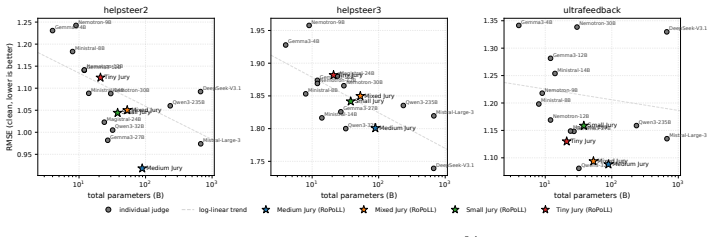
- A 3-judge RoPoLL committee at 38B parameters outperforms Mistral-Large-3 at 675B parameters by 1.31 times on HelpSteer-2 under 30 percent bimodal-random corruption.
- RoPoLL yields orders-of-magnitude improvement over PoLL against heavy-tailed Byzantine adversaries.
- The finite-sample bound and minimax lower bound match on the parametric rate but leave a sqrt(d) gap on the breakdown floor.
Where Pith is reading between the lines
- The same geometric-median replacement could be applied to other multi-model aggregation tasks such as ensemble decoding or preference tuning.
- The statistical-computational gap points to a need for faster high-dimensional robust estimators that still achieve breakdown 1/2.
- The contamination framing suggests testing whether training-data filtering benefits from similar robust aggregation before fine-tuning.
Load-bearing premise
Individual LLM judge errors behave like Huber contamination with the listed biased modes, and the geometric median is the right robust estimator for the consensus score.
What would settle it
A controlled simulation in which one judge is forced into sycophantic mode collapse while the others remain clean, then checking whether PoLL error grows without bound as contamination rate or dimension increases.
Figures












read the original abstract
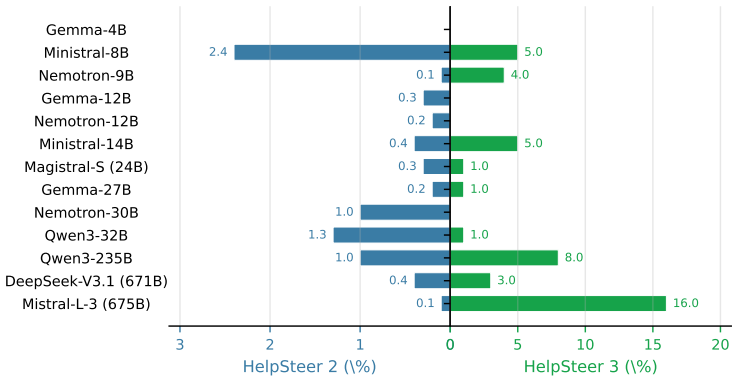
The LLM Jury, a Panel of LLM Evaluators (PoLL) reporting consensus scores, has become a practical alternative to single-judge LLM evaluation, yet its statistical behavior remains poorly understood. We formalize the LLM Jury under the Huber contamination model and show that PoLL incurs unbounded bias under any positive contamination, regardless of jury size, whenever a single judge fails in a biased, LLM-typical way (mode collapse, sycophancy, safety refusal). Framing jury consensus as classical robust mean estimation, we propose RoPoLL (Robust Panel of LLM-as-Judge), which preserves the PoLL panel but replaces the aggregation function with a robust mean estimator, instantiated with the geometric median (GM): tuning-free, with the optimal finite-sample breakdown point 1/2. A finite-sample error bound and a matching information-theoretic minimax lower bound agree on the parametric rate sigma*sqrt(d/N) and differ on the breakdown floor by a factor of sqrt(d), a statistical-computational gap that polynomial-time RoPoLL pays relative to the intractable Tukey halfspace median. Across 13 open-weight judges (4B-675B), three reward-model benchmarks, and four corruption regimes at rates up to 50%, RoPoLL dominates PoLL on every biased corruption type: by about 19% on cross-dimensional attacks at matched compute, and by orders of magnitude on heavy-tailed Byzantine adversaries. A 3-judge RoPoLL committee at 38B beats Mistral-Large-3 (675B) by 1.31x on HelpSteer-2 under 30% bimodal-random corruption, an 18x parameter advantage at better accuracy; a Noisy-GT control confirms the premium is paid against biased contamination, not benign imprecision.
Editorial analysis
A structured set of objections, weighed in public.
Referee Report
Summary. The manuscript formalizes the LLM Jury (PoLL) under the classical Huber contamination model, proves that standard averaging incurs unbounded bias under any positive fraction of biased judges (mode collapse, sycophancy, safety refusal), and proposes RoPoLL which retains the same panel but replaces the aggregator with the geometric median; it supplies a finite-sample error bound of order sigma*sqrt(d/N) together with a matching minimax lower bound (differing by a sqrt(d) factor on the breakdown floor), and reports that RoPoLL dominates PoLL by ~19% on cross-dimensional attacks and by orders of magnitude on heavy-tailed Byzantine corruptions across 13 open-weight judges, three reward-model benchmarks, and four corruption regimes up to 50%.
Significance. If the central claims hold, the work supplies a tuning-free, breakdown-point-1/2 aggregator for LLM panels together with explicit finite-sample and information-theoretic guarantees; the matching parametric rate, the 18x parameter-efficiency result (3-judge 38B RoPoLL vs 675B single model), and the Noisy-GT control that isolates bias from benign noise are concrete strengths that would be useful to the LLM-evaluation community.
major comments (3)
- [Abstract] Abstract: the claim that PoLL incurs unbounded bias 'under any positive contamination, regardless of jury size' is derived under the classical Huber mixture (arbitrary contamination independent of the clean data). The listed LLM-typical failures (sycophancy, safety refusal, mode collapse) are structured and input-dependent; this dependence can allow coordinated bias to pull the geometric median even when the contaminated fraction is below 1/2 and can invalidate the sigma*sqrt(d/N) finite-sample bound that assumes unstructured contamination. This assumption is load-bearing for both the motivation and the robustness guarantees.
- [Experiments] Experimental regimes (bimodal-random, heavy-tailed Byzantine, cross-dimensional): all four tested corruption models are non-adaptive or fully arbitrary. They therefore do not probe the input-dependent case highlighted above; the reported dominance (19% on cross-dimensional, orders of magnitude on Byzantine) cannot yet be taken as evidence that the same gains hold against the structured biases the paper itself lists as motivation.
- [Theoretical analysis] Theoretical bounds paragraph: the finite-sample upper bound and minimax lower bound are stated to agree on the rate sigma*sqrt(d/N) but to differ by a factor of sqrt(d) on the breakdown floor, producing a 'statistical-computational gap' that polynomial-time RoPoLL pays relative to the Tukey median. The manuscript should make explicit whether this gap affects the practical recommendation to use the geometric median or whether the gap is only asymptotic.
minor comments (1)
- [Abstract] Notation: the dimension d appears in the rate sigma*sqrt(d/N) but is never defined in the abstract; a one-sentence clarification of what the score vectors live in would help readers.
Simulated Author's Rebuttal
We thank the referee for the detailed and constructive comments. We address each major point below, clarifying the scope of our theoretical model and experiments while acknowledging where additional discussion is warranted.
read point-by-point responses
-
Referee: [Abstract] Abstract: the claim that PoLL incurs unbounded bias 'under any positive contamination, regardless of jury size' is derived under the classical Huber mixture (arbitrary contamination independent of the clean data). The listed LLM-typical failures (sycophancy, safety refusal, mode collapse) are structured and input-dependent; this dependence can allow coordinated bias to pull the geometric median even when the contaminated fraction is below 1/2 and can invalidate the sigma*sqrt(d/N) finite-sample bound that assumes unstructured contamination. This assumption is load-bearing for both the motivation and the robustness guarantees.
Authors: The manuscript explicitly states that the formalization and unbounded-bias result for PoLL are derived under the classical Huber contamination model (arbitrary, unstructured contamination). The LLM-typical failure modes are presented as motivating examples of biased judges rather than as the precise contamination process used in the proofs. We agree that input-dependent structured attacks lie outside the current guarantees and could in principle affect both the geometric median and the finite-sample bound. We will revise the abstract to explicitly qualify the unbounded-bias claim as holding under the Huber model and add a short limitations paragraph noting that coordinated, input-dependent biases remain an open question for future analysis. revision: partial
-
Referee: [Experiments] Experimental regimes (bimodal-random, heavy-tailed Byzantine, cross-dimensional): all four tested corruption models are non-adaptive or fully arbitrary. They therefore do not probe the input-dependent case highlighted above; the reported dominance (19% on cross-dimensional, orders of magnitude on Byzantine) cannot yet be taken as evidence that the same gains hold against the structured biases the paper itself lists as motivation.
Authors: The four corruption regimes were chosen to match the classical Huber setting used in the theory (non-adaptive or fully arbitrary contamination). We acknowledge that these regimes do not directly test input-dependent structured attacks. The reported gains therefore demonstrate robustness under the modeled contamination but cannot be extrapolated to the structured case without further experiments. We will add an explicit limitations statement in the experimental section and a sentence in the conclusion identifying input-dependent attacks as important future work. revision: yes
-
Referee: [Theoretical analysis] Theoretical bounds paragraph: the finite-sample upper bound and minimax lower bound are stated to agree on the rate sigma*sqrt(d/N) but to differ by a factor of sqrt(d) on the breakdown floor, producing a 'statistical-computational gap' that polynomial-time RoPoLL pays relative to the Tukey median. The manuscript should make explicit whether this gap affects the practical recommendation to use the geometric median or whether the gap is only asymptotic.
Authors: The gap concerns only the breakdown floor (geometric median achieves 1/2 while the information-theoretic optimum can be slightly higher by a sqrt(d) factor in finite samples); the leading error term sigma*sqrt(d/N) is identical. Because the number of judges N is typically small (3–13) and the geometric median is polynomial-time computable, the gap does not alter the practical recommendation. We will add one clarifying sentence in the theoretical analysis section stating that the gap is primarily of asymptotic interest and does not change the recommendation to use the geometric median for LLM panels. revision: partial
Circularity Check
No circularity: derivation applies standard Huber model and geometric median properties directly
full rationale
The paper's central theoretical claims (unbounded bias of the mean under positive Huber contamination, and GM's breakdown point of 1/2 with rate sigma*sqrt(d/N)) are obtained by direct invocation of classical results in robust statistics rather than by fitting parameters to the paper's LLM data, self-citation chains, or redefinition. No load-bearing step reduces to an input by construction; the Huber model and GM estimator are external, independently established objects whose properties are applied to the new LLM-jury setting. Experiments test the instantiated method but do not retroactively define the claimed bounds.
Axiom & Free-Parameter Ledger
axioms (2)
- domain assumption Huber contamination model applies to LLM judge outputs
- standard math Geometric median achieves breakdown point 1/2
Reference graph
Works this paper leans on
-
[1]
(2025).Robust and Efficient Learning in High Dimensions from Noisy Data
Acharya, A. (2025).Robust and Efficient Learning in High Dimensions from Noisy Data. PhD thesis, The University of Texas at Austin. Acharya, A., Hashemi, A., Jain, P., Sanghavi, S., Dhillon, I. S., and Topcu, U. (2022). Robust training in high dimensions via block coordinate geometric median descent. InInternational Conference on Artificial Intelligence a...
work page 2025
-
[2]
ChatEval: Towards Better LLM-based Evaluators through Multi-Agent Debate
Boucheron, S., Lugosi, G., and Massart, P. (2013).Concentration Inequalities: A Nonasymptotic Theory of Independence. Oxford University Press. Chan, C.-M., Chen, W., Su, Y ., Yu, J., Xue, W., Zhang, S., Fu, J., and Liu, Z. (2024). Chateval: To- wards better LLM-based evaluators through multi-agent debate.arXiv preprint arXiv:2308.07201. Chen, M., Gao, C.,...
work page internal anchor Pith review Pith/arXiv arXiv 2013
-
[3]
Dudley, R. M. (2002).Real Analysis and Probability, volume 74 ofCambridge Studies in Advanced Mathematics. Cambridge University Press, Cambridge. El Mhamdi, E. M., Guerraoui, R., and Rouault, S. (2018). The hidden vulnerability of distributed learning in Byzantium. InInternational Conference on Machine Learning, pages 3521–3530. 26 Esary, J. D., Proschan,...
work page Pith review arXiv 2002
-
[4]
Springer. Minsker, S. (2015). Geometric median and robust estimation in Banach spaces.Bernoulli, 21(4):2308–
work page 2015
-
[5]
Panickssery, A., Bowman, S. R., and Feng, S. (2024). LLM evaluators recognize and favor their own generations. InThe Thirty-eighth Annual Conference on Neural Information Processing Systems. Pitt, L. D. (1977). A gaussian correlation inequality for symmetric convex sets.The Annals of Probability, pages 470–474. Rockafellar, R. T. (1997).Convex analysis, volume
work page 2024
-
[6]
Verbosity bias in preference labeling by large language models
Princeton university press. Saito, K., Wachi, A., Wataoka, K., and Akimoto, Y . (2023). Verbosity bias in preference labeling by large language models.arXiv preprint arXiv:2310.10076. Small, C. G. (1990). A survey of multidimensional medians.International Statistical Review, 58(3):263–277. Stureborg, R., Alikaniotis, D., and Suhara, Y . (2024). Large lang...
-
[7]
Large Language Models are not Fair Evaluators
Cambridge university press. Wang, P., Li, L., Chen, L., Cai, Z., Zhu, D., Lin, B., Cao, Y ., Liu, Q., Liu, T., and Sui, Z. (2023). Large language models are not fair evaluators.arXiv preprint arXiv:2305.17926. Wang, Z., Dong, Y ., Delalleau, O., Zeng, J., Egert, G., Zhang, P., Kamalakara, A. S., and Kuchaiev, O. (2024). Helpsteer2: Open-source dataset for...
work page internal anchor Pith review Pith/arXiv arXiv 2023
-
[8]
Sums of continuous convex functions are continuous and convex, so F is continuous and convex
(i) Existence.Each summand z7→ ∥z− ˆyi∥2 is the Euclidean norm of an affine function ofz, hence continuous and convex (see any standard reference on convex analysis). Sums of continuous convex functions are continuous and convex, so F is continuous and convex. For coercivity, fix any data point ˆy1; by the reverse triangle inequality F(z)≥ ∥z− ˆy1∥2 ≥ ∥z∥...
work page 2000
-
[9]
If ∥z′∥2 were unbounded as the adversary varies the corrupted points within their m-coordinate budget, then for the competent points i∈S the unit vectors (z′ − ˆyi)/∥z′ − ˆyi∥2 would all lie in a small cone (all pointing approximately from the bounded competent cluster towardz′), so their sum has norm at least|S|(1−o(1)) . The corrupted contribution has n...
work page 1991
-
[10]
The number of iterations to reach toleranceϵis thereforeO(log(1/ϵ))
Convergence.Vardi and Zhang (2000) prove that the modified Weiszfeld iteration converges to the unique geometric median at a linear rate whenever the data are not collinear: there exists ρ∈(0,1) depending on the data configuration with ∥z(t) − ˆyGM∥2 ≤ρ t∥z(0) − ˆyGM∥2. The number of iterations to reach toleranceϵis thereforeO(log(1/ϵ)). Cost.Each iterati...
work page 2000
-
[11]
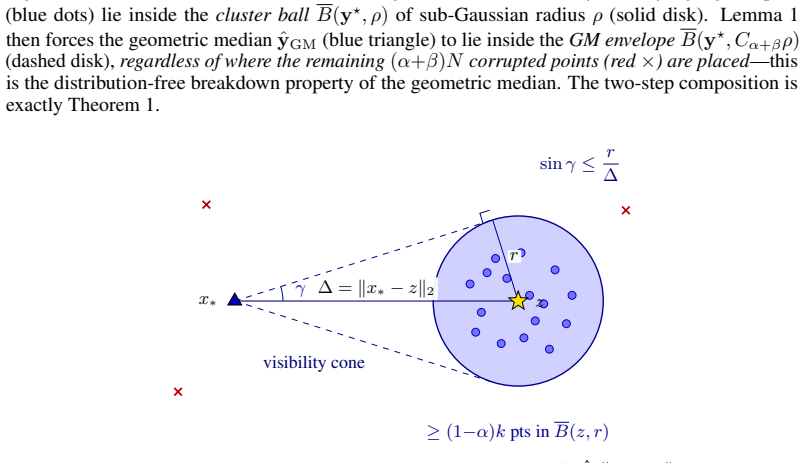
We give the proof of Minsker (2015), with the geometric setup made explicit. The argument is by contradiction: assume ∥x∗ −z∥ 2 > C αr and derive a violation of the optimality ofx ∗. For brevity write ∆≜∥x ∗ −z∥ 2 and let F(y)≜ Pk j=1 ∥y−x j∥2 denote the geometric-median objective. Since x∗ minimizes the convex function F on Rd, the one-sided directional ...
work page 2015
-
[12]
vs. corrupted (Zi = 1). Conditional on Zi = 0, Assumption 4 states that ϵi ∈R d isσ-sub-Gaussian, i.e. for everyλ∈R d, E exp ⟨λ,ϵ i⟩ Zi = 0 ≤exp 1 2 σ2∥λ∥2 2 .(31) We now show, from (31) alone, Pr ∥ϵi∥2 > σ(C 1 √ d+t) Zi = 0 ≤exp(−c t 2),∀t >0,(32) for absolute constantsC 1, c >0. We prove (32) directly from (31) via a covering-net argument over the unit ...
work page 2018
-
[13]
Substituting s=c t 2 with c= 1/C 2 2 = 1/8: C2σ√s= C2σ √ ct2 =C 2σ t/C2 =σ t. Hence for allt≥0, Pr ∥ϵi∥2 > C1σ √ d+σt ≤exp(−c t 2),(38) which is exactly (32) with the same absolute constantsC 1 = 2√2 log 5≤4andc= 1/8. Remark on the explicit constants.The covering radius 1/2, net size 5d, and resulting prefactor C1 = 2√2 log 5are not optimized; sharper cha...
work page 2013
-
[14]
The clean-rate term p d/N matches the upper bound exactly
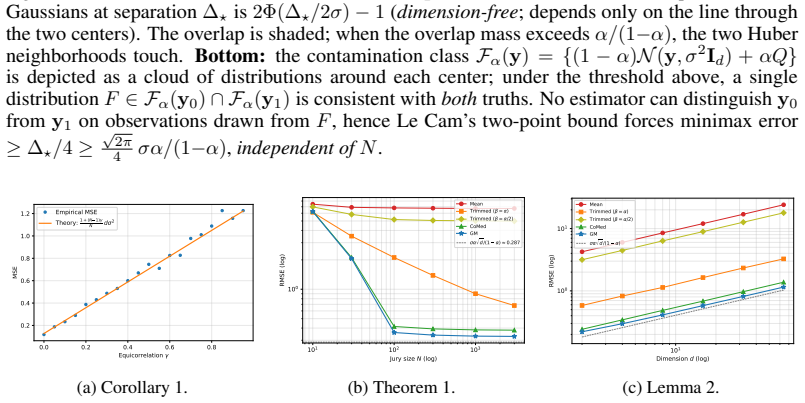
gives Ω(σ( p d/N+α/(1−α))) . The clean-rate term p d/N matches the upper bound exactly. On the breakdown floor the upper bound scales asCα+βσ √ d while the lower bound scales asσα/(1−α), leaving a gap of order √ d/α. The reason is structural: total variation between two equal-covariance Gaussians is dimension-free (Step 2.2 of the proof of Theorem 2), so ...
work page 2018
-
[15]
For jointly Gaussian competent noise with positive score correlation, the cluster indicators are positively associated by Pitt’s Gaussian correlation inequality (Pitt, 1977; Esary et al., 1967; Joag-Dev and Proschan, 1983), so ¯γW ≥0 ; we are not aware of a clean general upper bound on ¯γW in terms of ¯γalone. In practice, ¯γW can be estimated directly fr...
work page 1977
-
[16]
We invoke Le Cam’s two-point method (Tsybakov, 2009, Sec. 2.4): for any two parameter valuesy 0,y 1 ∈R d inducing observation distributionsF 0, F1 ∈ F α,σ, inf ˆy sup F∈{F 0,F1} EF [∥ˆy−y ⋆∥2]≥ ∥y0 −y 1∥2 4 · 1−TV(F ⊗N 0 , F ⊗N 1 ) .(59) The strategy is to construct (y0,y 1, F0, F1) maximising the right-hand side. Part 1 controls the parametric variance t...
work page 2009
-
[17]
Hence (1−α)P 0 +αQ 0 = (1−α)P 1 +αQ 1 is a common element ofF α(y0)∩ F α(y1), establishing (62)
= (1−α)(µ + −µ −) + (1−α)(µ − −µ +) = 0, using (63) (the ρ terms cancel). Hence (1−α)P 0 +αQ 0 = (1−α)P 1 +αQ 1 is a common element ofF α(y0)∩ F α(y1), establishing (62). Step 2.2 (Equal-covariance Gaussian TV is dimension-free).The total-variation distance between N(y 0, σ2Id) and N(y 1, σ2Id) depends only on ∆≜∥y 0 −y 1∥2: projecting onto the line y1 −y...
work page 2018
-
[18]
This is not slack in the analysis but a real statistical–computational gap
scales asCασ √ d while the lower bound scales asσα/(1− α); the gap is a √ d/α factor. This is not slack in the analysis but a real statistical–computational gap. The minimax-optimal estimator on the breakdown floor is the Tukey halfspace median (Tukey, 1975; Donoho and Gasko, 1992), whose exact computation is NP-hard for d≥3 (Johnson and Preparata, 1978; ...
work page 1975
discussion (0)
Sign in with ORCID, Apple, or X to comment. Anyone can read and Pith papers without signing in.