WildSplat: Feedforward Gaussian Splatting from Unposed In-the-Wild Images
Reviewed by Pith2026-07-07 15:54 UTCglm-5.2pith:W3BYVMTPopen to challenge →
The pith
One-pass 3D scene reconstruction from mismatched internet photos
A machine-rendered reading of the paper's core claim, the machinery that carries it, and where it could break.
Core claim
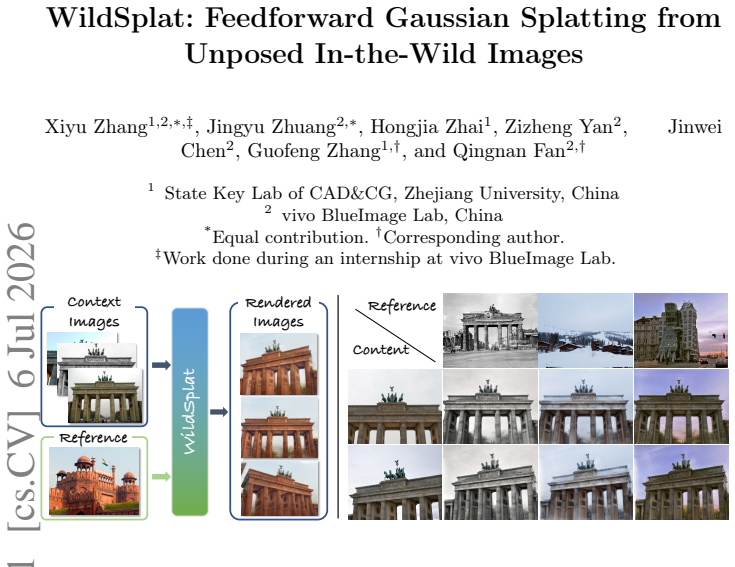
The key discovery is that explicit geometry-appearance decoupling via a dual-branch architecture with global pre-modulated cross-attention enables a single feedforward pass to reconstruct 3D scenes from photometrically inconsistent images, a setting where prior feedforward methods fail because they entangle geometry and appearance in a shared representation. The geometry branch produces structure invariant to lighting changes, and the appearance branch conditions color attributes on a reference image independently. The multi-reference training paradigm, which supervises multiple appearance renderings of the same geometry within a single iteration, proves the most critical component: removing
What carries the argument
Dual-branch architecture with (1) a geometry branch built on a VGGT-like transformer backbone using DINOv2 encoding that predicts appearance-invariant 3D Gaussian attributes (positions, rotations, scales, opacities) and camera poses, and (2) an appearance branch with an Appearance Injector module that uses AdaLN-Zero global pre-modulation (scale, shift, gating from the reference image's CLS token) followed by cross-attention (content features as queries, reference appearance tokens as keys/values) and self-attention to predict conditioned spherical harmonics color coefficients. A joint multi-reference training strategy renders the same geometry under M randomly sampled reference appearances,
If this is right
- Feedforward 3D reconstruction systems can now operate directly on internet photo collections without requiring precomputed camera poses or photometric consistency, removing two major bottlenecks for practical scene reconstruction at scale.
- The geometry-appearance decoupling enables appearance editing as a free byproduct: the same reconstructed geometry can be re-rendered under different reference appearances without re-running the geometry branch, supporting interactive relighting and style transfer applications.
- The multi-reference training paradigm, which forces geometry to remain invariant while appearance varies, suggests a general principle for training disentangled representations that could extend beyond 3D reconstruction to other multi-modal or multi-condition settings.
- The approach could be extended to dynamic scenes or temporally varying appearances (e.g., construction sites photographed over months) where both geometry and appearance change, by incorporating temporal conditioning into the appearance branch.
Where Pith is reading between the lines
- If the geometry branch truly produces illumination-invariant features, then feeding it images with aggressive color jittering should not degrade pose estimation or geometry quality — this is partially supported by the training-time color jittering, but a systematic evaluation of geometry quality under controlled illumination changes would be a strong test.
- The reported failure on localized spatially varying illumination (e.g., projected light patterns) suggests the global pre-modulation captures overall color tone but not spatially varying lighting, implying that a local or spatially-conditioned appearance model would be needed for scenes with cast shadows or spotlights.
- The competitive computational overhead (1.3s vs 1.1s for AnySplat at 16 views) suggests the dual-branch design adds minimal cost, but the memory scaling with input resolution noted in limitations could become a practical barrier for consumer-grade deployment on high-resolution imagery.
- The small test set (14 scenes total) and the specific left-half/right-half reference evaluation protocol mean the reported gains, while consistent across both datasets, may not reflect performance on scenes with fundamentally different appearance variation patterns (e.g., seasonal changes, night-to-day transitions).
Load-bearing premise
The evaluation rests on only 14 test scenes total (4 from Phototourism, 10 from MegaScenes) with a specific protocol that splits each ground-truth image in half, and the ablation study is conducted on only the Phototourism subset, making it hard to assess whether the reported gains and component contributions generalize across more diverse scene types and appearance variation patterns.
What would settle it
If the geometry branch's features are not truly illumination-invariant — for instance, if feeding the same scene under drastically different lighting conditions (e.g., day vs night) produces measurably different 3D Gaussian positions or poses — then the decoupling claim fails and the appearance conditioning is merely masking entanglement rather than resolving it.
Figures


read the original abstract
While feedforward 3D reconstruction excels at efficient novel view synthesis, it typically falters when faced with scenes under varying illumination. To this end, we introduce WildSplat, the first feedforward 3D Gaussian Splatting framework capable of appearance-conditioned novel-view synthesis for unposed in-the-wild images. To handle inconsistent photometric conditions, we propose a dual-branch architecture that explicitly decouples geometry from appearance. The geometry branch extracts an appearance-invariant 3D structure and jointly predicts camera poses. To govern the rendering appearance, the appearance branch injects target appearance cues into the content features via a globally pre-modulated cross-attention mechanism. To further prevent feature entanglement, we introduce a joint multi-reference training strategy that stabilizes the training process. Extensive experiments show that WildSplat surpasses existing optimization-based and feedforward methods, achieving state-of-the-art performance in in-the-wild novel view synthesis and appearance editing from sparse inputs in a single forward pass.
Editorial analysis
A structured set of objections, weighed in public.
Referee Report
Summary. WildSplat proposes a feedforward 3D Gaussian Splatting framework for unposed in-the-wild images with varying appearances. The method uses a dual-branch architecture: a geometry branch (built on VGGT) that extracts appearance-invariant 3D structure and predicts poses, and an appearance branch that injects target appearance cues from a reference image via global pre-modulation and cross-attention. A multi-reference training paradigm and geometry-guided view sampling strategy are also introduced. The method is evaluated on MegaScenes (10 scenes) and Phototourism (4 scenes) under 4/8/12-view settings, with additional results on DL3DV and pose estimation. The paper also demonstrates appearance editing and interpolation capabilities.
Significance. The paper addresses a genuine gap: existing feedforward 3DGS methods assume photometric consistency and cannot handle in-the-wild appearance variations. The dual-branch decoupling of geometry and appearance, combined with the appearance injector module, is a reasonable architectural contribution. The multi-reference training paradigm is a sensible strategy for encouraging disentanglement. The appearance editing and interpolation results (Figs. 5-6) are a nice demonstration of the decoupled representation. The computational efficiency analysis (Supplementary Fig. B) shows minimal overhead over AnySplat, which is a practical strength. The method also provides pose estimation results (Table 4) competitive with VGGT.
major comments (3)
- §4.1, Evaluation Protocol / Tables 1-2: The evaluation creates an information asymmetry that is load-bearing for the central claim of 'surpassing existing feedforward methods.' WildSplat receives the left half of each ground-truth target image as an appearance reference, while feedforward baselines (AnySplat, WorldMirror) have no reference-image input mechanism. This means WildSplat has access to the target appearance (same viewpoint, same image, spatially offset) while baselines do not. The +4.19 PSNR gap over WorldMirror on Phototourism 4-view (Table 2) could be substantially explained by this asymmetry rather than by superior geometry or disentanglement. The paper should either (a) provide feedforward baselines with some form of appearance conditioning (e.g., post-hoc color affine alignment to the reference) to make the comparison more equitable, (b) report appearance-agnostic metrics
- Table 3 vs Table 2, Phototourism 4-view: The ablation 'Full' model reports 18.52 PSNR (Table 3), while the main results table reports 19.57 PSNR (Table 2) for ostensibly the same setting (Phototourism, 4 views). This ~1 PSNR discrepancy is unexplained and raises questions about which configuration corresponds to the reported main results. The authors should clarify whether these are different checkpoints, different scene subsets, or different evaluation protocols.
- §4.3, Table 3: The ablation study is conducted only on Phototourism (4 test scenes). Given that the paper evaluates on 14 scenes total across two datasets, restricting the ablation to 4 scenes makes it difficult to assess whether the component contributions (especially multi-reference supervision, which shows the largest drop) generalize across diverse scene types. Extending the ablation to include MegaScenes scenes would strengthen the claims about each component's contribution.
minor comments (6)
- §3.2, Eq. (5): The notation switches between T_i^{(k)} (content features from geometry branch) and F_content (defined in Eq. 2 as a set). It would help to clarify whether F_content and {T_i^{(k)}} refer to the same quantities or different aggregations.
- §3.3, Algorithm 1: The algorithm references matrices S and R but their precise construction from SfM points is only briefly described in prose. A more formal definition (e.g., how the overlap matrix is computed) would improve reproducibility.
- Table 4: The pose evaluation uses 20 scenes from MegaScenes with 24 views each, but the main NVS evaluation uses 10 MegaScenes scenes. It is unclear whether these are the same or different scene sets.
- Supplementary A.2: The loss weights are listed as λ_i = {10, 1.0, 0.05, 0.05} in the main text (§3.3) but as λ1=10.0, λ2=10.0, λ3=1.0, λ4=0.05 in the supplementary. These appear inconsistent and should be reconciled.
- Fig. 2: The diagram is somewhat dense. Labeling the data flow between the geometry and appearance branches more explicitly (e.g., indicating where F_content is shared) would aid readability.
- §4.1: The paper mentions using an 'off-the-shelf video relighting model [18]' (TC-Light) to generate synthetic multi-illumination training data. The sensitivity of the final results to the quality of this synthetic data is not discussed. A brief comment on this would be valuable.
Simulated Author's Rebuttal
We thank the referee for a careful and constructive review. The referee raises three major points: (1) an information asymmetry in the evaluation protocol where WildSplat receives a reference image that baselines do not, (2) an unexplained ~1 PSNR discrepancy between Tables 2 and 3 for the same setting, and (3) the ablation being restricted to only 4 Phototourism scenes. We address each below. We agree with points (2) and (3) and will revise accordingly. On point (1), we agree the concern is legitimate and will add an ablated baseline with post-hoc color alignment, while also explaining why the core architectural comparison remains meaningful.
read point-by-point responses
-
Referee: §4.1, Evaluation Protocol / Tables 1-2: Information asymmetry — WildSplat receives the left half of the ground-truth target image as an appearance reference while feedforward baselines (AnySplat, WorldMirror) have no reference-image input mechanism. The +4.19 PSNR gap over WorldMirror could be substantially explained by this asymmetry. The paper should either (a) provide baselines with appearance conditioning (e.g., post-hoc color affine alignment to the reference), or (b) report appearance-agnostic metrics.
Authors: We agree that the evaluation protocol creates an asymmetry that should be addressed more carefully, and we appreciate the referee raising this point. We will incorporate the suggested remedy in the revised manuscript. Specifically, we will add a baseline variant in which AnySplat and WorldMirror outputs are post-hoc color-aligned to the reference image half via a per-image affine color transformation (following the appearance modeling approach used by WildGaussians and NeRF-W). This will provide a more equitable comparison where baselines also have access to target appearance cues. We will report these results alongside the existing tables. That said, we wish to clarify why we believe the core comparison remains informative even without this alignment. The fundamental problem WildSplat addresses is that existing feedforward methods produce entangled geometry-appearance representations: when input views have inconsistent lighting, the rendered novel views exhibit mixed, inconsistent appearances that cannot be resolved by post-hoc correction alone. A global color affine can shift the overall tone but cannot fix spatially inconsistent appearance (e.g., one region reflecting one input's lighting and another region reflecting a different input's lighting). This is visible in Figures 3-4, where AnySplat and WorldMirror produce buildings with inconsistent colors across different regions — a problem that a global affine transform cannot resolve. WildSplat's appearance injector, by contrast, predicts per-Gaussian color attributes conditioned on the reference, which is a fundamentally different capability. The post-hoc alignment baseline will help quantify how much of the gap is due to global tone matching versus genuine appearance disentanglement, and we expect it to show that a revision: no
Circularity Check
No circularity found: the derivation is self-contained, built on externally sourced architectures and datasets, with no self-citation chain or fitted-input-renamed-as-prediction pattern.
full rationale
The paper's central claim is that WildSplat achieves state-of-the-art appearance-conditioned novel view synthesis from unposed in-the-wild images. The architecture builds on VGGT [32] and AnySplat [11], both externally authored and cited. DINOv2 encoders [23] are pretrained and externally sourced. The pose distillation loss L_pose follows AnySplat's formulation [11], properly attributed. Evaluation benchmarks (MegaScenes [30], Phototourism [28], DL3DV [16]) are external datasets. The multi-reference training strategy, dual-branch decoupling, and appearance injector are novel contributions described with explicit equations (Eqs. 1-11). No step in the derivation chain reduces to its own inputs by construction. The L_pose loss is a distillation from a pretrained model, not a self-citation. The ablation (Table 3) removes components and measures impact, which is standard experimental methodology, not circular reasoning. The half-image reference protocol is an evaluation design choice (following NeRF-W [20]) that may raise fairness concerns but is not a circularity issue. No prediction is equivalent to a fitted input renamed. The paper is self-contained against external benchmarks.
Axiom & Free-Parameter Ledger
free parameters (7)
- Loss weights λ1-λ4 =
{10.0, 10.0, 1.0, 0.05}
- View sampling thresholds τs, τr, τn =
{0.25, 1.3, 5}
- Color jitter parameters =
brightness/saturation=0.3, contrast=0.5, hue=0.1
- Number of alternating-attention layers L =
24
- Appearance injector layers =
4
- Spherical harmonics degree k =
4
- Training iterations =
30k warmup + 60k end-to-end
axioms (4)
- domain assumption DINOv2 features encode appearance-invariant structural information suitable for geometry prediction
- domain assumption A single reference image provides sufficient appearance information to condition the entire scene rendering
- ad hoc to paper Global pre-modulation via the [CLS] token can shift content features into the target appearance domain before cross-attention
- domain assumption Synthetic relit data from a video editing model transfers to real in-the-wild appearance variations
invented entities (3)
-
Appearance Injector module
independent evidence
-
Multi-reference training paradigm
independent evidence
-
Geometry-guided view sampling
independent evidence
Reference graph
Works this paper leans on
-
[1]
Barron,J.T.,Mildenhall,B.,Tancik,M.,Hedman,P.,Martin-Brualla,R.,Srinivasan, P.P.: Mip-NeRF: A multiscale representation for anti-aliasing neural radiance fields. In: Int. Conf. Comput. Vis. pp. 5855–5864 (2021)
work page 2021
-
[2]
Barron, J.T., Mildenhall, B., Verbin, D., Srinivasan, P.P., Hedman, P.: Mip-NeRF 360: Unbounded anti-aliased neural radiance fields. In: IEEE Conf. Comput. Vis. Pattern Recog. pp. 5470–5479 (2022)
work page 2022
-
[3]
Barron, J.T., Mildenhall, B., Verbin, D., Srinivasan, P.P., Hedman, P.: Zip-NeRF: Anti-aliased grid-based neural radiance fields. In: Int. Conf. Comput. Vis. pp. 19697–19705 (2023)
work page 2023
-
[4]
Charatan, D., Li, S.L., Tagliasacchi, A., Sitzmann, V.: pixelSplat: 3D gaussian splats from image pairs for scalable generalizable 3D reconstruction. In: IEEE Conf. Comput. Vis. Pattern Recog. pp. 19457–19467 (2024)
work page 2024
-
[5]
Chen, A., Xu, Z., Zhao, F., Zhang, X., Xiang, F., Yu, J., Su, H.: MVSNeRF: Fast generalizable radiance field reconstruction from multi-view stereo. In: Int. Conf. Comput. Vis. pp. 14124–14133 (2021)
work page 2021
-
[6]
Chen, Y., Xu, H., Wu, Q., Zheng, C., Cham, T.J., Cai, J.: Explicit correspondence matching for generalizable neural radiance fields. IEEE Trans. Pattern Anal. Mach. Intell. (2025).https://doi.org/10.1109/TPAMI.2025.3598711
-
[7]
Chen, Y., Xu, H., Zheng, C., Zhuang, B., Pollefeys, M., Geiger, A., Cham, T.J., Cai, J.: MVSplat: Efficient 3D gaussian splatting from sparse multi-view images. In: Eur. Conf. Comput. Vis. pp. 370–386. Springer (2024)
work page 2024
-
[8]
Dahmani, H., Bennehar, M., Piasco, N., Roldao, L., Tsishkou, D.: SWAG: Splatting in the wild images with appearance-conditioned gaussians. In: Eur. Conf. Comput. Vis. pp. 325–340. Springer (2024) 16 X. Zhang et al
work page 2024
-
[9]
Debevec, P.E., Taylor, C.J., Malik, J.: Modeling and rendering architecture from photographs: A hybrid geometry- and image-based approach. In: SIGGRAPH. pp. 11–20. ACM (1996)
work page 1996
-
[10]
Du, Y., Smith, C., Tewari, A., Sitzmann, V.: Learning to render novel views from wide-baseline stereo pairs. In: IEEE Conf. Comput. Vis. Pattern Recog. pp. 4970–4980 (2023)
work page 2023
- [11]
- [12]
-
[13]
Kulhanek, J., Peng, S., Kukelova, Z., Pollefeys, M., Sattler, T.: WildGaussians: 3D gaussian splatting in the wild. In: Adv. Neural Inform. Process. Syst. (2024)
work page 2024
-
[14]
Kutulakos, K.N., Seitz, S.M.: A theory of shape by space carving. Int. J. Comput. Vis.38(3), 199–218 (2000)
work page 2000
-
[15]
Li, Z., Snavely, N.: MegaDepth: Learning single-view depth prediction from internet photos. In: IEEE Conf. Comput. Vis. Pattern Recog. pp. 2041–2050 (2018)
work page 2041
-
[16]
Ling, L., Sheng, Y., Tu, Z., Zhao, W., Xin, C., Wan, K., Yu, L., Guo, Q., Yu, Z., Lu, Y., et al.: DL3DV-10K: A large-scale scene dataset for deep learning-based 3D vision. In: IEEE Conf. Comput. Vis. Pattern Recog. pp. 22160–22169 (2024)
work page 2024
-
[17]
Liu, S., Li, T., Chen, W., Li, H.: Soft rasterizer: A differentiable renderer for image-based 3d reasoning. In: Int. Conf. Comput. Vis. pp. 7708–7717 (2019)
work page 2019
-
[18]
arXiv preprint arXiv:2506.18904 (2025)
Liu, Y., Luo, C., Tang, Z., Li, Y., Yang, Y., Ning, Y., Fan, L., Peng, J., Zhang, Z.: TC-Light: Temporally coherent generative rendering for realistic world transfer. arXiv preprint arXiv:2506.18904 (2025)
-
[19]
arXiv preprint arXiv:2510.10726 (2025)
Liu, Y., Min, Z., Wang, Z., Wu, J., Wang, T., Yuan, Y., Luo, Y., Guo, C.: World- Mirror: Universal 3D world reconstruction with any-prior prompting. arXiv preprint arXiv:2510.10726 (2025)
-
[20]
Martin-Brualla, R., Radwan, N., Sajjadi, M.S., Barron, J.T., Dosovitskiy, A., Duckworth, D.: NeRF in the wild: Neural radiance fields for unconstrained photo collections. In: IEEE Conf. Comput. Vis. Pattern Recog. pp. 7210–7219 (2021)
work page 2021
-
[21]
Commu- nications of the ACM65(1), 99–106 (2021)
Mildenhall, B., Srinivasan, P.P., Tancik, M., Barron, J.T., Ramamoorthi, R., Ng, R.: Nerf: Representing scenes as neural radiance fields for view synthesis. Commu- nications of the ACM65(1), 99–106 (2021)
work page 2021
-
[22]
GTA: A Geometry-Aware Attention Mechanism for Multi-View Transformers
Miyato, T., Jaeger, B., Welling, M., Geiger, A.: GTA: A geometry-aware attention mechanism for multi-view transformers. arXiv preprint arXiv:2310.10375 (2023)
work page internal anchor Pith review Pith/arXiv arXiv 2023
-
[23]
DINOv2: Learning Robust Visual Features without Supervision
Oquab, M., Darcet, T., Moutakanni, T., Vo, H., Szafraniec, M., Khalidov, V., Fernandez, P., Haziza, D., Massa, F., El-Nouby, A., et al.: DINOv2: Learning robust visual features without supervision. arXiv preprint arXiv:2304.07193 (2023)
work page internal anchor Pith review Pith/arXiv arXiv 2023
-
[24]
Peebles, W., Xie, S.: Scalable diffusion models with transformers. In: Int. Conf. Comput. Vis. pp. 4195–4205 (2023)
work page 2023
-
[25]
Sajjadi, M.S., Meyer, H., Pot, E., Bergmann, U., Greff, K., Radwan, N., Vora, S., Lučić, M., Duckworth, D., Dosovitskiy, A., et al.: Scene representation transformer: Geometry-free novel view synthesis through set-latent scene representations. In: IEEE Conf. Comput. Vis. Pattern Recog. pp. 6229–6238 (2022)
work page 2022
-
[26]
Schonberger, J.L., Frahm, J.M.: Structure-from-motion revisited. In: IEEE Conf. Comput. Vis. Pattern Recog. pp. 4104–4113 (2016)
work page 2016
-
[27]
Seitz, S.M., Dyer, C.R.: Photorealistic scene reconstruction by voxel coloring. Int. J. Comput. Vis.35(2), 151–173 (1999)
work page 1999
- [28]
-
[29]
Szeliski, R., Golland, P.: Stereo matching with transparency and matting. Int. J. Comput. Vis.32(1), 45–61 (1999)
work page 1999
-
[30]
Tung, J., Chou, G., Cai, R., Yang, G., Zhang, K., Wetzstein, G., Hariharan, B., Snavely, N.: MegaScenes: Scene-level view synthesis at scale. In: Eur. Conf. Comput. Vis. pp. 197–214. Springer (2024)
work page 2024
-
[31]
Waechter, M., Moehrle, N., Goesele, M.: Let there be color! large-scale texturing of 3d reconstructions. In: Eur. Conf. Comput. Vis. pp. 836–850. Springer (2014)
work page 2014
-
[32]
Wang, J., Chen, M., Karaev, N., Vedaldi, A., Rupprecht, C., Novotny, D.: VGGT: Visual geometry grounded transformer. In: IEEE Conf. Comput. Vis. Pattern Recog. pp. 5294–5306 (2025)
work page 2025
-
[33]
Wang, S., Leroy, V., Cabon, Y., Chidlovskii, B., Revaud, J.: DUSt3R: Geometric 3D vision made easy. In: IEEE Conf. Comput. Vis. Pattern Recog. pp. 20697–20709 (2024)
work page 2024
-
[34]
Splatfacto-W: A Nerfstudio Implementation of Gaussian Splatting for Unconstrained Photo Collections
Xu, C., Kerr, J., Kanazawa, A.: Splatfacto-W: A Nerfstudio implementation of gaus- sian splatting for unconstrained photo collections. arXiv preprint arXiv:2407.12306 (2024)
work page internal anchor Pith review Pith/arXiv arXiv 2024
-
[35]
Xu, H., Chen, A., Chen, Y., Sakaridis, C., Zhang, Y., Pollefeys, M., Geiger, A., Yu, F.: MuRF: Multi-baseline radiance fields. In: IEEE Conf. Comput. Vis. Pattern Recog. pp. 20041–20050 (2024)
work page 2024
-
[36]
Xu, J., Mei, Y., Patel, V.: Wild-GS: Real-time novel view synthesis from uncon- strained photo collections. Adv. Neural Inform. Process. Syst.37, 103334–103355 (2024)
work page 2024
-
[37]
No Pose, No Problem: Surprisingly Simple 3D Gaussian Splats from Sparse Unposed Images
Ye, B., Liu, S., Xu, H., Xueting, L., Pollefeys, M., Yang, M.H., Songyou, P.: NoPoSplat: No pose, no problem: Surprisingly simple 3D gaussian splats from sparse unposed images. arXiv preprint arXiv:2410.24207 (2024)
work page internal anchor Pith review Pith/arXiv arXiv 2024
-
[38]
Yu, A., Ye, V., Tancik, M., Kanazawa, A.: pixelNeRF: Neural radiance fields from one or few images. In: IEEE Conf. Comput. Vis. Pattern Recog. pp. 4578–4587 (2021)
work page 2021
-
[39]
arXiv preprint arXiv:2603.18510 (2026), CVPR 2026
Zhai, H., Zhang, Q., Pan, X., Zhang, X., Dong, Y., Zhang, H., Xu, D., Zhang, G.: OnlinePG: Online open-vocabulary panoptic mapping with 3D gaussian splatting. arXiv preprint arXiv:2603.18510 (2026), CVPR 2026
-
[40]
SplatLoc: 3D Gaussian Splatting-based Visual Localization for Augmented Reality
Zhai, H., Zhang, X., Zhao, B., Li, H., He, Y., Cui, Z., Bao, H., Zhang, G.: SplatLoc: 3D gaussian splatting-based visual localization for augmented reality. arXiv preprint arXiv:2409.14067 (2024)
work page internal anchor Pith review Pith/arXiv arXiv 2024
-
[41]
Zhang, D., Wang, C., Wang, W., Li, P., Qin, M., Wang, H.: Gaussian in the wild: 3D gaussian splatting for unconstrained image collections. In: Eur. Conf. Comput. Vis. pp. 341–359. Springer (2024)
work page 2024
-
[42]
arXiv preprint arXiv:2510.25129 (2025), NeurIPS 2025
Zhang, X., Bao, C., Chen, Y., Zhai, H., Dong, Y., Bao, H., Cui, Z., Zhang, G.: AtlasGS: Atlanta-world guided surface reconstruction with implicit structured gaussians. arXiv preprint arXiv:2510.25129 (2025), NeurIPS 2025
-
[43]
Zhu, Z., Fan, Z., Jiang, Y., Wang, Z.: FSGS: Real-time few-shot view synthesis using gaussian splatting. In: Eur. Conf. Comput. Vis. pp. 145–163. Springer (2024) Supplementary Material for WildSplat: Feedforward Gaussian Splatting from Unposed In-the-Wild Images A Extended Implementation Details A.1 Network Architecture The geometry branch is instantiated...
work page 2024
discussion (0)
Sign in with ORCID, Apple, or X to comment. Anyone can read and Pith papers without signing in.