Photon-initiated enhancements in the pair production of highly charged coloured particles
Pith reviewed 2026-05-21 04:11 UTC · model grok-4.3
The pith
Mixed QCD-QED contributions from gluon-photon initial states enhance pair-production rates of highly charged leptoquarks by up to 33 percent.
A machine-rendered reading of the paper's core claim, the machinery that carries it, and where it could break.
Core claim
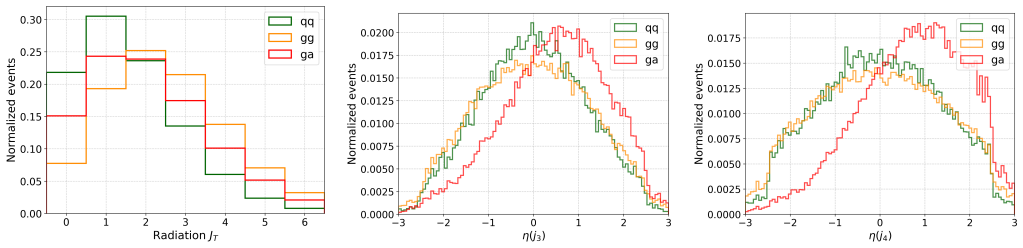
Tree-level mixed QCD-QED contributions from gluon-photon initial states enhance the pair-production rates of leptoquarks by up to ∼33% for a charge-5/3 state, rivalling the size of next-to-leading-order QCD corrections. The asymmetric colour flow of gγ fusion affects the radiation pattern, altering jet multiplicities and angular distributions. By recasting the latest ATLAS μμjj search data, these QED effects systematically strengthen mass exclusion limits and establish a necessary precision standard for bounding highly charged coloured states.
What carries the argument
The tree-level gluon-photon (gγ) fusion contribution to pair production of colour-triplet bosons, which scales with the square of the electric charge and produces asymmetric colour flow.
If this is right
- Production cross sections for high-charge states increase by amounts comparable to NLO QCD corrections.
- Jet multiplicities and angular distributions shift due to the distinct color flow in gγ fusion.
- Mass exclusion limits from existing LHC searches become systematically stronger.
- Theoretical predictions for highly charged coloured particles require inclusion of these mixed contributions as a precision standard.
Where Pith is reading between the lines
- Similar enhancements may appear in searches for other high-charge coloured particles such as certain vector-like quarks.
- Future LHC analyses should incorporate gγ-initiated samples in Monte Carlo simulations to model signal and background distributions correctly.
- The relative size of the effect could grow at higher collider energies where photon luminosities increase.
Load-bearing premise
Recasting the ATLAS μμjj search data accurately captures the impact of altered jet multiplicities and angular distributions from the asymmetric color flow in gγ fusion without requiring dedicated detector-level simulation.
What would settle it
A full detector-level simulation of gγ-initiated events showing that the recast mass limits do not strengthen, or a direct measurement of the pair-production cross section that matches pure QCD predictions rather than the enhanced rates.
Figures
read the original abstract
Strong interaction is typically assumed to dominate the pair production of heavy coloured resonances at the LHC. However, mixed QCD-QED contributions from gluon-photon ($g\gamma$) initial states become critical for highly charged states. This contribution scales with the square of their electric charges and maximises for particles in the fundamental colour representation. We study this effect for leptoquarks, which are colour-triplet bosons. We demonstrate that tree-level mixed QCD-QED contributions enhance their pair-production rates by up to $\sim 33\%$ for a charge-$5/3$ state, rivalling the size of next-to-leading-order QCD corrections. The asymmetric colour flow of $g\gamma$ fusion affects the radiation pattern, altering jet multiplicities and angular distributions. By recasting the latest ATLAS $\mu\mu jj$ search data, we find that these often-overlooked QED effects systematically strengthen mass exclusion limits, establishing a necessary precision standard for bounding highly charged coloured states.
Editorial analysis
A structured set of objections, weighed in public.
Referee Report
Summary. The paper claims that tree-level mixed QCD-QED contributions from gluon-photon initial states enhance the pair-production cross sections of highly charged colour-triplet leptoquarks by up to ∼33% for a charge-5/3 state, an effect comparable in size to NLO QCD corrections. The asymmetric colour flow in the gγ channel is noted to alter jet multiplicities and angular distributions; recasting the latest ATLAS μμjj search data is used to argue that these effects systematically strengthen mass exclusion limits.
Significance. If the results hold, the work would establish that QED-initiated processes must be included for precision predictions of highly charged coloured resonances at the LHC, since the enhancement rivals standard NLO QCD corrections and directly affects experimental bounds. The tree-level calculation with standard PDFs and couplings, free of additional fitted parameters, is a clear strength.
major comments (1)
- [Recasting of ATLAS μμjj data] The recasting applies published ATLAS μμjj selection efficiencies and acceptances directly to the gγ-induced kinematics. The asymmetric colour flow relative to gg or q q-bar channels changes parton-level jet multiplicities and angular distributions; without a dedicated detector-level simulation or explicit quantification of efficiency shifts, it is unclear whether the claimed strengthening of mass limits remains reliable at the level of the 33% rate enhancement. This step is load-bearing for the headline conclusion that QED effects strengthen exclusions.
minor comments (2)
- [Abstract] The abstract states the 33% enhancement but does not indicate the mass range or specific parameter choices at which the maximum occurs.
- [Calculation section] Explicit cross-section formulas, parton-distribution choices, and a brief validation against known NLO QCD results for leptoquark pair production would improve clarity and allow direct comparison.
Simulated Author's Rebuttal
We thank the referee for the positive assessment of our work's significance and for the constructive major comment on the recasting procedure. We address this point directly below, agreeing that further quantification is warranted while defending the robustness of our conclusions based on the nature of the ATLAS selection.
read point-by-point responses
-
Referee: The recasting applies published ATLAS μμjj selection efficiencies and acceptances directly to the gγ-induced kinematics. The asymmetric colour flow relative to gg or q q-bar channels changes parton-level jet multiplicities and angular distributions; without a dedicated detector-level simulation or explicit quantification of efficiency shifts, it is unclear whether the claimed strengthening of mass limits remains reliable at the level of the 33% rate enhancement. This step is load-bearing for the headline conclusion that QED effects strengthen exclusions.
Authors: We agree that the asymmetric colour flow in the gγ channel leads to differences in parton-level jet radiation and angular distributions compared to gg or qq̄ initial states, and that a full detector-level simulation would be the gold standard for precision. However, the ATLAS μμjj search employs inclusive selections on muon pT, η, dilepton invariant mass, and jet pT that are designed to capture a broad range of signal topologies for resonance searches. Standard recasting practices in the literature apply published efficiencies to new signal samples with the same final state when the kinematic differences are not extreme. To address the concern explicitly, we will add a new subsection in the revised manuscript that compares the relevant parton-level distributions (jet multiplicity, ΔR between jets and muons, pT spectra) between gγ and gg samples and estimates the resulting acceptance variation. Our preliminary parton-level study indicates that any efficiency shift is at most ~8%, which remains smaller than the 33% cross-section enhancement; the strengthening of the mass limits therefore persists. We will incorporate this estimated shift as an additional systematic uncertainty on the recast limits and update the relevant figures and text accordingly. revision: partial
Circularity Check
No circularity: tree-level cross-section calculation is self-contained
full rationale
The paper computes the pair-production cross section at tree level by adding the gγ-initiated channel to the standard gg and q q-bar channels using conventional PDFs and QED/QCD couplings. This enhancement (up to ~33% for charge 5/3) follows directly from the parton luminosities and matrix elements without any parameter fitted to the final result, without renaming a known pattern, and without load-bearing self-citations that close the derivation loop. The subsequent recasting of ATLAS μμjj limits applies published efficiencies to the new kinematics; while this step carries modeling assumptions, it does not reduce the claimed rate enhancement to a tautology or to the paper's own inputs by construction. The derivation chain therefore remains independent of the target observable.
Axiom & Free-Parameter Ledger
axioms (2)
- domain assumption Tree-level matrix elements for gγ → LQ LQ* are sufficient to capture the leading mixed contribution
- standard math Standard proton PDFs and couplings can be used without additional tuning
Lean theorems connected to this paper
-
IndisputableMonolith/Cost/FunctionalEquation.leanwashburn_uniqueness_aczel unclear?
unclearRelation between the paper passage and the cited Recognition theorem.
We demonstrate that tree-level mixed QCD-QED contributions enhance their pair-production rates by up to ∼33% for a charge-5/3 state, rivalling the size of next-to-leading-order QCD corrections.
What do these tags mean?
- matches
- The paper's claim is directly supported by a theorem in the formal canon.
- supports
- The theorem supports part of the paper's argument, but the paper may add assumptions or extra steps.
- extends
- The paper goes beyond the formal theorem; the theorem is a base layer rather than the whole result.
- uses
- The paper appears to rely on the theorem as machinery.
- contradicts
- The paper's claim conflicts with a theorem or certificate in the canon.
- unclear
- Pith found a possible connection, but the passage is too broad, indirect, or ambiguous to say the theorem truly supports the claim.
Reference graph
Works this paper leans on
-
[1]
J. C. Pati and A. Salam,Lepton Number as the Fourth Color,Phys. Rev. D10(1974) 275–289. [Erratum: Phys.Rev.D 11, 703–703 (1975)]
work page 1974
-
[2]
H. Georgi and S. L. Glashow,Unity of All Elementary Particle Forces,Phys. Rev. Lett.32(1974) 438–441
work page 1974
-
[3]
H. Fritzsch and P. Minkowski,Unified Interactions of Leptons and Hadrons,Annals Phys.93(1975) 193–266
work page 1975
- [4]
-
[5]
B. Schrempp and F. Schrempp,LIGHT LEPTOQUARKS, Phys. Lett. B153(1985) 101–107
work page 1985
-
[6]
Wudka,COMPOSITE LEPTOQUARKS,Phys
J. Wudka,COMPOSITE LEPTOQUARKS,Phys. Lett. B167 (1986) 337–342
work page 1986
-
[7]
R-parity violating supersymmetry
R. Barbier et al.,R-parity violating supersymmetry,Phys. Rept.420(2005) 1–202, [hep-ph/0406039]
work page internal anchor Pith review Pith/arXiv arXiv 2005
-
[8]
Physics of leptoquarks in precision experiments and at particle colliders
I. Doršner, S. Fajfer, A. Greljo, J. F. Kamenik and N. Košnik,Physics of leptoquarks in precision experiments and at particle colliders,Phys. Rept.641(2016) 1–68, [1603.04993]
work page internal anchor Pith review Pith/arXiv arXiv 2016
- [9]
-
[10]
A. Bhaskar, A. Das, T. Mandal, S. Mitra and R. Sharma, Fresh look at the LHC limits on scalar leptoquarks,Phys. Rev. D109(2024) 055018, [2312.09855]
-
[11]
A. Das, T. Mandal, S. Mitra and R. Sharma,Fresh look at the LHC limits on vector leptoquarks,Phys. Rev. D113 (2026) 055007, [2507.18295]. [12]A TLAScollaboration, G. Aad et al.,Search for pairs of scalar leptoquarks decaying into quarks and electrons or muons in√s= 13 TeVppcollisions with the ATLAS detector,JHEP10(2020) 112, [2006.05872]
-
[12]
W. Buchmuller, R. Ruckl and D. Wyler,Leptoquarks in Lepton - Quark Collisions,Phys. Lett. B191(1987) 442–448. [Erratum: Phys.Lett.B 448, 320–320 (1999)]
work page 1987
-
[13]
FeynRules 2.0 - A complete toolbox for tree-level phenomenology
A. Alloul, N. D. Christensen, C. Degrande, C. Duhr and B. Fuks,FeynRules 2.0 - A complete toolbox for tree-level phenomenology,Comput. Phys. Commun.185(2014) 2250–2300, [1310.1921]
work page internal anchor Pith review Pith/arXiv arXiv 2014
-
[14]
UFO - The Universal FeynRules Output
C. Degrande, C. Duhr, B. Fuks, D. Grellscheid, O. Mattelaer and T. Reiter,UFO - The Universal FeynRules Output,Comput. Phys. Commun.183(2012) 1201–1214, [1108.2040]
work page internal anchor Pith review Pith/arXiv arXiv 2012
-
[15]
J. Alwall, R. Frederix, S. Frixione, V. Hirschi, F. Maltoni, O. Mattelaer et al.,The automated computation of tree-level and next-to-leading order differential cross sections, and their matching to parton shower simulations, JHEP07(2014) 079, [1405.0301]
work page internal anchor Pith review Pith/arXiv arXiv 2014
-
[16]
Pair Production of Scalar Leptoquarks at the LHC to NLO Parton Shower Accuracy
T. Mandal, S. Mitra and S. Seth,Pair Production of Scalar Leptoquarks at the LHC to NLO Parton Shower Accuracy, Phys. Rev. D93(2016) 035018, [1506.07369]
work page internal anchor Pith review Pith/arXiv arXiv 2016
-
[17]
C. Degrande,Automatic evaluation of UV and R2 terms for beyond the Standard Model Lagrangians: a proof-of-principle,Comput. Phys. Commun.197(2015) 239–262, [1406.3030]
work page internal anchor Pith review Pith/arXiv arXiv 2015
-
[18]
The SysCalc code: A tool to derive theoretical systematic uncertainties
A. Kalogeropoulos and J. Alwall,The SysCalc code: A tool to derive theoretical systematic uncertainties,1801.08401
work page internal anchor Pith review Pith/arXiv arXiv
-
[19]
LHAPDF6: parton density access in the LHC precision era
A. Buckley, J. Ferrando, S. Lloyd, K. Nordström, B. Page, M. Rüfenacht et al.,LHAPDF6: parton density access in the LHC precision era,Eur. Phys. J. C75(2015) 132, [1412.7420]. [21]NNPDFcollaboration, R. D. Ball, V. Bertone, S. Carrazza, L. Del Debbio, S. Forte, A. Guffanti et al.,Parton distributions with QED corrections,Nucl. Phys. B877 (2013) 290–320, [...
work page internal anchor Pith review Pith/arXiv arXiv 2015
-
[20]
PDF4LHC recommendations for LHC Run II
J. Butterworth et al.,PDF4LHC recommendations for LHC 5 Run II,J. Phys. G43(2016) 023001, [1510.03865]
work page internal anchor Pith review Pith/arXiv arXiv 2016
-
[21]
How bright is the proton? A precise determination of the photon parton distribution function
A. Manohar, P. Nason, G. P. Salam and G. Zanderighi, How bright is the proton? A precise determination of the photon parton distribution function,Phys. Rev. Lett.117 (2016) 242002, [1607.04266]
work page internal anchor Pith review Pith/arXiv arXiv 2016
-
[22]
Single Productions of Colored Particles at the LHC: An Example with Scalar Leptoquarks
T. Mandal, S. Mitra and S. Seth,Single Productions of Colored Particles at the LHC: An Example with Scalar Leptoquarks,JHEP07(2015) 028, [1503.04689]
work page internal anchor Pith review Pith/arXiv arXiv 2015
-
[23]
T. Mandal, S. Mitra and S. Raz,RD(∗) motivatedS 1 leptoquark scenarios: Impact of interference on the exclusion limits from LHC data,Phys. Rev. D99(2019) 055028, [1811.03561]
work page internal anchor Pith review Pith/arXiv arXiv 2019
-
[24]
A. Bhaskar, D. Das, T. Mandal, S. Mitra and C. Neeraj, Precise limits on the charge-2/3 U1 vector leptoquark, Phys. Rev. D104(2021) 035016, [2101.12069]
-
[25]
NNLL resummation for stop pair-production at the LHC
W. Beenakker, C. Borschensky, R. Heger, M. Krämer, A. Kulesza and E. Laenen,NNLL resummation for stop pair-production at the LHC,JHEP05(2016) 153, [1601.02954]. Appendix: Colour scaling of thegg-initiated production Thegg-initiated pair production ofXR includess-,t-, and u-channel exchanges, along with a four-point (seagull) contact interaction exclusive ...
work page internal anchor Pith review Pith/arXiv arXiv 2016
discussion (0)
Sign in with ORCID, Apple, or X to comment. Anyone can read and Pith papers without signing in.