Probing Pair Correlations in QCD Matter with Photon Spectra
Pith reviewed 2026-06-28 13:39 UTC · model grok-4.3
The pith
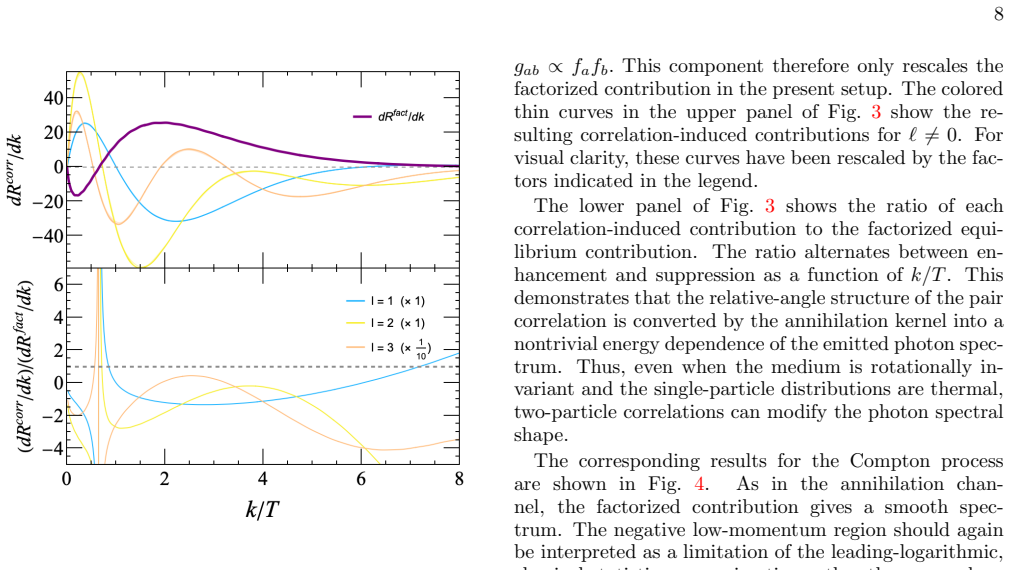
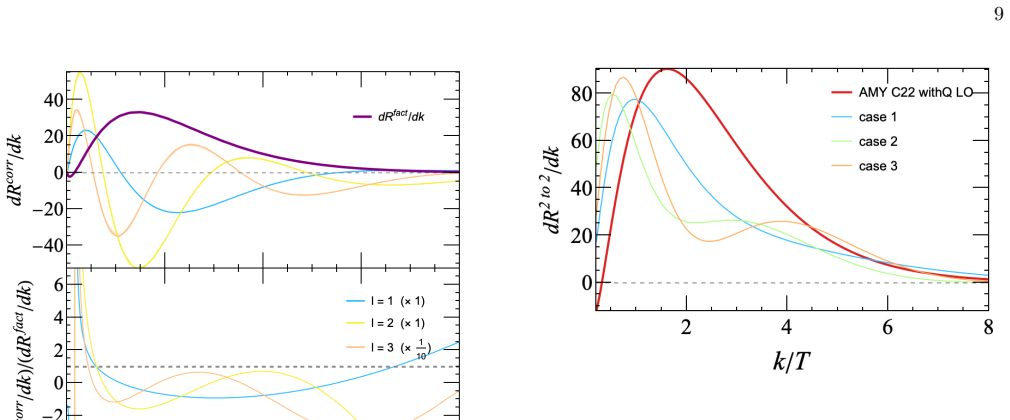
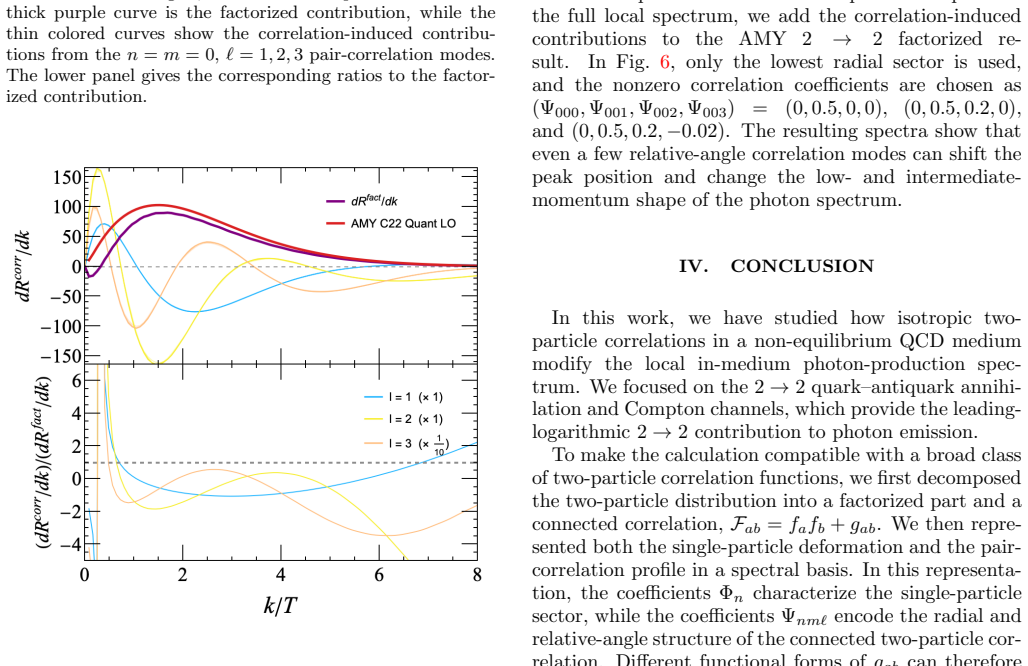
Pair correlations in the parton distribution generate sign-changing modifications to the photon spectrum that can equal the size of the factorized contribution.
A machine-rendered reading of the paper's core claim, the machinery that carries it, and where it could break.
Core claim
We decompose the two-particle distribution as F_ab = f_a f_b + g_ab, where g_ab is the pair correlation. Focusing on the 2-to-2 quark-antiquark annihilation and Compton channels, we compute the leading-logarithmic photon spectrum by expanding the single-particle distribution and pair correlation in a spectral basis. For a rotationally invariant medium, relative-angle modes of the pair correlation generate sign-changing modifications to the photon spectrum, with magnitudes that can be comparable to the factorized contribution. Thus photon spectra, although single-particle observables, can measure the momentum correlations of the emitting medium and therefore probe the early-time hydrodynamiza
What carries the argument
The decomposition F_ab = f_a f_b + g_ab together with its expansion in a spectral basis, which isolates how relative-angle modes of the pair correlation modify the leading-logarithmic yield from the 2-to-2 photon channels.
If this is right
- The photon spectrum receives sign-changing corrections from relative-angle modes of the pair correlation.
- These corrections can reach magnitudes comparable to the factorized contribution from the product of single-particle distributions.
- Photon production therefore functions as a probe of pair correlations in the non-equilibrium medium.
- The approach applies to the quark-antiquark annihilation and Compton scattering channels.
Where Pith is reading between the lines
- The spectral-basis method could be applied to concrete initial-state models to predict the size of correlation effects in actual collision data.
- Similar sensitivity to pair correlations may exist in other electromagnetic observables such as dilepton spectra.
- If the effect is observed, it would link photon measurements directly to the onset of hydrodynamization through the decay of initial momentum correlations.
Load-bearing premise
The two-particle distribution admits the decomposition into the product of single-particle distributions plus a separate pair correlation term, and the leading-logarithmic approximation remains valid for the 2-to-2 photon production channels when the medium is far from equilibrium.
What would settle it
A measurement showing that the photon spectrum in heavy-ion collisions lacks sign-changing modifications beyond the factorized prediction, or an explicit calculation in a specific far-from-equilibrium model in which the g_ab contributions remain much smaller than the f_a f_b term.
Figures
read the original abstract
Correlations in the phase-space distribution of partons play an important role in the initial stage of relativistic heavy-ion collisions, where the matter is dense and far from equilibrium. Photons produced in the hot medium, which predominantly originate from two-parton initial states, are sensitive to two-particle correlations in the phase-space distribution. In this work, we study how pair correlations in non-equilibrium QCD matter affect in-medium photon production. We decompose the two-particle distribution as $\mathcal F_{ab}=f_a f_b+g_{ab}$, where $g_{ab}$ is the pair correlation. Focusing on the $2\to2$ quark--antiquark annihilation and Compton channels, we compute the leading-logarithmic photon spectrum by expanding the single-particle distribution and pair correlation in a spectral basis, thereby accommodating a broad class of two-particle distributions. For a rotationally invariant medium, we find that relative-angle modes of the pair correlation generate sign-changing modifications to the photon spectrum, with magnitudes that can be comparable to the factorized contribution. Thus, photon spectra, although single-particle observables, can measure the momentum correlations of the emitting medium and therefore probe the early-time hydrodynamization.
Editorial analysis
A structured set of objections, weighed in public.
Referee Report
Summary. The paper claims that by decomposing the two-particle distribution as F_ab = f_a f_b + g_ab and computing the leading-logarithmic photon spectrum from qqbar annihilation and Compton scattering after expanding both f_a and g_ab in a spectral basis, the relative-angle modes of the pair correlation in a rotationally invariant non-equilibrium medium produce sign-changing modifications to the photon spectrum whose magnitudes can be comparable to the factorized contribution; thus photon spectra can probe early-time pair correlations and hydrodynamization.
Significance. If the result holds, the work offers a concrete route to access two-particle correlations via single-particle photon observables in the initial stage of heavy-ion collisions. The spectral-basis approach that accommodates a broad class of distributions is a methodological strength worth crediting, as is the explicit focus on non-equilibrium effects beyond thermal assumptions.
major comments (2)
- [leading-logarithmic photon spectrum computation] The leading-logarithmic approximation is invoked for the 2 o2 photon rates with arbitrary far-from-equilibrium f_a and g_ab (see the computation following the decomposition F_ab = f_a f_b + g_ab). Standard LLA derivations of the collinear logarithm rely on thermal distributions to fix the infrared screening scale and phase-space weighting; when these are replaced by rotationally invariant but non-thermal distributions, the effective Debye mass and matrix-element factors can change, so it is not immediate that the relative-angle modes of g_ab produce modifications of comparable size to the factorized term. This assumption is load-bearing for the central magnitude claim.
- [spectral basis expansion of pair correlation] The spectral-basis expansion of g_ab is used to isolate the relative-angle modes that generate the sign-changing corrections. No explicit demonstration is given that the truncation or basis choice preserves the claimed magnitude comparison once the infrared structure is recomputed self-consistently for the non-equilibrium case.
minor comments (1)
- The abstract states the central result but supplies no derivation outline, error estimates, or numerical checks, making it difficult for a reader to verify support for the claim without the full text.
Simulated Author's Rebuttal
We thank the referee for the careful review and for highlighting these important technical points regarding the leading-logarithmic approximation and the spectral expansion. We address each major comment below.
read point-by-point responses
-
Referee: [leading-logarithmic photon spectrum computation] The leading-logarithmic approximation is invoked for the 2→2 photon rates with arbitrary far-from-equilibrium f_a and g_ab (see the computation following the decomposition F_ab = f_a f_b + g_ab). Standard LLA derivations of the collinear logarithm rely on thermal distributions to fix the infrared screening scale and phase-space weighting; when these are replaced by rotationally invariant but non-thermal distributions, the effective Debye mass and matrix-element factors can change, so it is not immediate that the relative-angle modes of g_ab produce modifications of comparable size to the factorized term. This assumption is load-bearing for the central magnitude claim.
Authors: We agree that the LLA extension to non-equilibrium distributions is not automatic and that the infrared structure must be handled carefully. In the manuscript the Debye mass is computed directly from the given rotationally invariant f_a, and the collinear logarithm is obtained from the same phase-space integration that appears in the thermal case; the g_ab term enters the rate at the same order through the identical matrix elements. Nevertheless, a fully self-consistent recomputation of screening for each distribution would strengthen the argument. We will add an appendix deriving the LLA cutoff for arbitrary rotationally invariant distributions and explicitly comparing the factorized and correlated contributions at leading log. revision: yes
-
Referee: [spectral basis expansion of pair correlation] The spectral-basis expansion of g_ab is used to isolate the relative-angle modes that generate the sign-changing corrections. No explicit demonstration is given that the truncation or basis choice preserves the claimed magnitude comparison once the infrared structure is recomputed self-consistently for the non-equilibrium case.
Authors: The basis is complete for rotationally invariant functions, so truncation is controlled by the decay of higher coefficients. The magnitude comparison is performed mode-by-mode at fixed leading-log order. We acknowledge that an explicit check with the infrared scale recomputed after each truncation would be desirable. We will include a short numerical test showing that the leading relative-angle modes dominate the correction and that the truncation error remains smaller than the reported effect for the distributions examined. revision: partial
Circularity Check
No circularity; direct forward computation from decomposed distribution
full rationale
The derivation starts from the explicit decomposition F_ab = f_a f_b + g_ab, applies the leading-logarithmic approximation to the 2→2 channels, and expands both distributions in a spectral basis to obtain the photon spectrum. This is a self-contained forward calculation whose output is not forced by construction to equal any input parameter or prior self-citation. No load-bearing step reduces to a fit, a renamed known result, or an unverified self-citation chain. The result remains independent of the specific functional forms chosen for f and g_ab within the stated assumptions.
Axiom & Free-Parameter Ledger
axioms (2)
- domain assumption Leading-logarithmic approximation applies to photon production in the 2-to-2 quark-antiquark annihilation and Compton channels inside a non-equilibrium medium.
- domain assumption Two-particle distribution admits the decomposition F_ab = f_a f_b + g_ab.
Reference graph
Works this paper leans on
-
[1]
Thus3 Kann = 4N2 c |Mann|2 = 4 N2 c −1 e2g2 s X f=u,d,s Q2 f u t + t u
To obtain the kernel summed over the spin and color states of the incoming quark and antiquark, one multiplies the averaged result by (2Nc)(2Nc) = 4N2 c . Thus3 Kann = 4N2 c |Mann|2 = 4 N2 c −1 e2g2 s X f=u,d,s Q2 f u t + t u . (41) Eq. (40) can also be written in terms of the electromag- netic couplingα EM =e 2/(4π) and the strong coupling αs =g ...
-
[2]
E. L. Feinberg, Nuovo Cim. A34, 391 (1976)
1976
-
[3]
E. V. Shuryak, Phys. Lett. B78, 150 (1978)
1978
-
[4]
Kajantie and H
K. Kajantie and H. I. Miettinen, Z. Phys. C9, 341 (1981)
1981
-
[5]
L. D. McLerran and T. Toimela, Phys. Rev. D31, 545 (1985)
1985
-
[6]
Kajantie, J
K. Kajantie, J. I. Kapusta, L. D. McLerran, and A. Mekjian, Phys. Rev. D34, 2746 (1986)
1986
-
[7]
Tserruya, Landolt-Bornstein23, 176 (2010), arXiv:0903.0415 [nucl-ex]
I. Tserruya, Landolt-Bornstein23, 176 (2010), arXiv:0903.0415 [nucl-ex]
Pith/arXiv arXiv 2010
- [8]
-
[9]
Jackson, EPJ Web Conf.364, 01023 (2026), arXiv:2509.00262 [hep-ph]
G. Jackson, EPJ Web Conf.364, 01023 (2026), arXiv:2509.00262 [hep-ph]
arXiv 2026
-
[10]
Du, EPJ Web Conf.339, 01016 (2025), arXiv:2503.09045 [nucl-th]
L. Du, EPJ Web Conf.339, 01016 (2025), arXiv:2503.09045 [nucl-th]
arXiv 2025
-
[11]
X.-Y. Wu, H. Gao, B. Forster, C. Gale, G. Jackson, and S. Jeon, Phys. Rev. Lett.134, 242301 (2025), arXiv:2412.15052 [nucl-th]
arXiv 2025
-
[12]
H. Gao, X.-Y. Wu, C. Gale, G. Jackson, and S. Jeon, (2026), arXiv:2605.30180 [nucl-th]
Pith/arXiv arXiv 2026
-
[13]
A. Adareet al.(PHENIX), Phys. Rev. Lett.104, 132301 (2010), arXiv:0804.4168 [nucl-ex]
Pith/arXiv arXiv 2010
-
[14]
A. Adareet al.(PHENIX), Phys. Rev. Lett.109, 122302 (2012), arXiv:1105.4126 [nucl-ex]
Pith/arXiv arXiv 2012
-
[15]
F.-M. Liu and S.-X. Liu, Phys. Rev. C89, 034906 (2014), arXiv:1212.6587 [nucl-th]
Pith/arXiv arXiv 2014
-
[16]
R. Rapp and H. van Hees, Phys. Lett. B753, 586 (2016), arXiv:1411.4612 [hep-ph]
Pith/arXiv arXiv 2016
-
[17]
S. Acharyaet al.(ALICE), Phys. Lett. B789, 308 (2019), arXiv:1805.04403 [nucl-ex]
Pith/arXiv arXiv 2019
-
[18]
P. Dasgupta, G.-L. Ma, R. Chatterjee, L. Yan, S. Zhang, and Y.-G. Ma, Eur. Phys. J. A57, 134 (2021), arXiv:2007.09543 [nucl-th]
arXiv 2021
- [19]
-
[20]
J. Adamet al.(ALICE), Phys. Lett. B754, 235 (2016), arXiv:1509.07324 [nucl-ex]
Pith/arXiv arXiv 2016
-
[21]
W. Hui, S. Ben-Hao, T. An, and S. Zu-Xun, Phys. Rev. C61, 064905 (2000)
2000
-
[22]
Stankus, Ann
P. Stankus, Ann. Rev. Nucl. Part. Sci.55, 517 (2005)
2005
-
[23]
F.-M. Liu and K. Werner, J. Phys. G36, 035101 (2009), arXiv:0712.3619 [hep-ph]
Pith/arXiv arXiv 2009
-
[24]
I. Vitev and B.-W. Zhang, Phys. Lett. B669, 337 (2008), arXiv:0804.3805 [hep-ph]
Pith/arXiv arXiv 2008
- [25]
-
[26]
J. F. Owens, Rev. Mod. Phys.59, 465 (1987)
1987
-
[27]
J. Churchill, L. Yan, S. Jeon, and C. Gale, Phys. Rev. C103, 024904 (2021), arXiv:2008.02902 [hep-ph]
arXiv 2021
-
[28]
O. Garcia-Montero, A. Mazeliauskas, P. Plaschke, and S. Schlichting, JHEP03, 053 (2024), arXiv:2308.09747 [hep-ph]
arXiv 2024
-
[29]
O. Garcia-Montero, P. Plaschke, and S. Schlichting, Phys. Rev. D111, 034036 (2025), arXiv:2403.04846 [hep- ph]
arXiv 2025
-
[30]
J.-F. Paquet, C. Shen, G. S. Denicol, M. Luzum, B. Schenke, S. Jeon, and C. Gale, Phys. Rev. C93, 044906 (2016), arXiv:1509.06738 [hep-ph]
Pith/arXiv arXiv 2016
-
[31]
S. Turbide, R. Rapp, and C. Gale, Phys. Rev. C69, 014903 (2004), arXiv:hep-ph/0308085
Pith/arXiv arXiv 2004
-
[32]
R. J. Fries, B. Muller, and D. K. Srivastava, Phys. Rev. Lett.90, 132301 (2003), arXiv:nucl-th/0208001
Pith/arXiv arXiv 2003
-
[33]
S. Turbide, C. Gale, S. Jeon, and G. D. Moore, Phys. Rev. C72, 014906 (2005), arXiv:hep-ph/0502248
Pith/arXiv arXiv 2005
-
[34]
G.-Y. Qin, J. Ruppert, C. Gale, S. Jeon, and G. D. Moore, Phys. Rev. C80, 054909 (2009), arXiv:0906.3280 12 [hep-ph]
Pith/arXiv arXiv 2009
-
[35]
F.-M. Liu, T. Hirano, K. Werner, and Y. Zhu, Phys. Rev. C80, 034905 (2009), arXiv:0902.1303 [hep-ph]
Pith/arXiv arXiv 2009
-
[36]
M. Dion, J.-F. Paquet, B. Schenke, C. Young, S. Jeon, and C. Gale, Phys. Rev. C84, 064901 (2011), arXiv:1109.4405 [hep-ph]
Pith/arXiv arXiv 2011
-
[37]
C. Shen, U. W. Heinz, J.-F. Paquet, and C. Gale, Phys. Rev. C89, 044910 (2014), arXiv:1308.2440 [nucl-th]
Pith/arXiv arXiv 2014
-
[38]
C. Gale, Y. Hidaka, S. Jeon, S. Lin, J.-F. Paquet, R. D. Pisarski, D. Satow, V. V. Skokov, and G. Vujanovic, Phys. Rev. Lett.114, 072301 (2015), arXiv:1409.4778 [hep-ph]
Pith/arXiv arXiv 2015
-
[39]
H. van Hees, M. He, and R. Rapp, Nucl. Phys. A933, 256 (2015), arXiv:1404.2846 [nucl-th]
Pith/arXiv arXiv 2015
-
[40]
M. Jia, H. Li, and D. Hou, Phys. Lett. B846, 138239 (2023), arXiv:2211.16770 [hep-ph]
arXiv 2023
-
[41]
J. I. Kapusta, P. Lichard, and D. Seibert, Phys. Rev. D 44, 2774 (1991), [Erratum: Phys.Rev.D 47, 4171 (1993)]
1991
-
[42]
Baier, H
R. Baier, H. Nakkagawa, A. Niegawa, and K. Redlich, Z. Phys. C53, 433 (1992)
1992
-
[43]
P. B. Arnold, G. D. Moore, and L. G. Yaffe, JHEP12, 009 (2001), arXiv:hep-ph/0111107
Pith/arXiv arXiv 2001
-
[44]
P. B. Arnold, G. D. Moore, and L. G. Yaffe, JHEP11, 057 (2001), arXiv:hep-ph/0109064
Pith/arXiv arXiv 2001
-
[45]
L. D. Landau and I. Pomeranchuk, Dokl. Akad. Nauk Ser. Fiz.92, 535 (1953)
1953
-
[46]
L. D. Landau and I. Pomeranchuk, Dokl. Akad. Nauk Ser. Fiz.92, 735 (1953)
1953
-
[47]
A. B. Migdal, Phys. Rev.103, 1811 (1956)
1956
-
[48]
P. Aurenche, F. Gelis, and H. Zaraket, Phys. Rev. D62, 096012 (2000), arXiv:hep-ph/0003326
Pith/arXiv arXiv 2000
-
[49]
P. B. Arnold, G. D. Moore, and L. G. Yaffe, JHEP06, 030 (2002), arXiv:hep-ph/0204343
Pith/arXiv arXiv 2002
-
[50]
H.-z. Zhang, Z.-b. Kang, B.-W. Zhang, and E. Wang, Eur. Phys. J. C67, 445 (2010), arXiv:hep-ph/0609159
Pith/arXiv arXiv 2010
- [51]
-
[52]
Y. Hidaka, S. Lin, R. D. Pisarski, and D. Satow, JHEP 10, 005 (2015), arXiv:1504.01770 [hep-ph]
Pith/arXiv arXiv 2015
- [53]
-
[54]
A. Adareet al.(PHENIX), Phys. Rev. C94, 064901 (2016), arXiv:1509.07758 [nucl-ex]
arXiv 2016
-
[55]
A. Monnai, Int. J. Mod. Phys. A37, 2230006 (2022), arXiv:2203.13208 [nucl-th]
arXiv 2022
-
[56]
S. Acharyaet al.(ALICE), Phys. Lett. B868, 139645 (2025), arXiv:2411.14366 [hep-ex]
arXiv 2025
-
[57]
G. L. Kasza, PTEP2026, 033D01 (2026), arXiv:2507.13240 [hep-ph]
Pith/arXiv arXiv 2026
-
[58]
H. S. Scheid, EPJ Web Conf.364, 01022 (2026), arXiv:2509.26456 [nucl-ex]
arXiv 2026
- [59]
-
[60]
Averyanov, Phys
D. Averyanov, Phys. Part. Nucl.57, 188 (2026)
2026
-
[61]
M. Buzzegoli, S. Busuioc, J. D. Kroth, N. Vijayakumar, and K. Tuchin, (2026), arXiv:2602.13044 [hep-ph]
Pith/arXiv arXiv 2026
-
[62]
J. D. Kroth and K. Tuchin, (2026), arXiv:2602.02746 [hep-ph]
arXiv 2026
-
[63]
Liu, (2026), arXiv:2604.25165 [hep-ph]
F.-M. Liu, (2026), arXiv:2604.25165 [hep-ph]
Pith/arXiv arXiv 2026
-
[64]
X. An, R. Brants, M. P. Heller, and Y. Yin, (2025), arXiv:2511.11555 [hep-th]
arXiv 2025
- [65]
-
[66]
C. V. P. de Brito, D. Wagner, G. S. Denicol, and D. H. Rischke, Phys. Rev. D113, 096007 (2026), arXiv:2411.06267 [nucl-th]
arXiv 2026
-
[67]
X. Du, S. Schlichting, and J. Zhu, Phys. Rev. D113, 096009 (2026), arXiv:2512.08007 [hep-ph]
Pith/arXiv arXiv 2026
- [68]
- [69]
discussion (0)
Sign in with ORCID, Apple, or X to comment. Anyone can read and Pith papers without signing in.