REVIEW 3 major objections 1 minor 36 references
Quark--hadron duality in inclusive electron--proton scattering at high $Q^{2}$: structure functions and truncated moments from CLAS12
T0 review · 3 major / 1 minor · reviewed 2026-06-30 · grok-4.3
Pith's one-line read CLAS12 data confirm quark-hadron duality holds in the resonance region up to Q² of 10 GeV² through matching structure functions and moments.
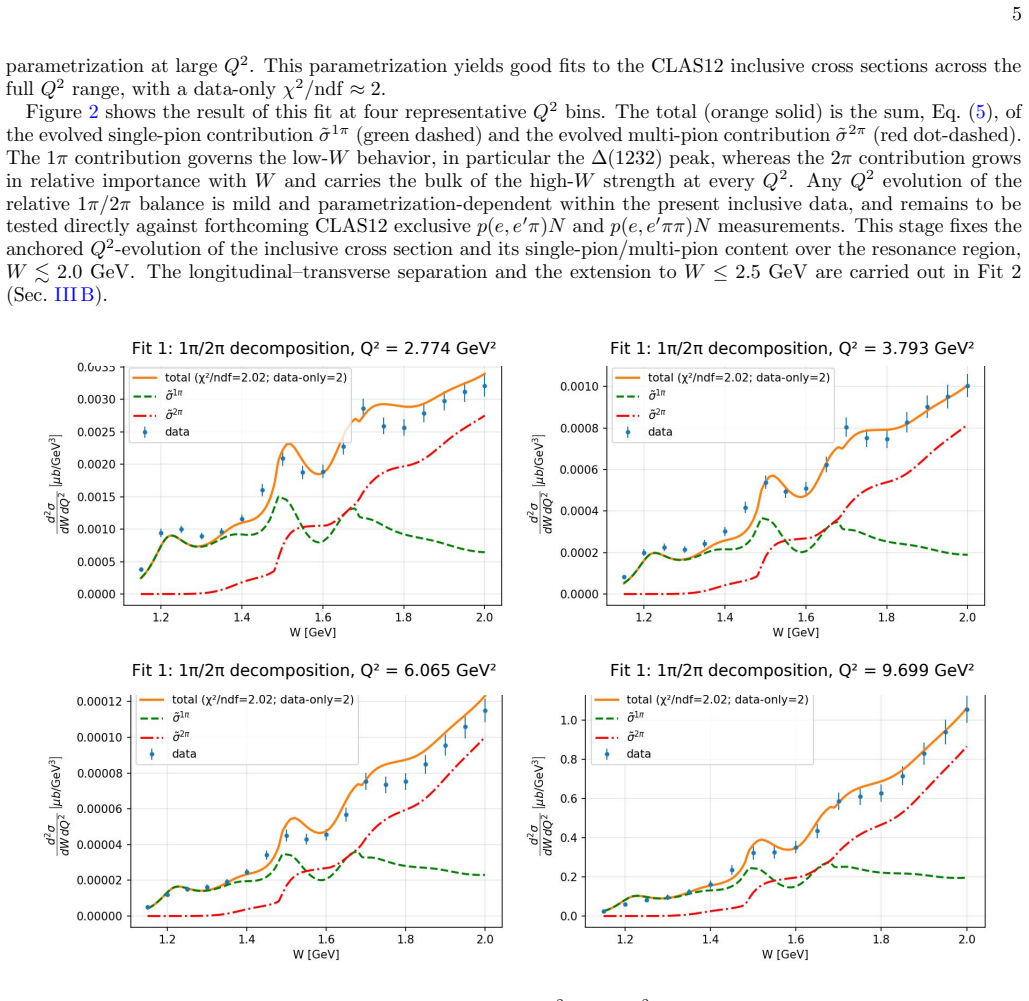
desk verdict The paper extends duality tests to Q²~10 GeV² with new CLAS12 data but the L-T separation rests on a data-tuned model extension, so the consistency with CJ15 is not fully independent. read the letter →
The pith
A machine-rendered reading of the paper's core claim, the machinery that carries it, and where it could break.
The reading
What carries the argument
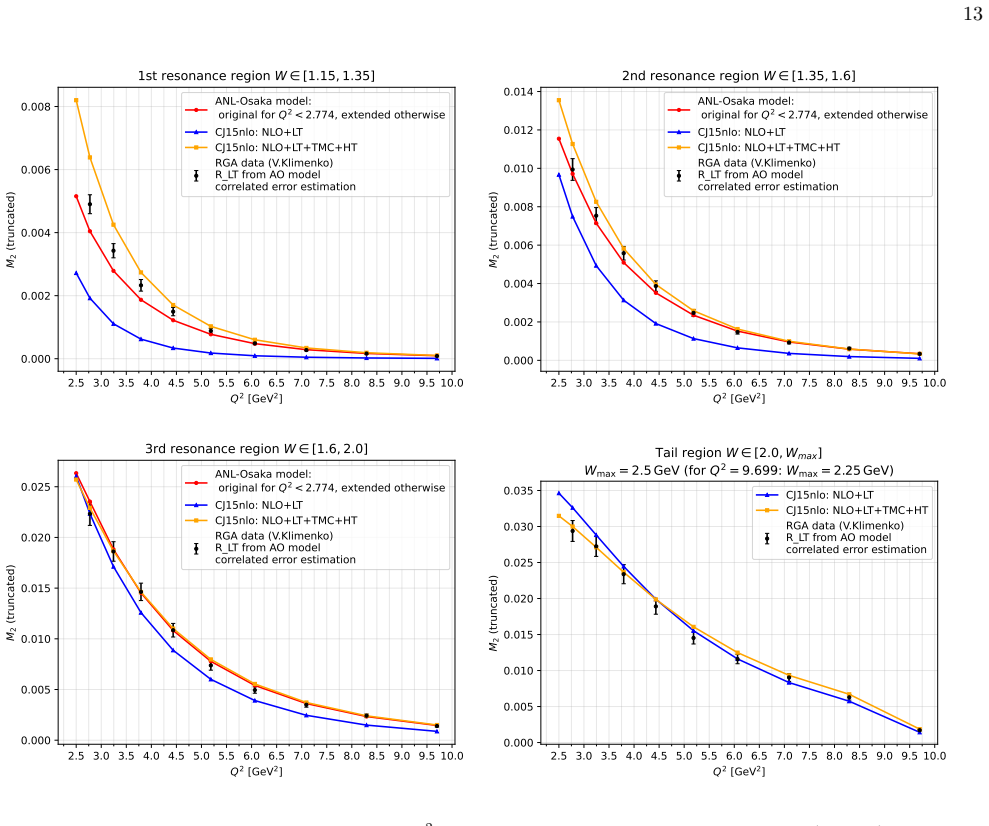
The W-truncated Cornwall-Norton moments M2(Q²) of the structure function F2(W,Q²), obtained after an ANL-Osaka-constrained longitudinal-transverse decomposition of the measured cross sections.
What would settle it
A new measurement at Q² near 10 GeV² that shows the CLAS12-extracted truncated moments deviating from the CJ15 predictions by more than the combined experimental and higher-twist uncertainties.
Extended reading notes
Core claim
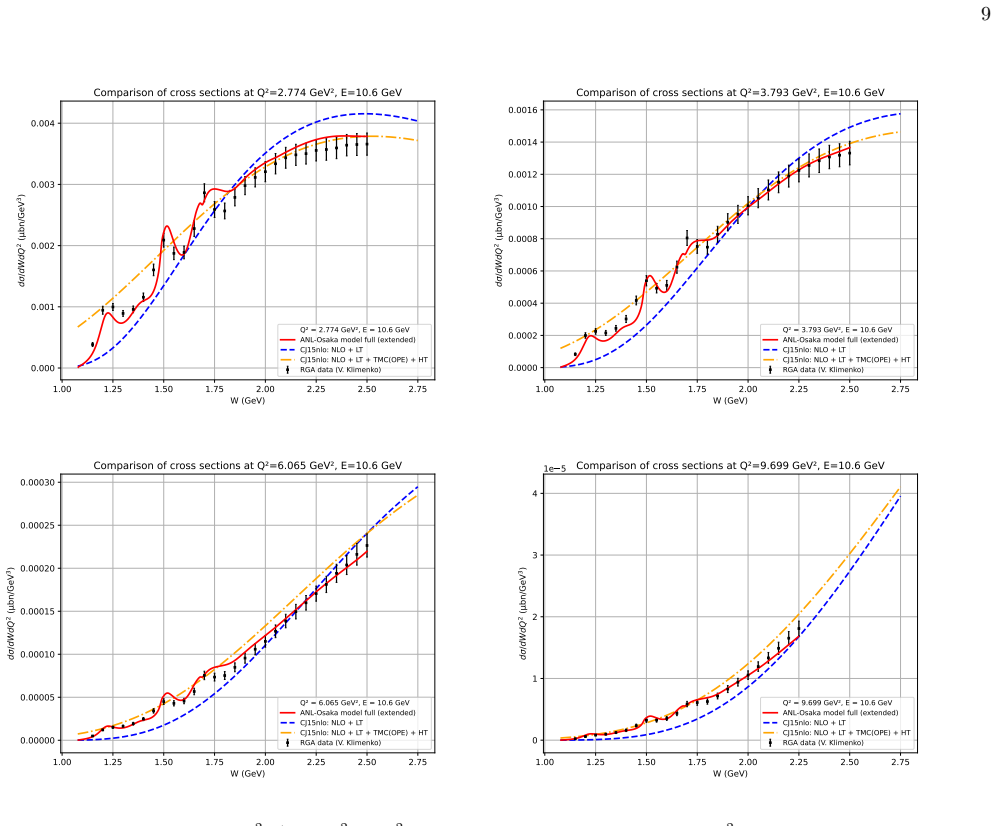
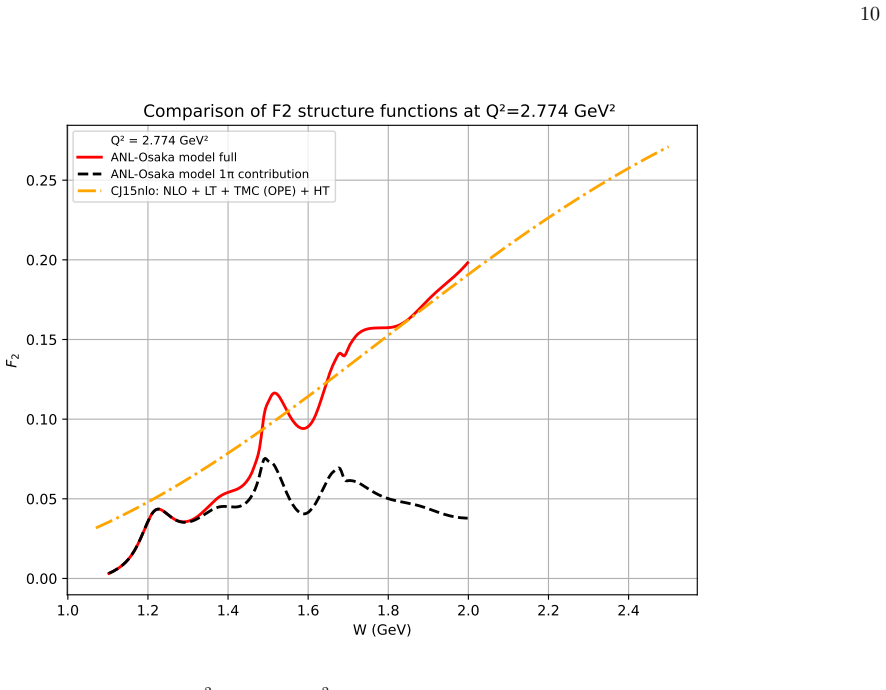
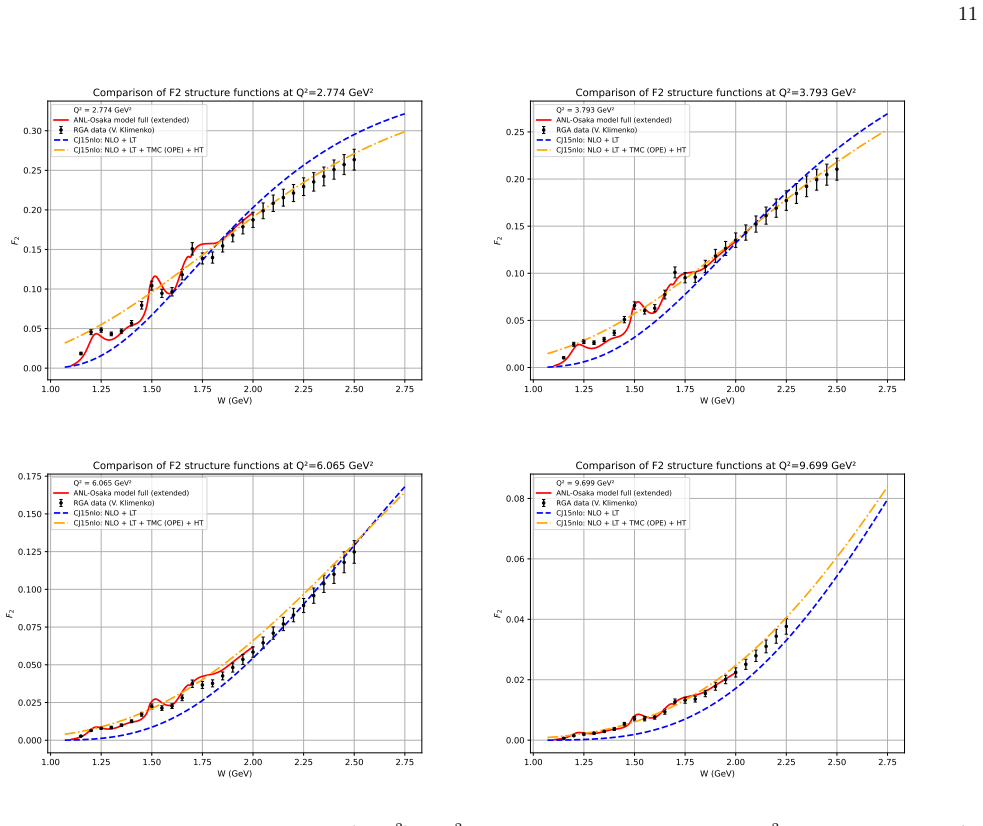
The central claim is that inclusive electron-proton scattering data in the nucleon resonance region up to Q² ≈ 10 GeV² exhibit both local and global quark-hadron duality, as evidenced by the agreement between the measured cross sections, extracted F2(W,Q²), and W-truncated Cornwall-Norton moments M2(Q²) with the CJ15 global QCD analysis including target-mass and higher-twist corrections. The study develops a high-Q² extension of the ANL-Osaka dynamical coupled-channels model to enable this comparison, revealing that multi-meson channels are essential for the resonance strength above the Delta(1232), and that a threshold effect in the partonic calculation explains residual discrepancies rathe
Load-bearing premise
The high-Q² extension of the coupled-channels model, fitted to the new cross-section data, produces an unbiased extraction of F2 and the moments.
Editorial extensions
If this is right
- Duality can be tested quantitatively at momentum transfers several times larger than in earlier experiments.
- Multi-meson final states must be included to reproduce the full resonance-region strength required by duality.
- The partonic calculation must incorporate the physical pion-production threshold to remove the remaining discrepancy in the first resonance region.
- Consistency across cross sections, structure functions, and moments strengthens the case for using resonance data to constrain higher-twist terms.
Reading between the lines
- Resonance-region data at these Q² values could be folded into global fits to tighten constraints on higher-twist coefficients.
- The threshold mismatch points to a calculational improvement that would be worth testing in other kinematic regimes where duality is examined.
- If the same model extension works at still higher Q², it could map the Q² range over which duality remains valid.
Signed reviews
Editorial analysis
A structured set of objections, weighed in public.
Referee Report
Summary. The manuscript presents a high-precision study of quark-hadron duality in inclusive electron-proton scattering using CLAS12 data spanning 2.55 ≤ Q² ≤ 10.4 GeV². A phenomenological high-Q² extension of the Argonne-Osaka dynamical coupled-channels model is developed, anchored at Q₀²=2.774 GeV² and constrained by the measured cross sections, to enable longitudinal-transverse decomposition, extraction of F₂(W,Q²), and evaluation of W-truncated Cornwall-Norton moments M₂(Q²). These quantities are compared to the CJ15 global QCD analysis (including target-mass and higher-twist corrections), with reported consistency interpreted as quantitative evidence for both local and global duality at higher Q² than previously explored. The work also identifies a threshold effect in the partonic calculation and notes the role of multi-meson channels in the resonance region.
Significance. If the robustness of the high-Q² extension can be established, the results would extend quantitative tests of quark-hadron duality to a new kinematic domain, with multi-level comparisons (cross sections, F₂, and moments) providing a stronger test than single-observable studies. The explicit discussion of the pion-production threshold mismatch and the necessity of multi-meson channels for duality offers mechanistic insight that could inform future modeling.
major comments (3)
- [High-Q² extension section] High-Q² extension section: the phenomenological extension is anchored at Q₀²=2.774 GeV² and explicitly constrained by the same CLAS12 cross-section data used to test duality via the CJ15 comparison. This setup makes the reported consistency at least partly dependent on the model fit rather than constituting an independent data-driven test of duality.
- [L-T decomposition and F₂ extraction] L-T decomposition and F₂ extraction: the central claim of quantitative evidence for duality rests on the extracted F₂(W,Q²) and M₂(Q²) being consistent with CJ15, yet the manuscript provides no quantitative assessment of uncertainties in the longitudinal-transverse separation, fit quality of the extension, or sensitivity to assumptions in the multi-meson channels and pion threshold.
- [Comparison with CJ15 section] Comparison with CJ15 section: consistency is asserted at the cross-section, structure-function, and truncated-moment levels, but without reported χ² values, uncertainty bands on the differences, or explicit propagation of model uncertainties from the ANL-Osaka extension, the strength of the evidence for duality cannot be evaluated.
minor comments (1)
- The abstract notes that the single-pion channel underestimates the inclusive strength above the Δ(1232) and that multi-meson channels carry the remainder, but a quantitative breakdown of channel contributions at the highest Q² would strengthen this supporting observation.
Simulated Author's Rebuttal
We thank the referee for the careful and constructive review. We address each major comment below and indicate the revisions we will make to strengthen the manuscript.
read point-by-point responses
-
Referee: [High-Q² extension section] the phenomenological extension is anchored at Q₀²=2.774 GeV² and explicitly constrained by the same CLAS12 cross-section data used to test duality via the CJ15 comparison. This setup makes the reported consistency at least partly dependent on the model fit rather than constituting an independent data-driven test of duality.
Authors: We agree that agreement at the cross-section level is influenced by the model constraint to the data. However, the primary duality test occurs at the extracted F₂(W,Q²) and truncated moments M₂(Q²), which are compared to the independent CJ15 global QCD analysis (not fitted to these CLAS12 data). The extension enables the L-T decomposition required for F₂ but does not dictate the CJ15 comparison. We will revise the text to explicitly distinguish the cross-section fit from the independent structure-function and moment tests. revision: partial
-
Referee: [L-T decomposition and F₂ extraction] the central claim of quantitative evidence for duality rests on the extracted F₂(W,Q²) and M₂(Q²) being consistent with CJ15, yet the manuscript provides no quantitative assessment of uncertainties in the longitudinal-transverse separation, fit quality of the extension, or sensitivity to assumptions in the multi-meson channels and pion threshold.
Authors: This is a fair criticism. In the revision we will add the χ² per degree of freedom for the high-Q² extension fit, quantitative uncertainty estimates for the L-T separation obtained from model-parameter variations, and sensitivity studies addressing the multi-meson channel assumptions and pion-threshold treatment. revision: yes
-
Referee: [Comparison with CJ15 section] consistency is asserted at the cross-section, structure-function, and truncated-moment levels, but without reported χ² values, uncertainty bands on the differences, or explicit propagation of model uncertainties from the ANL-Osaka extension, the strength of the evidence for duality cannot be evaluated.
Authors: We accept that quantitative metrics are needed. We will include χ² values for the relevant comparisons, overlay uncertainty bands on the differences between our results and CJ15, and propagate the ANL-Osaka extension uncertainties to the extracted F₂ and moments. These additions will allow a more rigorous assessment of the duality evidence. revision: yes
Circularity Check
No significant circularity detected
full rationale
The paper measures cross sections, develops a phenomenological extension of the ANL-Osaka model anchored at low Q² and constrained by those cross sections to perform L-T separation, extracts F2(W,Q²) and truncated moments M2(Q²), and compares the results to the independent CJ15 global QCD analysis (with TMC and HT corrections). This comparison supplies the claimed evidence for duality and does not reduce by construction to a fit of the same quantities or to a self-citation chain; CJ15 is an external benchmark, and the model serves only as an extraction tool rather than a source of the tested prediction.
Assumptions & free parameters
free parameters (1)
- high-Q² extension parameters of ANL-Osaka
assumptions (2)
- domain assumption The ANL-Osaka dynamical coupled-channels framework remains applicable after phenomenological extension to Q²≈10 GeV²
- domain assumption CJ15 global QCD analysis with target-mass and higher-twist corrections provides an independent benchmark for duality tests
Cite this review
Pith. "Pith review of Quark--hadron duality in inclusive electron--proton scattering at high $Q^{2}$: structure functions and truncated moments from CLAS12." pith.science (2026). https://pith.science/paper/W5ORXHE5
@misc{pith2026260629690,
  author       = {Pith},
  title        = {Pith review of: Quark--hadron duality in inclusive electron--proton scattering at high $Q^2$: structure functions and truncated moments from CLAS12},
  year         = {2026},
  howpublished = {\url{https://pith.science/paper/W5ORXHE5}},
  note         = {Machine review of arXiv:2606.29690}
}
abstract
We present a high-precision study of quark--hadron duality in inclusive electron--proton scattering in the nucleon resonance region, extending to $Q^2\approx10~\mathrm{GeV}^2$, based on recent CLAS12 cross-section measurements at Jefferson Lab. The data, taken with a 10.6~GeV beam, span $2.55 \le Q^2 \le 10.4~\mathrm{GeV}^2$ and cover the full resonance region up to $W\approx2.5~\mathrm{GeV}$. To reach the CLAS12 kinematics, we develop a phenomenological high-$Q^2$ extension of the Argonne--Osaka (ANL-Osaka) dynamical coupled-channels framework, anchored to the original calculation at $Q_0^2=2.774~\mathrm{GeV}^2$ and constrained by the measured cross sections. This enables an ANL-Osaka-constrained longitudinal--transverse decomposition and determination of the proton structure function $F_2(W,Q^2)$, from which we evaluate $W$-truncated Cornwall--Norton moments $M_2(Q^2)$. Comparison with the CJ15 global QCD analysis, including target-mass and higher-twist corrections, shows consistency at the cross-section, structure-function, and truncated-moment levels, providing quantitative evidence for both local and global quark--hadron duality at substantially higher $Q^2$ than previously explored. We further identify a threshold effect in the partonic calculation: the finite-$Q^2$ corrections do not enforce the physical pion-production threshold, and the residual discrepancy in the first resonance region is consistent with this effect rather than a breakdown of duality. Within the coupled-channel description, the single-pion channel alone underestimates the inclusive resonance-region strength above the $\Delta(1232)$, which is carried predominantly by the multi-meson channels, as required for duality.
Figures
Figures from the paper (3 more)
Reference graph
Works this paper leans on
-
[1]
F2 ω′(Q2, W);c 1, c2, c3 F2 ω′(Q2 0, W);c 1, c2, c3 σ1π(W, Q2 0),(6) ˜σ2π(W, Q2) =e −β(Q2−Q2
-
[2]
F2 ω′(Q2, W);c ′ 1, c′ 2, c′ 3 F2 ω′(Q2 0, W);c ′ 1, c′ 2, c′ 3 σ2π(W, Q2 0),(7) whereσ 1π(W, Q2
-
[3]
are the ANL-Osaka single-pion and multi-pion cross sections at the anchor point, ω′(Q2, W) = 1 +W 2/Q2, and the modified Breidenbach–Kuti function is [25] F2 ω′;c 1, c2, c3 = 3X i=1 ci 1− 1 ω′ 2+i .(8) By construction, this parametrization reproduces the ANL-Osaka model atQ 2 =Q 2 0, while the exponential factors e−α(Q2−Q2
-
[4]
This parametrization yields good fits to the CLAS12 inclusive cross sections across the fullQ 2 range, with a data-onlyχ 2/ndf≈2
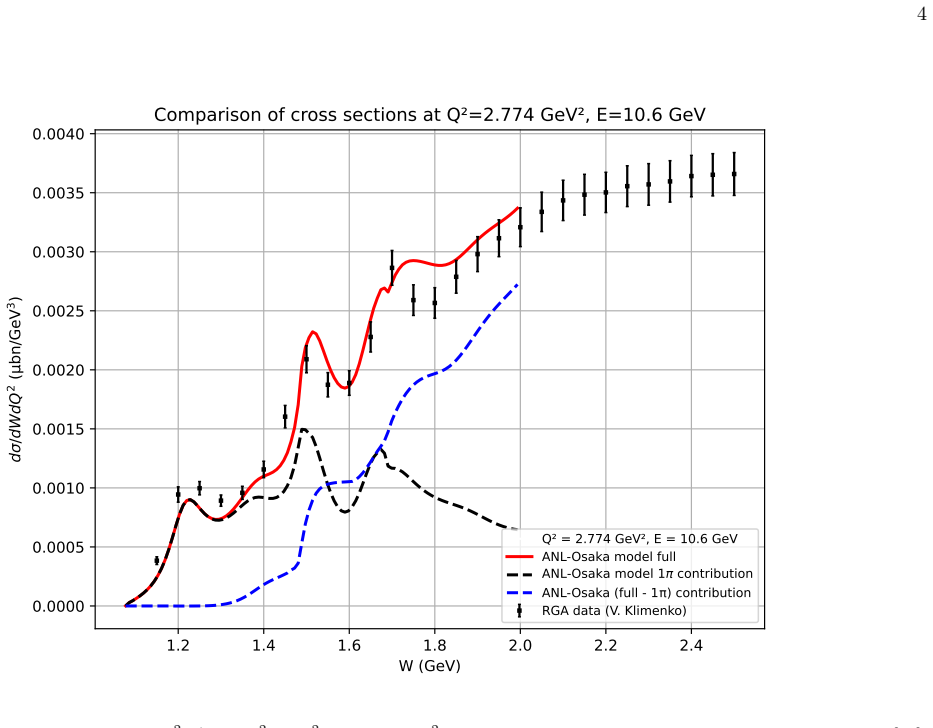
stabilize the extrapolation by suppressing the otherwise divergent behavior of theω ′ 5 parametrization at largeQ 2. This parametrization yields good fits to the CLAS12 inclusive cross sections across the fullQ 2 range, with a data-onlyχ 2/ndf≈2. Figure 2 shows the result of this fit at four representativeQ 2 bins. The total (orange solid) is the sum, Eq....
-
[5]
σAO L,input(Q2 0, W),(16) with the ANL-Osaka input cross sectionsσ AO T,input andσ AO L,input extended inWup to 2.5 GeV and the exponential scaling functions f(Q 2;α) = exp[α(Q 2 −Q 2 0)], f(Q 2;β) = exp[β(Q 2 −Q 2 0)].(17) In this construction, theWdependence ofσ AO T,input(Q2 0, W) andσ AO L,input(Q2 0, W) is taken from the original ANL- Osaka calculati...
-
[6]
= 4X i=1 c′ i 1− 1 ω′ 2+i ,(19) in order to capture the change in curvature observed in the high-Wdata (W≳2.0 GeV) asQ 2 increases. The parameters{α, β, c i, c′ i}are determined by minimizing the totalχ 2, χ2 total =χ 2 data + Φ penalty,(20) where the data term is χ2 data = X {Q2 i ,Wj } σtot data(Q2 i , Wj)−σ tot AO(Q2 i , Wj) 2 ∆σtot data(Q2 i , Wj)2 ,(...
2000
-
[7]
E. D. Bloom and F. J. Gilman, Phys. Rev. Lett.25, 1140 (1970)
1970
-
[8]
E. D. Bloom and F. J. Gilman, Phys. Rev. D4, 2901 (1971)
1971
Show all 36 references
-
[9]
Melnitchouk, R
W. Melnitchouk, R. Ent, and C. Keppel, Phys. Rep.406, 127 (2005)
2005
-
[10]
S. P. Malaceet al.(Jefferson Lab E00-115 Collaboration), Phys. Rev. C80, 035207 (2009)
2009
-
[11]
A. N. Hiller Blin, W. Melnitchouk, V. I. Mokeev, V. D. Burkert, V. V. Chesnokov, A. Pilloni, and A. P. Szczepaniak, Phys. Rev. C104, 065201 (2021), arXiv:2105.05834 [hep-ph]
2021
-
[12]
Accardi, L
A. Accardi, L. T. Brady, W. Melnitchouk, J. F. Owens, and N. Sato, Phys. Rev. D93, 114017 (2016)
2016
-
[13]
Georgi and H
H. Georgi and H. D. Politzer, Phys. Rev. D14, 1829 (1976)
1976
-
[14]
Schienbeinet al., J
I. Schienbeinet al., J. Phys. G35, 053101 (2008)
2008
-
[15]
V. D. Burkertet al., Nucl. Instrum. Meth. A959, 163419 (2020). 14
2020
-
[16]
Klimenkoet al.(CLAS Collaboration), Phys
V. Klimenkoet al.(CLAS Collaboration), Phys. Rev. C112, 025201 (2025)
2025
-
[17]
Tvaskiset al., Phys
V. Tvaskiset al., Phys. Rev. C97, 045204 (2018)
2018
-
[18]
Osipenkoet al.(CLAS Collaboration), Phys
M. Osipenkoet al.(CLAS Collaboration), Phys. Rev. D67, 092001 (2003)
2003
-
[19]
Sato and T.-S
T. Sato and T.-S. H. Lee, Phys. Rev. C54, 2660 (1996)
1996
-
[20]
Matsuyama, T
A. Matsuyama, T. Sato, and T.-S. H. Lee, Phys. Rep.439, 193 (2007)
2007
-
[21]
Julia-Diaz, T.-S
B. Julia-Diaz, T.-S. H. Lee, A. Matsuyama, and T. Sato, Phys. Rev. C77, 065201 (2007)
2007
-
[22]
Kamano, B
H. Kamano, B. Julia-Diaz, T.-S. H. Lee, A. Matsuyama, and T. Sato, Phys. Rev. C79, 025206 (2009)
2009
-
[23]
Suzuki, T
N. Suzuki, T. Sato, and T.-S. H. Lee, Phys. Rev. C82, 045206 (2010)
2010
-
[24]
Kamano, S
H. Kamano, S. X. Nakamura, T.-S. H. Lee, and T. Sato, Phys. Rev. C88, 035209 (2013)
2013
-
[25]
S. X. Nakamura, H. Kamano, and T. Sato, Phys. Rev. D92, 074024 (2015)
2015
-
[26]
Kamano, S
H. Kamano, S. X. Nakamura, T.-S. H. Lee, and T. Sato, Phys. Rev. C94, 015201 (2016)
2016
-
[27]
Buckley, J
A. Buckley, J. Ferrando, S. Lloyd, K. Nordstrom, B. Page, M. Ruefenacht, M. Schoenherr, and F. Siegert, Eur. Phys. J. C 75, 132 (2015), arXiv:1412.7420 [hep-ph]
2015 arXiv
-
[28]
A. V. Anisovich, R. Beck, E. Klempt, V. A. Nikonov, A. V. Sarantsev, and U. Thoma, Eur. Phys. J. A48, 15 (2012)
2012
-
[29]
R¨ onchen, M
D. R¨ onchen, M. D¨ oring, F. Huang, H. Haberzettl, J. Haidenbauer, C. Hanhart, S. Krewald, U.-G. Meißner, and K. Nakayama, Eur. Phys. J. A49, 44 (2013)
2013
-
[30]
M. Mai, M. D¨ oring, C. Granados, H. Haberzettl, J. Hergenrather, U.-G. Meißner, D. R¨ onchen, I. Strakovsky, and R. Work- man, Phys. Rev. C103, 065204 (2021)
2021
-
[31]
Breidenbach and J
M. Breidenbach and J. Kuti, Phys. Lett. B41, 345 (1972)
1972
-
[32]
James and M
F. James and M. Roos, Comput. Phys. Commun.10, 343 (1975)
1975
-
[33]
Efron, Ann
B. Efron, Ann. Statist.7, 1 (1979)
1979
-
[34]
Efron and R
B. Efron and R. J. Tibshirani,An Introduction to the Bootstrap(Chapman & Hall/CRC, 1994)
1994
-
[35]
J. M. Cornwall and R. E. Norton, Phys. Rev.177, 2584 (1969)
1969
-
[36]
Accardiet al., Eur
A. Accardiet al., Eur. Phys. J. A60, 173 (2024)
2024
Reviewed June 30, 2026 · model on record in the stance chip above.
Discussion (0). Continue with ORCID to comment.