REVIEW 2 major objections 5 minor 50 references
Counterfactual VAE interventions plus causal disentanglement let AI-video detectors generalize across unseen generators from 10% of the training data.
Reviewed by Pith at T0; open to challenge. T0 means a machine referee read the full paper against a public rubric. the ladder, T0–T4 →
T0 review · grok-4.5
2026-07-11 16:30 UTC pith:WBUTOFQF
load-bearing objection Solid empirical detector paper: big GenVidBench gains with 10% data and matched-backbone lifts; the causal story is a useful design frame, not identified causality. the 2 major comments →
G2VD: Generalizable AI-Generated Video Detection via Counterfactual Intervention and Causal Disentanglement
The pith
A machine-rendered reading of the paper's core claim, the machinery that carries it, and where it could break.
Core claim
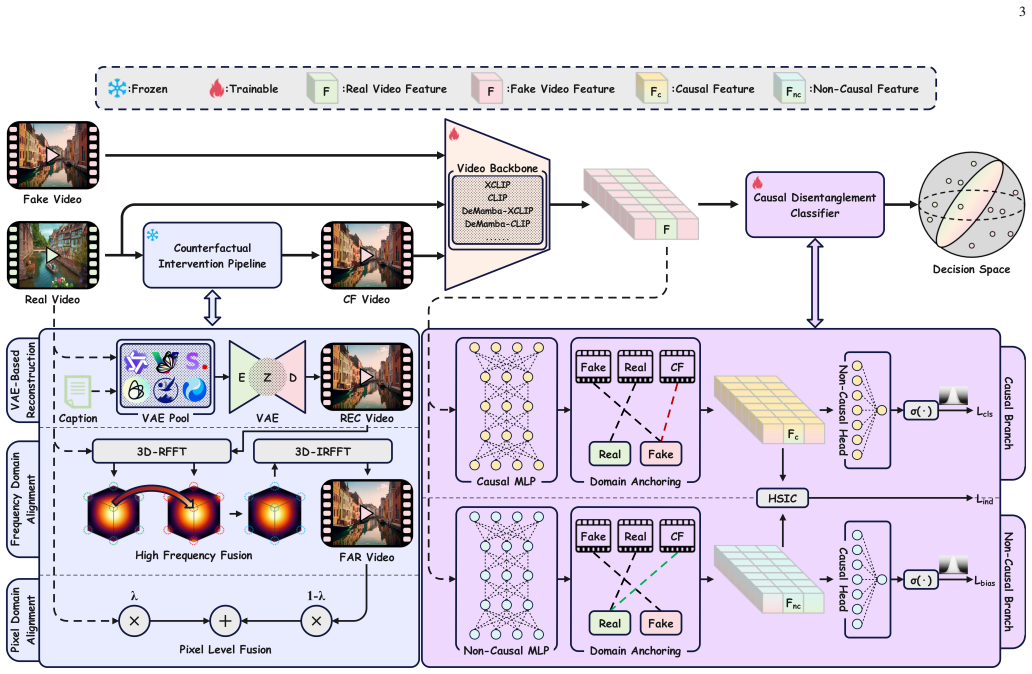
Cross-generator failure in AI-generated video detection is driven by entanglement of causal forgery cues with non-causal domain biases; constructing counterfactual samples that recombine generator-like reconstruction traces with real-video domain factors, then training a dual domain-anchored classifier with an HSIC independence constraint, separates those cues so the detector generalizes to unseen generators.
What carries the argument
CFIPipeline plus the causal disentanglement classifier: VAE reconstruction of real videos, followed by high-frequency amplitude fusion and pixel blending, produces counterfactuals labeled as fake for the causal branch and real for the non-causal branch; HSIC then forces the two branch representations apart so inference uses only the causal branch.
Load-bearing premise
The method assumes that reconstructing a real video with a video VAE, then aligning frequency amplitude and pixels, injects transferable generator-like forgery traces while still preserving the real video's domain factors.
What would settle it
Train and evaluate with the full pipeline but replace the VAE pool with a pure reconstruction autoencoder that adds no synthesis-style traces (or with heavy post-processing that erases those traces); if cross-domain GenVidBench accuracy and AUC collapse back toward the matched backbone without CFI, the counterfactual isolation claim fails.
If this is right
- Detectors can be trained on a small fraction of labeled source-generator data and still transfer to unseen T2V and I2V models.
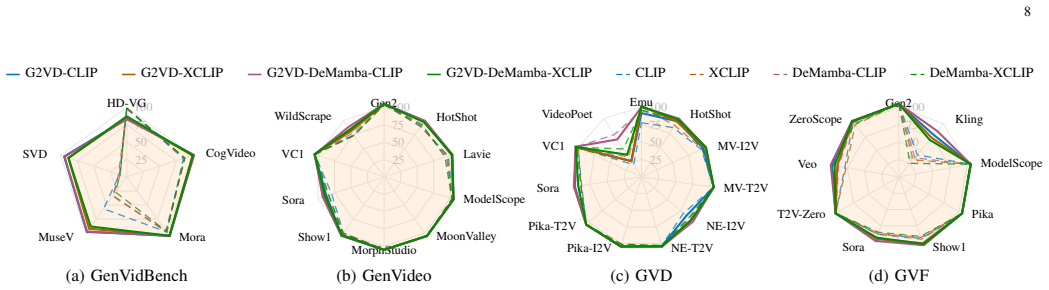
- Matched video backbones (CLIP, XCLIP, DeMamba variants) each gain when the same counterfactual and dual-branch recipe is attached, so the gains are not tied to one feature extractor.
- Shortcut learning on generator fingerprints can be reduced by deliberately breaking the correlation between domain style and the authenticity label during training.
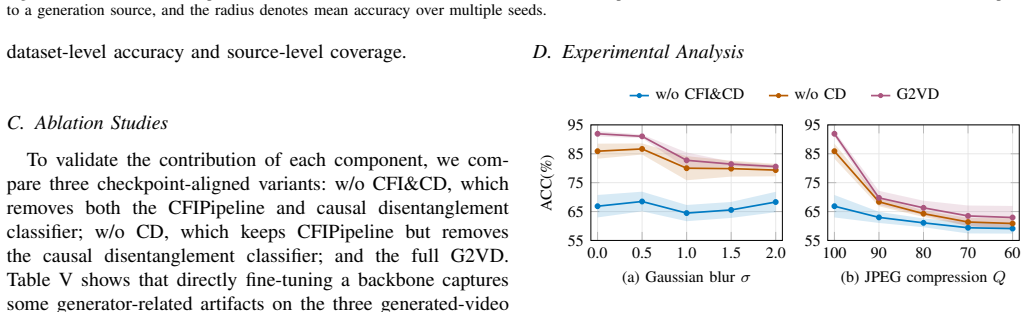
- Open challenges remain for heavy JPEG compression and false alarms on artifact-rich real videos, which the authors flag as next robustness targets.
Where Pith is reading between the lines
- The same SCM-plus-counterfactual recipe could transfer to still-image or audio deepfake detection wherever reconstruction models can supply controlled synthetic traces.
- Because inference drops the non-causal branch, production systems only need the backbone and causal head, which keeps deployment cost close to a standard fine-tune.
- If future generators stop using VAE-style latents, the VAE pool would need replacement by whatever reconstruction operators those generators share, or the intervention would lose its causal force.
Editorial analysis
A structured set of objections, weighed in public.
Referee Report
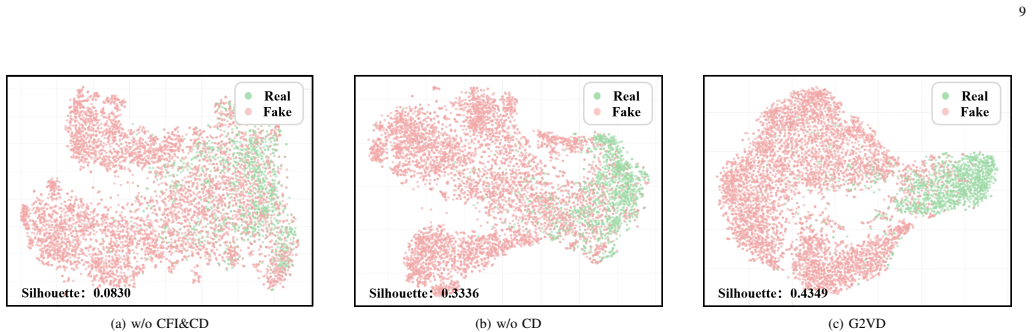
Summary. The paper proposes G2VD for cross-generator AI-generated video detection, attributing generalization failure to shortcut learning that entangles causal forgery cues with domain-specific bias. Under an SCM formulation (Eq. 1–3), it constructs counterfactual samples via a CFIPipeline (VAE reconstruction of real videos, frequency-amplitude alignment, and pixel mixing; Eqs. 4–9) labeled as fake, then trains a dual-branch causal disentanglement classifier with domain-anchored objectives and an HSIC independence loss (Eqs. 10–16). Inference uses only the backbone and causal branch. Experiments train on 10% of GenVidBench Pair1 and evaluate on Pair2 plus GenVideo, GVD, and GVF against matched backbones and prior detectors (Tables I–IV), with ablations (Table V), robustness curves, silhouette scores, and t-SNE supporting the reported gains.
Significance. If the results hold, G2VD is a practically useful contribution to a high-stakes detection problem: large, multi-seed, multi-dataset gains on hard cross-generator splits (especially GenVidBench >90% ACC / ~0.95 AUC with only 10% training data), consistent lifts over matched CLIP/XCLIP/DeMamba backbones, and released code. The dual-branch domain-anchoring design and HSIC constraint are a clear, reproducible operationalization of causal/non-causal separation for this task, even if the SCM framing is more interpretive than formally identified. The work is significant for the AI-generated media forensics community as an empirical generalization recipe rather than as a closed causal identification result.
major comments (2)
- [§III.B, Eqs. (3)–(9); Table V] §III.B, Eqs. (3)–(9): The central causal claim is that VAE reconstruction of real videos, after amplitude-only frequency alignment and pixel mixing, approximately realizes X_cf := f(S_f, U_r)—injecting generator-like causal traces while preserving real non-causal factors. Table V shows CFIPipeline supplies the dominant GenVidBench gain (roughly 63% → 85% mean ACC), so this premise is load-bearing. The manuscript does not provide direct evidence that the intervention isolates synthesis-process cues rather than generic autoencoder/reconstruction artifacts (e.g., comparison of VAE-pool reconstructions against non-generative autoencoders, content-preserving non-VAE corruptions, or measurement of residual U_r fidelity). Without such controls, the empirical lifts remain credible but the causal interpretation and the claim of isolating generator-intrinsic cues are overstated.
- [§IV.A.4; Abstract; Tables I–IV] §IV.A.4 and Tables I–IV: Training uses a 10% subsample of GenVidBench Pair1 only, with free choices including the 14-VAE pool, high-pass mask M_high, mix coefficient λ, and loss weights (w_cls, w_bias, w_ind). The paper reports multi-seed means but does not report sensitivity of the headline GenVidBench result to these design choices, nor a full-data baseline for the same protocol. Because the abstract and conclusion emphasize both the >90% ACC / ~0.95 AUC and the 10%-data regime, a short sensitivity or full-data comparison is needed to establish that the claimed generalization is not an artifact of a particular subsample or hyperparameter setting.
minor comments (5)
- [§III.A–C] §III.A–C: The SCM (Eq. 1) is a useful organizing device, but S and U are never identified beyond the dual-branch labeling scheme; phrasing such as “causal factors” / “non-causal factors” should be tempered to “task-relevant” / “domain-anchored” where identification is not claimed.
- [Table I; §IV.B.1] Table I vs. Tables II–IV: NPR and some baselines show strong source-level ACC with weak real-class performance (e.g., HD-VG 9.01%). The discussion notes class bias; reporting balanced accuracy or real/fake breakdowns more systematically would make cross-method comparisons fairer.
- [§IV.D.1; Fig. 4] §IV.D.1 / Fig. 4: Robustness is shown only for CLIP-based variants under blur and JPEG; a brief note on whether other backbones behave similarly would strengthen the limitation discussion.
- [§IV.A.4] Implementation details: Exact values or selection ranges for λ, M_high, and the three loss weights are not stated in the main text; please add them (or point to a config in the code release) for reproducibility.
- [Throughout; Tables I–IV] Minor presentation: occasional spacing/typo issues (e.g., “V AEs”, “V AEs” split) and dense multi-seed tables would benefit from a short “how to read” note on bold/underline conventions.
Circularity Check
No significant circularity: empirical detector design with held-out evaluation; counterfactual labels and dual-branch objectives are design choices, not algebraic identities that force the reported accuracies.
full rationale
G2VD is an empirical ML paper, not a closed-form derivation. The SCM (Eq. 1) and the counterfactual recombination X_cf := f(S_f, U_r) (Eq. 3) are modeling motivations; CFIPipeline (VAE reconstruction plus frequency/pixel alignment, Eqs. 4–9) and the dual domain-anchored branches with HSIC (Eqs. 10–16) are training-time design choices that encourage separation of cues. They do not algebraically force the measured cross-domain ACC/AUC. Reported gains (Tables I–IV, ablations Table V) are obtained by training on 10% of GenVidBench Pair1 and testing on held-out generators and external datasets (GenVideo, GVD, GVF). Citations (Pearl, CIRL, HSIC, backbones) are external methodological support, not a self-citation uniqueness chain that collapses the central claim. The load-bearing soft spot is the modeling assumption that VAE+alignment approximates the intended counterfactual—not a by-construction reduction of the evaluation metrics. Score 0 with empty steps is therefore appropriate.
Axiom & Free-Parameter Ledger
free parameters (5)
- pixel-mix coefficient λ
- loss weights w_cls, w_bias, w_ind
- high-pass mask M_high
- VAE pool membership and per-batch sampling
- 10% Pair1 training subsample
axioms (4)
- domain assumption Authenticity is governed by an SCM in which causal factors S affect both X and Y while non-causal factors U affect only X (Eq. 1).
- ad hoc to paper VAE reconstruction of a real video introduces generator-like causal traces S_f while frequency/pixel alignment approximately preserves U_r, yielding X_cf := f(S_f, U_r).
- domain assumption Opposite domain-anchoring labels for the two branches, plus HSIC(F_c, F_nc), separate task-relevant from domain-specific representations.
- domain assumption Amplitude-only RFFT fusion corrects compression mismatch without destroying reconstruction structure.
invented entities (2)
-
CFIPipeline (VAE pool + frequency alignment + pixel alignment)
no independent evidence
-
Domain-anchored causal disentanglement classifier (causal vs non-causal branches)
no independent evidence
read the original abstract
The rapid advancement of AI-generated videos poses increasing security risks and calls for robust detectors with strong cross-domain generalization. Although existing methods achieve promising results under in-domain evaluation, their performance often degrades substantially when tested on unseen generators. A key reason is shortcut learning, where detectors rely on domain-specific spurious cues, such as generator-dependent fingerprints and generation styles, instead of intrinsic forgery traces. To address this issue, we propose G2VD, a Generalizable AI-Generated Video Detection framework based on counterfactual intervention and causal disentanglement. First, G2VD introduces a counterfactual intervention pipeline (CFIPipeline) that generates controlled counterfactual samples via variational autoencoders (VAEs), followed by frequency-domain and pixel-domain alignment, thereby encouraging the detector to focus on generator-intrinsic cues. Building on this intervention process, we further design a causal disentanglement classifier consisting of two domain-anchored branches with distinct classification objectives, combined with an HSIC-based independence constraint to encourage the separation of task-relevant cues from domain-specific bias. Across four public datasets, G2VD shows strong average cross-domain performance and consistent gains over matched backbones. On the challenging GenVidBench cross-domain setting, it exceeds 90% accuracy and reaches an AUC close to 0.95. Notably, this performance is obtained using only 10% of the original training data. The code is available at https://github.com/dumeng98/G2VD.
Figures


Reference graph
Works this paper leans on
-
[1]
Video generation models as world simulators,
T. Brooks, B. Peebles, C. Holmeset al., “Video generation models as world simulators,” OpenAI, Tech. Rep., 2024. [Online]. Available: https://openai.com/index/video-generation-models-as-world-simulators/
2024
-
[2]
Stable video diffusion: Scaling latent video diffusion models to large datasets,
A. Blattmann, T. Dockhorn, S. Kulalet al., “Stable video diffusion: Scaling latent video diffusion models to large datasets,”arXiv preprint arXiv:2311.15127, 2023
Pith/arXiv arXiv 2023
-
[3]
Cogvideox: Text-to-video diffusion models with an expert transformer,
Z. Yang, J. Teng, W. Zhenget al., “Cogvideox: Text-to-video diffusion models with an expert transformer,”arXiv preprint arXiv:2408.06072, 2024
Pith/arXiv arXiv 2024
-
[4]
Hunyuanvideo: A system- atic framework for large video generative models,
W. Kong, Q. Tian, Z. Zhanget al., “Hunyuanvideo: A system- atic framework for large video generative models,”arXiv preprint arXiv:2412.03603, 2024
Pith/arXiv arXiv 2024
-
[5]
Wan: Open and advanced large-scale video generative models,
Team Wan, A. Wang, B. Aiet al., “Wan: Open and advanced large-scale video generative models,”arXiv preprint arXiv:2503.20314, 2025
Pith/arXiv arXiv 2025
-
[6]
Deepfakebench: A comprehensive benchmark of deepfake detection,
Z. Yan, Y . Zhang, X. Yuanet al., “Deepfakebench: A comprehensive benchmark of deepfake detection,” inAdvances in Neural Information Processing Systems, vol. 36, 2023, pp. 4534–4565
2023
-
[7]
Genvidbench: A 6-million benchmark for AI-generated video detection,
Z. Ni, Q. Yan, M. Huanget al., “Genvidbench: A 6-million benchmark for AI-generated video detection,” inProceedings of the AAAI Confer- ence on Artificial Intelligence, vol. 40, no. 18, 2026, pp. 15 582–15 590
2026
-
[8]
Faceforensics++: Learning to detect manipulated facial images,
A. R ¨ossler, D. Cozzolino, L. Verdolivaet al., “Faceforensics++: Learning to detect manipulated facial images,” inProceedings of the IEEE/CVF International Conference on Computer Vision (ICCV), 2019, pp. 1–11. 10
2019
-
[9]
Multi-attentional deepfake detec- tion,
H. Zhao, W. Zhou, D. Chenet al., “Multi-attentional deepfake detec- tion,” inProceedings of the IEEE/CVF Conference on Computer Vision and Pattern Recognition (CVPR), 2021, pp. 2185–2194
2021
-
[10]
Face x-ray for more general face forgery detection,
L. Li, J. Bao, T. Zhanget al., “Face x-ray for more general face forgery detection,” inProceedings of the IEEE/CVF Conference on Computer Vision and Pattern Recognition (CVPR), 2020, pp. 5001–5010
2020
-
[11]
End-to-end reconstruction-classification learning for face forgery detection,
J. Cao, C. Ma, T. Yaoet al., “End-to-end reconstruction-classification learning for face forgery detection,” inProceedings of the IEEE/CVF Conference on Computer Vision and Pattern Recognition (CVPR), 2022, pp. 4113–4122
2022
-
[12]
Exploring temporal coherence for more general video face forgery detection,
Y . Zheng, J. Bao, D. Chenet al., “Exploring temporal coherence for more general video face forgery detection,” inProceedings of the IEEE/CVF International Conference on Computer Vision (ICCV), 2021, pp. 15 044–15 054
2021
-
[13]
Spatiotemporal inconsistency learning for deepfake video detection,
Z. Gu, Y . Chen, T. Yaoet al., “Spatiotemporal inconsistency learning for deepfake video detection,” inProceedings of the 29th ACM International Conference on Multimedia, 2021, pp. 3473–3481
2021
-
[14]
Is space-time attention all you need for video understanding?
G. Bertasius, H. Wang, and L. Torresani, “Is space-time attention all you need for video understanding?” inProceedings of the 38th International Conference on Machine Learning (ICML). PMLR, 2021, pp. 813–824
2021
-
[15]
VideoMAE: Masked autoencoders are data-efficient learners for self-supervised video pre-training,
Z. Tong, Y . Song, J. Wanget al., “VideoMAE: Masked autoencoders are data-efficient learners for self-supervised video pre-training,” in Advances in Neural Information Processing Systems, vol. 35, 2022, pp. 10 078–10 093
2022
-
[16]
ViViT: A video vision transformer,
A. Arnab, M. Dehghani, G. Heigoldet al., “ViViT: A video vision transformer,” inProceedings of the IEEE/CVF International Conference on Computer Vision (ICCV), 2021, pp. 6836–6846
2021
-
[17]
Expanding language-image pretrained models for general video recognition,
B. Ni, H. Peng, M. Chenet al., “Expanding language-image pretrained models for general video recognition,” inEuropean Conference on Computer Vision (ECCV). Springer, 2022, pp. 1–18
2022
-
[18]
Decof: Generated video detection via frame consistency: The first benchmark dataset,
L. Ma, J. Zhang, H. Denget al., “Decof: Generated video detection via frame consistency: The first benchmark dataset,”arXiv preprint arXiv:2402.02085, 2024
Pith/arXiv arXiv 2024
-
[19]
AI-generated video detection via spatial- temporal anomaly learning,
J. Bai, M. Lin, G. Caoet al., “AI-generated video detection via spatial- temporal anomaly learning,” inPattern Recognition and Computer Vision (PRCV 2024), ser. Lecture Notes in Computer Science, vol. 15040. Springer, 2025, pp. 460–470
2024
-
[20]
Demamba: AI-generated video detection on million-scale genvideo benchmark,
H. Chen, Y . Hong, Z. Huanget al., “Demamba: AI-generated video detection on million-scale genvideo benchmark,”Science China Infor- mation Sciences, vol. 69, no. 6, p. 162103, 2026
2026
-
[21]
BusterX: MLLM-powered AI- generated video forgery detection and explanation,
H. Wen, Y . He, Z. Huanget al., “BusterX: MLLM-powered AI- generated video forgery detection and explanation,”arXiv preprint arXiv:2505.12620, 2025
Pith/arXiv arXiv 2025
-
[22]
Shortcut learning in deep neural networks,
R. Geirhos, J.-H. Jacobsen, C. Michaeliset al., “Shortcut learning in deep neural networks,”Nature Machine Intelligence, vol. 2, no. 11, pp. 665–673, 2020
2020
-
[23]
UCF: Uncovering common features for generalizable deepfake detection,
Z. Yan, Y . Zhang, Y . Fanet al., “UCF: Uncovering common features for generalizable deepfake detection,” inProceedings of the IEEE/CVF International Conference on Computer Vision (ICCV), 2023, pp. 22 412– 22 423
2023
-
[24]
Transcending forgery specificity with latent space augmentation for generalizable deepfake detection,
Z. Yan, Y . Luo, S. Lyuet al., “Transcending forgery specificity with latent space augmentation for generalizable deepfake detection,” in Proceedings of the IEEE/CVF Conference on Computer Vision and Pattern Recognition (CVPR), 2024, pp. 8984–8994
2024
-
[25]
Detecting deepfakes with self-blended images,
K. Shiohara and T. Yamasaki, “Detecting deepfakes with self-blended images,” inProceedings of the IEEE/CVF Conference on Computer Vision and Pattern Recognition (CVPR), 2022, pp. 18 720–18 729
2022
-
[26]
Dual data alignment makes AI-generated image detector easier generalizable,
R. Chen, J. Xi, Z. Yanet al., “Dual data alignment makes AI-generated image detector easier generalizable,” inAdvances in Neural Information Processing Systems, 2025
2025
-
[27]
Pearl,Causality: Models, Reasoning, and Inference, 2nd ed
J. Pearl,Causality: Models, Reasoning, and Inference, 2nd ed. Cam- bridge University Press, 2009
2009
-
[28]
Toward causal representation learning,
B. Sch ¨olkopf, F. Locatello, S. Baueret al., “Toward causal representation learning,”Proceedings of the IEEE, vol. 109, no. 5, pp. 612–634, 2021
2021
-
[29]
Causality inspired representation learning for domain generalization,
F. Lv, J. Liang, S. Liet al., “Causality inspired representation learning for domain generalization,” inProceedings of the IEEE/CVF Conference on Computer Vision and Pattern Recognition (CVPR), 2022, pp. 8046– 8056
2022
-
[30]
Measuring statistical de- pendence with hilbert-schmidt norms,
A. Gretton, O. Bousquet, A. Smolaet al., “Measuring statistical de- pendence with hilbert-schmidt norms,” inAlgorithmic Learning Theory (ALT), ser. Lecture Notes in Computer Science, vol. 3734. Springer, 2005, pp. 63–77
2005
-
[31]
Thinking in frequency: Face forgery detection by mining frequency-aware clues,
Y . Qian, G. Yin, L. Shenget al., “Thinking in frequency: Face forgery detection by mining frequency-aware clues,” inEuropean Conference on Computer Vision (ECCV). Springer, 2020, pp. 86–103
2020
-
[32]
Rethinking the up-sampling operations in CNN-based generative network for generalizable deepfake detection,
C. Tan, Y . Zhao, S. Weiet al., “Rethinking the up-sampling operations in CNN-based generative network for generalizable deepfake detection,” inProceedings of the IEEE/CVF Conference on Computer Vision and Pattern Recognition (CVPR), 2024, pp. 28 130–28 139
2024
-
[33]
Lips don’t lie: A gener- alisable and robust approach to face forgery detection,
A. Haliassos, K. V ougioukas, S. Petridiset al., “Lips don’t lie: A gener- alisable and robust approach to face forgery detection,” inProceedings of the IEEE/CVF Conference on Computer Vision and Pattern Recognition (CVPR), 2021, pp. 5039–5049
2021
-
[34]
MINTIME: Multi-identity size-invariant video deepfake detection,
D. A. Coccomini, G. Kordopatis-Zilos, G. Amatoet al., “MINTIME: Multi-identity size-invariant video deepfake detection,”IEEE Transac- tions on Information Forensics and Security, vol. 19, pp. 6084–6096, 2024
2024
-
[35]
TALL: Thumbnail layout for deepfake video detection,
Y . Xu, J. Liang, G. Jiaet al., “TALL: Thumbnail layout for deepfake video detection,” inProceedings of the IEEE/CVF International Con- ference on Computer Vision (ICCV), 2023, pp. 22 658–22 668
2023
-
[36]
Altfreezing for more general video face forgery detection,
Z. Wang, J. Bao, W. Zhouet al., “Altfreezing for more general video face forgery detection,” inProceedings of the IEEE/CVF Conference on Computer Vision and Pattern Recognition (CVPR), 2023, pp. 4129– 4138
2023
-
[37]
Generalizing deepfake video detection with plug-and-play: Video-level blending and spatiotemporal adapter tuning,
Z. Yan, Y . Zhao, S. Chenet al., “Generalizing deepfake video detection with plug-and-play: Video-level blending and spatiotemporal adapter tuning,” inProceedings of the IEEE/CVF Conference on Computer Vision and Pattern Recognition (CVPR), 2025
2025
-
[38]
D3: Training-free AI-generated video detection using second-order features,
C. Zheng, R. Suo, C. Linet al., “D3: Training-free AI-generated video detection using second-order features,” inProceedings of the IEEE/CVF International Conference on Computer Vision (ICCV), 2025, pp. 12 852– 12 862
2025
-
[39]
M. Arjovsky, L. Bottou, I. Gulrajaniet al., “Invariant risk minimization,” arXiv preprint arXiv:1907.02893, 2019
Pith/arXiv arXiv 1907
-
[40]
Contextual debiasing for visual recognition with causal mechanisms,
R. Liu, H. Liu, G. Liet al., “Contextual debiasing for visual recognition with causal mechanisms,” inProceedings of the IEEE/CVF Conference on Computer Vision and Pattern Recognition (CVPR), 2022, pp. 12 755– 12 765
2022
-
[41]
Counterfactual VQA: A cause-effect look at language bias,
Y . Niu, K. Tang, H. Zhanget al., “Counterfactual VQA: A cause-effect look at language bias,” inProceedings of the IEEE/CVF Conference on Computer Vision and Pattern Recognition (CVPR), 2021, pp. 12 700– 12 710
2021
-
[42]
Challenging common assump- tions in the unsupervised learning of disentangled representations,
F. Locatello, S. Bauer, M. Lucicet al., “Challenging common assump- tions in the unsupervised learning of disentangled representations,” in Proceedings of the 36th International Conference on Machine Learning (ICML), 2019, pp. 4114–4124
2019
-
[43]
Domain-adversarial training of neural networks,
Y . Ganin, E. Ustinova, H. Ajakanet al., “Domain-adversarial training of neural networks,”Journal of Machine Learning Research, vol. 17, no. 59, pp. 1–35, 2016
2016
-
[44]
InfoGAN: Interpretable rep- resentation learning by information maximizing generative adversarial nets,
X. Chen, Y . Duan, R. Houthooftet al., “InfoGAN: Interpretable rep- resentation learning by information maximizing generative adversarial nets,” inAdvances in Neural Information Processing Systems, vol. 29, 2016
2016
-
[45]
Learning transferable visual models from natural language supervision,
A. Radford, J. W. Kim, C. Hallacyet al., “Learning transferable visual models from natural language supervision,” inProceedings of the 38th International Conference on Machine Learning (ICML). PMLR, 2021, pp. 8748–8763
2021
-
[46]
TAEHV: Tiny autoencoder for hunyuan video,
O. Boer Bohan, “TAEHV: Tiny autoencoder for hunyuan video,” https: //github.com/madebyollin/taehv, 2025
2025
-
[47]
Open-sora: Democratizing efficient video production for all,
Z. Zheng, X. Peng, T. Yanget al., “Open-sora: Democratizing efficient video production for all,”arXiv preprint arXiv:2412.20404, 2024
Pith/arXiv arXiv 2024
-
[48]
Ltx-video: Realtime video latent diffusion,
Y . HaCohen, N. Chiprut, B. Brazowskiet al., “Ltx-video: Realtime video latent diffusion,”arXiv preprint arXiv:2501.00103, 2024
Pith/arXiv arXiv 2024
-
[49]
VideoV AE+: Large motion video autoencoding with cross-modal video V AE,
Y . Xing, Y . Fei, Y . Heet al., “VideoV AE+: Large motion video autoencoding with cross-modal video V AE,” inProceedings of the IEEE/CVF International Conference on Computer Vision (ICCV), 2025, pp. 17 951–17 960
2025
-
[50]
Silhouettes: A graphical aid to the interpretation and validation of cluster analysis,
P. J. Rousseeuw, “Silhouettes: A graphical aid to the interpretation and validation of cluster analysis,”Journal of Computational and Applied Mathematics, vol. 20, pp. 53–65, 1987
1987
discussion (0)
Sign in with ORCID, Apple, or X to comment. Anyone can read and Pith papers without signing in.