REVIEW 2 major objections 5 minor 77 references
A diffusion score trained only on small lattices can generate accurate large-volume φ⁴ ensembles without retraining.
Reviewed by Pith at T0; open to challenge. T0 means a machine referee read the full paper against a public rubric. the ladder, T0–T4 →
T0 review · grok-4.5
2026-07-10 06:19 UTC pith:WCNU5AWJ
load-bearing objection Solid, carefully validated demonstration that multi-L convolutional score training transfers to larger unseen lattices for φ⁴, with residual IR bias quantified rather than hidden. the 2 major comments →
Diffusion Models for Sampling Near Criticality in Lattice Field Theories
The pith
A machine-rendered reading of the paper's core claim, the machinery that carries it, and where it could break.
Core claim
Cross-volume generalization works for score-based diffusion samplers of lattice φ⁴ theory: a fully convolutional network whose weights are shared across volumes, when trained on many cheap small-lattice ensembles, produces reverse-SDE samples at an unseen larger volume that reproduce the propagator and most scalar observables, and at criticality can outperform an otherwise identical model trained only at the target size.
What carries the argument
The fully convolutional U-Net score network with circular padding and volume-shared weights; it learns a local drift that is evaluated at any lattice size, and is used inside the reverse variance-exploding SDE (with optional Metropolis-adjusted Langevin correction) to transport noise to the Boltzmann measure.
Load-bearing premise
That multi-volume training on several small lattices supplies enough finite-size infrared information for the shared local score to control the zero-mode distribution on a substantially larger unseen lattice.
What would settle it
Generate unfiltered reverse-SDE ensembles at L=64 from a model trained only on L∈{4,8,16,32} and compare the broken-phase and critical susceptibilities and zero-mode cumulants to FA-HMC–Wolff; a growing, uncorrectable excess as the volume ratio increases would falsify clean transfer.
If this is right
- Large-volume scalar ensembles can be produced from reference data generated only on cheaper small lattices, without retraining at the target size.
- Independent reverse trajectories replace long autocorrelated Markov chains once the multi-volume score is learned, reducing critical-slowing-down cost in practice.
- In-distribution training at the largest volume is not automatically optimal; multi-L training can improve critical infrared observables.
- Optional exact MALA refinement with the action gradient can remove residual zero-mode bias while retaining most of the equilibration gain from the diffusion proposal.
Where Pith is reading between the lines
- Multi-volume training appears to act as an infrared regularizer: seeing the zero-mode at several finite sizes constrains long-wavelength score components more effectively than a single large volume.
- The same transfer logic, if gauge-equivariant and fermion-aware scores can be trained, would let small-lattice QCD ensembles seed large-volume generation.
- Residual action-density bias in three dimensions is amplified by on-site cancellations; architectures that match single-site moments more tightly should suppress it without extra volume.
- A controlled volume-ratio scan beyond factor-of-two linear size would map where multi-L transfer remains quantitative versus where infrared degradation reappears.
Editorial analysis
A structured set of objections, weighed in public.
Referee Report
Summary. The manuscript studies variance-exploding score-based diffusion models as generative samplers for lattice φ⁴ theory in D=2 and D=3 across the symmetric, near-critical, and broken phases. Ensembles from reverse-SDE sampling are validated against FA-HMC–Wolff references on scalar observables, joint (magnetization, action-density) distributions, single-site cumulants, and the momentum-space propagator G(|k|). Residual bias is reported mainly in the zero-mode (especially susceptibility in the broken phase) and, in 3D, the action density. The authors introduce a small-t score diagnostic, a MALA acceptance diagnostic, and an HMC-referenced MSE-based ESS. Using a fully convolutional U-Net with circular padding and shared weights, they demonstrate cross-volume training: a 3D model trained on L∈{4,8,16,32} samples the unseen L=64 lattice and, at criticality, improves several observables relative to in-distribution L=64 training, establishing multi-L score transfer as a route to large-volume sampling.
Significance. Critical slowing down remains a central bottleneck in lattice field theory. Demonstrating that a local, fully convolutional score trained only on cheaper small volumes can generate usable ensembles at an unseen larger volume—with propagator agreement from UV to IR and competitive or better critical observables—is a concrete and practically relevant result for generative sampling. The multi-L versus single-size extrapolation comparison isolates the value of multi-volume finite-size information. The local diagnostics and HMC-referenced ESS are reusable tools for the community. Residual IR and action-density biases are quantified rather than hidden, and code is released. If the cross-L transfer continues to hold under gauge-equivariant and fermion-aware extensions, the approach would matter for full QCD volume scaling.
major comments (2)
- App. A (and the 3D rows of Tabs. III–VI): the two support filters (site field range and magnetization support) are defined from the target-volume L=64 HMC ensemble and reject up to ~200/512 in-distribution broken-phase samples. The central practical claim—that the score from cheap small lattices transfers to the target volume without retraining—is weakened if production sampling still needs large-L HMC to define acceptance windows. The unfiltered Tabs. V–VI and the exact MALA refinement rows help, but the main text (Sec. IV, Sec. VI, abstract) should state filter rates, that filters use target-volume HMC, and which claims survive without them or after MALA alone.
- Sec. VI and Tab. IV (broken phase, 3D): the residual susceptibility excess at unseen L=64 remains the main exception even for the largest multi-L model (χ≈9.3(6) filtered vs HMC 4.9(1); worse unfiltered). The paper correctly attributes this to intra-sector zero-mode width. Because the abstract’s transfer claim is otherwise strong, the main text should state more sharply which observables are reliable after pure reverse-SDE transfer and which still require exact MALA (score or −∇S) before the ensembles can be used for precision IR physics.
minor comments (5)
- Sec. III B / sampling appendices: reverse-SDE uses 2000 EM steps (log grid in 2D, linear in 3D). A short wall-clock or NFE comparison to FA-HMC–Wolff and a note on whether EDM/DPM-style fewer-step solvers preserve the reported G(|k|) would help readers assess cost.
- Sec. VI: cross-L noise scales σ are described as coarse pairwise-distance choices and differ by training set and κ. A one-paragraph sensitivity check (or fixed-σ ablation) would strengthen the claim that multi-L transfer is not an artifact of σ retuning.
- Fig. 1 caption and Tab. III: the broken-phase peak broadening is said to be invisible by eye yet quantified by χ; consider adding a one-line inset or quoting σ_DM/σ_HMC in the caption for readability.
- App. E: residual addition inside ResBlocks is omitted for stability. A brief note on whether this choice affects conservativeness (App. G) or MALA acceptance would connect architecture to the diagnostics.
- Notation: Σ(t) vs Σ_max and the normalized field ˆϕ appear in several places; a short symbol table or consistent first-use definitions in Sec. III would reduce cross-referencing load.
Circularity Check
No significant circularity: empirical sampler validated against independent FA-HMC–Wolff ensembles; score never sees the action in training.
full rationale
The paper’s load-bearing claims are empirical: reverse-SDE ensembles are compared to FA-HMC–Wolff references generated by a different algorithm (Sec. IV, App. B); cross-L transfer is tested by training on small volumes and sampling unseen L=64 against the same independent references (Sec. VI, Tabs. III–VI, Figs. 16–19); single-size baselines isolate multi-volume contribution. Training uses only denoising score matching on configurations (Eq. 21); the action enters solely as a post-hoc diagnostic (s_θ vs −∇S, MALA acceptance) and optional exact Metropolis correction, not as a training target. The HMC-referenced ESS (Sec. V C, App. F) measures bias and variance relative to the external reference rather than assuming the DM is correct. Noise-scale and κ_c choices are standard hyperparameters / Binder-crossing estimates used to set test points, not fitted inputs renamed as predictions. Self-citations supply prior diffusion-lattice architecture and SDE comparisons; they are not uniqueness theorems or load-bearing premises that force the central transfer result. No self-definitional identity, fitted-input-as-prediction, or ansatz-smuggling reduction is present.
Axiom & Free-Parameter Ledger
free parameters (4)
- VE noise scale σ
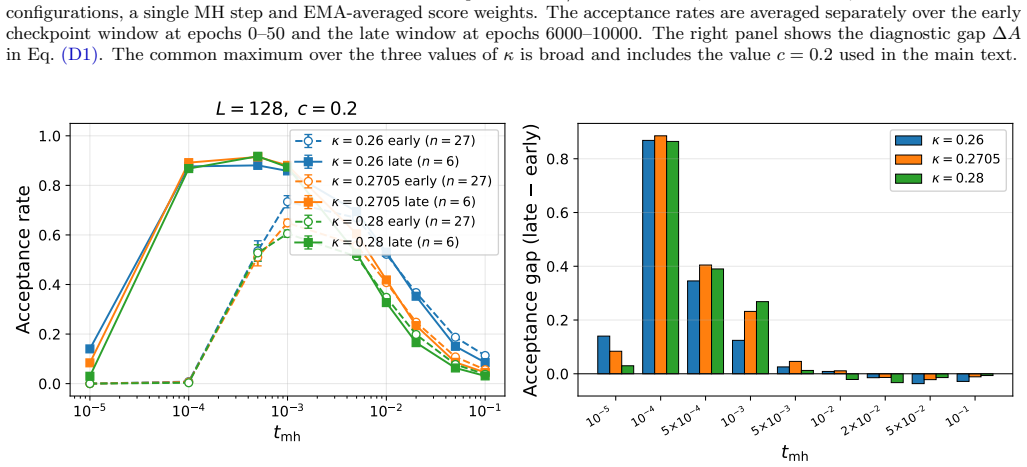
- MALA step-size coefficient c and evaluation time t_mh
- Support-filter thresholds (site range and magnetization support)
- Network channel widths and residual-block design
axioms (3)
- standard math The reverse-time SDE (Anderson) with a sufficiently accurate score recovers the target Boltzmann measure in the continuous-time limit.
- domain assumption Lattice ϕ⁴ theory with the given action belongs to the Ising universality class in 2D and 3D; κ_c can be located by Binder crossings.
- ad hoc to paper A fully convolutional network with circular padding defines a local, translation-equivariant score that can be evaluated at any lattice size sharing the same weights.
read the original abstract
We investigate generative diffusion models as denoising samplers for two- and three-dimensional lattice $\phi^4$ theory across the symmetric, near-critical, and broken phases. Validated against ensembles generated by Fourier-accelerated HMC combined with Wolff cluster updates, the reverse-SDE sampler reproduces scalar observables and the momentum-space propagator $G(|k|)$, with residual bias concentrated in the zero-mode and, in three dimensions, the action density. We introduce two local diagnostics and an HMC-referenced effective sample size (ESS), which probe the learned drift directly, through a Metropolis-adjusted Langevin acceptance rate, and through observable-level bias and variance. Exploiting a fully convolutional architecture with weights shared across different volumes ($V=L^D$), we show that cross-volume training transfers to unseen sizes, matching or slightly improving in-distribution training in the two-dimensional symmetric and broken phases. A three-dimensional model trained on $L \in \{4, 8, 16, 32\}$ reproduces the propagator and most scalar observables at the unseen lattice size $L = 64$ across the phase diagram, with the residual susceptibility excess in the broken phase as the main exception, and improves several critical observables relative to in-distribution $L = 64$ training. This establishes cross-volume generalization as a viable mechanism for large-volume sampling, and the score learned from many cheap small-lattice configurations transfers to the target volume without retraining.
Figures





Reference graph
Works this paper leans on
-
[1]
Two-dimensional theory atλ= 0.022 The two-dimensional scan usesL= 16,32,64,128,256. The order parameter in Fig. 20 changes from a broad finite-volume crossover at smallLto a steep rise at the largest volumes. The transition window is centered near κ≃0.271, and the production pointκ= 0.2705 used in the main text lies within this finite-volume critical regi...
work page 2000
-
[2]
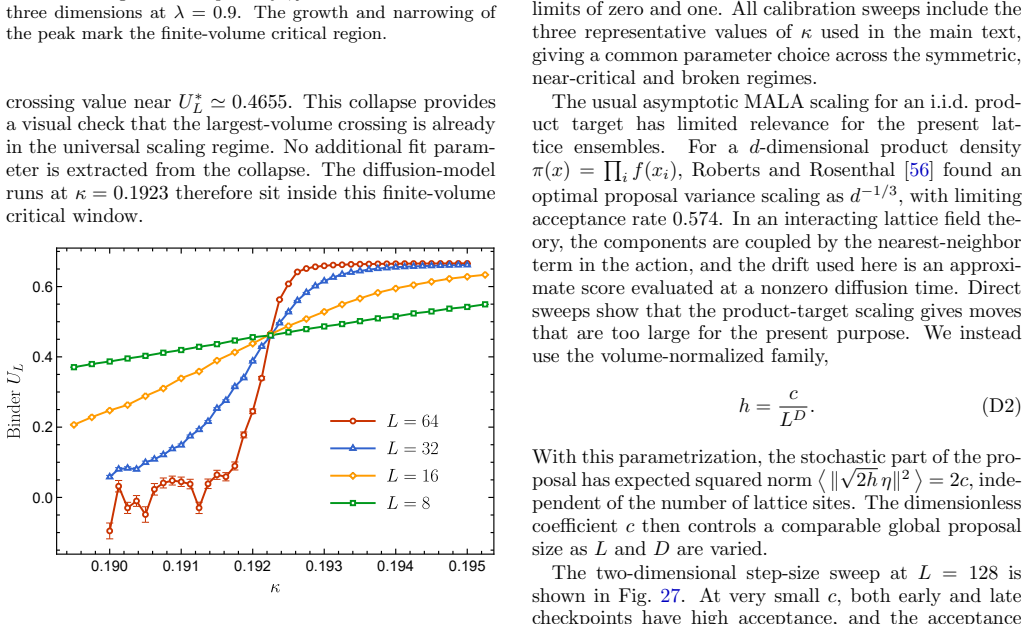
Three-dimensional theory atλ= 0.9 The three-dimensional scan usesL= 8,16,32,64. The order parameter in Fig. 24 rises from the symmetric regime to the broken regime over a window centered near κ≃0.192. The broad crossover atL= 8 is replaced by a much sharper change atL= 64, consistent with the growth of the correlation length. The susceptibility in Fig. 25...
work page 1923
-
[3]
At zero diffusion time, the score in the raw field variable is fixed by the lattice action
Score-network ansatz The learned map iss θ(ˆϕ, t), the score in the normalized field coordinate used by the neural network. At zero diffusion time, the score in the raw field variable is fixed by the lattice action. Sincep 0(ϕ)∝e −S[ϕ], sy(ϕ,0) =− ∂S ∂ϕy .(E1) 30 (a) NCSN++ U-Net (b) Res Blockt → GFP → Linear + SiLU → temb ∈ Rde C0 C1 C2 C3 C3 C3 C2 C1 C0...
-
[4]
Training objective and optimization All networks are trained with the VE denoising score- matching objective in Eq. (21). For a mini-batch of normalized fields ˆϕ, we samplet∼U(10 −5,1) and η∼ N(0,1), form ˆϕt = ˆϕ+ Σ(t)η,(E7) and minimize, Lbatch = 1 B BX b=1 Σ(tb)sθ(ˆϕ(b) tb , tb) +η b 2 2 .(E8) HereBis the mini-batch size. The norm is taken over all la...
work page 1923
-
[5]
Diffusion-time loss diagnostics in three dimensions The curves in Fig. 32 decompose the recorded denois- ing score-matching loss according to the diffusion time sampled for each training configuration. This decompo- sition is useful because the VE noise scale Σ(t) fixes the resolution of the denoising problem. For each sample we record, ℓb(tb) = Σ(tb)sθ(ˆ...
work page 1923
-
[6]
We take the free-field limit of Eq
Free-field check of the ESS estimator An independent check of the MSE-matched ESS esti- mator is obtained in the free-field limit, where the target distribution and the VE marginals are known exactly. We take the free-field limit of Eq. (1) by settingλ= 0, S0[ϕ] = X x " ϕ2 x −2κ DX µ=1 ϕxϕx+ˆµ # .(F9) This action can be written as, S0[ϕ] = 1 2 X x,y ϕx(C ...
-
[7]
Flow-based lattice samplers [22, 66–69] instead quantify efficiency through reweighting
Likelihood ESS in the free-field limit The diagnostics used in the main text are based on an MSE-matched, observable-wise ESS. Flow-based lattice samplers [22, 66–69] instead quantify efficiency through reweighting. A configuration drawn from the proposal pt is corrected toward the targetp 0 by the importance weightw=p 0/pt, and the quality of this correc...
-
[8]
Training lowers the fraction by orders of mag- nitude, reachingR∼10 −5 at late epochs. The three curves cross during training, and the late-epoch resid- ual is largest at the smallest diffusion time. This order- ing follows from the training objective. The weighting ω(t) = Σ 2(t) in Eq. (21) is smallest at smallt, so the score near the data manifold recei...
-
[9]
I. Montvay and G. M¨ unster,Quantum fields on a lattice, Cambridge Monographs on Mathematical Physics (Cam- bridge University Press, 1997)
work page 1997
-
[10]
Smit,Introduction to Quantum Fields on a Lattice, Vol
J. Smit,Introduction to Quantum Fields on a Lattice, Vol. 15 (Cambridge University Press, 2003)
work page 2003
- [11]
-
[12]
R. H. Swendsen and J.-S. Wang, Nonuniversal critical dynamics in Monte Carlo simulations, Phys. Rev. Lett. 58, 86 (1987)
work page 1987
-
[13]
Wolff, Collective Monte Carlo Updating for Spin Sys- tems, Phys
U. Wolff, Collective Monte Carlo Updating for Spin Sys- tems, Phys. Rev. Lett.62, 361 (1989)
work page 1989
-
[14]
C. T. H. Davies, G. G. Batrouni, G. R. Katz, A. S. Kron- feld, G. P. Lepage, K. G. Wilson, P. Rossi, and B. Svetit- sky, Fourier Acceleration in Lattice Gauge Theories. 1. Landau Gauge Fixing, Phys. Rev. D37, 1581 (1988)
work page 1988
-
[15]
M. Luscher and P. Weisz, Scaling Laws and Triviality Bounds in the Lattice phi-4 Theory. 3. N Component Model, Nucl. Phys. B318, 705 (1989)
work page 1989
-
[16]
Critical Phenomena and Renormalization-Group Theory
A. Pelissetto and E. Vicari, Critical phenomena and renormalization group theory, Phys. Rept.368, 549 (2002), arXiv:cond-mat/0012164
work page internal anchor Pith review Pith/arXiv arXiv 2002
-
[17]
An improved lattice measurement of the critical coupling in phi^4_2 theory
D. Schaich and W. Loinaz, An Improved lattice measure- ment of the critical coupling in phi(2)**4 theory, Phys. Rev. D79, 056008 (2009), arXiv:0902.0045 [hep-lat]
work page internal anchor Pith review Pith/arXiv arXiv 2009
-
[18]
Supersymmetry Breaking in Low Dimensional Models
C. Wozar and A. Wipf, Supersymmetry Breaking in Low Dimensional Models, Annals Phys.327, 774 (2012), arXiv:1107.3324 [hep-lat]
work page internal anchor Pith review Pith/arXiv arXiv 2012
-
[19]
J. M. Pawlowski and J. M. Urban, Reducing Autocor- relation Times in Lattice Simulations with Generative Adversarial Networks, Mach. Learn. Sci. Tech.1, 045011 (2020), arXiv:1811.03533 [hep-lat]
work page internal anchor Pith review Pith/arXiv arXiv 2020
-
[20]
M. S. Albergo, G. Kanwar, and P. E. Shanahan, Flow- based generative models for Markov chain Monte Carlo in lattice field theory, Phys. Rev. D100, 034515 (2019), arXiv:1904.12072 [hep-lat]
work page internal anchor Pith review Pith/arXiv arXiv 2019
-
[21]
L. Del Debbio, J. M. Rossney, and M. Wilson, Efficient 38 modeling of trivializing maps for latticeϕ4 theory using normalizing flows: A first look at scalability, Phys. Rev. D104, 094507 (2021), arXiv:2105.12481 [hep-lat]
work page internal anchor Pith review Pith/arXiv arXiv 2021
-
[22]
Conditional Normalizing flow for Monte Carlo sampling in lattice scalar field theory
A. Singha, D. Chakrabarti, and V. Arora, Conditional normalizing flow for Markov chain Monte Carlo sampling in the critical region of lattice field theory, Phys. Rev. D 107, 014512 (2023), arXiv:2207.00980 [hep-lat]
work page internal anchor Pith review Pith/arXiv arXiv 2023
-
[23]
M. S. Albergo, D. Boyda, K. Cranmer, D. C. Hackett, G. Kanwar, S. Racani` ere, D. J. Rezende, F. Romero- L´ opez, P. E. Shanahan, and J. M. Urban, Flow-based sampling in the lattice Schwinger model at criticality, Phys. Rev. D106, 014514 (2022), arXiv:2202.11712 [hep- lat]
work page internal anchor Pith review Pith/arXiv arXiv 2022
-
[24]
Stochastic normalizing flows as non-equilibrium transformations
M. Caselle, E. Cellini, A. Nada, and M. Panero, Stochas- tic normalizing flows as non-equilibrium transformations, JHEP07, 015, arXiv:2201.08862 [hep-lat]
work page internal anchor Pith review Pith/arXiv arXiv
-
[25]
J. Finkenrath, Tackling critical slowing down using global correction steps with equivariant flows: the case of the Schwinger model (2022), arXiv:2201.02216 [hep-lat]
work page internal anchor Pith review Pith/arXiv arXiv 2022
-
[26]
Renormalization Group Flow as Optimal Transport
J. Cotler and S. Rezchikov, Renormalization group flow as optimal transport, Phys. Rev. D108, 025003 (2023), arXiv:2202.11737 [hep-th]
work page internal anchor Pith review Pith/arXiv arXiv 2023
-
[27]
Advances in machine-learning-based sampling motivated by lattice quantum chromodynamics
K. Cranmer, G. Kanwar, S. Racani` ere, D. J. Rezende, and P. E. Shanahan, Advances in machine-learning-based sampling motivated by lattice quantum chromodynam- ics, Nature Rev. Phys.5, 526 (2023), arXiv:2309.01156 [hep-lat]
work page internal anchor Pith review Pith/arXiv arXiv 2023
-
[28]
Physics-informed renormalisation group flows
F. Ihssen and J. M. Pawlowski, Physics-informed renor- malisation group flows, Annals Phys.481, 170177 (2025), arXiv:2409.13679 [hep-th]
work page internal anchor Pith review Pith/arXiv arXiv 2025
-
[29]
Multi-Lattice Sampling of Quantum Field Theories via Neural Operator-based Flows
B. M´ at´ e and F. Fleuret, Multi-lattice sampling of quan- tum field theories via neural operator-based flows, Mach. Learn. Sci. Tech.5, 045053 (2024), arXiv:2401.00828 [cs.LG]
work page internal anchor Pith review Pith/arXiv arXiv 2024
-
[30]
Super-Resolving Normalising Flows for Lattice Field Theories
M. Bauer, R. Kapust, J. M. Pawlowski, and F. L. Tem- men, Super-resolving normalising flows for lattice field theories, SciPost Phys.19, 077 (2025), arXiv:2412.12842 [hep-lat]
work page internal anchor Pith review Pith/arXiv arXiv 2025
-
[31]
Multilevel Generative Samplers for Investigating Critical Phenomena
A. Singha, E. Cellini, K. A. Nicoli, K. Jansen, S. K¨ uhn, and S. Nakajima, Multilevel Generative Sam- plers for Investigating Critical Phenomena, inInterna- tional Conference on Learning Representations(2025) arXiv:2503.08918 [cs.LG]
work page internal anchor Pith review Pith/arXiv arXiv 2025
-
[32]
Generative diffusion model with inverse renormalization group flows
K. Masuki and Y. Ashida, Generative diffusion model with inverse renormalization group flows (2025), arXiv:2501.09064 [cond-mat.stat-mech]
work page internal anchor Pith review Pith/arXiv arXiv 2025
- [33]
- [34]
-
[35]
Lattice field theories with a sign problem
G. Aarts and D. Sexty, Lattice field theories with a sign problem (2026), arXiv:2604.24290 [hep-lat]
work page internal anchor Pith review Pith/arXiv arXiv 2026
- [36]
-
[37]
Generative Modeling by Estimating Gradients of the Data Distribution
Y. Song and S. Ermon, Generative modeling by estimat- ing gradients of the data distribution, inAdvances in Neural Information Processing Systems, Vol. 32 (2019) arXiv:1907.05600 [cs.LG]
work page internal anchor Pith review Pith/arXiv arXiv 2019
-
[38]
J. Ho, A. Jain, and P. Abbeel, Denoising diffusion probabilistic models, inAdvances in Neural Informa- tion Processing Systems, Vol. 33 (2020) pp. 6840–6851, arXiv:2006.11239 [cs.LG]
work page internal anchor Pith review Pith/arXiv arXiv 2020
-
[39]
Y. Song, J. Sohl-Dickstein, D. P. Kingma, A. Kumar, S. Ermon, and B. Poole, Score-based generative mod- eling through stochastic differential equations, inInter- national Conference on Learning Representations(2021) arXiv:2011.13456 [cs.LG]
work page internal anchor Pith review Pith/arXiv arXiv 2021
-
[40]
B. D. O. Anderson, Reverse-time diffusion equation mod- els, Stochastic Processes and their Applications12, 313 (1982)
work page 1982
-
[41]
G. Parisi and Y.-s. Wu, Perturbation Theory Without Gauge Fixing, Sci. Sin.24, 483 (1981)
work page 1981
-
[42]
P. H. Damgaard and H. Huffel, Stochastic Quantization, Phys. Rept.152, 227 (1987)
work page 1987
-
[43]
L. Wang, G. Aarts, and K. Zhou, Diffusion models as stochastic quantization in lattice field theory, JHEP05, 060, arXiv:2309.17082 [hep-lat]
work page internal anchor Pith review Pith/arXiv arXiv
-
[44]
L. Wang, G. Aarts, and K. Zhou, Generative Diffu- sion Models for Lattice Field Theory, in37th Confer- ence on Neural Information Processing Systems(2023) arXiv:2311.03578 [hep-lat]
work page internal anchor Pith review Pith/arXiv arXiv 2023
-
[45]
On learning higher-order cumulants in diffusion models
G. Aarts, D. E. Habibi, L. Wang, and K. Zhou, On learn- ing higher-order cumulants in diffusion models, Mach. Learn. Sci. Tech.6, 025004 (2025), arXiv:2410.21212 [hep-lat]
work page internal anchor Pith review Pith/arXiv arXiv 2025
-
[46]
Understanding Diffusion Models by Feynman's Path Integral
Y. Hirono, A. Tanaka, and K. Fukushima, Understand- ing Diffusion Models by Feynman’s Path Integral (2024), arXiv:2403.11262 [cs.LG]
work page internal anchor Pith review Pith/arXiv arXiv 2024
-
[47]
Stochastic quantization and diffusion models
K. Fukushima, S. Kamata, and Y. Hirono, Stochastic Quantization and Diffusion Models, J. Phys. Soc. Jap. 94, 031010 (2025), arXiv:2411.11297 [hep-lat]
work page internal anchor Pith review Pith/arXiv arXiv 2025
- [48]
-
[49]
Q. Zhu, G. Aarts, W. Wang, K. Zhou, and L. Wang, Diffusion models for lattice gauge field simulations, in Machine Learning and the Physical Sciences: Workshop at NeurIPS 2024(2024) arXiv:2410.19602 [hep-lat]
work page internal anchor Pith review Pith/arXiv arXiv 2024
- [50]
- [51]
-
[52]
H. Alharazin, J. Y. Panteleeva, and B. D. Sun, Diffusion Models for SU(2) Lattice Gauge Theory in Two Dimen- sions (2026), arXiv:2602.09045 [hep-lat]
-
[53]
Diffusion model for SU(N) gauge theories
J. Komijani, M. K. Marinkovic, and L. Turgut, Diffusion model for SU(N) gauge theories (2026), arXiv:2605.06134 [hep-lat]
work page internal anchor Pith review Pith/arXiv arXiv 2026
- [54]
-
[55]
Physics-Driven Learning for Inverse Problems in Quantum Chromodynamics
G. Aarts, K. Fukushima, T. Hatsuda, A. Ipp, S. Shi, L. Wang, and K. Zhou, Physics-driven learning for in- verse problems in quantum chromodynamics, Nature Rev. Phys.7, 154 (2025), arXiv:2501.05580 [hep-lat]
work page internal anchor Pith review Pith/arXiv arXiv 2025
-
[56]
L. M. Del Bono, G. Biroli, P. Charbonneau, and M. Gabri´ e, The critical slowing down in diffusion models (2026), arXiv:2605.12597 [cond-mat.dis-nn]
work page internal anchor Pith review Pith/arXiv arXiv 2026
-
[57]
H. Ruan, J. Li, X. Guo, and L. Wang, Generative Crit- icality in Large Language Model Temperature Scaling (2026), arXiv:2606.06238 [cs.LG]. 39
work page internal anchor Pith review Pith/arXiv arXiv 2026
-
[58]
H. Kleinert and V. Schulte-Frohlinde,Critical Properties of Phi4-Theories(WORLD SCIENTIFIC, 2001)
work page 2001
-
[59]
Improved Techniques for Training Score-Based Generative Models
Y. Song and S. Ermon, Improved techniques for train- ing score-based generative models, inAdvances in Neu- ral Information Processing Systems, Vol. 33 (2020) pp. 12438–12448, arXiv:2006.09011 [cs.LG]
work page internal anchor Pith review Pith/arXiv arXiv 2020
-
[60]
Elucidating the Design Space of Diffusion-Based Generative Models
T. Karras, M. Aittala, T. Aila, and S. Laine, Elucidat- ing the design space of diffusion-based generative models, inAdvances in Neural Information Processing Systems, Vol. 35 (2022) arXiv:2206.00364 [cs.CV]
work page internal anchor Pith review Pith/arXiv arXiv 2022
-
[61]
C. Lu, Y. Zhou, F. Bao, J. Chen, C. Li, and J. Zhu, DPM-Solver: A fast ODE solver for diffusion probabilis- tic model sampling in around 10 steps, inAdvances in Neural Information Processing Systems, Vol. 35 (2022) arXiv:2206.00927 [cs.LG]
work page internal anchor Pith review Pith/arXiv arXiv 2022
-
[62]
P. Vincent, A connection between score matching and denoising autoencoders, Neural Computation23, 1661 (2011)
work page 2011
-
[63]
K. H. Lam, T. Farghly, C. Williams, J. Yang, Y. W. Teh, and A. Doucet, Metropolis-adjusted diffusion mod- els (2026), arXiv:2605.09654 [stat.ML]
work page internal anchor Pith review Pith/arXiv arXiv 2026
-
[64]
G. O. Roberts and J. S. Rosenthal, Optimal scaling of discrete approximations to Langevin diffusions, J. R. Statist. Soc. B60, 255 (1998)
work page 1998
-
[65]
Aspects of scaling and scalability for flow-based sampling of lattice QCD
R. Abbottet al., Aspects of scaling and scalability for flow-based sampling of lattice QCD, Eur. Phys. J. A59, 257 (2023), arXiv:2211.07541 [hep-lat]
work page internal anchor Pith review Pith/arXiv arXiv 2023
-
[66]
Analyzing and Improving the Training Dynamics of Diffusion Models
T. Karras, M. Aittala, J. Lehtinen, J. Hellsten, T. Aila, and S. Laine, Analyzing and improving the training dynamics of diffusion models, inProceedings of the IEEE/CVF Conference on Computer Vision and Pattern Recognition(2024) pp. 24174–24184, arXiv:2312.02696 [cs.CV]
work page internal anchor Pith review Pith/arXiv arXiv 2024
-
[67]
Lattice simulations of real-time quantum fields
J. Berges, S. Borsanyi, D. Sexty, and I. O. Stamatescu, Lattice simulations of real-time quantum fields, Phys. Rev. D75, 045007 (2007), arXiv:hep-lat/0609058
work page internal anchor Pith review Pith/arXiv arXiv 2007
-
[68]
Real-time dynamics of the $O(4)$ scalar theory within the fRG approach
Y.-y. Tan, Y.-r. Chen, and W.-j. Fu, Real-time dynam- ics of theO(4) scalar theory within the fRG approach, SciPost Phys.12, 026 (2022), arXiv:2107.06482 [hep-ph]
work page internal anchor Pith review Pith/arXiv arXiv 2022
-
[69]
Universality of pseudo-Goldstone damping near critical points
Y.-y. Tan, Y.-r. Chen, W.-j. Fu, and W.-J. Li, Universal- ity of pseudo-Goldstone damping near critical points, Na- ture Commun.16, 2916 (2025), arXiv:2403.03503 [hep- th]
work page internal anchor Pith review Pith/arXiv arXiv 2025
- [70]
-
[71]
Gauge-equivariant flow models for sampling in lattice field theories with pseudofermions
R. Abbottet al., Gauge-equivariant flow models for sam- pling in lattice field theories with pseudofermions, Phys. Rev. D106, 074506 (2022), arXiv:2207.08945 [hep-lat]
work page internal anchor Pith review Pith/arXiv arXiv 2022
-
[72]
Y.-y. Tan, G. Aarts, D. E. Habibi, B. Lucini, and L. Wang, DM-for-phi4 (2026), GitHub repository
work page 2026
-
[73]
R. C. Brower and P. Tamayo, Embedded Dynamics for ϕ4 Theory, Phys. Rev. Lett.62, 1087 (1989)
work page 1989
-
[74]
M. S. Albergo, D. Boyda, D. C. Hackett, G. Kanwar, K. Cranmer, S. Racani` ere, D. J. Rezende, and P. E. Shanahan, Introduction to Normalizing Flows for Lattice Field Theory (2021), arXiv:2101.08176 [hep-lat]
work page internal anchor Pith review Pith/arXiv arXiv 2021
-
[75]
Learning Lattice Quantum Field Theories with Equivariant Continuous Flows
M. Gerdes, P. de Haan, C. Rainone, R. Bondesan, and M. C. N. Cheng, Learning lattice quantum field theories with equivariant continuous flows, SciPost Phys.15, 238 (2023), arXiv:2207.00283 [hep-lat]
work page internal anchor Pith review Pith/arXiv arXiv 2023
-
[76]
Flow-based sampling for lattice field theories
G. Kanwar, Flow-based sampling for lattice field theories, in40th International Symposium on Lattice Field Theory (2024) arXiv:2401.01297 [hep-lat]
work page internal anchor Pith review Pith/arXiv arXiv 2024
-
[77]
K. A. Nicoli, C. J. Anders, L. Funcke, T. Hartung, K. Jansen, P. Kessel, S. Nakajima, and P. Stornati, Esti- mation of Thermodynamic Observables in Lattice Field Theories with Deep Generative Models, Phys. Rev. Lett. 126, 032001 (2021), arXiv:2007.07115 [hep-lat]
work page internal anchor Pith review Pith/arXiv arXiv 2021
discussion (0)
Sign in with ORCID, Apple, or X to comment. Anyone can read and Pith papers without signing in.