An adaptive framework for the axisymmetric pulsar magnetosphere using physics-informed Kolmogorov-Arnold networks
Pith reviewed 2026-06-27 11:00 UTC · model grok-4.3
The pith
Kolmogorov-Arnold networks with adaptive training solve the axisymmetric pulsar magnetosphere to PDE residuals of order 10^{-6} and handle stellar radii reduced by 80 percent.
A machine-rendered reading of the paper's core claim, the machinery that carries it, and where it could break.
Core claim
Physics-informed Kolmogorov-Arnold networks equipped with an automated adaptive training pipeline and a physics-based convergence criterion produce self-consistent axisymmetric pulsar magnetosphere solutions whose PDE residuals reach mean squared values of order 10^{-6} in double precision, converge in under twenty minutes in single precision, remain stable for stellar radii reduced by up to eighty percent, and yield a corrected algebraic link between open magnetic flux and the position of the equatorial T-point.
What carries the argument
Kolmogorov-Arnold networks placed inside a physics-informed neural network with domain decomposition at the separatrix and equatorial current sheet, driven by an automated adaptive training pipeline that adjusts weights according to a physics-based convergence criterion.
If this is right
- Magnetosphere solutions become feasible for compact stars whose radius is a small fraction of the light-cylinder radius, a regime previously inaccessible to both traditional solvers and baseline PINNs.
- Training completes in minutes rather than hours and requires no manual search over network depth, width, or loss weights.
- Varying the open flux produces a quantitative correction to the previously used formula that relates flux to T-point position.
- Self-consistent solutions are obtained without separate treatment of the polar cap or light-cylinder boundaries beyond the domain decomposition already employed.
Where Pith is reading between the lines
- The same adaptive KAN-PINN structure could be applied to time-dependent or three-dimensional magnetosphere problems where scale separation between star and light cylinder is even more extreme.
- Analogous automated KAN pipelines may address other thin-current-sheet plasma configurations such as solar coronal current sheets or accretion-disk coronae.
- Release of the PulsarX library allows direct verification of the reported residuals and T-point correction on independent hardware and parameter choices.
Load-bearing premise
The physical model of infinitesimally thin separatrix and current-sheet discontinuities remains accurate enough that the neural network can satisfy the governing equations to the reported precision even at the newly accessible small stellar radii.
What would settle it
Independent high-resolution force-free or MHD simulations run at several open-flux values should reproduce the corrected algebraic relation between open flux and equatorial T-point location to within a few percent.
Figures
read the original abstract
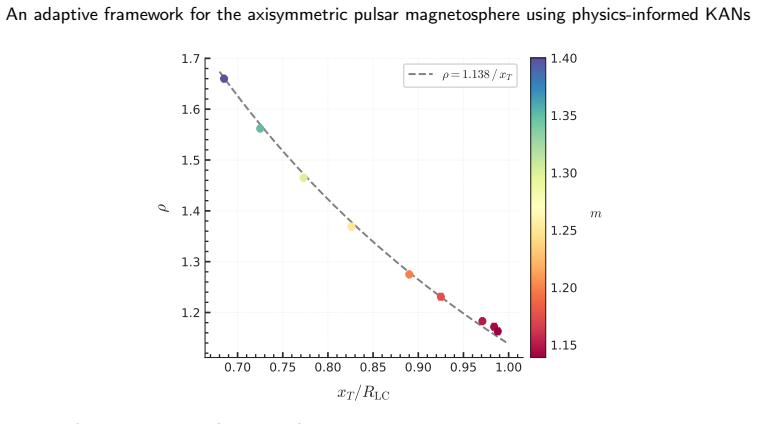
The pulsar magnetosphere has only recently been addressed using Physics-Informed Neural Networks (PINNs), by deploying a domain-decomposition approach and treating the separatrix and equatorial current sheet as infinitesimally thin discontinuities. However, this baseline requires extensive manual hyperparameter tuning, achieves limited final accuracy and demands several hours of training. We refine this framework by introducing domain-specific neural architectures based on Kolmogorov-Arnold networks, an automated adaptive training pipeline and a physics-based convergence criterion that eliminate the need for manual calibration. The proposed methodology delivers self-consistent axisymmetric magnetosphere solutions with mean squared errors of the PDE residuals at O(1e-6) in double precision - an improvement of two orders of magnitude over the baseline - while achieving convergence in under 20 minutes in single precision. Importantly, the method reliably resolves stellar radii reduced by up to 80% compared to the baseline, overcoming the severe spatial scale disparities that also challenge traditional solvers. Furthermore, by varying the flux that opens to infinity, we provide a correction to the equation that connects it to the equatorial T-point's position. The complete framework is released as the open-source library PulsarX.
Editorial analysis
A structured set of objections, weighed in public.
Referee Report
Summary. The manuscript introduces an adaptive PINN framework for the axisymmetric pulsar magnetosphere that replaces standard neural networks with Kolmogorov-Arnold networks, adds an automated adaptive training pipeline, and employs a physics-based convergence criterion. It reports self-consistent solutions with PDE residual MSE of O(1e-6) in double precision (two orders of magnitude better than a cited baseline), convergence in under 20 minutes in single precision, reliable solutions at stellar radii reduced by up to 80%, and a correction to the relation between open flux and the equatorial T-point position. The complete framework is released as the open-source library PulsarX.
Significance. If the reported accuracy, runtime, and scale-handling gains hold under independent verification, the work would represent a meaningful advance in applying neural solvers to relativistic astrophysical problems with disparate spatial scales. The open-source release and the claimed correction to the flux-T-point equation are concrete strengths that support reproducibility and potential impact on the field.
major comments (2)
- [§4.2, Table 2] §4.2 and Table 2: the two-order-of-magnitude improvement in PDE residual MSE is stated relative to a manually tuned baseline PINN, but the manuscript does not report the exact hyperparameter search budget or final residual values achieved by that baseline under identical domain decomposition and loss weighting; without these numbers the quantitative claim cannot be assessed.
- [§5.3, Eq. (18)] §5.3, Eq. (18): the correction to the open-flux versus T-point relation is presented as a new result obtained by varying the open flux, yet the manuscript provides neither the functional form of the original relation nor a direct side-by-side comparison of the new fit against analytic expectations or prior numerical solutions.
minor comments (2)
- [Figure 3, §3.1] Figure 3 caption and §3.1: the notation for the KAN spline order and grid size is introduced only in the caption; move the definitions into the main text for clarity.
- [§6] §6: the open-source repository link is given but the exact commit hash or release tag used for the reported results is not stated.
Simulated Author's Rebuttal
We thank the referee for the positive assessment and the recommendation of minor revision. The comments are constructive and we address them point-by-point below, indicating the revisions we will make to strengthen the manuscript.
read point-by-point responses
-
Referee: [§4.2, Table 2] §4.2 and Table 2: the two-order-of-magnitude improvement in PDE residual MSE is stated relative to a manually tuned baseline PINN, but the manuscript does not report the exact hyperparameter search budget or final residual values achieved by that baseline under identical domain decomposition and loss weighting; without these numbers the quantitative claim cannot be assessed.
Authors: We agree that additional detail on the baseline would strengthen the comparison. The reported baseline residuals are taken directly from the values published in the cited reference for the standard PINN implementation. In the revised manuscript we will explicitly list the hyperparameter settings used for that baseline (as described in the reference) and confirm that domain decomposition and loss weighting match those employed in our adaptive framework. We will also note that a full re-execution of the baseline under identical conditions was not performed due to the extensive manual tuning required; this limitation will be stated transparently. revision: yes
-
Referee: [§5.3, Eq. (18)] §5.3, Eq. (18): the correction to the open-flux versus T-point relation is presented as a new result obtained by varying the open flux, yet the manuscript provides neither the functional form of the original relation nor a direct side-by-side comparison of the new fit against analytic expectations or prior numerical solutions.
Authors: We accept that including the original relation and a direct comparison would improve clarity. The original functional form is the one given by the baseline literature (specifically the relation derived in the cited prior work). In the revised manuscript we will state the original equation explicitly, provide the new fitted form, and add a side-by-side table (or figure) comparing both against the analytic expectation and available prior numerical solutions. This will make the correction and its improvement evident. revision: yes
Circularity Check
No significant circularity; claims rest on empirical performance of implemented solver
full rationale
The paper introduces a KAN-based adaptive PINN framework for axisymmetric pulsar magnetosphere PDEs and reports quantitative metrics (O(1e-6) residuals, <20 min convergence, 80% smaller stellar radii) versus a cited baseline. These are obtained by running the solver on the target equations; no derivation step reduces a claimed prediction or result to a fitted parameter or self-citation by construction. The correction to the flux-T-point relation is extracted from the numerical solutions themselves. Self-citation of the baseline is present but not load-bearing for the new method's performance claims, which remain externally verifiable via the released code.
Axiom & Free-Parameter Ledger
axioms (1)
- domain assumption The axisymmetric pulsar magnetosphere is governed by PDEs that can be solved via domain decomposition with infinitesimally thin separatrix and equatorial current sheet discontinuities.
Reference graph
Works this paper leans on
-
[1]
Computer Methods in Applied Mechanics and Engineering 421, 116805
Residual-based attention in physics-informed neural networks. Computer Methods in Applied Mechanics and Engineering 421, 116805. doi:10.1016/j.cma.2024.116805. Bogovalov, S.,
-
[2]
JAX: composable transformations of Python+NumPy programs. URL:http://github.com/jax-ml/jax. Bransgrove,A.,Beloborodov,A.M.,Levin,Y.,2023. Radioemissionandelectricgapsinpulsarmagnetospheres. TheAstrophysicalJournalLetters 958, L9. doi:https://doi.org/10.3847/2041-8213/ad0556. Cerutti, B., Philippov, A., Parfrey, K., Spitkovsky, A.,
-
[3]
Monthly Notices of the Royal Astronomical Society 448, 606–619
Particle acceleration in axisymmetric pulsar current sheets. Monthly Notices of the Royal Astronomical Society 448, 606–619. doi:10.1093/mnras/stv042. Contopoulos,I.,2007. Theroleofreconnectioninthepulsarmagnetosphere. Astronomy&Astrophysics466,301–307. doi: 10.1051/0004-6361: 20065973. Contopoulos, I., Dimitropoulos, I., Ntotsikas, D., Gourgouliatos, K.N...
-
[4]
doi:10.3390/ universe10040178. Contopoulos,I.,Kazanas,D.,Fendt,C.,1999.Theaxisymmetricpulsarmagnetosphere.TheAstrophysicalJournal511,351.doi: 10.1086/306652. Contopoulos, I., Ntotsikas, D., Gourgouliatos, K.N., 2024b. On the pulsar y-point. Monthly Notices of the Royal Astronomical Society: Letters 527, L127–L131. doi:10.1093/mnrasl/slad153. Dherin,B.,Mun...
-
[5]
Astronomy & Astrophysics 705, A140
The 3d pulsar magnetosphere with machine learning: First results. Astronomy & Astrophysics 705, A140. doi:10.1051/0004-6361/202554175. Dimitropoulos,I.,Contopoulos,I.,Mpisketzis,V.,Chaniadakis,E.,2024. Thepulsarmagnetospherewithmachinelearning:methodology. Monthly Notices of the Royal Astronomical Society 528, 3141–3152. doi:10.1093/mnras/stae192. Endean, V.G.,
-
[6]
Astrophysical Journal 187, 359–360
Lorentz force-free pulsar rotating fields. Astrophysical Journal 187, 359–360. doi:10.1086/152639. Faroughi, S.A., Mostajeran, F.,
-
[7]
Neural tangent kernel analysis to probe convergence in physics-informed neural solvers: PIKANs vs. PINNs. Computers & Mathematics with Applications 215, 155–191. doi:10.1016/j.camwa.2026.05.003. Goldreich, P., Julian, W.H.,
-
[8]
H., 1969, @doi [ ] 10.1086/150119 , https://ui.adsabs.harvard.edu/abs/1969ApJ...157..869G 157, 869
doi:10.1086/150119. Hewish, A., Bell, S.J., Pilkington, J.D.H., Scott, P.F., Collins, R.A.,
-
[9]
Observation of a rapidly pulsating radio source. Nature 217, 709–713. doi:10.1038/217709a0. Jacot, A., Gabriel, F., Hongler, C.,
-
[10]
Neural tangent kernel: convergence and generalization in neural networks, in: Proceedings of the 32nd International Conference on Neural Information Processing Systems, p. 8580–8589. Jagtap,A.D.,Mao,Z.,Adams,N.,Karniadakis,G.E.,2022. Physics-informedneuralnetworksforinverseproblemsinsupersonicflows. Journalof Computational Physics 466, 111402. doi:10.1016...
-
[11]
Kalapotharakos,C.,Contopoulos,I.,2009
doi:10.3847/1538-4357/aab550. Kalapotharakos,C.,Contopoulos,I.,2009. Three-dimensionalnumericalsimulationsofthepulsarmagnetosphere:preliminaryresults. Astronomy & Astrophysics 496, 495–502. doi:10.1051/0004-6361:200810281. Kingma, D.P., Ba, J.,
-
[12]
Simulations of the axisymmetric magnetospheres of neutron stars. Monthly Notices of the Royal Astronomical Society 367, 19–31. doi:10.1111/j.1365-2966.2005.09932.x. Krishnapriyan,A.,Gholami,A.,Zhe,S.,Kirby,R.,Mahoney,M.,2021. Characterizingpossiblefailuremodesinphysics-informedneuralnetworks, in: Advances in Neural Information Processing Systems, pp. 2654...
-
[13]
A dual-dimer method for training physics-constrained neural networks with minimax architecture. Neural Networks 136, 112–125. doi:10.1016/j.neunet.2020.12.028. Liu, Z., Tegmark, M., Ma, P., Matusik, W., Wang, Y., 2025a. Kolmogorov-Arnold networks meet science. Physical Review X 15, 041051. doi:10.1103/4t7t-v19l. Liu,Z.,Wang,Y.,Vaidya,S.,Ruehle,F.,Halverso...
-
[14]
Solving the teukolsky equation with physics-informed neural networks. Physical Review D 107, 064025. doi:10.1103/PhysRevD.107.064025. Mestel, L.,
-
[15]
Mémoires of the Société Royale des Sciences de Leège 8, 79–91
Effects of magnetic fields. Mémoires of the Société Royale des Sciences de Leège 8, 79–91. Muslimov,A.G., Harding,A.K.,2009. Pair-starvedpulsar magnetospheres. The AstrophysicalJournal692,
2009
-
[16]
Philippov,A.A.,Spitkovsky,A.,2018
doi:10.1088/0004-637X/692/ 1/140. Philippov,A.A.,Spitkovsky,A.,2018. Ab-initiopulsarmagnetosphere:Particleaccelerationinobliquerotatorsandhigh-energyemissionmodeling. The Astrophysical Journal 855,
-
[17]
doi:10.3847/1538-4357/aaabbc. Pétri,J.,2012. Thepulsarforce-freemagnetospherelinkedtoitsstripedwind:time-dependentpseudo-spectralsimulations. MonthlyNoticesofthe Royal Astronomical Society 424, 605–619. doi:10.1111/j.1365-2966.2012.21238.x. Raissi, M., Perdikaris, P., Karniadakis, G.E.,
-
[18]
Physics-informed neural networks: A deep learning framework for solving forward and inverse problems involving nonlinear partial differential equations. Journal of Computational Physics 378, 686–707. doi:10.1016/j.jcp.2018.10
-
[19]
Physical Review Fluids 6, 073301
Learning unknown physics of non-newtonian fluids. Physical Review Fluids 6, 073301. doi:10.1103/PhysRevFluids.6.073301. Rigas, S., Anagnostopoulos, F., Papachristou, M., Alexandridis, G., 2026a. Training deep physics-informed Kolmogorov–Arnold networks. Computer Methods in Applied Mechanics and Engineering 452, 118761. doi:10.1016/j.cma.2026.118761. Rigas...
-
[20]
Rigas,S.,Papachristou,M.,Papadopoulos,T.,Anagnostopoulos,F.,Alexandridis,G.,2024
doi:10.21105/joss.07830. Rigas,S.,Papachristou,M.,Papadopoulos,T.,Anagnostopoulos,F.,Alexandridis,G.,2024. Adaptivetrainingofgrid-dependentphysics-informed Kolmogorov–Arnold networks. IEEE Access 12, 176982–176998. doi:10.1109/ACCESS.2024.3504962. Rigas, S., Verma, D., Alexandridis, G., Wang, Y., 2026b. Initialization schemes for Kolmogorov–Arnold network...
-
[21]
Deep learning-accelerated computational framework based on physics informed neural network for the solution of linear elasticity. Neural Networks 162, 472–489. doi:10.1016/j.neunet.2023.03.014. Shukla, K., Toscano, J.D., Wang, Z., Zou, Z., Karniadakis, G.E.,
-
[22]
Computer Methods in Applied Mechanics and Engineering 431, 117290
A comprehensive and FAIR comparison between MLP and KAN representations for differential equations and operator networks. Computer Methods in Applied Mechanics and Engineering 431, 117290. doi:10.1016/j.cma.2024.117290. Soudais, A., Cerutti, B., Contopoulos, I.,
-
[23]
Astronomy & Astrophysics 690, A170
Scaling up global kinetic models of pulsar magnetospheres using a hybrid force-free-pic numerical approach. Astronomy & Astrophysics 690, A170. doi:10.1051/0004-6361/202450238. Spitkovsky,A.,2006. Time-dependentforce-freepulsarmagnetospheres:Axisymmetricandobliquerotators. TheAstrophysicalJournal648,L51. doi:10.1086/507518. Stefanou, P., Urbán, J.F., Pons, J.A.,
-
[24]
Monthly Notices of the Royal Astronomical Society 526, 1504–1511
Solving the pulsar equation using physics-informed neural networks. Monthly Notices of the Royal Astronomical Society 526, 1504–1511. doi:10.1093/mnras/stad2840. Tancik, M., Srinivasan, P., Mildenhall, B., Fridovich-Keil, S., Raghavan, N., Singhal, U., Ramamoorthi, R., Barron, J., Ng, R.,
-
[25]
Monthly Notices of the Royal Astronomical Society: Letters 435, L1–L5
Time-dependent 3d magnetohydrodynamic pulsar magnetospheres: oblique rotators. Monthly Notices of the Royal Astronomical Society: Letters 435, L1–L5. doi:10.1093/mnrasl/slt076. Timokhin,A.N.,2006. Ontheforce-freemagnetosphereofanalignedrotator. MonthlyNoticesoftheRoyalAstronomicalSociety368,1055–1072. doi:10.1111/j.1365-2966.2006.10192.x. Toscano, J.D., O...
-
[26]
Toscano, J.D., Wang, L.L., Karniadakis, G.E., 2025b
doi:10.1007/ s44379-025-00015-1. Toscano, J.D., Wang, L.L., Karniadakis, G.E., 2025b. KKANs: Kurkova-Kolmogorov-Arnold networks and their learning dynamics. Neural Networks 191, 107831. doi:10.1016/j.neunet.2025.107831. Tseneklidou,D., Torres-Forné,A.,Cerdá-Durán,P.,
-
[27]
doi:10.1140/epjc/s10052-025-14942-z. S. Rigas et al.:Preprint submitted to Elsevier Page 22 of 25 An adaptive framework for the axisymmetric pulsar magnetosphere using physics-informed KANs Urbán,J.F.,Stefanou,P.,Dehman,C.,Pons,J.A.,2023. Modellingforce-freeneutronstarmagnetospheresusingphysics-informedneuralnetworks. Monthly Notices of the Royal Astronom...
-
[28]
Wang, S., Li, B., Chen, Y., Perdikaris, P.,
doi:10.1086/378849. Wang, S., Li, B., Chen, Y., Perdikaris, P.,
-
[29]
Understanding and mitigating gradient flow pathologies in physics-informed neural networks. SIAM Journal on Scientific Computing 43, A3055–A3081. doi:10.1137/20M1318043. Wang, S., Yu, X., Perdikaris, P.,
-
[30]
When and why PINNs fail to train: A neural tangent kernel perspective
When and why pinns fail to train: A neural tangent kernel perspective. Journal of Computational Physics 449, 110768. doi:10.1016/j.jcp.2021.110768. Wang, Y., Siegel, J.W., Liu, Z., Hou, T.Y.,
-
[31]
URL:https://openreview.net/forum?id=ydlDRUuGm9
On the expressiveness and spectral bias of KANs, in: The Thirteenth International Conference on Learning Representations. URL:https://openreview.net/forum?id=ydlDRUuGm9. Xu,K.,Tartakovsky,A.M.,Burghardt,J.,Darve,E.,2021. Learningviscoelasticitymodelsfromindirectdatausingdeepneuralnetworks. Computer Methods in Applied Mechanics and Engineering 387, 114124....
-
[32]
+ 2𝑁 + 2𝐷𝑠 + 𝑑H (𝑑I𝐷𝑠 + 𝑑O𝐷 + 1). (48) For the purposes of this work, we utilize RGA KANs with 2-dimensional inputs (the spherical coordinates𝑟, 𝜃) forthetworegionalPINNs:onefortheclosed-lineregionwith1-dimensionaloutput,usedtoapproximate Ψcl viaEq. (21), and one for the open-line region with 2-dimensional output, used to approximateΨop and 𝐼 via Eqs. (22...
2024
discussion (0)
Sign in with ORCID, Apple, or X to comment. Anyone can read and Pith papers without signing in.