REVIEW 3 major objections 5 minor 53 references
Pressure reveals two quantum phase transitions in kagome superconductor RbV3Sb5, one hidden inside the charge-density-wave state.
Reviewed by Pith at T0; open to challenge. T0 means a machine referee read the full paper against a public rubric. the ladder, T0–T4 →
T0 review · deepseek-v4-flash
2026-08-03 20:03 UTC pith:WEOTEFJA
load-bearing objection A real double-peak in Ic,sf for RbV3Sb5, but the weaker peak at p' is not yet established; the paper is honest about the gap, and the strong peak at pc is solid. the 3 major comments →
Giant critical current peak induced by pressure in kagome superconductor RbV₃Sb₅
The pith
A machine-rendered reading of the paper's core claim, the machinery that carries it, and where it could break.
Core claim
The zero-temperature self-field critical current Ic,sf(0) of RbV3Sb5, measured from ambient pressure to 26.8 kbar, increases by up to two orders of magnitude and displays a double-peak structure. A prominent peak appears at p_c ≈ 23 kbar, where the CDW transition temperature extrapolates to zero, with a normalized enhancement of about 60-fold over ambient pressure. A weaker but distinct peak emerges at p′ ≈ 13 kbar, inside the CDW phase, with about a 27-fold enhancement. At this same pressure, Tc stops increasing with pressure and enters a plateau. The authors argue that the p_c peak reflects enhanced quantum fluctuations as CDW order is suppressed, while the p′ peak indicates a second, hidd
What carries the argument
The central probe is the self-field transport critical current Ic,sf, defined from the onset of voltage in zero-field current-voltage measurements. For thin flakes with half-thickness much smaller than the London penetration depth, Ic,sf(0) is proportional to λ⁻³, making it a direct zero-temperature measure of the superfluid density and a sensitive detector of quantum phase transitions. The paper combines this probe with a standard s-wave gap model to extract the zero-temperature gap Δ0 from the temperature dependence of Ic,sf. To interpret the 13 kbar anomaly, it uses a single-dxz-orbital tight-binding model of the trihexagonal CDW state, showing that the gap magnitude ΔCDW = 6δt controls w
Load-bearing premise
The weaker critical-current peak at p′ ≈ 13 kbar is a genuine intrinsic property of RbV3Sb5 and not an artifact of the sparse pressure sampling or sample-to-sample scatter, since the evidence rests on only a few pressure points with no reported error bars.
What would settle it
Measure Ic,sf(0) at fine pressure intervals between 12 and 15 kbar on several freshly prepared samples; if the peak near 13 kbar does not reproduce consistently, or if a single additional pressure point flattens it, the claim of a hidden quantum phase transition at p′ collapses.
If this is right
- The dominant Ic,sf(0) peak at p_c ≈ 23 kbar strengthens the view that suppressing CDW order enhances the superconducting condensate, consistent with quantum-critical behavior seen in cuprates, heavy fermions, and CsV3Sb5.
- The weaker peak at p′ ≈ 13 kbar is presented as evidence for a second, previously hidden zero-temperature transition within the CDW phase, which should be sought by microscopic probes.
- The plateau in Tc above p′ implies that the hidden transition interrupts the pressure-driven enhancement of superconductivity, potentially explaining the qualitative difference from CsV3Sb5.
- The constant gap ratio 2Δ0/kBTc across the full pressure range indicates that the pairing mechanism and nodeless gap symmetry are robust; the anomaly at p′ does not involve a change in pairing symmetry.
- The Lifshitz-transition scenario naturally explains why this feature appears in RbV3Sb5 but not in CsV3Sb5, because the van Hove singularity lies closer to the Fermi energy in RbV3Sb5.
Where Pith is reading between the lines
- A direct test of the Lifshitz scenario would be high-pressure Hall-effect or quantum-oscillation measurements across 13 kbar: a sign change or a new oscillation frequency would confirm the appearance of the Γ-centered pocket.
- The roughly 27-fold enhancement at p′ compared to 60-fold at p_c suggests that the hidden transition produces a subtler electronic reconstruction—perhaps a change in CDW stacking rather than a global Fermi-surface overhaul.
- If p′ is a genuine quantum critical point, zero-field thermodynamic probes such as specific heat or thermal conductivity should show non-Fermi-liquid-like behavior near 13 kbar, even outside the superconducting state.
- Fine-grained pressure studies on fresh samples, with more points between 12 and 15 kbar, would separate a true phase transition from a smooth crossover; the current data rely on only one or two points per sample in that range.
Editorial analysis
A structured set of objections, weighed in public.
Referee Report
Summary. The manuscript reports pressure-dependent transport measurements of the kagome superconductor RbV3Sb5 up to ~27 kbar using three thin exfoliated flakes. The central experimental result is a non-monotonic, double-peak pressure dependence of the zero-temperature self-field critical current Ic,sf(0): a strong peak near pc ≈ 23 kbar, where the CDW transition extrapolates to zero, and a weaker peak near p′ ≈ 13 kbar inside the CDW phase. The authors extract the superconducting gap Δ0 by fitting Ic,sf(T) with a single s-wave BCS-type formula, obtaining 2Δ0/kBTc ≈ 4–5, roughly constant across pressure. They interpret the weaker peak as evidence for a hidden zero-temperature phase transition — either a CDW reconstruction or a Lifshitz transition — and support this with an illustrative tight-binding calculation. The paper frames the result as identifying two quantum phase transitions that control the unusual pressure dependence of Tc in RbV3Sb5.
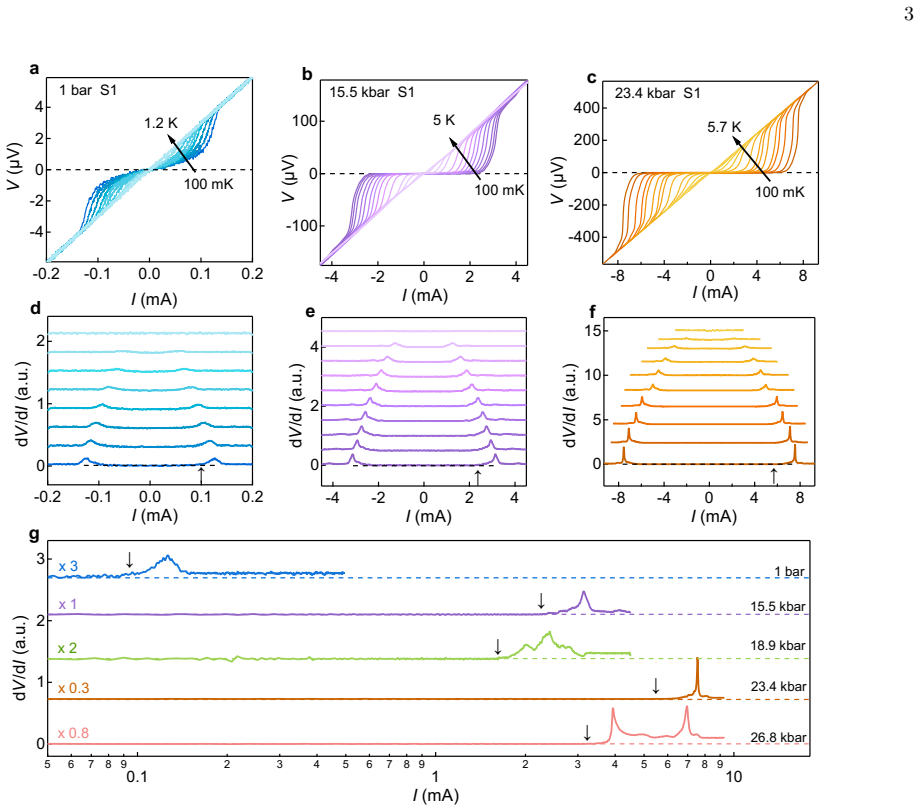
Significance. If the double-peak structure is robust, this is a significant result. It would place RbV3Sb5 among the few superconductors where the self-field critical current responds sharply to two distinct pressure-tuned quantum anomalies, and the reported enhancement (IN ≈ 60 at pc) is much larger than the analogous enhancement in CsV3Sb5. The use of Ic,sf(0) as a zero-temperature probe is well motivated by prior work, and the raw 100-mK dV/dI curves in Fig. 2 provide model-independent evidence for non-monotonicity at selected pressures. The main limitation is that the weaker peak at p′ — the load-bearing claim for a second transition — rests on very sparse pressure coverage and unquantified sample-to-sample scatter. The theoretical Lifshitz scenario is acknowledged as illustrative and does not by itself constrain p′.
major comments (3)
- [Fig. 4b and 'Drastic Enhancement and Double-peak Feature' section] The weaker peak at p′ ≈ 13 kbar is the central evidence for a second quantum phase transition, but the data supporting it are minimal. Between ~12.8 and 15.5 kbar there appear to be at most one or two IN points per sample, and IN is obtained by normalizing each sample to its own ambient-pressure Ic,sf(0). No error bars, pressure uncertainties, or repeated measurements are reported. A single upward-fluctuating point, or a sample with an unusually low ambient Ic,sf value, can produce a spurious ~27-fold peak. The authors should provide a table of all measured pressures and IN values, with estimates of uncertainty, and ideally dense pressure sweeps through p′ for at least one sample.
- [Fig. 4b and conclusion, 'hidden quantum phase transition'] The claimed coincidence between the weaker Ic,sf peak and the change in Tc(p) from rising to plateau is not quantitatively established. The Tc data in Fig. 4 are sparse near p′, and the p′ location is not assigned an uncertainty. The statement that the peak 'coincides precisely' with the Tc change therefore overstates the evidence. A quantitative comparison — e.g., fitting Tc(p) with a kink and showing the p′ estimate with confidence interval — is needed before the correlation can be treated as causal rather than accidental.
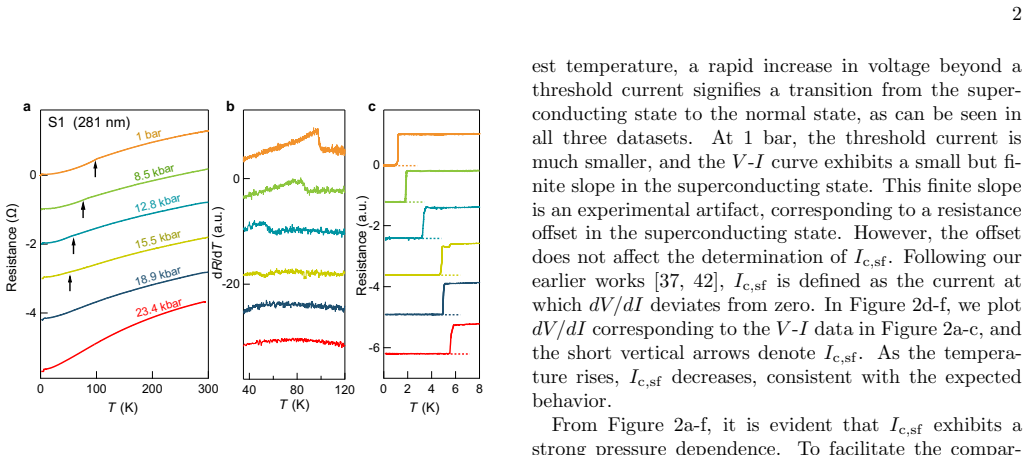
- [Fig. 2 and extraction of Ic,sf] The paper defines Ic,sf as the current where dV/dI deviates from zero, but no objective criterion, numerical threshold, or uncertainty estimate is given. The V-I curves have finite slope in the 'superconducting' branch, and the onset in dV/dI can be rounded. Because the entire pressure dependence of IN is based on these threshold values, the authors should specify the extraction algorithm and provide error bars on Ic,sf, including the effect of the finite residual resistance offset mentioned in the text.
minor comments (5)
- [Fig. 4a] The 2Δ0/kBTc values are shown without error bars. The conclusion that the ratio is 'pressure-invariant strong-coupling' would be strengthened by reporting fit uncertainties and the temperature range used for the s-wave fits.
- [Eq. (2)] Equation (2) is the low-temperature BCS approximation for λ−2(T). The text says it provides an 'excellent description' over the whole temperature range; please state the fit range and justify extending this asymptotic form close to Tc.
- [Fig. 5 and Origin section] The Lifshitz-transition model uses two illustrative values of ΔCDW (0.135 eV and 0.045 eV) with no mapping to pressure or to p′. This is acceptable as a hypothesis, but the text should state more explicitly that the model does not predict the location of the weaker peak.
- [Data presentation] A table listing all measured pressures for S1, S2, and S3, together with Tc, TCDW, Ic,sf(0), and IN, would greatly improve transparency and allow readers to assess the density of pressure coverage near p′.
- [General] The Data Availability statement says data are 'available upon request'; in the current data-sharing environment, deposition of the raw transport curves in a public repository would be more appropriate for a claim of this importance.
Circularity Check
No significant circularity: the double-peak feature is read directly from measured Ic,sf(0) data, and the models are used only for gap extraction and illustration.
full rationale
The paper's central claim—two peaks in the zero-temperature self-field critical current of RbV3Sb5 under pressure—is an empirical observation obtained directly from measured dV/dI data, not from a fitted model or from an assumed input. The s-wave gap model (Eqs. 1-2) is used only to extract Δ0 and to characterize the temperature dependence of Ic,sf(T); the double-peak structure of IN(p) is constructed from the measured zero-temperature Ic,sf values, and the paper explicitly checks that the structure persists after normalizing by Tc and Tc^1.5, ruling out that it is an artifact of the Tc variation. The Lifshitz/CDW-reconstruction scenarios are presented as tentative possibilities ('our analysis suggests the possibility...', 'future experiments... will shed light'), and the theoretical calculation in Fig. 5 is explicitly illustrative ('To simplify the discussion... two illustrative gap values'), not used to predict the peak positions. Self-citations to earlier works [37, 42] provide the measurement protocol and comparative context from CsV3Sb5, but the RbV3Sb5 data and the double-peak observation are independent of those citations. The limitation about the weaker peak relying on sparse data is a robustness concern, not a circularity concern. No step in the derivation chain assumes the conclusion as an input, and no fitted parameter is renamed as a prediction. Therefore the derivation is self-contained with respect to the claims made.
Axiom & Free-Parameter Ledger
free parameters (2)
- Δ0 (zero-temperature superconducting gap) =
0.25–1.46 meV (8 pressures)
- ΔCDW values in Fig. 5 =
0.135 eV (ambient) and 0.045 eV (high pressure)
axioms (4)
- domain assumption Thin-film self-field critical current formula (Eq. 1)
- domain assumption BCS s-wave penetration depth temperature dependence (Eq. 2)
- domain assumption λ(0) = 690 nm from μSR of Ref. [29]
- domain assumption Single d_xz-orbital tight-binding model (t = −0.5 eV, t′ = −0.08 eV)
read the original abstract
Superconductivity can coexist or compete with other orders such as magnetism or density waves. Optimizing superconductivity requires identifying competing orders that may disrupt Cooper pair coherence. Here, we use the self-field critical current ($I_{\rm c,sf}$) to probe pressure-tuned superconductivity in the kagome superconductor RbV$_3$Sb$_5$. As pressure destabilizes the charge-density wave (CDW) state, $I_{\rm c,sf}$ drastically enhances, peaking near the critical pressure where the CDW state is completely suppressed at zero temperature. Surprisingly, a weaker $I_{\rm c,sf}$ peak emerges within the CDW phase. Near the pressure of the weaker peak, the superconducting phase transition temperature shifts from an increasing trend with pressure to a near plateau. Our analysis suggests the possibility of a sudden change in the CDW pattern or a Lifshitz transition, highlighting the need for microscopic examinations of the CDW state for understanding the pressure evolution of superconductivity in RbV$_3$Sb$_5$.
Figures


Reference graph
Works this paper leans on
-
[1]
Band touching from real-space topology in frustrated hopping models,
D. L. Bergman, C. Wu, and L. Balents, “Band touching from real-space topology in frustrated hopping models,” Phys. Rev. B78, 125104 (2008)
2008
-
[2]
Spin liquids in frustrated magnets,
L. Balents, “Spin liquids in frustrated magnets,” Nature 464, 199 (2010)
2010
-
[3]
Colloquium: Herbertsmithite and the search for the quantum spin liquid,
M. R. Norman, “Colloquium: Herbertsmithite and the search for the quantum spin liquid,” Rev. Mod. Phys. 88, 041002 (2016)
2016
-
[4]
Quantum spin liquid states,
Y. Zhou, K. Kanoda, and T.-K. Ng, “Quantum spin liquid states,” Rev. Mod. Phys.89, 025003 (2017)
2017
-
[5]
Unconven- tional Fermi surface instabilities in the kagome Hubbard model,
M. L. Kiesel, C. Platt, and R. Thomale, “Unconven- tional Fermi surface instabilities in the kagome Hubbard model,” Phys. Rev. Lett.110, 126405 (2013)
2013
-
[6]
Frustration-induced highly anisotropic magnetic patterns in the classical xy model on the kagome lattice,
A. Andreanov and M. V. Fistul, “Frustration-induced highly anisotropic magnetic patterns in the classical xy model on the kagome lattice,” Phys. Rev. B102, 140405 (2020)
2020
-
[7]
Mechanism of exotic density-wave and beyond- Migdal unconventional superconductivity in kagome metal A V3Sb5 (A= K, Rb, Cs),
R. Tazai, Y. Yamakawa, S. Onari, and H. Kon- tani, “Mechanism of exotic density-wave and beyond- Migdal unconventional superconductivity in kagome metal A V3Sb5 (A= K, Rb, Cs),” Sci. Adv.8, eabl4108 (2022)
2022
-
[8]
Charge density wave order in the kagome metal A V 3Sb5 (A= Cs, Rb, K),
S. Wu, B. R. Ortiz, H. Tan, S. D. Wilson, B. Yan, T. Birol, and G. Blumberg, “Charge density wave order in the kagome metal A V 3Sb5 (A= Cs, Rb, K),” Phys. Rev. B105, 155106 (2022)
2022
-
[9]
Charge order landscape and competition with superconductivity in kagome met- als,
M. Kang, S. Fang, J. Yoo, B. R. Ortiz, Y. M. Oey, J. Choi, S. H. Ryu, J. Kim, C. Jozwiak, A. Bostwick, E. Rotenberg, E. Kaxiras, J. G. Checkelsky, S. D. Wil- son, J.-H. Park, and R. Comin, “Charge order landscape and competition with superconductivity in kagome met- als,” Nat. Mater.22, 186 (2023)
2023
-
[10]
Orbital-hybridization-driven charge density wave tran- sition in CsV3Sb5 kagome superconductor,
S. Han, C. S. Tang, L. Li, Y. Liu, H. Liu, J. Gou, J. Wu, D. Zhou, P. Yang, C. Diao, J. Ji, J. Bao, L. Zhang, M. Zhao, M. V. Miloˇ sevi´ c, Y. Guo, L. Tian, M. B. H. Breese, G. Cao, C. Cai, A. T. S. Wee, and X. Yin, “Orbital-hybridization-driven charge density wave tran- sition in CsV3Sb5 kagome superconductor,” Adv. Mater. 35, 2209010 (2023)
2023
-
[11]
Topological kagome magnets and superconductors,
J.-X. Yin, B. Lian, and M. Z. Hasan, “Topological kagome magnets and superconductors,” Nature612, 647 (2022)
2022
-
[12]
Competing electronic orders on kagome lattices at van hove filling,
W.-S. Wang, Z.-Z. Li, Y.-Y. Xiang, and Q.-H. Wang, “Competing electronic orders on kagome lattices at van hove filling,” Phys. Rev. B87, 115135 (2013)
2013
-
[13]
Sublattice interference in the kagome Hubbard model,
M. L. Kiesel and R. Thomale, “Sublattice interference in the kagome Hubbard model,” Phys. Rev. B86, 121105 (2012)
2012
-
[14]
Interaction-driven topological insulators on the kagome and the decorated honeycomb lattices,
J. Wen, A. R¨ uegg, C.-C. J. Wang, and G. A. Fiete, “Interaction-driven topological insulators on the kagome and the decorated honeycomb lattices,” Phys. Rev. B82, 075125 (2010)
2010
-
[15]
Topological surface states and flat bands in the kagome superconductor CsV 3Sb5,
Y. Hu, S. M. Teicher, B. R. Ortiz, Y. Luo, S. Peng, L. Huai, J. Ma, N. C. Plumb, S. D. Wilson, J. He, and M. Shi, “Topological surface states and flat bands in the kagome superconductor CsV 3Sb5,” Sci. Bull.67, 495 (2022)
2022
-
[16]
Tuning the competition between superconduc- tivity and charge order in the kagome superconductor Cs(V1−xNbx)3Sb5,
Y. Li, Q. Li, X. Fan, J. Liu, Q. Feng, M. Liu, C. Wang, J.-X. Yin, J. Duan, X. Li, Z. Wang, H.-H. Wen, and Y. Yao, “Tuning the competition between superconduc- tivity and charge order in the kagome superconductor Cs(V1−xNbx)3Sb5,” Phys. Rev. B105, L180507 (2022)
2022
-
[17]
Fermi level tuning and double-dome superconductivity in the kagome metal CsV3Sb5−xSnx,
Y. M. Oey, B. R. Ortiz, F. Kaboudvand, J. Frassineti, E. Garcia, R. Cong, S. Sanna, V. F. Mitrovi´ c, R. Se- shadri, and S. D. Wilson, “Fermi level tuning and double-dome superconductivity in the kagome metal CsV3Sb5−xSnx,” Phys. Rev. Mater.6, L041801 (2022)
2022
-
[18]
Evolution of superconductivity and charge order in pressurized RbV 3Sb5,
F. Du, S. Luo, R. Li, B. R. Ortiz, Y. Chen, S. D. Wilson, Y. Song, and H. Yuan, “Evolution of superconductivity and charge order in pressurized RbV 3Sb5,” Chin. Phys. B31, 017404 (2022)
2022
-
[19]
Pres- sure evolution of electron dynamics in the superconduct- ing kagome metal CsV 3Sb5,
M. Wenzel, A. A. Tsirlin, F. Capitani, Y. T. Chan, B. R. Ortiz, S. D. Wilson, M. Dressel, and E. Uykur, “Pres- sure evolution of electron dynamics in the superconduct- ing kagome metal CsV 3Sb5,” npj Quantum Mater.8, 45 (2023)
2023
-
[20]
Pressure- induced double superconducting domes and charge insta- bility in the kagome metal KV 3Sb5,
F. Du, S. Luo, B. R. Ortiz, Y. Chen, W. Duan, D. Zhang, X. Lu, S. D. Wilson, Y. Song, and H. Yuan, “Pressure- induced double superconducting domes and charge insta- bility in the kagome metal KV 3Sb5,” Phys. Rev. B103, L220504 (2021)
2021
-
[21]
Double superconducting 8 dome and triple enhancement ofT c in the kagome su- perconductor CsV3Sb5 under high pressure,
K. Y. Chen, N. N. Wang, Q. W. Yin, Y. H. Gu, K. Jiang, Z. J. Tu, C. S. Gong, Y. Uwatoko, J. P. Sun, H. C. Lei, J. P. Hu, and J.-G. Cheng, “Double superconducting 8 dome and triple enhancement ofT c in the kagome su- perconductor CsV3Sb5 under high pressure,” Phys. Rev. Lett.126, 247001 (2021)
2021
-
[22]
Charge density wave orders and en- hanced superconductivity under pressure in the kagome metal CsV3Sb5,
Q. Wang, P. Kong, W. Shi, C. Pei, C. Wen, L. Gao, Y. Zhao, Q. Yin, Y. Wu, G. Li, H. Lei, J. Li, Y. Chen, S. Yan, and Y. Qi, “Charge density wave orders and en- hanced superconductivity under pressure in the kagome metal CsV3Sb5,” Adv. Mater.33, 2102813 (2021)
2021
-
[23]
New kagome prototype materials: discovery of KV3Sb5, RbV3Sb5, and CsV 3Sb5,
B. R. Ortiz, L. C. Gomes, J. R. Morey, M. Winiarski, M. Bordelon, J. S. Mangum, I. W. H. Oswald, J. A. Rodriguez-Rivera, J. R. Neilson, S. D. Wilson, E. Ertekin, T. M. McQueen, and E. S. Toberer, “New kagome prototype materials: discovery of KV3Sb5, RbV3Sb5, and CsV 3Sb5,” Phys. Rev. Mater.3, 094407 (2019)
2019
-
[24]
Emergence of new van hove singularities in the charge density wave state of a topological kagome metal RbV 3Sb5,
S. Cho, H. Ma, W. Xia, Y. Yang, Z. Liu, Z. Huang, Z. Jiang, X. Lu, J. Liu, Z. Liu, J. Li, J. Wang, Y. Liu, J. Jia, Y. Guo, J. Liu, and D. Shen, “Emergence of new van hove singularities in the charge density wave state of a topological kagome metal RbV 3Sb5,” Phys. Rev. Lett. 127, 236401 (2021)
2021
-
[25]
Observation of uncon- ventional charge density wave without acoustic phonon anomaly in kagome superconductorsAV 3Sb5 (A= Rb, Cs),
H. Li, T. T. Zhang, T. Yilmaz, Y. Y. Pai, C. E. Marvin- ney, A. Said, Q. W. Yin, C. S. Gong, Z. J. Tu, E. Vescovo, C. S. Nelson, R. G. Moore, S. Murakami, H. C. Lei, H. N. Lee, B. J. Lawrie, and H. Miao, “Observation of uncon- ventional charge density wave without acoustic phonon anomaly in kagome superconductorsAV 3Sb5 (A= Rb, Cs),” Phys. Rev. X11, 031050 (2021)
2021
-
[26]
Su- perconductivity and normal-state properties of kagome metal RbV 3Sb5 single crystals,
Q. Yin, Z. Tu, C. Gong, Y. Fu, S. Yan, and H. Lei, “Su- perconductivity and normal-state properties of kagome metal RbV 3Sb5 single crystals,” Chin. Phys. Lett.38, 037403 (2021)
2021
-
[27]
Charge-density-wave-induced bands renormal- ization and energy gaps in a kagome superconductor RbV3Sb5,
Z. Liu, N. Zhao, Q. Yin, C. Gong, Z. Tu, M. Li, W. Song, Z. Liu, D. Shen, Y. Huang, K. Liu, H. Lei, and S. Wang, “Charge-density-wave-induced bands renormal- ization and energy gaps in a kagome superconductor RbV3Sb5,” Phys. Rev. X11, 041010 (2021)
2021
-
[28]
Three-state nematic- ity and magneto-optical Kerr effect in the charge density waves in kagome superconductors,
Y. Xu, Z. Ni, Y. Liu, B. R. Ortiz, Q. Deng, S. D. Wilson, B. Yan, L. Balents, and L. Wu, “Three-state nematic- ity and magneto-optical Kerr effect in the charge density waves in kagome superconductors,” Nat. Phys.18, 1470 (2022)
2022
-
[29]
Tunable unconventional kagome superconductivity in charge ordered RbV 3Sb5 and KV 3Sb5,
Z. Guguchia, C. Mielke, D. Das, R. Gupta, J.-X. Yin, H. Liu, Q. Yin, M. H. Christensen, Z. Tu, C. Gong, N. Shumiya, M. S. Hossain, T. Gamsakhurdashvili, M. Elender, P. Dai, A. Amato, Y. Shi, H. C. Lei, R. M. Fernandes, M. Z. Hasan, H. Luetkens, and R. Khasanov, “Tunable unconventional kagome superconductivity in charge ordered RbV 3Sb5 and KV 3Sb5,” Nat. ...
2023
-
[30]
Anomalous Hall effect and two- dimensional Fermi surfaces in the charge-density-wave state of kagome metal RbV 3Sb5,
L. Wang, W. Zhang, Z. Wang, T. F. Poon, W. Wang, C. W. Tsang, J. Xie, X. Zhou, Y. Zhao, S. Wang, K. T. Lai, and S. K. Goh, “Anomalous Hall effect and two- dimensional Fermi surfaces in the charge-density-wave state of kagome metal RbV 3Sb5,” J. Phys. Mater.6, 02LT01 (2023)
2023
-
[31]
Nontrivial Fermi surface topology and large anomalous Hall effect in the kagome superconductor RbV 3Sb5,
Y. Wang, Z. Chen, Y. Nie, Y. Zhang, Q. Niu, G. Zheng, X. Zhu, W. Ning, and M. Tian, “Nontrivial Fermi surface topology and large anomalous Hall effect in the kagome superconductor RbV 3Sb5,” Phys. Rev. B108, 035117 (2023)
2023
-
[32]
Microscopic nature of the charge-density wave in the kagome superconductor RbV 3Sb5,
J. Frassineti, P. Bonf` a, G. Allodi, E. Garcia, R. Cong, B. R. Ortiz, S. D. Wilson, R. De Renzi, V. F. Mitrovi´ c, and S. Sanna, “Microscopic nature of the charge-density wave in the kagome superconductor RbV 3Sb5,” Phys. Rev. Res.5, L012017 (2023)
2023
-
[33]
Nature of unconventional pairing in the kagome superconductors A V3Sb5 (A= K,Rb,Cs),
X. Wu, T. Schwemmer, T. M¨ uller, A. Consiglio, G. San- giovanni, D. Di Sante, Y. Iqbal, W. Hanke, A. P. Schny- der, M. M. Denner, M. H. Fischer, T. Neupert, and R. Thomale, “Nature of unconventional pairing in the kagome superconductors A V3Sb5 (A= K,Rb,Cs),” Phys. Rev. Lett.127, 177001 (2021)
2021
-
[34]
Compe- tition between charge-density-wave and superconductiv- ity in the kagome metal RbV 3Sb5,
N. N. Wang, K. Y. Chen, Q. W. Yin, Y. N. N. Ma, B. Y. Pan, X. Yang, X. Y. Ji, S. L. Wu, P. F. Shan, S. X. Xu, Z. J. Tu, C. S. Gong, G. T. Liu, G. Li, Y. Uwatoko, X. L. Dong, H. C. Lei, J. P. Sun, and J.-G. Cheng, “Compe- tition between charge-density-wave and superconductiv- ity in the kagome metal RbV 3Sb5,” Phys. Rev. Res.3, 043018 (2021)
2021
-
[35]
Three-dimensional charge density wave and surface-dependent vortex-core states in a kagome super- conductor CsV3Sb5,
Z. Liang, X. Hou, F. Zhang, W. Ma, P. Wu, Z. Zhang, F. Yu, J.-J. Ying, K. Jiang, L. Shan, Z. Wang, and X.- H. Chen, “Three-dimensional charge density wave and surface-dependent vortex-core states in a kagome super- conductor CsV3Sb5,” Phys. Rev. X11, 031026 (2021)
2021
-
[36]
Twofold van Hove singularity and origin of charge order in topo- logical kagome superconductor CsV3Sb5,
M. Kang, S. Fang, J.-K. Kim, B. R. Ortiz, S. H. Ryu, J. Kim, J. Yoo, G. Sangiovanni, D. Di Sante, B.-G. Park, C. Jozwiak, A. Bostwick, E. Rotenberg, E. Kaxi- ras, S. D. Wilson, J.-H. Park, and R. Comin, “Twofold van Hove singularity and origin of charge order in topo- logical kagome superconductor CsV3Sb5,” Nat. Phys.18, 301 (2022)
2022
-
[37]
Quantum phase transition as a promising route to enhance the critical current in kagome super- conductor CsV3Sb5,
W. Wang, L. Wang, X. Liu, C. W. Tsang, Z. Wang, T. F. Poon, S. Wang, K. T. Lai, W. Zhang, J. L. Tallon, and S. K. Goh, “Quantum phase transition as a promising route to enhance the critical current in kagome super- conductor CsV3Sb5,” Adv. Sci.11, 2410099 (2024)
2024
-
[38]
Doping dependence of the critical current in Bi2Sr2CaCu2O8+δ,
M. Naamneh, J. C. Campuzano, and A. Kanigel, “Doping dependence of the critical current in Bi2Sr2CaCu2O8+δ,” Phys. Rev. B90, 224501 (2014)
2014
-
[39]
Universal self-field crit- ical current for thin-film superconductors,
E. F. Talantsev and J. L. Tallon, “Universal self-field crit- ical current for thin-film superconductors,” Nat. Com- mun.6, 7820 (2015)
2015
-
[40]
A peak in the critical current for quantum critical superconductors,
S.-G. Jung, S. Seo, S. Lee, E. D. Bauer, H.-O. Lee, and T. Park, “A peak in the critical current for quantum critical superconductors,” Nat. Commun.9, 434 (2018)
2018
-
[41]
Peak in the critical cur- rent density in (Ca xSr1−x)3Rh4Sn13 tuned towards the structural quantum critical point,
X. Liu, W. Zhang, K. T. Lai, K. Moriyama, J. Tallon, K. Yoshimura, and S. K. Goh, “Peak in the critical cur- rent density in (Ca xSr1−x)3Rh4Sn13 tuned towards the structural quantum critical point,” Phys. Rev. B105, 214524 (2022)
2022
-
[42]
Nodeless super- conductivity in kagome metal CsV3Sb5 with and without time reversal symmetry breaking,
W. Zhang, X. Liu, L. Wang, C. W. Tsang, Z. Wang, S. T. Lam, W. Wang, J. Xie, X. Zhou, Y. Zhao, S. Wang, J. Tallon, K. T. Lai, and S. K. Goh, “Nodeless super- conductivity in kagome metal CsV3Sb5 with and without time reversal symmetry breaking,” Nano Lett.23, 872 (2023)
2023
-
[43]
Uni- versal scaling of the self-field critical current in super- conductors: from sub-nanometre to millimetre size,
E. F. Talantsev, W. P. Crump, and J. L. Tallon, “Uni- versal scaling of the self-field critical current in super- conductors: from sub-nanometre to millimetre size,” Sci. Rep.7, 10010 (2017)
2017
-
[44]
Effect of magnetic impu- rities on superconductivity in LaH 10,
D. V. Semenok, I. A. Troyan, A. V. Sadakov, D. Zhou, M. Galasso, A. G. Kvashnin, A. G. Ivanova, I. A. Kruglov, A. A. Bykov, K. Y. Terent’ev, A. V. Cherepakhin, O. A. Sobolevskiy, K. S. Pervakov, A. Y. Seregin, T. Helm, T. F¨ orster, A. D. Grockowiak, S. W. Tozer, Y. Nakamoto, K. Shimizu, V. M. Pudalov, I. S. Lyubutin, and A. R. Oganov, “Effect of magnetic...
2022
-
[45]
S-wave superconductivity in kagome metal CsV3Sb5 re- vealed by 121/123Sb NQR and 51V NMR measurements,
C. Mu, Q. Yin, Z. Tu, C. Gong, H. Lei, Z. Li, and J. Luo, “S-wave superconductivity in kagome metal CsV3Sb5 re- vealed by 121/123Sb NQR and 51V NMR measurements,” Chin. Phys. Lett.38, 077402 (2021)
2021
-
[46]
Microscopic evidence for anisotropic multigap supercon- ductivity in the CsV 3Sb5 kagome superconductor,
R. Gupta, D. Das, C. H. Mielke III, Z. Guguchia, T. Shiroka, C. Baines, M. Bartkowiak, H. Luetkens, R. Khasanov, Q. Yin, Z. Tu, C. Gong, and H. Lei, “Microscopic evidence for anisotropic multigap supercon- ductivity in the CsV 3Sb5 kagome superconductor,” npj Quantum Mater.7, 49 (2022)
2022
-
[47]
Two types of charge order with distinct interplay with super- conductivity in the kagome material CsV 3Sb5,
R. Gupta, D. Das, C. Mielke III, E. T. Ritz, F. Hotz, Q. Yin, Z. Tu, C. Gong, H. Lei, T. Birol, R. M. Fernan- des, Z. Guguchia, H. Luetkens, and R. Khasanov, “Two types of charge order with distinct interplay with super- conductivity in the kagome material CsV 3Sb5,” Com- mun. Phys.5, 232 (2022)
2022
-
[48]
Muon spin re- laxation study of the layered kagome superconductor CsV3Sb5,
Z. Shan, P. K. Biswas, S. K. Ghosh, T. Tula, A. D. Hillier, D. Adroja, S. Cottrell, G.-H. Cao, Y. Liu, X. Xu, Y. Song, H. Yuan, and M. Smidman, “Muon spin re- laxation study of the layered kagome superconductor CsV3Sb5,” Phys. Rev. Res.4, 033145 (2022)
2022
-
[49]
Nodeless superconductivity in the kagome metal CsV 3Sb5,
W. Duan, Z. Nie, S. Luo, F. Yu, B. R. Ortiz, L. Yin, H. Su, F. Du, A. Wang, Y. Chen, X. Lu, J. Ying, S. D. Wilson, X. Chen, Y. Song, and H. Yuan, “Nodeless superconductivity in the kagome metal CsV 3Sb5,” Sci. China: Phys. Mech. Astron.64, 107462 (2021)
2021
-
[50]
Charge-loop current order andZ 3 nematicity mediated by bond order fluctuations in kagome metals,
R. Tazai, Y. Yamakawa, and H. Kontani, “Charge-loop current order andZ 3 nematicity mediated by bond order fluctuations in kagome metals,” Nat. Commun.14, 7845 (2023)
2023
-
[51]
Impact of charge-density-wave pattern on the super- conducting gap in Vanadium-based kagome superconduc- tors,
T. Nagashima, K. Ishihara, Y. Yamakawa, F. Chen, K. Imamura, M. Roppongi, R. Grasset, M. Kon- czykowski, B. R. Ortiz, A. C. Salinas, S. D. Wilson, R. Tazai, H. Kontani, K. Hashimoto, and T. Shibauchi, “Impact of charge-density-wave pattern on the super- conducting gap in Vanadium-based kagome superconduc- tors,” Commun. Phys.8, 303 (2025)
2025
-
[52]
Emergent charge order in pressurized kagome supercon- ductor CsV3Sb5,
L. Zheng, Z. Wu, Y. Yang, L. Nie, M. Shan, K. Sun, D. Song, F. Yu, J. Li, D. Zhao, S. Li, B. Kang, Y. Zhou, K. Liu, Z. Xiang, J. Ying, Z. Wang, T. Wu, and X. Chen, “Emergent charge order in pressurized kagome supercon- ductor CsV3Sb5,” Nature611, 682 (2022)
2022
-
[53]
Fragile pressure- induced magnetism in FeSe superconductors with a thick- ness reduction,
J. Xie, X. Liu, W. Zhang, S. M. Wong, X. Zhou, Y. Zhao, S. Wang, K. T. Lai, and S. K. Goh, “Fragile pressure- induced magnetism in FeSe superconductors with a thick- ness reduction,” Nano Lett.21, 9310 (2021)
2021
discussion (0)
Sign in with ORCID, Apple, or X to comment. Anyone can read and Pith papers without signing in.