REVIEW 3 major objections 5 minor 76 references
Locally tuned hydrodynamics of active polymer chains
T0 review · 3 major / 5 minor · reviewed 2026-08-05 · deepseek-v4-flash
Pith's one-line read The flow field around a stiff active polymer is set by where the balancing counterforce sits relative to the chain's center, not by the local force dipole.
desk verdict New local counterforce method for MPCD active polymers is a real addition, and the stiff-chain pusher/puller inversion is plausible, but the central tuning claim needs far-field support for the d=±σ cases before I'd fully buy it. read the letter →
The pith
A machine-rendered reading of the paper's core claim, the machinery that carries it, and where it could break.
The reading
What carries the argument
The central mechanism is the movable counterforce volume: a sphere of diameter 2σ, centered at r_cf = R_iact + d e_f, in which the reaction force −F_a is distributed equally among the n_cf solvent particles present. Varying d (chosen here as ±σ or larger values such as ±4.5σ) shifts where the fluid is pushed back, changing the sign and center of the effective force dipole. Work done: it enforces a strictly force-free polymer–fluid system while providing a single tunable parameter that selects the hydrodynamic flow type; combined with bond force transmission in the chain, it explains why stiff chains show flow fields centered at the chain's center of mass and why flexible chains behave differ
What would settle it
Simulate a stiff 10-mer with d varied continuously from +4.5σ to −4.5σ and track the far-field ϱ^-2 coefficient: the force-propagation picture predicts the sign flips exactly when the counterforce center crosses the chain's center of mass, with near-zero dipole strength at the crossing; a sign flip at some other point, or no sign flip, would falsify it.
Extended reading notes
Core claim
By specifying the position of the counterforce volume relative to the active monomer—ahead or behind the active force—the authors obtain four models (head-active with counterforce before/behind, tail-active with counterforce before/behind) and show that the counterforce position alone can tune the hydrodynamic flow field of the active polymer between puller and pusher types. The deeper discovery is that the resulting flow type is not simply fixed by the sign of the local force dipole: for stiff chains, the active force is transmitted almost instantaneously through the bonds to all monomers, so the effective dipole emerges at the chain's center and its sign is set by the counterforce's displa
Load-bearing premise
The whole flow-tuning picture rests on treating the small sphere of solvent that receives the counterforce as a faithful stand-in for a real swimmer's reaction force, even though the system is not strictly torque-free and the solvent's density varies by about 10% near the force dipole.
Editorial extensions
If this is right
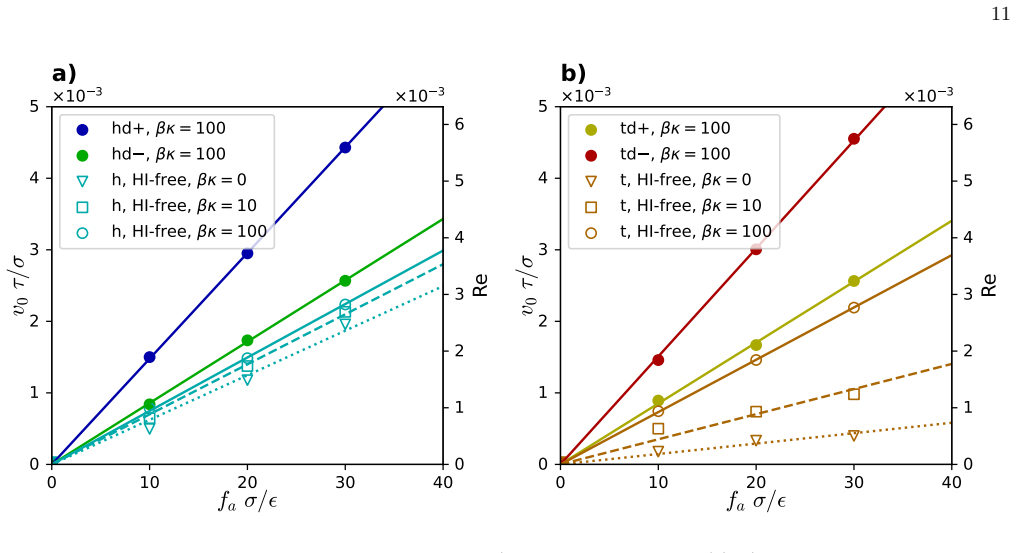
- Swimming speed of stiff active polymers grows linearly with active force, while flexible polymers show a nonlinear, activity-site-dependent relation.
- Head activity straightens the chain (activity-induced stiffening), increasing orientation persistence; tail activity crumples the chain locally and speeds up backbone decorrelation, including a 'cat's tail' sub-diffusive regime in flexible chains.
- Conformational and dynamic differences between head- and tail-active polymers persist even when hydrodynamic interactions are turned off.
- For stiff chains, placing the counterforce near a monomer slows the polymer, whereas placing it outside (hd+ and td−) yields faster swimmers, and in all cases the far field is a force dipole whose direction is set by counterforce placement relative to the chain center.
- The measured force-dipole strengths for head-active d = −4.5σ and tail-active d = +4.5σ are nearly equal in magnitude but opposite in sign, confirming the rod-like force transmission picture.
Reading between the lines
- If the flow type is set by counterforce position relative to the chain center of mass for stiff chains, then continuously sweeping d through the chain's center should flip the far-field dipole sign at the crossing point—an easily testable prediction for simulations.
- The same local-counterforce idea could generalise to other flexible active objects (e.g., ring polymers or filaments with distributed activity): the effective multipole order and flow direction should be predictable from the force transmission matrix along the contour, not just the local active site.
- The decoupling of conformation from flow type—since counterforce placement changes swimming speed but barely changes chain shape—suggests design rules for artificial microswimmers where propulsion efficiency and far-field disturbance can be optimised separately.
- Because the paper finds hydrodynamic interactions barely affect chain conformation, the pusher/puller tuning might be observable in a lattice-Boltzmann or boundary-element implementation as well, provided the reaction force is applied over a similar local volume; the 10% density variations near the dipole are an MPCD compressibility artifact that more accurate solvers could remove.
Signed reviews
Editorial analysis
A structured set of objections, weighed in public.
Referee Report
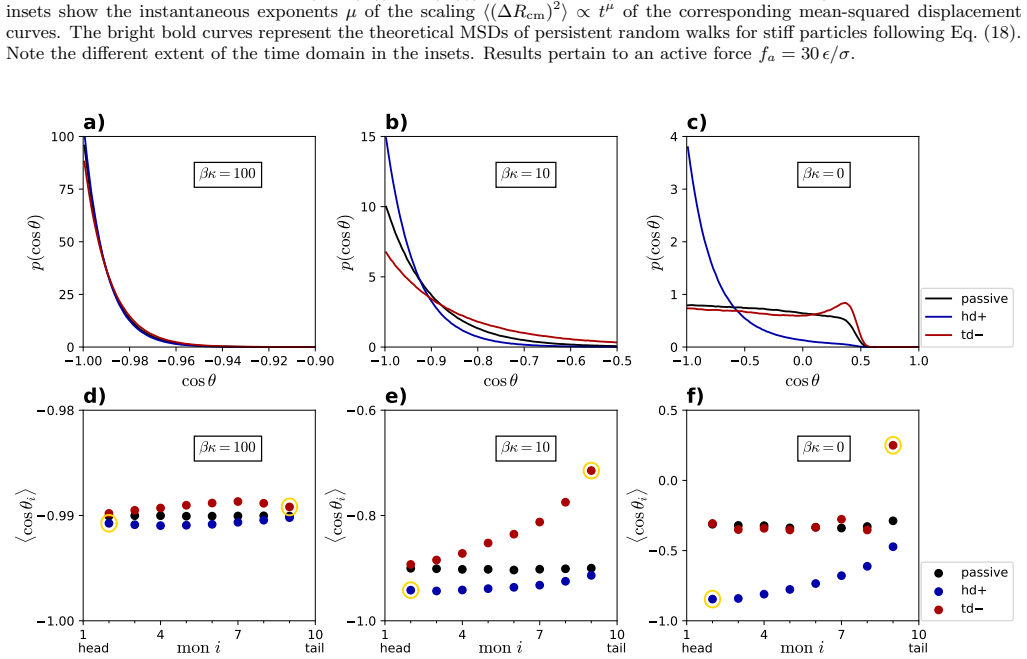
Summary. The manuscript reports multi-particle collision dynamics (MPCD) simulations of active polymer chains (N=10) in which a single end monomer – head or tail – experiences a constant force along the local bond direction. To keep the system force-free, the authors introduce a local counterforce distributed over solvent particles inside a sphere of diameter 2σ centered at r_cf = R_iact + d e_f (Eq. 9). Four models are defined by active site (head/tail) and counterforce displacement (d=±σ): hd+, hd−, td+, td−. The paper examines swimming velocity, backbone orientational autocorrelation, MSD, radius of gyration, bond-angle distributions, monomer-resolved force projections, and solvent flow fields. For stiff chains, the active site has little effect on structural/dynamic properties, while for flexible chains head activity induces effective stiffening and tail activity causes crumpling and a 'cat's tail' sub-diffusive regime. The main claim is that the counterforce position tunes the hydrodynamic flow fields: hd+ and td− give the naively expected puller and pusher flows, whereas stiff hd− and td+ show the opposite, an inversion attributed to force redistribution along the polymer backbone. Far-field fits for d=±4.5σ confirm dipolar flows with opposite dipole signs.
Significance. The central idea – that the flow topology of an active polymer can be selected by counterforce placement, and that internal force transmission can override the naive local force-dipole expectation – is interesting and would be of value to the active-matter and soft-matter communities if firmly established. The simulation study is systematic and internally consistent across several observables (swimming velocity, RG, Cf, MSD, flow fields, per-monomer forces). The monomer-resolved force analysis in Fig. 9 directly supports the interpretation that the strongest backbone force lies near the counterforce volume. However, the load-bearing evidence for the 'tuning' claim is Fig. 6, which is qualitative, whereas the only quantitative far-field dipole analysis (Sec. VIII, Figs. 10–11) is performed for d=±4.5σ. The potential artifacts from torque fluctuations, compressibility, and the finite counterforce volume are acknowledged but not quantified. The new counterforce method is also not validated against a known test case. Thus the paper is a promising contribution that requires additional quantitative support before the main claim can be accepted.
major comments (3)
- [Sec. V and Sec. VIII (Fig. 6, Figs. 10–11)] The central claim that the flow field can be tuned by counterforce placement rests on the visual classification in Fig. 6 for d=±σ models. The only quantitative evidence for a force-dipole far field is the fit to Eq. (27) for d=±4.5σ (Figs. 10–11). For d=±σ the counterforce volume (diameter 2σ centered at r_cf = R_iact ± σ e_f) overlaps the active monomer and its neighbor, so the flow at the distances shown is not necessarily in the dipole regime. The ~10% density inhomogeneity (Sec. V) and the fluctuating torque can contribute velocity components of comparable magnitude. Please provide a quantitative far-field analysis (e.g., r^{-2} fit vs. r^{-3}, or inclusion of a rotlet term) for the d=±σ cases, or otherwise demonstrate that the classification is robust to these local effects.
- [Sec. II.B (Eqs. 9–10) and Sec. V] The system is not torque-free: distributing -F_a over n_cf solvent particles inside a sphere produces a stochastic torque whose magnitude fluctuates as n_cf and the particle positions fluctuate. The authors note that the torque fluctuates around zero, but they do not quantify it. In a 3D Stokes flow a rotlet decays as r^{-2}, the same as a force dipole, so a spurious torque could contaminate both the sign and the magnitude of the measured dipole in Fig. 6 and the fits of Sec. VIII. Please report the distribution and RMS of the total torque on the solvent (or the polymer+solvent system) and estimate the resulting rotlet velocity field. A simple control would be to compare the flow of a symmetric force pair (e.g., two equal and opposite forces far from the chain) with and without the stochastic torque.
- [Sec. II.B (method validation)] The new locally-tuned counterforce scheme is not validated against a known hydrodynamic test case. For example, the flow field of a single active monomer with a distant counterforce (or a rigid dumbbell) could be compared with the analytical Oseen tensor/dipole solution, and the effect of the finite counterforce sphere (diameter 2σ) and the MPCD collision-cell size could be quantified. Without such a benchmark it is difficult to rule out artifacts specific to the method, particularly for the quantitative dipole strengths p reported in Sec. VIII (p = 15.7 and −17.3 mσ²/τ²).
minor comments (5)
- [Sec. III, Eq. (18)] The phrase 'theoretical MSD' / 'prediction' is too strong: v0, τr, and Dpass are all measured from the same simulations, so Eq. (18) is a self-consistency check rather than an independent prediction. Please rephrase.
- [Sec. IV] Typo: 'beding rigidity' should be 'bending rigidity'.
- [Sec. III, Eq. (15)] The symbol lcm is used in the Reynolds number formula but the text says choosing lc = Nσ as characteristic size; please align the notation.
- [Sec. VIII] The force dipole strengths p are quoted without uncertainties. Please provide standard errors or confidence intervals from the fits.
- [Fig. 6 caption] The caption is uninformative; please specify which panels correspond to which of the four models and the stiffness values, and define the arrows/color scale in the caption.
Circularity Check
No significant circularity: central claims are direct simulation measurements; no derivation reduces to its inputs.
full rationale
The paper's central claims—that counterforce placement tunes the flow fields and that stiff chains can invert naive pusher/puller expectations—are direct observations of MPCD simulations, not derived predictions from fitted inputs. The flow fields are measured from solvent velocities; the pusher/puller classification is read from the geometry of those measured fields. The force dipole strength p in Eq. (27) is obtained by fitting the measured far-field velocity to a standard dipole form, which is a characterization, not a prediction forced by construction. The persistent-random-walk comparison (Eq. 18) uses v0, τr, and Dpass measured from the same simulations; this is a self-consistency check rather than an independent test, but it is not circular because the MSD is a separately measured observable and the parameters are not fit to the MSD curve. Self-citations (e.g., Zöttl & Stark 2016 for the PRW model and dipole flow classification) are standard textbook results with stated assumptions and are not used to forbid alternatives or to establish uniqueness, so they are not load-bearing. The paper explicitly acknowledges limitations—the system is not strictly torque-free (Sec. II B) and density inhomogeneities reach ~10% near the force dipole (Sec. V)—but these are correctness and robustness caveats about the fidelity of the model, not circular steps: the observed flows are not defined in terms of the conclusions drawn from them. Overall the derivation chain is self-contained and the central results do not reduce to their own inputs.
Assumptions & free parameters
free parameters (5)
- counterforce displacement d =
±σ (Sec. II.B) and ±4.5σ (Sec. VIII)
- active force magnitude fa =
30 ε/σ, varied from 0 to 40 ε/σ
- bending stiffness βκ =
0, 10, 100
- persistent random walk parameters (v0, τr, Dpass) =
measured: v0 via Eq. 14; τr via Eq. 16-17; Dpass ≈ 2e-4 σ²/τ via Eq. 19
- force dipole strength p =
p = 15.7 mσ²/τ² (pusher), p = -17.3 mσ²/τ² (puller)
assumptions (6)
- domain assumption MPCD with Maxwell-Boltzmann cell thermostat correctly captures hydrodynamics and thermal fluctuations
- ad hoc to paper Distributing the counterforce evenly over solvent particles in a sphere of diameter 2σ centered at r_cf is a valid force-free swimmer construction
- domain assumption Low Reynolds number (Re < 6e-3) so Stokes flow and force dipole far-field scaling apply
- domain assumption 48 runs x 9000τ measurements give converged steady state averages
- standard math p(cos θ) ∝ exp(-βκ_eff cos θ) describes active conformation statistics as an equilibrium-like distribution
- domain assumption The persistent random walk model (Eq. 18) describes center-of-mass MSD of stiff active polymers
Cite this review
Pith. "Pith review of Locally tuned hydrodynamics of active polymer chains." pith.science (2026). https://pith.science/paper/WFKDLQIX
@misc{pith2026250818789,
  author       = {Pith},
  title        = {Pith review of: Locally tuned hydrodynamics of active polymer chains},
  year         = {2026},
  howpublished = {\url{https://pith.science/paper/WFKDLQIX}},
  note         = {Machine review of arXiv:2508.18789}
}
read the original abstract
We employ mesoscopic simulations to study active polymers in a solvent via multi-particle collision dynamics. We investigate linear chains in which either the head or tail monomer exerts an active force, directed away from or towards its neighbor, respectively, while the remaining monomers are passive. We find that, in contrast to flexible chains, for stiff chains the position of the active monomer has minimal influence on both the structural and dynamic properties of the chain. An active head monomer pulls the chain behind it, straightening the backbone -- an effect that can be interpreted as activity-induced stiffening. In contrast, an active tail pushes into the chain, causing crumpling. This leads to faster decorrelation of the polymer backbone over time, rendering the active motion less persistent. These effects occur regardless of whether hydrodynamic interactions are included or not. Hydrodynamics is included by the imposition of a local counter-force in the surrounding fluid, as opposed to distributing the former equally to all fluid elements. By specifying the position of this counterforce onto the fluid, we can tune the hydrodynamic flow fields of the active polymers being both contractile and extensile. Interestingly, the emerging pusher- and puller flow fields are strongly influenced by the force propagation inside the polymer chain.
Figures


Figures from the paper (9 more)




Reference graph
Works this paper leans on
-
[1]
author author T. Vicsek \ and\ author A. Zafeiris ,\ 10.1016/j.physrep.2012.03.004 journal journal Phys. Rep. \ volume 517 ,\ pages 71 ( year 2012 ) NoStop
-
[2]
Ramaswamy ,\ 10.1146/annurev-conmatphys-070909-104101 journal journal Annu
author author S. Ramaswamy ,\ 10.1146/annurev-conmatphys-070909-104101 journal journal Annu. Rev. Condens. Matter Phys. \ volume 1 ,\ pages 323 ( year 2010 ) NoStop
-
[3]
author author J. Elgeti , author R. G. \ Winkler , \ and\ author G. Gompper ,\ 10.1088/0034-4885/78/5/056601 journal journal Rep. Prog. Phys. \ volume 78 ,\ pages 056601 ( year 2015 ) NoStop
-
[4]
author author D. Mizuno , author C. Tardin , author C. F. \ Schmidt , \ and\ author F. C. \ MacKintosh ,\ 10.1126/science.1134404 journal journal Science \ volume 315 ,\ pages 370 ( year 2007 ) NoStop
-
[5]
author author A. Yildiz , author M. Tomishige , author R. D. \ Vale , \ and\ author P. R. \ Selvin ,\ 10.1126/science.1093753 journal journal Science \ volume 303 ,\ pages 676 ( year 2004 ) NoStop
-
[6]
author author M. Guthold , author X. Zhu , author C. Rivetti , author G. Yang , author N. H. \ Thomson , author S. Kasas , author H. G. \ Hansma , author B. Smith , author P. K. \ Hansma , \ and\ author C. Bustamante ,\ 10.1016/S0006-3495(99)77067-0 journal journal Biophys. J. \ volume 77 ,\ pages 2284 ( year 1999 ) NoStop
-
[7]
author author Y. X. \ Mejia , author E. Nudler , \ and\ author C. Bustamante ,\ 10.1073/pnas.1421067112 journal journal Proc. Natl. Acad. Sci. U.S.A. \ volume 112 ,\ pages 743 ( year 2015 ) NoStop
-
[8]
author author J. R. \ Howse , author R. A. L. \ Jones , author A. J. \ Ryan , author T. Gough , author R. Vafabakhsh , \ and\ author R. Golestanian ,\ 10.1103/PhysRevLett.99.048102 journal journal Phys. Rev. Lett. \ volume 99 ,\ pages 048102 ( year 2007 ) NoStop
Show all 76 references
-
[9]
Palacci , author C
author author J. Palacci , author C. Cottin-Bizonne , author C. Ybert , \ and\ author L. Bocquet ,\ 10.1103/PhysRevLett.105.088304 journal journal Phys. Rev. Lett. \ volume 105 ,\ pages 088304 ( year 2010 ) NoStop
2010 doi
-
[10]
\ Jiang , author N
author author H.-R. \ Jiang , author N. Yoshinaga , \ and\ author M. Sano ,\ 10.1103/PhysRevLett.105.268302 journal journal Phys. Rev. Lett. \ volume 105 ,\ pages 268302 ( year 2010 ) NoStop
2010 doi
-
[11]
author author A. P. \ Bregulla , author H. Yang , \ and\ author F. Cichos ,\ 10.1021/nn501568e journal journal ACS Nano \ volume 8 ,\ pages 6542 ( year 2014 ) NoStop
2014 doi
-
[12]
Wang \ and\ author W
author author J. Wang \ and\ author W. Gao ,\ 10.1021/nn3028997 journal journal ACS Nano \ volume 6 ,\ pages 5745 ( year 2012 ) NoStop
2012 doi
-
[13]
Bechinger , author R
author author C. Bechinger , author R. Di Leonardo , author H. L\"owen , author C. Reichhardt , author G. Volpe , \ and\ author G. Volpe ,\ 10.1103/RevModPhys.88.045006 journal journal Rev. Mod. Phys. \ volume 88 ,\ pages 045006 ( year 2016 ) NoStop
2016 doi
-
[14]
author author M. E. \ Cates \ and\ author J. Tailleur ,\ 10.1146/annurev-conmatphys-031214-014710 journal journal Annu. Rev. Condens. Matter Phys. \ volume 6 ,\ pages 219 ( year 2015 ) NoStop
2015 doi
-
[15]
Z \"o ttl \ and\ author H
author author A. Z \"o ttl \ and\ author H. Stark ,\ 10.1146/annurev-conmatphys-040821-115500 journal journal Annu. Rev. Condens. Matter Phys. \ volume 14 ,\ pages 109 ( year 2023 ) NoStop
2023 doi
-
[16]
Smrek \ and\ author K
author author J. Smrek \ and\ author K. Kremer ,\ 10.1103/PhysRevLett.118.098002 journal journal Phys. Rev. Lett. \ volume 118 ,\ pages 098002 ( year 2017 ) NoStop
2017 doi
-
[17]
Smrek , author I
author author J. Smrek , author I. Chubak , author C. N. \ Likos , \ and\ author K. Kremer ,\ 10.1038/s41467-019-13696-z journal journal Nat. Commun \ volume 11 ,\ pages 26 ( year 2020 ) NoStop
2020 doi
-
[18]
Loi , author S
author author D. Loi , author S. Mossa , \ and\ author L. F. \ Cugliandolo ,\ 10.1039/C1SM05819C journal journal Soft Matter \ volume 7 ,\ pages 10193 ( year 2011 ) NoStop
2011 doi
-
[19]
Kaiser , author S
author author A. Kaiser , author S. Babel , author B. ten Hagen , author C. von Ferber , \ and\ author H. L \"o wen ,\ 10.1063/1.4916134 journal journal J. Chem. Phys. \ volume 142 ,\ pages 124905 ( year 2015 ) NoStop
2015 doi
-
[20]
Bianco , author E
author author V. Bianco , author E. Locatelli , \ and\ author P. Malgaretti ,\ 10.1103/PhysRevLett.121.217802 journal journal Phys. Rev. Lett. \ volume 121 ,\ pages 217802 ( year 2018 ) NoStop
2018 doi
-
[21]
Mart \' n-G \'o mez , author T
author author A. Mart \' n-G \'o mez , author T. Eisenstecken , author G. Gompper , \ and\ author R. G. \ Winkler ,\ 10.1039/C9SM00391F journal journal Soft Matter \ volume 15 ,\ pages 3957 ( year 2019 ) NoStop
2019 doi
-
[22]
Das , author N
author author S. Das , author N. Kennedy , \ and\ author A. Cacciuto ,\ 10.1039/D0SM01526A journal journal Soft Matter \ volume 17 ,\ pages 160 ( year 2021 ) NoStop
2021 doi
-
[23]
author author R. G. \ Winkler ,\ 10.1039/C5SM02965A journal journal Soft Matter \ volume 12 ,\ pages 3737 ( year 2016 ) NoStop
2016 doi
-
[24]
author author J. T. \ Siebert , author J. Letz , author T. Speck , \ and\ author P. Virnau ,\ 10.1039/C6SM02622B journal journal Soft Matter \ volume 13 ,\ pages 1020 ( year 2017 ) NoStop
2017 doi
-
[25]
author author R. E. \ Isele-Holder , author J. Elgeti , \ and\ author G. Gompper ,\ 10.1039/C5SM01683E journal journal Soft Matter \ volume 11 ,\ pages 7181 ( year 2015 ) NoStop
2015 doi
-
[26]
Locatelli , author V
author author E. Locatelli , author V. Bianco , \ and\ author P. Malgaretti ,\ 10.1103/PhysRevLett.126.097801 journal journal Phys. Rev. Lett. \ volume 126 ,\ pages 097801 ( year 2021 ) NoStop
2021 doi
-
[27]
author author A. R. \ Tejedor , author J. Ram\' rez , \ and\ author M. Ripoll ,\ 10.1103/PhysRevResearch.6.L032002 journal journal Phys. Rev. Res. \ volume 6 ,\ pages L032002 ( year 2024 ) NoStop
2024 doi
-
[28]
Landi , author G
author author C. Landi , author G. Janzen , author F. Sciortino , author J. Russo , author C. Valeriani , \ and\ author D. A. \ Matoz-Fernandez ,\ 10.48550/arXiv.2507.20969 title Collective filament wrapping and nested spiral formation in active polydisperse systems , \ ( year...
-
[29]
Jaiswal , author P
author author S. Jaiswal , author P. Maity , author S. Thakur , \ and\ author M. Ripoll ,\ 10.48550/arXiv.2503.18099 title Critical role of the motor density and distribution on polar active polymers , \ ( year 2025 ),\ http://arxiv.org/abs/2503.18099 arXiv:2503.18099 [cond-ma...
-
[30]
author author M. K. \ Faluweki , author J. Cammann , author M. G. \ Mazza , \ and\ author L. Goehring ,\ 10.1103/PhysRevLett.131.158303 journal journal Phys. Rev. Lett. \ volume 131 ,\ pages 158303 ( year 2023 ) NoStop
2023 doi
-
[31]
Nguyen , author Y
author author C. Nguyen , author Y. Ozkan-Aydin , author H. Tuazon , author D. I. \ Goldman , author M. S. \ Bhamla , \ and\ author O. Peleg ,\ 10.3389/fphy.2021.734499 journal journal Front. Phys. \ volume 9 ,\ pages 734499 ( year 2021 ) NoStop
2021
-
[32]
Sinaasappel , author M
author author R. Sinaasappel , author M. Fazelzadeh , author T. Hooijschuur , author Q. Di , author S. Jabbari-Farouji , \ and\ author A. Deblais ,\ 10.1103/PhysRevLett.134.128303 journal journal Phys. Rev. Lett. \ volume 134 ,\ pages 128303 ( year 2025 ) NoStop
2025 doi
-
[33]
author author R. G. \ Winkler \ and\ author G. Gompper ,\ 10.1063/5.0011466 journal journal J. Chem. Phys. \ volume 153 ,\ pages 040901 ( year 2020 ) NoStop
2020 doi
-
[34]
Malevanets \ and\ author R
author author A. Malevanets \ and\ author R. Kapral ,\ 10.1063/1.478857 journal journal J. Chem. Phys. \ volume 110 ,\ pages 8605 ( year 1999 ) NoStop
1999 doi
-
[35]
Gompper , author T
author author G. Gompper , author T. Ihle , author D. M. \ Kroll , \ and\ author R. G. \ Winkler ,\ title Multi-particle collision dynamics: A particle-based mesoscale simulation approach to the hydrodynamics of complex fluids , \ in\ 10.1007/978-3-540-87706-6_1 booktitle Adva...
2009 doi
-
[36]
Z \"o ttl ,\ 10.1088/1674-1056/ab943f journal journal Chinese Phys
author author A. Z \"o ttl ,\ 10.1088/1674-1056/ab943f journal journal Chinese Phys. B \ volume 29 ,\ pages 074701 ( year 2020 ) NoStop
2020 doi
-
[37]
Kozhukhov \ and\ author T
author author T. Kozhukhov \ and\ author T. N. \ Shendruk ,\ 10.1126/sciadv.abo5788 journal journal Sci. Adv. \ volume 8 ,\ pages eabo5788 ( year 2022 ) NoStop
2022 doi
-
[38]
Baziei , author B
author author O. Baziei , author B. Loewe , \ and\ author T. N. \ Shendruk ,\ 10.1103/PhysRevE.111.015416 journal journal Phys. Rev. E \ volume 111 ,\ pages 015416 ( year 2025 ) NoStop
2025 doi
-
[39]
author author M. T. \ Downton \ and\ author H. Stark ,\ 10.1088/0953-8984/21/20/204101 journal journal J. Phys. Condens. Matter \ volume 21 ,\ pages 204101 ( year 2009 ) NoStop
2009 doi
-
[40]
author author I. O. \ G\"otze \ and\ author G. Gompper ,\ 10.1103/PhysRevE.82.041921 journal journal Phys. Rev. E \ volume 82 ,\ pages 041921 ( year 2010 ) NoStop
2010 doi
-
[41]
Z\"ottl \ and\ author H
author author A. Z\"ottl \ and\ author H. Stark ,\ 10.1103/PhysRevLett.108.218104 journal journal Phys. Rev. Lett. \ volume 108 ,\ pages 218104 ( year 2012 ) NoStop
2012 doi
-
[42]
Z \"o ttl \ and\ author H
author author A. Z \"o ttl \ and\ author H. Stark ,\ 10.1140/epje/i2018-11670-3 journal journal Eur. Phys. J. E \ volume 41 ,\ pages 61 ( year 2018 ) NoStop
2018 doi
-
[43]
Hu , author M
author author J. Hu , author M. Yang , author G. Gompper , \ and\ author R. G. \ Winkler ,\ 10.1039/C5SM01678A journal journal Soft Matter \ volume 11 ,\ pages 7867 ( year 2015 ) NoStop
2015 doi
-
[44]
Z \"o ttl \ and\ author J
author author A. Z \"o ttl \ and\ author J. M. \ Yeomans ,\ 10.1038/s41567-019-0454-3 journal journal Nat. Phys. \ volume 15 ,\ pages 554 ( year 2019 ) NoStop
2019 doi
-
[45]
Martin , author T
author author P. Martin , author T. C. \ Adhyapak , \ and\ author H. Stark ,\ 10.1039/D5SM00371G journal journal Soft Matter \ volume 21 ,\ pages 5921 ( year 2025 ) NoStop
2025 doi
-
[46]
Wu-Zhang , author P
author author B. Wu-Zhang , author P. Zhang , author R. Baillou , author A. Lindner , author E. Clement , author G. Gompper , \ and\ author D. A. \ Fedosov ,\ 10.1098/rsif.2025.0035 journal journal J. R. Soc. Interface \ volume 22 ,\ pages 20250035 ( year 2025 ) NoStop
2025
-
[47]
Yang , author J
author author Y. Yang , author J. Elgeti , \ and\ author G. Gompper ,\ 10.1103/PhysRevE.78.061903 journal journal Phys. Rev. E \ volume 78 ,\ pages 061903 ( year 2008 ) NoStop
2008 doi
-
[48]
Elgeti , author U
author author J. Elgeti , author U. B. \ Kaupp , \ and\ author G. Gompper ,\ 10.1016/j.bpj.2010.05.015 journal journal Biophys. J. \ volume 99 ,\ pages 1018 ( year 2010 ) NoStop
2010 doi
-
[49]
author author J. L. \ M \"u nch , author D. Alizadehrad , author S. B. \ Babu , \ and\ author H. Stark ,\ 10.1039/C6SM01304J journal journal Soft Matter \ volume 12 ,\ pages 7350 ( year 2016 ) NoStop
2016 doi
-
[50]
author author M. C. \ Marchetti , author J. F. \ Joanny , author S. Ramaswamy , author T. B. \ Liverpool , author J. Prost , author M. Rao , \ and\ author R. A. \ Simha ,\ 10.1103/RevModPhys.85.1143 journal journal Rev. Mod. Phys. \ volume 85 ,\ pages 1143 ( year 2013 ) NoStop
2013 doi
-
[51]
Clop\'es Llah\' , author A
author author J. Clop\'es Llah\' , author A. Mart\' n-G\'omez , author G. Gompper , \ and\ author R. G. \ Winkler ,\ 10.1103/PhysRevE.105.015310 journal journal Phys. Rev. E \ volume 105 ,\ pages 015310 ( year 2022 ) NoStop
2022 doi
-
[52]
Elgeti \ and\ author G
author author J. Elgeti \ and\ author G. Gompper ,\ 10.1209/0295-5075/85/38002 journal journal EPL \ volume 85 ,\ pages 38002 ( year 2009 ) NoStop
2009 doi
-
[53]
van Steijn , author M
author author L. van Steijn , author M. Fazelzadeh , \ and\ author S. Jabbari-Farouji ,\ 10.48550/arXiv.2407.17602 title Conformation and dynamics of wet tangentially-driven active filaments , \ ( year 2024 ),\ http://arxiv.org/abs/2407.17602 arXiv:2407.17602 [cond-mat.soft] NoStop
-
[54]
Jain \ and\ author S
author author N. Jain \ and\ author S. Thakur ,\ 10.1021/acs.macromol.1c02502 journal journal Macromolecules \ volume 55 ,\ pages 2375 ( year 2022 ) NoStop
2022 doi
-
[55]
Jaiswal , author M
author author S. Jaiswal , author M. Ripoll , \ and\ author S. Thakur ,\ 10.1021/acs.macromol.4c00720 journal journal Macromolecules \ volume 57 ,\ pages 6968 ( year 2024 ) NoStop
2024 doi
-
[56]
author author J. D. \ Weeks , author D. Chandler , \ and\ author H. C. \ Andersen ,\ 10.1063/1.1674820 journal journal J. Chem. Phys. \ volume 54 ,\ pages 5237 ( year 1971 ) NoStop
1971 doi
-
[57]
Kremer \ and\ author G
author author K. Kremer \ and\ author G. S. \ Grest ,\ 10.1063/1.458541 journal journal J. Chem. Phys. \ volume 92 ,\ pages 5057 ( year 1990 ) NoStop
1990 doi
-
[58]
Faller , author A
author author R. Faller , author A. Kolb , \ and\ author F. M \"u ller-Plathe ,\ 10.1039/A809796H journal journal Phys. Chem. Chem. Phys. \ volume 1 ,\ pages 2071 ( year 1999 ) NoStop
-
[59]
Faller , author F
author author R. Faller , author F. M \"u ller-Plathe , \ and\ author A. Heuer ,\ 10.1021/ma000058y journal journal Macromolecules \ volume 33 ,\ pages 6602 ( year 2000 ) NoStop
-
[60]
Verlet ,\ 10.1103/PhysRev.159.98 journal journal Phys
author author L. Verlet ,\ 10.1103/PhysRev.159.98 journal journal Phys. Rev. \ volume 159 ,\ pages 98 ( year 1967 ) NoStop
1967 doi
-
[61]
author author W. C. \ Swope , author H. C. \ Andersen , author P. H. \ Berens , \ and\ author K. R. \ Wilson ,\ 10.1063/1.442716 journal journal J. Chem. Phys. \ volume 76 ,\ pages 637 ( year 1982 ) NoStop
1982 doi
-
[63]
Malevanets \ and\ author J
author author A. Malevanets \ and\ author J. M. \ Yeomans ,\ 10.1209/epl/i2000-00428-0 journal journal Europhys. Lett. \ volume 52 ,\ pages 231 ( year 2000 ) NoStop
-
[64]
Ihle \ and\ author D
author author T. Ihle \ and\ author D. M. \ Kroll ,\ 10.1103/PhysRevE.63.020201 journal journal Phys. Rev. E \ volume 63 ,\ pages 020201 ( year 2001 ) NoStop
2001 doi
-
[65]
author author C. C. \ Huang , author A. Chatterji , author G. Sutmann , author G. Gompper , \ and\ author R. G. \ Winkler ,\ 10.1016/j.jcp.2009.09.024 journal journal J. Comput. Phys. \ volume 229 ,\ pages 168 ( year 2010 ) NoStop
2009 doi
-
[66]
Kikuchi , author C
author author N. Kikuchi , author C. M. \ Pooley , author J. F. \ Ryder , \ and\ author J. M. \ Yeomans ,\ 10.1063/1.1603721 journal journal J. Chem. Phys. \ volume 119 ,\ pages 6388 ( year 2003 ) NoStop
2003 doi
-
[67]
Happel \ and\ author H
author author J. Happel \ and\ author H. Brenner ,\ https://books.google.com/books?hl=de&lr=&id=u-ptCQAAQBAJ&pgis=1 title Low Reynolds number hydrodynamics: with special applications to particulate media \ ( publisher Martinus Nijhoff, The Hague ,\ year 2012 ) NoStop
2012
-
[68]
Kim \ and\ author S
author author S. Kim \ and\ author S. J. \ Karrila ,\ @noop title Microhydrodynamics: Principles and Selected Applications \ ( publisher Dover Publications Inc. ,\ address Mineaola, New York ,\ year 2005 ) NoStop
2005
-
[69]
Rubinstein \ and\ author R
author author M. Rubinstein \ and\ author R. H. \ Colby ,\ 10.1093/oso/9780198520597.001.0001 title Polymer Physics \ ( publisher Oxford University Press ,\ year 2003 ) NoStop
2003
-
[70]
Z \"o ttl \ and\ author H
author author A. Z \"o ttl \ and\ author H. Stark ,\ 10.1088/0953-8984/28/25/253001 journal journal J. Phys. Condens. Matter \ volume 28 ,\ pages 253001 ( year 2016 ) NoStop
2016 doi
-
[71]
Lauga \ and\ author T
author author E. Lauga \ and\ author T. R. \ Powers ,\ 10.1088/0034-4885/72/9/096601 journal journal Rep. Prog. Phys. \ volume 72 ,\ pages 096601 ( year 2009 ) NoStop
2009 doi
-
[72]
Ripoll , author R
author author M. Ripoll , author R. G. \ Winkler , \ and\ author G. Gompper ,\ 10.1140/epje/i2006-10220-0 journal journal Eur. Phys. J. E \ volume 23 ,\ pages 349 ( year 2007 ) NoStop
2007 doi
-
[73]
Liebetreu \ and\ author C
author author M. Liebetreu \ and\ author C. N. \ Likos ,\ 10.1038/s43246-019-0006-5 journal journal Commun. Mater. \ volume 1 ,\ pages 4 ( year 2020 ) NoStop
2020 doi
-
[74]
Schneck , author J
author author C. Schneck , author J. Smrek , author C. N. \ Likos , \ and\ author A. Z \"o ttl ,\ 10.1039/D3NR04258H journal journal Nanoscale \ volume 16 ,\ pages 8880 ( year 2024 ) NoStop
2024 doi
-
[75]
Saintillan \ and\ author M
author author D. Saintillan \ and\ author M. J. \ Shelley ,\ 10.1103/PhysRevLett.99.058102 journal journal Phys. Rev. Lett. \ volume 99 ,\ pages 058102 ( year 2007 ) NoStop
2007 doi
-
[76]
Z\"ottl \ and\ author H
author author A. Z\"ottl \ and\ author H. Stark ,\ 10.1103/PhysRevLett.112.118101 journal journal Phys. Rev. Lett. \ volume 112 ,\ pages 118101 ( year 2014 ) NoStop
2014 doi
-
[77]
author author A. W. \ Zantop \ and\ author H. Stark ,\ 10.1039/D2SM00449F journal journal Soft Matter \ volume 18 ,\ pages 6179 ( year 2022 ) NoStop
2022 doi
Reviewed August 5, 2026 · model on record in the stance chip above.
Discussion (0). Continue with ORCID to comment.