Vehicle Routing Problem Meets Large Language Models: An Overview and Perspectives
Pith reviewed 2026-07-02 08:42 UTC · model grok-4.3
The pith
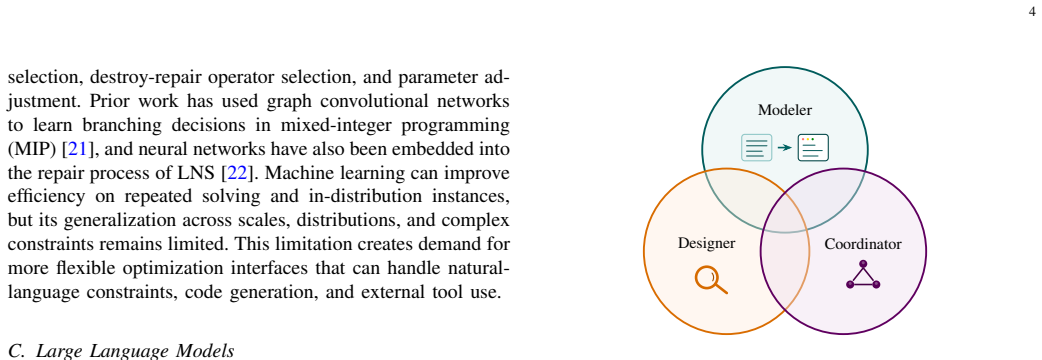
Large language models serve as modelers, designers, or coordinators when applied to vehicle routing problems.
A machine-rendered reading of the paper's core claim, the machinery that carries it, and where it could break.
Core claim
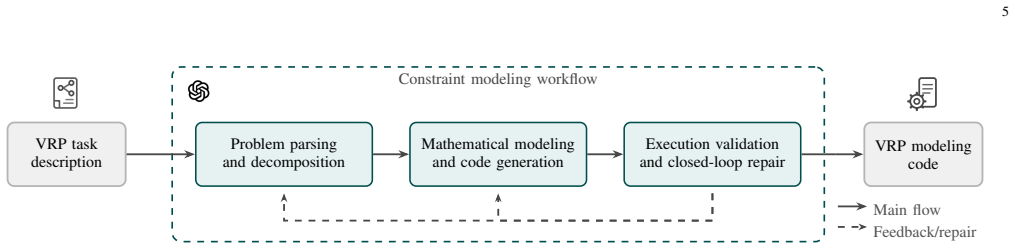
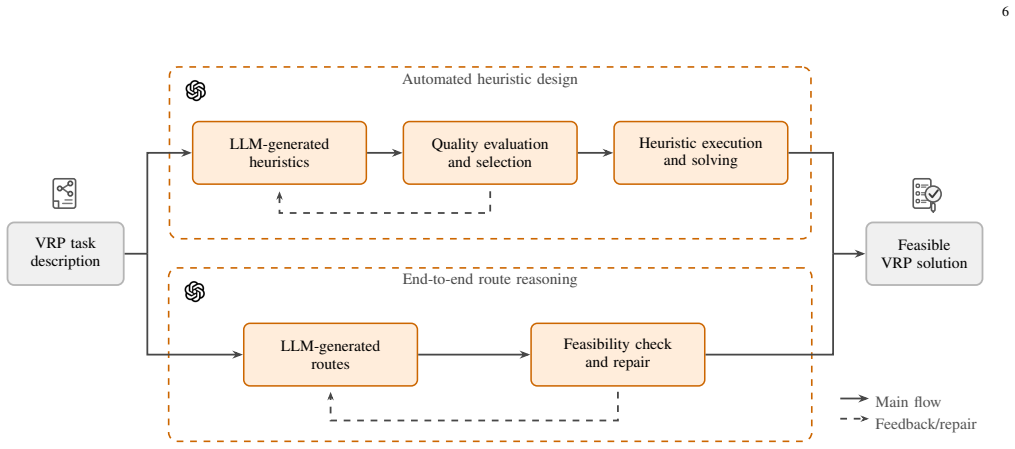
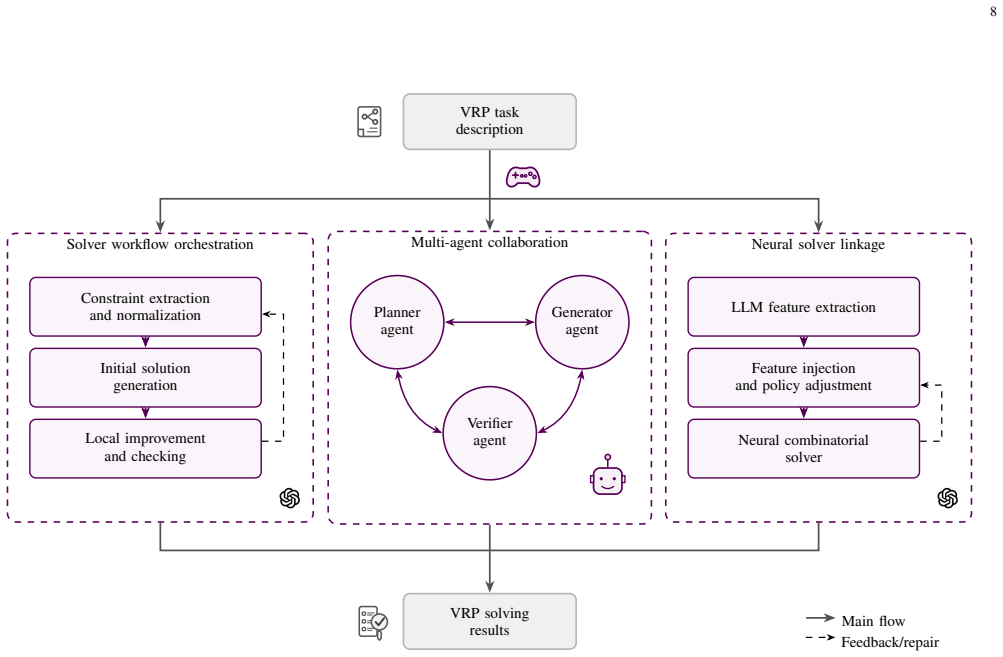
The paper establishes that LLM-driven VRP research can be organized into three roles: modelers that translate natural-language requirements into constraints and modeling code, designers that generate heuristics, operators, or route plans, and coordinators that organize tool calls, multi-agent collaboration, and connections with neural solvers. The survey also covers standard benchmarks, operational datasets, LLM-oriented evaluation frameworks, and comparative experiments to support this organization.
What carries the argument
The three-role categorization (modeler, designer, coordinator) that classifies how LLMs contribute to VRP research and organizes the landscape of studies.
If this is right
- Future work can systematically target gaps in the modeler role for handling intricate operational constraints.
- Designers can focus on generating effective heuristics that compete with classical methods on NP-hard instances.
- Coordinators enable tighter integration between LLMs and existing neural or exact solvers for practical use.
- Standardized benchmarks and evaluation frameworks can compare performance across the three roles.
- The structure provides a reference point for advancing intelligent decision-making in manufacturing and automation.
Where Pith is reading between the lines
- The same role division could be tested on other combinatorial problems such as scheduling or facility location.
- Multi-role LLM systems might allow a single model to switch between translation, planning, and coordination within one routing session.
- Real-world logistics datasets could be used to measure whether coordinator-style LLM setups reduce response time to dynamic requests.
- Industrial users without optimization expertise might rely more on modeler LLMs to formulate problems directly from descriptions.
Load-bearing premise
The three-role categorization accurately and comprehensively captures the main contributions in LLM-driven VRP research without significant gaps or overlaps.
What would settle it
A review that finds multiple published LLM-VRP studies that cannot be placed into the modeler, designer, or coordinator roles would undermine the central organization.
Figures
read the original abstract
The vehicle routing problem (VRP) is a central optimization problem in artificial intelligence, logistics automation, transportation scheduling, and industrial decision-making. VRP and its variants are NP-hard, and practical routing tasks often combine time windows, vehicle capacities, pickup-and-delivery relations, dynamic requests, and other operational constraints, making both modeling and solving difficult. Large language models (LLMs) provide a flexible interface for routing optimization by processing natural-language requirements, generating code, reasoning over constraints, and interacting with external tools. This survey reviews LLM-driven research on VRP, covering the basic definition, main variants, major solver families, and LLM concepts needed for this topic. Existing studies are organized into three roles: modelers translate natural-language requirements into constraints and modeling code; designers generate heuristics, operators, or route plans; and coordinators organize tool calls, multi-agent collaboration, and connections with neural solvers. The survey also reviews standard benchmarks, real or near-real operational datasets, LLM-oriented evaluation frameworks, and two comparative experiments. The goal is to clarify current progress in LLM-assisted routing optimization and provide a structured reference for intelligent decision-making, advanced manufacturing, and industrial automation.
Editorial analysis
A structured set of objections, weighed in public.
Referee Report
Summary. The manuscript is a survey on the intersection of the Vehicle Routing Problem (VRP) and large language models (LLMs). It covers VRP definitions and variants, major solver families, core LLM concepts, organizes existing studies into three roles (modelers that translate natural-language requirements into constraints and code; designers that generate heuristics, operators, or route plans; coordinators that organize tool calls, multi-agent collaboration, and neural-solver connections), reviews standard benchmarks, operational datasets, and LLM-oriented evaluation frameworks, and reports two comparative experiments.
Significance. If the three-role taxonomy can be made robust, the survey would supply a structured reference for LLM-assisted routing optimization in logistics, advanced manufacturing, and industrial automation. The coverage of benchmarks, datasets, and experiments is a concrete strength that could help researchers identify evaluation standards.
major comments (1)
- [Section organizing existing studies into three roles] The section that introduces and applies the three-role categorization (modelers, designers, coordinators) provides no explicit assignment criteria, decision tree, or overlap analysis. Because many LLM-VRP tasks (e.g., an LLM that emits PyVRP-style modeling code that also contains custom operators and external solver calls) simultaneously perform modeling, heuristic generation, and tool coordination, the claimed partitioning is vulnerable to non-exclusive or subjective placement of the same papers, undermining the central organizational claim.
minor comments (1)
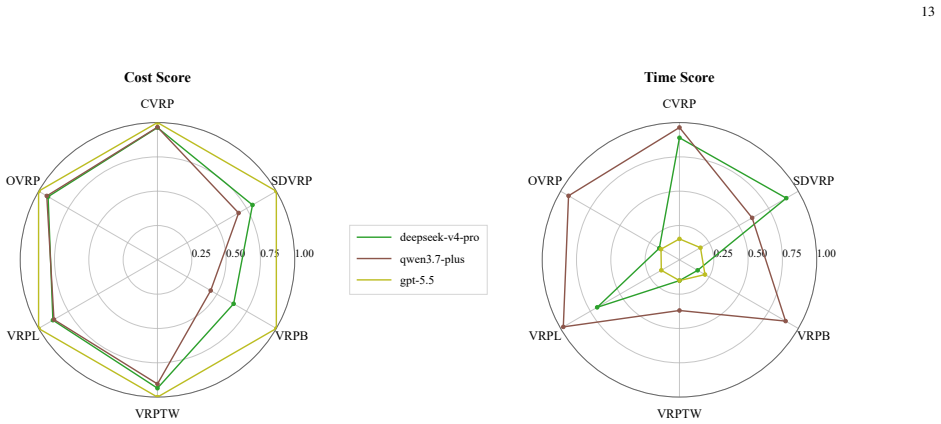
- [Section describing the comparative experiments] The description of the two comparative experiments would benefit from an explicit statement of the evaluation metrics, baseline LLMs, and VRP instances used, so readers can assess reproducibility.
Simulated Author's Rebuttal
We thank the referee for the constructive feedback on our survey. We address the major comment below and will revise the manuscript to strengthen the presentation of the taxonomy.
read point-by-point responses
-
Referee: The section that introduces and applies the three-role categorization (modelers, designers, coordinators) provides no explicit assignment criteria, decision tree, or overlap analysis. Because many LLM-VRP tasks (e.g., an LLM that emits PyVRP-style modeling code that also contains custom operators and external solver calls) simultaneously perform modeling, heuristic generation, and tool coordination, the claimed partitioning is vulnerable to non-exclusive or subjective placement of the same papers, undermining the central organizational claim.
Authors: We appreciate the referee's observation. The three-role taxonomy is intended as a high-level conceptual framework to organize the literature according to the dominant function of the LLM in each study, rather than as a set of mutually exclusive partitions. We agree, however, that the absence of explicit assignment criteria and overlap analysis leaves the framework open to the subjectivity concerns raised. In the revised manuscript we will add a dedicated subsection that (i) states the primary classification criteria (the main intended contribution of the LLM as described by the authors of each paper), (ii) supplies a concise decision flowchart for assignment, and (iii) discusses representative overlap cases, including hybrid modeling-plus-design examples, with explicit placement rationales. These additions will make the organizational claim more robust without altering the surveyed content. revision: yes
Circularity Check
Survey paper exhibits no circularity; taxonomy is organizational, not derived.
full rationale
This is a literature survey with no equations, derivations, predictions, or fitted quantities. The three-role categorization (modelers, designers, coordinators) is presented as a review structure for organizing existing studies rather than a result obtained from any self-referential definition, self-citation chain, or input-to-output reduction. No load-bearing steps reduce to the paper's own inputs by construction, satisfying the default expectation for non-circular survey work.
Axiom & Free-Parameter Ledger
Reference graph
Works this paper leans on
-
[1]
Machine learning for combinato- rial optimization: A methodological tour d’horizon,
Y . Bengio, A. Lodi, and A. Prouvost, “Machine learning for combinato- rial optimization: A methodological tour d’horizon,”European Journal of Operational Research, vol. 290, no. 2, pp. 405–421, 2021
2021
-
[2]
Language models are few-shot learners,
T. Brown, B. Mann, N. Ryder, M. Subbiah, J. D. Kaplan, P. Dhariwal, A. Neelakantanet al., “Language models are few-shot learners,” in Advances in Neural Information Processing Systems (NeurIPS), vol. 33, 2020, pp. 1877–1901
2020
-
[3]
Evaluating Large Language Models Trained on Code
M. Chen, J. Tworek, H. Jun, Q. Yuan, H. P. d. O. Pintoet al., “Evaluating large language models trained on code,”arXiv preprint arXiv:2107.03374, 2021
work page internal anchor Pith review Pith/arXiv arXiv 2021
-
[4]
A systematic survey on large language models for algorithm design,
F. Liu, Y . Yao, P. Guo, Z. Yang, Z. Zhao, X. Lin, X. Tong, M. Yuan, Z. Lu, Z. Wanget al., “A systematic survey on large language models for algorithm design,”arXiv preprint arXiv:2410.14716, 2024
-
[5]
Large Language Models for Operations Research: A Comprehensive Survey
X. Xiu, J. Li, J. Zhang, Y . Zheng, N. Wang, Y . Xue, T. Liu, J. Tang, and Y . Li, “Large language models for operations research: A comprehensive survey,”arXiv preprint arXiv:2605.20849, 2026
work page internal anchor Pith review Pith/arXiv arXiv 2026
-
[6]
Large language models in opera- tions research: Methods, applications, and challenges,
K. Wang, Z. Wan, Z. Jiao, S. Y . Chang, J. Ning, L. Zhang, J. Duan, Z. Guo, Q. Zhou, S. Yanget al., “Large language models in opera- tions research: Methods, applications, and challenges,”arXiv preprint arXiv:2509.18180, 2025
-
[7]
A structured review of large language models in metaheuristic optimisation,
S. Ghanbarzadeh, P. Sumari, and R. Vinuesa, “A structured review of large language models in metaheuristic optimisation,”Machine Learning with Applications, vol. 22, p. 100740, 2025
2025
-
[8]
Route optimization reimagined: Multi-modal large language models for next- generation vehicle routing,
S. Y . Albalkhi, D. F. Alotaibi, T. Dimitriou, and I. Ahmad, “Route optimization reimagined: Multi-modal large language models for next- generation vehicle routing,”IEEE Access, 2026
2026
-
[9]
The truck dispatching problem,
G. B. Dantzig and J. H. Ramser, “The truck dispatching problem,” Management Science, vol. 6, no. 1, pp. 80–91, 1959
1959
-
[10]
Stronger multi-commodity flow formulations of the Capacitated Vehicle Routing Problem,
A. N. Letchford and J. J. Salazar-Gonz ´alez, “Stronger multi-commodity flow formulations of the Capacitated Vehicle Routing Problem,”Euro- pean Journal of Operational Research, vol. 244, no. 3, pp. 730–738, 2015
2015
-
[11]
Fifty years of vehicle routing,
G. Laporte, “Fifty years of vehicle routing,”Transportation Science, vol. 43, no. 4, pp. 408–416, 2009
2009
-
[12]
A general heuristic for vehicle routing problems,
D. Pisinger and S. Ropke, “A general heuristic for vehicle routing problems,”Computers & Operations Research, vol. 34, no. 8, pp. 2403– 2435, 2007
2007
-
[13]
An adaptive large neighborhood search heuristic for the pickup and delivery problem with time windows,
S. Ropke and D. Pisinger, “An adaptive large neighborhood search heuristic for the pickup and delivery problem with time windows,” Transportation Science, vol. 40, no. 4, pp. 455–472, 2006
2006
-
[14]
A hybrid genetic algorithm with adaptive diversity management for a large class of vehicle routing problems with time windows,
T. Vidal, T. G. Crainic, M. Gendreau, and C. Prins, “A hybrid genetic algorithm with adaptive diversity management for a large class of vehicle routing problems with time windows,”Computers & Operations Research, vol. 40, no. 1, pp. 475–489, 2013
2013
-
[15]
Pointer networks,
O. Vinyals, M. Fortunato, and N. Jaitly, “Pointer networks,” inAdvances in Neural Information Processing Systems (NeurIPS), vol. 28, 2015
2015
-
[16]
Attention, learn to solve routing problems!
W. Kool, H. van Hoof, and M. Welling, “Attention, learn to solve routing problems!” inInternational Conference on Learning Representations (ICLR), 2019
2019
-
[17]
POMO: Policy optimization with multiple optima for reinforcement learning,
Y .-D. Kwon, J. Choo, B. Kim, I. Yoon, Y . Gwon, and S. Min, “POMO: Policy optimization with multiple optima for reinforcement learning,” in Advances in Neural Information Processing Systems (NeurIPS), vol. 33, 2020
2020
-
[18]
Sym-NCO: Leveraging symmetricity for neural combinatorial optimization,
M. Kim, J. Park, and J. Park, “Sym-NCO: Leveraging symmetricity for neural combinatorial optimization,” inAdvances in Neural Information Processing Systems (NeurIPS), vol. 35, 2022
2022
-
[19]
Neural combinatorial optimization with heavy decoder: Toward large scale generalization,
F. Luo, X. Lin, F. Liu, Q. Zhang, and Z. Wang, “Neural combinatorial optimization with heavy decoder: Toward large scale generalization,” in Advances in Neural Information Processing Systems (NeurIPS), vol. 36, 2023. 15
2023
-
[20]
RouteFinder: Towards foundation models for vehicle routing problems,
F. Berto, C. Hua, N. G. Zepeda, A. Hottung, N. Wouda, L. Lan, J. Park, K. Tierney, and J. Park, “RouteFinder: Towards foundation models for vehicle routing problems,”Transactions on Machine Learning Research (TMLR), 2025
2025
-
[21]
Exact combinatorial optimization with graph convolutional neural networks,
M. Gasse, D. Chetelat, N. Ferroni, L. Charlin, and A. Lodi, “Exact combinatorial optimization with graph convolutional neural networks,” inAdvances in Neural Information Processing Systems (NeurIPS), vol. 32, 2019
2019
-
[22]
Neural large neighborhood search for the capacitated vehicle routing problem,
A. Hottung and K. Tierney, “Neural large neighborhood search for the capacitated vehicle routing problem,” inEuropean Conference on Artificial Intelligence (ECAI), 2020, pp. 443–450
2020
-
[23]
Progress in neural NLP: Modeling, learning, and reasoning,
M. Zhou, N. Duan, S. Liu, and H.-Y . Shum, “Progress in neural NLP: Modeling, learning, and reasoning,”Engineering, vol. 6, no. 3, pp. 275– 290, 2020
2020
-
[24]
Attention is all you need,
A. Vaswani, N. Shazeer, N. Parmar, J. Uszkoreit, L. Jones, A. N. Gomez, Ł. Kaiser, and I. Polosukhin, “Attention is all you need,” inAdvances in Neural Information Processing Systems (NeurIPS), vol. 30, 2017
2017
-
[25]
Recent advances in natural language processing via large pre-trained language models: A survey,
B. Min, H. Ross, E. Sulem, A. P. B. Veyseh, A. Bhattacharjee, A. Cattan, S. Yoon, Y . Kwon, Y . Hsuet al., “Recent advances in natural language processing via large pre-trained language models: A survey,”ACM Computing Surveys, vol. 56, pp. 1–40, 2023
2023
-
[26]
How abilities in large language models are affected by supervised fine-tuning data composition,
G. Dong, H. Yuan, K. Luet al., “How abilities in large language models are affected by supervised fine-tuning data composition,”arXiv preprint arXiv:2310.05492, 2023
-
[27]
Training language models to follow instructions with human feedback,
L. Ouyang, J. Wu, X. Jiang, D. Almeida, C. Wainwright, P. Mishkin, C. Zhang, S. Agarwal, K. Slama, A. Rayet al., “Training language models to follow instructions with human feedback,” inAdvances in Neural Information Processing Systems (NeurIPS), vol. 35, 2022, pp. 27 730–27 744
2022
-
[28]
GPT-4 technical report,
OpenAI, “GPT-4 technical report,” OpenAI, Tech. Rep., 2023
2023
-
[29]
A. Yang, B. Yang, B. Zhang, B. Hui, B. Zheng, B. Yu, C. Li, D. Liu, F. Huang, H. Weiet al., “Qwen2.5 technical report,”arXiv preprint arXiv:2412.15115, 2024
work page internal anchor Pith review Pith/arXiv arXiv 2024
-
[30]
DeepSeek-R1: Incentivizing Reasoning Capability in LLMs via Reinforcement Learning
DeepSeek-AI, “DeepSeek-R1: Incentivizing reasoning capability in LLMs via reinforcement learning,”arXiv preprint arXiv:2501.12948, 2025
work page internal anchor Pith review Pith/arXiv arXiv 2025
-
[31]
LoRA: Low-Rank Adaptation of Large Language Models
E. J. Hu, Y . Shen, P. Wallis, Z. Allen-Zhuet al., “LoRA: Low-rank adaptation of large language models,”arXiv preprint arXiv:2106.09685, 2022
work page internal anchor Pith review Pith/arXiv arXiv 2022
-
[32]
OptiMUS: Optimization modeling using MIP solvers and large language models,
A. AhmadiTeshnizi, W. Gao, and M. Udell, “OptiMUS: Optimization modeling using MIP solvers and large language models,”arXiv preprint arXiv:2310.06116, 2023
-
[33]
OptiMUS: Scalable opti- mization modeling with (MI)LP solvers and large language models,
A. Ahmaditeshnizi, W. Gao, and M. Udell, “OptiMUS: Scalable opti- mization modeling with (MI)LP solvers and large language models,” in International Conference on Machine Learning (ICML), 2024
2024
-
[34]
Solving general natural-language-description optimization problems with large language models,
J. Zhang, W. Wang, S. Guo, L. Wang, F. Lin, C. Yang, and W. Yin, “Solving general natural-language-description optimization problems with large language models,” inthe 2024 Conference of the North American Chapter of the Association for Computational Linguistics: Human Language Technologies (Volume 6: Industry Track), 2024, pp. 483–490
2024
-
[35]
ORMind: A cognitive-inspired end-to-end reasoning framework for operations research,
Z. Wang, B. Chen, Y . Huang, Q. Cao, M. He, J. Fan, and X. Liang, “ORMind: A cognitive-inspired end-to-end reasoning framework for operations research,” inthe 63rd Annual Meeting of the Association for Computational Linguistics (Volume 6: Industry Track), 2025, pp. 104–131
2025
-
[36]
ORLM: A customizable framework in training large models for automated optimization modeling,
C. Huang, Z. Tang, S. Hu, R. Jiang, X. Zheng, D. Ge, B. Wang, and Z. Wang, “ORLM: A customizable framework in training large models for automated optimization modeling,”Operations Research, vol. 73, no. 6, pp. 2986–3009, 2025
2025
-
[37]
LLaMoCo: Instruction tuning of large language models for optimization code generation,
Z. Ma, H. Guo, J. Chen, G. Peng, Z. Cao, Y . Ma, and Y .-J. Gong, “LLaMoCo: Instruction tuning of large language models for optimization code generation,”arXiv preprint arXiv:2403.01131, 2024
-
[38]
Op- timAI: Optimizing optimization problems with AI,
R. Thind, V . Vashishtha, J. Umenberger, and K. H. Johansson, “Op- timAI: Optimizing optimization problems with AI,”arXiv preprint arXiv:2504.16918, 2025
-
[39]
AlphaOPT: Formulating Optimization Programs with Self-Improving LLM Experience Library
X. Kong, W. Ning, H. Wu, and Y . Zheng, “AlphaOPT: Formulating optimization programs with self-improving LLM experience library,” arXiv preprint arXiv:2510.18428, 2025
work page internal anchor Pith review Pith/arXiv arXiv 2025
-
[40]
OptiTree: Hierarchical thoughts generation with tree search for LLM optimization modeling,
H. Liu, J. Wang, Y . Cai, X. Han, Y . Kuang, and J. Hao, “OptiTree: Hierarchical thoughts generation with tree search for LLM optimization modeling,” inAdvances in Neural Information Processing Systems (NeurIPS), 2025
2025
-
[41]
OR-R1: Automating modeling and solving of operations research optimization problem via test-time re- inforcement learning,
Z. Ding, Z. Tan, J. Zhang, and T. Chen, “OR-R1: Automating modeling and solving of operations research optimization problem via test-time re- inforcement learning,” inthe AAAI Conference on Artificial Intelligence, 2026
2026
-
[42]
To the Globe (TTG): Towards language-driven guaranteed travel planning,
D. Ju, S. Jiang, A. Cohen, A. Foss, S. Mitts, A. Zharmagambetov, B. Amos, X. Li, J. T. Kao, M. Fazel-Zarandi, and Y . Tian, “To the Globe (TTG): Towards language-driven guaranteed travel planning,” inthe 2024 Conference on Empirical Methods in Natural Language Processing: System Demonstrations, 2024
2024
-
[43]
DRoC: Elevating large language models for complex vehicle routing via decomposed retrieval of constraints,
X. Jiang, Y . Wu, C. Zhang, and Y . Zhang, “DRoC: Elevating large language models for complex vehicle routing via decomposed retrieval of constraints,” inInternational Conference on Learning Representations (ICLR), 2025
2025
-
[44]
ORThought: Benchmarking and automating logis- tics optimization modeling with structured LLM reasoning,
Y . Yang, Y . Li, Z. Xiong, H. Tian, Q. Su, X. Wang, D. Wu, F. He, Y . Yin, X. Yeet al., “ORThought: Benchmarking and automating logis- tics optimization modeling with structured LLM reasoning,”Artificial Intelligence for Transportation, vol. 6, p. 100059, 2026
2026
-
[45]
Algorithm evolution using large language model,
F. Liu, X. Lin, Q. Zhang, K. C. Tan, and S. Kwong, “Algorithm evolution using large language model,”arXiv preprint arXiv:2311.15249, 2023
-
[46]
Mathematical discoveries from program search with large language models,
B. Romera-Paredes, M. Barekatain, A. Novikov, M. Balog, M. P. Kumar, E. Dupontet al., “Mathematical discoveries from program search with large language models,”Nature, vol. 625, pp. 468–475, 2024
2024
-
[47]
Evolution of heuristics: Towards efficient automatic algorithm design using large language model,
F. Liu, X. Tong, M. Yuan, X. Lin, F. Luo, Z. Wang, Z. Lu, and Q. Zhang, “Evolution of heuristics: Towards efficient automatic algorithm design using large language model,” inInternational Conference on Machine Learning (ICML), 2024
2024
-
[48]
ReEvo: Large language models as hyper-heuristics with reflective evolution,
H. Ye, J. Wang, Z. Cao, F. Berto, C. Hua, H. Kim, J. Park, and G. Song, “ReEvo: Large language models as hyper-heuristics with reflective evolution,” inAdvances in Neural Information Processing Systems (NeurIPS), 2024
2024
-
[49]
Monte carlo tree search for comprehensive exploration in LLM-based automatic heuristic design,
Z. Zheng, Z. Xie, Z. Wang, and B. Hooi, “Monte carlo tree search for comprehensive exploration in LLM-based automatic heuristic design,” inInternational Conference on Machine Learning (ICML), 2025, pp. 78 338–78 373
2025
-
[50]
HSEvo: Elevating automatic heuristic design with diversity-driven harmony search and genetic algo- rithm using LLMs,
P. V . T. Dat, L. Doan, and H. T. T. Binh, “HSEvo: Elevating automatic heuristic design with diversity-driven harmony search and genetic algo- rithm using LLMs,” inAAAI Conference on Artificial Intelligence, 2025, pp. 26 931–26 938
2025
-
[51]
Multi-objective evolution of heuristic using large language model,
S. Yao, F. Liu, X. Linet al., “Multi-objective evolution of heuristic using large language model,” inAAAI Conference on Artificial Intelligence, 2025, pp. 27 144–27 152
2025
-
[52]
Automatic algorithm design assisted by LLMs for solving vehicle routing problems,
L. Ma, X. Hao, R. Yanget al., “Automatic algorithm design assisted by LLMs for solving vehicle routing problems,” inInternational Conference on Signal Processing (ICSP), 2024, pp. 247–252
2024
-
[53]
VRPAgent: LLM-driven discovery of heuristic operators for vehicle routing problems,
A. Hottung, F. Berto, C. Hua, H. Ye, H. Kim, J. Park, and K. Tierney, “VRPAgent: LLM-driven discovery of heuristic operators for vehicle routing problems,”arXiv preprint arXiv:2510.07073, 2025
-
[54]
M. Malik, J. Zhou, S. R. Chirra, and Z. Cao, “PyVRP+: LLM-driven metacognitive heuristic evolution for hybrid genetic search in vehicle routing problems,”arXiv preprint arXiv:2604.07872, 2026
work page internal anchor Pith review Pith/arXiv arXiv 2026
-
[55]
Enhancing CVRP Solver through LLM-driven Automatic Heuristic Design
Z. Xie, F. Liu, Z. Wang, and Q. Zhang, “Enhancing CVRP solver through LLM-driven automatic heuristic design,”arXiv preprint arXiv:2602.23092, 2026
work page internal anchor Pith review Pith/arXiv arXiv 2026
-
[56]
G-LNS: Generative large neighbor- hood search for LLM-based automatic heuristic design,
B. Zhao, H. Wang, and L. Zeng, “G-LNS: Generative large neighbor- hood search for LLM-based automatic heuristic design,”arXiv preprint arXiv:2602.08253, 2026
-
[57]
LLM-based automatic heuristic design for vehicle- drone collaborative routing problems,
H. Shi and L. Zhen, “LLM-based automatic heuristic design for vehicle- drone collaborative routing problems,”Transportation Research Part E: Logistics and Transportation Review, vol. 209, p. 104760, 2026
2026
-
[58]
LLM4AD: A platform for algorithm design with large language model,
F. Liu, R. Zhang, Z. Xie, X. Tong, M. Yuan, Q. Zhang, and X. Lin, “LLM4AD: A platform for algorithm design with large language model,” arXiv preprint arXiv:2412.17287, 2024
-
[59]
HeurAgenix: Leveraging LLMs for solving complex combinatorial optimization challenges,
X. Yang, L. Zhang, H. Qianet al., “HeurAgenix: Leveraging LLMs for solving complex combinatorial optimization challenges,”arXiv preprint arXiv:2506.15196, 2025
-
[60]
Gen- eralizable heuristic generation through LLMs with meta-optimization,
Y . Shi, J. Zhou, W. Song, J. Bi, Y . Wu, Z. Cao, and J. Zhang, “Gen- eralizable heuristic generation through LLMs with meta-optimization,” inthe International Conference on Learning Representations (ICLR), 2026
2026
-
[61]
CALM: Co- evolution of algorithms and language model for automatic heuristic design,
Z. Huang, W. Wu, K. Wu, J. Wang, and W.-B. Lee, “CALM: Co- evolution of algorithms and language model for automatic heuristic design,”arXiv preprint arXiv:2505.12285, 2025
-
[62]
Refining hybrid genetic search for CVRP via reinforcement learning-finetuned LLM,
R. Zhu, C. Zhang, and Z. Cao, “Refining hybrid genetic search for CVRP via reinforcement learning-finetuned LLM,” inthe International Conference on Learning Representations (ICLR), 2026
2026
-
[63]
A large language model-enhanced Q- Learning for capacitated vehicle routing problem with time windows,
L. Cao, M. Wang, and X. Xiong, “A large language model-enhanced Q- Learning for capacitated vehicle routing problem with time windows,” in 2025 IEEE 28th International Conference on Intelligent Transportation Systems (ITSC), 2025. 16
2025
-
[64]
From words to routes: Applying large language models to vehicle routing,
Z. Huang, G. Shi, and G. S. Sukhatme, “From words to routes: Applying large language models to vehicle routing,”arXiv preprint arXiv:2403.10795, 2024
-
[65]
ARS: Automatic routing solver with large language models,
K. Li, F. Liu, Z. Wanget al., “ARS: Automatic routing solver with large language models,”arXiv preprint arXiv:2502.15359, 2025
-
[66]
Using large language models to solve the electric vehicle routing problem with advanced prompting techniques,
U. Zafar and S. Bayhan, “Using large language models to solve the electric vehicle routing problem with advanced prompting techniques,” in2025 IEEE 19th International Conference on Compatibility, Power Electronics and Power Engineering (CPE-POWERENG), 2025
2025
-
[67]
ReAct: Synergizing reasoning and acting in language models,
S. Yao, J. Zhao, D. Yu, N. Du, I. Shafran, K. Narasimhan, and Y . Cao, “ReAct: Synergizing reasoning and acting in language models,” in International Conference on Learning Representations (ICLR), 2023
2023
-
[68]
Toolformer: Language models can teach themselves to use tools,
T. Schick, J. Dwivedi-Yu, R. Dess `ı, R. Raileanu, M. Lomeliet al., “Toolformer: Language models can teach themselves to use tools,” in Advances in Neural Information Processing Systems (NeurIPS), 2023
2023
-
[69]
AutoGPT,
T. B. Richards, “AutoGPT,” 2023, gitHub repository
2023
-
[70]
LangChain: Building applications with LLMs through com- posability,
H. Chase, “LangChain: Building applications with LLMs through com- posability,” 2022, gitHub repository
2022
-
[71]
DRAGON: LLM-driven decomposition and reconstruction agents for large-scale combinatorial optimization,
X. Chen, X. Zhang, X. Wu, C. Yang, Z. Liao, L. Li, S. Xia, F. Shi, Y . Yang, and W. Ma, “DRAGON: LLM-driven decomposition and reconstruction agents for large-scale combinatorial optimization,” inthe International Conference on Autonomous Agents and Multiagent Systems (AAMAS), 2026
2026
-
[72]
Multi-agent large language models as evolutionary optimizers for scheduling optimization,
Y . Wang, J. Wang, and Z. Chu, “Multi-agent large language models as evolutionary optimizers for scheduling optimization,”Computers & Industrial Engineering, vol. 206, p. 111197, 2025
2025
-
[73]
HMACE: Heterogeneous Multi-Agent Collaborative Evolution for Combinatorial Optimization
D. Yan, M. Xue, Z. Wang, Q. Hao, and W. Du, “HMACE: Heteroge- neous multi-agent collaborative evolution for combinatorial optimiza- tion,”arXiv preprint arXiv:2605.07214, 2026
work page internal anchor Pith review Pith/arXiv arXiv 2026
-
[74]
CORAL: Towards Autonomous Multi-Agent Evolution for Open-Ended Discovery
A. Qu, H. Zheng, Z. Zhou, Y . Yan, Y . Tang, S. Y . Ong, F. Hong, K. Zhou, C. Jiang, M. Kong, J. Zhu, X. Jiang, S. Li, C. Wu, B. K. H. Low, J. Zhao, and P. P. Liang, “CORAL: Towards autonomous multi-agent evolution for open-ended discovery,”arXiv preprint arXiv:2604.01658, 2026
work page internal anchor Pith review Pith/arXiv arXiv 2026
-
[75]
An agentic framework with LLMs for solving complex vehicle routing problems,
N. Zhang, Z. Cao, J. Zhou, C. Zhang, and Y .-S. Ong, “An agentic framework with LLMs for solving complex vehicle routing problems,” inInternational Conference on Learning Representations (ICLR), 2026
2026
-
[76]
Large language models powered neural solvers for generalized vehicle routing problems,
C. D. Tran, Q. Nguyen-Tri, H. T. T. Binh, and H. Thanh-Tung, “Large language models powered neural solvers for generalized vehicle routing problems,” inICLR 2025 Workshop on Towards Agentic AI for Science, 2025
2025
-
[77]
LLMAide: Language-assisted neural solver for vehicle routing problems,
M. Malik, J. Zhou, Y . Jin, and Z. Cao, “LLMAide: Language-assisted neural solver for vehicle routing problems,” inthe International Confer- ence on Autonomous Agents and Multiagent Systems (AAMAS) Extended Abstracts, 2026
2026
-
[78]
URS: A Unified Neural Routing Solver for Cross-Problem Zero-Shot Generalization
C. Zhou, C. Yu, S. Yao, X. Lin, Z. Wang, Y . Zhou, and Q. Zhang, “URS: A unified neural routing solver for cross-problem zero-shot generalization,”arXiv preprint arXiv:2509.23413, 2025
work page internal anchor Pith review Pith/arXiv arXiv 2025
-
[79]
A generalized neural solver based on LLM- guided heuristic evoluation framework for solving diverse variants of vehicle routing problems,
M. Chi, W. Pang, X. Wu, P. Zhao, Y . Li, T. Wang, J. Qian, Y . Xiao, L. Wang, and Y . Zhou, “A generalized neural solver based on LLM- guided heuristic evoluation framework for solving diverse variants of vehicle routing problems,”Expert Systems with Applications, vol. 296, no. Part A, p. 128876, 2026
2026
-
[80]
A universal framework for vehicle routing problems with large language models,
R.-B. Zeng, M.-X. Yang, M.-L. Lei, L.-F. Niu, and Y .-H. Dai, “A universal framework for vehicle routing problems with large language models,”Journal of the Operations Research Society of China, 2026
2026
discussion (0)
Sign in with ORCID, Apple, or X to comment. Anyone can read and Pith papers without signing in.