REVIEW 3 major objections 4 minor 38 references
MindMemOS: A Portable and Self-Evolving Memory Operating Layer for AI Agents
T0 review · 3 major / 4 minor · reviewed 2026-08-16 · deepseek-v4-flash
Pith's one-line read Agent memory can be made self-evolving by storing facts as entity-property-time records and revising schemas, conflicts, and skills from usage.
desk verdict A credible integrated memory system, but the headline LOCOMO claim rests on imported baselines and a sub-point margin that needs verification before I'd repeat it. read the letter →
The pith
A machine-rendered reading of the paper's core claim, the machinery that carries it, and where it could break.
The reading
What carries the argument
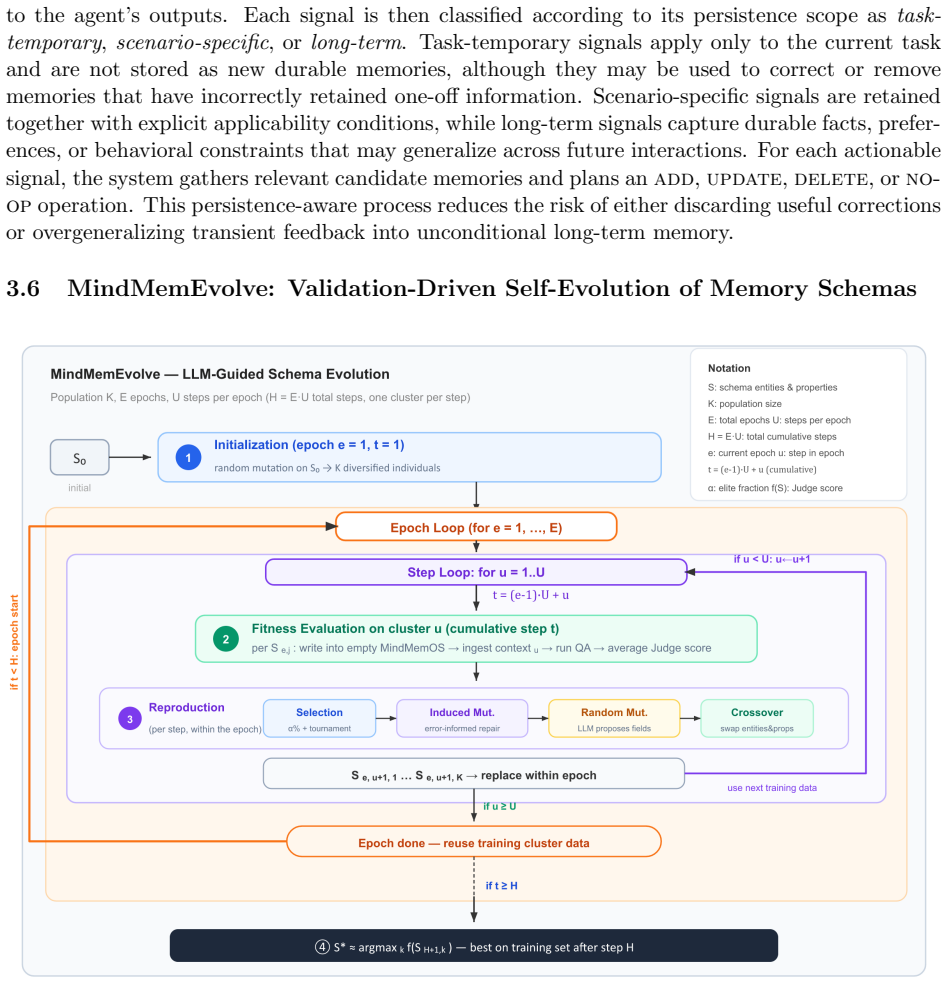
The load-bearing object is the three-dimensional entity–property–time memory structure, where each memory record binds an entity to a property and a temporal reference, with relational edges between entities and timeline edges between successive property versions. This structure is what makes the other mechanisms possible: it gives a stable interface for adding, searching, and mutating memories, and it lets conflicts be represented as competing versions on a timeline rather than as overwrites. The paper's named algorithms are routes through this interface: MindMemEvolve (an LLM-guided evolutionary search over schema definitions, with induced mutation from judge errors), dreaming (offline entity-centered consolidation that archives superseded memories and records supersedes edges), feedback (explicit and implicit correction-to-action conversion with persistence scoping), and MindSkillEvolve (trajectory analysis into versioned skill edits, with a score-supervised variant). The compact search module ties them to queries by hybrid BM25 plus dense retrieval, bidirectional graph traversal, and an agentic controller that decides when enough evidence has been collected.
What would settle it
Re-run the four LOCOMO reasoning types with EverOS, Mem0, memU, Zep, and MemOS inside the authors' own evaluation harness, using identical prompt templates and judge model on the same question subset. If 94.03% no longer beats 93.05% by a stable margin, the claimed superiority is an evaluation artifact; if it persists, the comparison stands.
Extended reading notes
Core claim
MindMemOS claims that memory quality in LLM agents is itself a designable and optimizable layer, not a fixed store. It organizes all memories as nodes in a three-dimensional graph (entity × property × time), so a fact is always bound to what it is about, which attribute it describes, and when it holds; this lets the system keep timelines instead of overwriting history. On top of that representation, four evolution mechanisms operate: MindMemEvolve uses validation-driven evolutionary search to rewrite the schema (expanding 2 properties to 49 in a PersonaMem case, with held-out accuracy rising from 61.07% to 64.63%); dreaming merges redundant and contradictory records offline and archives obsolete ones; feedback converts user corrections into persistent or task-temporary memory edits; and MindSkillEvolve turns execution trajectories into versioned skill updates. The paper reports that this combination achieves the best overall accuracy on LOCOMO (94.03) and PersonaMem (70.63) among the compared systems, improves FactConsolidation accuracy on MemoryAgentBench under two models, and raises SpreadsheetBench success by up to 5.9 points over the no-skill baseline.
Load-bearing premise
The LOCOMO superiority claim depends on the baseline numbers taken from the EverOS paper being produced by the same protocol, prompt templates, judge model, answer model, and question subset; if they are not, the 0.98-point lead could be an artifact.
Editorial extensions
If this is right
- If the reported evaluations hold, a schema-guided memory layer can outperform hand-tuned memory systems on very long conversational memory without retraining the agent; the 94.03% LOCOMO overall and 82.29% open-domain scores are the concrete manifest.
- Dreaming gives a measurable win on selective-forgetting tasks: it raises overall FactConsolidation accuracy (for example, 0.377 to 0.459 with gpt-4o-mini) while moving roughly one fifth of active memories to archive, so consolidation and compression can coexist with better retrieval.
- Trajectory-derived skills are sufficient to improve downstream task success even without task scores (55.3% vs 51.3% no-skill on SpreadsheetBench), and adding scores tightens the rules further (57.2%).
- Because the same structure supports both schema-free MindVanilla and schema-guided MindSchema, portability and adaptivity are not in tension: one layer can span both modes behind a single API.
- Schema evolution generalizes to held-out data in the reported PersonaMem split (61.07% to 64.63%), so the optimized schema is not merely overfitting the training clusters.
Reading between the lines
- A testable extension the paper does not run: the same evolutionary loop that rewrites schemas could also tune retrieval depth, consolidation frequency, or feedback sensitivity, since all of them sit behind the same memory interface.
- The unevolved initial skill's underperformance suggests a bootstrapping constraint: self-evolution helps only if the starting skill is validated, a design problem the paper documents but does not elevate into a headline result.
- Dreaming turns timestamp comparison into persistent supersedes edges; an untested corollary is that the same mechanism could resolve non-temporal conflicts, such as changed preferences across sessions, where the current evidence is limited to one illustrative case.
- MindVanilla's 87.60 vs MindSchema's 94.03 on LOCOMO indicates schema guidance is a major source of the gain; a clean ablation would separate modeling from retrieval, which the paper's evaluations do not fully isolate.
Signed reviews
Editorial analysis
A structured set of objections, weighed in public.
Referee Report
Summary. MindMemOS proposes a portable memory operating layer for LLM agents, built on an entity–property–time graph, with four self-adaptation mechanisms: MindMemEvolve (evolutionary schema search), dreaming (offline memory consolidation), feedback (explicit and implicit correction handling), and MindSkillEvolve (trajectory-driven skill refinement). The system is evaluated on LOCOMO, PersonaMem, MemoryAgentBench (FactConsolidation), and SpreadsheetBench, reporting 94.03% on LOCOMO, 70.63% on PersonaMem, dreaming gains up to +0.084 accuracy with ~20% compression, and a 5.9–9.2 percentage-point skill-evolution improvement over no-skill/initial-skill baselines. The paper also includes case studies and full appendix schemas and skill contents. The central claims are empirically evaluated against public benchmarks; the LOCOMO SOTA claim, however, rests on baselines imported from a prior paper.
Significance. If the headline results are robust, MindMemOS is a useful engineering contribution: it unifies schema-guided and schema-free memory, adds a plausible evolutionary schema optimizer, and demonstrates that offline consolidation and skill evolution improve downstream task success. The paper ships a code repository, provides complete schema and skill definitions in appendices, and reports within-system before/after dreaming comparisons, which are not circular. The MindMemEvolve evaluation is held-out with training-set selection, which is methodologically sound. The main significance is bounded by evaluation gaps: the LOCOMO SOTA margin is small and imported, and several tables lack error bars or significance tests. The contributions are credible but not yet fully established as stated.
major comments (3)
- [Section 4.1, Table 1] The headline LOCOMO claim (MindSchema 94.03 vs EverOS 93.05) rests on baselines 'cited from the EverOS paper' and on a subset of 'four main reasoning types' whose exact composition is not reported. The paper states that the configuration is 'fully aligned with the EverOS default implementation,' but it does not provide the evidence needed to verify alignment: the prompt templates used for baselines, the identity of the LLM driving the memory system, the judge prompt, or the per-category question counts in the four-type subset. Since the margin is 0.98 points, the abstract-level state-of-the-art claim depends on this imported comparison. Please either rerun the baselines in the same harness under the authors' control or provide a detailed protocol-matching appendix, and report error bars or a significance test.
- [Section 4.1, Table 2] The PersonaMem baselines are run locally, which is better than importing numbers, but the table still lacks error bars or significance tests. The overall gain is 70.63 vs 67.57 (3.06 points), and the per-category column 'Recall Mem.' contains only 17 questions, so a difference of one or two answers can swing category-level accuracy by several points. The paper's own note about this small category undermines confidence that the reported overall advantage is robust. Please report variance (e.g., multiple runs or bootstrap confidence intervals) and a significance test, or moderate the claim of 'best overall accuracy.'
- [Section 5.3, Figure 14] The evidence for MindMemEvolve, a central contribution, is a single held-out benchmark with a 3.56-point improvement, and the paper itself states that PersonaMem is not a 'sensitivity-demanding' scenario and that the search space explored in 60 steps may be limited. The evolved schema expands to 49 properties, but this is presented only on one dataset with one bootstrap schema. Because the contribution is framed as a general self-adaptation mechanism, a single modest result is insufficient to support that generality. Please add at least one additional scenario or benchmark for MindMemEvolve, or explicitly reframe the contribution as a preliminary demonstration on PersonaMem.
minor comments (4)
- [Table 1] The column header 'T emporal' has a spacing typo; it should read 'Temporal.'
- [References] The text refers to 'EverOS' but reference [10] lists 'EverMemOS'; please make the naming consistent throughout.
- [Appendix A] The JSON schema in Appendix A contains '//' comments, which are not valid JSON; either remove them or clearly label the block as a schema illustration rather than a parseable file.
- [Section 5.2] The feedback case study is forthrightly labeled as a single-instance demonstration, which is good; a brief sentence about generality would help but is not required.
Circularity Check
Dreaming's FactConsolidation gain is partly by construction via the benchmark's own temporal-supersede rule; headline LOCOMO/PersonaMem claims remain independent.
-
self definitional
[Section 4.2 (Dreaming Evaluation) and Section 5.1 (Dreaming case study)]
"The benchmark treats the later fact as the valid memory and asks questions that require the agent to answer according to the final consolidated state. ... Since M1 was ingested later than M2, the planner applies the benchmark’s temporal supersede rule and selects M1 as the authoritative active memory."
MemoryAgentBench's FactConsolidation ground truth is defined by temporal recency: the later fact is the valid memory. Dreaming's planner is explicitly described as applying the benchmark's own temporal supersede rule to archive the earlier fact. The reported accuracy gains (e.g., overall 0.377 to 0.459 with gpt-4o-mini, and 0.545 to 0.585 with gpt-5-mini) therefore follow in part from encoding the evaluation's correctness definition into the algorithm. The result is not wholly forced because conflict detection, entity scoping, and retrieval still require empirical work, so the circularity is localized and disclosed rather than a collapse of the paper's main claims.
full rationale
The central evaluations are empirically self-contained. LOCOMO and PersonaMem are external benchmarks; baseline numbers are cited from the EverOS paper, and MindMemOS's own configuration is claimed to be aligned with EverOS's defaults, which is a verification concern rather than a circular derivation. MindMemEvolve optimizes schemas on a training subset (196 QA pairs) and reports a held-out test-set gain (bootstrap 61.07% vs. evolved 64.63%), which is a legitimate generalization protocol. MindSkillEvolve is a behavioral before/after on SpreadsheetBench with repeated runs and fixed task suites. The authors' self-citations [15,16] are used only to motivate the existence of memory-maintenance challenges and are not load-bearing for the reported performance numbers. The single localized circular element is the dreaming experiment on MemoryAgentBench's FactConsolidation subset, where the planner's temporal-supersede action rule is the same rule that defines the benchmark's ground truth; the improvement there is partly by construction. Because this affects one supporting experiment rather than the headline claims, the overall circularity score is low.
Assumptions & free parameters
free parameters (5)
- PersonaMem entity modeling schema (entity modeling.json) =
user entity with custom higher-order properties
- LOCOMO evaluation subset =
four reasoning types; categories not enumerated
- MindMemEvolve hyperparameters =
E=5, U=12, K=10, alpha, p_prune, p_cross
- Dreaming configuration =
top-k=50, chunk size 4096, lookback window
- Skill evolution cycle =
trigger every 40 tasks, batch size 8
assumptions (5)
- domain assumption LLM-based Judge scores faithfully measure answer correctness in Eq. (1) and Section 3.6.
- domain assumption Baseline results cited from EverOS were produced under comparable conditions.
- domain assumption The answer model's reasoning capability is a fixed background; any errors are attributed to memory rather than model.
- domain assumption MemoryAgentBench's newer-fact-wins rule is the correct ground truth for conflict resolution.
- ad hoc to paper Evolutionary search over schemas explores a sufficiently useful space within 60 steps.
invented entities (3)
-
Episodic entity fallback
-
Higher-order property (order=2)
-
Supersedes edge
Cite this review
Pith. "Pith review of MindMemOS: A Portable and Self-Evolving Memory Operating Layer for AI Agents." pith.science (2026). https://pith.science/paper/WGVCNH4L
@misc{pith2026260812428,
  author       = {Pith},
  title        = {Pith review of: MindMemOS: A Portable and Self-Evolving Memory Operating Layer for AI Agents},
  year         = {2026},
  howpublished = {\url{https://pith.science/paper/WGVCNH4L}},
  note         = {Machine review of arXiv:2608.12428}
}
read the original abstract
Memory is a core component of AI agents, enabling them to accumulate experience, maintain personalization, and adapt over long-term interactions. However, existing memory systems often remain fixed after development, limiting their ability to adapt their memory models, organization strategies, and procedural knowledge through continued use. We present MindMemOS, a portable and self-evolving memory operating layer that organizes open-world information using a unified entity property timestructure. MindMemOS supports scenario-adaptive memory modeling, higher-order pattern discovery, autonomous memory refinement, and continuous skill evolution. Its MindMemEvolve algorithm employs validation-driven evolutionary search to optimize memory schemas for target scenarios, whiledreaming consolidates accumulated memories by merging redundant records and resolving conflicts. In addition, implicit corrective feedback serves as a human-in-the-loop signal for identifying and revising potentially inaccurate or misaligned memories. Its MindSkillEvolve algorithm further transforms agent execution trajectories into reusable and progressively refined skills. MindMemOS achieves 94.03% accuracy on LOCOMO and 70.63% on PersonaMem. MindSkillEvolve improves SpreadsheetBench success by 9.2 percentage points over the initial-skill baseline.
Figures


Figures from the paper (11 more)




Reference graph
Works this paper leans on
-
[1]
OpenCode.https://github.com/anomalyco/opencode, 2026
AnomalyCo. OpenCode.https://github.com/anomalyco/opencode, 2026
work page 2026
-
[2]
Claude Code.https://docs.anthropic.com/en/docs/claude-code/overview, 2025
Anthropic. Claude Code.https://docs.anthropic.com/en/docs/claude-code/overview, 2025
work page 2025
-
[3]
Nested Learning: The Illusion of Deep Learning Architectures
Ali Behrouz, Meisam Razaviyayn, Peilin Zhong, and Vahab Mirrokni. Nested Learning: The Illusion of Deep Learning Architectures. InAdvances in Neural Information Processing Systems 38 (NeurIPS 2025), 2025
work page 2025
-
[4]
ZenBrain: A Neuroscience-Inspired 7-Layer Memory Architecture for Autonomous AI Systems
Alexander Bering. ZenBrain: A Neuroscience-Inspired 7-Layer Memory Architecture for Au- tonomous AI Systems.https://arxiv.org/abs/2604.23878, 2026
work page Pith review arXiv 2026
-
[5]
Mem0: Building Production-Ready AI Agents with Scalable Long-Term Memory.https://arxiv
Prateek Chhikara, Dev Khant, Saket Aryan, Taranjeet Singh, and Deshraj Yadav. Mem0: Building Production-Ready AI Agents with Scalable Long-Term Memory.https://arxiv. org/abs/2504.19413, 2025
arXiv 2025
-
[6]
MemBrain: Agent-Native Memory for AI Agents.https://github.com/ feelingai-team/MemBrain, 2026
FeelingAI Team. MemBrain: Agent-Native Memory for AI Agents.https://github.com/ feelingai-team/MemBrain, 2026
work page 2026
-
[7]
VikingMem: A Memory Base Management System for Stateful LLM-based Applications
Jiajie Fu, Junwen Chen, Mengzhao Wang, Aoxiang He, Maojia Sheng, Xiangyu Ke, Yifan Zhu, and Yunjun Gao. VikingMem: A Memory Base Management System for Stateful LLM-based Applications.https://arxiv.org/abs/2605.29640, 2026
work page Pith review arXiv 2026
-
[8]
LatentMem: Customizing Latent Memory for Multi-Agent Systems
Muxin Fu, Guibin Zhang, Xiang Xue, Yifan Li, Zhen He, Sheng Huang, Xiang Qu, Yiran Cheng, and Yibo Yang. LatentMem: Customizing Latent Memory for Multi-Agent Systems. https://arxiv.org/abs/2602.03036, 2026
arXiv 2026
Show all 38 references
-
[9]
From RAG to Memory: Non-Parametric Continual Learning for Large Language Models.https://arxiv
Bernal Jim´ enez Guti´ errez, Yiheng Shu, Weijian Qi, Sizhe Zhou, and Yu Su. From RAG to Memory: Non-Parametric Continual Learning for Large Language Models.https://arxiv. org/abs/2502.14802, 2025
2025 arXiv
-
[10]
EverMemOS: A Self-Organizing Memory Oper- ating System for Structured Long-Horizon Reasoning.https://arxiv.org/abs/2601.02163, 2026
Chuanrui Hu, Xingze Gao, Zuyi Zhou, et al. EverMemOS: A Self-Organizing Memory Oper- ating System for Structured Long-Horizon Reasoning.https://arxiv.org/abs/2601.02163, 2026
2026
-
[11]
Evaluating Memory in LLM Agents via In- cremental Multi-Turn Interactions
Yuanzhe Hu, Yu Wang, and Julian McAuley. Evaluating Memory in LLM Agents via In- cremental Multi-Turn Interactions. InThe Fourteenth International Conference on Learning Representations, 2026
2026
-
[12]
Rethinking Memory Mechanisms of Foundation Agents in the Second Half: A Survey.https://arxiv.org/abs/2602.06052, 2026
Wei-Chieh Huang, Weizhi Zhang, Ying Liang, et al. Rethinking Memory Mechanisms of Foundation Agents in the Second Half: A Survey.https://arxiv.org/abs/2602.06052, 2026
2026
-
[13]
Infini Memory: Maintainable Topic Documents for Long-Term LLM Agent Memory.https://arxiv.org/abs/2606.10677, 2026
Suozhao Ji, Baodong Wu, Zehao Wang, Lei Xia, Qingping Li, Ruisong Wang, Wenbo Ding, Zhenhua Zhu, Boxun Li, Guohao Dai, and Yu Wang. Infini Memory: Maintainable Topic Documents for Long-Term LLM Agent Memory.https://arxiv.org/abs/2606.10677, 2026
2026 arXiv
-
[14]
Taylor, and Dan Roth
Bowen Jiang, Zhuoqun Hao, Young-Min Cho, Bryan Li, Yuan Yuan, Sihao Chen, Lyle Ungar, Camillo J. Taylor, and Dan Roth. Know Me, Respond to Me: Benchmarking LLMs for Dynamic User Profiling and Personalized Responses at Scale.https://arxiv.org/abs/2504. 14225, 2025. 26
2025
-
[15]
Retain or Consolidate? Budget-Dependent Operator Selection for Language Agent Memory.https://arxiv.org/abs/2607.17545, 2026
Qingcan Kang, Mingyang Liu, Shixiong Kai, Kaichao Liang, Zhentao Tang, Yuqi Cui, Tao Zhong, and Mingxuan Yuan. Retain or Consolidate? Budget-Dependent Operator Selection for Language Agent Memory.https://arxiv.org/abs/2607.17545, 2026
2026 arXiv
-
[16]
Learning What to Remember: Observability-Safe Memory Retention via Constrained Opti- mization for Long-Horizon Language Agents.https://arxiv.org/abs/2606.10616, 2026
Qingcan Kang, Liu Mingyang, Shixiong Kai, Kaichao Liang, Tao Zhong, and Mingxuan Yuan. Learning What to Remember: Observability-Safe Memory Retention via Constrained Opti- mization for Long-Horizon Language Agents.https://arxiv.org/abs/2606.10616, 2026
2026 arXiv
-
[17]
MemOS: A Memory OS for AI System.https: //arxiv.org/abs/2507.03724, 2025
Zhiyu Li, Chenyang Xi, Chunyu Li, et al. MemOS: A Memory OS for AI System.https: //arxiv.org/abs/2507.03724, 2025
2025 arXiv
-
[18]
SpreadsheetBench: Towards Challenging Real World Spreadsheet Manipulation.arXiv preprint arXiv:2406.14991, 2024
Zeyao Ma, Bohan Zhang, Jing Zhang, Jifan Yu, Xiaokang Zhang, Xiaohan Zhang, Sijia Luo, Xi Wang, and Jie Tang. SpreadsheetBench: Towards Challenging Real World Spreadsheet Manipulation.arXiv preprint arXiv:2406.14991, 2024
2024 arXiv
-
[19]
Evaluating Very Long-Term Conversational Memory of LLM Agents.https: //arxiv.org/abs/2402.17753, 2024
Adyasha Maharana, Dong-Ho Lee, Sergey Tulyakov, Francesco Barbieri, Yuwei Fang, and Mohit Bansal. Evaluating Very Long-Term Conversational Memory of LLM Agents.https: //arxiv.org/abs/2402.17753, 2024
2024 arXiv
-
[20]
memU: Your Personal Memory, Across Every Agent.https://github.com/ NevaMind-AI/memU, 2025
NevaMind-AI. memU: Your Personal Memory, Across Every Agent.https://github.com/ NevaMind-AI/memU, 2025
2025
-
[21]
OpenAI Codex CLI.https://github.com/openai/codex, 2025
OpenAI. OpenAI Codex CLI.https://github.com/openai/codex, 2025
2025
-
[22]
OpenClaw: An Open Platform for AI Agent Task Execution.https: //docs.openclaw.ai/, 2026
OpenClaw Team. OpenClaw: An Open Platform for AI Agent Task Execution.https: //docs.openclaw.ai/, 2026
2026
-
[23]
SCOPE: Prompt Evolution for Enhancing Agent Effectiveness.https: //arxiv.org/abs/2512.15374, 2025
Zehua Pei et al. SCOPE: Prompt Evolution for Enhancing Agent Effectiveness.https: //arxiv.org/abs/2512.15374, 2025
2025 arXiv
-
[24]
MemoRAG: Boosting Long Context Processing with Global Memory-Enhanced Re- trieval Augmentation
Hongjin Qian, Zheng Liu, Peitian Zhang, Kelong Mao, Defu Lian, Zhicheng Dou, and Tiejun Huang. MemoRAG: Boosting Long Context Processing with Global Memory-Enhanced Re- trieval Augmentation. InProceedings of the ACM on Web Conference 2025, pages 2366–2377, 2025
2025
-
[25]
Zep: A Temporal Knowledge Graph Architecture for Agent Memory.https://arxiv.org/abs/ 2501.13956, 2025
Preston Rasmussen, Pavlo Paliychuk, Travis Beauvais, Jack Ryan, and Daniel Chalef. Zep: A Temporal Knowledge Graph Architecture for Agent Memory.https://arxiv.org/abs/ 2501.13956, 2025
2025 arXiv
-
[26]
SkillGrad: Optimizing Agent Skills Like Gradient Descent.https://arxiv.org/abs/2605.27760, 2026
Hanyu Wang, Yifan Lan, Bochuan Cao, Lu Lin, and Jinghui Chen. SkillGrad: Optimizing Agent Skills Like Gradient Descent.https://arxiv.org/abs/2605.27760, 2026
2026 arXiv
-
[27]
Mirix: Multi-Agent Memory System for LLM-Based Agents.https://arxiv.org/abs/2507.07957, 2025
Yu Wang, Xi Chen, Ryuichi Takanobu, Zhenyu Liang, et al. Mirix: Multi-Agent Memory System for LLM-Based Agents.https://arxiv.org/abs/2507.07957, 2025
2025 arXiv
-
[28]
MemoryLLM: Towards Self-Updatable Large Language Models
Yu Wang, Yifan Gao, Xiusi Chen, Haoming Jiang, Shiyang Li, Jingfeng Yang, Qingyu Yin, Zheng Li, Xian Li, Bing Yin, Jingbo Shang, and Julian McAuley. MemoryLLM: Towards Self-Updatable Large Language Models. InProceedings of the 41st International Conference on Machine Learning ...
2024
-
[29]
G-MemLLM: Gated Latent Memory Augmentation for Long-Context Reasoning in Large Language Models.https://arxiv.org/abs/2602.00015, 2026
Xun Xu. G-MemLLM: Gated Latent Memory Augmentation for Long-Context Reasoning in Large Language Models.https://arxiv.org/abs/2602.00015, 2026. 27
2026
-
[30]
G- Memory: Tracing Hierarchical Memory for Multi-Agent Systems
Guibin Zhang, Muxin Fu, Guancheng Wan, Miao Yu, Kun Wang, and Shuicheng Yan. G- Memory: Tracing Hierarchical Memory for Multi-Agent Systems. InAdvances in Neural In- formation Processing Systems (NeurIPS), Spotlight, 2025
2025
-
[31]
MemGen: Weaving Generative Latent Memory for Self-Evolving Agents
Guibin Zhang, Muxin Fu, and Shuicheng Yan. MemGen: Weaving Generative Latent Memory for Self-Evolving Agents. InThe Fourteenth International Conference on Learning Represen- tations (ICLR), 2026
2026
-
[32]
MemEvolve: Meta-Evolution of Agent Memory Systems
Guibin Zhang, Haotian Ren, Chong Zhan, Zhenhong Zhou, Junhao Wang, He Zhu, Wangchun- shu Zhou, and Shuicheng Yan. MemEvolve: Meta-Evolution of Agent Memory Systems. https://arxiv.org/abs/2512.18746, 2025. Accepted at ICML 2026
2025 arXiv
-
[33]
MemSkill: Learning and Evolving Memory Skills for Self-Evolving Agents
Haozhen Zhang, Quanyu Long, Jianzhu Bao, Tao Feng, Weizhi Zhang, Haodong Yue, and Wenya Wang. MemSkill: Learning and Evolving Memory Skills for Self-Evolving Agents. https://arxiv.org/abs/2602.02474, 2026
2026 arXiv
-
[34]
MemRL: Self-Evolving Agents via Runtime Reinforcement Learning on Episodic Memory
Shengtao Zhang, Jiaqian Wang, Ruiwen Zhou, Junwei Liao, Yuchen Feng, Zhuo Li, Yujie Zheng, Weinan Zhang, Ying Wen, Zhiyu Li, Feiyu Xiong, Yutao Qi, Bo Tang, and Muning Wen. MemRL: Self-Evolving Agents via Runtime Reinforcement Learning on Episodic Memory. https://arxiv.org/abs...
2026 arXiv
-
[35]
Experience Compression Spectrum: Unifying Memory, Skills, and Rules in LLM Agents
Xing Zhang, Guanghui Wang, Yanwei Cui, Wei Qiu, Ziyuan Li, Bing Zhu, and Peiyang He. Experience Compression Spectrum: Unifying Memory, Skills, and Rules in LLM Agents. https://arxiv.org/abs/2604.15877, 2026
2026 arXiv
-
[36]
A Survey on the Memory Mechanism of Large Language Model- based Agents.ACM Transactions on Information Systems, 2025
Zeyu Zhang, Quanyu Dai, Xiaohe Bo, Chen Ma, Rui Li, Xu Chen, Jieming Zhu, Zhenhua Dong, and Ji-Rong Wen. A Survey on the Memory Mechanism of Large Language Model- based Agents.ACM Transactions on Information Systems, 2025
2025
-
[37]
ExpeL: LLM Agents Are Experiential Learners
Andrew Zhao, Daniel Huang, Quentin Xu, Matthieu Lin, Yong-Jin Liu, and Gao Huang. ExpeL: LLM Agents Are Experiential Learners. InProceedings of the AAAI Conference on Artificial Intelligence, volume 38, pages 19632–19642, 2024
2024
-
[38]
entity type
Tianyu Zhao and Llion Jones. Fast-weight Product Key Memory.arXiv preprint arXiv:2601.00671, 2026. 28 A Schema Definitions for MindMemEvolve Case Study Baseline Schema (S 0) Baseline SchemaS 0 (2 dynamic properties) { "entity type": "user", "entity instruction": "Two kinds of ...
2026
Reviewed August 16, 2026 · model on record in the stance chip above.
Discussion (0). Continue with ORCID to comment.