M-EPDet: Real-Time Real-Bogus Classification and Transient Candidate Judgement for the EP-WXT Pipeline via Multi-Modal Data
Pith reviewed 2026-06-25 21:16 UTC · model grok-4.3
The pith
M-EPDet filters genuine astrophysical sources from artifacts and cosmic rays in EP-WXT data at 98.31 percent recall while cutting candidate volume by 99.25 percent.
A machine-rendered reading of the paper's core claim, the machinery that carries it, and where it could break.
Core claim
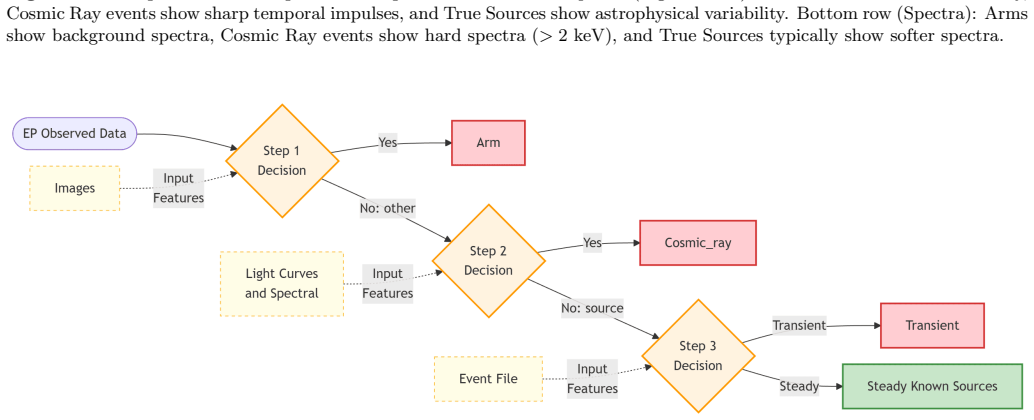
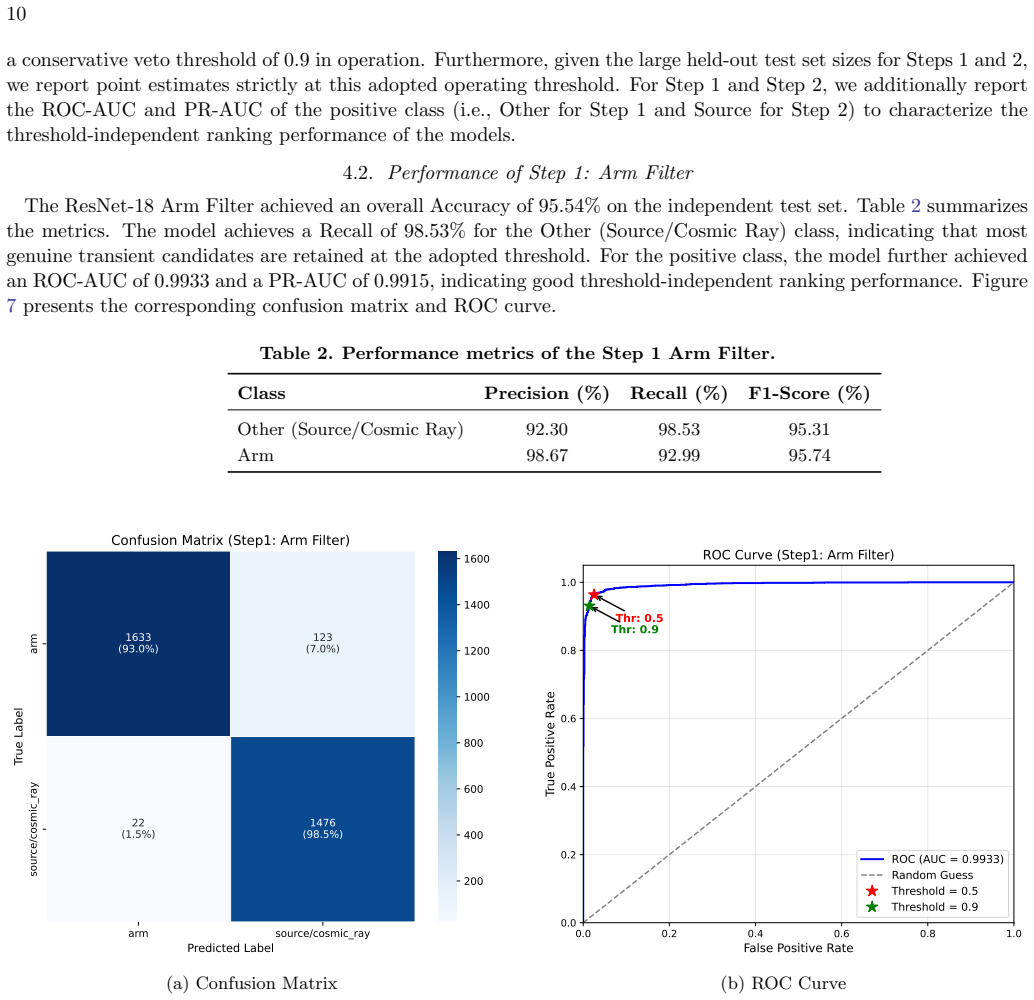
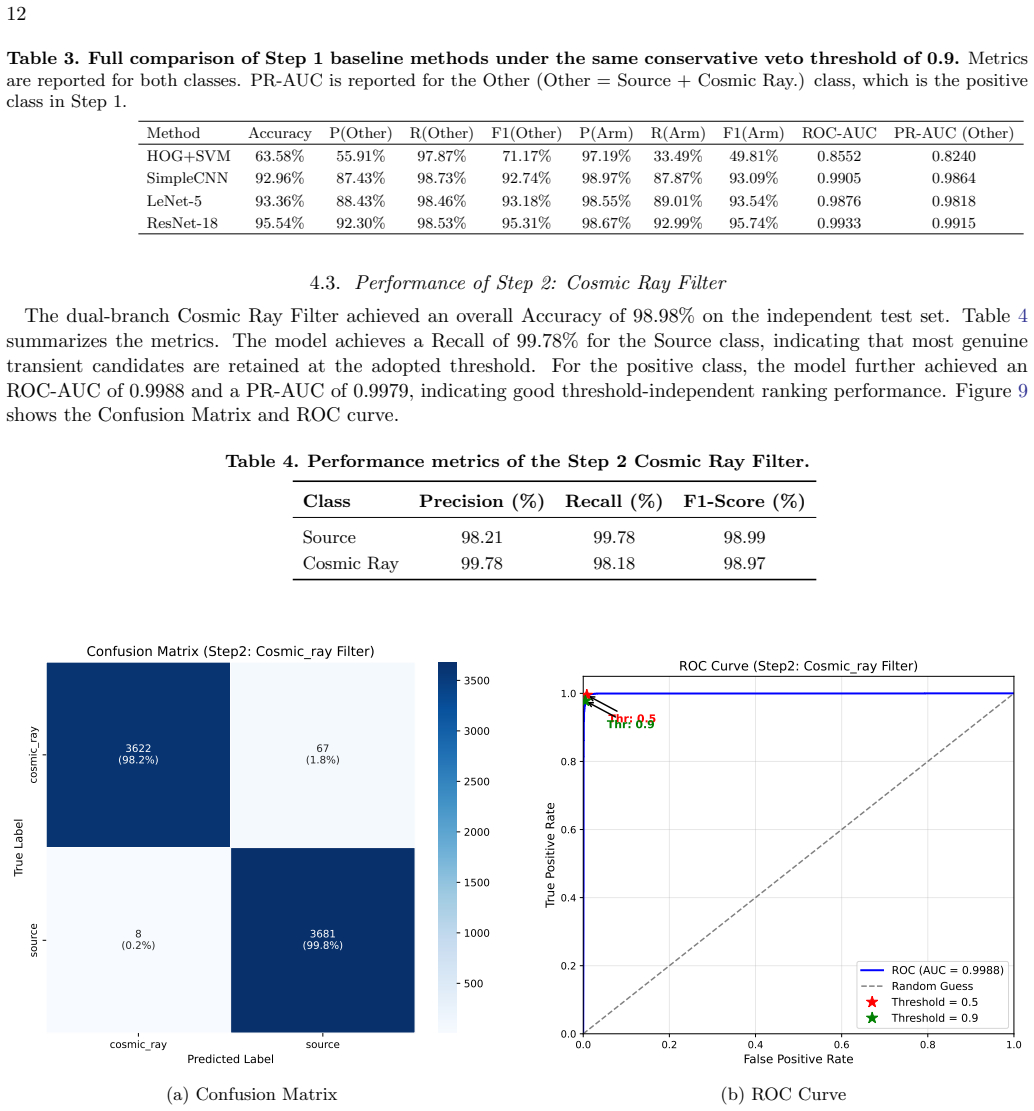
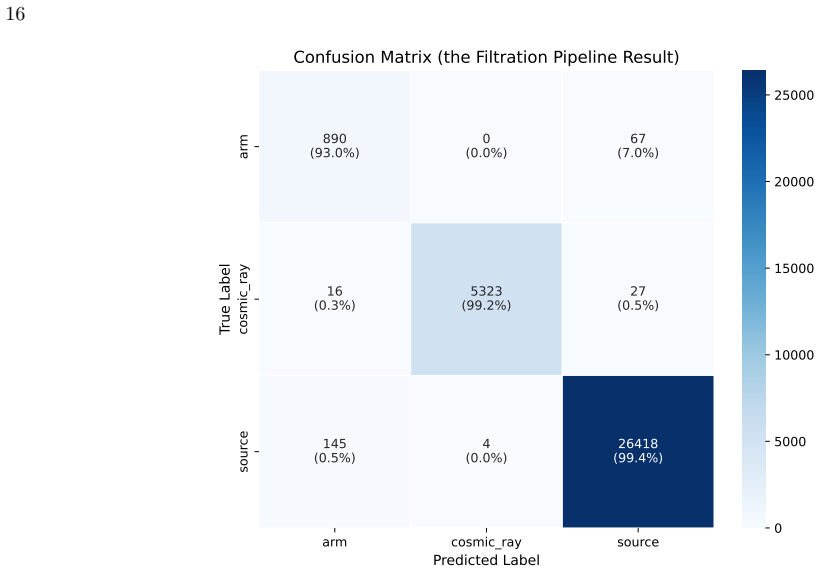
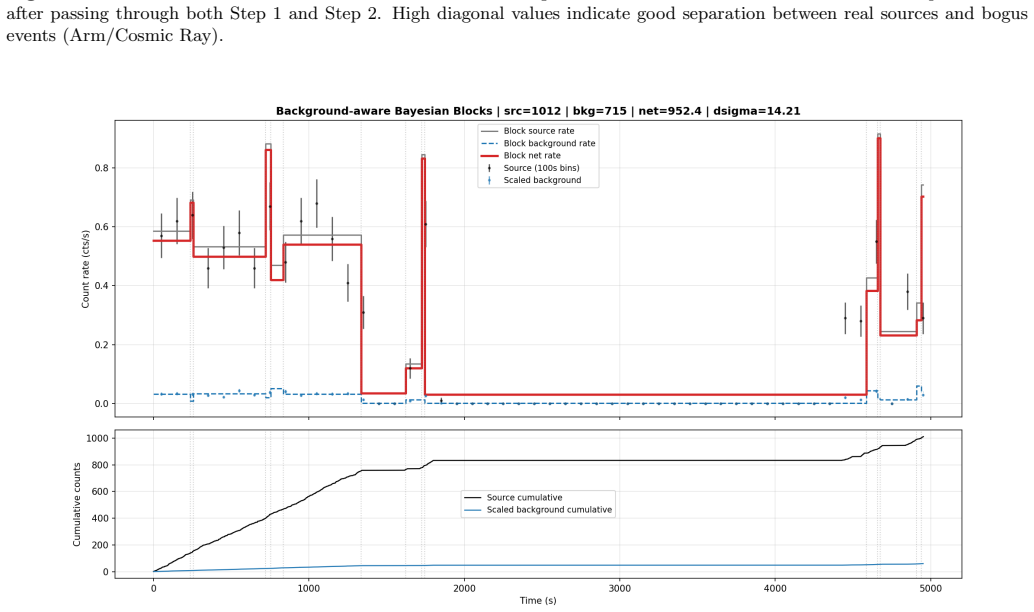
Using on-orbit EP-WXT observations, the cascading M-EPDet framework achieves a Real-Bogus Recall of 98.31 percent (98.53 percent times 99.78 percent) for genuine astrophysical sources, rejects 92.99 percent of instrumental artifacts and 98.18 percent of Cosmic Ray events, and passes only 0.75 percent of post-filtration observations to the Bayesian Blocks module, producing a 99.25 percent reduction in candidate volume.
What carries the argument
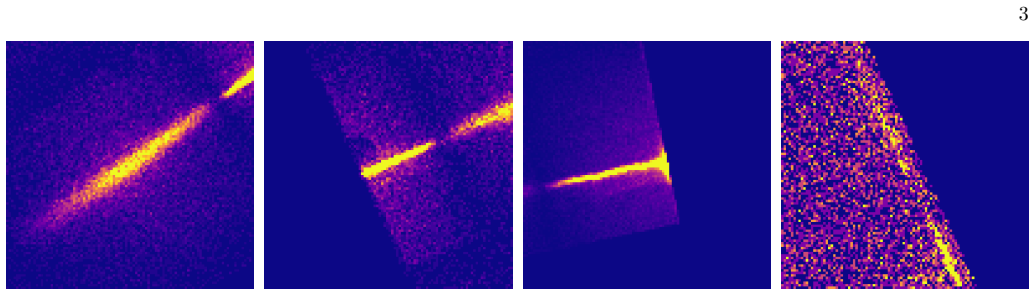
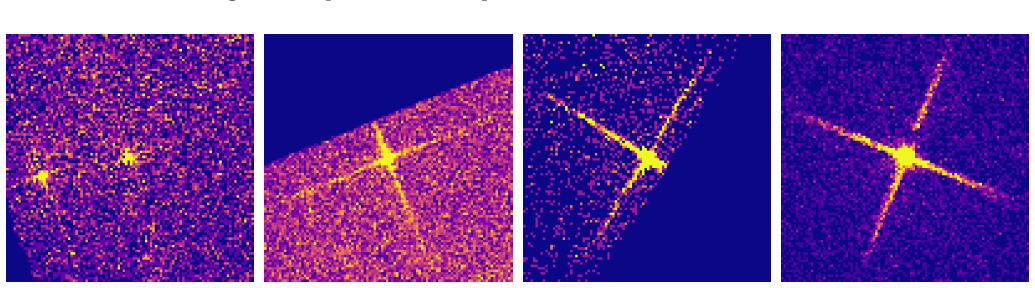
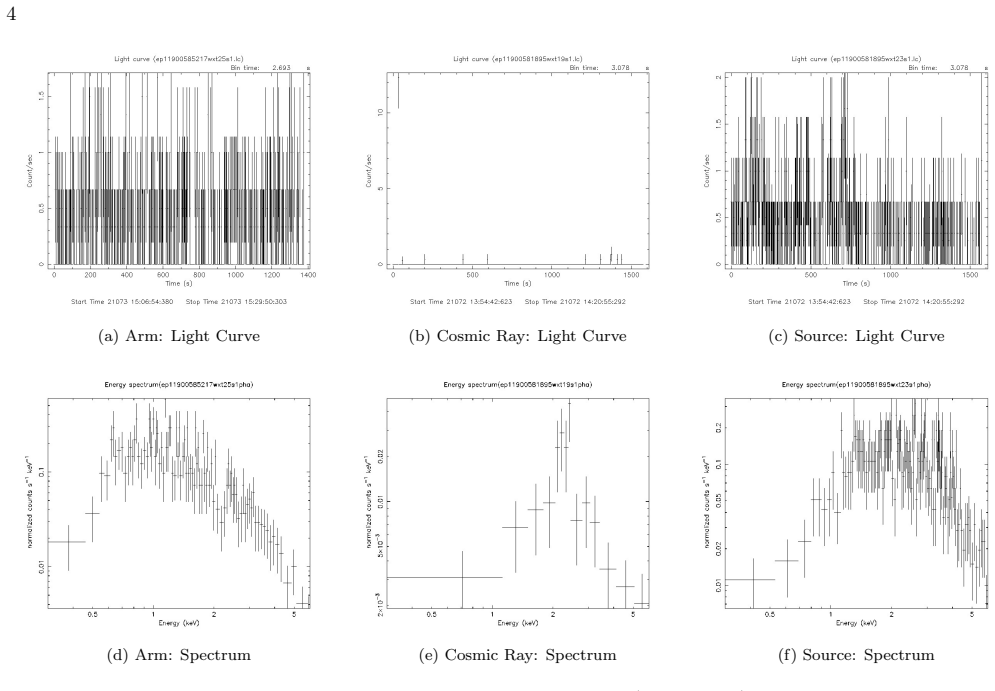
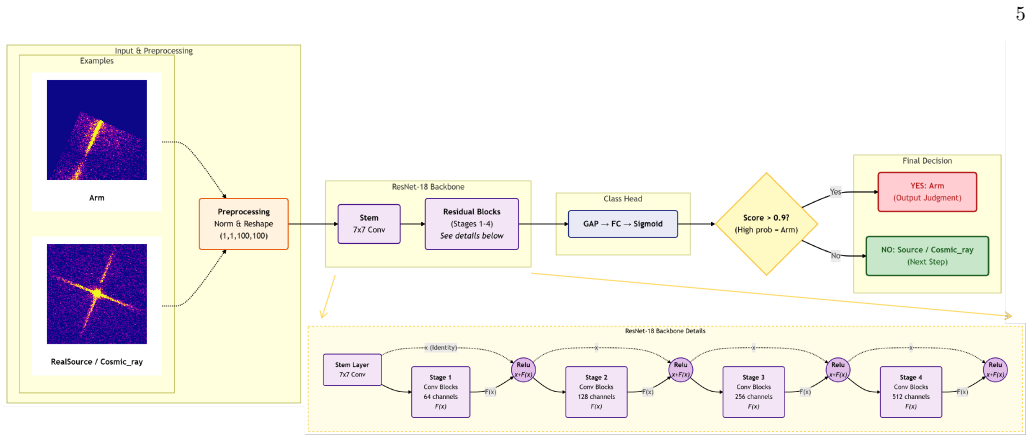
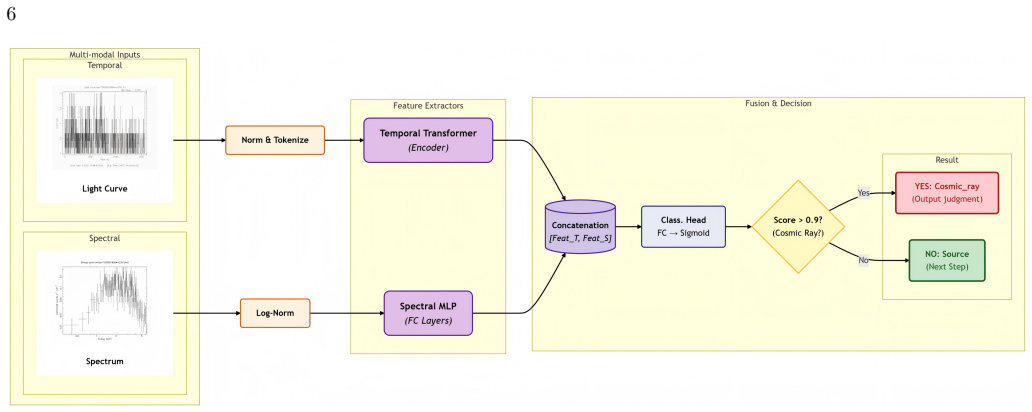
A three-step cascading framework that applies a ResNet-based Arm filter, followed by a dual-branch temporal-spectral Cosmic Ray filter, followed by a background-aware Bayesian Blocks variability module.
If this is right
- The EP-WXT pipeline can operate with real-time automated vetting instead of exhaustive manual inspection.
- Genuine single-exposure transients remain available for follow-up at a retention rate above 98 percent.
- Instrumental and cosmic-ray false positives are suppressed before the variability stage, lowering downstream computational load.
- The modular cascade allows independent tuning or replacement of any single filter without retraining the entire system.
Where Pith is reading between the lines
- Similar multi-modal cascades could be tested on data from other lobster-eye or wide-field X-ray instruments facing comparable artifact rates.
- The final Bayesian Blocks step could be replaced by other single-exposure variability tests if the background model changes.
- If the rejection rates hold on new data, the framework directly scales the feasible survey volume without proportional growth in human review effort.
Load-bearing premise
The on-orbit observations used for training and testing represent the distribution of future exposures without substantial performance loss on new data.
What would settle it
A measured drop in Real-Bogus Recall below 95 percent when the trained models are applied to a fresh batch of on-orbit exposures collected after the training period.
Figures
read the original abstract
The Wide-field X-ray Telescope (WXT) onboard the Einstein Probe (EP) produces a large post-detection candidate stream in which genuine astrophysical sources coexist with instrumental artifacts and Cosmic Ray events. We present M-EPDet, a three-step post-detection framework for real-time candidate vetting in EP-WXT lobster-eye Micro-pore Optics (MPO) data. The framework combines a ResNet-based Arm filter, a dual-branch temporal-spectral Cosmic Ray filter, and a background-aware Bayesian Blocks module for single-exposure variability screening. Using on-orbit EP-WXT observations, we report decoupled metrics for the cascading system. M-EPDet achieves a Real-Bogus Recall of 98.31\% ($98.53\% \times 99.78\%$) for genuine astrophysical sources, together with rejection rates of 92.99\% for instrumental artifacts and 98.18\% for Cosmic Ray events. In the final step, the Bayesian Blocks module flags 0.75\% of the post-filtration observations, corresponding to a 99.25\% reduction in candidate volume. The system is deployed in the EP-WXT pipeline as a lightweight real-time service, reducing the manual-inspection burden in candidate vetting.
Editorial analysis
A structured set of objections, weighed in public.
Referee Report
Summary. The manuscript presents M-EPDet, a three-stage cascade for real-time real-bogus classification of EP-WXT candidates: a ResNet-based Arm filter, a dual-branch temporal-spectral Cosmic Ray filter, and a background-aware Bayesian Blocks module. Using on-orbit EP-WXT observations, it reports a Real-Bogus Recall of 98.31% (98.53% × 99.78%), artifact rejection of 92.99%, CR rejection of 98.18%, and a final 99.25% reduction in candidate volume, with the system deployed as a lightweight service in the EP-WXT pipeline.
Significance. If the reported metrics generalize, the framework would meaningfully reduce the manual vetting load for transient searches in wide-field X-ray lobster-eye data. The decoupled, multi-modal design and on-orbit deployment constitute a practical engineering contribution to astronomical pipelines.
major comments (2)
- [Abstract] Abstract: The headline performance figures (98.31% recall, 92.99% artifact rejection, 98.18% CR rejection, 99.25% volume reduction) are presented as direct empirical results on on-orbit data, yet the manuscript supplies no description of training/validation splits, temporal or exposure-parameter partitioning, cross-validation strategy, or out-of-distribution hold-out sets. This information is load-bearing for assessing whether the metrics reflect robust generalization rather than dataset-specific correlations.
- [Abstract] Abstract and evaluation description: The claim that the on-orbit observations are representative of future EP-WXT exposures (required for the reported metrics to transfer to live operations) is not supported by any explicit test of distributional shift or external validation; without such evidence the central performance claims cannot be verified.
minor comments (1)
- [Abstract] The notation for the composite recall (98.53% × 99.78%) should be accompanied by an explicit statement of statistical independence or error propagation.
Simulated Author's Rebuttal
We thank the referee for the detailed and constructive report. The comments correctly identify gaps in the description of our evaluation methodology. We address each point below and will revise the manuscript to provide the requested information and clarifications.
read point-by-point responses
-
Referee: [Abstract] Abstract: The headline performance figures (98.31% recall, 92.99% artifact rejection, 98.18% CR rejection, 99.25% volume reduction) are presented as direct empirical results on on-orbit data, yet the manuscript supplies no description of training/validation splits, temporal or exposure-parameter partitioning, cross-validation strategy, or out-of-distribution hold-out sets. This information is load-bearing for assessing whether the metrics reflect robust generalization rather than dataset-specific correlations.
Authors: We agree that the current manuscript lacks explicit details on data partitioning and validation strategy. Section 3 describes the on-orbit dataset but does not enumerate the train/validation/test splits, temporal partitioning criteria, or cross-validation procedure. In the revised manuscript we will add a dedicated subsection under Experiments that specifies: (i) the temporal split used to separate training and test observations, (ii) the exposure-parameter stratification applied, (iii) the 5-fold cross-validation protocol employed during model selection, and (iv) any hold-out sets constructed to probe out-of-distribution behavior. These additions will allow readers to evaluate the robustness of the reported metrics. revision: yes
-
Referee: [Abstract] Abstract and evaluation description: The claim that the on-orbit observations are representative of future EP-WXT exposures (required for the reported metrics to transfer to live operations) is not supported by any explicit test of distributional shift or external validation; without such evidence the central performance claims cannot be verified.
Authors: We acknowledge that no explicit distributional-shift experiments (e.g., Kolmogorov-Smirnov tests on feature distributions across observation epochs or instrument configurations) or external validation sets are presented. The on-orbit data used for both training and testing span multiple weeks of EP-WXT operations, and the system has been deployed in the live pipeline, but these facts alone do not constitute a formal test of future representativeness. In the revision we will (a) add a paragraph discussing potential sources of distributional shift and (b) include any feasible statistical comparisons between early and late observation periods. If additional external data cannot be obtained, we will qualify the generalization statement accordingly. revision: partial
Circularity Check
No circularity: empirical metrics are direct measurements on held-out observations
full rationale
The paper reports performance figures (recall, rejection rates, volume reduction) obtained by running the three-stage M-EPDet cascade on on-orbit EP-WXT data. These quantities are computed directly from the output of the filters and Bayesian Blocks module applied to the evaluation exposures; they are not obtained by fitting parameters to the target metrics themselves, nor do they reduce via self-citation to prior results by the same authors, nor are they renamed known patterns. No equations or claims in the provided text exhibit self-definitional loops, fitted-input predictions, or load-bearing self-citations. The derivation chain is therefore self-contained as an empirical evaluation.
Axiom & Free-Parameter Ledger
Reference graph
Works this paper leans on
-
[1]
Astropy Collaboration, Robitaille, T. P., Tollerud, E. J., et al. 2013, Astronomy & Astrophysics, 558, A33, doi: 10.1051/0004-6361/201322068 Astropy Collaboration, Price-Whelan, A. M., Sip˝ ocz, B. M., et al. 2018, The Astronomical Journal, 156, 123, doi: 10.3847/1538-3881/aabc4f Astropy Collaboration, Price-Whelan, A. M., Lim, P. L., et al. 2022, The Ast...
-
[2]
Experimental Astronomy , keywords =
Cheng, H., Zhang, C., Ling, Z., et al. 2025a, Experimental Astronomy, 60, 15, doi: 10.1007/s10686-025-10025-9
-
[3]
In-flight calibration of the Lobster Eye Imager for Astronomy
Cheng, H., Pan, H.-W., Liu, Y., et al. 2025b, arXiv e-prints, arXiv:2506.20369, doi: 10.48550/arXiv.2506.20369
work page internal anchor Pith review Pith/arXiv arXiv doi:10.48550/arxiv.2506.20369
-
[4]
1995, Machine learning, 20, 273
Cortes, C., & Vapnik, V. 1995, Machine learning, 20, 273
1995
-
[5]
Stefano, R., & Kashyap, V. L. 2025, MNRAS, 537, 931, doi: 10.1093/mnras/stae2808
-
[6]
2022, MNRAS, 513, 1742, doi: 10.1093/mnras/stac983
Goode, S., Cooke, J., Zhang, J., et al. 2022, MNRAS, 513, 1742, doi: 10.1093/mnras/stac983
-
[7]
Harris, C. R., Millman, K. J., van der Walt, S. J., et al. 2020, Nature, 585, 357, doi: 10.1038/s41586-020-2649-2
-
[8]
2016, in Proceedings of the IEEE Conference on Computer Vision and Pattern Recognition (CVPR)
He, K., Zhang, X., Ren, S., & Sun, J. 2016, in Proceedings of the IEEE Conference on Computer Vision and Pattern Recognition (CVPR)
2016
-
[9]
Hunter, J. D. 2007, Computing in Science & Engineering, 9, 90, doi: 10.1109/MCSE.2007.55
-
[10]
2023, ApJS, 264, 43, doi: 10.3847/1538-4365/acab02
Jia, P., Liu, W., Liu, Y., & Pan, H. 2023, ApJS, 264, 43, doi: 10.3847/1538-4365/acab02
-
[11]
L., Lyman, J., Steeghs, D., et al
Killestein, T. L., Lyman, J., Steeghs, D., et al. 2021, MNRAS, 503, 4838, doi: 10.1093/mnras/stab633
-
[12]
1998, Proceedings of the IEEE, 86, 2278
LeCun, Y., Bottou, L., Bengio, Y., & Haffner, P. 1998, Proceedings of the IEEE, 86, 2278
1998
-
[13]
Ling, Z. X., Sun, X. J., Zhang, C., et al. 2023, Research in Astronomy and Astrophysics, 23, 095007, doi: 10.1088/1674-4527/acd593 pandas development team, T. 2020, pandas-dev/pandas: Pandas, latest Zenodo, doi: 10.5281/zenodo.3509134
-
[14]
2019, in Advances in Neural Information Processing Systems 32, 8024–8035
Paszke, A., Gross, S., Massa, F., et al. 2019, in Advances in Neural Information Processing Systems 32, 8024–8035
2019
-
[15]
2011, Journal of Machine Learning Research, 12, 2825
Pedregosa, F., Varoquaux, G., Gramfort, A., et al. 2011, Journal of Machine Learning Research, 12, 2825
2011
-
[16]
Ruiz, A., Georgakakis, A., Georgantopoulos, I., et al. 2024, MNRAS, 527, 3674, doi: 10.1093/mnras/stad3339 S´ anchez-S´ aez, P., Reyes, I., Valenzuela, C., et al. 2021, AJ, 161, 141, doi: 10.3847/1538-3881/abd5c1
-
[17]
Scargle, J. D., Norris, J. P., Jackson, B., & Chiang, J. 2013, ApJ, 764, 167, doi: 10.1088/0004-637X/764/2/167
-
[18]
G., Gagliano, A., Malanchev, K., et al
Shah, V. G., Gagliano, A., Malanchev, K., et al. 2025, ApJ, 995, 4, doi: 10.3847/1538-4357/ae1130 20
-
[19]
2022, A&A, 657, A138, doi: 10.1051/0004-6361/202141259
Tranin, H., Godet, O., Webb, N., & Primorac, D. 2022, A&A, 657, A138, doi: 10.1051/0004-6361/202141259
-
[20]
2017, in Advances in Neural Information Processing Systems, ed
Vaswani, A., Shazeer, N., Parmar, N., et al. 2017, in Advances in Neural Information Processing Systems, ed. I. Guyon, U. V. Luxburg, S. Bengio, H. Wallach, R. Fergus, S. Vishwanathan, & R. Garnett, Vol. 30 (Curran Associates, Inc.). https://proceedings.neurips.cc/paper files/paper/2017/ file/3f5ee243547dee91fbd053c1c4a845aa-Paper.pdf
2017
-
[21]
2026, EP260314a: refined analysis of the EP-WXT and EP-FXT observations,, GCN Circular 44016 https://gcn.nasa.gov/circulars/44016
Wu, Y., Li, R.-Z., Zhao, Y., & Pan, H.-W. 2026, EP260314a: refined analysis of the EP-WXT and EP-FXT observations,, GCN Circular 44016 https://gcn.nasa.gov/circulars/44016
2026
-
[22]
2018, Scientia Sinica
Yuan, W., Zhang, C., Chen, Y., et al. 2018, Scientia Sinica
2018
-
[23]
Physica, Mechanica & Astronomica, 48, 039502, doi: 10.1360/SSPMA2017-00297
-
[24]
2025, Science China
Yuan, W., Dai, L., Feng, H., et al. 2025, Science China
2025
-
[25]
Physics, Mechanics, and Astronomy, 68, 239501, doi: 10.1007/s11433-024-2600-3
-
[26]
Zhang, C., Ling, Z. X., Sun, X. J., et al. 2022, ApJL, 941, L2, doi: 10.3847/2041-8213/aca32f
-
[27]
2026, Astronomy and Computing, 55, 101073, doi: 10.1016/j.ascom.2026.101073
Zhang, Z., Xu, Y., Liu, Y., Cui, C., & Fan, D. 2026, Astronomy and Computing, 55, 101073, doi: 10.1016/j.ascom.2026.101073
-
[28]
2024, Research in Astronomy and Astrophysics, 24, 085016, doi: 10.1088/1674-4527/ad634f
Zuo, X., Tao, Y., Liu, Y., et al. 2024, Research in Astronomy and Astrophysics, 24, 085016, doi: 10.1088/1674-4527/ad634f
discussion (0)
Sign in with ORCID, Apple, or X to comment. Anyone can read and Pith papers without signing in.