REVIEW 3 major objections 5 minor 84 references
Visual Language Models as Zero-Shot Deepfake Detectors
T0 review · 3 major / 5 minor · reviewed 2026-08-06 · deepseek-v4-flash
Pith's one-line read This paper claims that zero-shot vision-language models, scored by normalized yes/no token probabilities, can outperform deepfake detectors trained specifically for the task.
desk verdict A new 60k SimSwap benchmark and a practical token-probability scoring trick are the real assets; the headline claim that zero-shot VLMs beat trained detectors is not yet supported because VLM accuracy is measured at test-set-tuned thresholds while baselines are fixed. read the letter →
The pith
A machine-rendered reading of the paper's core claim, the machinery that carries it, and where it could break.
The reading
What carries the argument
The load-bearing mechanism is the normalized token-probability score (Eq. 2): for a prompt such as 'Is this photo real?', the model defines fake probability as $P_{\text{no}}/(P_{\text{no}}+P_{\text{yes}})$, where the probabilities come from summing the VLM's first-step token distributions over semantically equivalent yes and no tokens, and similarly for the real probability $P_{\text{yes}}/(P_{\text{no}}+P_{\text{yes}})$. This turns a hard binary answer into a continuous confidence score that supports threshold-based metrics (AUC, EER, FAR/FRR), and it is what the comparison experiments use in place of the earlier binary-answer baseline. The same idea extends to multi-token answer strings and multiple classes via Algorithm 1, which multiplies per-token autoregressive probabilities including an EOS term and normalizes class sums.
What would settle it
Run the same Table 2 comparison with thresholds chosen from a held-out validation split and GPT-4o's prompt frozen before any evaluation image is seen; if a specialized detector such as SBI then matches or exceeds the zero-shot VLM accuracy on the SimSwap dataset, the claimed zero-shot superiority is falsified.
Extended reading notes
Core claim
The paper's central claim is that a VLM, prompted with a simple 'Is this photo real?' question, yields a usable deepfake score from the first decoding step: instead of taking the argmax token, the authors sum the probabilities of all 'real' tokens and all 'fake' tokens, normalize the two sums to one, and treat the normalized fake probability as the image's deepfake confidence (Eq. 2). In zero-shot use on a novel SimSwap-based dataset, this normalized score lifts accuracy well above the binary argmax baseline and, for most models, above specialized detectors that were not trained on that distribution; InstructBLIP with this scoring is the best VLM, behind only the SBI self-blended-image detector among the specialized methods. Fine-tuning only the Q-Former of InstructBLIP for one epoch on a fraction of DFDC-P yields near-perfect image-level metrics, and the same fine-tuned model retains and even improves its out-of-domain performance on the new CelebA-HQ dataset. The authors generalize the scoring to multi-token answers and multi-class labels (Algorithm 1), giving a route to calibrated probability vectors for several manipulation types at once.
Load-bearing premise
The reported superiority assumes that picking each VLM's threshold from the test set and tuning GPT-4o's prompt on a 100-image sample gives VLMs no unfair advantage over the fixed pretrained detectors they are compared with.
Editorial extensions
If this is right
- Zero-shot VLM detection can be deployed without collecting or labeling training data, so it can react to a new fake-generation technique as soon as the model is updated.
- Because the method returns a confidence score rather than a hard yes/no, it can be plugged directly into biometric workflows that set operating thresholds on false acceptance and false rejection rates.
- A single-epoch fine-tune of only the Q-Former component on a known data distribution yields near-perfect image-level accuracy on that distribution, and the fine-tuned model stays strong out of distribution.
- The multi-class extension allows one prompt to output a calibrated probability vector over manipulation types (real, face-swap, GAN, diffusion, compression), which could feed downstream risk or compliance decisions.
- Four of six specialized detectors scored poorly on the unseen SimSwap dataset, so the paper's comparison suggests zero-shot VLMs generalize across generators better than detectors trained on other deepfake datasets.
Reading between the lines
- The authors do not draw out that, if this holds across generators, deepfake detection becomes a prompt-engineering and scoring problem around foundation models rather than a bespoke-classifier training problem.
- A testable extension the paper does not run: score the same zero-shot VLMs on fakes from a diffusion-based face swap or on re-encoded video to see whether the normalized score keeps its margin over SBI.
- The paper leaves implicit a deployment caveat: the method's cost (24GB-class GPUs or API fees above $5 per thousand images) may restrict it to high-value checks such as KYC onboarding rather than real-time social-media moderation.
- The threshold-sensitivity of the reported accuracies suggests that a validation-split threshold protocol could change the ranking; that test is not in the paper.
Editorial analysis
A structured set of objections, weighed in public.
Referee Report
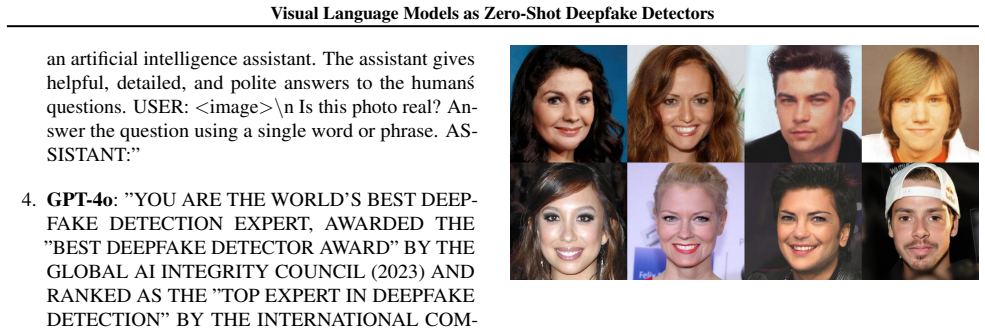
Summary. The paper proposes a zero-shot deepfake detection method based on Visual Language Models (VLMs). Instead of taking the arg-max token from a VQA prompt, the authors sum the token probabilities for 'yes'/'no' answer sets and normalize them to obtain a continuous fake score (Eq. 2). The method is evaluated on a new 60,000-image CelebA-HQ/SimSwap dataset and on DFDC-P. The authors report that zero-shot VLMs outperform most specialized deepfake detectors on the new dataset, and that InstructBLIP fine-tuned for one epoch on DFDC-P achieves near-perfect metrics. The central claim is that VLMs beat trained detectors because of their generalizability and zero-shot capabilities, and that they can be quickly adapted to in-domain data.
Significance. If the comparison were sound, the result would be practically valuable: a simple probabilistic reformulation of VLM outputs would make zero-shot deepfake detection competitive with specialized models, and a light fine-tuning procedure would allow rapid adaptation to new data distributions. The method is simple and potentially reproducible across many open VLMs, which is a strength. However, the paper does not ship code, the main benchmark dataset is from the authors' parallel work and its public availability is unclear, and the reported comparisons are weakened by methodological asymmetries described below. The core idea—using normalized token probabilities rather than binary answers—is reasonable and could be a useful contribution, but the experimental evidence as presented does not yet substantiate the superiority claim.
major comments (3)
- [Section 4.1, Tables 1-2] VLM accuracy is reported at the optimal threshold for each model, selected from the grid [0.1, ..., 0.9] on the test set, while the trained detectors (FF, MAT, M2TR, RECCE, CADDM, SBI) are presented as fixed pretrained models with no indication that their thresholds were tuned in the same way. This asymmetry makes the ACC comparisons in Table 2 not apples-to-apples and directly undermines the claim in Section 5 that VLMs 'outperform specifically trained deepfake detectors.' The authors should either fix the threshold to 0.5 for all methods or select thresholds on a held-out split disjoint from the test set, and then re-report both ACC and AUC.
- [Section 3.3] The GPT-4o prompt was engineered on a 100-image sample ('We sampled 100 fake and real images'), but the paper never states whether those images were part of the evaluation set. If the tuning sample overlaps the test set, the reported GPT-4o accuracy of 69.2 (Table 1) is optimistically biased. The authors must clarify the provenance of the tuning images and, if necessary, re-evaluate on a disjoint test set or demonstrate that the prompt design did not use test labels.
- [Section 4.2, Figure 2] The DFDC-P few-shot experiment fine-tunes InstructBLIP on a training split but compares it only to pretrained detectors that were not fine-tuned on DFDC-P. This does not support the claim that VLMs can be 'quickly and efficiently fine-tuned to achieve near-perfect metrics' relative to traditional methods. A traditional detector (e.g., Xception or SBI) fine-tuned on the same training split should be included as a baseline, otherwise the comparison conflates the benefit of in-domain training with the benefit of the VLM architecture.
minor comments (5)
- [Equation 2] The final expression '= ePno' is notationally unclear; presumably it denotes the normalized probability \tilde{P}_{fake}, but as written it appears to introduce a spurious exponential. Please rewrite the equation with explicit definitions.
- [Section 3.2] The sentence 'what can be seen at 1 Algorithm 1' is incomplete; the algorithm reference should be integrated grammatically (e.g., 'as shown in Algorithm 1').
- [References] Reference (Fraser, 2023) is a tweet URL; this is not an archival citation and should be replaced or removed.
- [Table 1] The GPT-4o row has dashes for AUC and EER with no explanation; the paper should state that closed APIs do not expose full token distributions in this setting, so these metrics could not be computed.
- [Section 5 and Table 1] The statement that the fine-tuned model 'improving all metrics (see Table 1)' is not directly supported, because Table 1 does not report results for the fine-tuned InstructBLIP on the CelebA-HQ dataset; the referenced result in Section 4.2 is described qualitatively without numbers. Please add the actual metrics.
Circularity Check
No significant circularity: the normalized-token score is a neutral transformation, the headline comparison is against external pretrained detectors, and the self-cited dataset is an evaluation input rather than a derived result.
full rationale
The paper's derivation chain is Eq. 1 (argmax hard label) to Eq. 2 (normalized first-token probabilities) to thresholded classification. Eq. 2 is a deterministic normalization of the VLM's own output distribution, with no parameter fitted to the labels, so it is not circular by construction. The empirical claims are supported by comparisons against external baselines (FF, MAT, M2TR, RECCE, CADDM, SBI) on a new CelebA-HQ/SimSwap dataset, where the baselines are pretrained detectors taken from prior work. The dataset is sourced from the authors' parallel work (Pirogov & Artemev, 2025), but that citation supplies an evaluation input and motivation, not a theorem or fitted value to which the paper's conclusion reduces. The reported 'optimal threshold' chosen from the grid in Section 4.1 and the prompt engineering on a 100-image sample in Section 3.3 are genuine threats to the fairness of the accuracy comparison: they can inflate the VLM numbers relative to the fixed baselines. However, this is an experimental-design flaw involving test-set tuning, not a self-referential derivation; the AUC columns in Table 2 are threshold-independent and still show the qualitative ordering used in the conclusion. No equation is defined in terms of the quantity it claims to predict, and no load-bearing claim is justified solely by a self-citation. The Limitations section acknowledges the narrow scope of the dataset and unexamined VLM biases, which further supports treating the reported superiority as an empirical evaluation rather than a circular derivation. Therefore no significant circularity is found.
Assumptions & free parameters
free parameters (2)
- classification threshold per model =
optimal value from the grid [0.1,0.2,...,0.9] on the test set
- GPT-4o prompt template =
long role prompt printed in Section 3.3
assumptions (4)
- domain assumption The CelebA-HQ + SimSwap images with gender matching form a representative deepfake benchmark.
- domain assumption First-token VLM probabilities are meaningful confidence estimates for classification.
- domain assumption The SOTA detector results in Table 2 were obtained under the same test-time protocol as the VLM results.
- domain assumption DFDC-P video labels are valid for image-level frame evaluation.
Cite this review
Pith. "Pith review of Visual Language Models as Zero-Shot Deepfake Detectors." pith.science (2026). https://pith.science/paper/WLUVP6G5
@misc{pith2026250722469,
  author       = {Pith},
  title        = {Pith review of: Visual Language Models as Zero-Shot Deepfake Detectors},
  year         = {2026},
  howpublished = {\url{https://pith.science/paper/WLUVP6G5}},
  note         = {Machine review of arXiv:2507.22469}
}
read the original abstract
The contemporary phenomenon of deepfakes, utilizing GAN or diffusion models for face swapping, presents a substantial and evolving threat in digital media, identity verification, and a multitude of other systems. The majority of existing methods for detecting deepfakes rely on training specialized classifiers to distinguish between genuine and manipulated images, focusing only on the image domain without incorporating any auxiliary tasks that could enhance robustness. In this paper, inspired by the zero-shot capabilities of Vision Language Models, we propose a novel VLM-based approach to image classification and then evaluate it for deepfake detection. Specifically, we utilize a new high-quality deepfake dataset comprising 60,000 images, on which our zero-shot models demonstrate superior performance to almost all existing methods. Subsequently, we compare the performance of the best-performing architecture, InstructBLIP, on the popular deepfake dataset DFDC-P against traditional methods in two scenarios: zero-shot and in-domain fine-tuning. Our results demonstrate the superiority of VLMs over traditional classifiers.
Figures

Reference graph
Works this paper leans on
-
[1]
write newline
" write newline "" before.all 'output.state := FUNCTION n.dashify 't := "" t empty not t #1 #1 substring "-" = t #1 #2 substring "--" = not "--" * t #2 global.max substring 't := t #1 #1 substring "-" = "-" * t #2 global.max substring 't := while if t #1 #1 substring * t #2 global.max substring 't := if while FUNCTION format.date year duplicate empty "emp...
-
[2]
Flamingo: a visual language model for few-shot learning, 2022
Alayrac, J.-B., Donahue, J., Luc, P., Miech, A., Barr, I., Hasson, Y., Lenc, K., Mensch, A., Millican, K., Reynolds, M., Ring, R., Rutherford, E., Cabi, S., Han, T., Gong, Z., Samangooei, S., Monteiro, M., Menick, J., Borgeaud, S., Brock, A., Nematzadeh, A., Sharifzadeh, S., Binkowski, M., Barreira, R., Vinyals, O., Zisserman, A., and Simonyan, K. Flaming...
arXiv 2022
-
[3]
Large scale GAN training for high fidelity natural image synthesis
Brock, A., Donahue, J., and Simonyan, K. Large scale GAN training for high fidelity natural image synthesis. In 7th International Conference on Learning Representations, ICLR 2019, New Orleans, LA, USA, May 6-9, 2019 . OpenReview.net, 2019. URL https://openreview.net/forum?id=B1xsqj09Fm
2019
-
[4]
Roop unleashed
C0untFloyd. Roop unleashed. https://github.com/C0untFloyd/roop-unleashed, 2023
2023
-
[5]
End-to-end reconstruction-classification learning for face forgery detection
Cao, J., Ma, C., Yao, T., Chen, S., Ding, S., and Yang, X. End-to-end reconstruction-classification learning for face forgery detection. In 2022 IEEE/CVF Conference on Computer Vision and Pattern Recognition (CVPR), pp.\ 4103--4112, 2022. doi:10.1109/CVPR52688.2022.00408
-
[6]
Cao, Q., Shen, L., Xie, W., Parkhi, O. M., and Zisserman, A. Vggface2: A dataset for recognising faces across pose and age. In 13th IEEE International Conference on Automatic Face & Gesture Recognition, FG 2018, Xi'an, China, May 15-19, 2018 , pp.\ 67--74. IEEE Computer Society, 2018. doi:10.1109/FG.2018.00020. URL https://doi.org/10.1109/FG.2018.00020
arXiv 2018
-
[7]
Antifakeprompt: Prompt-tuned vision-language models are fake image detectors
Chang, Y.-M., Yeh, C., Chiu, W.-C., and Yu, N. Antifakeprompt: Prompt-tuned vision-language models are fake image detectors. arXiv preprint arXiv:2310.17419, 2023
arXiv 2023
-
[8]
Simswap: An efficient framework for high fidelity face swapping
Chen, R., Chen, X., Ni, B., and Ge, Y. Simswap: An efficient framework for high fidelity face swapping. In Proceedings of the 28th ACM International Conference on Multimedia, MM '20, pp.\ 2003–2011, New York, NY, USA, 2020. Association for Computing Machinery. ISBN 9781450379885. doi:10.1145/3394171.3413630. URL https://doi.org/10.1145/3394171.3413630
arXiv 2003
Show all 84 references
-
[9]
Local relation learning for face forgery detection, 2021
Chen, S., Yao, T., Chen, Y., Ding, S., Li, J., and Ji, R. Local relation learning for face forgery detection, 2021. URL https://arxiv.org/abs/2105.02577
2021 arXiv
-
[10]
Xception: Deep learning with depthwise separable convolutions
Chollet, F. Xception: Deep learning with depthwise separable convolutions. In Proceedings of the IEEE conference on computer vision and pattern recognition, pp.\ 1251--1258, 2017
2017
-
[11]
ComfyUI . Comfyui. https://github.com/comfyanonymous/ComfyUI, 2023. Accessed: 2025-07-29
2023
-
[12]
Dai, W., Li, J., Li, D., Tiong, A. M. H., Zhao, J., Wang, W., Li, B., Fung, P., and Hoi, S. Instructblip: Towards general-purpose vision-language models with instruction tuning, 2023. URL https://arxiv.org/abs/2305.06500
2023 arXiv
-
[13]
DeepSeek-AI, Guo, D., Yang, D., Zhang, H., Song, J., Zhang, R., Xu, R., Zhu, Q., Ma, S., Wang, P., Bi, X., Zhang, X., Yu, X., Wu, Y., Wu, Z. F., Gou, Z., Shao, Z., Li, Z., Gao, Z., Liu, A., Xue, B., Wang, B., Wu, B., Feng, B., Lu, C., Zhao, C., Deng, C., Zhang, C., Ruan, C., D...
2025 arXiv
-
[14]
Arcface: Additive angular margin loss for deep face recognition
Deng, J., Guo, J., Xue, N., and Zafeiriou, S. Arcface: Additive angular margin loss for deep face recognition. In IEEE Conference on Computer Vision and Pattern Recognition, CVPR 2019, Long Beach, CA, USA, June 16-20, 2019 , pp.\ 4690--4699. Computer Vision Foundation / IEEE ,...
2019
-
[15]
Dolhansky, B., Bitton, J., Pflaum, B., Lu, J., Howes, R., Wang, M., and Ferrer, C. C. The deepfake detection challenge (dfdc) dataset, 2020. URL https://arxiv.org/abs/2006.07397
2020 arXiv
-
[16]
Implicit identity leakage: The stumbling block to improving deepfake detection generalization
Dong, S., Wang, J., Ji, R., Liang, J., Fan, H., and Ge, Z. Implicit identity leakage: The stumbling block to improving deepfake detection generalization. In Proceedings of the IEEE/CVF Conference on Computer Vision and Pattern Recognition, pp.\ 3994--4004, 2023
2023
-
[17]
An image is worth 16x16 words: Transformers for image recognition at scale
Dosovitskiy, A., Beyer, L., Kolesnikov, A., Weissenborn, D., Zhai, X., Unterthiner, T., Dehghani, M., Minderer, M., Heigold, G., Gelly, S., et al. An image is worth 16x16 words: Transformers for image recognition at scale. arXiv preprint arXiv:2010.11929, 2020
2010 arXiv
-
[18]
Asking chatgpt to generate a random number
Fraser, C. Asking chatgpt to generate a random number. https://x.com/colin_fraser/status/1636755134679224320, 2023. Accessed: 2025-07-29
2023
-
[19]
J., Pouget - Abadie, J., Mirza, M., Xu, B., Warde - Farley, D., Ozair, S., Courville, A
Goodfellow, I. J., Pouget - Abadie, J., Mirza, M., Xu, B., Warde - Farley, D., Ozair, S., Courville, A. C., and Bengio, Y. Generative adversarial nets. In Ghahramani, Z., Welling, M., Cortes, C., Lawrence, N. D., and Weinberger, K. Q. (eds.), Advances in Neural Information Pro...
2014
-
[20]
Google colab
Google LLC . Google colab. https://colab.research.google.com/, 2020. Accessed: 2025-07-29
2020
-
[21]
Google LLC . Veo 3. https://deepmind.google/models/veo/, 2025. Accessed: 2025-07-29
2025
-
[22]
Gulrajani, I., Ahmed, F., Arjovsky, M., Dumoulin, V., and Courville, A. C. Improved training of wasserstein gans. In Guyon, I., von Luxburg, U., Bengio, S., Wallach, H. M., Fergus, R., Vishwanathan, S. V. N., and Garnett, R. (eds.), Advances in Neural Information Processing Sy...
2017
-
[23]
Lips don't lie: A generalisable and robust approach to face forgery detection, 2021
Haliassos, A., Vougioukas, K., Petridis, S., and Pantic, M. Lips don't lie: A generalisable and robust approach to face forgery detection, 2021. URL https://arxiv.org/abs/2012.07657
2021 arXiv
-
[24]
Deepfake detection using deep learning methods: A systematic and comprehensive review
Heidari, A., Jafari Navimipour, N., Dag, H., and Unal, M. Deepfake detection using deep learning methods: A systematic and comprehensive review. Wiley Interdisciplinary Reviews: Data Mining and Knowledge Discovery, 14 0 (2): 0 e1520, 2024
2024
-
[25]
The curious case of neural text degeneration, 2020
Holtzman, A., Buys, J., Du, L., Forbes, M., and Choi, Y. The curious case of neural text degeneration, 2020. URL https://arxiv.org/abs/1904.09751
2020 arXiv
-
[26]
A survey on hallucination in large language models: Principles, taxonomy, challenges, and open questions, 2023
Huang, L., Yu, W., Ma, W., Zhong, W., Feng, Z., Wang, H., Chen, Q., Peng, W., Feng, X., Qin, B., and Liu, T. A survey on hallucination in large language models: Principles, taxonomy, challenges, and open questions, 2023. URL https://arxiv.org/abs/2311.05232
2023 arXiv
-
[27]
and Belongie, S
Huang, X. and Belongie, S. J. Arbitrary style transfer in real-time with adaptive instance normalization. In IEEE International Conference on Computer Vision, ICCV 2017, Venice, Italy, October 22-29, 2017 , pp.\ 1510--1519. IEEE Computer Society, 2017. doi:10.1109/ICCV.2017.16...
2017 doi
-
[28]
Isola, P., Zhu, J., Zhou, T., and Efros, A. A. Image-to-image translation with conditional adversarial networks. In 2017 IEEE Conference on Computer Vision and Pattern Recognition, CVPR 2017, Honolulu, HI, USA, July 21-26, 2017 , pp.\ 5967--5976. IEEE Computer Society, 2017. d...
2017 doi
-
[29]
Perceiver: General perception with iterative attention, 2021
Jaegle, A., Gimeno, F., Brock, A., Zisserman, A., Vinyals, O., and Carreira, J. Perceiver: General perception with iterative attention, 2021. URL https://arxiv.org/abs/2103.03206
2021 arXiv
-
[30]
Can chatgpt detect deepfakes? a study of using multimodal large language models for media forensics, 2024
Jia, S., Lyu, R., Zhao, K., Chen, Y., Yan, Z., Ju, Y., Hu, C., Li, X., Wu, B., and Lyu, S. Can chatgpt detect deepfakes? a study of using multimodal large language models for media forensics, 2024. URL https://arxiv.org/abs/2403.14077
2024 arXiv
-
[31]
Jia Guo, J. D. Insightface: 2d and 3d face analysis project. https://github.com/deepinsight/insightface, 2017
2017
-
[32]
Jiang, L., Li, R., Wu, W., Qian, C., and Loy, C. C. Deeperforensics-1.0: A large-scale dataset for real-world face forgery detection, 2020. URL https://arxiv.org/abs/2001.03024
2020 arXiv
-
[33]
Progressive growing of gans for improved quality, stability, and variation, 2018
Karras, T., Aila, T., Laine, S., and Lehtinen, J. Progressive growing of gans for improved quality, stability, and variation, 2018. URL https://arxiv.org/abs/1710.10196
2018 arXiv
-
[34]
A style-based generator architecture for generative adversarial networks
Karras, T., Laine, S., and Aila, T. A style-based generator architecture for generative adversarial networks. In IEEE Conference on Computer Vision and Pattern Recognition, CVPR 2019, Long Beach, CA, USA, June 16-20, 2019 , pp.\ 4401--4410. Computer Vision Foundation / IEEE , ...
2019
-
[35]
Y., Salakhutdinov, R., and Fried, D
Koh, J. Y., Salakhutdinov, R., and Fried, D. Grounding language models to images for multimodal inputs and outputs, 2023. URL https://arxiv.org/abs/2301.13823
2023 arXiv
-
[36]
What matters when building vision-language models?, 2024
Laurençon, H., Tronchon, L., Cord, M., and Sanh, V. What matters when building vision-language models?, 2024. URL https://arxiv.org/abs/2405.02246
2024 arXiv
-
[37]
Why do facial deepfake detectors fail? In Proceedings of the 2nd Workshop on Security Implications of Deepfakes and Cheapfakes, pp.\ 24--28, 2023
Le, B., Tariq, S., Abuadbba, A., Moore, K., and Woo, S. Why do facial deepfake detectors fail? In Proceedings of the 2nd Workshop on Security Implications of Deepfakes and Cheapfakes, pp.\ 24--28, 2023
2023
-
[38]
Le, B. M. and Woo, S. S. Add: Frequency attention and multi-view based knowledge distillation to detect low-quality compressed deepfake images, 2021. URL https://arxiv.org/abs/2112.03553
2021 arXiv
-
[39]
Le, B. M. and Woo, S. S. Quality-agnostic deepfake detection with intra-model collaborative learning, 2023. URL https://arxiv.org/abs/2309.05911
2023 arXiv
-
[40]
M., Kim, J., Tariq, S., Moore, K., Abuadbba, A., and Woo, S
Le, B. M., Kim, J., Tariq, S., Moore, K., Abuadbba, A., and Woo, S. S. Sok: Facial deepfake detectors. arXiv preprint arXiv:2401.04364, 2024
2024 arXiv
-
[41]
Blip: Bootstrapping language-image pre-training for unified vision-language understanding and generation, 2022
Li, J., Li, D., Xiong, C., and Hoi, S. Blip: Bootstrapping language-image pre-training for unified vision-language understanding and generation, 2022. URL https://arxiv.org/abs/2201.12086
2022 arXiv
-
[42]
Blip-2: Bootstrapping language-image pre-training with frozen image encoders and large language models, 2023
Li, J., Li, D., Savarese, S., and Hoi, S. Blip-2: Bootstrapping language-image pre-training with frozen image encoders and large language models, 2023. URL https://arxiv.org/abs/2301.12597
2023 arXiv
-
[43]
Faceshifter: Towards high fidelity and occlusion aware face swapping
Li, L., Bao, J., Yang, H., Chen, D., and Wen, F. Faceshifter: Towards high fidelity and occlusion aware face swapping. arXiv preprint arXiv:1912.13457, 2019
1912 arXiv
-
[44]
Celeb-df: A large-scale challenging dataset for deepfake forensics, 2020
Li, Y., Yang, X., Sun, P., Qi, H., and Lyu, S. Celeb-df: A large-scale challenging dataset for deepfake forensics, 2020. URL https://arxiv.org/abs/1909.12962
2020 arXiv
-
[45]
Fakebench: Uncover the achilles' heels of fake images with large multimodal models, 2024
Li, Y., Liu, X., Wang, X., Wang, S., and Lin, W. Fakebench: Uncover the achilles' heels of fake images with large multimodal models, 2024. URL https://arxiv.org/abs/2404.13306
2024 arXiv
-
[46]
L., and Dollár, P
Lin, T.-Y., Maire, M., Belongie, S., Bourdev, L., Girshick, R., Hays, J., Perona, P., Ramanan, D., Zitnick, C. L., and Dollár, P. Microsoft coco: Common objects in context, 2015. URL https://arxiv.org/abs/1405.0312
2015 arXiv
-
[47]
Liu, H., Li, C., Wu, Q., and Lee, Y. J. Visual instruction tuning, 2023. URL https://arxiv.org/abs/2304.08485
2023 arXiv
-
[48]
Liu, H., Li, C., Li, Y., and Lee, Y. J. Improved baselines with visual instruction tuning, 2024 a . URL https://arxiv.org/abs/2310.03744
2024 arXiv
-
[49]
Few-shot unsupervised image-to-image translation
Liu, M., Huang, X., Mallya, A., Karras, T., Aila, T., Lehtinen, J., and Kautz, J. Few-shot unsupervised image-to-image translation. In 2019 IEEE/CVF International Conference on Computer Vision, ICCV 2019, Seoul, Korea (South), October 27 - November 2, 2019 , pp.\ 10550--10559....
2019
-
[50]
Liu, P., Tao, Q., and Zhou, J. T. Evolving from single-modal to multi-modal facial deepfake detection: A survey. arXiv preprint arXiv:2406.06965, 2024 b
2024 arXiv
-
[51]
and Hutter, F
Loshchilov, I. and Hutter, F. Decoupled weight decay regularization, 2019. URL https://arxiv.org/abs/1711.05101
2019 arXiv
-
[52]
Fooocus-inswapper
machineminded. Fooocus-inswapper. https://github.com/machineminded/Fooocus-inswapper, 2024
2024
-
[53]
H., Yamagishi, J., and Echizen, I
Nguyen, H. H., Yamagishi, J., and Echizen, I. Capsule-forensics: Using capsule networks to detect forged images and videos, 2018. URL https://arxiv.org/abs/1810.11215
2018 arXiv
-
[54]
FSGAN : Subject agnostic face swapping and reenactment
Nirkin, Y., Keller, Y., and Hassner, T. FSGAN : Subject agnostic face swapping and reenactment. In Proceedings of the IEEE International Conference on Computer Vision, pp.\ 7184--7193, 2019
2019
-
[55]
Fsganv2: Improved subject agnostic face swapping and reenactment
Nirkin, Y., Keller, Y., and Hassner, T. Fsganv2: Improved subject agnostic face swapping and reenactment. IEEE Transactions on Pattern Analysis and Machine Intelligence, 2022
2022
-
[56]
Introducing chatgpt
OpenAI. Introducing chatgpt. https://openai.com/index/chatgpt/, 2022. Accessed: 2025-07-29
2022
-
[57]
S., RP, L., Jiang, J., et al
Perov, I., Gao, D., Chervoniy, N., Liu, K., Marangonda, S., Um \'e , C., Dpfks, M., Facenheim, C. S., RP, L., Jiang, J., et al. Deepfacelab: Integrated, flexible and extensible face-swapping framework. arXiv preprint arXiv:2005.05535, 2020
2005 arXiv
-
[58]
and Artemev, M
Pirogov, V. and Artemev, M. Evaluating deepfake detectors in the wild, 2025. URL https://arxiv.org/abs/2507.21905
2025 arXiv
-
[59]
Thinking in frequency: Face forgery detection by mining frequency-aware clues, 2020
Qian, Y., Yin, G., Sheng, L., Chen, Z., and Shao, J. Thinking in frequency: Face forgery detection by mining frequency-aware clues, 2020. URL https://arxiv.org/abs/2007.09355
2020 arXiv
-
[60]
W., Hallacy, C., Ramesh, A., Goh, G., Agarwal, S., Sastry, G., Askell, A., Mishkin, P., Clark, J., Krueger, G., and Sutskever, I
Radford, A., Kim, J. W., Hallacy, C., Ramesh, A., Goh, G., Agarwal, S., Sastry, G., Askell, A., Mishkin, P., Clark, J., Krueger, G., and Sutskever, I. Learning transferable visual models from natural language supervision. CoRR, abs/2103.00020, 2021. URL https://arxiv.org/abs/2...
2021 arXiv
-
[61]
Towards the detection of diffusion model deepfakes
Ricker, J., Damm, S., Holz, T., and Fischer, A. Towards the detection of diffusion model deepfakes. arXiv preprint arXiv:2210.14571, 2022
2022 arXiv
-
[62]
Faceforensics++: Learning to detect manipulated facial images
Rossler, A., Cozzolino, D., Verdoliva, L., Riess, C., Thies, J., and Nie ner, M. Faceforensics++: Learning to detect manipulated facial images. In Proceedings of the IEEE/CVF international conference on computer vision, pp.\ 1--11, 2019
2019
-
[63]
Salesforce. Lavis. https://github.com/salesforce/LAVIS, 2022. Accessed: 2025-07-29
2022
-
[64]
Sangwan, S. Roop. https://github.com/s0md3v/roop, 2023 a
2023
-
[65]
Roop for stablediffusion
Sangwan, S. Roop for stablediffusion. https://github.com/s0md3v/sd-webui-roop, 2023 b
2023
-
[66]
Shield : An evaluation benchmark for face spoofing and forgery detection with multimodal large language models, 2024
Shi, Y., Gao, Y., Lai, Y., Wang, H., Feng, J., He, L., Wan, J., Chen, C., Yu, Z., and Cao, X. Shield : An evaluation benchmark for face spoofing and forgery detection with multimodal large language models, 2024. URL https://arxiv.org/abs/2402.04178
2024 arXiv
-
[67]
and Yamasaki, T
Shiohara, K. and Yamasaki, T. Detecting deepfakes with self-blended images. In Proceedings of the IEEE/CVF Conference on Computer Vision and Pattern Recognition, pp.\ 18720--18729, 2022
2022
-
[68]
Adaptive face forgery detection in cross domain
Song, L., Fang, Z., Li, X., Dong, X., Jin, Z., Chen, Y., and Lyu, S. Adaptive face forgery detection in cross domain. In Avidan, S., Brostow, G., Ciss \'e , M., Farinella, G. M., and Hassner, T. (eds.), Computer Vision -- ECCV 2022, pp.\ 467--484, Cham, 2022. Springer Nature S...
2022
-
[69]
Fraud report 2024
Sumsub . Fraud report 2024. https://sumsub.com/fraud-report-2024/, 2024. Accessed: 2025-07-29
2024
-
[70]
Domain general face forgery detection by learning to weight
Sun, K., Liu, H., Ye, Q., Gao, Y., Liu, J., Shao, L., and Ji, R. Domain general face forgery detection by learning to weight. Proceedings of the AAAI Conference on Artificial Intelligence, 35 0 (3): 0 2638--2646, May 2021 a . doi:10.1609/aaai.v35i3.16367. URL https://ojs.aaai....
2021 doi
-
[71]
Dual contrastive learning for general face forgery detection, 2021 b
Sun, K., Yao, T., Chen, S., Ding, S., L, J., and Ji, R. Dual contrastive learning for general face forgery detection, 2021 b . URL https://arxiv.org/abs/2112.13522
2021 arXiv
-
[72]
Towards general visual-linguistic face forgery detection, 2024
Sun, K., Chen, S., Yao, T., Yang, H., Sun, X., Ding, S., and Ji, R. Towards general visual-linguistic face forgery detection, 2024. URL https://arxiv.org/abs/2307.16545
2024 arXiv
-
[73]
One detector to rule them all: Towards a general deepfake attack detection framework
Tariq, S., Lee, S., and Woo, S. One detector to rule them all: Towards a general deepfake attack detection framework. In Proceedings of the Web Conference 2021, WWW ’21. ACM, April 2021. doi:10.1145/3442381.3449809. URL http://dx.doi.org/10.1145/3442381.3449809
2021
-
[74]
Gemini: A family of highly capable multimodal models, 2024 a
Team, G. Gemini: A family of highly capable multimodal models, 2024 a . URL https://arxiv.org/abs/2312.11805
2024 arXiv
-
[75]
Gpt-4 technical report, 2024 b
Team, O. Gpt-4 technical report, 2024 b . URL https://arxiv.org/abs/2303.08774
2024 arXiv
-
[76]
N., Kaiser, ., and Polosukhin, I
Vaswani, A., Shazeer, N., Parmar, N., Uszkoreit, J., Jones, L., Gomez, A. N., Kaiser, ., and Polosukhin, I. Attention is all you need. Advances in neural information processing systems, 30, 2017
2017
-
[77]
M2tr: Multi-modal multi-scale transformers for deepfake detection
Wang, J., Wu, Z., Ouyang, W., Han, X., Chen, J., Jiang, Y.-G., and Li, S.-N. M2tr: Multi-modal multi-scale transformers for deepfake detection. In Proceedings of the 2022 international conference on multimedia retrieval, pp.\ 615--623, 2022
2022
-
[78]
Chain-of-thought prompting elicits reasoning in large language models, 2023
Wei, J., Wang, X., Schuurmans, D., Bosma, M., Ichter, B., Xia, F., Chi, E., Le, Q., and Zhou, D. Chain-of-thought prompting elicits reasoning in large language models, 2023. URL https://arxiv.org/abs/2201.11903
2023 arXiv
-
[79]
Few-shot classification with feature map reconstruction networks
Wertheimer, D., Tang, L., and Hariharan, B. Few-shot classification with feature map reconstruction networks. In Proceedings of the IEEE/CVF conference on computer vision and pattern recognition, pp.\ 8012--8021, 2021
2021
-
[80]
C., and Nie, Y
Wu, Y., Zhang, P., Xiong, W., Oguz, B., Gee, J. C., and Nie, Y. The role of chain-of-thought in complex vision-language reasoning task, 2023. URL https://arxiv.org/abs/2311.09193
2023 arXiv
-
[81]
Hallucination is inevitable: An innate limitation of large language models, 2024
Xu, Z., Jain, S., and Kankanhalli, M. Hallucination is inevitable: An innate limitation of large language models, 2024. URL https://arxiv.org/abs/2401.11817
2024 arXiv
-
[82]
Coca: Contrastive captioners are image-text foundation models, 2022
Yu, J., Wang, Z., Vasudevan, V., Yeung, L., Seyedhosseini, M., and Wu, Y. Coca: Contrastive captioners are image-text foundation models, 2022. URL https://arxiv.org/abs/2205.01917
2022 arXiv
-
[83]
Common sense reasoning for deep fake detection, 2024
Zhang, Y., Colman, B., Shahriyari, A., and Bharaj, G. Common sense reasoning for deep fake detection, 2024. URL https://arxiv.org/abs/2402.00126
2024 arXiv
-
[84]
Multi-attentional deepfake detection
Zhao, H., Zhou, W., Chen, D., Wei, T., Zhang, W., and Yu, N. Multi-attentional deepfake detection. In Proceedings of the IEEE/CVF conference on computer vision and pattern recognition, pp.\ 2185--2194, 2021
2021
Reviewed August 6, 2026 · model on record in the stance chip above.
Discussion (0). Sign in to comment.