REVIEW 3 major objections 5 minor 2 cited by
Breakdown of the thermodynamic limit in quantum spin and dimer models
T0 review · 3 major / 5 minor · reviewed 2026-08-15 · deepseek-v4-flash
Pith's one-line read The thermodynamic limit can fail: the same spin Hamiltonian has different bulk phases on square and diamond domains.
desk verdict A genuinely useful exact method and two clean examples of shape-dependent ground-state phase separation at RK points, wrapped in a title that overstates what is proven. read the letter →
The pith
A machine-rendered reading of the paper's core claim, the machinery that carries it, and where it could break.
The reading
What carries the argument
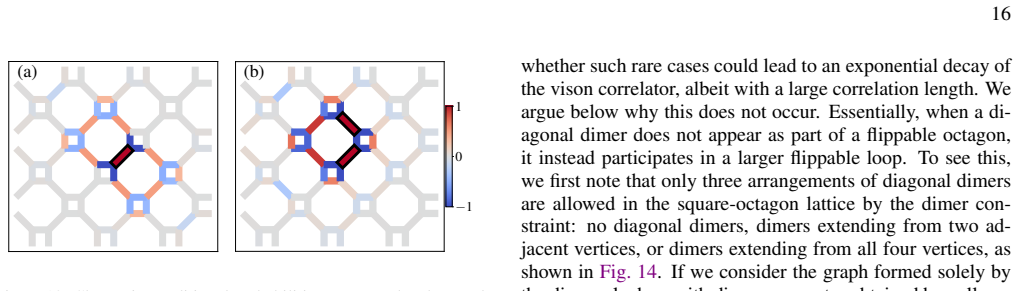
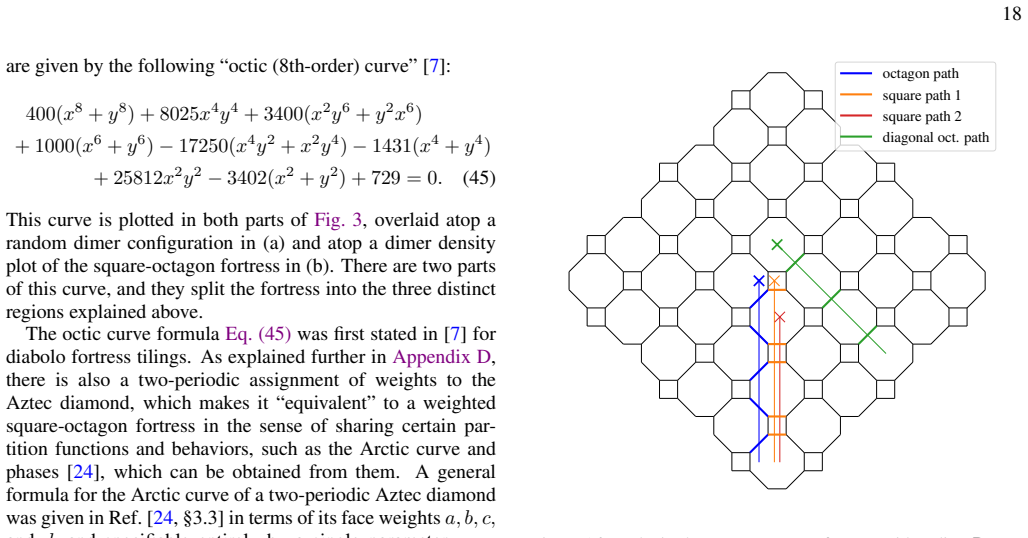
The load-bearing object is the Kasteleyn matrix $K$, a signed adjacency matrix whose determinant counts dimer coverings and whose inverse gives all local correlation functions through Kenyon's formula. The paper's most useful identity is the vison correlator $\langle(-1)^{\eta_E}\rangle = \det(I - 2K'_E K^{-1}_E)$, which turns a nonlocal string correlator into a finite determinant; combined with fraction-free sparse LU decomposition, it yields exact correlators on ill-conditioned graphs. For the square-octagon lattice, the inverse Kasteleyn matrix is expressed by contour integrals of rational functions divided by the characteristic polynomial $P(z,w) = -5 + z + z^{-1} + w + w^{-1}$, whose gap controls exponential decay and whose zero set on the square lattice would give power laws. For the fortress, the three-region structure comes from a quoted equivalence between the unweighted fortress and a two-periodic weighted Aztec diamond with weights $a=b=c=1$ and $d=1/2$, whose Arctic octic curve is imported from the literature. The strong Szegő limit theorem for Toeplitz determinants supplies the infinite-string vison constant.
What would settle it
Compare the exact partition function and edge-occupation probabilities of the unweighted square-octagon fortress, computed directly at large radius with integer arithmetic, against the weighted-Aztec-diamond predictions; a discrepancy in the limiting frozen-region probabilities, or a central correlation length differing from $-\log((3-\sqrt{5})/2)^{-1} \approx 1.039$, would falsify the claimed three-region structure.
Extended reading notes
Core claim
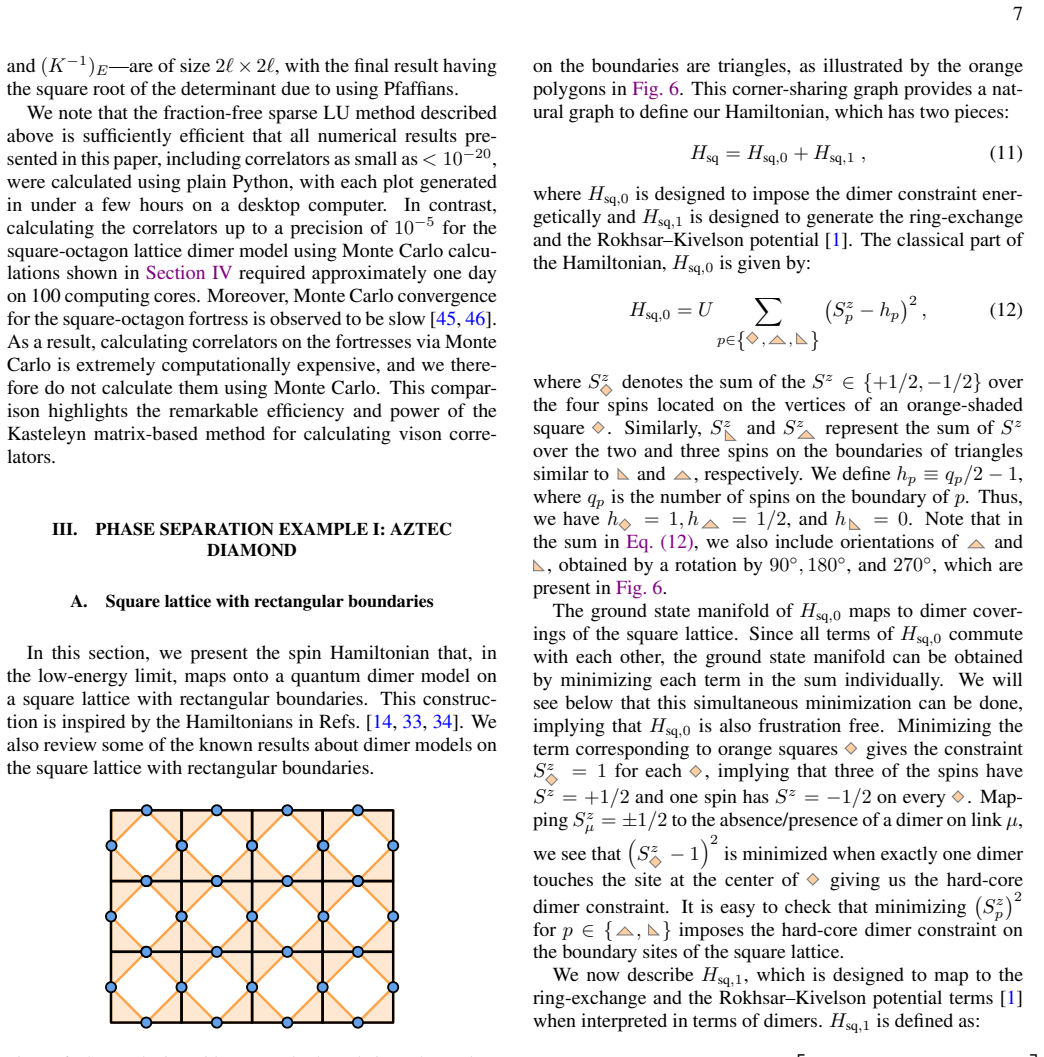
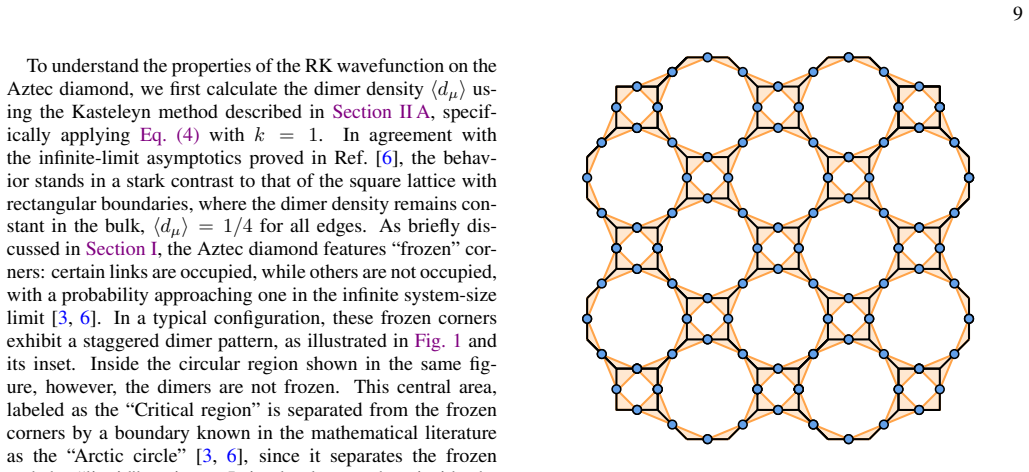
The central discovery is that the thermodynamic limit can fail to be shape-independent in exact ground states of local quantum Hamiltonians. For the square lattice, the authors reverse-engineer a spin-1/2 Hamiltonian whose low-energy sector is the Rokhsar–Kivelson dimer model; at the RK point the ground state is the uniform superposition of all perfect matchings. On a rectangular domain this state is critical everywhere, with power-law dimer–dimer correlations. On the Aztec diamond—the same Hamiltonian with different boundary terms—the same state develops frozen staggered regions outside the Arctic circle, occupying about 21 percent of the area, with power-law critical correlations inside. For the square-octagon lattice, the rectangular-boundary model has exponentially decaying dimer correlations and a constant vison correlator along octagon paths, with the infinite-string constant 0.774596669..., indicating a gapped ordered phase. On the square-octagon fortress, the same model separates into three regions: frozen staggered corners, a critical intermediate region, and a central region with the same gapped short-range-entangled phase as the rectangular-boundary case, with phase boundaries given by the octic curve Eq. (45).
Load-bearing premise
The fortress phase diagram rests on an equivalence, quoted rather than proved here, between the unweighted square-octagon fortress and a specific weighted Aztec diamond; if that equivalence is inexact, the octic-curve region boundaries are unsupported.
Editorial extensions
If this is right
- If these claims hold, numerical or experimental studies of these Hamiltonians must specify not just lattice and boundary conditions but the global shape of the domain, because the infinite-size limit is not a single object.
- The square-octagon fortress shows phase separation can occur between a gapped central region and frozen corners separated by a critical region, so the phenomenon is not confined to a single fine-tuned point; the gapped central region is expected to remain stable under small perturbations.
- The exact Kasteleyn-based vison correlator, computed to precision around $10^{-21}$, replaces Monte Carlo estimates at the $10^{-6}$ level for RK wavefunctions on planar lattices, making spin-liquid diagnostics far cheaper.
- The central region of the fortress and the square-boundary square-octagon lattice share the same phase, with exponentially decaying dimer correlations and a constant vison correlator; this phase is not a $\mathbb{Z}_2$ quantum spin liquid but an ordered short-range-entangled state.
- The frozen corner regions occupy a finite fraction of the system, about $1-\pi/4 \approx 21\%$ for the Aztec diamond, so the phase separation is macroscopic rather than a boundary-localized effect.
Reading between the lines
- These constructions suggest a sharper definition of the thermodynamic limit: for shape-dependent phase separation, the limit should be taken along specified shapes, and one could classify Hamiltonians by whether their infinite-volume phase diagram depends on the limiting shape.
- The same Kasteleyn determinant method should extend to Wilson-loop observables and to non-bipartite planar graphs, giving an exact probe of confinement in RK-type dimer models beyond the square-octagon lattice.
- A Rydberg-atom implementation of the square-octagon dimer model with fortress boundaries could test the predicted constant vison correlator directly, creating coexisting frozen, critical, and gapped regions in a single experiment.
- If perturbation away from the RK point leaves the gapped central region intact, shape-induced phase separation may be observable at the accessible sizes of current quantum simulators, since the macroscopic frozen region already appears at moderate radii.
Signed reviews
Editorial analysis
A structured set of objections, weighed in public.
Referee Report
Summary. The paper constructs local spin-1/2 Hamiltonians on square and square-octagon lattices whose low-energy sectors are Rokhsar-Kivelson quantum dimer models. At the RK point the ground state is the uniform superposition of classical dimer coverings, so classical dimer results transfer. On square-shaped domains the standard critical phase is recovered; on Aztec-diamond domains the Arctic circle produces macroscopic frozen and critical regions, giving a shape-dependent thermodynamic limit. For the square-octagon lattice with rectangular boundaries the authors compute dimer-dimer correlators analytically in the infinite-size limit, obtain exponential decay, and prove via the strong Szegő limit theorem that the vison correlator along an octagon path tends to the nonzero constant sqrt(60)/10, identifying an ordered short-range entangled phase. For the square-octagon fortress they use a correspondence with a weighted Aztec diamond to claim three regions (frozen, critical, gaseous), with the central region behaving like the rectangular case. They also introduce an exact fraction-free LU method for vison correlators.
Significance. The exact square-octagon rectangular results are solid and the vison correlator method is a genuine technical contribution with clear advantages over Monte Carlo. The central conceptual claim—shape-dependent thermodynamic limit at the RK point—is rigorously established for the Aztec-diamond example and is plausible for the fortress conditional on the cited classical equivalence. The paper is careful with Kasteleyn asymptotics, checks the conditions of the strong Szegő theorem, and uses exact integer arithmetic for ill-conditioned fortress matrices, which makes the numerical results reproducible. The main weaknesses are that the fortress three-region structure rests on a not-fully-stated equivalence with a weighted Aztec diamond and that the claimed critical region is explicitly numerically inconclusive; the robustness-away-from-RK claim is also presented as a demonstration despite being explicitly left as future work.
major comments (3)
- [Appendix D and Section V B] The three-region structure of the fortress ground state rests on the asserted equivalence between the unweighted square-octagon fortress and a two-periodic weighted Aztec diamond with face weights a=b=c=1 and d=1/2. Appendix D states the weight assignment and quotes partition-function identities, but it does not state the precise equivalence theorem or establish that the local dimer statistics used in Section V (dimer probabilities, dimer-dimer correlators, vison correlators) coincide between the two models. Since Eq. (45) and the frozen/critical/gaseous phase assignment are imported through this correspondence, please provide a precise statement of the equivalence with a specific reference or proof, and explain in what sense the Arctic curve and local statistics transfer to the fortress.
- [Section V C and abstract] The abstract states that the diamond-shaped domain has a region 'exhibiting critical correlations,' but Section V C reports that in the intermediate region 'the numerical plots are less conclusive; however, we expect the dimer-dimer connected correlator to exhibit power-law decay.' No power-law fit, scaling collapse, or analytic argument for the fortress critical region is shown. Because the three-phase structure is a headline result, the claim of a critical phase should either be supported by data or explicitly downgraded to an expectation in both the abstract and the discussion.
- [Section VI (Discussion)] The discussion states that the fortress example 'demonstrates that the breakdown of the thermodynamic limit can persist beyond fine-tuned points,' but no perturbation analysis is performed; the only evidence offered is the expectation that the gapped central region survives, and Future Direction 3 lists an explicit quantum Monte Carlo test of stability as open. Please either present a concrete stability argument (for example perturbation theory or QMC data) or clearly label robust stability as a conjecture rather than a demonstrated result.
minor comments (5)
- [Section III A] The sentence 'These properties can can be derived using Kasteleyn matrix methods' contains a duplicated word; please fix the typo.
- [Section IV A] The text refers to 'Hsor,0' in the sentence following Eq. (21); this should be 'Hsos,0' for consistency with the notation introduced in Eq. (19).
- [Section V C] The sentence comparing paths 'considered in Section V' should refer to Section IV, since the rectangular-boundary paths are defined there.
- [Figure 12 caption] The caption contains a garbled phrase, 'square paths a, which show a mixture of constant and exponential decay behavior'; please rephrase and define the labeling of square paths clearly.
- [Figure 22 caption and Appendix C] The caption spells 'Kastelen matrix condition number'; the correct spelling is 'Kasteleyn'. The same appendix also refers to 'Kastelen matrix condition number' in the title of the figure.
Circularity Check
No significant circularity: the RK construction openly imports classical dimer theorems and then derives quantum correlators from the Kasteleyn kernel, with no fitted parameter renamed as prediction.
full rationale
The paper's central move is explicitly constructive: it defines spin Hamiltonians whose U→∞ low-energy sector is a quantum dimer model, and at J=V the ground state is the uniform superposition of all dimer coverings. All subsequent phase statements for the Aztec diamond and square-octagon fortress are then computed (or imported) from the classical dimer measure, not fitted. The dimer-dimer and vison correlators are obtained from the Kasteleyn inverse matrix via Kenyon's formula and the determinant identity det(I−2K'K^{-1}), with analytic limits (e.g., Eq. (30)) obtained by Toeplitz/Szegő asymptotics and confirmed by FFLU and Monte Carlo; no parameter is tuned to data. The only load-bearing external inputs—the Arctic circle theorem, the octic curve Eq. (45), and the fortress–weighted-Aztec correspondence of Appendix D—are cited mathematical results from Refs. [3,7,24,77], not from the present authors, so they are independent support rather than self-citation. The paper's self-citations (Refs. [33,34,71]) are not load-bearing for the thermodynamic-limit claim; Ref. [34] is used only for a qualitative analogy to 'Ruby family' order. The fortress example does rely on an unproved (in this paper) identification with a weighted Aztec diamond, but that is a correctness or verification gap, not circularity: the octic curve and phase structure are stated as imports, not derived from the paper's own outputs. Numerical inconclusiveness in the critical region (Section V C: 'the numerical plots are less conclusive') lowers confidence but does not create a circular derivation.
Assumptions & free parameters
free parameters (1)
- RK coupling ratio V=J =
V4=J4>0, V8=J8>0; V=J
assumptions (6)
- standard math Kasteleyn theory for planar and torus bipartite graphs: number of dimer coverings equals |det K|, with Kenyon's formula for local statistics.
- domain assumption Arctic circle theorem for random domino tilings of the Aztec diamond (Jockusch-Propp-Shor; Cohn-Elkies-Propp).
- domain assumption Equivalence of the unweighted square-octagon fortress to a two-periodic weighted Aztec diamond with weights a=b=c=1, d=1/2, yielding the octic curve Eq. (45).
- domain assumption Ergodicity of ring-exchange moves on the square-octagon lattice, ensuring a unique RK ground state.
- standard math Strong Szego limit theorem for Toeplitz determinants.
- domain assumption Large-U limit: for U≫|V|,|J|, the spin Hamiltonian's low-energy sector is described by the effective RK dimer Hamiltonian.
Cite this review
Pith. "Pith review of Breakdown of the thermodynamic limit in quantum spin and dimer models." pith.science (2026). https://pith.science/paper/WMLQUDQI
@misc{pith2026250615769,
  author       = {Pith},
  title        = {Pith review of: Breakdown of the thermodynamic limit in quantum spin and dimer models},
  year         = {2026},
  howpublished = {\url{https://pith.science/paper/WMLQUDQI}},
  note         = {Machine review of arXiv:2506.15769}
}
read the original abstract
The thermodynamic limit is foundational to statistical mechanics, underlying our understanding of many-body phases. It assumes that, as the system size grows infinitely at fixed density of particles, unambiguous macroscopic phases emerge that are independent of the system's boundary shape. We present explicit quantum spin and dimer Hamiltonians whose ground states violate this principle. Our construction relies on the previous mathematical work on classical dimers on the Aztec diamond and the square-octagon fortress, where geometry-dependent phase behaviors are observed in the infinite-size limit. We reverse engineer quantum spin Hamiltonians on the square and the square-octagon lattices whose ground states at the Rokhsar-Kivelson points are described by classical dimer coverings. On diamond-shaped domains, we find macroscopic boundary regions exhibiting distinct quantum phases from those on square-shaped domains. We study the nature of these phases by calculating the dimer-dimer and vison correlators and adapt Kasteleyn matrix based analytical and numerical methods for computing the vison correlator, which are significantly more efficient than standard Monte Carlo techniques. Our results show that the square-octagon lattice supports a single gapped short-range entangled phase, with exponentially decaying dimer correlators and a constant vison correlator. When the same model is considered on a diamond-shaped domain, two additional macroscopic regions emerge, with one near the corners and exhibiting staggered dimer order, and another exhibiting critical correlations.
Figures


Figures from the paper (17 more)









Forward citations
Cited by 2 Pith papers
-
Exactly Solvable Topological Phase Transition in a Quantum Dimer Model
A tunable triangular-lattice quantum dimer model is shown to undergo an exactly solvable continuous topological phase transition at edge weight α = 3, from a Z2 quantum spin liquid to a columnar ordered state.
-
Approaching Kasteleyn transition in frustrated quantum Heisenberg antiferromagnets
A spin-1/2 Heisenberg antiferromagnet on the anisotropic diamond-decorated honeycomb lattice realizes a Kasteleyn crossover that becomes arbitrarily sharp as the anisotropy tends to zero.
Reference graph
Works this paper leans on
-
[1]
Classical mixtures of such doubly periodic weighted dimer coverings have been studied exten- sively in the mathematical literature [21, 23, 27, 64]
Study wavefunctions where dimer coverings appear with amplitudes determined by doubly periodic edge weights. Classical mixtures of such doubly periodic weighted dimer coverings have been studied exten- sively in the mathematical literature [21, 23, 27, 64]. A natural question is whether one can construct an RK- like Hamiltonian whose ground state realizes...
-
[2]
Identify a lattice which shows phase separation for cer- tain boundary shapes across a finite region of the phase diagram, with at least one region realizing a quantum spin liquid phase
-
[3]
(22)] away from the RK point using quantum Monte Carlo calculations, which has been used to study several other dimer models [48, 65, 66]
Explicitly test the stability of phase separation of the quantum dimer model on the square-octagon fortress [Eq. (22)] away from the RK point using quantum Monte Carlo calculations, which has been used to study several other dimer models [48, 65, 66]
-
[4]
Investigating the phases of a quantum dimer model corresponding to these different lattices is another compelling direction
The emergence of macroscopic regions with distinct behavior of correlators in dimer models is not unique to the Aztec diamond or the square-octagon fortress; similar phenomena are seen in lozenge tilings of a hexagon [38, 67] as well as with Aztec-like boundaries in other bipartite lattices. Investigating the phases of a quantum dimer model corresponding ...
-
[5]
The Rydberg blockade mechanism can be used to impose the dimer constraint on the Kagome lat- tice [68, 69], as well as the square and the triangular lattices [70]
From an experimental standpoint, Rydberg atom ar- rays offer a natural platform for realizing dimer mod- els [68–73]. The Rydberg blockade mechanism can be used to impose the dimer constraint on the Kagome lat- tice [68, 69], as well as the square and the triangular lattices [70]. Extending these approaches to implement the dimer model on the square-octag...
-
[6]
Dimer models on the simple cubic and diamond lattices have been studied [20, 74, 75], and it is known that the RK wavefunction lies in a U(1) quantum spin liquid phase
Three-dimensional quantum dimer models are known to exhibit exotic phases, such as a U(1) quantum spin liquid. Dimer models on the simple cubic and diamond lattices have been studied [20, 74, 75], and it is known that the RK wavefunction lies in a U(1) quantum spin liquid phase. An interesting question is whether phase separation can occur on a cubic latt...
-
[7]
In particular, the ability to calculate Wilson loops exactly provides a valuable tool for probing confine- ment/deconfinement in dimer model
The method for calculating the vison correlator de- scribed in Section II B, can be extended to calculate many other important observables, such as the Wilson loops. In particular, the ability to calculate Wilson loops exactly provides a valuable tool for probing confine- ment/deconfinement in dimer model. Since these quan- tities decay exponentially with...
-
[8]
D. S. Rokhsar and S. A. Kivelson, Superconductivity and the Quantum Hard-Core Dimer Gas, Phys. Rev. Lett. 61, 2376 (1988)
1988
Show all 89 references
-
[9]
Elkies, G
N. Elkies, G. Kuperberg, M. Larsen, and J. Propp, Alternating- sign matrices and domino tilings Part I, J. Algebr. Comb.1, 111 (1992)
1992
-
[10]
Jockusch, J
W. Jockusch, J. Propp, and P. Shor, Random domino tilings and the Arctic Circle theorem (1998), arXiv:math/9801068
1998 arXiv
-
[11]
Elkies, G
N. Elkies, G. Kuperberg, M. Larsen, and J. Propp, Alternating- sign matrices and domino tilings Part II, J. Algebr. Comb. 1, 219 (1992)
1992
-
[12]
Kenyon, Local statistics of lattice dimers, Ann
R. Kenyon, Local statistics of lattice dimers, Ann. Inst. Henri Poincar´e (B) Probab. Stat. 33, 591 (1997)
1997
-
[13]
H. Cohn, N. Elkies, and J. Propp, Local statistics for random domino tilings of the Aztec diamond, Duke Math. J. 85, 117 (1996)
1996
-
[14]
Propp, Generalized domino-shuffling, Theor
J. Propp, Generalized domino-shuffling, Theor. Comput. Sci. 303, 267 (2003)
2003
-
[15]
Kenyon, Lectures on Dimers (2009), arXiv:0910.3129
R. Kenyon, Lectures on Dimers (2009), arXiv:0910.3129
2009 arXiv
-
[16]
P. W. Kasteleyn, The statistics of dimers on a lattice: I. the num- ber of dimer arrangements on a quadratic lattice, Physica 27, 1209 (1961)
1961
-
[17]
H. N. Temperley and M. E. Fisher, Dimer problem in statistical mechanics-an exact result, Phil. Mag. 6, 1061 (1961)
1961
-
[18]
M. E. Fisher, Statistical mechanics of dimers on a plane lattice, Phys. Rev. 124, 1664 (1961). 22
1961
-
[19]
E. W. Montroll, R. B. Potts, and J. C. Ward, Correlations and spontaneous magnetization of the two-dimensional Ising model, J. Math. Phys. 4, 308 (1963)
1963
-
[20]
Moessner and K
R. Moessner and K. S. Raman, Quantum dimer models, in In- troduction to Frustrated Magnetism: Materials, Experiments, Theory (Springer Berlin Heidelberg, Berlin, Heidelberg, 2011) pp. 437–479
2011
-
[21]
Balents, M
L. Balents, M. P. A. Fisher, and S. M. Girvin, Fractionaliza- tion in an easy-axis Kagome antiferromagnet, Phys. Rev. B 65, 224412 (2002)
2002
-
[22]
Savary and L
L. Savary and L. Balents, Quantum spin liquids: A review, Rep. Prog. Phys. 80, 016502 (2017)
2017
-
[23]
Senthil and M
T. Senthil and M. P. A. Fisher,Z2 gauge theory of electron frac- tionalization in strongly correlated systems, Phys. Rev. B 62, 7850 (2000)
2000
-
[24]
Moessner and S
R. Moessner and S. L. Sondhi, Resonating Valence Bond Phase in the Triangular Lattice Quantum Dimer Model, Phys. Rev. Lett. 86, 1881 (2001)
2001
-
[25]
Fendley, R
P. Fendley, R. Moessner, and S. L. Sondhi, Classical dimers on the triangular lattice, Phys. Rev. B 66, 214513 (2002)
2002
-
[26]
Misguich, D
G. Misguich, D. Serban, and V . Pasquier, Quantum dimer model on the Kagome lattice: Solvable dimer-liquid and Ising gauge theory, Phys. Rev. Lett.89, 137202 (2002)
2002
-
[27]
Hermele, M
M. Hermele, M. P. A. Fisher, and L. Balents, Pyrochlore pho- tons: The U (1) spin liquid in a S = 1/2 three-dimensional frustrated magnet, Phys. Rev. B 69, 064404 (2004)
2004
-
[28]
Chhita and B
S. Chhita and B. Young, Coupling functions for domino tilings of Aztec diamonds, Adv. Math. 259, 173 (2014)
2014
-
[29]
Chhita, K
S. Chhita, K. Johansson, and B. Young, Asymptotic domino statistics in the Aztec diamond, Ann. Appl. Probab. 25, 1232 (2015)
2015
-
[30]
Chhita and K
S. Chhita and K. Johansson, Domino statistics of the two- periodic Aztec diamond, Adv. Math. 294, 37 (2016)
2016
-
[31]
Di Francesco and R
P. Di Francesco and R. Soto-Garrido, Arctic curves of the octa- hedron equation, J. Phys. A 47, 285204, 34 (2014)
2014
-
[32]
Duits and A
M. Duits and A. B. J. Kuijlaars, The two-periodic Aztec dia- mond and matrix valued orthogonal polynomials, J. Eur. Math. Soc. (JEMS) 23, 1075 (2021)
2021
-
[33]
Berggren and M
T. Berggren and M. Duits, Correlation functions for determi- nantal processes defined by infinite block Toeplitz minors, Adv. Math. 356, 106766, 48 (2019)
2019
-
[34]
Berggren and A
T. Berggren and A. Borodin, Geometry of the doubly periodic Aztec dimer model (2023), arXiv:2306.07482
2023 arXiv
-
[35]
Boutillier and B
C. Boutillier and B. Tili `ere, Fock’s dimer model on the Aztec diamond, arXiv:2405.20284 (2025)
2025 arXiv
-
[36]
Kenyon, A
R. Kenyon, A. Okounkov, and S. Sheffield, Dimers and amoe- bae, Ann. of Math. (2) 163, 1019 (2006)
2006
-
[37]
Moessner, S
R. Moessner, S. L. Sondhi, and E. Fradkin, Short-ranged res- onating valence bond physics, quantum dimer models, and Ising gauge theories, Phys. Rev. B 65, 024504 (2001)
2001
-
[38]
Misguich and F
G. Misguich and F. Mila, Quantum dimer model on the trian- gular lattice: Semiclassical and variational approaches to vison dispersion and condensation, Phys. Rev. B 77, 134421 (2008)
2008
-
[39]
Ioselevich, D
A. Ioselevich, D. A. Ivanov, and M. V . Feigelman, Ground-state properties of the Rokhsar-Kivelson dimer model on the triangu- lar lattice, Phys. Rev. B 66, 174405 (2002)
2002
-
[40]
J. Shah, G. Nambiar, A. V . Gorshkov, and V . Galitski, A quantum monomer-dimer model on Penrose tilings (2025), arXiv:2503.15588
2025
-
[41]
Balasubramanian, V
S. Balasubramanian, V . Galitski, and A. Vishwanath, Classical vertex model dualities in a family of two-dimensional frustrated quantum antiferromagnets, Phys. Rev. B 106, 195127 (2022)
2022
-
[42]
P. W. Kasteleyn, Dimer statistics and phase transitions, J. Math. Phys. 4, 287 (1963)
1963
-
[43]
P. W. Kasteleyn, Graph theory and crystal physics, in Graph Theory and Theoretical Physics, edited by F. Harary (Academic Press, London, 1967) pp. 43–110
1967
-
[44]
Cimasoni, The geometry of dimer models, Winter Braids Lect
D. Cimasoni, The geometry of dimer models, Winter Braids Lect. Notes 1, Exp. No. 2, 14 (2014)
2014
-
[45]
Gorin,Lectures on random lozenge tilings, Cambridge Stud- ies in Advanced Mathematics, V ol
V . Gorin,Lectures on random lozenge tilings, Cambridge Stud- ies in Advanced Mathematics, V ol. 193 (Cambridge University Press, Cambridge, 2021) pp. viii+250
2021
-
[46]
Senthil and M
T. Senthil and M. P. A. Fisher, Fractionalization in the cuprates: Detecting the topological order, Phys. Rev. Lett.86, 292 (2001)
2001
-
[47]
Senthil and M
T. Senthil and M. P. A. Fisher, Fractionalization, topological order, and cuprate superconductivity, Phys. Rev. B 63, 134521 (2001)
2001
-
[48]
In terms of concepts from the mathematics literature, the vison correlator is related to a form of the height function modulo two
-
[49]
H. R. Lee and B. D. Saunders, Fraction free Gaussian elimina- tion for sparse matrices, J. Symb. Comput. 19, 393 (1995)
1995
-
[50]
G. C. Nakos, P. R. Turner, and R. M. Williams, Fraction-free algorithms for linear and polynomial equations, ACM SIGSAM Bull. 31, 11 (1997)
1997
-
[51]
D. B. Wilson, Determinant algorithms for random planar struc- tures, in SODA, V ol. 97 (ACM/SIAM, 1997) pp. 258–267
1997
-
[52]
P. J. Bhakta, Markov chains for weighted lattice structures , Ph.D. thesis, Georgia Institute of Technology (2016)
2016
-
[53]
Bhakta and D
P. Bhakta and D. Randall, Sampling weighted perfect match- ings on the square-octagon lattice, Theor. Comput. Sci. 699, 21 (2017)
2017
-
[54]
M. E. Fisher and J. Stephenson, Statistical mechanics of dimers on a plane lattice. ii. dimer correlations and monomers, Phys. Rev. 132, 1411 (1963)
1963
-
[55]
Z. Yan, Z. Zhou, O. F. Sylju˚asen, J. Zhang, T. Yuan, J. Lou, and Y . Chen, Widely existing mixed phase structure of the quan- tum dimer model on a square lattice, Phys. Rev. B103, 094421 (2021)
2021
-
[56]
Banerjee, M
D. Banerjee, M. B ¨ogli, C. P. Hofmann, F.-J. Jiang, P. Widmer, and U.-J. Wiese, Finite-volume energy spectrum, fractionalized strings, and low-energy effective field theory for the quantum dimer model on the square lattice, Phys. Rev. B 94, 115120 (2016)
2016
-
[57]
H. Cohn, R. Kenyon, and J. Propp, A variational principle for domino tilings, J. Amer. Math. Soc. 14, 297 (2001)
2001
-
[58]
Broer and F
H. Broer and F. Takens, Dynamical systems and chaos, Applied Mathematical Sciences, V ol. 172 (Springer, New York, 2011) pp. xvi+313
2011
-
[59]
F. Y . Wu, Dimers on two-dimensional lattices, Int. J. Mod. Phys. B 20, 5357 (2006)
2006
-
[60]
Szeg ¨o, On certain Hermitian forms associated with the Fourier series of a positive function, Comm
G. Szeg ¨o, On certain Hermitian forms associated with the Fourier series of a positive function, Comm. S ´em. Math. Univ. Lund [Medd. Lunds Univ. Mat. Sem.] , 228 (1952)
1952
-
[61]
Widom, Asymptotic behavior of block Toeplitz matrices and determinants, Adv
H. Widom, Asymptotic behavior of block Toeplitz matrices and determinants, Adv. Math. 13, 284 (1974)
1974
-
[62]
B ¨ottcher and B
A. B ¨ottcher and B. Silbermann, Analysis of Toeplitz operators (Springer-Verlag, Berlin, 1990) p. 512
1990
-
[63]
B ¨ottcher, The Onsager formula, the Fisher-Hartwig conjec- ture, and their influence on research into Toeplitz operators, J
A. B ¨ottcher, The Onsager formula, the Fisher-Hartwig conjec- ture, and their influence on research into Toeplitz operators, J. Stat. Phys. 78, 575 (1995)
1995
-
[64]
Basor, J
E. Basor, J. Dubail, T. Emig, and R. Santachiara, Modified Szeg¨o-Widom asymptotics for block Toeplitz matrices with zero modes, J. Stat. Phys. 174, 28 (2019)
2019
-
[65]
E. L. Basor and T. Ehrhardt, Asymptotics of block Toeplitz de- terminants and the classical dimer model, Comm. Math. Phys. 274, 427 (2007)
2007
-
[66]
W. P. Thurston, Conway’s tiling groups, Amer. Math. Monthly 23 97, 757 (1990)
1990
-
[67]
Kenyon and A
R. Kenyon and A. Okounkov, Limit shapes and the complex Burgers equation, Acta Math. 199, 263 (2007)
2007
-
[68]
Kenyon, Height fluctuations in the honeycomb dimer model, Comm
R. Kenyon, Height fluctuations in the honeycomb dimer model, Comm. Math. Phys. 281, 675 (2008)
2008
-
[69]
Schramm and S
O. Schramm and S. Sheffield, Contour lines of the two- dimensional discrete Gaussian free field, Acta Math. 202, 21 (2009)
2009
-
[70]
Poulson, High-performance sampling of generic determinan- tal point processes, Philos
J. Poulson, High-performance sampling of generic determinan- tal point processes, Philos. Trans. Roy. Soc. A 378, 20190059, 17 (2020)
2020
-
[71]
Borodin and M
A. Borodin and M. Duits, Biased 2 × 2 periodic Aztec diamond and an elliptic curve, Probab. Theory and Relat. Fields187, 259 (2023)
2023
-
[72]
O. F. Sylju ˚asen, Plaquette phase of the square-lattice quantum dimer model: Quantum Monte Carlo calculations, Phys. Rev. B 73, 245105 (2006)
2006
-
[73]
Shannon, O
N. Shannon, O. Sikora, F. Pollmann, K. Penc, and P. Fulde, Quantum Ice: A Quantum Monte Carlo Study, Phys. Rev. Lett. 108, 067204 (2012)
2012
-
[74]
H. Cohn, M. Larsen, and J. Propp, The shape of a typical boxed plane partition (2002), arXiv:math/9801059
2002 arXiv
-
[75]
Semeghini, H
G. Semeghini, H. Levine, A. Keesling, S. Ebadi, T. T. Wang, D. Bluvstein, R. Verresen, H. Pichler, M. Kalinowski, R. Sama- jdar, A. Omran, S. Sachdev, A. Vishwanath, M. Greiner, V . Vuleti´c, and M. D. Lukin, Probing topological spin liquids on a programmable quantum simulator...
2021
-
[76]
Verresen, M
R. Verresen, M. D. Lukin, and A. Vishwanath, Prediction of Toric Code Topological Order from Rydberg Blockade, Phys. Rev. X 11, 031005 (2021)
2021
-
[77]
Z. Zeng, G. Giudici, and H. Pichler, Quantum dimer models with Rydberg gadgets, Phys. Rev. Res. 7, L012006 (2025)
2025
-
[78]
J. Shah, G. Nambiar, A. V . Gorshkov, and V . Galitski, Quantum Spin Ice in Three-Dimensional Rydberg Atom Arrays, Phys. Rev. X 15, 011025 (2025)
2025
-
[79]
A. W. Glaetzle, M. Dalmonte, R. Nath, I. Rousochatzakis, R. Moessner, and P. Zoller, Quantum spin-ice and dimer models with rydberg atoms, Phys. Rev. X 4, 041037 (2014)
2014
-
[80]
Z. Yan, R. Samajdar, Y .-C. Wang, S. Sachdev, and Z. Y . Meng, Triangular lattice quantum dimer model with variable dimer density, Nat. Commun. 13, 5799 (2022)
2022
-
[81]
D. A. Huse, W. Krauth, R. Moessner, and S. L. Sondhi, Coulomb and Liquid Dimer Models in Three Dimensions, Phys. Rev. Lett. 91, 167004 (2003)
2003
-
[82]
Balasubramanian, D
S. Balasubramanian, D. Bulmash, V . Galitski, and A. Vish- wanath, Interplay of symmetry breaking and deconfinement in three-dimensional quantum vertex models, Phys. Rev. B 110, L180401 (2024)
2024
-
[83]
R. L. Burden, J. D. Faires, and A. M. Burden, Numerical anal- ysis, 10th ed. (Cengage Learning, 2015)
2015
-
[84]
Di Francesco, T -systems, networks and dimers, Comm
P. Di Francesco, T -systems, networks and dimers, Comm. Math. Phys. 331, 1237 (2014). Appendix A: Kasteleyn method on a torus As Kasteleyn showed in Ref. [9], counting dimer config- urations on graphs with periodic boundary conditions (PBC) (equivalently, on a torus) requires ...
2014
-
[85]
large-size
Full-size Kasteleyn matrices For this derivation, we primarily work with the full-size Kasteleyn matrices K00 n , K01 n , K10 n , and K11 n , both for conve- nience and to better follow along with the method in Ref. [50]. These are the same type of matrices used when working w...
-
[86]
flattening
Square-octagon partition function Because it can be useful for calculating quantities such as edge probabilities, we place edge weights a on the octagon (non-square) edges and b on the square edges, as depicted in Fig. 21. Ultimately, we will set a = b = 1 to recover the b b b...
-
[87]
21) as: E[ea] = lim n→∞ a 4n2Zn ∂Zn ∂a = 1 4π2 Z 2π 0 Z 2π 0 −a4 +a2b2(cost + coss) −a4− 4b4 + 2a2b2(cost + coss)dtds
Dimer occupation probabilities In the limit n→ ∞, the above calculations give the ex- pected dimer occupation number on the diagonal edges (edges 27 with weighta in Fig. 21) as: E[ea] = lim n→∞ a 4n2Zn ∂Zn ∂a = 1 4π2 Z 2π 0 Z 2π 0 −a4 +a2b2(cost + coss) −a4− 4b4 + 2a2b2(cost +...
-
[88]
Inverse Kasteleyn matrix To determine the entries of the inverse Kasteleyn matrix, we return to the block-diagonal form ofS−1K00 n S as described in Eq. (B5). Taking the inverse yields K00 n −1 =S áB−1 0,0 B−1 0,1 ... B−1 n−1,n−1 ë S−1, (B14) where eachB−1 jk has the block for...
-
[89]
2-periodic
and whose partition function are identical to that of a square-octagon fortress with another set of weights. Details of the process for obtaining this correspondence are given in Ref. [77], where the square-octagon lattice is considered a particular case of a more general type...
Reviewed August 15, 2026 · model on record in the stance chip above.
Discussion (0). Continue with ORCID to comment.