Nonminimal couplings and preheating effects in R²-Higgs inflation after ACT and SPT
Pith reviewed 2026-06-27 08:53 UTC · model grok-4.3
The pith
Dimension-six nonminimal couplings allow R²-Higgs inflation to match the higher scalar spectral index from recent CMB data while also inducing rapid preheating.
A machine-rendered reading of the paper's core claim, the machinery that carries it, and where it could break.
Core claim
The dimension-six operators |Φ|² R² and |Φ|⁴ R accommodate the enhanced scalar spectral index n_s preferred by combined CMB+BAO analyses in the R²-Higgs inflation model. Using a doubly covariant formalism, the same region of parameter space induces rapid preheating through the production of Goldstone modes. If thermalization proceeds efficiently through this preheating mechanism, it may help match the inflationary scale with the CMB reference scale.
What carries the argument
The dimension-six operators |Φ|² R² and |Φ|⁴ R, which adjust the inflationary potential to raise n_s and drive preheating via Goldstone mode production under a doubly covariant formalism.
If this is right
- The model accommodates the enhanced n_s from recent CMB+BAO data.
- Rapid preheating occurs through Goldstone mode production in the same viable parameter space.
- Efficient thermalization via this channel can align the inflationary scale with the CMB reference scale.
Where Pith is reading between the lines
- The same nonminimal operators could be tested in other Higgs-inflation variants to address similar spectral index discrepancies.
- The resulting preheating dynamics may generate detectable features in the early-universe gravitational wave spectrum.
- Future high-precision CMB measurements could further restrict the allowed strengths of these dimension-six couplings.
Load-bearing premise
Thermalization proceeds efficiently through the preheating mechanism induced by these nonminimal couplings, thereby helping match the inflationary scale with the CMB reference scale.
What would settle it
A calculation showing that Goldstone mode production remains too slow for efficient thermalization in the parameter region that fits the observed n_s, or new observations that rule out the enhanced n_s value.
Figures
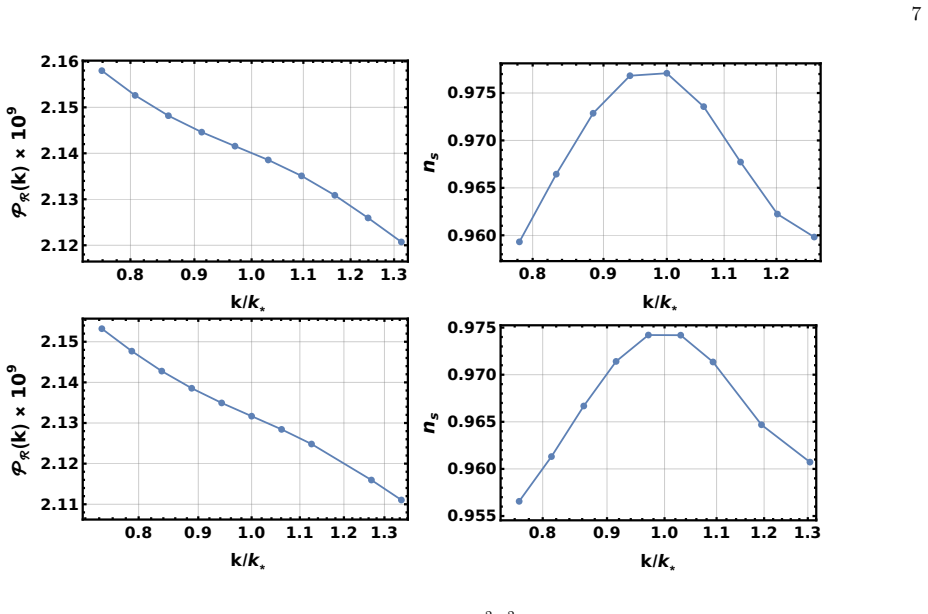
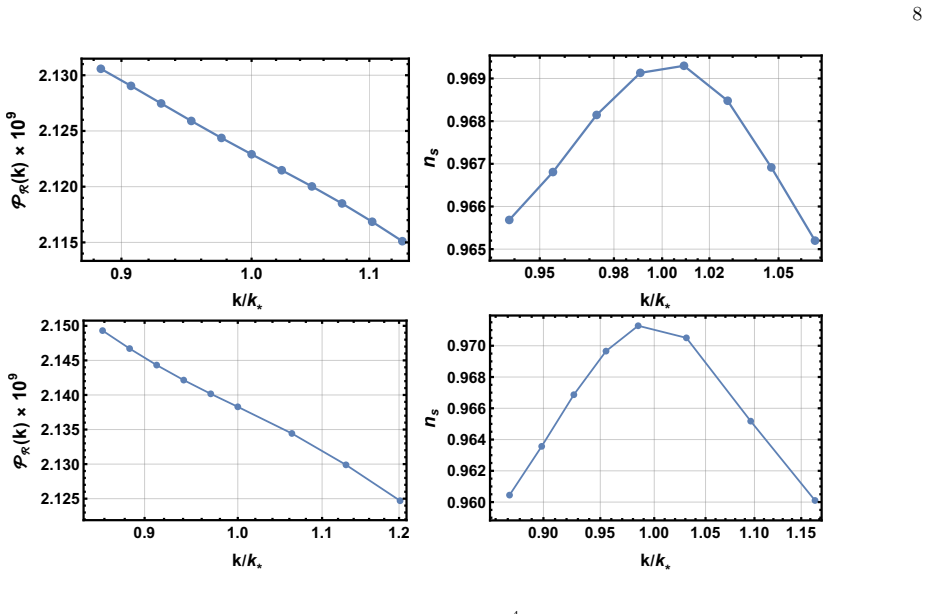
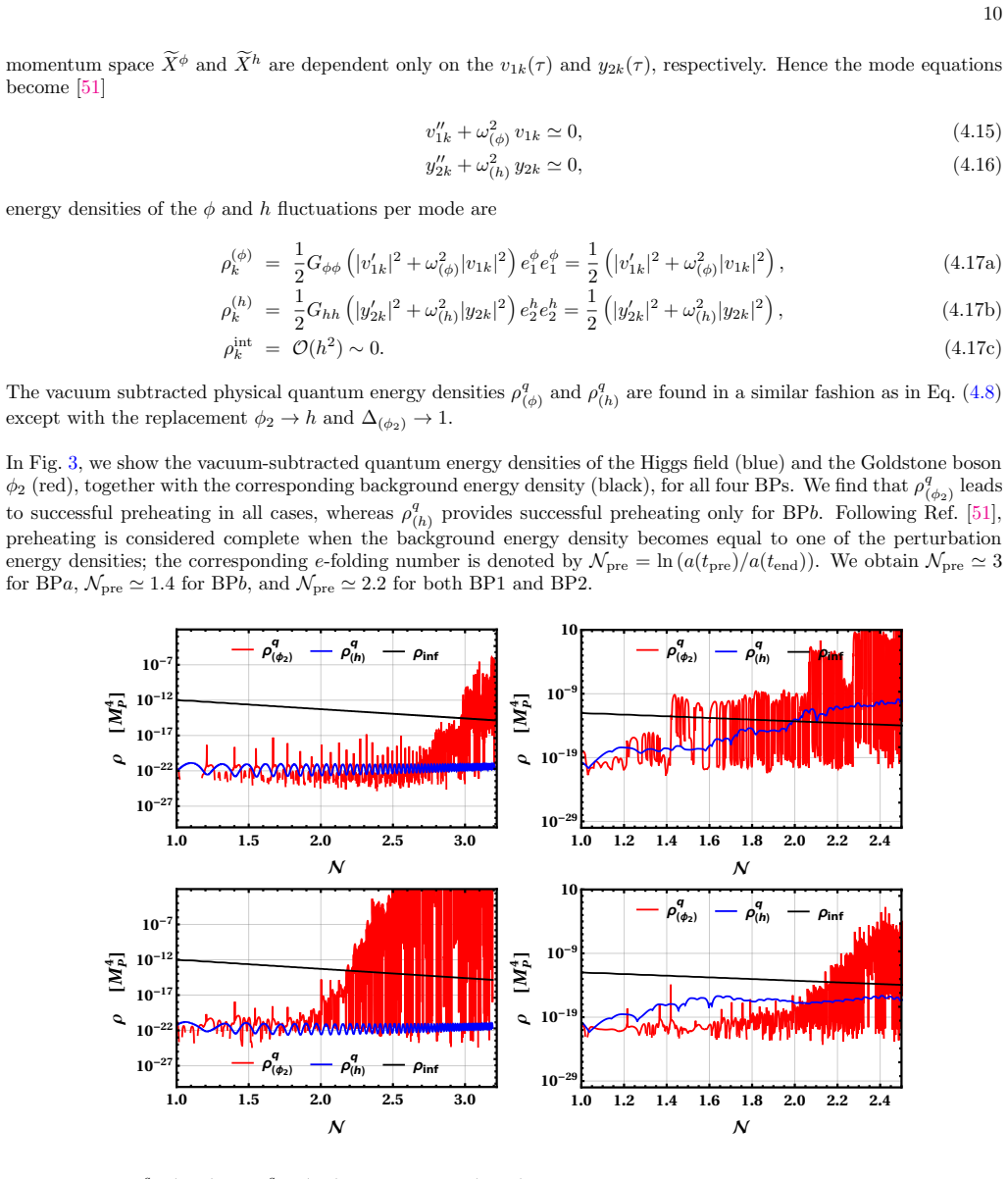
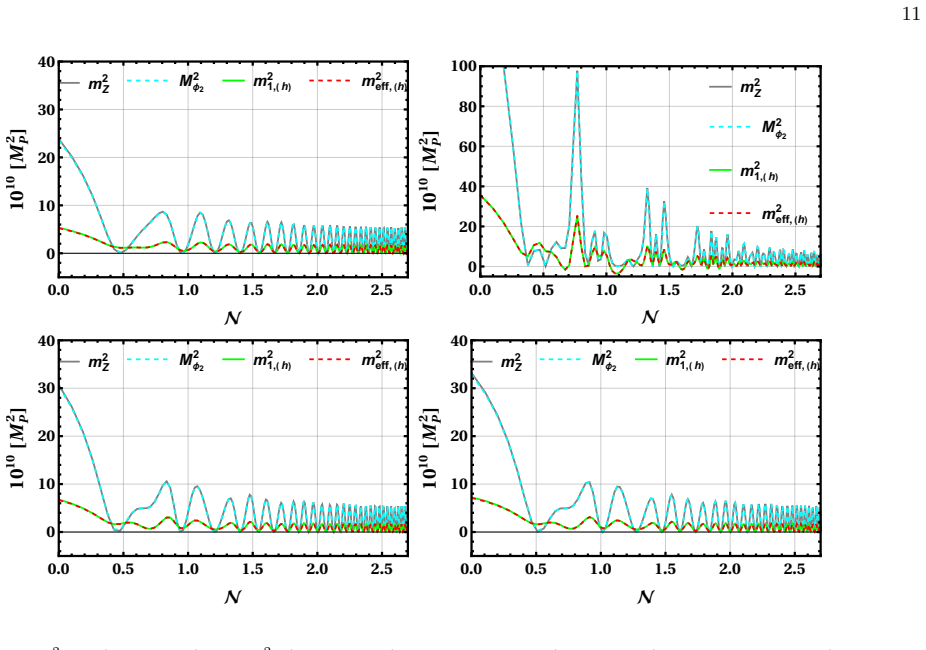
read the original abstract
We study the effects of dimension-four and dimension-six nonminimal Higgs couplings to the Ricci scalar $R$ in the $R^2$-Higgs inflation model in light of the recent ACT and SPT observations. We show that the dimension-six operators $|\Phi|^2 R^2$ and $|\Phi|^4 R$ can accommodate the enhanced scalar spectral index $n_s$ preferred by the combined CMB+BAO analyses. Using a doubly covariant formalism, we find that the same region of parameter space that explains the observed value of $n_s$ can also induce rapid preheating through the production of the Goldstone modes. If thermalization proceeds efficiently through this preheating mechanism, it may help match the inflationary scale with the CMB reference scale.
Editorial analysis
A structured set of objections, weighed in public.
Referee Report
Summary. The paper studies dimension-four and dimension-six nonminimal Higgs couplings to the Ricci scalar in the R²-Higgs inflation model in light of recent ACT and SPT data. It claims that the operators |Φ|²R² and |Φ|⁴R can accommodate the enhanced n_s preferred by CMB+BAO analyses. Using a doubly covariant formalism, the same parameter region is shown to induce rapid preheating via Goldstone-mode production; the authors note that if thermalization proceeds efficiently, this may help reconcile the inflationary scale with the CMB reference scale.
Significance. If the central results hold, the work provides a concrete link between the inflationary parameters needed for the observed n_s and post-inflationary dynamics, strengthening the phenomenological viability of R²-Higgs models. The application of the doubly covariant formalism to preheating calculations is a technical strength that could be reused in related inflationary scenarios.
major comments (2)
- [Abstract and §4] Abstract and §4 (preheating analysis): the claim that the same couplings 'may help match the inflationary scale with the CMB reference scale' rests on the conditional statement that thermalization proceeds efficiently, yet no quantitative estimate of the thermalization timescale or efficiency is provided for the parameter values that fit n_s. This leaves the scale-matching step unverified and load-bearing for the full claim.
- [§3.2] §3.2 (parameter scan for n_s): the region of parameter space identified for |Φ|²R² and |Φ|⁴R that raises n_s to the ACT+SPT+BAO value is stated to overlap with the rapid-preheating region, but the overlap is presented only qualitatively; explicit bounds or a joint contour plot showing the intersection would be required to substantiate that the same values simultaneously satisfy both requirements.
minor comments (2)
- [§2] Notation for the doubly covariant formalism is introduced without a self-contained summary of its key equations; a brief appendix recalling the relevant covariant derivatives would improve readability.
- [Figure 3] Figure 3 (preheating efficiency vs. coupling strength) lacks error bands on the numerical results and does not indicate the number of e-folds or lattice resolution used.
Simulated Author's Rebuttal
We thank the referee for the careful reading and constructive comments on our manuscript. We address each major comment point by point below.
read point-by-point responses
-
Referee: [Abstract and §4] Abstract and §4 (preheating analysis): the claim that the same couplings 'may help match the inflationary scale with the CMB reference scale' rests on the conditional statement that thermalization proceeds efficiently, yet no quantitative estimate of the thermalization timescale or efficiency is provided for the parameter values that fit n_s. This leaves the scale-matching step unverified and load-bearing for the full claim.
Authors: The manuscript frames the scale-matching explicitly as conditional ('If thermalization proceeds efficiently through this preheating mechanism, it may help...'), rather than as a verified result. The core findings are the n_s accommodation by the dimension-six operators and the demonstration of rapid Goldstone-mode preheating in the relevant parameter space using the doubly covariant formalism. We agree that a quantitative thermalization estimate is absent and would require a separate calculation beyond the present scope. In revision we will strengthen the conditional language in the abstract and §4 to avoid any implication of verification, while retaining the preheating results as the substantiated link. revision: partial
-
Referee: [§3.2] §3.2 (parameter scan for n_s): the region of parameter space identified for |Φ|²R² and |Φ|⁴R that raises n_s to the ACT+SPT+BAO value is stated to overlap with the rapid-preheating region, but the overlap is presented only qualitatively; explicit bounds or a joint contour plot showing the intersection would be required to substantiate that the same values simultaneously satisfy both requirements.
Authors: The parameter scan of §3.2 identifies the n_s-compatible region for the dimension-six operators, and §4 then evaluates preheating rates for representative points drawn from that region. We acknowledge that the overlap is shown only through this sequential presentation rather than a single joint figure. In the revised manuscript we will add an explicit joint contour plot (or tabulated bounds) that overlays the n_s-compatible region with the domain of rapid preheating, thereby making the intersection quantitative. revision: yes
Circularity Check
No circularity: parameter fitting to n_s is independent of preheating calculation
full rationale
The abstract states that dimension-six operators are shown to accommodate the observed n_s via the combined CMB+BAO analyses, after which the same parameter region is shown (via doubly covariant formalism) to induce rapid preheating. No equations, self-citations, or ansatze are supplied that would make the preheating output reduce to the n_s fit by construction, nor does the thermalization assumption serve as a load-bearing input that defines the n_s result. The derivation therefore remains self-contained against external data benchmarks, with the preheating step constituting an independent computation rather than a tautological renaming or fitted-input prediction.
Axiom & Free-Parameter Ledger
Reference graph
Works this paper leans on
-
[1]
Action and Equations of Motion 2
-
[2]
Background and perturbation 4 .2
Inflationary dynamics 4 .1. Background and perturbation 4 .2. Dynamics of the perturbations 5
-
[3]
Preheating with Higgs Nonminimal couplings and scale matching 7
-
[4]
The same is true for the single-field like regime of theR 2-Higgs inflation model
Discussion and Summary 12 References 13 1 Introduction Recent measurements of the scalar spectral indexns from combined cosmic microwave background (CMB) observations by Planck [1], the Atacama Cosmology Telescope (ACT) [2], and the South Pole Telescope (SPT) [3], together with baryon acoustic oscillation (BAO) data from DESI, disfavor the original Starob...
Pith/arXiv arXiv 2026
-
[5]
Y. Akrami et al. (Planck), Planck 2018 results. X. Constraints on inflation, Astron. Astrophys.641, A10 (2020), arXiv:1807.06211 [astro-ph.CO]
Pith/arXiv arXiv 2018
-
[6]
T. Louis et al. (Atacama Cosmology Telescope), The Atacama Cosmology Telescope: DR6 power spectra, likelihoods and ΛCDM parameters, JCAP11, 062, arXiv:2503.14452 [astro-ph.CO]
-
[7]
E. Camphuis et al. (SPT-3G), SPT-3G D1: CMB temperature and polarization power spectra and cosmology from 2019 and 2020 observations of the SPT-3G Main field, (2025), arXiv:2506.20707 [astro-ph.CO]
Pith/arXiv arXiv 2019
-
[8]
A. A. Starobinsky, A New Type of Isotropic Cosmological Models Without Singularity, Phys. Lett. B91, 99 (1980)
1980
-
[9]
A. A. Starobinsky, The Perturbation Spectrum Evolving from a Nonsingular Initially De-Sitter Cosmology and the Mi- crowave Background Anisotropy, Sov. Astron. Lett.9, 302 (1983)
1983
-
[10]
Vilenkin, Classical and Quantum Cosmology of the Starobinsky Inflationary Model, Phys
A. Vilenkin, Classical and Quantum Cosmology of the Starobinsky Inflationary Model, Phys. Rev. D32, 2511 (1985)
1985
-
[11]
M. B. Mijic, M. S. Morris, and W.-M. Suen, TheR 2 Cosmology: Inflation Without a Phase Transition, Phys. Rev. D34, 2934 (1986)
1986
-
[12]
Maeda, Inflation as a Transient Attractor inR 2 Cosmology, Phys
K.-i. Maeda, Inflation as a Transient Attractor inR 2 Cosmology, Phys. Rev. D37, 858 (1988)
1988
-
[13]
M. Abdul Karim et al. (DESI), DESI DR2 Results II: Measurements of Baryon Acoustic Oscillations and Cosmological Constraints, (2025), arXiv:2503.14738 [astro-ph.CO]
Pith/arXiv arXiv 2025
-
[14]
M. Drees and Y. Xu, Refined predictions for Starobinsky inflation and post-inflationary constraints in light of ACT, Phys. Lett. B867, 139612 (2025), arXiv:2504.20757 [astro-ph.CO]
arXiv 2025
-
[15]
R. Kallosh and A. Linde, On the Present Status of Inflationary Cosmology, (2025), arXiv:2505.13646 [hep-th]
arXiv 2025
-
[16]
S. Aoki, H. Otsuka, and R. Yanagita, Higgs-modular inflation, Phys. Rev. D112, 043505 (2025), arXiv:2504.01622 [hep-ph]
arXiv 2025
-
[17]
I. D. Gialamas, A. Karam, A. Racioppi, and M. Raidal, Has ACT measured radiative corrections to the tree-level Higgs-like inflation?, (2025), arXiv:2504.06002 [astro-ph.CO]
arXiv 2025
-
[18]
D. S. Zharov, O. O. Sobol, and S. I. Vilchinskii, Reheating ACTs on Starobinsky and Higgs inflation, (2025), arXiv:2505.01129 [astro-ph.CO]
arXiv 2025
-
[19]
L. Liu, Z. Yi, and Y. Gong, Reconciling Higgs Inflation with ACT Observations through Reheating, (2025), arXiv:2505.02407 [astro-ph.CO]
Pith/arXiv arXiv 2025
-
[20]
M. R. Haque, S. Pal, and D. Paul, Improved Predictions on Higgs-Starobinsky Inflation and Reheating with ACT DR6 and Primordial Gravitational Waves, (2025), arXiv:2505.04615 [astro-ph.CO]
arXiv 2025
-
[21]
Yogesh, A. Mohammadi, Q. Wu, and T. Zhu, Starobinsky like inflation and EGB Gravity in the light of ACT, (2025), arXiv:2505.05363 [astro-ph.CO]
arXiv 2025
-
[22]
I. D. Gialamas, T. Katsoulas, and K. Tamvakis, Keeping the relation between the Starobinsky model and no-scale super- gravity ACTive, (2025), arXiv:2505.03608 [gr-qc]
arXiv 2025
- [23]
-
[24]
Pallis, Kinetically modified Palatini inflation meets ACT data, Phys
C. Pallis, Kinetically modified Palatini inflation meets ACT data, Phys. Lett. B868, 139739 (2025), arXiv:2505.23243 [hep-ph]
arXiv 2025
-
[25]
S. Saini and A. Nautiyal, Power lawα-Starobinsky inflation, (2025), arXiv:2505.16853 [astro-ph.CO]
arXiv 2025
-
[26]
W. J. Wolf, Inflationary attractors and radiative corrections in light of ACT data, (2025), arXiv:2506.12436 [astro-ph.CO]
arXiv 2025
-
[27]
X. Wang, K. Kohri, and T. T. Yanagida, Primordial Black Holes SaveR2 Inflation, (2025), arXiv:2506.06797 [astro-ph.CO]
arXiv 2025
-
[28]
M. Piva, Classification off(R) Theories Of Inflation And The Uniqueness of Starobinsky Model, (2025), arXiv:2507.02637 [hep-th]
arXiv 2025
-
[29]
N. Sidik Risdianto, R. H. S. Budhi, N. Shobcha, and A. Salim Adam, The Preheating Stage on The Starobinsky Inflation after ACT, (2025), arXiv:2507.12868 [gr-qc]
Pith/arXiv arXiv 2025
-
[30]
D. S. Zharov, O. O. Sobol, and S. I. Vilchinskii, ACT observations, reheating, and Starobinsky and Higgs inflation, Phys. Rev. D112, 023544 (2025)
2025
-
[31]
E. G. M. Ferreira, E. McDonough, L. Balkenhol, R. Kallosh, L. Knox, and A. Linde, The BAO-CMB Tension and Implications for Inflation, (2025), arXiv:2507.12459 [astro-ph.CO]
arXiv 2025
- [32]
-
[33]
S. D. Odintsov and V. K. Oikonomou, Confronting rainbow-deformed f(R) gravity with the ACT data, Phys. Lett. B870, 139909 (2025), arXiv:2508.17358 [gr-qc]
arXiv 2025
-
[34]
V. K. Oikonomou, Strong Gravity Effects onR 2-corrected Single Scalar Field Inflation and Compatibility with the ACT Data, (2025), arXiv:2508.17363 [gr-qc]
arXiv 2025
-
[35]
M. G. Park, D. Y. Cheong, and S. C. Park, Beyond the Starobinsky model after ACT, Phys. Lett. B873, 140217 (2026), arXiv:2509.04105 [hep-ph]. 14
arXiv 2026
-
[36]
S. D. Odintsov and V. K. Oikonomou, Power-law F(R) gravity as deformations to Starobinsky inflation in view of ACT, Phys. Lett. B870, 139907 (2025), arXiv:2509.06251 [gr-qc]
arXiv 2025
-
[37]
E. O. Pozdeeva and S. Y. Vernov, Primordial Black Holes Formation in InflationaryF(R)Models with Scalar Fields, Moscow Univ. Phys. Bull.80, S903 (2025), arXiv:2509.21220 [gr-qc]
Pith/arXiv arXiv 2025
-
[38]
Modak, R2-Higgs inflation: R3 contribution and preheating after ACT and SPT data, Phys
T. Modak, R2-Higgs inflation: R3 contribution and preheating after ACT and SPT data, Phys. Rev. D112, 115006 (2025), arXiv:2509.02979 [hep-ph]
arXiv 2025
-
[39]
Modak, Echoes of R3 modification and Goldstone preheating in the CMB-BAO landscape, Phys
T. Modak, Echoes of R3 modification and Goldstone preheating in the CMB-BAO landscape, Phys. Lett. B876, 140384 (2026), arXiv:2512.20730 [hep-ph]
Pith/arXiv arXiv 2026
-
[40]
F. Pineda and L. O. Pimentel, Isocurvature-induced features in multifield Higgs-R2 inflation, Phys. Rev. D113, 103541 (2026), arXiv:2512.14455 [astro-ph.CO]
Pith/arXiv arXiv 2026
- [41]
-
[42]
S. M. Lee, T. Modak, K.-y. Oda, and T. Takahashi, Ultraviolet sensitivity in Higgs-Starobinsky inflation, JCAP08, 045, arXiv:2303.09866 [hep-ph]
-
[43]
V. R. Ivanov, S. V. Ketov, E. O. Pozdeeva, and S. Y. Vernov, Analytic extensions of Starobinsky model of inflation, JCAP 03(03), 058, arXiv:2111.09058 [gr-qc]
-
[44]
J.-O. Gong and T. Tanaka, A covariant approach to general field space metric in multi-field inflation, JCAP03, 015, [Erratum: JCAP 02, E01 (2012)], arXiv:1101.4809 [astro-ph.CO]
Pith/arXiv arXiv 2012
-
[45]
E. I. Sfakianakis and J. van de Vis, Preheating after Higgs Inflation: Self-Resonance and Gauge boson production, Phys. Rev. D99, 083519 (2019), arXiv:1810.01304 [hep-ph]
Pith/arXiv arXiv 2019
-
[46]
D. I. Kaiser, E. A. Mazenc, and E. I. Sfakianakis, Primordial Bispectrum from Multifield Inflation with Nonminimal Couplings, Phys. Rev. D87, 064004 (2013), arXiv:1210.7487 [astro-ph.CO]
Pith/arXiv arXiv 2013
-
[47]
Kodama and M
H. Kodama and M. Sasaki, Cosmological Perturbation Theory, Prog. Theor. Phys. Suppl.78, 1 (1984)
1984
-
[48]
V. F. Mukhanov, H. A. Feldman, and R. H. Brandenberger, Theory of cosmological perturbations. Part 1. Classical perturbations. Part 2. Quantum theory of perturbations. Part 3. Extensions, Phys. Rept.215, 203 (1992)
1992
-
[49]
K. A. Malik and D. Wands, Cosmological perturbations, Phys. Rept.475, 1 (2009), arXiv:0809.4944 [astro-ph]
Pith/arXiv arXiv 2009
-
[50]
J. Elliston, D. Seery, and R. Tavakol, The inflationary bispectrum with curved field-space, JCAP11, 060, arXiv:1208.6011 [astro-ph.CO]
-
[51]
Sasaki, Large Scale Quantum Fluctuations in the Inflationary Universe, Prog
M. Sasaki, Large Scale Quantum Fluctuations in the Inflationary Universe, Prog. Theor. Phys.76, 1036 (1986)
1986
-
[52]
V. F. Mukhanov, Quantum Theory of Gauge Invariant Cosmological Perturbations, Sov. Phys. JETP67, 1297 (1988)
1988
-
[53]
B. A. Bassett, S. Tsujikawa, and D. Wands, Inflation dynamics and reheating, Rev. Mod. Phys.78, 537 (2006), arXiv:astro- ph/0507632
arXiv 2006
-
[54]
P. A. R. Ade et al. (BICEP, Keck), Improved Constraints on Primordial Gravitational Waves using Planck, WMAP, and BICEP/Keck Observations through the 2018 Observing Season, Phys. Rev. Lett.127, 151301 (2021), arXiv:2110.00483 [astro-ph.CO]
arXiv 2018
-
[55]
Y. Cado, C. Englert, T. Modak, and M. Quir´ os, Implication of preheating on gravity assisted baryogenesis in R2-Higgs inflation, Phys. Rev. D111, 023042 (2025), arXiv:2411.11128 [hep-ph]
arXiv 2025
-
[56]
M. P. DeCross, D. I. Kaiser, A. Prabhu, C. Prescod-Weinstein, and E. I. Sfakianakis, Preheating after Multifield In- flation with Nonminimal Couplings, I: Covariant Formalism and Attractor Behavior, Phys. Rev. D97, 023526 (2018), arXiv:1510.08553 [astro-ph.CO]
Pith/arXiv arXiv 2018
-
[57]
M. He, R. Jinno, K. Kamada, A. A. Starobinsky, and J. Yokoyama, Occurrence of tachyonic preheating in the mixed Higgs-R2 model, JCAP01, 066, arXiv:2007.10369 [hep-ph]
arXiv 2007
-
[58]
J. Kim, X. Wang, Y.-l. Zhang, and Z. Ren, Enhancement of primordial curvature perturbations in R 3-corrected Starobinsky-Higgs inflation, JCAP09, 011, arXiv:2504.12035 [astro-ph.CO]
-
[59]
M. Satoh, S. Kanno, and J. Soda, Circular Polarization of Primordial Gravitational Waves in String-inspired Inflationary Cosmology, Phys. Rev. D77, 023526 (2008), arXiv:0706.3585 [astro-ph]
Pith/arXiv arXiv 2008
-
[60]
Weinberg, Effective Field Theory for Inflation, Phys
S. Weinberg, Effective Field Theory for Inflation, Phys. Rev. D77, 123541 (2008), arXiv:0804.4291 [hep-th]
Pith/arXiv arXiv 2008
-
[61]
Z.-K. Guo and D. J. Schwarz, Power spectra from an inflaton coupled to the Gauss-Bonnet term, Phys. Rev. D80, 063523 (2009), arXiv:0907.0427 [hep-th]
Pith/arXiv arXiv 2009
-
[62]
S. D. Odintsov and V. K. Oikonomou, Viable Inflation in Scalar-Gauss-Bonnet Gravity and Reconstruction from Obser- vational Indices, Phys. Rev. D98, 044039 (2018), arXiv:1808.05045 [gr-qc]
Pith/arXiv arXiv 2018
- [63]
-
[64]
S. Kawai and J. Kim, Primordial black holes from Gauss-Bonnet-corrected single field inflation, Phys. Rev. D104, 083545 (2021), arXiv:2108.01340 [astro-ph.CO]
arXiv 2021
-
[65]
S. Koh, S. C. Park, and G. Tumurtushaa, Higgs inflation with a Gauss-Bonnet term, Phys. Rev. D110, 023523 (2024), arXiv:2308.00897 [gr-qc]
arXiv 2024
discussion (0)
Sign in with ORCID, Apple, or X to comment. Anyone can read and Pith papers without signing in.