REVIEW 2 major objections 5 minor 100 references
Low-frequency HRRLs pin dense warm ionized gas in the Galactic plane to electron densities of 6–15 cm^{-3}, but temperature and emission measure stay underconstrained without priors or higher S/N.
Reviewed by Pith at T0; open to challenge. T0 means a machine referee read the full paper against a public rubric. the ladder, T0–T4 →
T0 review · grok-4.5
2026-07-10 05:40 UTC pith:WPIJPI2Z
load-bearing objection Solid multi-frequency HRRL work that cleanly recovers n_e = 6–15 cm^{-3} under stated assumptions; the continuum geometry and single-zone model are the known soft spots, already quantified by the authors. the 2 major comments →
Constraints on the properties of warm ionized gas from low-frequency hydrogen radio recombination lines
The pith
A machine-rendered reading of the paper's core claim, the machinery that carries it, and where it could break.
Core claim
When low-frequency (342 and 800 MHz) and 5.8 GHz HRRL profiles are modeled jointly with a non-LTE radiative-transfer forward model, the electron density of the emitting gas is constrained to 6–15 cm^{-3} at the observed positions; temperature and emission measure cannot be recovered independently without an external prior or higher signal-to-noise observations.
What carries the argument
The non-LTE brightness formula for a recombination line (including background and internal continuum, departure coefficients, and Voigt pressure broadening) evaluated across three principal quantum numbers and sampled with MCMC; this is the object that maps observed line profiles onto n_e, T_e and EM.
Load-bearing premise
The model assumes that the observed continuum can be split into a homogeneous background fraction and a non-thermal fraction that scales simply with path length and distance; if the continuum is clumpy or the filling factors differ, the stimulated-emission term changes and the recovered density shifts by tens of percent.
What would settle it
A factor-of-four increase in signal-to-noise at 800 MHz (or the addition of a high-S/N ~180 MHz HRRL) toward the same three positions, followed by a re-run of the same MCMC without a temperature prior, would either collapse the T_e–EM posterior onto unique values or leave it still unconstrained, directly testing the claim that higher S/N alone can break the degeneracy.
Editorial analysis
A structured set of objections, weighed in public.
Referee Report
Summary. The paper presents new GBT observations of hydrogen radio recombination lines at 342 MHz and 800 MHz toward three Galactic-plane positions chosen to minimize known HII regions, combined with GDIGS 5.8 GHz HRRL cubes. Using a forward-modeling approach based on the non-LTE line brightness formula of Shaver (1975), the authors recover electron densities of 6–15 cm^{-3} for the emitting gas. Synthetic-data validation shows that n_e is constrained to ~20 % while T_e and EM remain degenerate without an informative temperature prior (taken from the Quireza et al. 2006 Galactic curve). Continuum fractions are fixed geometrically following Roshi & Anantharamaiah (2001). The abstract and §4.3 correctly state that T_e and EM require either priors or higher S/N.
Significance. The work updates classic low-frequency HRRL analyses with modern instrumentation, fully sampled higher-frequency cubes, and an explicit MCMC treatment of line profiles rather than separate intensity/width ratios. The synthetic validation (§4.2, Fig. 6) is a clear methodological strength: it quantifies the T_e–EM–v_rms degeneracy and the residual bias in n_e under free continuum fractions. The derived densities sit between earlier ORT results and FIR [NII] values, and the ionization-budget comparison (§4.8) is a useful, falsifiable check. The paper is appropriately caveated and does not over-claim temperature or path-length constraints.
major comments (2)
- §4.1 continuum partition: T_bg = T_c (D_gal – D)/D_gal and T_nth = T_c L/D_gal assumes a homogeneous slab and a smooth non-thermal background. Because the observed continuum is largely non-thermal (β ≈ –2.2, §3.3), any clumpiness or free-free/non-thermal mismatch changes the stimulated-emission term that dominates the low-frequency lines. Validation (Fig. 6) already shows free f_bg shifts the n_e peak by ~20 %. The absolute scale of the reported 6–15 cm^{-3} range is therefore geometry-dependent at the tens-of-percent level. A short additional test (or explicit statement of the residual systematic) would strengthen the central claim.
- §4.3 and Table 5: results for G24.07–0.59 (especially the 90 km s^{-1} component) are presented alongside the other two sight-lines even though §3.1 and §4.4 note beam dilution and that the component is brighter on 5′ scales. The paper correctly flags the issue, but the tabulated densities for this position should either be omitted from the headline range or corrected for filling factor so that the claimed 6–15 cm^{-3} interval is not diluted by a known systematic.
minor comments (5)
- Table 2: S/N is omitted for the double-peaked G24.07–0.59 profiles; a brief note explaining the omission would help the reader.
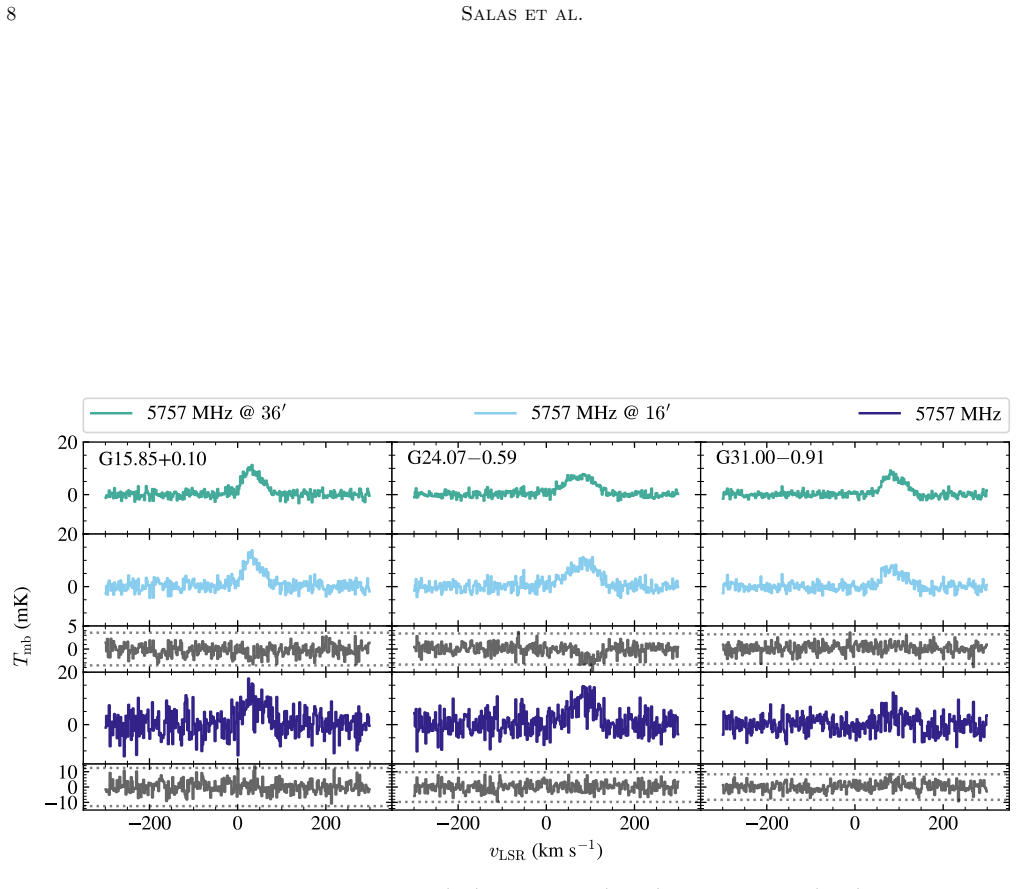
- Figure 2 caption: the scaling applied to higher-frequency spectra before differencing should be stated more explicitly (peak matching is mentioned in the text but not in the caption).
- §4.4 multi-volume tests: the statement that unequal-EM components prevent convergence is useful; a one-sentence quantification of how often such configurations are expected would place the single-zone assumption in context.
- Typographical: “Hiiregions” appears repeatedly without the space or roman numeral formatting used elsewhere; consistent “H II regions” would improve readability.
- §2.1: the 10 % absolute flux uncertainty is adopted but never propagated into the posterior widths; a short remark on whether it is sub-dominant to the statistical errors would be helpful.
Circularity Check
Minor self-citation of continuum-partition ansatz; n_e itself is fitted from multi-frequency non-LTE line ratios with an external T_e prior and is not forced by construction.
specific steps
-
ansatz smuggled in via citation
[§4.1 (paragraph after Eq. 2)]
"We adopt the prescription by Roshi & Anantharamaiah (2001), setting T_bg,ν = T_c (D_gal − D)/D_gal and T_nth = T_c L/D_gal, with T_c the observed continuum brightness, D_gal the size of the Galactic disk along the line of sight, D the distance to the gas responsible for the HRRL emission and L the size of the HRRL emitting region along the line of sight. This is equivalent to assuming that the ISM is homogeneous behind the HRRL emitting region."
The continuum partition that sets the stimulated-emission term (the dominant density diagnostic at low frequency) is imported wholesale from a prior paper whose author list overlaps the present one; the prior work itself introduced the homogeneous-slab ansatz without independent derivation. Freeing f_bg (as the paper does in validation) shifts the n_e posterior peak by ~20 %, so the absolute scale of the claimed densities inherits this untested geometric assumption via self-citation.
full rationale
The derivation chain is standard RRL radiative transfer (Shaver 1975 brightness formula + Salgado et al. 2017 departure coefficients and pressure broadening). Multi-frequency (342/800/5757 MHz) line profiles are forward-modelled via MCMC; the frequency dependence of stimulated emission primarily constrains n_e (validated on synthetics to ~20 % bias). T_e is given an informative Gaussian prior taken from the independent Galactic temperature curve of Quireza et al. (2006). Continuum fractions f_bg and f_m are fixed by a geometric homogeneous-slab prescription adopted from Roshi & Anantharamaiah (2001) (a co-author), which is an ansatz rather than a fit to the present HRRL intensities; the paper itself quantifies the resulting ~20 % shift when f_bg is left free and explores multi-zone effects. No equation reduces the reported n_e range (6–15 cm^{-3}) to a previously fitted parameter of the same authors, nor is a uniqueness theorem invoked. The result is therefore model-dependent at the tens-of-percent level (as the authors state) but not circular by construction. Score 2 reflects only the single load-bearing self-citation of the continuum ansatz.
Axiom & Free-Parameter Ledger
free parameters (5)
- n_e (electron density)
- EM (emission measure)
- T_e (electron temperature)
- v_rms (non-thermal velocity dispersion)
- f_bg, f_m (continuum fractions)
axioms (5)
- domain assumption Non-LTE departure coefficients b_n computed following Salgado et al. (2017a) for n_e = 0.1–1500 cm^{-3}, T_e = 1000–21000 K.
- domain assumption Continuum brightness is partitioned as T_bg = T_c (D_gal – D)/D_gal and T_nth = T_c L/D_gal (homogeneous slab).
- domain assumption Gas is a single homogeneous volume that fills the beam (or beam-filling factor = 1).
- domain assumption Kinematic distances from Reid et al. (2014) rotation curve, with near/far ambiguity resolved by proximity to known HII regions or left open.
- standard math Voigt line profile with collisional + radiation pressure broadening from Salgado et al. (2017b).
read the original abstract
The ionized gas in the Milky Way is a major component of the interstellar medium. Observations of extinction free tracers, such as hydrogen radio recombination lines (HRRLs), have revealed the presence of a dense (electron density 1 to 100 cm$^{-3}$) warm ionized medium. Motivated by advances in radio instrumentation, the existence of fully sampled HRRL maps, and a better knowledge about the population of discrete HII regions in our Galaxy, we have acquired new low-frequency ($\nu\lesssim1$ GHz) observations of HRRLs to characterize the properties of this gas. We target three positions in the Galactic plane, with few or no known HII regions, using the 342 MHz and 800 MHz feeds of the Green Bank Telescope. We detect HRRL emission from all three positions. We combine these with the fully sampled HRRL 5.8 GHz cubes from the GBT Diffuse Ionized Gas Survey (GDIGS) to determine the gas properties using a forward modeling approach. From our analysis we find electron densities between 6 and 15 cm$^{-3}$, and that to determine the gas temperature and emission measure we require informative priors or higher signal-to-noise observations.
Figures




Reference graph
Works this paper leans on
-
[1]
IEEE Transactions on Automatic Control , keywords =
A New Look at the Statistical Model Identification. IEEE Transactions on Automatic Control , keywords =
-
[2]
The HIPASS survey of the Galactic plane in Radio Recombination Lines
The HIPASS survey of the Galactic plane in radio recombination lines. , keywords =. doi:10.1093/mnras/stv751 , archivePrefix =. 1411.4497 , primaryClass =
work page internal anchor Pith review Pith/arXiv arXiv doi:10.1093/mnras/stv751
- [3]
-
[4]
Journal of Astrophysics and Astronomy , keywords =
A survey of radio recombination line emission from the galactic plane at 325 MHz. Journal of Astrophysics and Astronomy , keywords =. doi:10.1007/BF02715005 , url =
-
[5]
Journal of Astrophysics and Astronomy , keywords =
Low density ionized gas in the inner galaxy - Interpretation of recombination line observations at 325 MHz. Journal of Astrophysics and Astronomy , keywords =. doi:10.1007/BF02715006 , adsurl =
-
[6]
Journal of Astrophysics and Astronomy , keywords =
Ionized gas towards Galactic centre - Constraints from low-frequency recombination lines. Journal of Astrophysics and Astronomy , keywords =. doi:10.1007/BF02714207 , url =
-
[7]
Resolution of the Distance Ambiguity for Galactic HII Regions
Resolution of the Distance Ambiguity for Galactic H II Regions. , keywords =. doi:10.1088/0004-637X/690/1/706 , archivePrefix =. 0810.5570 , primaryClass =
work page internal anchor Pith review Pith/arXiv arXiv doi:10.1088/0004-637x/690/1/706
-
[8]
The WISE Catalog of Galactic HII Regions
The WISE Catalog of Galactic H II Regions. , keywords =. doi:10.1088/0067-0049/212/1/1 , archivePrefix =. 1312.6202 , primaryClass =
work page internal anchor Pith review Pith/arXiv arXiv doi:10.1088/0067-0049/212/1/1
-
[9]
A Green Bank Telescope Survey of Large Galactic HII Regions
A Green Bank Telescope Survey of Large Galactic H II Regions. , keywords =. doi:10.3847/1538-4365/aa956a , archivePrefix =. 1710.07397 , primaryClass =
work page internal anchor Pith review Pith/arXiv arXiv doi:10.3847/1538-4365/aa956a
-
[10]
The GBT Diffuse Ionized Gas Survey (GDIGS): Survey Overview and First Data Release. arXiv e-prints , keywords =
-
[11]
A VLA Census of the Galactic H II Region Population
A VLA Census of the Galactic H II Region Population. , keywords =. doi:10.3847/1538-4365/abd5c0 , archivePrefix =. 2103.02049 , primaryClass =
work page internal anchor Pith review Pith/arXiv arXiv doi:10.3847/1538-4365/abd5c0
-
[12]
Astropy: A community Python package for astronomy. , archivePrefix = "arXiv", eprint =. doi:10.1051/0004-6361/201322068 , url =
-
[13]
The Astropy Project: Building an inclusive, open-science project and status of the v2.0 core package
The Astropy Project: Building an Open-science Project and Status of the v2.0 Core Package. , keywords =. doi:10.3847/1538-3881/aabc4f , archivePrefix =. 1801.02634 , primaryClass =
work page internal anchor Pith review Pith/arXiv arXiv doi:10.3847/1538-3881/aabc4f
-
[14]
RRL Observations Using ORT at 328 MHz and WSRT at 1.4 GHz from ELDWIM. , keywords =. doi:10.1088/0004-6256/143/2/45 , url =
-
[15]
The Analyst , year = 2015, month = jan, volume =
Baseline correction using asymmetrically reweighted penalized least squares smoothing. The Analyst , year = 2015, month = jan, volume =. doi:10.1039/C4AN01061B , adsurl =
-
[16]
Azimuthal Metallicity Structure in the Milky Way Disk
Azimuthal Metallicity Structure in the Milky Way Disk. , keywords =. doi:10.1088/0004-637X/806/2/199 , archivePrefix =. 1505.04090 , primaryClass =
work page internal anchor Pith review Pith/arXiv arXiv doi:10.1088/0004-637x/806/2/199
-
[17]
Discovery of a New Population of Galactic HII Regions with Ionized Gas Velocity Gradients. arXiv e-prints , keywords =
-
[18]
The Green Bank Telescope Galactic H II Region Discovery Survey
The Green Bank Telescope Galactic H II Region Discovery Survey. , keywords =. doi:10.1088/2041-8205/718/2/L106 , archivePrefix =. 1006.5929 , primaryClass =
work page internal anchor Pith review Pith/arXiv arXiv doi:10.1088/2041-8205/718/2/l106 2041
-
[19]
The HI Parkes All Sky Survey: southern observations, calibration and robust imaging. , keywords =. doi:10.1046/j.1365-8711.2001.04102.x , url =
-
[20]
Morphology of the Interstellar Cooling Lines Detected by COBE
Morphology of the Interstellar Cooling Lines Detected by COBE. , keywords =. doi:10.1086/174761 , archivePrefix =. astro-ph/9311032 , primaryClass =
work page internal anchor Pith review Pith/arXiv arXiv doi:10.1086/174761
-
[21]
Filling factors and scale heights of the DIG in the Milky Way
Filling factors and scale heights of the diffuse ionized gas in the Milky Way. Astronomische Nachrichten , keywords =. doi:10.1002/asna.200510488 , archivePrefix =. astro-ph/0511172 , primaryClass =
work page internal anchor Pith review Pith/arXiv arXiv doi:10.1002/asna.200510488
-
[22]
I.Catalogue of nebulous objects
The velocity field of the outer Galaxy in the southern hemisphere. I.Catalogue of nebulous objects. , keywords =
-
[23]
A New 1.4GHz Radio Continuum Map of the Sky South of Declination +25 deg
A New 1.4 GHz Radio Continuum Map of the Sky South of Declination +25. , keywords =. doi:10.1017/pasa.2013.36 , archivePrefix =. 1310.2414 , primaryClass =
work page internal anchor Pith review Pith/arXiv arXiv doi:10.1017/pasa.2013.36 2013
-
[24]
S-band Polarization All Sky Survey (S-PASS): survey description and maps
S-band Polarization All-Sky Survey (S-PASS): survey description and maps. , keywords =. doi:10.1093/mnras/stz806 , archivePrefix =. 1903.09420 , primaryClass =
work page internal anchor Pith review Pith/arXiv arXiv doi:10.1093/mnras/stz806 1903
-
[25]
The Radio Sky at Meter Wavelengths: m-mode Analysis Imaging with the OVRO-LWA. , keywords =. doi:10.3847/1538-3881/aac721 , archivePrefix =. 1711.00466 , primaryClass =
work page internal anchor Pith review Pith/arXiv arXiv doi:10.3847/1538-3881/aac721
-
[26]
Searching for the largest bound atoms in space
Searching for the largest bound atoms in space. , keywords =. doi:10.1051/0004-6361/201936562 , archivePrefix =. 1910.06374 , primaryClass =
work page internal anchor Pith review Pith/arXiv arXiv doi:10.1051/0004-6361/201936562 1910
-
[27]
Super Star Clusters in the Central Starburst of NGC 4945
Super Star Clusters in the Central Starburst of NGC 4945. , keywords =. doi:10.3847/1538-4357/abb67d , archivePrefix =. 2009.05154 , primaryClass =
work page internal anchor Pith review Pith/arXiv arXiv doi:10.3847/1538-4357/abb67d 2009
-
[28]
The Vertical Structure of Warm Ionised Gas in the Milky Way
The Vertical Structure of Warm Ionised Gas in the Milky Way. , keywords =. doi:10.1071/AS08004 , archivePrefix =. 0808.2550 , primaryClass =
work page internal anchor Pith review Pith/arXiv arXiv doi:10.1071/as08004
-
[29]
Herschel Galactic plane survey of [NII] fine structure emission
Herschel Galactic Plane Survey of [NII] Fine Structure Emission. , keywords =. doi:10.1088/0004-637X/814/2/133 , archivePrefix =. 1510.05706 , primaryClass =
work page internal anchor Pith review Pith/arXiv arXiv doi:10.1088/0004-637x/814/2/133
-
[30]
, year = 1972, month = sep, volume =
A Longitude Survey of Radio Recombination Lines from the Diffuse Interstellar Medium. , year = 1972, month = sep, volume =. doi:10.1086/151660 , url =
-
[31]
Astrophysics and Space Science Library , year = 2009, series =
Radio Recombination Lines. Astrophysics and Space Science Library , year = 2009, series =
work page 2009
-
[32]
, year = 1970, month = nov, volume =
Radio Recombination Lines from Diffuse Interstellar Gas. , year = 1970, month = nov, volume =. doi:10.1086/180631 , url =
-
[33]
The warm ionized medium in spiral galaxies
The warm ionized medium in spiral galaxies. Reviews of Modern Physics , keywords =. doi:10.1103/RevModPhys.81.969 , archivePrefix =. 0901.0941 , primaryClass =
work page internal anchor Pith review Pith/arXiv arXiv doi:10.1103/revmodphys.81.969
-
[34]
I - Observations at southern declinations and for the North Polar region
A 408 MHz all-sky continuum survey. I - Observations at southern declinations and for the North Polar region. , keywords =
-
[35]
A 408 MHz all-sky continuum survey. II. The atlas of contour maps. , keywords =
-
[36]
Australian Journal of Physics Astrophysical Supplement , keywords =
A southern hemisphere survey of the galactic plane at 5 GHz. Australian Journal of Physics Astrophysical Supplement , keywords =
-
[37]
Radio Recombination Lines from Inner Galaxy Diffuse Gas. I. High-Sensitivity Observations: He +/H + and Carbon. , keywords =. doi:10.1086/177154 , url =
-
[38]
Radio Recombination Lines from Inner Galaxy Diffuse Gas. II. The Extended Low-Density Warm Ionized Medium and the ``Worm-ionized Medium''. , keywords =. doi:10.1086/177503 , url =
-
[39]
The Turbulent Warm Ionized Medium: Emission Measure Distribution and MHD Simulations
The Turbulent Warm Ionized Medium: Emission Measure Distribution and MHD Simulations. , keywords =. doi:10.1086/590543 , archivePrefix =. 0805.0155 , primaryClass =
work page internal anchor Pith review Pith/arXiv arXiv doi:10.1086/590543
-
[40]
The Journal of Open Source Software , year = 2016, month = aug, volume = 1, eid =
ChainConsumer. The Journal of Open Source Software , year = 2016, month = aug, volume = 1, eid =. doi:10.21105/joss.00045 , adsurl =
-
[41]
Peering into the Milky Way by FAST: I. Exquisite HI structures in the inner Galactic disk from the piggyback line observations of the FAST GPPS survey. Science China Physics, Mechanics, and Astronomy , keywords =. doi:10.1007/s11433-022-2040-8 , archivePrefix =. 2211.11299 , primaryClass =
work page internal anchor Pith review Pith/arXiv arXiv doi:10.1007/s11433-022-2040-8 2040
-
[42]
Australian Journal of Physics , year = 1963, month = mar, volume =
On the Existence of an Ionized Layer about the Galactic Plane. Australian Journal of Physics , year = 1963, month = mar, volume =. doi:10.1071/PH630001 , url =
-
[43]
, year = 1971, month = aug, volume =
Detection of Radio Recombination-Line Emission Associated with Distributed Ionized Hydrogen. , year = 1971, month = aug, volume =. doi:10.1086/151057 , url =
-
[44]
The Rhodes/HartRAO 2326-MHz radio continuum survey. , keywords =. doi:10.1046/j.1365-8711.1998.01367.x , url =
-
[45]
The Dense Warm Ionized Medium in the Inner Galaxy
The dense warm ionized medium in the inner Galaxy. , keywords =. doi:10.1051/0004-6361/202040223 , archivePrefix =. 2105.07023 , primaryClass =
work page internal anchor Pith review Pith/arXiv arXiv doi:10.1051/0004-6361/202040223
-
[46]
Errors Associated with Fitting Gaussian Profiles to Noisy Emission-Line Spectra. , keywords =. doi:10.1086/133096 , adsurl =
-
[47]
A survey of ionized hydrogen in the plane of the Galaxy. , keywords =. doi:10.1086/154737 , url =
-
[48]
A Survey of Radio H II Regions in the Northern Sky. , keywords =. doi:10.1086/191383 , url =
-
[49]
Matteo Luisi and L. D. Anderson and Dana S. Balser and Trey V. Wenger and T. M. Bania , title =. doi:10.3847/1538-4357/aa8fd2 , url =
-
[50]
Ionization Profiles of Galactic HII Regions
Ionization Profiles of Galactic H II Regions. , keywords =. doi:10.3847/1538-4365/aaf6a5 , archivePrefix =. 1812.01539 , primaryClass =
work page internal anchor Pith review Pith/arXiv arXiv doi:10.3847/1538-4365/aaf6a5
-
[51]
The GBT Diffuse Ionized Gas Survey: Tracing the Diffuse Ionized Gas around the Giant HII Region W43
The GBT Diffuse Ionized Gas Survey: Tracing the Diffuse Ionized Gas around the Giant Hii Region W43. , keywords =. doi:10.3847/1538-4357/ab643e , archivePrefix =. 1912.08657 , primaryClass =
work page internal anchor Pith review Pith/arXiv arXiv doi:10.3847/1538-4357/ab643e 1912
-
[52]
Theoretical Ratio of Beam Efficiency to Aperture Efficiency
-
[53]
Modeling the Elevation and Frequency Dependence of Aperture Efficiency for the GBTs Pipeline
-
[54]
A Multiwavelength Optical Emission Line Survey of Warm Ionized Gas in the Galaxy
A Multiwavelength Optical Emission Line Survey of Warm Ionized Gas in the Galaxy. , keywords =. doi:10.1086/508441 , archivePrefix =. astro-ph/0609558 , primaryClass =
work page internal anchor Pith review Pith/arXiv arXiv doi:10.1086/508441
-
[55]
A new calibration of stellar parameters of Galactic O stars
A new calibration of stellar parameters of Galactic O stars. , keywords =. doi:10.1051/0004-6361:20042386 , archivePrefix =. astro-ph/0503346 , primaryClass =
work page internal anchor Pith review Pith/arXiv arXiv doi:10.1051/0004-6361:20042386
-
[56]
, year = 1973, month = jan, volume =
Radio recombination line emissionfrom the galactic plane. , year = 1973, month = jan, volume =. doi:10.1093/mnras/165.2.149 , url =
-
[57]
The Southern Galactic Plane Survey: HI Observations and Analysis
The Southern Galactic Plane Survey: H I Observations and Analysis. , keywords =. doi:10.1086/430114 , archivePrefix =. astro-ph/0503134 , primaryClass =
work page internal anchor Pith review Pith/arXiv arXiv doi:10.1086/430114
-
[58]
Gradients of chemical abundances in the Milky Way from H II regions: distances derived from Gaia EDR3 parallaxes and temperature inhomogeneities. , keywords =. doi:10.1093/mnras/stab3782 , archivePrefix =. 2112.12600 , primaryClass =
work page internal anchor Pith review Pith/arXiv arXiv doi:10.1093/mnras/stab3782
-
[59]
, year = 1968, month = may, volume =
Oscillator Strengths for High-level Transitions in Hydrogen. , year = 1968, month = may, volume =. doi:10.1038/218756a0 , adsurl =
-
[60]
, year = 1978, month = nov, volume =
The Galactic Extended Low-density HII Region and Its Relation to Star Formation and Diffuse IR Emission. , year = 1978, month = nov, volume =
work page 1978
-
[61]
The Luminosity Function of OB Associations in the Galaxy. , keywords =. doi:10.1086/303587 , url =
-
[62]
Star Formation in Massive Clusters Via the Wilkinson Microwave Anisotropy Probe and the Spitzer Glimpse Survey. , keywords =. doi:10.1088/0004-637X/709/1/424 , archivePrefix =. 0906.1026 , primaryClass =
work page internal anchor Pith review Pith/arXiv arXiv doi:10.1088/0004-637x/709/1/424
-
[63]
Post-correlation radio frequency interference classification methods. , keywords =. doi:10.1111/j.1365-2966.2010.16471.x , archivePrefix =. 1002.1957 , primaryClass =
-
[64]
Carbon and hydrogen radio recombination lines from the cold clouds towards Cassiopeia A
Carbon and hydrogen radio recombination lines from the cold clouds towards Cassiopeia A. , keywords =. doi:10.1093/mnras/stw2818 , archivePrefix =. 1609.06857 , primaryClass =
work page internal anchor Pith review Pith/arXiv arXiv doi:10.1093/mnras/stw2818
-
[65]
Spectroscopy with the Engineering Development Array: cold H ^ + at 63 MHz towards the Galactic Centre. , keywords =. doi:10.1093/mnras/stz950 , archivePrefix =. 1907.03127 , primaryClass =
work page internal anchor Pith review Pith/arXiv arXiv doi:10.1093/mnras/stz950 1907
- [66]
-
[67]
Expanding bubbles in Orion A: [CII] observations of M42, M43, and NGC 1977
Expanding bubbles in Orion A: [C II] observations of M 42, M 43, and NGC 1977. , keywords =. doi:10.1051/0004-6361/202037560 , archivePrefix =. 2005.03917 , primaryClass =
work page internal anchor Pith review Pith/arXiv arXiv doi:10.1051/0004-6361/202037560 1977
-
[68]
Studies of low-frequency recombination lines from the direction of the Galactic Centre and other galactic sources. , keywords =. doi:10.1093/mnras/182.3.473 , url =
-
[69]
, archivePrefix = "arXiv", eprint =
An Accurate Flux Density Scale from 50 MHz to 50 GHz. , archivePrefix = "arXiv", eprint =. doi:10.3847/1538-4365/aa6df9 , url =
-
[70]
Electron Densities and Nitrogen Abundances in Ionized Gas Derived Using [N II] Fine-structure and Hydrogen Recombination Lines. , keywords =. doi:10.3847/1538-4357/ab46c2 , archivePrefix =. 1905.06935 , primaryClass =
-
[71]
Interstellar Dust and Related Topics , year = 1973, editor =
Rocket Measurements of the Galactic Background at 100&mu. Interstellar Dust and Related Topics , year = 1973, editor =
work page 1973
-
[72]
Planck 2018 results. II. Low Frequency Instrument data processing. , keywords =. doi:10.1051/0004-6361/201833293 , archivePrefix =. 1807.06206 , primaryClass =
work page internal anchor Pith review Pith/arXiv arXiv doi:10.1051/0004-6361/201833293 2018
-
[73]
Pound, Marc and Teuben, Peter and Catlett, Victoria and Salas, Pedro and Smith, Evan and Chamberlin, Thomas , journal =. dysh: A. 2025 , month =
work page 2025
-
[74]
2015 URSI-USNC Radio Science Meeting , year = 2015, month = jul, eid =
The versatile GBT astronomical spectrometer (VEGAS): Current status and future plans. 2015 URSI-USNC Radio Science Meeting , year = 2015, month = jul, eid =. doi:10.1109/USNC-URSI.2015.7303578 , url =
-
[75]
The Electron Temperature Gradient in the Galactic Disk
The Electron Temperature Gradient in the Galactic Disk. , keywords =. doi:10.1086/508803 , archivePrefix =. astro-ph/0609006 , primaryClass =
work page internal anchor Pith review Pith/arXiv arXiv doi:10.1086/508803
-
[76]
A radio continuum survey of the northen sky at 1420 MHz - Part I. , keywords =
-
[77]
A radio continuum survey of the northern sky at 1420 MHz. II. , keywords =
-
[78]
A radio continuum survey of the southern sky at 1420 MHz. The atlas of contour maps. , keywords =. doi:10.1051/0004-6361:20011000 , url =
-
[79]
Trigonometric Parallaxes of High Mass Star Forming Regions: The Structure and Kinematics of the Milky Way. , keywords =. doi:10.1088/0004-637X/783/2/130 , archivePrefix =. 1401.5377 , primaryClass =
work page internal anchor Pith review Pith/arXiv arXiv doi:10.1088/0004-637x/783/2/130
-
[80]
An improved source-subtracted and destriped 408 MHz all-sky map
An improved source-subtracted and destriped 408-MHz all-sky map. , keywords =. doi:10.1093/mnras/stv1274 , archivePrefix =. 1411.3628 , primaryClass =
work page internal anchor Pith review Pith/arXiv arXiv doi:10.1093/mnras/stv1274
discussion (0)
Sign in with ORCID, Apple, or X to comment. Anyone can read and Pith papers without signing in.