REVIEW 2 major objections 5 minor 2 cited by
Systems of difference equations on a vector valued function that admit 3D space of scalar potentials
T0 review · 2 major / 5 minor · reviewed 2026-08-14 · deepseek-v4-flash
Pith's one-line read Separated invariants of Yang-Baxter maps form a 3D potential space.
desk verdict A systematic, checkable account of separated-variable invariants for Yang–Baxter maps that connects bond systems to the ABS list; the 'exhaustive' claim needs a completeness proof before the central count is fully earned. read the letter →
The pith
A machine-rendered reading of the paper's core claim, the machinery that carries it, and where it could break.
The reading
What carries the argument
The load-bearing object is the separation-of-variables equation for the invariant, written as $F(U)+G(V)=f(u)+g(v)$. Differentiating it and using the inverse map converts it into a relation that separates into $m(U)F'''(U)+2m'(U)F''(U)+m''(U)F'(U)=c$, which integrates twice to $m(U)F'(U)=\tfrac{c}{2}U^2+dU+e$; the polynomial $m(U)$ for each map is given explicitly. The three constants $c,d,e$ (plus the additive constant) are exactly the three-dimensional space of potentials, and the discrete quadrature $\psi_i+\psi=f(u_i,p_i)$ (or $\psi_i-\psi$) is the mechanism that carries these invariants from maps to lattice potentials.
What would settle it
Find, for any map in the F-list or cH-list, a separated-variable invariant that is not a linear combination of the three invariants listed in Table 1. If such an invariant exists, the assertion that the space is three-dimensional is false; equivalently, solving the separated ODE (17)-(18) and finding more than a three-parameter family of solutions would disprove the classification.
Extended reading notes
Core claim
The central claim is that the separated-variable invariants of these maps are not accidental: each map carries exactly a three-dimensional space of them, and that space is the full set of scalar potentials for the corresponding lattice system. The derivation reduces the search to a master differential equation $m(u)F'(u)=\tfrac{c}{2}u^2+du+e$, whose integration yields the three independent invariants listed in the tables. From these potentials, every edge system is rewritten as a vertex equation, with the ABS list appearing when the potential is fractional linear, and higher-degree or multi-valued vertex relations appearing otherwise. The paper treats the edge (bond) systems as primary and the vertex equations as 'idolons' derived from them, so that non-single-valued evolution of a vertex relation is resolved by the underlying bond system.
Load-bearing premise
The classification of invariants is complete only if every separated-variable invariant satisfies the derived differential equation (15) and every solution of that equation is captured up to homographic equivalence; the paper assumes this exhaustiveness rather than proving it.
Editorial extensions
If this is right
- Each difference system in Tables 3 and 4 is multidimensionally consistent, extending to $n$ dimensions with the compatibility $u^i_{jk}=u^i_{kj}$.
- The ABS equations arise as derived objects, not as input: their potentials coincide with specific choices of the three-dimensional invariant spaces.
- Vertex relations that are not single-valued become a well-posed evolution once the corresponding bond system is imposed.
- In each family there is a multilinear idolon, and non-auto Bäcklund transformations send solutions of that multilinear equation to solutions of all other equations in the family.
Reading between the lines
- The paper's completeness claim could be made fully rigorous by classifying all solutions of equation (15) on the projective line; the argument given integrates the equation up to homographic equivalence but does not prove that equivalence exhausts the solution set.
- The same invariant-as-potential mechanism should extend to quadrirational maps outside the F and cH lists, where the dimension of the separated-invariant space might still be three but with higher-degree potentials, producing new vertex relations.
- The 'bond system as primary, vertex equation as idolon' hierarchy offers a test for integrability of an arbitrary vertex equation: ask whether it admits a completion by a compatible bond system.
Signed reviews
Editorial analysis
A structured set of objections, weighed in public.
Referee Report
Summary. The paper studies involutive maps on CP^1 × CP^1, chiefly the degree-two F-list and cH-list of quadrirational Yang-Baxter maps and their companions, and claims to find, for each such map, the complete set of invariants and alternating invariants with separated variables. It argues that these invariants form a three-dimensional affine space and derives them from a first-order ODE obtained by separating variables. The paper then places each map on the edges of a Z^2 lattice, uses the separated invariants to introduce scalar potentials on vertices, and shows that rewriting the edge systems in terms of these potentials yields known discrete integrable equations, including the ABS list. The final sections discuss multidimensional consistency, Bäcklund transformations, and the distinction between bond systems and vertex models.
Significance. If the claimed exhaustiveness is correct, the paper provides a systematic and genuinely useful bridge between Yang-Baxter maps (bond systems) and vertex equations of ABS type via separation of variables, and it gives a unified explanation of the appearance of non-multiaffine and multi-valued relations in this context. The explicit invariant tables are a strength, since the listed invariants can be directly verified by substitution, and the reduction to the ordinary differential equation (18) is a clean and testable mechanism. The potential formulation in Tables 3 and 4 and the recovery of ABS equations in Table 8 are concrete, falsifiable results. The main weakness is that the exhaustive character of the invariant lists is asserted rather than proved, and that assertion is load-bearing for the title's '3D space' claim.
major comments (2)
- [Section 4, Eqs. (16)-(18)] Sections 3 and 4 assert that the three invariants per map in Table 1 exhaust all invariants (or alternating invariants) with separated variables, and this exhaustiveness is load-bearing for the title's '3D space' and for Table 8. The derivation, however, only establishes a necessary condition: differentiating (16) and separating variables leads to (17) and hence to (18) for any sufficiently smooth solution. It is not shown that every solution of (18) with arbitrary separation constants actually solves the original identity (16), nor that the space of solutions of (18) is exactly spanned by the three functions of Table 1. In addition, the derivation divides by quantities such as m(U)n(V) and by denominators of the inverse map, so the zeros and singularities of the maps in Section 2.2, where logarithmic invariants are singular, require a separate argument. Please supply a proof of the converse and exhaustiveness, for instance by substituting the general solution of (18) back into (16) and counting admissible constants, or explicitly state the completeness claim as conditional.
- [Section 1, Eq. (2)] Equation (2) states that for arbitrary a,b,c,d the function I(u,v)=a(u-v)+b(u^2+p-v^2-q)+c(u^3+3pu-v^3-3qv)+d is an alternating invariant of map (1). This is not correct for d≠0: for the involution (1), I(U,V)=-I(u,v)+2d, so the alternating property holds only for d=0. The same slip underlies the phrase '3-dimensional affine space' immediately afterwards: the space is 3-dimensional only after one subtracts the trivial constant, that is, it is the affine space of potentials rather than the linear space of alternating invariants. Please correct the statement and the associated dimension count.
minor comments (5)
- [Section 4, Eq. (15) and Table 2] The connection between the ODE (15), with coefficients b0,...,c4, and the polynomials m(u), n(v) in Table 2 is not explicitly written out. A short derivation showing how (18) follows from (15) under a homographic transformation would make this section much easier to check.
- [Section 2.1, Proposition 2.1] Proposition 2.1 is stated as an 'iff' classification of degree-one involutive maps of the form (6), but no proof or reference for this classification is provided. If it is a new result, a proof should be included; if it is taken from earlier work, that reference should be given.
- [Section 6.2, after Eq. (26)] The sentence 'within ABS list only the above equations admit existence of the potentials ψ' is a classification claim that is not proved or referenced in the manuscript. Either provide a derivation or qualify the statement.
- [Abstract and Section 1] There are typographical errors, including 'sytems' in the abstract and 'integrable sytems' in the introduction; the paper would benefit from a careful proofreading pass.
- [Tables 3 and 4] The notation p_i is used both for the lattice parameter and for the function on edges, and Tables 3 and 4 list four constants a,b,c,d without explaining which of them can be absorbed into the definition of ψ. A brief remark on the affine freedom in the potentials would avoid confusion.
Circularity Check
No significant circularity; the derivation chain is self-contained.
full rationale
The paper's derivation chain is maps (F/cH lists) -> bond systems -> separated-variable invariants -> potentials -> vertex equations/ABS list. Each step is exhibited in the text or in external classifications. The invariants in Table 1 are presented directly and can be checked by substitution; Section 4 derives a necessary ODE (17)-(18) from the separated-variable ansatz (16), and the potentials in Tables 3-4 are the same invariants reinterpreted as discrete quadratures. The recovery of H1, H2, H3, Q1, Q3, A1, A2 in Table 8 is via explicit point transformations, not by assuming the target equations. The only self-citations ([11], [12], [5], [6], [14]) are background or methodological; the 'exhaustive list' for the degree-1 maps is delegated to [11], but those maps are not used in the ABS recovery and the central F/cH tables are presented in this paper. The Section 4 exhaustiveness step (that every solution of (18) satisfying (16) is captured) is asserted rather than proved; this is a completeness/correctness gap, not a circular reduction, because the ODE is derived from the ansatz rather than from the target list. No fitted parameter is renamed as a prediction, and no uniqueness theorem from the authors' prior work is invoked to force the choice.
Assumptions & free parameters
assumptions (4)
- domain assumption The F-list and cH-list provide a complete classification of the relevant quadrirational involutive maps.
- standard math Invariants with separated variables are assumed to be of the form F(U)+G(V)=f(u)+g(v) with sufficiently differentiable F and G.
- ad hoc to paper The method of Section 4 is assumed to exhaust all separated-variable invariants.
- domain assumption For the vertex models, the bond system provides a well-posed initial value problem that resolves non-single-valuedness.
Cite this review
Pith. "Pith review of Systems of difference equations on a vector valued function that admit 3D space of scalar potentials." pith.science (2026). https://pith.science/paper/WQ2N54YC
@misc{pith2026190801706,
  author       = {Pith},
  title        = {Pith review of: Systems of difference equations on a vector valued function that admit 3D space of scalar potentials},
  year         = {2026},
  howpublished = {\url{https://pith.science/paper/WQ2N54YC}},
  note         = {Machine review of arXiv:1908.01706}
}
abstract
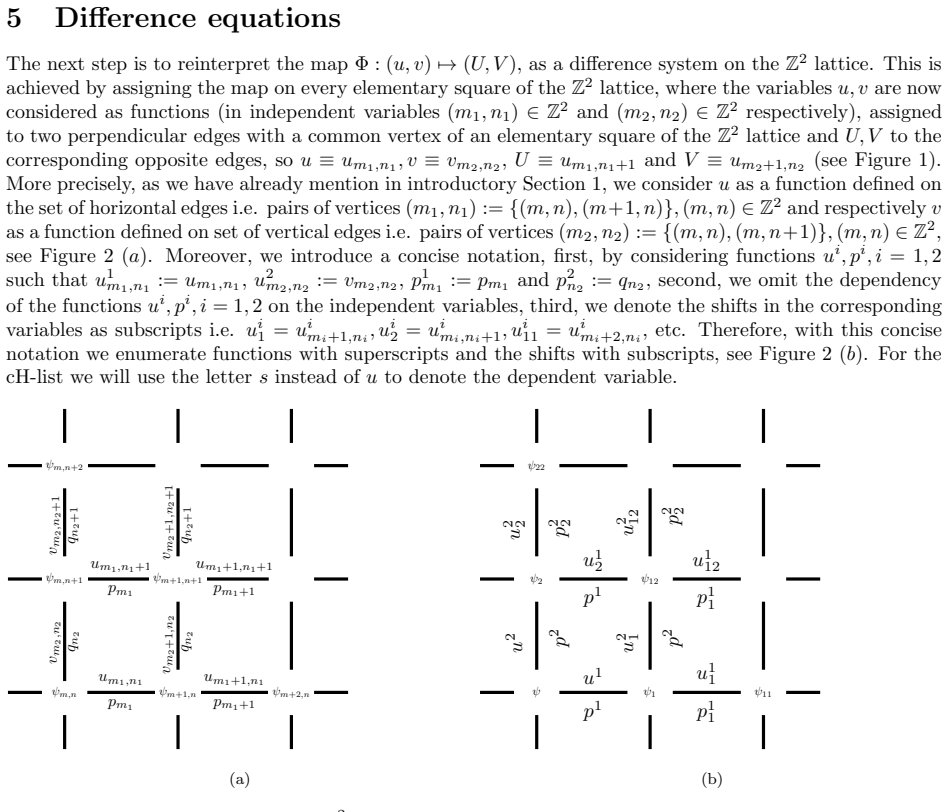
For some involutive maps $\Phi:{\mathbb C}P^1 \times {\mathbb C}P^1 \to {\mathbb C}P^1 \times {\mathbb C}P^1$ we find all invariants with separated variables. We investigate a link of the maps and their invariants with separated variables to discrete integrable systems. Maps correspond to integrable systems on edges (bond systems), while their invariants with separated variables yields potentials of the bond systems, that allows us to rewrite the integrable sytems as models on vertices. Among the latter ones one can find well known integrable difference equations as well as difference relations, which in contrast to the equations give non-single-valued evolution of the dependent variable. However, the non-single-valuedness can be resolved by the link with the bond system.
Figures


Figures from the paper (2 more)


Forward citations
Cited by 2 Pith papers
-
Non-Abelian elastic collisions, associated difference systems of equations and discrete analytic functions
A single non-abelian system of equations unifies classical and relativistic elastic collisions, and its lattice reinterpretation subsumes both the linear and nonlinear theories of discrete analytic functions.
-
Tetrahedron maps and symmetries of three dimensional integrable discrete equations
A symmetry-invariant method for 3D lattice equations produces tetrahedron maps, including new vector, non-commutative, and entwining examples.
Reference graph
Works this paper leans on
-
[19]
V.G. Papageorgiou, A.G. Tongas, and A.P. Veselov. Yang-Baxte r maps and symmetries of integrable equations on quad-graphs. J. Math. Phys. , 47:Art. no. 083502, 2006
work page 2006
-
[1]
V.E. Adler, A.I. Bobenko, and Yu.B. Suris. Classification of integra ble equations on quad-graphs. The consistency approach. Comm. Math. Phys. , 233(3):513–543, 2003
work page 2003
-
[2]
V.E. Adler, A.I. Bobenko, and Yu.B. Suris. Geometry of Yang-Bax ter maps: pencils of conics and quadrirational mappings. Comm. Anal. Geom. , 12(5):967–1007, 2004
work page 2004
-
[3]
V.E. Adler and A.P. Veselov. Cauchy problem for integrable discret e equations on quad-graphs. Acta Appl. Math. , 84(2):237–262, 2004
work page 2004
- [4]
- [5]
-
[6]
J. Atkinson and M. Nieszporski. Multi-quadratic quad equations: integrable cases from a factorised- discriminant hypothesis. Int. Math. Res. Not. , 2220(15):4215–4240, 2013
work page 2013
-
[7]
R. Boll. Classification of 3D consistent quad-equations. J. Nonlinear Math. Phys. , 18(3):337–365, 2011
work page 2011
Show all 21 references
-
[8]
Dimakis and F
A. Dimakis and F. M¨ uller-Hoissen. Matrix KP: tropical limit and Yang -Baxter maps. Lett. Math. Phys. , 2018
2018
-
[9]
Joshi and F.W
N Hietarinta, J. Joshi and F.W. Nijhoff. Discrete Systems and Integrablity . Cambridge Texts in Applied Mathematics (No. 54). Cambridge University Press, 2016
2016
-
[10]
Kashaev, I.G
R.M. Kashaev, I.G. Korepanov, and S.M. Sergeev. Functional t etrahedron equation. Theor. Math. Phys., 117:1402–1413, 1998
1998
-
[11]
Kassotakis and M
P. Kassotakis and M. Nieszporski. Families of integrable equation s. SIGMA, 7:100, 2011
2011
-
[12]
Kassotakis and M
P. Kassotakis and M. Nieszporski. On non-multiaffine consistent -around-the-cube lattice equations. Phys. Lett. A , 376(45):3135–3140, 2012. arXiv:1106.0435
2012 arXiv
-
[13]
Kassotakis and M
P. Kassotakis and M. Nieszporski. 2 n−rational maps. J. Phys. A: Math. Theor. , 50(21):21LT01, 2017
2017
-
[14]
Kassotakis and M
P. Kassotakis and M. Nieszporski. Difference systems in bond an d face variables and non-potential versions of discrete integrable systems. J. Phys. A: Math. Theor. , 51(38):385203, 2018
2018
-
[15]
Kouloukas
T. Kouloukas. Relativistic collisions as Yang-Baxter maps. Phys. Lett. A , 381(40):3445 – 3449, 2017
2017
-
[16]
Nijhoff and H
F. Nijhoff and H. Capel. The discrete korteweg-de vries equatio n. Acta Applicandae Mathematica , 39(1):133–158, 1995. 15
1995
-
[17]
Nijhoff, G.R.W
F.W. Nijhoff, G.R.W. Quispel, and H.W. Capel. Direct linearization of no nlinear difference-difference equations. Phys. Lett. A , 97:125–128, 1983
1983
-
[18]
Papageorgiou, Yu.B
V.G. Papageorgiou, Yu.B. Suris, A.G. Tongas, and A.P. Veselov. O n quadrirational Yang-Baxter maps. SIGMA, 6:9pp, 2010
2010
-
[20]
S.M. Sergeev. Solutions of the functional tetrahedron equat ion connected with the local Yang-Baxter equation for the ferro-electric condition. Lett. Math. Phys. , 45(2):113–119, 1998
1998
-
[21]
A.P. Veselov. Yang-Baxter maps and integrable dynamics. Phys. Lett. A , 314:214–221, 2003. 16
2003
Reviewed August 14, 2026 · model on record in the stance chip above.
Discussion (0). Continue with ORCID to comment.