REVIEW 2 major objections 6 minor 1 cited by
A Fundamental Bound for Robust Quantum Gate Control
T0 review · 2 major / 6 minor · reviewed 2026-08-06 · deepseek-v4-flash
Pith's one-line read A single time-bandwidth product $T\Omega_{\rm bnd}$ sets a universal lower bound on worst-case and average gate fidelity for any bounded Hamiltonian uncertainty.
desk verdict The theorem is real and the proof checks out, but the abstract's certification and unknown-unknown claims outrun the assumptions; worth refereeing with revisions. read the letter →
The pith
A machine-rendered reading of the paper's core claim, the machinery that carries it, and where it could break.
The reading
What carries the argument
The machinery is an interaction-picture analysis in which the error is carried by $\tilde U(T) = (U_S(T)\otimes U_B(T))^\dagger U(T)$. Under the transformation $\tilde U = (I+K)V$, with $K(t)$ built from the deviation of the interaction-picture Hamiltonian from its time average, the deviation $\|V(T)-I\|$ is controlled by a Bellman-Gronwall inequality. The three frequency bounds of Eq. (28)---$\Omega_{\rm unc}$ on the instantaneous Hamiltonian norm, $\Omega_{\rm avg}$ on the time-averaged interaction Hamiltonian norm, and $\Omega_{\rm dev}^{\rm avg}$ on the maximum deviation from that average---combine into $c(T) = T\Omega_{\rm avg} + (T\Omega_{\rm unc})(T\Omega_{\rm dev}^{\rm avg})/4$, and the dimensionless combination $T\Omega_{\rm bnd} = 2\sqrt{c(T)}$ enters the exponential in $F_{\rm lb}$. The bound's shape, an exponential quadratic in $T\Omega_{\rm bnd}$, is what makes the infidelity upper bound rise steeply once $T\Omega_{\rm bnd}$ exceeds about 1.88 radians.
What would settle it
Set up a small system-bath model, say one qubit coupled through $\sigma_z$ to a few bath qubits, specify the uncertainty sets exactly, sample or exhaust the unknown Hamiltonian parameters, and compute the true worst-case fidelity by optimizing over pure input states; if any sample with valid bounds violates $F \ge F_{\rm lb}$, the theorem is refuted. On a real device, estimate $\Omega_{\rm bnd}$ from independent noise characterization and test whether measured infidelities ever fall below the predicted $1-F_{\rm lb}$ curve, which would falsify the assumed uncertainty model.
Extended reading notes
Core claim
The paper's central claim is Theorem 1: for a finite-dimensional system-bath pair, given uncertainty bounds $\Omega_{\rm unc}$, $\Omega_{\rm avg}$, and $\Omega_{\rm dev}^{\rm avg}$ as in Eq. (28), define $T\Omega_{\rm bnd} = \sqrt{(T\Omega_{\rm unc})(T\Omega_{\rm dev}^{\rm avg}) + 4T\Omega_{\rm avg}}$ and $F_{\rm lb} = \max\{1 - \tfrac{1}{2}(\exp((T\Omega_{\rm bnd}/2)^2)-1)^2, 0\}$. If the nominal (uncertainty-free) evolution reaches the target unitary up to a global phase, then the worst-case fidelity over all pure input states and the Haar-averaged fidelity both satisfy $F \ge F_{\rm lb}$. The proof covers arbitrary pure, possibly system-bath entangled initial states, arbitrary finite-norm Hamiltonian decompositions, and all bounded uncertainty sources; the paper presents this as a fundamental robustness limit that robust-control strategies cannot undercut, and a falsifiable benchmark for hardware.
Load-bearing premise
The theorem's guarantee is only as strong as the three uncertainty bounds in Eq. (28) actually upper-bounding the real Hamiltonian uncertainties---the paper provides no procedure for obtaining them---and the argument assumes finite operator norms, which excludes bosonic baths.
Editorial extensions
If this is right
- Once $T\Omega_{\rm bnd}$ is quantified for a device, the curve in Fig. 1 gives a certified maximum infidelity; for example, reaching $10^{-4}$ at 50 ns requires $\Omega_{\rm bnd}/2\pi \le 754$ kHz, while $10^{-5}$ requires 425 kHz.
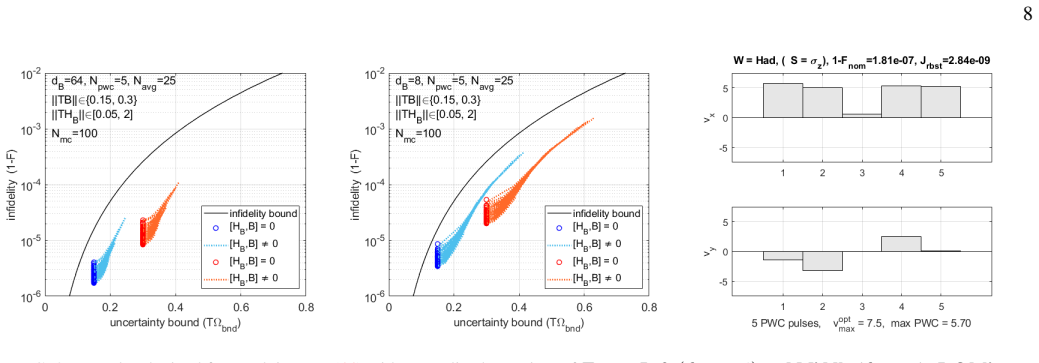
- The bound supplies an explicit robustness objective for pulse design: minimize the nominal infidelity and the time-averaged interaction terms simultaneously; the paper's five-pulse Hadamard example reaches nominal error $1.81\times10^{-7}$ with the average disturbance nearly nulled.
- Because the bound aggregates 'known unknowns' and 'unknown unknowns,' it quantifies safety margin when hidden errors inflate the uncertainty; a doubling of $T\Omega_{\rm unc}$ from 0.15 to 0.30 rad is predicted to raise the guaranteed infidelity from $1.59\times10^{-5}$ to $2.59\times10^{-4}$, still below $10^{-3}$.
- When control can annihilate all time-averaged interaction terms, $T\Omega_{\rm bnd}$ reduces to the intrinsic uncertainty $T\Omega_{\rm unc}$, giving a minimum achievable error floor for the device.
- Any measured fidelity below $F_{\rm lb}$ falsifies the assumed uncertainty model, making the bound a Popper-style experimental test of the device model rather than a merely theoretical statement.
Reading between the lines
- An implicit consequence the paper does not develop: $T\Omega_{\rm bnd}$ could be turned into an error budget for fault-tolerant architectures, since physical-to-logical qubit overhead depends on gate error rates; mapping measured $\Omega_{\rm bnd}$ to logical error rates would let architects trade error correction against control quality.
- The bound is a worst-case guarantee, so typical noise realizations should do better; a natural testable extension is to measure the distribution of infidelities over random initial states and random Hamiltonian samples and compare the observed tail, not just the mean, with $F_{\rm lb}$.
- The finite-operator-norm requirement excludes bosonic baths; replacing the $\Omega$ bounds with input-state-dependent correlation functions, as the paper suggests, could extend the result to cavity and oscillator modes, where one could test whether an analogous curve holds.
- The connection to the control landscape suggests the two-objective optimization may be especially effective in high-dimensional systems, where more null-space directions could make $J_{\rm rbst}$ easier to nullify; this is an extrapolation, not a claim in the paper.
Editorial analysis
A structured set of objections, weighed in public.
Referee Report
Summary. The paper derives a universal lower bound on worst-case and average gate fidelity for coherent quantum control in the presence of bounded Hamiltonian uncertainties. The central object is the dimensionless time-bandwidth product TΩ_bnd defined in Eq. (29), and the bound F_lb in Eq. (30). Under the assumption that the nominal unitary is achieved (F_nom = 1), Theorem 1 states that both worst-case and average gate fidelity are at least F_lb for arbitrary pure, possibly system-bath entangled input states, without assuming a completely positive map. The proof combines an interaction-picture averaging transformation with a Bellman-Gronwall inequality, and the paper also proposes a two-objective robust-control optimization and illustrates it on a single-qubit Hadamard gate with an unknown σ_z system-bath coupling. The numerical Monte Carlo results are consistent with the proven bound.
Significance. If the bound is valid, it is a significant contribution: it gives a single-parameter aggregate characterization of the effect of many types of bounded Hamiltonian uncertainty and applies to arbitrary initial system-bath entanglement, going beyond the usual CP-map framework. The proof chain in Appendix B is detailed and appears mathematically sound: the averaging transformation, the norm bounds on (I+K)^{-1}, and the Bellman-Gronwall integration all check out. The numerical example is a reasonable consistency check rather than a fit of the bound. The paper also makes concrete claims about device certification, unknown unknowns, and falsifiability; these claims are currently too strong relative to what is actually proven, because the theorem is conditional on uncertainty bounds that the paper does not provide a procedure to obtain. Once that gap is honestly framed, the result would be a useful analysis and synthesis target for robust quantum control.
major comments (2)
- [Section 4.A, Eq. (28)] The first displayed inequality in Eq. (28) is false as written. It states Ω_unc ≥ max_t(‖H_coh^S(t)‖ + Σα ‖Sα‖‖Bα‖) ≥ max_t ‖H_unc(t)‖, but H_unc(t) in Eq. (6) includes the bath self-dynamics term I_S⊗H_B, whose norm is not bounded by the coherent-error and coupling norms. For any nonzero H_B, the rightmost inequality fails, so the hypotheses of Theorem 1 are literally unsatisfiable in the generic open-system setting. The proof in Appendix B only needs a bound on the interaction-picture Hamiltonian H̃(t), in which the bath self-energy cancels (see Eqs. (19)-(20) and (B20)). Please correct Eq. (28) to state that Ω_unc bounds max_t ‖H̃(t)‖, or equivalently the interaction-picture coherent and coupling terms, rather than ‖H_unc(t)‖.
- [Abstract and Section 5.D] The claims of device certification and inclusion of 'unknown unknowns' go beyond the theorem. Theorem 1 is a conditional statement: if Ω_unc, Ω_avg, and Ω_dev_avg are valid upper bounds on the relevant Hamiltonian norms, then F ≥ F_lb. The paper does not provide a procedure for obtaining these bounds; Section 5 states that a complementary data-driven uncertainty estimation procedure is required and defers it, and Section 8 again lists it as future work. Without such a procedure, the abstract's claim that the bound 'certifies whether a given hardware platform can, in principle, reach a specified fault-tolerance threshold' and Section 5.D's assertion that TΩ_bnd contains 'all uncertainties, both those known and unknown' are not supported. Unknown unknowns are included only if an independent upper bound on their norm is already available. Please reframe the certification and unknown-unknown statements as conditional on the existence of valid Eq. (28) bounds, and state explicitly that the estimation problem is an unresolved prerequisite.
minor comments (6)
- [Section 3.C] There is a typo: 'fidleities' should be 'fidelities'.
- [Section 4, Eq. (32)] The phrase 'without the max' is unclear; please reformulate, e.g., 'If the max is omitted, the condition 0 ≤ F_lb ≤ 1 is equivalent to TΩ_bnd ≤ 2√ln(1+√2) = 1.8776 rad'.
- [Figure 3] The caption should explicitly state in both the left and middle panels that the red points correspond to ‖T B‖ = 0.3 and the blue points to ‖T B‖ = 0.15; the current legend can be misread.
- [Section 7.C, Eq. (45)] The objective J_rbst uses a discrete approximation of the time-average; please state clearly that this is an approximation used for synthesis, while the theorem's guarantee applies to the continuous-time Hamiltonian evolution.
- [Section 7.D and Section 8] The statement that the bound is tight to within one order of magnitude should be qualified as a statement about the specific numerical example, not a general tightness property of the bound.
- [Theorem 1 and Appendix B] The theorem's average-fidelity statement F_avg ≥ F_lb is inherited from F_avg ≥ F_wc and the worst-case bound; this is valid, but the main text should state this explicitly rather than leaving the reader to infer it from Appendix B.
Circularity Check
No significant circularity: Theorem 1 is a self-contained conditional bound; the few self-citations are not load-bearing.
full rationale
The central derivation is self-contained. Theorem 1 is an implication: if Omega_unc, Omega_avg, and Omega_dev_avg satisfy the Eq. (28) bounds, then Appendix B proves the Bellman-Gronwall estimate ||U~(T)-I|| <= e^{c(T)}-1 with c(T)=T Omega_avg + (T Omega_unc)(T Omega_dev_avg)/4, and Eq. (29)-(30) merely algebraically repackage 2 sqrt(c(T)) as T Omega_bnd. No parameter is fitted to make the inequality hold, and F_lb is not used as an input to define the Omega bounds. The numerical example optimizes F_nom and J_rbst and then compares simulated infidelities to the proven bound; that is a consistency check of a theorem, not a prediction from a fitted quantity. The self-citations to [46] for the averaging transformation and [58] for the optional W_B extension are not load-bearing because the needed lemmas are proved in Appendix B and the main theorem does not depend on those papers' results being accepted. The genuine weakness is operational rather than circular: Section 5 explicitly says that determining T Omega_bnd requires a 'complementary data-driven uncertainty estimation procedure' and defers it, and Section 4.A acknowledges that finite-norm assumptions exclude bosonic baths. There is also a correctness slip in the first line of Eq. (28), where Omega_unc >= max_t ||H_unc(t)|| is stated even though H_unc(t) includes I_S tensor H_B, which cancels in the interaction picture; the proof only needs the norm of the interaction-picture Hamiltonian. None of these issues reduce the derivation to its own inputs.
Assumptions & free parameters
free parameters (4)
- Omega_unc, Omega_avg, Omega_dev_avg (uncertainty bounds) =
must be supplied by user; example uses ||B|| in {0.15, 0.3} and ||T H_B|| in [0.05, 2] rad
- lambda (robustness weight) =
0.1
- v_max (control amplitude limit) =
7.5 normalized; 114 MHz at T = 50 ns
- N_pwc, N_avg, N_mc (discretization and sampling counts) =
5 pulses, 25 samples, 100 Monte Carlo realizations
assumptions (6)
- domain assumption The total Hamiltonian has the bipartite structure of Eq. (3) with constant, bounded-norm uncertain terms H_B and H_SB; all operator norms are finite.
- domain assumption The uncertainty bounds of Eq. (28) are valid upper bounds on the interaction-picture terms: ||eH(t)|| <= Omega_unc, ||avg(eH)|| <= Omega_avg, and ||eH(t) - avg(eH)|| <= Omega_dev_avg.
- domain assumption Nominal fidelity is maximized: F_nom = 1, i.e., U_S(T) = phi W_S for the target unitary.
- standard math Evolution is unitary on the full system-bath Hilbert space with pure, possibly entangled, initial states, and hbar = 1.
- standard math The averaging transformation eU = (I+K)V is well defined because I+K is invertible (Lemma 3), with K(0) = K(T) = 0 so that V(T) = eU(T).
- standard math The Bellman-Gronwall lemma from Coddington and Levinson (ref [14]) applies to the integral inequality (B8).
Cite this review
Pith. "Pith review of A Fundamental Bound for Robust Quantum Gate Control." pith.science (2026). https://pith.science/paper/WQGYQ6QL
@misc{pith2026250701215,
  author       = {Pith},
  title        = {Pith review of: A Fundamental Bound for Robust Quantum Gate Control},
  year         = {2026},
  howpublished = {\url{https://pith.science/paper/WQGYQ6QL}},
  note         = {Machine review of arXiv:2507.01215}
}
abstract
We derive a universal performance limit for coherent quantum control in the presence of modeled and unmodeled uncertainties. For any target unitary $W$ that is implementable in the absence of error, we prove that the worst-case (and hence the average) gate fidelity obeys the lower bound $F \ge \Flb\bigl(\tf \Omeff\bigr)$, where $\tf$ is the gate duration and $\Omeff$ is a single frequency-like measure that aggregates \emph{all} bounded uncertainty sources, e.g., coherent control imperfections, unknown couplings, and residual environment interactions, without assuming an initially factorizable system-bath state or a completely positive map. The bound is obtained by combining an interaction-picture averaging method with a Bellman-Gronwall inequality and holds for any finite-norm Hamiltonian decomposition. Hence it applies equally to qubits, multi-level qudits, and ancilla-assisted operations. Because $\Flb$ depends only on the dimensionless product $\tf\Omeff$, it yields a device-independent metric that certifies whether a given hardware platform can, in principle, reach a specified fault-tolerance threshold, and also sets a quantitative target for robust-control synthesis and system identification.
Figures


Figures from the paper (1 more)

Forward citations
Cited by 1 Pith paper
-
Fidelity-Based Robustness Margins for Finite-Time Quantum Control
A fidelity-threshold Lipschitz certificate and recentering algorithm certify a finite perturbation radius for scalar Hamiltonian uncertainty in piecewise-constant quantum control.
Reference graph
Works this paper leans on
-
[1]
may produce considerable havoc
INTRODUCTION Quantum processors have progressed well beyond lab- oratory proofs of concept, yet they remain far from the fully fault-tolerant regime envisioned for large-scale computa- tion [1]. Current resource estimates indicate that the physical- to-logical qubit ratio required for fault tolerance is still pro- hibitive [2–4]. In most architectures the...
arXiv 2025
-
[2]
Errors Errors affecting performance can occur during state prepa- ration, state evolution, and measurement
UNCERTAINTY MODELING A. Errors Errors affecting performance can occur during state prepa- ration, state evolution, and measurement. Errors in state preparation and measurement (referred to as SPAM) will cer- tainly corrupt any evaluation of the state evolution even if the latter is ideal. These three operations all require control with differing goals.We ...
-
[3]
FIDELITY A. Uhlmann fidelity The Uhlmann fidelity between two statesρandσis [54], F(ρ, σ) = Tr q√ρ σ√ρ(9) Whenσis a pure state|ψ⟩ ⟨ψ|this reduces toF(ρ, ψ) =p ⟨ψ|ρ|ψ⟩, and when alsoρis a pure state|ϕ⟩ ⟨ϕ|, we have F(ϕ, ψ) =|⟨ψ|ϕ⟩|. 1 For the bipartite system Eq. (1), as- suming a decoupled initial state|ψ in⟩=|ψ S⟩⊗|ψ B⟩, the map from theS-channel input d...
-
[4]
ROBUST PERFORMANCE LIMIT As Eq. (23) shows, ifF nom = 1and the final-time interaction-picture unitary eU(T)≈Ithen bothF wc, Favg ≈ 3 ∥·∥is also commonly known as the operator-norm [59]: for any matrix A,∥A∥is the maximum singular value, and ifAis Hermitian, then∥A∥ equals the maximum absolute value of the eigenvalues. The Frobenius norm is the square root...
-
[5]
A direct approach to maximizeF wc for any input state is to maximize the lower boundF low wc in Eq
Our aim is to find a limit on how closely this goal can be achieved. A direct approach to maximizeF wc for any input state is to maximize the lower boundF low wc in Eq. (24). Equiv- alently posed as an optimization problem, minimizemax Hunc ∥ eU(T)−I∥ subject to eH(t)∈ Hunc, ⃗ v(t) ={vj(t)} ∈ V=RNc (26) with eU(t)and eH(t)from Eq. (18)-Eq. (20) and whereH...
-
[6]
= 1.8776radians (32) which defines a physical range of error bound values for which Flb provides a non-trivial bound. B. Sketch of proof The full proof in Section B is based on a modified version of the standard transformation of variables used in the clas- sicMethod of Averaging[13]. In this case, the variable to be transformed is the interaction-picture...
-
[7]
known unknowns
INTERPRETATIONS As previously presented in the Introduction, Fig. 1 shows a plot on a logarithmic scale of the infidelity upper bound 1−F lb versus the effective time-bandwidth uncertainty bound TΩ bnd. To utilize the bounding curve to predict expected per- formance, the range of the effective uncertainty levelTΩ bnd needs to be determined from the device...
-
[8]
bumpy” with numerous sad- dles and seldom (topologically “almost never
ROBUST OPTIMIZATION The main result on the limit of robust performance, Theo- rem 1, provides a means, and criteria, for bothanalysisand synthesisof a robust design for a controlled quantum gate. Specifically, to makeF nom = 1the final time nominal sys- tem unitaryU S(T)should be very close to the targetW S, and simultaneously, the terms in the time-bandw...
Show all 109 references
-
[9]
Single qubit system Consider a single qubit system with controls inσ x andσ y, no coherent errors, and known to be coupled viaσ z to an un- certain time-independent bath
NUMERICAL EXAMPLE A. Single qubit system Consider a single qubit system with controls inσ x andσ y, no coherent errors, and known to be coupled viaσ z to an un- certain time-independent bath. The resulting model Hamilto- nian is, H(t) =H S(t)⊗I B +I B ⊗H B +H SB HS(t) =v x(t)σ...
-
[10]
With a magnitude constraint ofv max placed on the controls, a robust control candidate that makes both1−F nom andJ rbst be≈0is found by solving a single- stage optimization Eq. (36) for controls{v x(t), vy(t), t∈ [0, T]}from, minimize1−F nom +λJ rbst subject toF nom =|Tr(W S †...
-
[11]
either known or unknown but bounded
CONCLUDING REMARKS AND OUTLOOK Theorem 1 settles a long-standing question in robust quan- tum control:How good can a quantum gate be if every error is “either known or unknown but bounded”?By expressing the worst-case infidelity solely as a function of the dimensionless time-b...
-
[12]
Set E≡U−I , z(ψ)≡⟨ψ|U|ψ⟩(A1) Lemma 1(Worst-case fidelity lower bound)
Some basic inequalities LetUbe an arbitraryd×dunitary and|ψ⟩an arbitrary, normalized pure state. Set E≡U−I , z(ψ)≡⟨ψ|U|ψ⟩(A1) Lemma 1(Worst-case fidelity lower bound). F(ψ)≡ |⟨ψ|U|ψ⟩| ≥max 1− 1 2 ∥E∥2 ,0 (A2) where∥E∥ ≡sup∥x∥2=1 ∥Ex∥2 denotes the induced2-norm. Proof.We have|z...
-
[13]
(21) at the final-time, fidelity only depends on the interaction-picture unitary eU(T)
Lower bound If the target unitaryW S is achieved by the nominal (uncertainty-free) system, then from Eq. (21) at the final-time, fidelity only depends on the interaction-picture unitary eU(T). Stated formally as, Fnom = 1 equivalently US(T) =ϕW S,|ϕ|= 1 ⇒ ...
-
[14]
Calculating worst-case fidelity Following Eq. (21), the worst-case fidelityF wc = minψin |⟨ψin|A|ψin⟩|with thed×dunitaryA= WS †US(T)⊗I B) eU(T), can be found from the equivalent convex optimization, minimize|Tr(Aρ)| subject toρ≥0,Trρ= 1 (A14) whereρcan be an arbitrary mixed st...
-
[15]
When the interaction-picture Hamiltonian time-average Ωavg = eH = 0, thenΩ dev avg = Ω unc and the limit bound becomesTΩ bnd =TΩ unc
Thus, in the worst-case setting 0≤TΩ bnd ≤2 r ln 1 + √ 2 = 1.8776radians (B35) For example, with a gate time ofT= 50nsec,Ω bnd ≤37.55 Mhz. When the interaction-picture Hamiltonian time-average Ωavg = eH = 0, thenΩ dev avg = Ω unc and the limit bound becomesTΩ bnd =TΩ unc. In t...
-
[16]
sys- tem
Summary A few extensions are briefly discussed which fit the un- certainty model framework where each has a similar struc- ture and resulting robust performance limit bounds: (i) Lind- blad, (ii) ancilla, (iii) multilevel systems, and (iv) crosstalk. With some modifications, t...
-
[17]
vectorized
Lindblad master equation As previously noted, the induced norm of bosonic bath Hamiltonians diverges with bath dimension,e.g., forB α(t) from Eq. (8),∥B α(t)∥ → ∞asdB → ∞. As argued,e.g., in [64], this requires a different measure of uncertainty,e.g., based on input-state-depe...
-
[18]
Ancilla The link to error correction requires ancilla qubits, result- ing in the following modification of the bipartite system block 15 diagram Eq. (1) to thetripartitesystem S, A− − − − − − → |ψ(0)⟩ B− − − − − − → U(t) − − − − − − →S, A |ψ(t)⟩ − − − − − − →B (C7) There are n...
-
[19]
Multilevel systems Extra levels that are excluded from the basic model are eas- ily accounted for,e.g., a qutrit as the system and then an extra level that is excluded. The first step is to express the total system Hamiltonian as, H(t) =H M(t)⊗I B +I M ⊗H B +H MB HM(t) = " HS(...
-
[20]
main” and “specta- tor
Crosstalk Unwanted interactions can occur within the system, the lat- ter being nullified (ideally) by control; see,e.g., [87–89]. Con- ventionally, the system is divided into “main” and “specta- tor” qubits, with the former performing the computation in a dS-dimensional Hilbe...
-
[21]
Quantum Computing in the NISQ era and be- yond,
John Preskill, “Quantum Computing in the NISQ era and be- yond,” Quantum2, 79 (2018)
2018
-
[22]
Opportunities and challenges in fault- tolerant quantum computation,
Daniel Gottesman, “Opportunities and challenges in fault- tolerant quantum computation,” arXiv preprint 2210.15844 (2022)
2022 arXiv
-
[23]
Assessing requirements to scale to prac- tical quantum advantage,
Michael E. Beverland, Prakash Murali, Matthias Troyer, Krysta M. Svore, Torsten Hoefler, Vadym Kliuchnikov, Guang Hao Low, Mathias Soeken, Aarthi Sundaram, and Alexander Vaschillo, “Assessing requirements to scale to prac- tical quantum advantage,” arXiv preprint 2211.07629 (2022)
2022 arXiv
-
[24]
Beyond nisq: The megaquop machine,
John Preskill, “Beyond nisq: The megaquop machine,” ACM Transactions on Quantum Computing6(2025), 10.1145/3723153
2025 doi
-
[25]
Constant-overhead fault-tolerant quantum computation with reconfigurable atom arrays,
Qian Xu, J. Pablo Bonilla Ataides, Christopher A. Pattison, Nithin Raveendran, Dolev Bluvstein, Jonathan Wurtz, Bane Vasi´c, Mikhail D. Lukin, Liang Jiang, and Hengyun Zhou, “Constant-overhead fault-tolerant quantum computation with reconfigurable atom arrays,” Nature Physics2...
2024
-
[26]
Quantum error correction below the sur- face code threshold,
Rajeev Acharyaet al., “Quantum error correction below the sur- face code threshold,” Nature638, 920–926 (2025)
2025
-
[27]
Lidar and T.A
D.A. Lidar and T.A. Brun, eds.,Quantum Error Correction (Cambridge University Press, Cambridge, UK, 2013)
2013
-
[28]
Quantum mechanical computers,
Richard P. Feynman, “Quantum mechanical computers,”Optics News, Optics News11, 11–20 (1985)
1985
-
[29]
On the input-output stability of time-varying nonlinear feedback systems–part ii: Conditions involving cir- cles in the frequency plane and sector nonlinearities,
George Zames, “On the input-output stability of time-varying nonlinear feedback systems–part ii: Conditions involving cir- cles in the frequency plane and sector nonlinearities,” IEEE Transactions on Automatic Control11, 465–476 (1966)
1966
-
[30]
C. A. Desoer and M. Vidyasagar,Feedback Systems: Input- Output Properties(Academic Press, 1975)
1975
-
[31]
S. Boyd, L. El Ghaoui, E. Feron, and V . Balakrishnan,Lin- ear Matrix Inequalities in System and Control Theory(SIAM studies in applied mathematics: 15, 1994). 17
1994
-
[32]
K. Zhou, J. C. Doyle, and K. Glover,Robust and Optimal Con- trol(Prentice-Hall, 1996)
1996
-
[33]
Hale,Ordinary Differential Equations, 2nd ed
Jack K. Hale,Ordinary Differential Equations, 2nd ed. (Krieger, 1980)
1980
-
[34]
E. A. Coddington and N. Levinson,Theory of ordinary differ- ential equations(McGraw-Hill, 1955)
1955
-
[35]
Nielsen and I.L
M.A. Nielsen and I.L. Chuang,Quantum Computation and Quantum Information(Cambridge University Press, Cam- bridge, UK, 2010)
2010
-
[36]
Experimental repetitive quantum error cor- rection,
Philipp Schindler, Julio T. Barreiro, Thomas Monz, V olckmar Nebendahl, Daniel Nigg, Michael Chwalla, Markus Hennrich, and Rainer Blatt, “Experimental repetitive quantum error cor- rection,” Science332, 1059–1061 (2011)
2011
-
[37]
Dy- namics of initially entangled open quantum systems,
Thomas F. Jordan, Anil Shaji, and E. C. G. Sudarshan, “Dy- namics of initially entangled open quantum systems,” Physical Review A70, 052110– (2004)
2004
-
[38]
Dynamics beyond completely positive maps: Some properties and applications,
Hilary A. Carteret, Daniel R. Terno, and Karol ˙Zyczkowski, “Dynamics beyond completely positive maps: Some properties and applications,” Phys. Rev. A77, 042113 (2008)
2008
-
[39]
Completely positive maps and classical correlations,
C ´esar A Rodr ´ıguez-Rosario, Kavan Modi, Aik-Meng Kuah, Anil Shaji, and E C G Sudarshan, “Completely positive maps and classical correlations,” J. of Phys. A41, 205301 (2008)
2008
-
[40]
Complete positivity, markovianity, and the quantum data-processing inequality, in the presence of ini- tial system-environment correlations,
Francesco Buscemi, “Complete positivity, markovianity, and the quantum data-processing inequality, in the presence of ini- tial system-environment correlations,” Phys. Rev. Lett.113, 140502– (2014)
2014
-
[41]
A general framework for complete positivity,
Jason M. Dominy, Alireza Shabani, and Daniel A. Lidar, “A general framework for complete positivity,” Quant. Inf. Proc. 15, 1 (2015)
2015
-
[42]
Beyond complete pos- itivity,
Jason M. Dominy and Daniel A. Lidar, “Beyond complete pos- itivity,” Quant. Inf. Proc.15, 1349 (2016)
2016
-
[43]
Erasure conversion for fault-tolerant quantum computing in alkaline earth rydberg atom arrays,
Yue Wu, Shimon Kolkowitz, Shruti Puri, and Jeff D. Thomp- son, “Erasure conversion for fault-tolerant quantum computing in alkaline earth rydberg atom arrays,” Nature Communications 13, 4657 (2022)
2022
-
[44]
Special issue on identification for robust control design,
R.L. Kosut, G.C. Goodwin, and M. Polis, “Special issue on identification for robust control design,” IEEE Trans. Aut. Contr.37(1992)
1992
-
[45]
Set-membership iden- tification of systems with parametric and nonparametric uncer- tainty,
R.L. Kosut, M.K. Lau, and S.P. Boyd, “Set-membership iden- tification of systems with parametric and nonparametric uncer- tainty,” Automatic Control, IEEE Transactions on37, 929–941 (1992)
1992
-
[46]
An informal review of model validation,
Roy Smith, “An informal review of model validation,” inThe Modeling of Uncertainty in Control Systems, edited by Roy S. Smith and Mohammed Dahleh (Springer Berlin Heidelberg, Berlin, Heidelberg, 1994) pp. 51–59
1994
-
[47]
Benchmark- ing quantum gates and circuits,
Vinay Tripathi, Daria Kowsari, Kumar Saurav, Haimeng Zhang, Eli M. Levenson-Falk, and Daniel A. Lidar, “Benchmark- ing quantum gates and circuits,” Chemical Reviews (2025), 10.1021/acs.chemrev.4c00870
2025 doi
-
[48]
Robust dynamical decou- pling of quantum systems with bounded controls,
Lorenza Viola and Emanuel Knill, “Robust dynamical decou- pling of quantum systems with bounded controls,” Physical Re- view Letters90, 037901– (2003)
2003
-
[49]
Enhanced convergence and robust performance of randomized dynamical decoupling,
Lea F. Santos and Lorenza Viola, “Enhanced convergence and robust performance of randomized dynamical decoupling,” Phys. Rev. Lett.97, 150501 (2006)
2006
-
[50]
Optimized dynamical decoupling via genetic algorithms,
Gregory Quiroz and Daniel A. Lidar, “Optimized dynamical decoupling via genetic algorithms,” Phys. Rev. A88, 052306– (2013)
2013
-
[51]
Robustness of composite pulses to time-dependent control noise,
Chingiz Kabytayev, Todd J. Green, Kaveh Khodjasteh, Michael J. Biercuk, Lorenza Viola, and Kenneth R. Brown, “Robustness of composite pulses to time-dependent control noise,” Physical Review A90, 012316– (2014)
2014
-
[52]
Arbitrarily accurate pulse sequences for robust dynamical decoupling,
Genko T. Genov, Daniel Schraft, Nikolay V . Vitanov, and Thomas Halfmann, “Arbitrarily accurate pulse sequences for robust dynamical decoupling,” Physical Review Letters118, 133202– (2017)
2017
-
[53]
Designing dynamically corrected gates robust to multiple noise sources using geometric space curves,
Hunter T. Nelson, Evangelos Piliouras, Kyle Connelly, and Edwin Barnes, “Designing dynamically corrected gates robust to multiple noise sources using geometric space curves,” Phys. Rev. A108, 012407 (2023)
2023
-
[54]
Implementing and benchmarking dy- namically corrected gates on superconducting devices using space curve quantum control,
Hisham Amer, Evangelos Piliouras, Edwin Barnes, and Sophia E. Economou, “Implementing and benchmarking dy- namically corrected gates on superconducting devices using space curve quantum control,” arXiv preprint 2504.09767 (2025)
2025 arXiv
-
[55]
An automated geometric space curve approach for designing dy- namically corrected gates,
Evangelos Piliouras, Dennis Lucarelli, and Edwin Barnes, “An automated geometric space curve approach for designing dy- namically corrected gates,” arXiv preprint 2503.11492 (2025)
2025
-
[56]
Arbitrary quantum control of qubits in the presence of universal noise,
Todd J Green, Jarrah Sastrawan, Hermann Uys, and Michael J Biercuk, “Arbitrary quantum control of qubits in the presence of universal noise,” New Journal of Physics15, 095004 (2013)
2013
-
[57]
Ro- bust control of quantum gates via sequential convex program- ming,
Robert L. Kosut, Matthew D. Grace, and Constantin Brif, “Ro- bust control of quantum gates via sequential convex program- ming,” Phys. Rev. A88, 052326 (2013)
2013
-
[58]
Exper- imental noise filtering by quantum control,
A. Soare, H. Ball, D. Hayes, J. Sastrawan, M. C. Jarratt, J. J. McLoughlin, X. Zhen, T. J. Green, and M. J. Biercuk, “Exper- imental noise filtering by quantum control,” Nature Physics10, 825–829 (2014)
2014
-
[59]
Robustness of composite pulses to time-dependent control noise,
Chingiz Kabytayev, Todd J. Green, Kaveh Khodjasteh, Michael J. Biercuk, Lorenza Viola, and Kenneth R. Brown, “Robustness of composite pulses to time-dependent control noise,” Phys. Rev. A90, 012316 (2014)
2014
-
[60]
General transfer- function approach to noise filtering in open-loop quantum con- trol,
Gerardo A. Paz-Silva and Lorenza Viola, “General transfer- function approach to noise filtering in open-loop quantum con- trol,” Phys. Rev. Lett.113, 250501 (2014)
2014
-
[61]
Struc- tured singular value analysis for spintronics network informa- tion transfer control,
E. A. Jonckheere, S. G. Schirmer, and F. C. Langbein, “Struc- tured singular value analysis for spintronics network informa- tion transfer control,” ArXiv e-prints (2017), arXiv:1706.03247 [quant-ph]
2017 arXiv
-
[62]
Software tools for quantum control: improving quantum computer performance through noise and error suppression,
Harrison Ball, Michael J Biercuk, Andre R R Carvalho, Ji- ayin Chen, Michael Hush, Leonardo A De Castro, Li Li, Per J Liebermann, Harry J Slatyer, Claire Edmunds, Virginia Frey, Cornelius Hempel, and Alistair Milne, “Software tools for quantum control: improving quantum comput...
2021
-
[63]
Engineering effective hamiltonians,
Holger Haas, Daniel Puzzuoli, Feihao Zhang, and David G Cory, “Engineering effective hamiltonians,” New Journal of Physics21, 103011 (2019)
2019
-
[64]
Frame-based filter-function formalism for quantum characterization and control,
Teerawat Chalermpusitarak, Behnam Tonekaboni, Yuanlong Wang, Leigh M. Norris, Lorenza Viola, and Gerardo A. Paz-Silva, “Frame-based filter-function formalism for quantum characterization and control,” PRX Quantum2, 030315 (2021)
2021
-
[65]
Filter functions for quantum processes under correlated noise,
Pascal Cerfontaine, Tobias Hangleiter, and Hendrik Bluhm, “Filter functions for quantum processes under correlated noise,” Phys. Rev. Lett.127, 170403 (2021)
2021
-
[66]
Robust quantum control: Analysis and synthesis via averaging,
Robert L. Kosut, Gaurav Bhole, and Herschel Rabitz, “Robust quantum control: Analysis and synthesis via averaging,” arXiv preprint 2208.14193 (2022)
2022 arXiv
-
[67]
Bringing quantum systems under control: A tuto- rial invitation to quantum computing and its relation to bilinear control systems,
Julian Berberich, Robert L. Kosut, and Thomas Schulte- Herbr¨uggen, “Bringing quantum systems under control: A tuto- rial invitation to quantum computing and its relation to bilinear control systems,” (2024), arXiv:2412.00736 [eess.SY]
2024
-
[68]
Robust quan- tum control in closed and open systems: Theory and practice,
Carrie Ann Weidner, Emily A. Reed, Jonathan Monroe, Ben- jamin Sheller, Sean O’Neil, Eliav Maas, Edmond A. Jonck- heere, Frank C. Langbein, and Sophie Schirmer, “Robust quan- tum control in closed and open systems: Theory and practice,” 18 Automatica172, 111987 (2025)
2025
-
[69]
Engineering precise and robust effective hamiltonians,
Jiahui Chen and David Cory, “Engineering precise and robust effective hamiltonians,” (2025), arXiv:2506.20730 [quant-ph]
2025 arXiv
-
[70]
Dis- tance bounds on quantum dynamics,
Daniel A. Lidar, Paolo Zanardi, and Kaveh Khodjasteh, “Dis- tance bounds on quantum dynamics,” Phys. Rev. A78, 012308 (2008)
2008
-
[71]
Noiseless quantum codes,
P. Zanardi and M. Rasetti, “Noiseless quantum codes,” Phys. Rev. Lett.79, 3306–3309 (1997)
1997
-
[72]
Theory of quantum error correction for general noise,
Emanuel Knill, Raymond Laflamme, and Lorenza Viola, “Theory of quantum error correction for general noise,” Phys. Rev. Lett.84, 2525–2528 (2000)
2000
-
[73]
Theory of initialization- free decoherence-free subspaces and subsystems,
Alireza Shabani and Daniel A. Lidar, “Theory of initialization- free decoherence-free subspaces and subsystems,” Physical Re- view A72, 042303– (2005)
2005
-
[74]
The “transition probability
A. Uhlmann, “The “transition probability”in the state space of a *-algebra,” Reports on Mathematical Physics9, 273–279 (1976)
1976
-
[75]
Fidelity for mixed quantum states,
Richard Jozsa, “Fidelity for mixed quantum states,” Journal of Modern Optics41, 2315–2323 (1994)
1994
-
[76]
Distance measures to compare real and ideal quan- tum processes,
Alexei Gilchrist, Nathan K. Langford, and Michael A. Nielsen, “Distance measures to compare real and ideal quan- tum processes,” Physical Review A71(2005), 10.1103/phys- reva.71.062310
2005 doi
-
[77]
On the distance between unitary propagators of quantum systems of differing dimensions,
R. L. Kosut, M. Grace, C. Brif, and H. Rabitz, “On the distance between unitary propagators of quantum systems of differing dimensions,” quant-ph/0606064 (2006)
2006 arXiv
-
[78]
Environment-invariant measure of distance between evolutions of an open quantum system,
Matthew D Grace, Jason Dominy, Robert L Kosut, Constantin Brif, and Herschel Rabitz, “Environment-invariant measure of distance between evolutions of an open quantum system,” New Journal of Physics12, 015001 (2010)
2010
-
[79]
Bhatia,Matrix Analysis, Graduate Texts in Mathematics No
R. Bhatia,Matrix Analysis, Graduate Texts in Mathematics No. 169 (Springer-Verlag, New York, 1997)
1997
-
[80]
Dynamical suppression of de- coherence in two-state quantum systems,
Lorenza Viola and Seth Lloyd, “Dynamical suppression of de- coherence in two-state quantum systems,” Phys. Rev. A58, 2733–2744 (1998)
1998
-
[81]
Dynamical decoupling of open quantum systems,
Lorenza Viola, Emanuel Knill, and Seth Lloyd, “Dynamical decoupling of open quantum systems,” Physical Review Letters 82, 2417–2421 (1999)
1999
-
[82]
Keeping a quantum bit alive by optimizedπ- pulse sequences,
G ¨otz S. Uhrig, “Keeping a quantum bit alive by optimizedπ- pulse sequences,” Phys. Rev. Lett.98, 100504– (2007)
2007
-
[83]
Performance of de- terministic dynamical decoupling schemes: Concatenated and periodic pulse sequences,
Kaveh Khodjasteh and Daniel A. Lidar, “Performance of de- terministic dynamical decoupling schemes: Concatenated and periodic pulse sequences,” Phys. Rev. A75, 062310– (2007)
2007
-
[84]
Combin- ing dynamical decoupling with fault-tolerant quantum compu- tation,
Hui Khoon Ng, Daniel A. Lidar, and John Preskill, “Combin- ing dynamical decoupling with fault-tolerant quantum compu- tation,” Phys. Rev. A84, 012305 (2011)
2011
-
[85]
Rigorous performance bounds for quadratic and nested dynamical decou- pling,
Yuhou Xia, G ¨otz S. Uhrig, and Daniel A. Lidar, “Rigorous performance bounds for quadratic and nested dynamical decou- pling,” Phys. Rev. A84, 062332 (2011)
2011
-
[86]
Completely positive master equation for arbitrary driving and small level spacing,
Evgeny Mozgunov and Daniel Lidar, “Completely positive master equation for arbitrary driving and small level spacing,” Quantum4, 227 (2020)
2020
-
[87]
Optimal control of two qubits via a single cav- ity drive in circuit quantum electrodynamics,
Joseph L. Allen, Robert Kosut, Jaewoo Joo, Peter Leek, and Eran Ginossar, “Optimal control of two qubits via a single cav- ity drive in circuit quantum electrodynamics,” Phys. Rev. A95, 042325 (2017)
2017
-
[88]
A note on commutative bilinear optimal con- trol,
A. Krener, “A note on commutative bilinear optimal con- trol,” IEEE Transactions on Automatic Control23, 1111–1111 (1978)
1978
-
[89]
Quantum optimally controlled transition landscapes,
Herschel A. Rabitz, Michael M. Hsieh, and Carey M. Rosen- thal, “Quantum optimally controlled transition landscapes,” Science303, 1998–2001 (2004)
2004
-
[90]
Landscape of unitary transformations in controlled quantum dynamics,
Tak-San Ho, Jason Dominy, and Herschel Rabitz, “Landscape of unitary transformations in controlled quantum dynamics,” Phys. Rev. A79, 013422 (2009)
2009
-
[91]
Optimal control landscape for the generation of unitary trans- formations with constrained dynamics,
Michael Hsieh, Rebing Wu, Herschel Rabitz, and Daniel Lidar, “Optimal control landscape for the generation of unitary trans- formations with constrained dynamics,” Physical Review A81, 062352– (2010)
2010
-
[92]
Exploring the top and bottom of the quantum con- trol landscape,
Vincent Beltrani, Jason Dominy, Tak-San Ho, and Herschel Rabitz, “Exploring the top and bottom of the quantum con- trol landscape,” The Journal of Chemical Physics134, 194106 (2011)
2011
-
[93]
Exploring con- strained quantum control landscapes,
Katharine W. Moore and Herschel Rabitz, “Exploring con- strained quantum control landscapes,” The Journal of Chemical Physics137, 134113 (2012)
2012
-
[94]
Characterization of control noise effects in optimal quantum unitary dynamics,
David Hocker, Constantin Brif, Matthew D. Grace, Ashley Donovan, Tak-San Ho, Katharine Moore Tibbetts, Rebing Wu, and Herschel Rabitz, “Characterization of control noise effects in optimal quantum unitary dynamics,” Physical Review A90 (2014)
2014
-
[95]
Con- trol landscapes are almost always trap free: a geometric assess- ment,
Benjamin Russell, Herschel Rabitz, and Re-Bing Wu, “Con- trol landscapes are almost always trap free: a geometric assess- ment,” Journal of Physics A: Mathematical and Theoretical50, 205302 (2017)
2017
-
[96]
Quan- tum control landscape of bipartite systems,
Robert L Kosut, Christian Arenz, and Herschel Rabitz, “Quan- tum control landscape of bipartite systems,” Journal of Physics A: Mathematical and Theoretical (2019)
2019
-
[97]
On direct product matrices,
W. E. Roth, “On direct product matrices,” Bulletin of the Amer- ican Mathematical Society40, 461–468 (1934)
1934
-
[98]
Theory of nuclear-induced spec- tral diffusion: Spin decoherence of phosphorus donors in si and gaas quantum dots,
R. de Sousa, S. Das Sarma, “Theory of nuclear-induced spec- tral diffusion: Spin decoherence of phosphorus donors in si and gaas quantum dots,” Phys. Rev. B68, 115322 (2003)
2003
-
[99]
Popper and K.R
K.R. Popper and K.R. Popper,The Logic of Scientific Discov- ery, ISSR library (Routledge, 2002)
2002
-
[100]
The unfalsified control concept and learning,
M. G. Safonov and Tung-Ching Tsao, “The unfalsified control concept and learning,” IEEE Transactions on Automatic Con- trol42, 843–847 (1997)
1997
-
[101]
Uncertainty model unfalsi- fication,
R.L. Kosut and B.D.O. Anderson, “Uncertainty model unfalsi- fication,” inProceedings of the 36th IEEE Conference on Deci- sion and Control, V ol. 1 (1997) pp. 163–168 vol.1
1997
-
[102]
Breuer and F
H.-P. Breuer and F. Petruccione,The Theory of Open Quantum Systems(Oxford University Press, Oxford, 2002)
2002
-
[103]
Huelga,Open Quantum Systems: An Introduction, SpringerBriefs in Physics (Springer-Verlag, Berlin Heidelberg, 2012)
Angel Rivas and Susana F. Huelga,Open Quantum Systems: An Introduction, SpringerBriefs in Physics (Springer-Verlag, Berlin Heidelberg, 2012)
2012
-
[104]
Coarse graining can beat the rotating-wave approximation in quantum markovian master equations,
Christian Majenz, Tameem Albash, Heinz-Peter Breuer, and Daniel A. Lidar, “Coarse graining can beat the rotating-wave approximation in quantum markovian master equations,” Phys. Rev. A88, 012103– (2013)
2013
-
[105]
From completely positive maps to the quantum Markovian semigroup master equation,
Daniel A. Lidar, Zsolt Bihary, and K.Birgitta Whaley, “From completely positive maps to the quantum Markovian semigroup master equation,” Chem. Phys.268, 35 (2001)
2001
-
[106]
Quan- tum non-markovianity: characterization, quantification and de- tection,
´Angel Rivas, Susana F Huelga, and Martin B Plenio, “Quan- tum non-markovianity: characterization, quantification and de- tection,” Reports on Progress in Physics77, 094001 (2014)
2014
-
[107]
Suppression of crosstalk in superconducting qubits using dynamical decoupling,
Vinay Tripathi, Huo Chen, Mostafa Khezri, Ka-Wa Yip, E. M. Levenson-Falk, and Daniel A. Lidar, “Suppression of crosstalk in superconducting qubits using dynamical decoupling,” Physi- cal Review Applied18, 024068– (2022)
2022
-
[108]
Quantum crosstalk robust quantum control,
Zeyuan Zhou, Ryan Sitler, Yasuo Oda, Kevin Schultz, and Gregory Quiroz, “Quantum crosstalk robust quantum control,” Physical Review Letters131, 210802– (2023)
2023
-
[109]
Efficient chromatic- number-based multiqubit decoherence and crosstalk suppres- sion,
Amy F. Brown and Daniel A. Lidar, “Efficient chromatic- number-based multiqubit decoherence and crosstalk suppres- sion,” PRX Quantum6, 020354– (2025)
2025
Reviewed August 6, 2026 · model on record in the stance chip above.
Discussion (0). Sign in to comment.