Elemental Abundances from Off-center Carbon Burning in Accreting CO White Dwarfs: Implications for SN 2021yfj-like events
Pith reviewed 2026-06-30 02:39 UTC · model grok-4.3
The pith
Off-center carbon burning in accreting CO white dwarfs produces significant silicon and sulfur.
A machine-rendered reading of the paper's core claim, the machinery that carries it, and where it could break.
Core claim
Simulations of a CO white dwarf accreting He-rich material at time-dependent rates show that off-center carbon burning produces significant amounts of Si and S. The resulting elemental abundances are strongly affected by the initial carbon abundance of the WD. This makes the double WD merger scenario a viable progenitor channel for SN 2021yfj-like events.
What carries the argument
Time-dependent mass-accretion simulations of off-center carbon burning that modify the elemental abundances in the outer layers of an accreting CO white dwarf.
If this is right
- Off-center carbon burning can generate substantial quantities of Si and S in the white dwarf.
- The final Si and S abundances vary strongly with the white dwarf's initial carbon fraction.
- A merger of the resulting Si-rich CO white dwarf with an ONe white dwarf can supply the observed CSM composition for SN 2021yfj-like events.
- The progenitor channel begins with a CO white dwarf plus helium star binary system.
Where Pith is reading between the lines
- Abundance ratios from this channel could be searched for in other interacting supernovae to test how common the process is.
- The dependence on initial carbon content suggests that population synthesis models of white dwarf binaries should track carbon fractions to predict event rates.
- Similar off-center burning might operate in other accreting white dwarf systems and leave observable abundance signatures.
Load-bearing premise
The time-dependent mass-accretion rates chosen for the simulations match the actual accretion history in a real CO white dwarf plus helium star binary that reaches off-center carbon burning.
What would settle it
A direct measurement showing that the silicon-to-sulfur ratio or overall Si/S abundance in a candidate Si-rich white dwarf formed by this channel does not match the values produced in the simulations.
Figures
read the original abstract
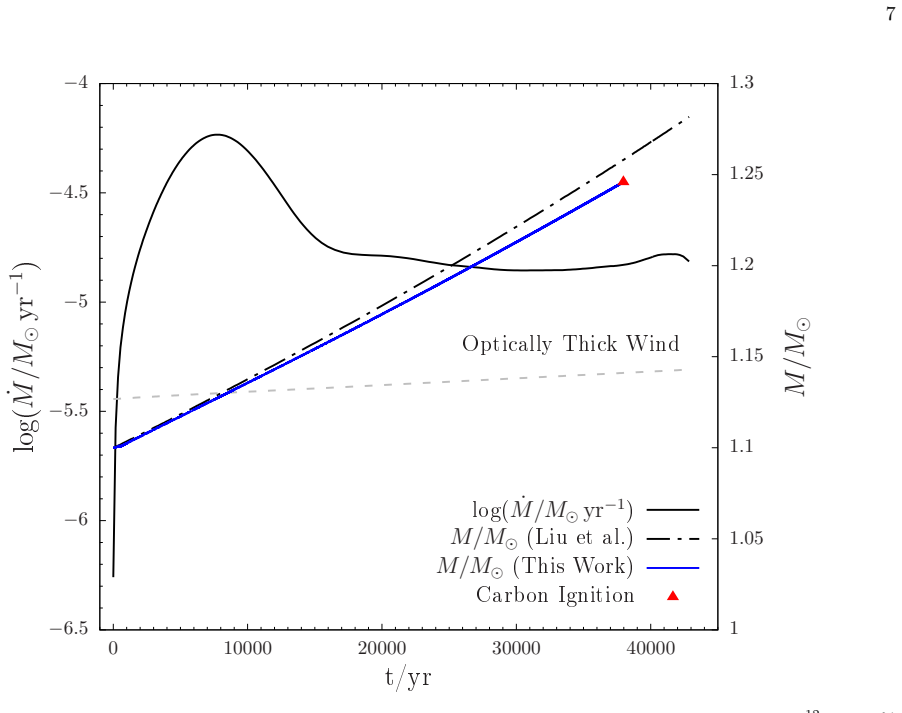
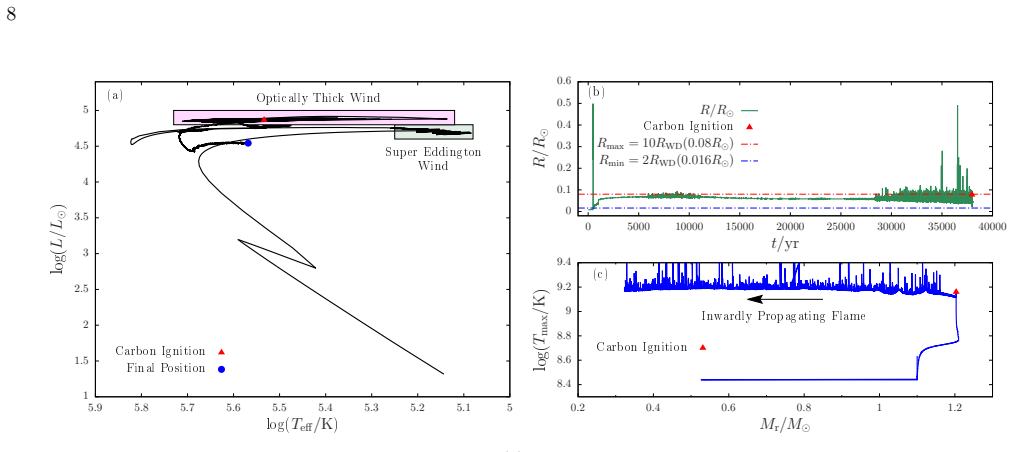
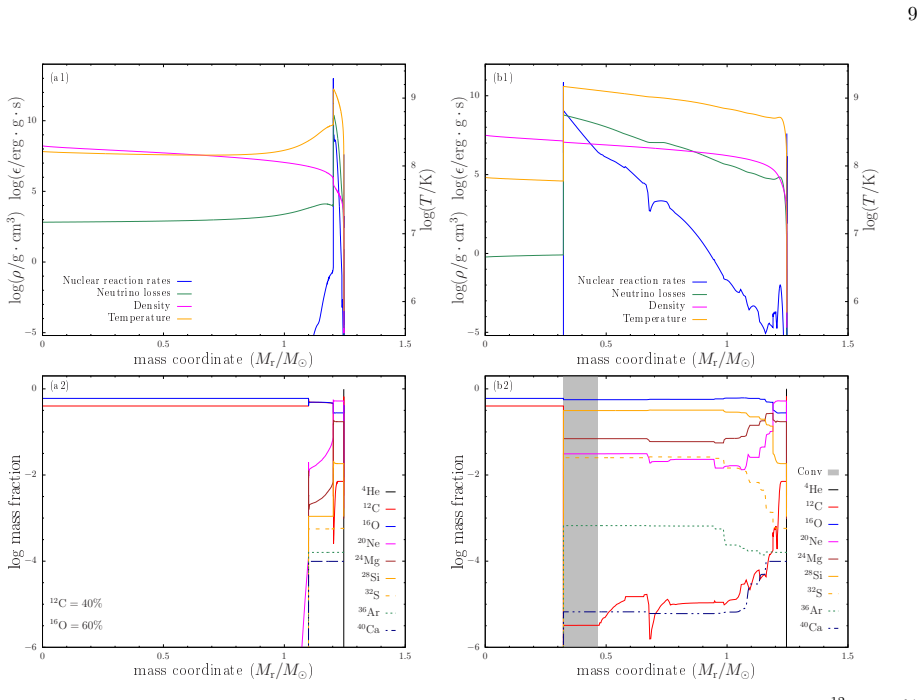
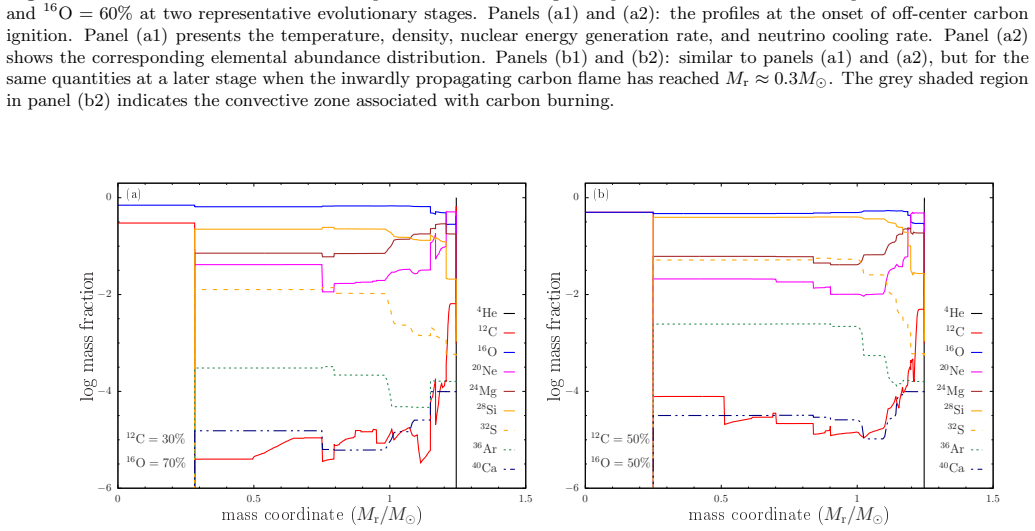
SN 2021yfj is a recently discovered interacting supernova that exhibits narrow emission lines of Si, S, and Ar, indicating the presence of circumstellar material (CSM) enriched with these elements surrounding the progenitor prior to the explosion. The origin of SN 2021yfj-like events remains uncertain. Recent work proposed that the SN 2021yfj-like events may stem from the double WD merger scenario, in which the merger of a Si-rich WD with a more massive ONe WD tidally strips about 0.3Msun of Si-rich material to form the CSM. If the merger subsequently triggers a supernova explosion, the interaction between the ejecta and the CSM can reproduce the observed light curve of SN 2021yfj. In this scenario, the progenitor system is a CO WD + He star binary, in which the CO WD accretes He-rich material from the He star. The accumulated material can trigger off-center carbon burning, potentially leading to the formation of a Si-rich WD. However, it remains unclear whether such off-center carbon burning can produce Si, S, and Ar in amounts comparable to those inferred for the CSM of SN 2021yfj. In this work, we simulate the evolution of a CO WD accreting He-rich material using time-dependent mass-accretion rates. Our results show that off-center carbon burning in the accreting CO WD can produce significant amounts of Si and S. We further found that the resulting elemental abundances are strongly affected by the initial carbon abundance of the WD. Based on our results, we suggest that the double WD merger scenario may provide a viable progenitor channel for SN 2021yfj-like events.
Editorial analysis
A structured set of objections, weighed in public.
Referee Report
Summary. The manuscript simulates the evolution of accreting CO white dwarfs using time-dependent He-rich mass-accretion rates. It reports that off-center carbon burning produces significant amounts of Si and S (with abundances strongly dependent on the WD's initial carbon abundance) and concludes that this supports the double WD merger scenario as a viable channel for SN 2021yfj-like events whose CSM shows narrow Si, S, and Ar lines.
Significance. If the chosen accretion histories prove representative of CO WD + He-star binaries, the work supplies a concrete nucleosynthetic pathway for forming the Si-rich material required by the proposed double-WD-merger model, thereby linking a specific binary channel to the observed CSM composition. The reported sensitivity to initial carbon abundance supplies a falsifiable prediction that could be tested against WD population models.
major comments (2)
- [Abstract / simulation setup] Abstract and simulation-setup paragraph: the time-dependent mass-accretion rates are adopted without derivation from binary-evolution calculations of CO WD + He-star systems, without comparison to the expected Ṁ range (~10^{-8}–10^{-6} M⊙ yr^{-1}), and without sensitivity tests to alternate histories. Because the central claim is that the resulting Si/S abundances are relevant to the SN 2021yfj CSM in the double-WD-merger channel, the physical representativeness of Ṁ(t) is load-bearing.
- [Results / comparison to SN 2021yfj] Results section (comparison to observations): the abstract asserts that off-center burning produces Si and S “in amounts comparable to those inferred for the CSM,” yet no quantitative mass fractions, total ejected masses, or direct numerical comparison to the observed CSM values are provided, nor are error bars or convergence tests reported. This leaves the “comparable” claim unsupported by the presented data.
minor comments (2)
- [Abstract] Abstract: the range of initial carbon abundances explored and the specific functional form of the adopted Ṁ(t) should be stated explicitly.
- [Throughout] Notation: ensure consistent use of symbols for mass-accretion rate (Ṁ) and initial carbon mass fraction (X_C) throughout the text and figures.
Simulated Author's Rebuttal
We thank the referee for their constructive comments on our manuscript. We address each major comment below and indicate the revisions that will be incorporated.
read point-by-point responses
-
Referee: [Abstract / simulation setup] Abstract and simulation-setup paragraph: the time-dependent mass-accretion rates are adopted without derivation from binary-evolution calculations of CO WD + He-star systems, without comparison to the expected Ṁ range (~10^{-8}–10^{-6} M⊙ yr^{-1}), and without sensitivity tests to alternate histories. Because the central claim is that the resulting Si/S abundances are relevant to the SN 2021yfj CSM in the double-WD-merger channel, the physical representativeness of Ṁ(t) is load-bearing.
Authors: We agree that demonstrating the physical representativeness of the adopted Ṁ(t) is important. The rates were selected to lie within the range expected for He-rich accretion onto CO WDs in binary systems. In the revised manuscript we will add an explicit comparison of our accretion histories to the literature range of ~10^{-8}–10^{-6} M⊙ yr^{-1} for CO WD + He-star binaries, together with a short discussion of their relevance to the double-WD-merger channel. We will also include sensitivity tests using alternate accretion histories to confirm that the Si and S yields remain robust. These additions will appear in the simulation-setup section. revision: yes
-
Referee: [Results / comparison to SN 2021yfj] Results section (comparison to observations): the abstract asserts that off-center burning produces Si and S “in amounts comparable to those inferred for the CSM,” yet no quantitative mass fractions, total ejected masses, or direct numerical comparison to the observed CSM values are provided, nor are error bars or convergence tests reported. This leaves the “comparable” claim unsupported by the presented data.
Authors: We acknowledge that the abstract claim would be strengthened by quantitative support. In the revised results section we will report the mass fractions of Si and S obtained from the simulations, provide a direct numerical comparison to the CSM abundances inferred for SN 2021yfj, and include convergence tests for the nucleosynthesis calculations. These changes will make the comparison explicit and address the concern raised. revision: yes
Circularity Check
Forward stellar evolution simulations yield independent abundance outputs
full rationale
The paper reports results from numerical integration of stellar structure equations under chosen time-dependent accretion rates and initial WD carbon abundances. The Si/S/Ar yields are computed outputs, not quantities defined by or fitted to the target SN 2021yfj observations. No equation reduces the reported abundances to the input Ṁ(t) histories by construction, and no self-citation chain or imported uniqueness theorem is invoked to force the conclusion that the double-WD-merger channel is viable. The central claim therefore remains an interpretation of independent simulation results rather than a tautology.
Axiom & Free-Parameter Ledger
free parameters (2)
- time-dependent mass-accretion rate
- initial carbon abundance of the WD
axioms (1)
- domain assumption Standard one-dimensional stellar evolution equations and nuclear reaction rates govern the structure and burning of the accreting CO white dwarf.
Reference graph
Works this paper leans on
-
[1]
2016, ApJ, 821, 28, doi: 10.3847/0004-637X/821/1/28
Brooks, J., Bildsten, L., Schwab, J., & Paxton, B. 2016, ApJ, 821, 28, doi: 10.3847/0004-637X/821/1/28
-
[2]
2014, MNRAS, 438, 14, doi: 10.1093/mnras/stt1766
Dan, M., Rosswog, S., Br¨ uggen, M., & Podsiadlowski, P. 2014, MNRAS, 438, 14, doi: 10.1093/mnras/stt1766
-
[3]
W., Taggart, K., Tinyanont, S., et al
Davis, K. W., Taggart, K., Tinyanont, S., et al. 2023, MNRAS, 523, 2530, doi: 10.1093/mnras/stad1433
-
[4]
Denissenkov, P. A., Herwig, F., Truran, J. W., & Paxton, B. 2013, ApJ, 772, 37, doi: 10.1088/0004-637X/772/1/37
-
[5]
Farmer, R., Fields, C. E., Petermann, I., et al. 2016, ApJS, 227, 22, doi: 10.3847/1538-4365/227/2/22
-
[6]
Filippenko, A. V. 1997, ARA&A, 35, 309, doi: 10.1146/annurev.astro.35.1.309 11
-
[7]
Fraser, M., Stritzinger, M. D., Brennan, S. J., et al. 2021, arXiv e-prints, arXiv:2108.07278, doi: 10.48550/arXiv.2108.07278
-
[8]
2017, Hydrogen-Rich Core-Collapse Supernovae, doi: 10.1007/978-3-319-21846-5 39
Gal-Yam, A. 2017, in Handbook of Supernovae, ed. A. W. Alsabti & P. Murdin, 195, doi: 10.1007/978-3-319-21846-5 35
-
[9]
Gal-Yam, A., Bruch, R., Schulze, S., et al. 2022, Nature, 601, 201, doi: 10.1038/s41586-021-04155-1
-
[10]
1996, ApJL, 470, L97, doi: 10.1086/310303
Hachisu, I., Kato, M., & Nomoto, K. 1996, ApJL, 470, L97, doi: 10.1086/310303 Jacobson-Gal´ an, W. V., Venkatraman, P., Margutti, R., et al. 2022, ApJ, 932, 58, doi: 10.3847/1538-4357/ac67dc
-
[11]
2018, ApJ, 869, 140, doi: 10.3847/1538-4357/aaedb7
Kashyap, R., Haque, T., Lor´ en-Aguilar, P., Garc ´ ıa-Berro, E., & Fisher, R. 2018, ApJ, 869, 140, doi: 10.3847/1538-4357/aaedb7
-
[12]
2004, ApJL, 613, L129, doi: 10.1086/425249
Kato, M., & Hachisu, I. 2004, ApJL, 613, L129, doi: 10.1086/425249
-
[13]
2016, ApJ, 832, 71, doi: 10.3847/0004-637X/832/1/71
Lecoanet, D., Schwab, J., Quataert, E., et al. 2016, ApJ, 832, 71, doi: 10.3847/0004-637X/832/1/71
-
[14]
2018, MNRAS, 473, 5352, doi: 10.1093/mnras/stx2756
Liu, D., Wang, B., & Han, Z. 2018, MNRAS, 473, 5352, doi: 10.1093/mnras/stx2756
-
[15]
Modjaz, M., Guti´ errez, C. P., & Arcavi, I. 2019, Nature Astronomy, 3, 717, doi: 10.1038/s41550-019-0856-2
-
[16]
J., Wu, C., Liu, D., Liu, Z.-W., & Wang, B
Moriya, T. J., Wu, C., Liu, D., Liu, Z.-W., & Wang, B. 2026, arXiv e-prints, arXiv:2603.07064, doi: 10.48550/arXiv.2603.07064
-
[17]
2023, A&A, 673, A27, doi: 10.1051/0004-6361/202346084
Nagao, T., Kuncarayakti, H., Maeda, K., et al. 2023, A&A, 673, A27, doi: 10.1051/0004-6361/202346084
-
[18]
1982, ApJ, 253, 798, doi: 10.1086/159682
Nomoto, K. 1982, ApJ, 253, 798, doi: 10.1086/159682
-
[19]
Pastorello, A., Smartt, S. J., Mattila, S., et al. 2007, Nature, 447, 829, doi: 10.1038/nature05825
-
[20]
2011, ApJS, 192, 3, doi: 10.1088/0067-0049/192/1/3
Paxton, B., Bildsten, L., Dotter, A., et al. 2011, ApJS, 192, 3, doi: 10.1088/0067-0049/192/1/3
-
[21]
2013, ApJS, 208, 4, doi: 10.1088/0067-0049/208/1/4
Paxton, B., Cantiello, M., Arras, P., et al. 2013, ApJS, 208, 4, doi: 10.1088/0067-0049/208/1/4
work page internal anchor Pith review doi:10.1088/0067-0049/208/1/4 2013
-
[22]
2015, ApJS, 220, 15, doi: 10.1088/0067-0049/220/1/15
Paxton, B., Marchant, P., Schwab, J., et al. 2015, ApJS, 220, 15, doi: 10.1088/0067-0049/220/1/15
work page internal anchor Pith review doi:10.1088/0067-0049/220/1/15 2015
-
[23]
Paxton, B., Schwab, J., Bauer, E. B., et al. 2018, ApJS, 234, 34, doi: 10.3847/1538-4365/aaa5a8
work page internal anchor Pith review doi:10.3847/1538-4365/aaa5a8 2018
-
[24]
Pellegrino, C., Howell, D. A., Terreran, G., et al. 2022, ApJ, 938, 73, doi: 10.3847/1538-4357/ac8ff6
-
[25]
A., Sollerman, J., Schulze, S., et al
Perley, D. A., Sollerman, J., Schulze, S., et al. 2022, ApJ, 927, 180, doi: 10.3847/1538-4357/ac478e
-
[26]
Piersanti, L., Tornamb´ e, A., & Yungelson, L. R. 2014, MNRAS, 445, 3239, doi: 10.1093/mnras/stu1885
-
[27]
2013, ApJ, 772, 1, doi: 10.1088/0004-637X/772/1/1
Raskin, C., & Kasen, D. 2013, ApJ, 772, 1, doi: 10.1088/0004-637X/772/1/1
-
[28]
Schulze, S., Gal-Yam, A., Dessart, L., et al. 2025, Nature, 644, 634, doi: 10.1038/s41586-025-09375-3
-
[29]
2016, MNRAS, 463, 3461, doi: 10.1093/mnras/stw2249
Schwab, J., Quataert, E., & Kasen, D. 2016, MNRAS, 463, 3461, doi: 10.1093/mnras/stw2249
-
[30]
2025, A&A, 704, A135, doi: 10.1051/0004-6361/202556369
Tsalapatas, K., Sollerman, J., Chiba, R., et al. 2025, A&A, 704, A135, doi: 10.1051/0004-6361/202556369
-
[31]
2009, MNRAS, 397, 985, doi: 10.1111/j.1365-2966.2009.15007.x
Wang, B., Meng, X., Chen, X., & Han, Z. 2009, MNRAS, 395, 847, doi: 10.1111/j.1365-2966.2009.14545.x
-
[32]
2017, MNRAS, 472, 1593, doi: 10.1093/mnras/stx2192
Wang, B., Podsiadlowski, P., & Han, Z. 2017, MNRAS, 472, 1593, doi: 10.1093/mnras/stx2192
-
[33]
Wong, T. L. S., & Schwab, J. 2019, ApJ, 878, 100, doi: 10.3847/1538-4357/ab1b49
-
[34]
Wong, T. L. S., Schwab, J., & G¨ otberg, Y. 2021, ApJ, 922, 241, doi: 10.3847/1538-4357/ac27ae
-
[35]
Woosley, S. E. 2017, ApJ, 836, 244, doi: 10.3847/1538-4357/836/2/244
-
[36]
Woosley, S. E., & Heger, A. 2015, ApJ, 810, 34, doi: 10.1088/0004-637X/810/1/34
-
[37]
2019, MNRAS, 486, 2977, doi: 10.1093/mnras/stz1028
Wu, C., & Wang, B. 2019, MNRAS, 486, 2977, doi: 10.1093/mnras/stz1028
-
[38]
2019, MNRAS, 483, 263, doi: 10.1093/mnras/sty3176
Wu, C., Wang, B., & Liu, D. 2019, MNRAS, 483, 263, doi: 10.1093/mnras/sty3176
-
[39]
2017, A&A, 604, A31, doi: 10.1051/0004-6361/201630099
Wu, C., Wang, B., Liu, D., & Han, Z. 2017, A&A, 604, A31, doi: 10.1051/0004-6361/201630099
-
[40]
2020, MNRAS, 495, 1445, doi: 10.1093/mnras/staa1277
Wu, C., Wang, B., Wang, X., Maeda, K., & Mazzali, P. 2020, MNRAS, 495, 1445, doi: 10.1093/mnras/staa1277
-
[41]
2023, ApJL, 944, L54, doi: 10.3847/2041-8213/acb6f3
Wu, C., Xiong, H., Lin, J., et al. 2023, ApJL, 944, L54, doi: 10.3847/2041-8213/acb6f3
-
[42]
2024, ApJ, 975, 186, doi: 10.3847/1538-4357/ad7e13
Zhang, Z., Wu, C., Aryan, A., et al. 2024, ApJ, 975, 186, doi: 10.3847/1538-4357/ad7e13
discussion (0)
Sign in with ORCID, Apple, or X to comment. Anyone can read and Pith papers without signing in.