REVIEW 1 major objections 5 minor 131 references
In a production app-store deployment, an adaptive sliding-window policy matches the revenue of the always-five-ads rule while recovering most conversion losses, beating every fixed ad-load benchmark.
Reviewed by Pith at T0; open to challenge. T0 means a machine referee read the full paper against a public rubric. the ladder, T0–T4 →
Raising sponsored-slot counts raises revenue up to 43% but lowers conversions up to 5%, and a deployed query-level adaptive ad-load policy achieves five-ad revenue with conversion losses closer to low-ad policies.
T0 review reviewed 2026-08-02 challenge →
load-bearing objection Strong causal experiment and a useful adaptive algorithm, but the headline deployment claim rests on a confounding comparison between cohorts with different histories, and the regret bound's key independence assumption conflicts with the deployed design. the 1 major comments →
Adaptive Ad Load Design for Sponsored Search Markets: Evidence, Theory, and Deployment
The pith
A machine-rendered reading of the paper's core claim, the machinery that carries it, and where it could break.
The reading
Core claim
The central claim is that a locally adaptive, model-free policy can shift the empirical revenue–conversion frontier outward relative to every fixed uniform or query-dependent static ad-load policy in a non-stationary sponsored-search market. The experiment shows that marginal revenue from additional slots depends sharply on query-level advertiser quality and on within-query changes such as brand-advertiser presence, so no single static rule is near-optimal. LAAL operationalizes this by maintaining sliding-window estimates of mean revenue and conversions for each query–ad-load pair, scalarizing them as λ·Revenue + Conversion with λ≈0.01 calibrated to the experiment's revealed exchange rate, a
What carries the argument
LAAL (Locally Adaptive Ad Load) is a model-free, query-level sliding-window decision rule: for each query and candidate ad load, it computes recent mean revenue and conversion per search over a fixed-length window (3 days in deployment), forms the scalarized reward r = λ·Revenue + Conversion (λ≈0.01, calibrated to the experiment's empirical revenue–conversion slope), and selects the ad load maximizing that reward. A tiny regularization term breaks near-ties toward fewer ads, and queries with fewer than m=100 recent observations fall back to a default of four ads. The e-LAAL deployment architecture splits traffic 90/10: 90% of users run LAAL while 10% are permanently assigned to fixed-ad-load
Load-bearing premise
The regret guarantee assumes that, for a given query's sequence of searches, the experimental cohort assigned to each search is independent across searches; in the deployed system users are permanently assigned to cohorts by hashed device IDs, so repeated searches by the same user are correlated, and without that independence the concentration argument behind the advertised regret bound is not proven.
What would settle it
Check whether LAAL's deployment point lies below the chord connecting the always-five-ads and always-six-ads arms in revenue–conversion space; if a replication places it below that line, the frontier-improvement claim fails. For the theory, examine user repetition within a 3-day window for high-volume queries: if a small number of users account for a large share of a query's searches, the per-search cohort assignments within the window are highly correlated, violating the independence assumption on which the high-probability regret bound rests.
If this is right
- Platforms should treat ad load as a query-level, time-varying decision; the best uniform static load shifted from three ads during the experiment to five ads during deployment, so any fixed rule chosen from historical data can become stale.
- A small exploration budget (10% static cohorts) is enough to maintain learning and credible counterfactuals while the adaptive arm exploits; the system-level e-LAAL mixture stays close to the pure LAAL arm.
- The policy adapts without a parametric reward model or observations of latent advertiser states: for brand queries it recommends fewer ads when the brand advertiser is absent and more when it is present, purely from recent outcomes.
- The frontier gains persist on non-brand queries, so the improvement is not driven solely by brand-query mechanics.
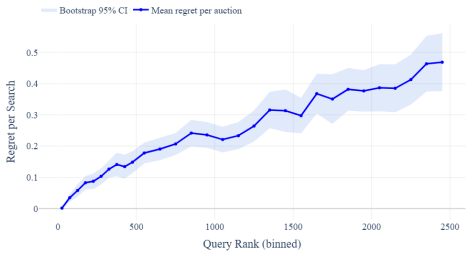
- LAAL's empirical regret relative to an ex post query-dependent oracle is near zero on the highest-volume queries, where local estimates are most precise.
Where Pith is reading between the lines
- The paper leaves implicit that the same architecture could be ported to other sponsored-search or e-commerce surfaces that observe query-level revenue and conversions, since LAAL requires no platform-specific model.
- The scalarization parameter λ is calibrated to the short-run revenue–conversion frontier; if the platform values conversions differently over the long run, re-running the deployment with different λ values would trace an adaptive Pareto frontier – a direct testable extension.
- The proven regret bound rests on an independence assumption that the permanent-cohort design does not strictly satisfy; a sharper theory would need to model user-level persistence, which suggests treating the deployment result primarily as empirical evidence rather than as a corollary of the bound.
- Because users under high ad loads search more, LAAL's conversion gains may compound over longer horizons; measuring engagement and repeated search behavior beyond the 22-day window would test whether the frontier improvement grows or decays.
Editorial analysis
A structured set of objections, weighed in public.
Referee Report
Summary. This paper studies ad-load design in a large Android app-store sponsored-search market. It first reports a 66-day user-level randomized field experiment (≈5.06M users) that exogenously varies the number of sponsored slots from 1 to 6, documenting a revenue–conversion trade-off: revenue per user rises by up to 43%, total conversions fall by up to 5%, and engagement declines by up to 2.2%. It further shows that the trade-off is heterogeneous across query-level ad-conversion segments and within queries over time as brand-advertiser presence changes. Motivated by these findings, the authors propose e-LAAL, an exploration-augmented, query-level sliding-window adaptive policy that combines a greedy adaptive arm (LAAL) with persistent static cohorts. They provide a finite-time dynamic-regret guarantee (Theorem 1, Web Appendix F) and report a 22-day production deployment serving 22.33 million users and 77.60 million searches, in which LAAL achieves revenue statistically indistinguishable from the always-5-ads policy while generating about 3% more conversions, and outperforms both historical and deployment-period static benchmarks.
Significance. If the empirical claims hold, the paper makes a substantial contribution: it provides some of the largest causal evidence on sponsored-search ad-load effects, documents economically meaningful heterogeneity, and demonstrates that a model-free adaptive policy can improve the revenue–conversion frontier at production scale. The field-experiment design is strong: randomized user cohorts, user-level regressions with tight standard errors, IPW normalization, and several robustness checks (non-brand queries, time trends, cohort-invariance tests) are sensible. The deployment is unusually large and the accompanying theoretical analysis, if valid, would be a useful addition to the non-stationary bandit literature. The paper is also candid about several limitations, including the short deployment window and the conditional-cohort-invariance assumption. However, two load-bearing concerns—the causal identification of the deployment comparison and the validity of the regret guarantee under the deployed cohort assignment—need to be addressed before the headline claims can be accepted.
major comments (1)
- [§8.2] The “deployment query-dependent empirical oracle” is selected ex post using the same 22-day deployment outcomes that are then used to compute LAAL's empirical regret (Eq. 21). This benchmark is infeasible and overfits noisy query-level outcomes, so the near-zero regret reported for high-volume queries is partly mechanical. The authors acknowledge the oracle is infeasible, and the comparison is useful as a diagnostic, but the claim that LAAL “exhibits near-zero empirical regret” should be interpreted with caution and should be accompanied by a discussion of the oracle's in-sample selection bias. A small addition—e.g., a split-sample or cross-validation construction—would strengthen this section.
minor comments (5)
- [§4.2.1, Eq. (5)] The query-level regressions cluster standard errors at the query level, but treatment is assigned at the user level and each user contributes multiple searches. Clustering at the user level (or two-way clustering) would be more conservative and should be considered, particularly for the heterogeneity estimates.
- [§6.5] The text says “We now discuss the three main parameters” but then lists five algorithmic hyperparameters (h, m, η, δ, i_def) in addition to λ and ε. Please adjust the wording for clarity.
- [Web Appendix F] The notation δ_sm is introduced in the appendix but not clearly connected to the main-text δ in Eq. (12). Use a single symbol to avoid confusion.
- [Figures 8b and 12] These figures would benefit from explicit axis labels and units (e.g., share of searches on the y-axis). Currently the y-axes appear unlabeled.
- [References] Some references are incomplete (e.g., “R. P. Leme et al. A field guide to personalized reserve prices” has no venue or year). Please complete the bibliography.
Circularity Check
No significant circularity: deployment result is a measured outcome, and fitted tuning parameters do not force the headline comparison.
full rationale
The paper's central deployment claim—LAAL delivering revenue essentially equal to T5 (36.13 vs. 36.11 per user) while increasing conversions (2.127 vs. 2.064 per user) in Table 6—is a direct measurement from the deployed cohorts, not a quantity reconstructed from fitted inputs. The scalarization weight λ=0.01 is calibrated from the first experiment's uniform-policy frontier (§6.5) and is then used to define the reward metric in the benchmark comparisons, but the headline trade-off improvement is stated in raw revenue and conversion units and would hold independently of λ. The default ad load i_def is fit from historical low-volume queries, but it only governs the 21% fallback searches and is not used to construct the LAAL-versus-static revenue/conversion comparison (§6.5, Appendix G). The dynamic regret bound in Appendix F is derived from explicit assumptions (E1–E4) and standard non-stationary bandit arguments, not imported from a self-citation or a uniqueness theorem. The paper contains self-citations, but none is load-bearing for the main empirical or theoretical claims. The inherited static cohorts do raise a legitimate causal-identification concern about prior 66-day exposure, but that is a selection/confounding threat rather than a circularity in the derivation chain. No step reduces a prediction to its own inputs by construction.
Axiom & Free-Parameter Ledger
free parameters (7)
- lambda (revenue-conversion scalarization) =
0.01
- h (sliding-window length) =
3 days
- m (minimum window volume) =
100
- i_def (fallback ad load) =
4
- eta (tie-break regularizer) =
1e-3
- delta (smoothing constant) =
1e-6
- epsilon (exploration mass) =
0.10
axioms (5)
- domain assumption Conditional cohort-invariance: pooled LAAL and static observations are comparable after conditioning on query, time, and realized ad load.
- ad hoc to paper Assumption E2: each search's cohort is drawn independently across searches; realized query-level static support satisfies (A5)-(A6).
- domain assumption Assumption E5: regular query rate, so each h-length window contains Theta(Nh/T) searches of a given query.
- domain assumption Random assignment via hashed device IDs yields exchangeable user cohorts.
- domain assumption The ad market is sufficiently thick so realized ad load matches intended treatment condition.
Cite this review
Pith. "Pith review of Adaptive Ad Load Design for Sponsored Search Markets: Evidence, Theory, and Deployment." pith.science (2026). https://pith.science/paper/WSOFASEG
@misc{pith2026260714418,
  author       = {Pith},
  title        = {Pith review of: Adaptive Ad Load Design for Sponsored Search Markets: Evidence, Theory, and Deployment},
  year         = {2026},
  howpublished = {\url{https://pith.science/paper/WSOFASEG}},
  note         = {Machine review of arXiv:2607.14418}
}
read the original abstract
Ad-load design is a central supply-side decision in sponsored search: more sponsored slots can raise revenue, but may crowd out organic results and degrade user outcomes. We study this trade-off using a large-scale randomized field experiment on an Android app store, where over five million users are exposed to one through six sponsored slots. Increasing ad load raises revenue by up to 43%, but reduces total search conversions by up to 5% and daily engagement by up to 2.2%. These average effects mask substantial heterogeneity: additional slots generate large revenue gains for high-ad-conversion queries, but little or negative marginal revenue for low-conversion queries. The trade-off also shifts within query as advertiser composition changes, such as brand-advertiser presence. Motivated by these findings, we design and deploy a novel adaptive algorithm -- exploration-augmented Locally Adaptive Ad Load (e-LAAL). e-LAAL combines LAAL, a model-free query-level decision rule that updates ad-load recommendations using recent outcomes, with static exploration arms that maintain support and provide fixed-policy counterfactual benchmarks. We provide a finite-time dynamic-regret guarantee for the e-LAAL architecture. In a platform-level production deployment serving 22.3 million users and 77.6 million searches, e-LAAL improves the empirical revenue--conversion trade-off relative to deployed static benchmarks and outperforms uniform and historical query-dependent static benchmarks.
Figures



Reference graph
Works this paper leans on
-
[1]
Abbasi-Yadkori, D
Y. Abbasi-Yadkori, D. P \'a l, and C. Szepesv \'a ri. Improved algorithms for linear stochastic bandits. In Advances in Neural Information Processing Systems 24, pages 2312--2320, 2011. URL https://proceedings.neurips.cc/paper/2011/hash/e1d5be1c7f2f456670de3d53c7b54f4a-Abstract.html
2011
-
[2]
Agrawal and N
S. Agrawal and N. Goyal. Thompson sampling for contextual bandits with linear payoffs. In Proceedings of the 30th International Conference on Machine Learning, volume 28 of Proceedings of Machine Learning Research, pages 127--135. PMLR, 2013. URL https://proceedings.mlr.press/v28/agrawal13.html
2013
-
[3]
Ads on the app store
Apple Ads . Ads on the app store. https://ads.apple.com/app-store, 2026. Accessed: 2026-06-02
2026
-
[4]
S. Athey and G. Ellison. Position auctions with consumer search. Quarterly Journal of Economics, 126 0 (3): 0 1213--1270, 2011. doi:10.1093/qje/qjr028
-
[6]
A. Carri \'o n, J. Wang, H. S. Nair, W. Xu, and Y. Zhang. Blending advertising with organic content in e-commerce: A virtual bids optimization approach. In Proceedings of the AAAI Conference on Artificial Intelligence (AAAI), volume 37, pages 4141--4149. AAAI Press, 2023. doi:10.1609/aaai.v37i4.25629. Also available as arXiv preprint arXiv:2105.13556
Pith/arXiv arXiv 2023
-
[7]
E. Cavenaghi, G. Sottocornola, F. Stella, and M. Zanker. Non-stationary multi-armed bandit: Empirical evaluation of a new concept drift-aware algorithm. Entropy, 23 0 (3): 0 380, 2021. doi:10.3390/e23030380
-
[9]
W. C. Cheung, D. Simchi-Levi, and R. Zhu. Learning to optimize under non-stationarity. In Proceedings of the Twenty-Second International Conference on Artificial Intelligence and Statistics (AISTATS), volume 89 of Proceedings of Machine Learning Research, pages 1079--1087. PMLR, 2019
2019
-
[10]
W. Chu, L. Li, L. Reyzin, and R. Schapire. Contextual bandits with linear payoff functions. In Proceedings of the Fourteenth International Conference on Artificial Intelligence and Statistics, volume 15 of Proceedings of Machine Learning Research, pages 208--214. PMLR, 2011. URL https://proceedings.mlr.press/v15/chu11a.html
2011
-
[11]
K. Deb, K. Sindhya, and J. Hakanen. Multi-objective optimization. In Decision sciences, pages 161--200. CRC Press, 2016
2016
-
[13]
A. Garivier and \'E . Moulines. On upper-confidence bound policies for switching bandit problems. In International Conference on Algorithmic Learning Theory (ALT), pages 174--188, 2011. doi:10.1007/978-3-642-24412-4_16. URL https://doi.org/10.1007/978-3-642-24412-4_16
-
[14]
A. Goldfarb and C. E. Tucker. Privacy regulation and online advertising. Management Science, 57 0 (1): 0 57--71, 2011. doi:10.1287/mnsc.1100.1246
arXiv 2011
-
[15]
A. Goli, J. Huang, D. Reiley, and N. M. Riabov. Measuring consumer sensitivity to audio advertising: a long-run field experiment on pandora internet radio. Quantitative Marketing and Economics, pages 1--31, 2025 a
2025
-
[17]
D. G. Horvitz and D. J. Thompson. A generalization of sampling without replacement from a finite universe. Journal of the American Statistical Association, 47 0 (260): 0 663--685, 1952. doi:10.1080/01621459.1952.10483446
arXiv 1952
-
[18]
Internet advertising revenue report: Full-year 2025 results
Interactive Advertising Bureau . Internet advertising revenue report: Full-year 2025 results. https://www.iab.com/wp-content/uploads/2026/04/IAB_PwC_Internet_Ad_Revenue_Report_Full_Year_2025_April_2026.pdf, Apr. 2026. Accessed: 2026-06-01
2025
-
[19]
L. Jain, Z. Li, E. Loghmani, B. Mason, and H. Yoganarasimhan. Effective adaptive exploration of prices and promotions in choice-based demand models. Marketing Science, 43 0 (5): 0 1002--1030, 2024
2024
-
[20]
A. Kim, S. Balachander, and K. Kannan. On the optimal number of advertising slots in a generalized second-price auction. Marketing Letters, 23 0 (3): 0 851--868, Sept. 2012. doi:10.1007/s11002-012-9193-2
-
[21]
Kohavi, A
R. Kohavi, A. Deng, B. Frasca, R. Longbotham, T. Walker, and Y. Xu. Trustworthy online controlled experiments: Five puzzling outcomes explained. In Proceedings of the 18th ACM SIGKDD international conference on Knowledge discovery and data mining, pages 786--794, 2012
2012
-
[22]
S. Lahaie and D. M. Pennock. Revenue analysis of a family of ranking rules for keyword auctions. In Proceedings of the 8th ACM Conference on Electronic Commerce (EC), pages 50--56, 2007. doi:10.1145/1250910.1250918
arXiv 2007
-
[23]
Lattimore and C
T. Lattimore and C. Szepesv \'a ri. Bandit algorithms. Cambridge University Press, 2020
2020
-
[24]
R. P. Leme et al. A field guide to personalized reserve prices, 2016. arXiv preprint
2016
-
[25]
L. Li, W. Chu, J. Langford, and R. E. Schapire. A contextual-bandit approach to personalized news article recommendation. In Proceedings of the 19th international conference on World wide web, pages 661--670, 2010
2010
-
[26]
G. Liao, Z. Wang, X. Wu, X. Shi, C. Zhang, Y. Wang, X. Wang, and D. Wang. Cross DQN : Cross deep Q network for ads allocation in feed, 2021. URL https://arxiv.org/abs/2109.04353. Accepted by WWW '22
Pith/arXiv arXiv 2021
-
[29]
M. Ostrovsky and M. Schwarz. Reserve prices in internet advertising auctions: A field experiment. Journal of Political Economy, 131 0 (12), 2023. doi:10.1086/725702
-
[30]
O. Rafieian and H. Yoganarasimhan. Targeting and privacy in mobile advertising. Marketing Science, 40 0 (2): 0 193--218, 2021. doi:10.1287/mksc.2020.1235
arXiv 2021
-
[31]
Rafieian, A
O. Rafieian, A. Kapoor, and A. Sharma. Multiobjective personalization of marketing interventions. Marketing Science, 44 0 (2): 0 457--477, 2025
2025
-
[32]
Russac, C
Y. Russac, C. Vernade, and O. Capp \'e . Weighted linear bandits for non-stationary environments. In Advances in Neural Information Processing Systems 32, pages 12040--12049, 2019. URL https://papers.nips.cc/paper/9372-weighted-linear-bandits-for-non-stationary-environments
2019
-
[33]
H. Sagtani, M. G. Jhawar, R. Mehrotra, and O. Jeunen. Ad-load balancing via off-policy learning in a content marketplace, 2023. URL https://arxiv.org/abs/2309.11518
Pith/arXiv arXiv 2023
-
[35]
A. Sayedi. Real-time bidding in online display advertising. Marketing Science, 37 0 (4): 0 553--568, 2018. doi:10.1287/mksc.2017.1083
arXiv 2018
-
[37]
Simonov, C
A. Simonov, C. Nosko, and J. M. Rao. Competition and crowd-out for brand keywords in sponsored search. Marketing Science eJournal, 2017. URL https://api.semanticscholar.org/CorpusID:947920
2017
-
[38]
F. Tr \`o v \`o , S. Paladino, M. Restelli, and N. Gatti. Sliding-window thompson sampling for non-stationary settings. Journal of Artificial Intelligence Research, 68: 0 311--364, 2020. doi:10.1613/jair.1.11407
-
[39]
H. R. Varian. Position auctions. International Journal of Industrial Organization, 25 0 (6): 0 1163--1178, 2007. doi:10.1016/j.ijio.2006.10.006
-
[40]
B. Wang, Z. Li, J. Tang, K. Zhang, S. Chen, and L. Ru. Learning to advertise: How many ads are enough? In J. Z. Huang, L. Cao, and J. Srivastava, editors, Advances in Knowledge Discovery and Data Mining: 15th Pacific-Asia Conference, PAKDD 2011, Shenzhen, China, May 24--27, 2011, Proceedings, Part II, volume 6635 of Lecture Notes in Computer Science, page...
-
[41]
Y. Wang, L. Tao, and X. X. Zhang. Recommending for a multi-sided marketplace: A multi-objective hierarchical approach. Marketing Science, 2024
2024
-
[43]
K. C. Wilbur, L. Xu, and D. Kempe. Correcting audience externalities in television advertising. Marketing Science, 32 0 (6): 0 892--912, 2013
2013
-
[44]
M. Yan, J. Xu, A. A. Tiwana, and M. Chatterjee. Ads allocation in feed via constrained optimization. In Proceedings of the 26th ACM SIGKDD International Conference on Knowledge Discovery and Data Mining (KDD), pages 3299--3307. ACM, 2020. doi:10.1145/3394486.3403391
arXiv 2020
- [45]
-
[46]
Z. Ye, D. J. Zhang, H. Zhang, R. Zhang, X. Chen, and Z. Xu. Cold start to improve market thickness on online advertising platforms: Data-driven algorithms and field experiments. Management Science, 69 0 (7): 0 3838--3860, 2023
2023
-
[47]
Yoganarasimhan
H. Yoganarasimhan. Search personalization using machine learning. Management Science, 66 0 (3): 0 1045--1070, 2020
2020
-
[48]
Yoganarasimhan, E
H. Yoganarasimhan, E. Barzegary, and A. Pani. Design and evaluation of optimal free trials. Management Science, 69 0 (6): 0 3220--3240, 2023
2023
-
[49]
S. Yuan, J. Wang, B. Chen, P. Mason, and S. Seljan. An empirical study of reserve price optimisation in real-time bidding. In Proceedings of the 20th ACM SIGKDD International Conference on Knowledge Discovery and Data Mining (KDD), pages 1897--1906. ACM, 2014. doi:10.1145/2623330.2623357
arXiv 1906
-
[51]
Proceedings of the Fourteenth International Conference on Artificial Intelligence and Statistics , series=
Contextual Bandits with Linear Payoff Functions , author=. Proceedings of the Fourteenth International Conference on Artificial Intelligence and Statistics , series=. 2011 , publisher=
2011
-
[52]
Marketing Science , volume=
Correcting audience externalities in television advertising , author=. Marketing Science , volume=. 2013 , publisher=
2013
-
[53]
Ads on the App Store , year =
-
[54]
Proceedings of the 18th ACM SIGKDD international conference on Knowledge discovery and data mining , pages=
Trustworthy online controlled experiments: Five puzzling outcomes explained , author=. Proceedings of the 18th ACM SIGKDD international conference on Knowledge discovery and data mining , pages=
-
[55]
Internet Advertising Revenue Report: Full-Year 2025 Results , year =
2025
-
[56]
Proceedings of the IEEE Conference on Computer Vision and Pattern Recognition (CVPR) , pages=
Fast Video Classification via Adaptive Cascading of Deep Models , author=. Proceedings of the IEEE Conference on Computer Vision and Pattern Recognition (CVPR) , pages=. 2017 , url=
2017
-
[57]
Computational Economics , year=
Competitive Pricing Using Model-Based Bandits , author=. Computational Economics , year=. doi:10.1007/s10614-024-10816-w , url=
-
[58]
International Conference on Algorithmic Learning Theory (ALT) , pages=
On Upper-Confidence Bound Policies for Switching Bandit Problems , author=. International Conference on Algorithmic Learning Theory (ALT) , pages=. 2011 , doi=
2011
-
[59]
2020 , publisher=
Bandit algorithms , author=. 2020 , publisher=
2020
-
[60]
Horvitz, D. G. and Thompson, D. J. , title =. Journal of the American Statistical Association , year =
-
[61]
Management Science , volume=
Design and evaluation of optimal free trials , author=. Management Science , volume=. 2023 , publisher=
2023
-
[62]
Marketing Science , volume=
Effective adaptive exploration of prices and promotions in choice-based demand models , author=. Marketing Science , volume=. 2024 , publisher=
2024
-
[63]
Advances in Neural Information Processing Systems 24 , pages=
Improved Algorithms for Linear Stochastic Bandits , author=. Advances in Neural Information Processing Systems 24 , pages=. 2011 , url=
2011
-
[64]
Proceedings of the 30th International Conference on Machine Learning , series=
Thompson Sampling for Contextual Bandits with Linear Payoffs , author=. Proceedings of the 30th International Conference on Machine Learning , series=. 2013 , publisher=
2013
-
[65]
Advances in Neural Information Processing Systems 27 , pages=
Stochastic Multi-Armed-Bandit Problem with Non-stationary Rewards , author=. Advances in Neural Information Processing Systems 27 , pages=. 2014 , url=
2014
-
[66]
Proceedings of the Twenty-Second International Conference on Artificial Intelligence and Statistics , series=
Learning to Optimize under Non-Stationarity , author=. Proceedings of the Twenty-Second International Conference on Artificial Intelligence and Statistics , series=. 2019 , publisher=
2019
-
[67]
Proceedings of the 19th international conference on World wide web , pages=
A contextual-bandit approach to personalized news article recommendation , author=. Proceedings of the 19th international conference on World wide web , pages=
-
[68]
Advances in Neural Information Processing Systems 32 , pages=
Weighted Linear Bandits for Non-Stationary Environments , author=. Advances in Neural Information Processing Systems 32 , pages=. 2019 , url=
2019
-
[69]
Proceedings of the tenth ACM international conference on web search and data mining , pages=
Unbiased learning-to-rank with biased feedback , author=. Proceedings of the tenth ACM international conference on web search and data mining , pages=
-
[70]
Management science , volume=
Advertiser prominence effects in search advertising , author=. Management science , volume=. 2018 , publisher=
2018
-
[71]
Marketing Science , year=
Recommending for a multi-sided marketplace: A multi-objective hierarchical approach , author=. Marketing Science , year=
-
[72]
Marketing Science , volume=
Multiobjective personalization of marketing interventions , author=. Marketing Science , volume=. 2025 , publisher=
2025
-
[73]
arXiv preprint arXiv:2504.13444 , year=
Balancing Engagement and Polarization: Multi-Objective Alignment of News Content Using LLMs , author=. arXiv preprint arXiv:2504.13444 , year=
-
[74]
Decision sciences , pages=
Multi-objective optimization , author=. Decision sciences , pages=. 2016 , publisher=
2016
-
[75]
Management Science , volume=
Search personalization using machine learning , author=. Management Science , volume=. 2020 , publisher=
2020
-
[76]
Journal of marketing research , volume=
Location, location, location: An analysis of profitability of position in online advertising markets , author=. Journal of marketing research , volume=. 2011 , publisher=
2011
-
[77]
Proceedings of the 2008 international conference on web search and data mining , pages=
An experimental comparison of click position-bias models , author=. Proceedings of the 2008 international conference on web search and data mining , pages=
2008
-
[78]
2014 , url=
Position Effects in Search Advertising: A Regression Discontinuity Approach , author=. 2014 , url=
2014
-
[79]
Proceedings of the eleventh ACM international conference on web search and data mining , pages=
Position bias estimation for unbiased learning to rank in personal search , author=. Proceedings of the eleventh ACM international conference on web search and data mining , pages=
-
[80]
The Power of Rankings: Quantifying the Effect of Rankings on Online Consumer Search and Purchase Decisions , author=. Mark. Sci. , year=
-
[81]
Consumer Search Activities and the Value of Ad Positions in Sponsored Search Advertising , author=. Mark. Sci. , year=
-
[82]
Behavioral Marketing eJournal , year=
Examining the Impact of Ranking on Consumer Behavior and Search Engine Revenue , author=. Behavioral Marketing eJournal , year=
-
[83]
What Makes Them Click: Empirical Analysis of Consumer Demand for Search Advertising , urldate =
Przemyslaw Jeziorski and Ilya Segal , journal =. What Makes Them Click: Empirical Analysis of Consumer Demand for Search Advertising , urldate =
-
[84]
1978 , publisher=
Optimal search for the best alternative , author=. 1978 , publisher=
1978
-
[85]
Quantitative Marketing and Economics , pages=
Measuring consumer sensitivity to audio advertising: a long-run field experiment on Pandora internet radio , author=. Quantitative Marketing and Economics , pages=. 2025 , publisher=
2025
-
[86]
Memory, and Conversion Outcomes (June 21, 2024) , year=
The Role of Digital Ad Clutter in Ad Viewership, Memory, and Conversion Outcomes , author=. Memory, and Conversion Outcomes (June 21, 2024) , year=
2024
-
[87]
Proceedings of the 16th international conference on World Wide Web , pages=
Predicting clicks: estimating the click-through rate for new ads , author=. Proceedings of the 16th international conference on World Wide Web , pages=
-
[88]
Marketing Science eJournal , year=
Competition and Crowd-Out for Brand Keywords in Sponsored Search , author=. Marketing Science eJournal , year=
-
[89]
and Li, Sai-Ming and Lewis, Randall A
Reiley, David H. and Li, Sai-Ming and Lewis, Randall A. , title =. Proceedings of the 11th ACM Conference on Electronic Commerce , pages =. 2010 , isbn =. doi:10.1145/1807342.1807390 , abstract =
arXiv 2010
-
[90]
International Conference on Machine Learning , pages=
Pareto regret analyses in multi-objective multi-armed bandit , author=. International Conference on Machine Learning , pages=. 2023 , organization=
2023
This paper was first reviewed by deepseek-v4-flash on August 2, 2026.
discussion (0)
Sign in with ORCID, Apple, or X to comment. Anyone can read and Pith papers without signing in.