Formation and evolution pathways of planets. I. Comparison between theory and observations
Pith reviewed 2026-07-01 00:37 UTC · model grok-4.3
The pith
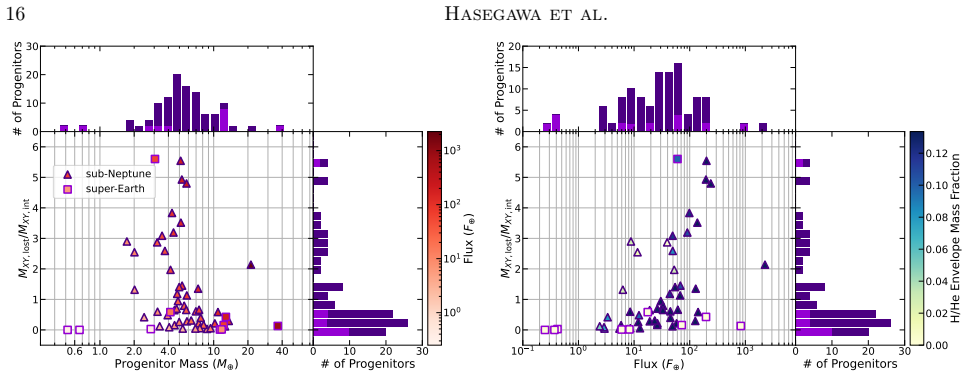
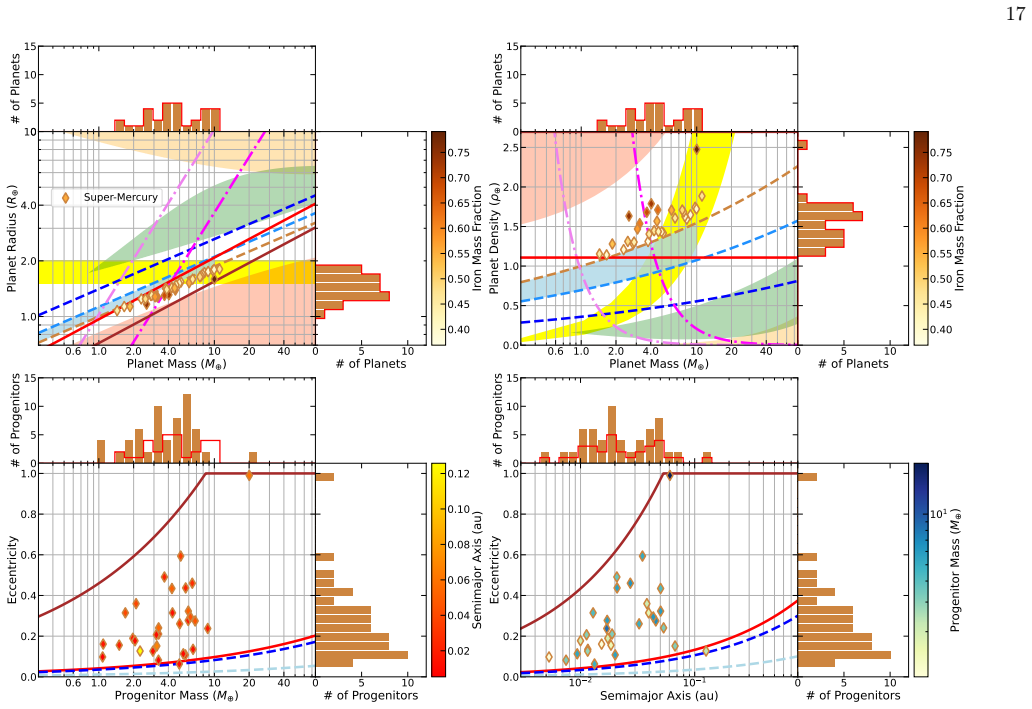
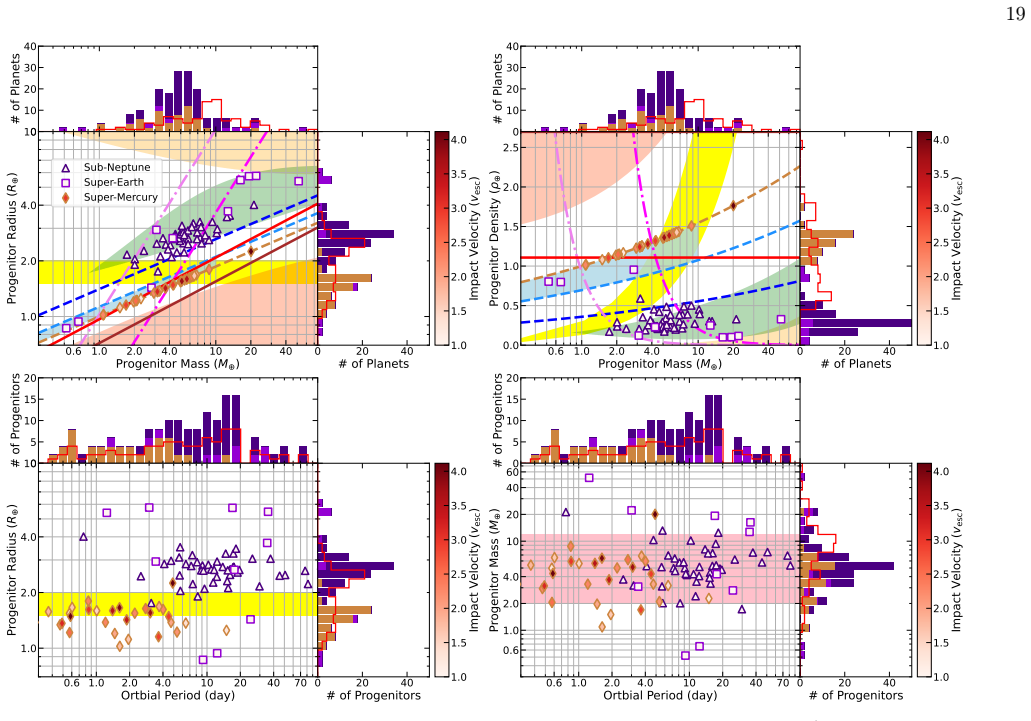
Photoevaporative and collisional mass losses diversify planet distributions in mass-radius diagrams after core accretion.
A machine-rendered reading of the paper's core claim, the machinery that carries it, and where it could break.
Core claim
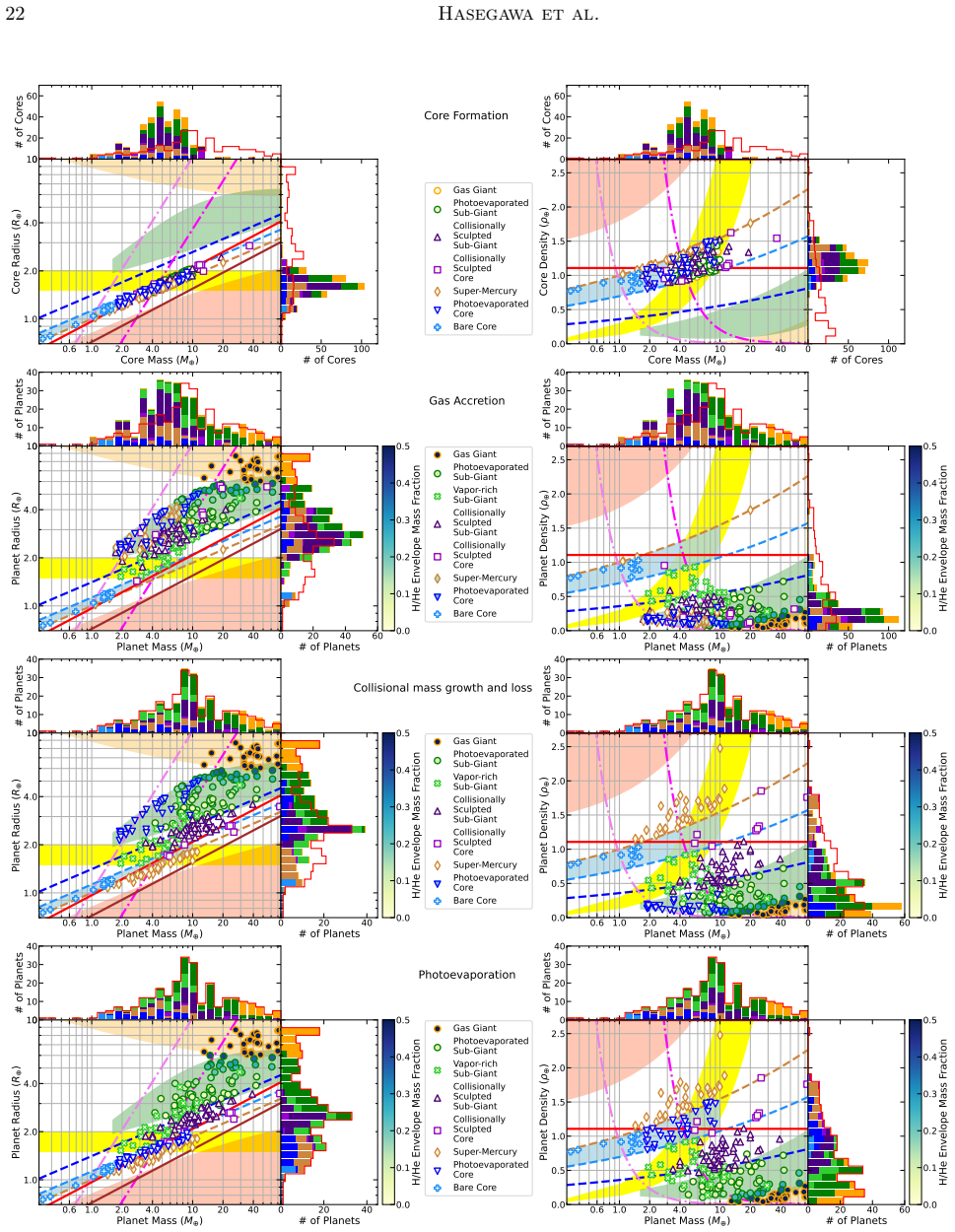
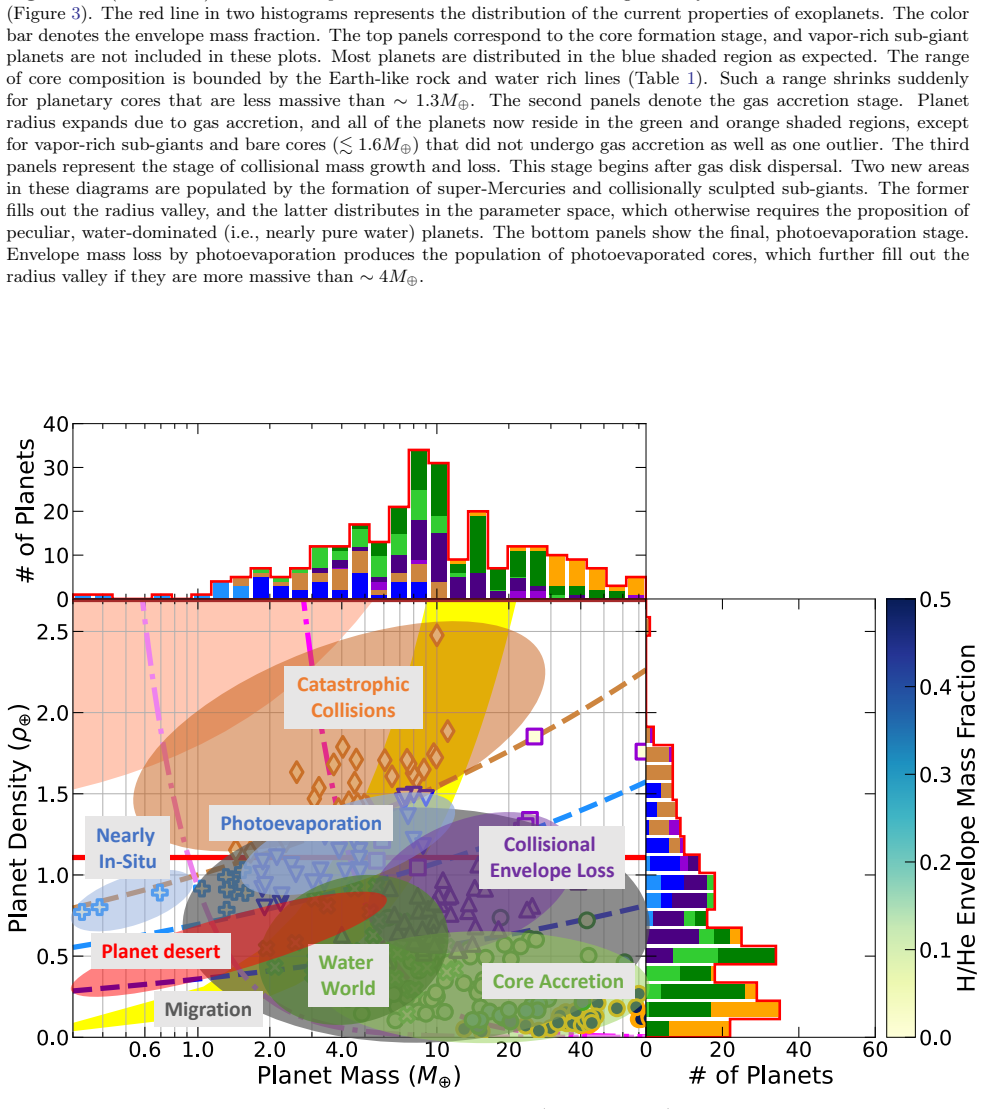
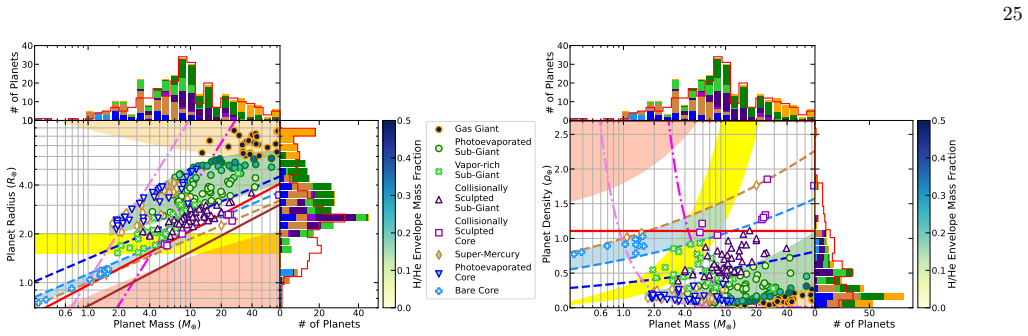
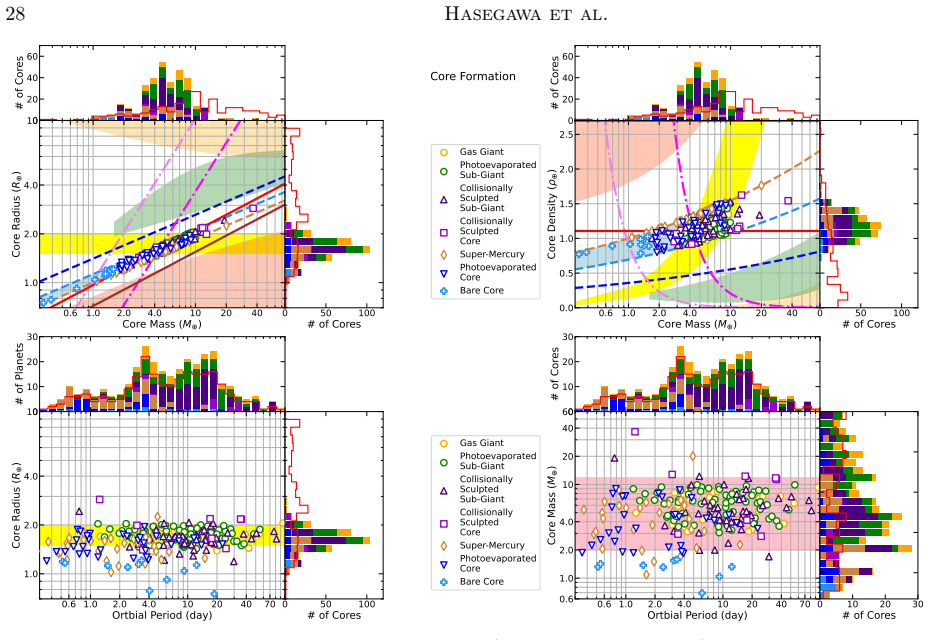
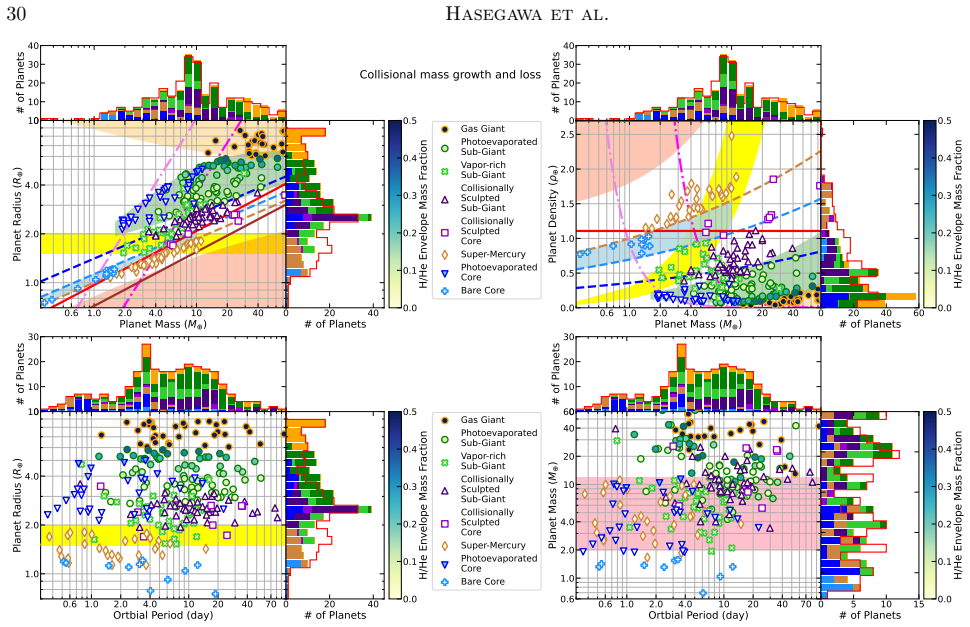
The distribution of planets in the diagrams is diversified by two evolution processes: photoevaporative and collisional mass losses, and the properties of planets before experiencing these processes are consistent with predictions of standard core accretion. In particular, collisional mass growth and loss move planets to the parameter space which is otherwise occupied by water-dominated planets, gathering non-necessity of invoking such planets. A potentially high abundance of water-rich planets are possible with the ice-to-rock ratio capped at 1/3.
What carries the argument
The integrated framework combining gas accretion/retention recipes, photoevaporative mass loss, and collisional mass loss models that divides evolution into four stages and maps resulting planet populations.
If this is right
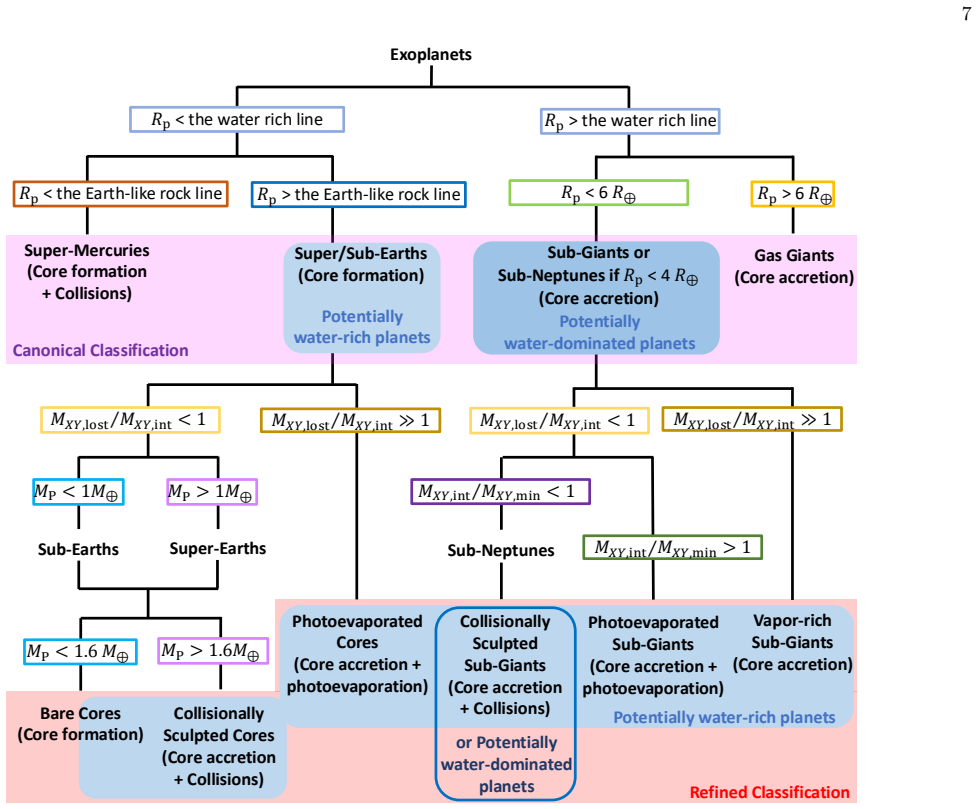
- The classification scheme recovers four canonical planet types and expands to eight classes due to the evolution processes.
- Collisional mass growth and loss allow water-rich planets with an ice-to-rock ratio of 1/3 to explain observed properties.
- Planets populate distinct regions of the diagrams depending on the timing and combination of the two mass-loss processes.
- The four-stage tracing produces time-dependent predictions for how planets fill the diagrams.
- The framework generates specific predictions when applied to habitable zone planets.
Where Pith is reading between the lines
- Observed dense small planets could often result from collisional stripping of initially larger bodies rather than direct formation as compact cores.
- Young cluster surveys could directly test the pre-loss core accretion signatures before mass loss acts.
- The model implies that occurrence rates of different planet classes depend on the efficiency of collisions in multi-planet systems.
- Precise measurements of small planets become the key observable for distinguishing the pathways.
Load-bearing premise
The integrated recipes for gas accretion/retention, photoevaporative mass loss, and collisional mass loss drawn from prior studies accurately capture the dominant processes without major missing physics, unaccounted observational selection effects, or inconsistencies between the cited models.
What would settle it
A census of planets around young stars that shows a mass-radius distribution incompatible with applying the mass-loss processes to an initial population generated by core accretion.
Figures
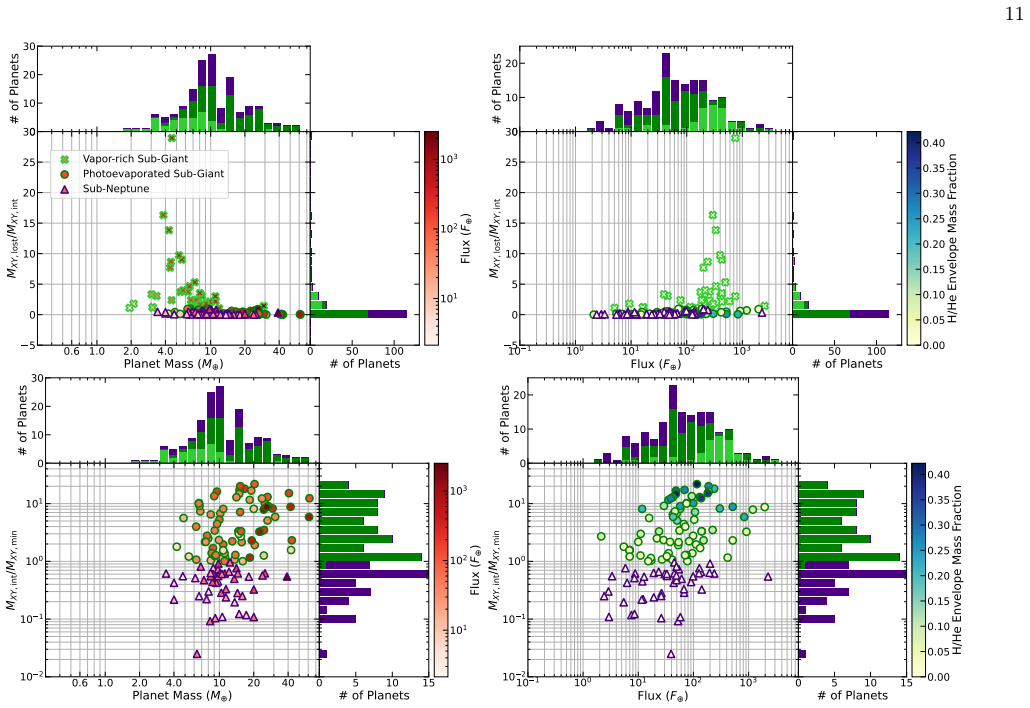
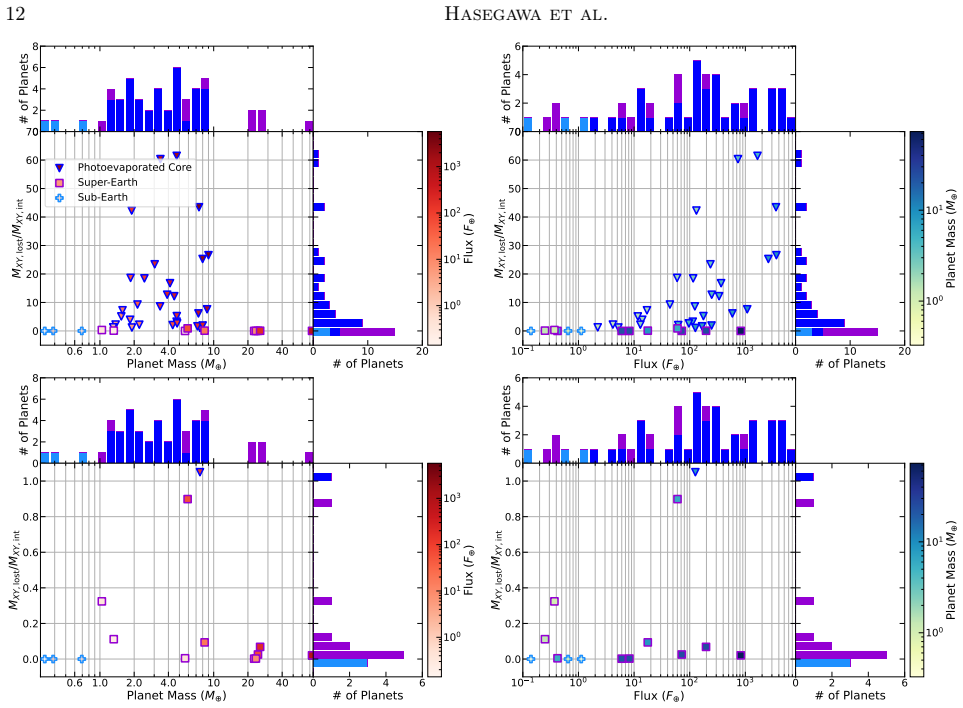
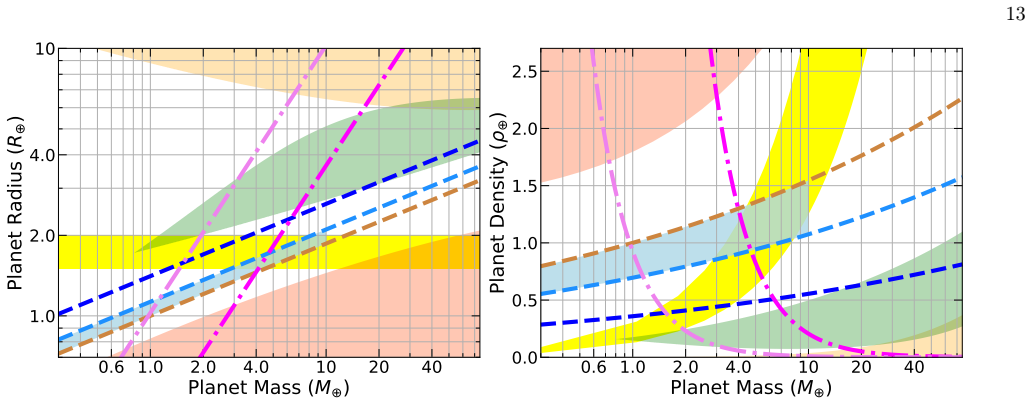
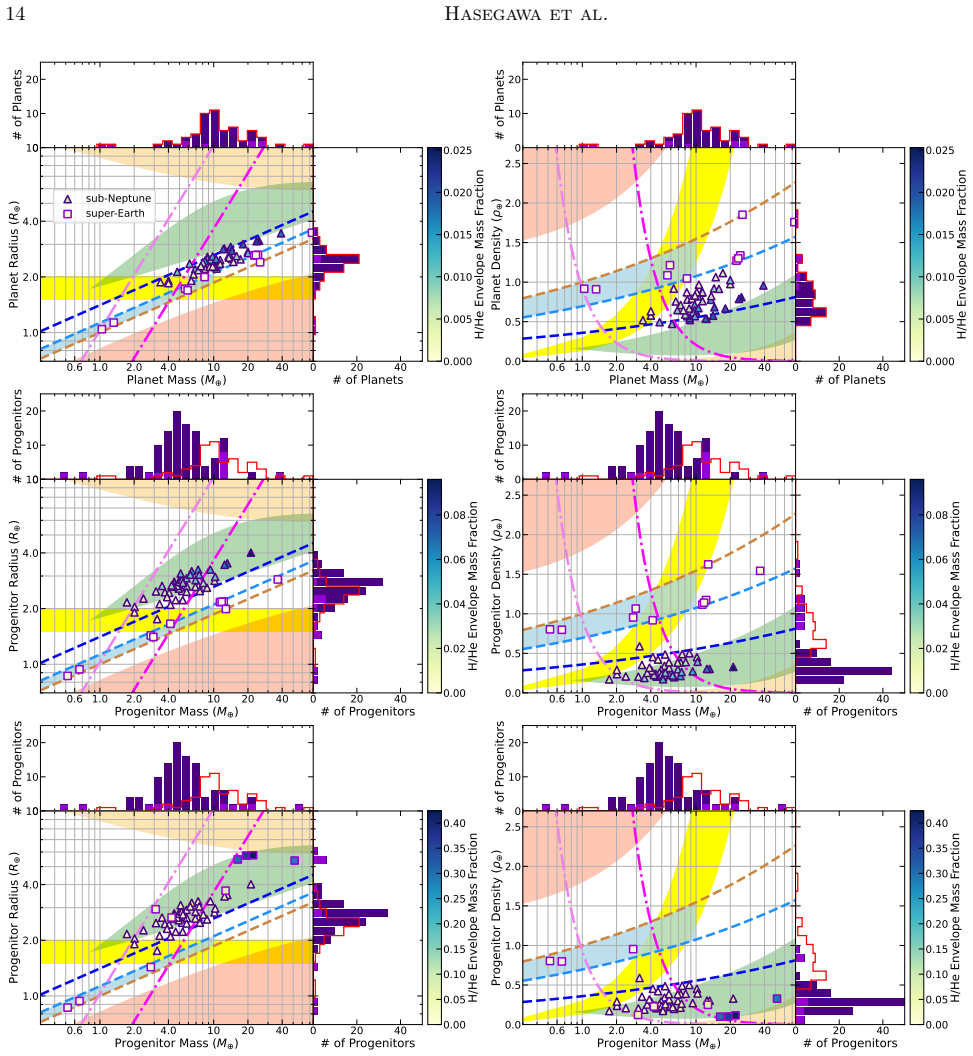

read the original abstract
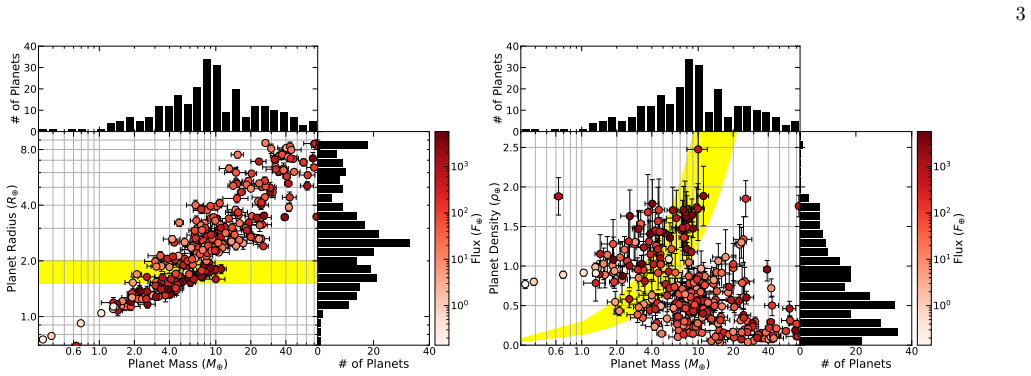
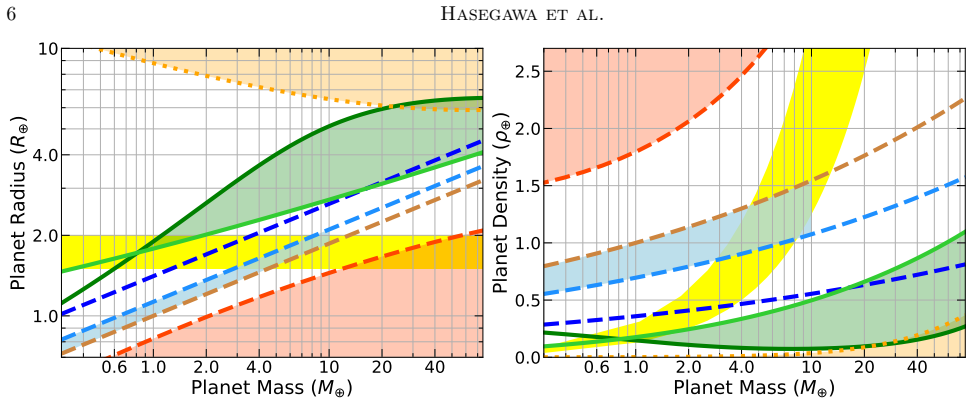
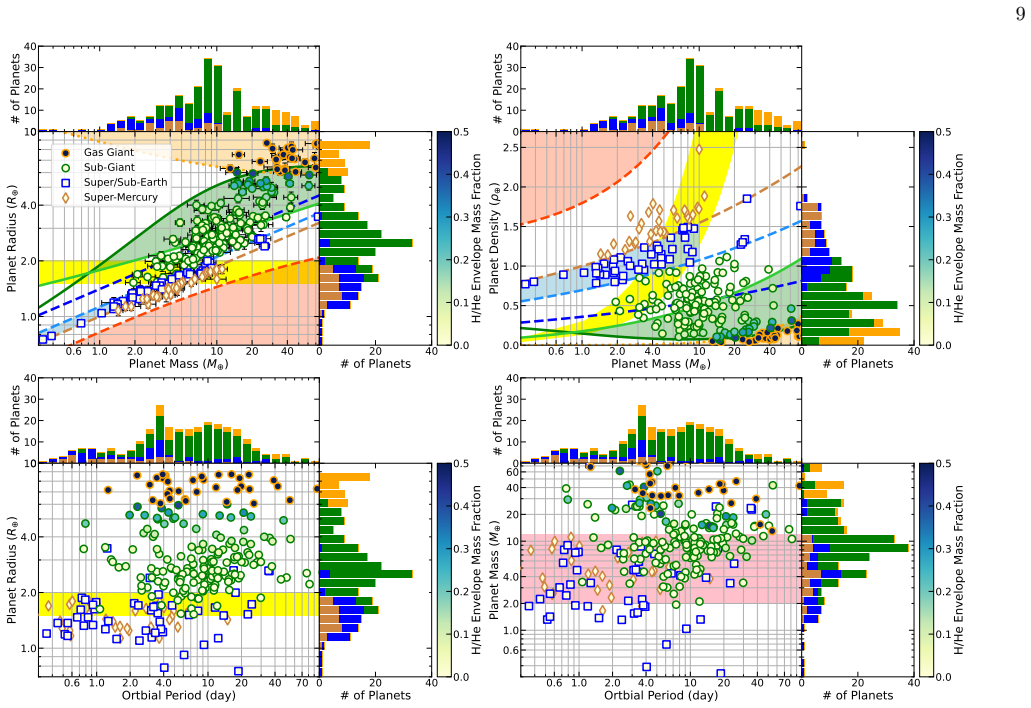
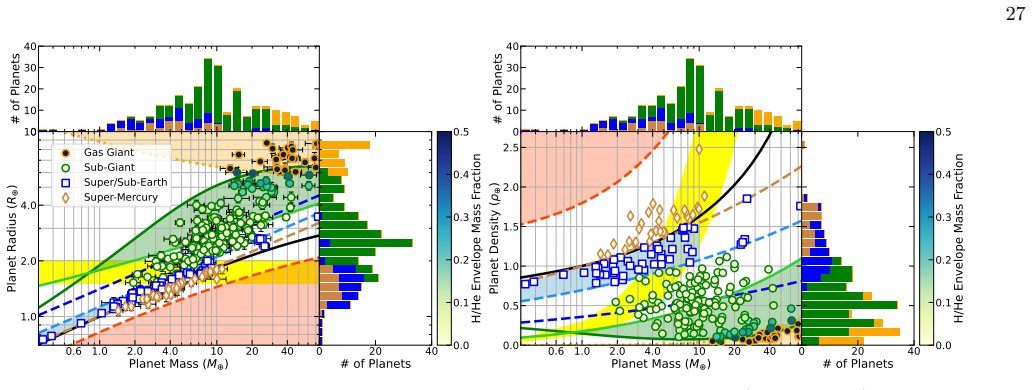
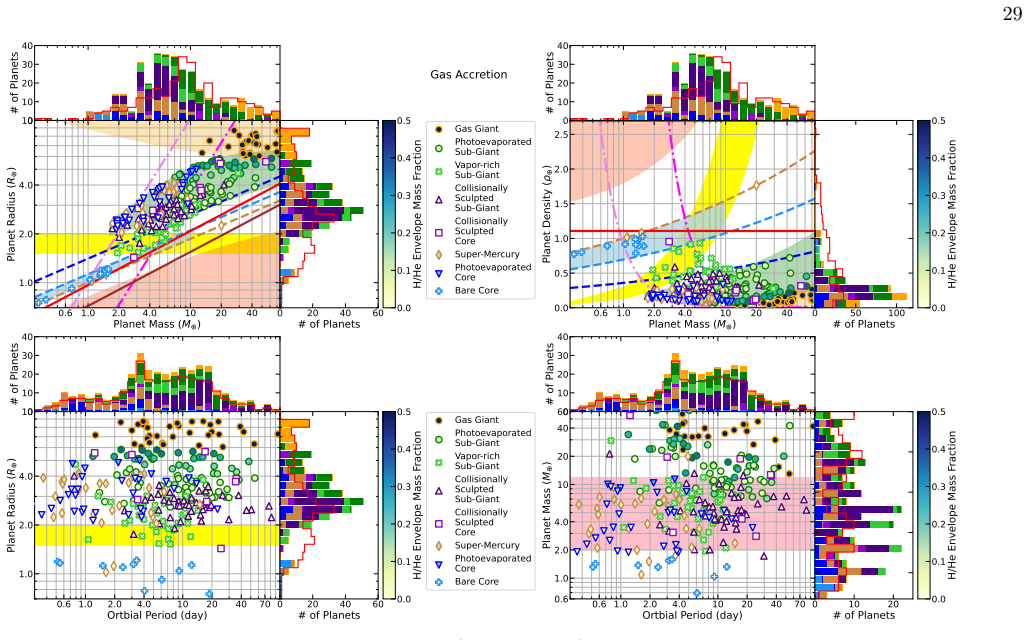
Discoveries of numerous exoplanets by various methods enable detailed characterization including bulk density. Formation and evolution pathways of planets can thus be probed in the mass-radius and mass-density diagrams. We develop a framework to identify dominant processes shaping parameter space in these diagrams by integrating previous studies. These include interior structure models, gas accretion/retention recipes, and photoevaporative and collisional mass losses. We find that the distribution of planets in the diagrams is diversified by two evolution processes: photoevaporative and collisional mass losses, and the properties of planets before experiencing these processes are consistent with predictions of standard core accretion. In particular, collisional mass growth and loss move planets to the parameter space, which is otherwise occupied by water-dominated (i.e., nearly pure water) planets, gathering non-necessity of invoking such planets. A potentially high abundance of water-rich planets are possible with the ice-to-rock ratio capped at $1/3$, similar to solar system comets. We propose a new classification scheme and apply to observed exoplanets. The classification scheme recovers four canonical planet types widely used in the literature and is expended to eight classes in total due to evolution processes. We divide formation and evolution pathways into four stages (core formation, gas accretion, collisional mass growth and loss, and photoevaporation) and trace how planets populate in the mass-radius and mass-density diagrams with time. We apply the framework to habitable zone planets and discuss possible predictions. This work emphasizes the importance of precise mass and radius measurements, especially for small-sized, potentially habitable planets.
Editorial analysis
A structured set of objections, weighed in public.
Referee Report
Summary. The manuscript develops a framework integrating prior interior structure models, gas accretion/retention recipes, and photoevaporative/collisional mass loss processes to interpret exoplanet distributions in mass-radius and mass-density diagrams. It claims that pre-evolution properties match standard core accretion predictions, that collisional growth and loss can populate regions otherwise attributed to water-dominated planets (thus reducing the need to invoke them), proposes an eight-class classification scheme extending four canonical types, traces four evolutionary stages, and applies the framework to habitable zone planets while stressing the value of precise mass-radius measurements.
Significance. If the integrated framework holds, the work provides a unified evolutionary interpretation of planet demographics that could simplify explanations of observed parameter space occupancy and generate predictions for future observations, particularly for small planets in the habitable zone. The emphasis on tracing pathways through distinct stages and the potential to cap ice-to-rock ratios at 1/3 (analogous to solar system comets) offers a falsifiable angle on composition diversity.
major comments (2)
- [Framework development and results sections (as described in abstract and skeptic note)] The central claim that collisional mass growth and loss move planets into the parameter space occupied by water-dominated planets (and thereby gather non-necessity of invoking such planets) rests on integration of recipes from separate prior studies; however, no explicit consistency checks are performed on differing assumptions about core composition, envelope structure, opacity treatments, or loss timescales across the cited models. This is load-bearing for the pathway-tracing conclusion.
- [Core accretion consistency claim (abstract and pathway tracing)] The assertion that properties of planets before experiencing photoevaporative and collisional processes are consistent with predictions of standard core accretion references prior literature but supplies no new self-consistent calculations or direct model comparisons within the manuscript to validate the mapping from initial conditions to observed distributions.
minor comments (2)
- [Abstract] The abstract states the central claims but would benefit from inclusion of at least one quantitative example (e.g., a specific mass-radius shift due to collisional loss) to allow immediate assessment of effect sizes.
- [Classification scheme section] Notation for the new eight-class scheme and the four evolutionary stages should be defined with explicit criteria or a table early in the text to improve traceability when applying the classification to observed exoplanets.
Simulated Author's Rebuttal
We thank the referee for their constructive comments on our manuscript. We address each major comment below, providing clarifications and indicating where revisions will be made to improve the robustness of our framework.
read point-by-point responses
-
Referee: The central claim that collisional mass growth and loss move planets into the parameter space occupied by water-dominated planets (and thereby gather non-necessity of invoking such planets) rests on integration of recipes from separate prior studies; however, no explicit consistency checks are performed on differing assumptions about core composition, envelope structure, opacity treatments, or loss timescales across the cited models. This is load-bearing for the pathway-tracing conclusion.
Authors: We agree that our approach integrates results from independent prior studies without performing additional consistency simulations across all models. This integration is the core of the framework, and while each component has been validated in its original context, we recognize the value of explicit checks. In the revised manuscript, we will add a new subsection discussing the assumptions regarding core composition, envelope structure, opacities, and timescales from the cited works, highlighting potential areas of inconsistency and justifying their use in the integrated model. This will strengthen the pathway-tracing conclusions. revision: yes
-
Referee: The assertion that properties of planets before experiencing photoevaporative and collisional processes are consistent with predictions of standard core accretion references prior literature but supplies no new self-consistent calculations or direct model comparisons within the manuscript to validate the mapping from initial conditions to observed distributions.
Authors: Our claim of consistency with standard core accretion is drawn from comparisons to established results in the literature rather than new calculations, as the manuscript focuses on post-formation evolutionary processes. To make this mapping more explicit, we will include direct comparisons by referencing specific predictions from core accretion models (such as those in the cited works) and add a figure showing how our pre-evolution planet properties align with those predictions in the mass-radius diagram. This revision will provide a clearer validation without altering the scope of the work. revision: yes
Circularity Check
No significant circularity; framework integrates independent prior recipes without self-referential reduction
full rationale
The paper constructs its framework by combining interior models, gas accretion recipes, photoevaporative loss, and collisional loss drawn from separate prior studies, then applies the composite to observed distributions. The claim that pre-evolution planets match standard core accretion is presented as an outcome of this tracing rather than a definitional input or fitted parameter renamed as prediction. No equations reduce to their own outputs by construction, no uniqueness theorem is imported from the same authors to force choices, and the classification scheme is an explicit post-processing step applied to data. The derivation chain remains externally anchored in the cited literature without load-bearing self-citation loops or ansatz smuggling.
Axiom & Free-Parameter Ledger
Reference graph
Works this paper leans on
-
[1]
Adams, F. C., & Laughlin, G. 2006, ApJ, 649, 992, doi: 10.1086/506142
-
[2]
Aguichine, A., Batalha, N., Fortney, J. J., et al. 2025, ApJ, 988, 186, doi: 10.3847/1538-4357/add935 28Hasega w a et al. 0 20 40 60# of Cores 0.6 1.0 2.0 4.0 10 20 40 Core Mass (M ) 1.0 2.0 4.0 10 Core Radius (R ) Gas Giant Photoevaporated Sub-Giant Collisionally Sculpted Sub-Giant Collisionally Sculpted Core Super-Mercury Photoevaporated Core Bare Core ...
-
[3]
Bodenheimer, P., & Pollack, J. B. 1986, Icarus, 67, 391, doi: 10.1016/0019-1035(86)90122-3
-
[4]
S., Zeng, L., Damasso, M., et al
Bonomo, A. S., Zeng, L., Damasso, M., et al. 2019, Nature Astronomy, 3, 416, doi: 10.1038/s41550-018-0684-9
-
[5]
Borucki, W. J., Koch, D., Basri, G., et al. 2010, Science, 327, 977, doi: 10.1126/science.1185402
-
[6]
Carter, P. J., Leinhardt, Z. M., Elliott, T., Stewart, S. T., & Walter, M. J. 2018, Earth and Planetary Science Letters, 484, 276, doi: 10.1016/j.epsl.2017.12.012
-
[7]
Cridland, A. J., van Dishoeck, E. F., Alessi, M., & Pudritz, R. E. 2019, A&A, 632, A63, doi: 10.1051/0004-6361/201936105
-
[8]
Farr, W. M. 2019, MNRAS, 482, 4146, doi: 10.1093/mnras/sty2830
-
[9]
Denman, T. R., Leinhardt, Z. M., & Carter, P. J. 2022, MNRAS, 513, 1680, doi: 10.1093/mnras/stac923
-
[10]
2020, MNRAS, 496, 1166, doi: 10.1093/mnras/staa1623
Mordasini, C. 2020, MNRAS, 496, 1166, doi: 10.1093/mnras/staa1623
-
[11]
Dou, J., Carter, P. J., & Leinhardt, Z. M. 2024, MNRAS, 529, 2577, doi: 10.1093/mnras/stae644
-
[12]
2021, A&A, 656, A69, doi: 10.1051/0004-6361/202038553
Emsenhuber, A., Mordasini, C., Burn, R., et al. 2021, A&A, 656, A69, doi: 10.1051/0004-6361/202038553
-
[13]
Fulton, B. J., Petigura, E. A., Howard, A. W., et al. 2017, AJ, 154, 109, doi: 10.3847/1538-3881/aa80eb
-
[14]
2024, MNRAS, 527, 79, doi: 10.1093/mnras/stad2962
Ghosh, T., & Chatterjee, S. 2024, MNRAS, 527, 79, doi: 10.1093/mnras/stad2962
-
[15]
Ginzburg, S., Schlichting, H. E., & Sari, R. 2016, ApJ, 825, 29, doi: 10.3847/0004-637X/825/1/29
-
[16]
Ginzburg, S., Schlichting, H. E., & Sari, R. 2018, MNRAS, 476, 759, doi: 10.1093/mnras/sty290
-
[17]
Gupta, A., & Schlichting, H. E. 2019, MNRAS, 487, 24, doi: 10.1093/mnras/stz1230
-
[18]
Hasegawa, Y. 2022, ApJ, 935, 101, doi: 10.3847/1538-4357/ac7b79 29 0 10 20 30 40# of Planets 0.6 1.0 2.0 4.0 10 20 40 Planet Mass (M ) 1.0 2.0 4.0 10 Planet Radius (R ) Gas Giant Photoevaporated Sub-Giant Vapor-rich Sub-Giant Collisionally Sculpted Sub-Giant Collisionally Sculpted Core Super-Mercury Photoevaporated Core Bare Core 0 20 40 60 # of Planets 0...
-
[19]
Hasegawa, Y., & Pudritz, R. E. 2012, ApJ, 760, 117, doi: 10.1088/0004-637X/760/2/117
-
[20]
Hasegawa, Y., & Pudritz, R. E. 2013, ApJ, 778, 78, doi: 10.1088/0004-637X/778/1/78
-
[21]
Hori, Y., & Ikoma, M. 2011, MNRAS, 416, 1419, doi: 10.1111/j.1365-2966.2011.19140.x
-
[22]
Ida, S., & Lin, D. N. C. 2004, ApJ, 604, 388, doi: 10.1086/381724
-
[23]
2012, ApJ, 753, 66, doi: 10.1088/0004-637X/753/1/66
Ikoma, M., & Hori, Y. 2012, ApJ, 753, 66, doi: 10.1088/0004-637X/753/1/66
-
[24]
2000, ApJ, 537, 1013, doi: 10.1086/309050
Ikoma, M., Nakazawa, K., & Emori, H. 2000, ApJ, 537, 1013, doi: 10.1086/309050
-
[25]
Innanen, K. A., Zheng, J. Q., Mikkola, S., & Valtonen, M. J. 1997, AJ, 113, 1915, doi: 10.1086/118405
-
[26]
2021, Science Advances, 7, eabc0444, doi: 10.1126/sciadv.abc0444
Johansen, A., Ronnet, T., Bizzarro, M., et al. 2021, Science Advances, 7, eabc0444, doi: 10.1126/sciadv.abc0444
-
[27]
Kegerreis, J. A., Eke, V. R., Massey, R. J., & Teodoro, L. F. A. 2020, ApJ, 897, 161, doi: 10.3847/1538-4357/ab9810
-
[28]
M.-R., Lessard, M., Malik, M., et al
Kempton, E. M.-R., Lessard, M., Malik, M., et al. 2023, ApJ, 953, 57, doi: 10.3847/1538-4357/ace10d
-
[29]
Knudson, M. D., Desjarlais, M. P., Lemke, R. W., et al. 2012, PhRvL, 108, 091102, doi: 10.1103/PhysRevLett.108.091102
-
[30]
2025, ApJL, 991, L49, doi: 10.3847/2041-8213/ae06fc
Kokubo, E., Hoshino, H., Matsumoto, Y., & Sari, R. 2025, ApJL, 991, L49, doi: 10.3847/2041-8213/ae06fc
-
[31]
2023, ApJ, 954, 196, doi: 10.3847/1538-4357/ace9ba
Kurosaki, K., & Inutsuka, S.-i. 2023, ApJ, 954, 196, doi: 10.3847/1538-4357/ace9ba
-
[32]
Lam, K. W. F., Csizmadia, S., Astudillo-Defru, N., et al. 2021, Science, 374, 1271, doi: 10.1126/science.aay3253
-
[33]
Lee, E. J., & Chiang, E. 2015, ApJ, 811, 41, doi: 10.1088/0004-637X/811/1/41
-
[34]
2019, Nature, 572, 355, doi: 10.1038/s41586-019-1470-2
Liu, S.-F., Hori, Y., Müller, S., et al. 2019, Nature, 572, 355, doi: 10.1038/s41586-019-1470-2
-
[35]
Lopez, E. D., & Fortney, J. J. 2013, ApJ, 776, 2, doi: 10.1088/0004-637X/776/1/2
-
[36]
Lopez, E. D., & Fortney, J. J. 2014, ApJ, 792, 1, doi: 10.1088/0004-637X/792/1/1
-
[37]
Lopez, E. D., Fortney, J. J., & Miller, N. 2012, ApJ, 761, 59, doi: 10.1088/0004-637X/761/1/59
-
[38]
2022, Science, 377, 1211, doi: 10.1126/science.abl7164
Luque, R., & Pallé, E. 2022, Science, 377, 1211, doi: 10.1126/science.abl7164
-
[39]
Madhusudhan, N., Amin, M. A., & Kennedy, G. M. 2014, ApJL, 794, L12, doi: 10.1088/2041-8205/794/1/L12 30Hasega w a et al. 0 10 20 30 40# of Planets 0.6 1.0 2.0 4.0 10 20 40 Planet Mass (M ) 1.0 2.0 4.0 10 Planet Radius (R ) Gas Giant Photoevaporated Sub-Giant Vapor-rich Sub-Giant Collisionally Sculpted Sub-Giant Collisionally Sculpted Core Super-Mercury P...
-
[40]
A., Sasselov, D., Hernquist, L., & Stewart, S
Marcus, R. A., Sasselov, D., Hernquist, L., & Stewart, S. T. 2010, ApJL, 712, L73, doi: 10.1088/2041-8205/712/1/L73
-
[41]
, year = 1995, month = nov, volume =
Mayor, M., & Queloz, D. 1995, Nature, 378, 355, doi: 10.1038/378355a0
-
[42]
2024, A&A, 688, A103, doi: 10.1051/0004-6361/202450177
Miyayama, R., & Kobayashi, H. 2024, A&A, 688, A103, doi: 10.1051/0004-6361/202450177
-
[43]
1980, Progress of Theoretical Physics, 64, 544, doi: 10.1143/PTP.64.544
Mizuno, H. 1980, Progress of Theoretical Physics, 64, 544, doi: 10.1143/PTP.64.544
-
[44]
2009, A&A, 501, 1139, doi: 10.1051/0004-6361/200810301
Mordasini, C., Alibert, Y., & Benz, W. 2009, A&A, 501, 1139, doi: 10.1051/0004-6361/200810301
-
[45]
Mumma, M. J., & Charnley, S. B. 2011, ARA&A, 49, 471, doi: 10.1146/annurev-astro-081309-130811 Öberg, K. I., Murray-Clay, R., & Bergin, E. A. 2011, ApJL, 743, L16, doi: 10.1088/2041-8205/743/1/L16
-
[46]
Ormel, C. W., & Kobayashi, H. 2012, ApJ, 747, 115, doi: 10.1088/0004-637X/747/2/115
-
[47]
Owen, J. E., & Jackson, A. P. 2012, MNRAS, 425, 2931, doi: 10.1111/j.1365-2966.2012.21481.x
-
[48]
Owen, J. E., & Wu, Y. 2016, ApJ, 817, 107, doi: 10.3847/0004-637X/817/2/107
-
[49]
2024, A&A, 688, A59, doi: 10.1051/0004-6361/202449911
Parc, L., Bouchy, F., Venturini, J., Dorn, C., & Helled, R. 2024, A&A, 688, A59, doi: 10.1051/0004-6361/202449911
-
[50]
, year = 1996, month = nov, volume =
Pollack, J. B., Hubickyj, O., Bodenheimer, P., et al. 1996, Icarus, 124, 62, doi: 10.1006/icar.1996.0190
-
[51]
2021, MNRAS, 508, 597, doi: 10.1093/mnras/stab2504
Pu, B., & Lai, D. 2021, MNRAS, 508, 597, doi: 10.1093/mnras/stab2504
-
[52]
Rafikov, R. R. 2006, ApJ, 648, 666, doi: 10.1086/505695
-
[53]
Rogers, J. G., Owen, J. E., & Schlichting, H. E. 2024, MNRAS, 529, 2716, doi: 10.1093/mnras/stae563
-
[54]
Santerne, A., Brugger, B., Armstrong, D. J., et al. 2018, Nature Astronomy, 2, 393, doi: 10.1038/s41550-018-0420-5
-
[55]
Seager, S., Kuchner, M., Hier-Majumder, C. A., & Militzer, B. 2007, ApJ, 669, 1279, doi: 10.1086/521346
-
[56]
Skinner, B. N., Pudritz, R. E., & Cloutier, R. 2026, arXiv e-prints, arXiv:2604.15304, doi: 10.48550/arXiv.2604.15304
work page internal anchor Pith review Pith/arXiv arXiv doi:10.48550/arxiv.2604.15304 2026
-
[57]
Stevenson, D. J. 1982, Planet. Space Sci., 30, 755, doi: 10.1016/0032-0633(82)90108-8
-
[58]
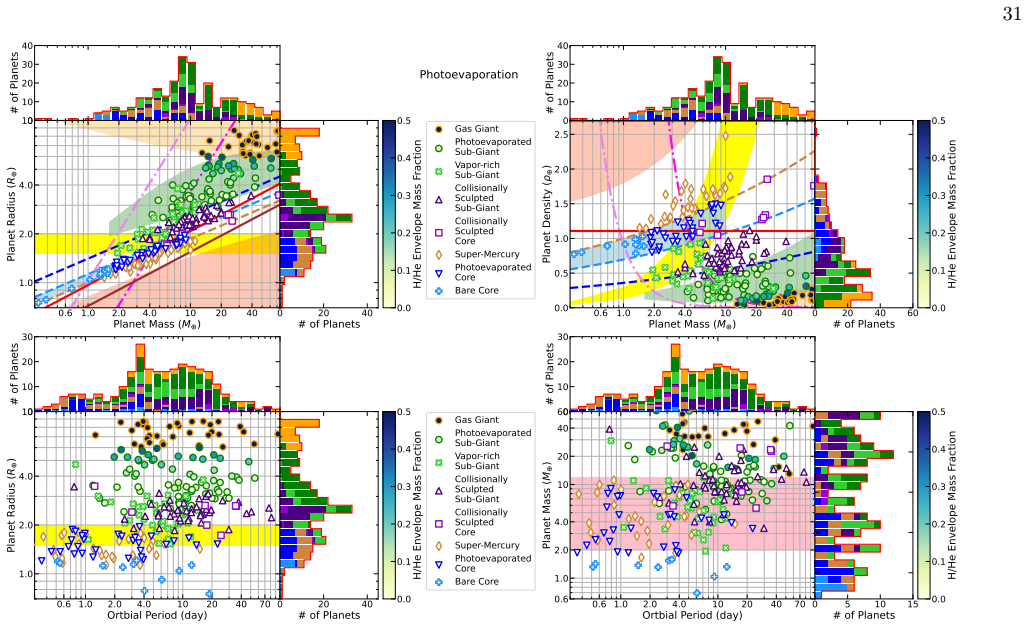
Zellem, R. T. 2019, ApJ, 881, 117, doi: 10.3847/1538-4357/ab2714 Toledo-Padrón, B., Lovis, C., Suárez Mascareño, A., et al. 2020, A&A, 641, A92, doi: 10.1051/0004-6361/202038187 31 0 10 20 30 40# of Planets 0.6 1.0 2.0 4.0 10 20 40 Planet Mass (M ) 1.0 2.0 4.0 10 Planet Radius (R ) Gas Giant Photoevaporated Sub-Giant Vapor-rich Sub-Giant Collisionally Scu...
-
[59]
Udry, S., & Santos, N. C. 2007, ARA&A, 45, 397, doi: 10.1146/annurev.astro.45.051806.110529
work page internal anchor Pith review Pith/arXiv arXiv doi:10.1146/annurev.astro.45.051806.110529 2007
-
[60]
2015, ApJL, 806, L26, doi: 10.1088/2041-8205/806/2/L26
Volk, K., & Gladman, B. 2015, ApJL, 806, L26, doi: 10.1088/2041-8205/806/2/L26
-
[61]
Winn, J. N., & Fabrycky, D. C. 2015, ARA&A, 53, 409, doi: 10.1146/annurev-astro-082214-122246
-
[62]
Zeng, L., Sasselov, D. D., & Jacobsen, S. B. 2016, ApJ, 819, 127, doi: 10.3847/0004-637X/819/2/127
-
[63]
Zeng, L., Jacobsen, S. B., Sasselov, D. D., et al. 2019, Proceedings of the National Academy of Science, 116, 9723, doi: 10.1073/pnas.1812905116
-
[64]
2021, ARA&A, 59, 291, doi: 10.1146/annurev-astro-112420-020055
Zhu, W., & Dong, S. 2021, ARA&A, 59, 291, doi: 10.1146/annurev-astro-112420-020055
discussion (0)
Sign in with ORCID, Apple, or X to comment. Anyone can read and Pith papers without signing in.