REVIEW 4 major objections 3 minor 1 cited by
Practical Insights on Grasp Strategies for Mobile Manipulation in the Wild
T0 review · 4 major / 3 minor · reviewed 2026-08-16 · deepseek-v4-flash
Pith's one-line read This paper reports that a fully autonomous mobile manipulator, SHOPPER, succeeded in 61 percent of 335 distinct grocery picks in an unmodified store, and attributes every failure to one of eight root causes.
desk verdict The failure analysis is the real contribution, but the taxonomy's percentages rest on unvalidated post-hoc labeling, so treat them as directional, not measured. read the letter →
The pith
A machine-rendered reading of the paper's core claim, the machinery that carries it, and where it could break.
The reading
What carries the argument
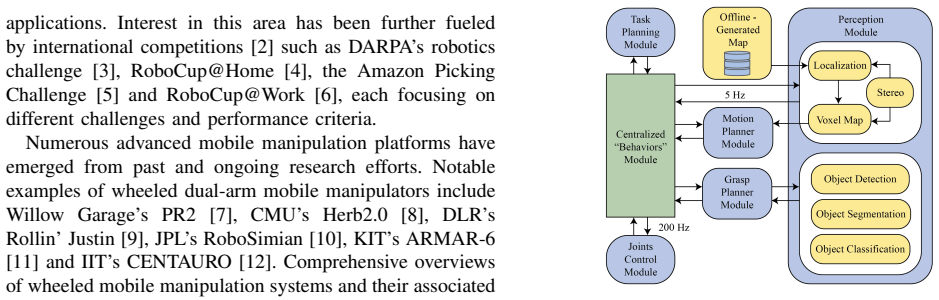
The argument is carried by the SHOPPER platform and its grasp-strategy suite operating as one integrated system, plus the eight-cause failure taxonomy that organizes the field-test data. The hardware pairs a two-finger gripper with a custom suction tool; the software pipeline detects and segments items, classifies them into strategy categories, plans grasps with either 2D antipodal hull sampling, 3D ellipsoidal shape-completed sampling, handle keypoint insertion, or side grasps for bags, and executes through compliant admittance control. Three mechanisms do the heaviest lifting: dithering, small compliant probing motions that recovered 14 of 17 initially failed suction grasps; a non-diagonal stiffness coupling in the admittance controller that deflects the tool upward when extraction is blocked by a shelf lip; and runtime tool-pose correction by point-cloud registration that brings commanded gripper poses to sub-centimeter accuracy. The taxonomy R1-R8 is what turns the raw pick attempts into a conclusion: each failed pick is assigned to one root cause, and the resulting distribution is the paper's evidence for where the remaining research effort should go.
What would settle it
Re-annotate the recorded failed picks with an independent panel using a written protocol and check whether the R1-R8 distribution is reproduced; if coders disagree or the top cause changes, the reported percentages are not stable ground truth.
Extended reading notes
Core claim
On its own terms, the paper's central discovery is a quantified failure taxonomy from a fully integrated robot operating in a real grocery store. SHOPPER attempted 335 distinct picks across three nights and successfully placed the target item in its basket in 61 percent of attempts. The authors attribute all observed failures to eight root causes: R1 heavy, bulky, or incompatible items (36.0 percent); R2 edge cases in motion and grasp planning (15.2 percent); R3 the target item being unexpectedly displaced during execution (14.4 percent); R4 difficult extraction from fixtures (8.8 percent); R5 interference from neighboring items (8.8 percent); R6 the item falling off the tool en route to the basket (7.2 percent); R7 perception errors such as missed collision voxels (5.6 percent); and R8 kinematic imprecision (4.0 percent). The tool-specific breakdown shows that suction failures are dominated by item incompatibility, while gripper failures are dominated by unexpected item displacement. The paper's interpretive claim is that most of these failures trace to open-loop execution without real-time item state tracking, and that the capabilities most needed for general-purpose mobile manipulation are reliable object state tracking and dual-arm coordination.
Load-bearing premise
The failure taxonomy is load-bearing, and it rests on the authors' manual labeling of each failed pick into one of eight causes, with no reported labeling protocol or cross-check, so the percentages could shift under different coders.
Editorial extensions
If this is right
- On this item set, heavy, bulky, or otherwise incompatible items are the single largest failure cause (36 percent overall; 45.6 percent of suction failures), so general grocery picking will require bimanual or alternative nonprehensile strategies.
- Open-loop grasp execution is a common thread: failures from displaced items, neighbor interference, and drops during transport (R3, R5, and R6) together account for about 30 percent of misses and would need closed-loop state tracking to address.
- A compliant dithering search recovers most initial suction misses (14 of 17), so small compliant probing around the planned pose is an effective and cheap robustness mechanism.
- Extraction remains hard in narrow shelf openings even with admittance control; adding rotational compliance during extraction is the paper's stated next step.
- The full-stack, in-store test format surfaces bottlenecks such as planning edge cases, kinematic imprecision, and partial observability that tabletop grasping benchmarks abstract away.
Reading between the lines
- Extending the paper's data, the non-planning failure classes look addressable by hardware and control changes; if they are additive, eliminating the largest tool-relevant classes could plausibly lift success from 61 percent to the mid-80s on this item set, a projection the paper does not make.
- The R1-R8 scheme could be reused as a reporting standard for other mobile-manipulation deployments; if multiple teams published the same breakdown, bottleneck comparisons across platforms would become possible, which the paper leaves implicit.
- The paper's own diagnosis suggests a concrete experiment it does not run: adding wrist cameras or tactile sensing to track the item through grasp and transport, then measuring whether R3, R5, and R6 failures drop, would directly test the open-loop-execution claim.
Signed reviews
Editorial analysis
A structured set of objections, weighed in public.
Referee Report
Summary. This paper presents SHOPPER, a wheeled dual-arm mobile manipulation platform with suction and gripper tools, and reports on its deployment in an unmodified grocery store. The authors describe a modular pipeline (perception, grasp-strategy classification, grasp pose planning, execution with admittance control) and a set of grasp strategies for shelves, produce piles, handled items, bags, and obstacles. The central empirical result is a field test with 335 distinct pick attempts and a 61% success rate (item placed in basket). The paper's main analytical contribution is a taxonomy of eight root causes (R1-R8) for all observed failures, with the distribution reported in Table I. The authors then draw practical conclusions about bottlenecks such as heavy/bulky items, open-loop execution, lack of real-time item state tracking, difficult extractions, and perception/kinematic noise.
Significance. If the failure taxonomy and success-rate claims are taken at face value, this is a useful systems-level data point for the mobile manipulation community: it quantifies performance in a genuinely unstructured environment, describes concrete engineering mitigations (dithering, admittance control with a non-diagonal stiffness term, tool-pose correction, ICP alignment), and identifies open problems. The paper's strengths include its full-stack online operation in an unmodified store, the relatively large number of pick attempts, the explicit disclosure of excluded glass items, and the public website with per-trial rankings. The main weakness is that the central analytical contribution, the R1-R8 distribution in Table I, rests on a post-hoc manual labeling process that is not described, validated, or made auditable; because the percentages drive the paper's qualitative insights, this is a load-bearing issue rather than a presentation concern.
major comments (4)
- [Section VI.A / Table I] The paper reports R1-R8 as "eight fundamental root causes behind all pick failures" and uses Table I to rank their frequencies, but no labeling protocol is provided. There are no explicit definitions of the decision boundary between categories (for example, when a failure is R3 versus R5 versus R6), no statement of whether labels were assigned prospectively or retrospectively by one or multiple coders, no per-pick evidence, and no inter-annotator agreement measure. Since the percentages (R1 at 36.0%, R2 at 15.2%, R3 at 14.4%) drive the conclusions in Section VI.B, please provide a coding protocol with mutually exclusive decision rules, raw counts per category and per tool, and, if possible, per-pick annotations or a reliability check. Without this, the distribution in Table I should be described as an exploratory classification rather than a validated measurement.
- [Section VI.B / Table I] Several of the eight categories are causally overlapping as discussed in the text. R3 (unexpectedly displaced target item), R5 (interference from neighboring item), and R6 (fell on the way to basket) are all attributed in Section VI.B to the same underlying deficiency, namely the lack of real-time item state tracking. Similarly, R4 (difficult extract) and R2 (edge cases in planning algorithms) can be hard to separate when shelf geometry restricts the admissible extraction trajectory. As defined, a single observed failure could plausibly be assigned to more than one bucket, so the reported percentages do not necessarily form a partition. Please either define mutually exclusive coding criteria that resolve these overlaps or reframe the table as symptom categories rather than fundamental root causes.
- [Section V.B / Section VI.A] The success-rate accounting is ambiguous with respect to recovery actions. Section V.B states that during the latest field test, 14 of 17 instances in which the suction grasp initially failed were successfully recovered through dithering. It is not specified whether these recovered attempts are counted as successes or as failures in the 61% value, nor whether the 17 instances are included in the 335 distinct pick attempts. Please define precisely what counts as a pick attempt, what counts as a success, and how transient failures that are later recovered are recorded in the denominator and in Table I.
- [Section VI.A / Table I] Table I presents percentages without raw counts or uncertainty. With 335 picks and a 39% failure rate, the rarest categories correspond to roughly five to ten observed failures (e.g., R8 at 4.0% overall, or R8 at 2.5% for suction), and small changes in coding can move these percentages substantially. Tool-specific comparisons are correspondingly fragile. Please report the raw number of failures per category and per tool, and provide at least the denominators or binomial confidence intervals so that the reader can assess the precision of the ranking.
minor comments (3)
- [Abstract / Section IV.A] The abstract says the goal is "picking any item in a real grocery store," but Section IV.A discloses that 236 of 959 automatically detected items are excluded from the graspable set because they are made of glass. Please qualify the "any item" phrasing to match the actual item scope.
- [Section V.C] The non-diagonal admittance control term is described only verbally. An equation or a small schematic showing how a deviation along the extraction axis produces motion in the vertical axis would make the mechanism much easier for readers to reproduce.
- [Table I] The tool-specific columns do not all sum exactly to 100% (the gripper column sums to approximately 99.9%), presumably due to rounding. Please add a footnote stating that percentages are rounded and indicate the total number of failures per tool.
Circularity Check
No circularity: the paper reports measured system performance and a failure taxonomy; no prediction is defined in terms of its inputs.
full rationale
The paper's contributions are an implemented grasping pipeline and an empirical field-test analysis. The central quantitative claim — 335 distinct picks with a 61% success rate — is a direct measurement, not the output of a fitted model or a derivation. The eight root causes in Table I are a post-hoc classification of observed failures, not quantities defined by equations that are then 'predicted' back. The design choices (2D antipodal grasping, suction grasping, dithering, admittance control) are engineering strategies supported by external or independently described methods; the citations to prior work by the same authors ([1], [26], [27]) support subsystem details such as mapping, point-cloud registration, and bimanual picking, rather than the paper's empirical claims. The failure percentages rest on manual labeling without a reported inter-annotator protocol, which is a measurement-reliability limitation and not a circularity: the taxonomy is not used to define success, nor is the distribution an input to any calculation that then reproduces itself. No equation in the paper equates a fitted parameter to a reported result, and no load-bearing claim is justified solely by a self-citation. Therefore there is no self-definitional, fitted-input, or self-citation-load-bearing step, and the appropriate score is 0.
Assumptions & free parameters
assumptions (3)
- domain assumption Navigation and localization bring the robot to within ±40 cm of each requested item before grasping begins.
- domain assumption The segmented point cloud from a single view is sufficient for grasp planning, with ellipsoid shape completion used only for produce.
- ad hoc to paper The manually labeled failure modes R1-R8 form a reliable partition of all observed pick failures.
Cite this review
Pith. "Pith review of Practical Insights on Grasp Strategies for Mobile Manipulation in the Wild." pith.science (2026). https://pith.science/paper/WT245GXY
@misc{pith2026250412512,
  author       = {Pith},
  title        = {Pith review of: Practical Insights on Grasp Strategies for Mobile Manipulation in the Wild},
  year         = {2026},
  howpublished = {\url{https://pith.science/paper/WT245GXY}},
  note         = {Machine review of arXiv:2504.12512}
}
read the original abstract
Mobile manipulation robots are continuously advancing, with their grasping capabilities rapidly progressing. However, there are still significant gaps preventing state-of-the-art mobile manipulators from widespread real-world deployments, including their ability to reliably grasp items in unstructured environments. To help bridge this gap, we developed SHOPPER, a mobile manipulation robot platform designed to push the boundaries of reliable and generalizable grasp strategies. We develop these grasp strategies and deploy them in a real-world grocery store -- an exceptionally challenging setting chosen for its vast diversity of manipulable items, fixtures, and layouts. In this work, we present our detailed approach to designing general grasp strategies towards picking any item in a real grocery store. Additionally, we provide an in-depth analysis of our latest real-world field test, discussing key findings related to fundamental failure modes over hundreds of distinct pick attempts. Through our detailed analysis, we aim to offer valuable practical insights and identify key grasping challenges, which can guide the robotics community towards pressing open problems in the field.
Figures


Figures from the paper (3 more)


Forward citations
Cited by 1 Pith paper
-
From Pixels to Shelf: An Integrated Robotic System for Autonomous Supermarket Stocking with a Mobile Manipulator
An integrated mobile manipulator system achieved 98.3% pick-and-place success in 724 mock supermarket stocking events, at 68.2 seconds per item, still slower than human workers.
Reference graph
Works this paper leans on
-
[1]
Demonstrating Mobile Ma- nipulation in the Wild: A Metrics-Driven Approach
Max Bajracharya et al. “Demonstrating Mobile Ma- nipulation in the Wild: A Metrics-Driven Approach”. In: Robotics Science and Systems . RSS2023. 2023
work page 2023
-
[2]
Research Challenges and Progress in Robotic Grasping and Manipulation Competitions
Yu Sun et al. “Research Challenges and Progress in Robotic Grasping and Manipulation Competitions”. In: IEEE Robotics and Automation Letters (2022)
work page 2022
-
[3]
The Hard Lessons of DARPA’s Robotics Challenge
Erico Guizzo and Evan Ackerman. “The Hard Lessons of DARPA’s Robotics Challenge”. In: IEEE Spectrum (2015)
work page 2015
-
[4]
RoboCup@ Home: Sci- entific Competition and Benchmarking for Domestic Service Robots
Thomas Wisspeintner et al. “RoboCup@ Home: Sci- entific Competition and Benchmarking for Domestic Service Robots”. In: Interaction Studies 10.3 (2009)
work page 2009
-
[5]
Lessons from the Amazon picking challenge: Four aspects of building robotic systems
Clemens Eppner et al. “Lessons from the Amazon picking challenge: Four aspects of building robotic systems.” In: Robotics: science and systems . 2016
work page 2016
-
[6]
RoboCup@Work: Competing for the Factory of the Future
Gerhard K. Kraetzschmar et al. “RoboCup@Work: Competing for the Factory of the Future”. In: RoboCup 2014: Robot World Cup XVIII . 2015
work page 2014
-
[7]
Autonomous Door Opening and Plugging in with a Personal Robot
Wim Meeussen et al. “Autonomous Door Opening and Plugging in with a Personal Robot”. In: IEEE Intl. Conf. on Robotics and Automation . 2010
work page 2010
-
[8]
Herb 2.0: Lessons Learned From Developing a Mobile Manipulator for the Home
Siddhartha S. Srinivasa et al. “Herb 2.0: Lessons Learned From Developing a Mobile Manipulator for the Home”. In: Proceedings of the IEEE (2012)
work page 2012
Show all 27 references
-
[9]
Rollin’Justin-Mobile Platform with Variable Base
Christoph Borst et al. “Rollin’Justin-Mobile Platform with Variable Base”. In: IEEE Intl. Conf. on Robotics and Automation. 2009
2009
-
[10]
Mobile Manipulation and Mobil- ity as Manipulation—Design and Algorithms of Ro- boSimian
Paul Hebert et al. “Mobile Manipulation and Mobil- ity as Manipulation—Design and Algorithms of Ro- boSimian”. In: Journal of Field Robotics 32.2 (2015)
2015
-
[11]
ARMAR-6: A High- Performance Humanoid for Human-Robot Collaboration in Real-World Scenarios
Tamim Asfour et al. “ARMAR-6: A High- Performance Humanoid for Human-Robot Collaboration in Real-World Scenarios”. In: IEEE Robotics & Automation Magazine 26.4 (2019)
2019
-
[12]
Reconfigurable and Agile Legged-Wheeled Robot Navigation in Clut- tered Environments With Movable Obstacles
Vignesh Sushrutha Raghavan et al. “Reconfigurable and Agile Legged-Wheeled Robot Navigation in Clut- tered Environments With Movable Obstacles”. In: IEEE Access 10 (2022)
2022
-
[13]
A Survey of Wheeled Mobile Manipulation: A Decision-Making Perspective
Shantanu Thakar et al. “A Survey of Wheeled Mobile Manipulation: A Decision-Making Perspective”. In: Journal of Mechanisms and Robotics (2023)
2023
-
[14]
A Review of the Challenges in Mobile Manip- ulation: Systems Design and RoboCup Challenges
Martin Sereinig, Wolfgang Werth, and Lisa-Marie Faller. “A Review of the Challenges in Mobile Manip- ulation: Systems Design and RoboCup Challenges”. In: Elektrotechnik und Informationstechnik (2020)
2020
-
[15]
Demonstrating Adaptive Mobile Manipulation in Retail Environments
Max Spahn et al. “Demonstrating Adaptive Mobile Manipulation in Retail Environments”. In: Robotics Science and Systems . 2024
2024
-
[16]
Toward Fully Autonomous Mobile Manipulation for Industrial Environments
Andreas D ¨omel et al. “Toward Fully Autonomous Mobile Manipulation for Industrial Environments”. In: International Journal of Advanced Robotic Systems (2017)
2017
-
[17]
GraspNet-1Billion: A Large- Scale Benchmark for General Object Grasping
Hao-Shu Fang et al. “GraspNet-1Billion: A Large- Scale Benchmark for General Object Grasping”. In: 2020 IEEE/CVF Conference on Computer Vision and Pattern Recognition (CVPR). 2020, pp. 11441–11450
2020
-
[18]
SuctionNet-1Billion: A Large- Scale Benchmark for Suction Grasping
Hanwen Cao et al. “SuctionNet-1Billion: A Large- Scale Benchmark for Suction Grasping”. In: IEEE Robotics and Automation Letters (2021)
2021
-
[19]
Adaptive Mobile Manipulation for Articulated Objects In the Open World
Haoyu Xiong et al. Adaptive Mobile Manipulation for Articulated Objects In the Open World . 2024
2024
-
[20]
Harmonic Mobile Manipulation
Ruihan Yang et al. “Harmonic Mobile Manipulation”. In: 2024 IEEE/RSJ International Conference on Intel- ligent Robots and Systems (IROS) . 2024
2024
-
[21]
Non-convex Robust PCA
Praneeth Netrapalli et al. “Non-convex Robust PCA”. In: Advances in Neural Information Processing Sys- tems. 2014
2014
-
[22]
End-to-End Object Detection with Transformers
Nicolas Carion et al. “End-to-End Object Detection with Transformers”. In: European Conf. on Computer Vision. Berlin, Heidelberg: Springer-Verlag, 2020
2020
-
[23]
A Billion Ways to Grasp: An Evaluation of Grasp Sampling Schemes on a Dense, Physics-based Grasp Data Set
Clemens Eppner, Arsalan Mousavian, and Dieter Fox. “A Billion Ways to Grasp: An Evaluation of Grasp Sampling Schemes on a Dense, Physics-based Grasp Data Set”. In: Int. Symp. on Robotics Research . 2019
2019
-
[24]
Experiments in force control of robotic manipulators
J Maples and Joseph Becker. “Experiments in force control of robotic manipulators”. In: Proceedings. 1986 IEEE International Conference on Robotics and Automation. V ol. 3. IEEE. 1986, pp. 695–702
1986
-
[25]
Stability and performance limits of interaction controllers
Wyatt S Newman. “Stability and performance limits of interaction controllers”. In: Journal of Dynamic Systems, Measurement, and Control . 1992
1992
-
[26]
A Direct Semi-Exhaustive Search Method for Robust, Partial-to-Full Point Cloud Registration
Richard Cheng et al. “A Direct Semi-Exhaustive Search Method for Robust, Partial-to-Full Point Cloud Registration”. In: IEEE/RSJ International Conference on Intelligent Robots and Systems . IEEE, 2024
2024
-
[27]
In the Wild Ungras- pable Object Picking with Bimanual Nonprehensile Manipulation
Albert Wu and Dan Kruse. “In the Wild Ungras- pable Object Picking with Bimanual Nonprehensile Manipulation”. In: IEEE Intl. Conf. on Robotics and Automation. IEEE. 2025
2025
Reviewed August 16, 2026 · model on record in the stance chip above.
Discussion (0). Continue with ORCID to comment.