REVIEW 3 major objections 5 minor 55 references
GeoChrono, a remote-sensing multimodal model, outperforms leading commercial MLLMs by over 20% on ChronoBench, a new four-level benchmark, by modeling each location's land-cover history as an explicit temporal trajectory.
Reviewed by Pith at T0; open to challenge. T0 means a machine referee read the full paper against a public rubric. the ladder, T0–T4 →
ChronoBench decomposes long-term remote sensing understanding into four cognitive levels, and the GeoChrono model, using per-location temporal trajectories, achieves 78.34% accuracy—over 20 points above prior MLLMs—but remains below the 92.28% human baseline.
T0 review reviewed 2026-08-01 challenge →
load-bearing objection The four-level taxonomy is a genuinely useful diagnostic lens and TempEnc is a sensible contribution, but the headline SOTA margin rests on a train/eval separation the paper never establishes. the 3 major comments →
GeoChrono: Benchmarking and Rethinking Long-Term Temporal Understanding in Remote Sensing
The pith
A machine-rendered reading of the paper's core claim, the machinery that carries it, and where it could break.
The reading
Core claim
The central claim is that the long-term memory deficit in MLLMs is not fixed by scale but by explicit temporal structure. Decoupling the spatio-temporal feature volume into per-location trajectories, formed by grouping tokens with the same spatial index across frames, and applying hybrid bidirectional and causal attention along each trajectory lets a 4B model recall land-cover histories that 32B and commercial models miss. The paper also claims this trajectory modeling is cheap: TempEnc adds 0.8% memory and 0.7% FLOPs, and the prompt-guided compressor removes over 56% of visual tokens while keeping 94.6% of full accuracy (74.11% vs. 78.34%). The benchmark numbers support the diagnosis: human
What carries the argument
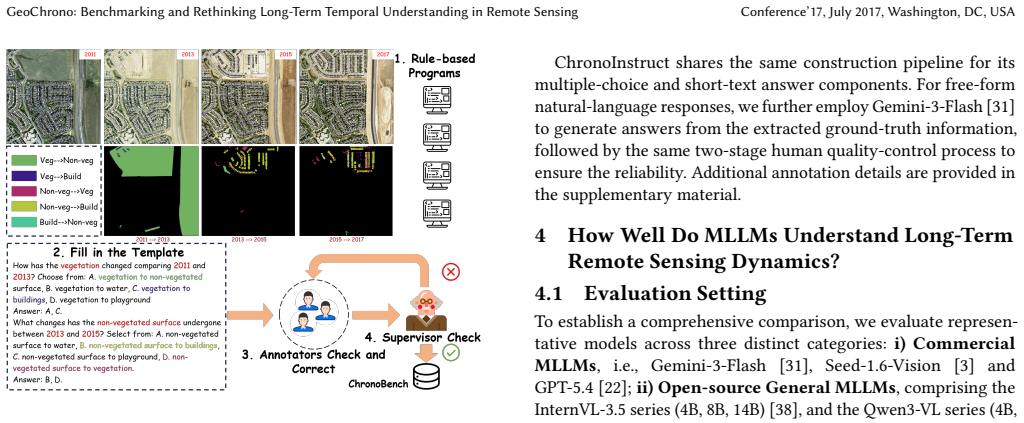
The Temporal Trajectory Encoder (TempEnc) groups visual tokens sharing the same spatial index across all T frames into per-location trajectories, then applies hybrid attention, half bidirectional and half causal, to capture both global temporal contrast and chronological order, with text-guided cross-attention filtering task-irrelevant timesteps. The Coarse-to-Fine Token Compressor (C2FComp) partitions each frame into spatial blocks, scores block relevance against the prompt, keeps the top-K blocks at full resolution, and compresses the static background, with the selection mask shared across frames to keep compression spatially consistent. ChronoBench and ChronoInstruct themselves, generate
Load-bearing premise
The model assumes that the same pixel index in every frame points to the same physical parcel of ground; if misregistration or orthorectification shift what a pixel covers across years, the per-location trajectories mix different places and the temporal signal is corrupted.
What would settle it
Co-register two frames of the same region with a deliberately small artificial shift, for example 5–10 pixels, and run GeoChrono's history-reconstruction task: if accuracy drops sharply at a shift far smaller than the spatial context kernel, the trajectory construction is relying on pixel-perfect alignment. Alternatively, measure the actual registration residual of the input frames against the change masks and compare it with the spatial context window used by TempEnc, which the paper does not report.
If this is right
- If GeoChrono's results hold, long-term memory in remote-sensing MLLMs can be substantially improved without massive scale-up: a 4B model with trajectory modeling beats commercial and 32B open-weights models.
- The four-level hierarchy offers a diagnostic lens: models can be compared level by level, and memory, not perception, is the blocker for long-term understanding.
- Instruction tuning on 104K rule-generated pairs transfers zero-shot to external change-understanding benchmarks, outperforming a domain model trained on its own instruction set.
- The coarse-to-fine compressor demonstrates that wide-area remote-sensing sequences are highly spatially redundant: over 56% token reduction retains 94.6% of accuracy, and even 73% reduction retains over 91%.
- The benchmark construction pipeline shows that large-scale temporal QA datasets can be produced automatically from change masks with minimal additional manual labeling, lowering the cost of future temporal benchmarks.
Where Pith is reading between the lines
- Editorial inference: the geostationary trajectory principle may generalize to any co-registered monitoring setting, such as repeated ground surveys, fixed-camera observation, or longitudinal medical imaging, where the same spatial location is observed across time.
- Editorial inference: the diagnosis that memory, not perception, is the bottleneck suggests that general video MLLMs, which lack the geostationary prior, could benefit from similar per-location trajectory modules when applied to co-registered frame stacks.
- Editorial inference: the failure analysis, which shows the model omits brief transitions between vegetation and non-vegetated surface, points to seasonal phenology as a limit; using near-infrared bands, which the paper mentions as future work, would offer a direct, testable improvement.
- Editorial inference: because ground truth is derived from rule-based programs over change masks, ChronoBench could be extended to new regions, sensors, or land-cover taxonomies with little extra human effort, making the benchmark a reusable template rather than a fixed snapshot.
Editorial analysis
A structured set of objections, weighed in public.
Referee Report
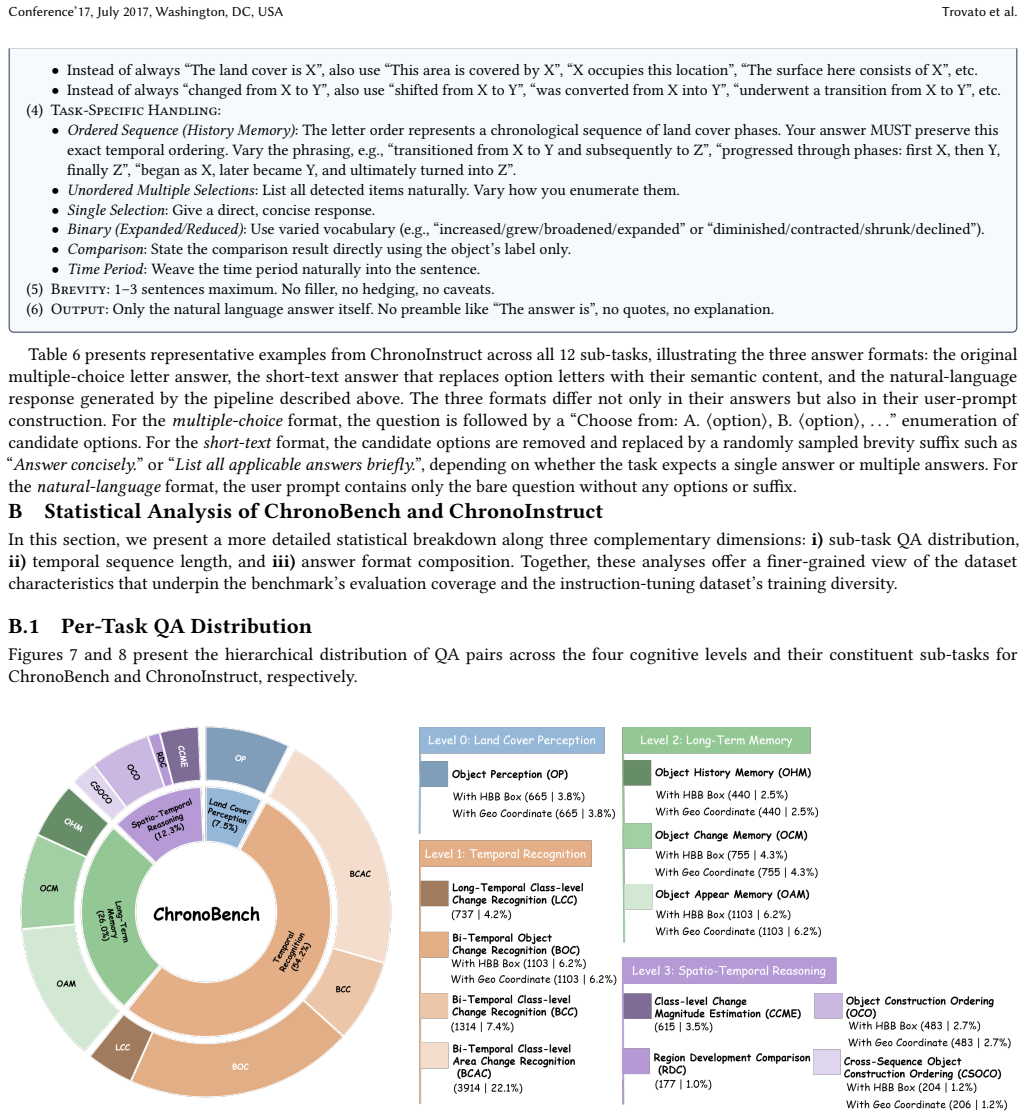
Summary. The paper introduces ChronoBench, a benchmark for long-term temporal understanding in remote sensing, organized as a four-level cognitive hierarchy (land cover perception, temporal recognition, long-term memory, spatio-temporal reasoning) with 12 sub-tasks and 17,689 QA pairs generated deterministically from DynamicVL's human-annotated semantic change masks. The authors evaluate commercial, open-source, and remote-sensing-domain MLLMs, finding a large human–model gap with Long-Term Memory as the primary bottleneck. They then propose GeoChrono, built on Qwen3-VL-4B, with a Temporal Trajectory Encoder (TempEnc) that groups visual tokens by spatial index across frames to model per-location evolution, and a Coarse-to-Fine Token Compressor (C2FComp) that selectively keeps fine tokens for task-relevant blocks and compresses the background. Training on the accompanying 104,949-sample ChronoInstruct dataset yields 78.34% OA on ChronoBench, surpassing the best commercial baseline (Gemini-3-Flash, 57.48%) by over 20 absolute points; C2FComp at a 1/4 selection ratio cuts visual tokens by 56.3% while retaining 94.6% of the full model's accuracy. Ablations and zero-shot results on DVL-Bench and CDVQA are also reported.
Significance. If the empirical claims hold, this is a useful contribution to remote sensing MLLM evaluation and modeling. The cognitive decomposition is a reasonable diagnostic lens, and the rule-based deterministic pipeline from human change masks makes ChronoBench's labels exact by construction, which is a genuine strength. The appendix provides unusually detailed construction, template, and evaluation protocols, and the authors commit to releasing code, data, and model weights. The TempEnc idea of exploiting the geostationary prior and the C2FComp prompt-guided compression are well motivated and supported by ablations and efficiency profiling. However, the headline SOTA claim rests on the independence of ChronoBench from ChronoInstruct's training data, and this independence is currently not established. Likewise, the core TempEnc mechanism depends on cross-frame spatial alignment that is asserted but not quantified. Both issues are checkable and addressable, so the contribution is potentially solid but needs verification.
major comments (3)
- [§3.3, Appendix B.1] The central SOTA claim requires that ChronoBench evaluation and ChronoInstruct training be disjoint, but the paper never states this. Appendix B.1 says ChronoInstruct is derived from the DVL-Suite training split (1,534 sequences), while §3.3 says ChronoBench is built from DynamicVL metadata with 500 regions / 3,469 images. Since both datasets use the same 12-task template family and the same mask-to-QA pipeline, any shared sequence or tile would let GeoChrono memorize template-mask correspondences and inflate the reported 20-point margin over API models that never saw these templates. Please report the exact overlap between ChronoBench regions/images/sequences and ChronoInstruct's training sequences, and construct ChronoBench from a disjoint held-out split if overlap exists. The zero-shot DVL-Bench result is partial evidence, but DVL-Bench is also from the DVL-Suite and does not cover th
- [§5.1, Eq. (2)] TempEnc's trajectory construction assumes that 'the sensor's perspective varies negligibly, so each spatial patch across frames corresponds to the same geographic location,' and Eq. (2) groups tokens sharing the same spatial index across all frames. This is load-bearing for the temporal modeling claim. NAIP images are orthorectified and may have residual co-registration errors, different scene extents, or slight rotations; if the same pixel index refers to slightly different ground parcels across years, the trajectories mix different locations. The paper provides no alignment-error statistics and no sensitivity analysis. Please quantify registration accuracy for the dataset or include an ablation (e.g., shifting/cropping frames by 1–2 tokens) to show TempEnc's behavior under realistic misalignment.
- [Algorithm 3, Appendix A.1.3] The text states that eight object-level tasks (OP, BOC, OAM, OCM, OHM, OCO, RDC, CSOCO) rely on Algorithm 3, but the algorithm's signature lists only τ∈{OP, BOC, OAM, OCM, OHM, OCO} and the pseudocode does not specify the RDC or CSOCO branches. The post-processing descriptions in the text help, but the missing algorithmic detail is exactly where the ground-truth construction for the two most complex reasoning tasks should be most explicit. Please include the full extraction logic for RDC and CSOCO in the pseudocode.
minor comments (5)
- [Table 3 and Table 9] Table 3 header uses 'FLOPS' while the text and Table 9 use 'FLOPs'; please unify to the standard 'FLOPs'.
- [Related Work, §2.2] 'TEOChatlas' appears as a name in the related-work text, but reference [10] is 'TEOChat'. Please correct the dataset name and citation to avoid confusion.
- [§4.2, Table 1] Human-level performance is based on only three domain experts; no inter-annotator agreement or per-expert variance is reported. A small human cohort can make the 92.28% reference number noisy. Please add agreement statistics or acknowledge this limitation.
- [Appendix A.2] Some template examples contain artifacts such as 'Now answer:' followed by a line break before the actual question (e.g., OP coordinate template 4). These are likely harmless but should be cleaned for the released version.
- [§3.2 / Appendix B.1] It is unclear whether the 500 ChronoBench regions are a subset of the 1,534 ChronoInstruct sequences or a separate collection. A sentence clarifying the relationship at the region level would help.
Circularity Check
ChronoBench and ChronoInstruct are generated by the same rule-based pipeline over DVL-Suite metadata, and the paper never demonstrates a disjoint train/eval split; GeoChrono's headline 20% margin is therefore not shown to be independent of its training distribution.
specific steps
-
fitted input called prediction
[Appendix B.1; Sec. 3.3; Sec. 6.1-6.2]
"ChronoInstruct comprises 104,949 QA pairs derived from the DVL-Suite [42] training split (1,534 image sequences). ... ChronoBench builds on the metadata provided by the DynamicVL team [42], which includes pixel-level semantic change masks annotated at consecutive timestamps. ... The model is trained for one epoch on ChronoInstruct."
GeoChrono is fine-tuned on ChronoInstruct and then scored on ChronoBench, but both datasets are produced by the same deterministic rule-based programs over the same DVL-Suite mask metadata and share the same 12-task template family. The paper never states that ChronoBench's 500 regions are disjoint from ChronoInstruct's 1,534 DVL training sequences, nor reports any overlap statistic. If any ChronoBench tile/sequence also appears in ChronoInstruct, the rule-generated answers for that tile are effectively present in training, so the 78.34% OA and >20% margin can reflect template/answer memorization instead of long-term temporal understanding. As written, the headline prediction is not demonstrated to be independent of the training distribution; the evaluation reduces to a fit unless split-di
full rationale
The central derivation (GeoChrono's SOTA claim) depends on ChronoBench being an unseen evaluation set. The paper supplies no evidence for this: ChronoBench and ChronoInstruct are both built via the same mask-traversal rule-based pipeline over DynamicVL's DVL-Suite metadata (Sec. 3.3, Appendix B.1), with the same question template families, and GeoChrono is trained on ChronoInstruct (Sec. 6.1). Without an explicit disjoint split or overlap statistic, the 20% margin over models that never saw these templates is vulnerable to memorization. This is a missing-evidence/leakage concern rather than a demonstrated mathematical equivalence, and the paper does include partial independent support: zero-shot results on DVL-Bench and CDVQA (Table 2) show generalization beyond the training distribution, and no self-citation chain is load-bearing. I therefore set the score at 5 rather than 8-10. If the authors release split metadata demonstrating non-overlap, the concern would be resolved and the score would drop to 0-2.
Axiom & Free-Parameter Ledger
free parameters (4)
- Data-construction thresholds (θ_a, θ_f, θ_t, θ_cov, θ_s, θ_m) =
not stated numerically
- C2FComp block size b =
2
- C2FComp selection ratio K/S_c =
1/4 for headline claim
- LoRA rank/alpha and learning rates =
rank=32, alpha=64, LR 1e-4/5e-4
axioms (6)
- domain assumption Each spatial patch index across frames corresponds to the same geographic location (geostationary prior).
- domain assumption DVL-Suite human-annotated semantic change masks are reliable ground truth for land-cover transitions.
- domain assumption Change sparsity: only a small fraction of regions change meaningfully, so static background can be compressed without proportional performance loss.
- domain assumption Five land-cover classes (vegetation, non-vegetated surface, water, buildings, playground) are sufficient and unambiguous for all temporal understanding tasks.
- domain assumption ChronoBench evaluation samples are independent of ChronoInstruct training samples.
- standard math Standard transformer machinery (attention, RoPE, Gumbel-Softmax, straight-through estimation) behaves as expected.
Cite this review
Pith. "Pith review of GeoChrono: Benchmarking and Rethinking Long-Term Temporal Understanding in Remote Sensing." pith.science (2026). https://pith.science/paper/WTRDX7HN
@misc{pith2026260715768,
  author       = {Pith},
  title        = {Pith review of: GeoChrono: Benchmarking and Rethinking Long-Term Temporal Understanding in Remote Sensing},
  year         = {2026},
  howpublished = {\url{https://pith.science/paper/WTRDX7HN}},
  note         = {Machine review of arXiv:2607.15768}
}
read the original abstract
Remote sensing offers an unparalleled vantage point for observing the Earth's long-term surface evolution, yet it demands that a model not only perceive land cover at isolated moments, but also track changes, memorize evolution histories, and reason across time and space. However, existing studies lack a systematic evaluation that dissects these distinct competencies. To fill this gap, we introduce ChronoBench, a multidimensional benchmark that decomposes this task into four progressive cognitive levels (i.e., Land Cover Perception, Temporal Recognition, Long-Term Memory, and Spatio-Temporal Reasoning). The ChronoBench comprises 12 sub-tasks and 17,689 rigorously validated QA (Question-Answer) pairs. Extensive evaluations reveal that mainstream MLLMs fall drastically behind human experts, with Long-Term Memory emerging as the most critical bottleneck. Motivated by this finding, we further propose GeoChrono, an MLLM with enhanced capabilities for tracing, memorizing, and reasoning about long-term geographic evolution. Leveraging the physical prior that geographic parcels remain spatially fixed while their semantics evolve, we design a Temporal Trajectory Encoder~(TempEnc) that constructs per-location temporal trajectories for dedicated land cover evolution modeling, and we introduce a Coarse-to-Fine Token Compressor~(C2FComp) that adaptively preserves dynamic regions while compressing the static background. To support training, we also construct ChronoInstruct, a 104K-sample instruction-tuning dataset spanning all competency levels for training. GeoChrono achieves state-of-the-art performance on ChronoBench, surpassing the leading commercial MLLMs by over 20%, while C2FComp reduces visual tokens by over 56% while retaining GeoChrono's 94.6% performance. The code and data will be available at https://github.com/IntelliSensing/GeoChrono
Figures






Reference graph
Works this paper leans on
-
[1]
Jean-Baptiste Alayrac, Jeff Donahue, Pauline Luc, Antoine Miech, Iain Barr, Yana Hasson, Karel Lenc, Arthur Mensch, Katherine Millican, Malcolm Reynolds, et al
-
[2]
Shuai Bai, Yuxuan Cai, Ruizhe Chen, Keqin Chen, Xionghui Chen, Zesen Cheng, Lianghao Deng, Wei Ding, Chang Gao, Chunjiang Ge, et al . 2025. Qwen3-vl technical report.arXiv preprint arXiv:2511.21631(2025)
Pith/arXiv arXiv 2025
-
[3]
ByteDance Seed. 2026. Seed 1.6. https://seed.bytedance.com/en/seed1_6. Ac- cessed: 2026-03-22
2026
-
[4]
Keshigeyan Chandrasegaran, Agrim Gupta, Lea M Hadzic, Taran Kota, Jimming He, Cristóbal Eyzaguirre, Zane Durante, Manling Li, Jiajun Wu, and Li Fei-Fei
-
[5]
Tri Dao. 2024. FlashAttention-2: Faster Attention with Better Parallelism and Work Partitioning. InInternational Conference on Learning Representations (ICLR)
2024
-
[6]
Pei Deng, Wenqian Zhou, and Hanlin Wu. 2025. Changechat: An interactive model for remote sensing change analysis via multimodal instruction tuning. In ICASSP 2025-2025 IEEE International Conference on Acoustics, Speech and Signal Processing (ICASSP). IEEE, 1–5
2025
-
[7]
Chaoyou Fu, Yuhan Dai, Yongdong Luo, Lei Li, Shuhuai Ren, Renrui Zhang, Zihan Wang, Chenyu Zhou, Yunhang Shen, Mengdan Zhang, et al. 2025. Video-mme: The first-ever comprehensive evaluation benchmark of multi-modal llms in video analysis. InProceedings of the IEEE/CVF conference on computer vision and pattern recognition. 24108–24118
2025
-
[8]
Edward J Hu, Yelong Shen, Phillip Wallis, Zeyuan Allen-Zhu, Yuanzhi Li, Shean Wang, Liang Wang, Weizhu Chen, et al. 2022. Lora: Low-rank adaptation of large language models.Iclr1, 2 (2022), 3
2022
-
[9]
Yuan Hu, Jianlong Yuan, Congcong Wen, Xiaonan Lu, Yu Liu, and Xiang Li. 2025. Rsgpt: A remote sensing vision language model and benchmark.ISPRS Journal of Photogrammetry and Remote Sensing224 (2025), 272–286
2025
-
[10]
Jeremy Andrew Irvin, Emily Ruoyu Liu, Joyce Chuyi Chen, Ines Dormoy, Jiny- oung Kim, Samar Khanna, Zhuo Zheng, and Stefano Ermon. 2024. Teochat: A large vision-language assistant for temporal earth observation data.arXiv preprint arXiv:2410.06234(2024)
Pith/arXiv arXiv 2024
-
[11]
Eric Jang, Shixiang Gu, and Ben Poole. 2016. Categorical reparameterization with gumbel-softmax.arXiv preprint arXiv:1611.01144(2016)
Pith/arXiv arXiv 2016
-
[12]
Kartik Kuckreja, Muhammad Sohail Danish, Muzammal Naseer, Abhijit Das, Salman Khan, and Fahad Shahbaz Khan. 2024. Geochat: Grounded large vision- language model for remote sensing. InProceedings of the IEEE/CVF conference on computer vision and pattern recognition. 27831–27840
2024
-
[13]
Junnan Li, Dongxu Li, Silvio Savarese, and Steven Hoi. 2023. Blip-2: Bootstrapping language-image pre-training with frozen image encoders and large language models. InInternational conference on machine learning. PMLR, 19730–19742
2023
-
[14]
Yujie Li, Wenjia Xu, Yuanben Zhang, Zhiwei Wei, and Mugen Peng. 2025. BTC- Chat: Advancing Remote Sensing Bi-temporal Change Captioning with Multi- modal Large Language Model.arXiv preprint arXiv:2509.05895(2025)
arXiv 2025
-
[15]
Chenyang Liu, Keyan Chen, Bowen Chen, Haotian Zhang, Zhengxia Zou, and Zhenwei Shi. 2024. Rscama: Remote sensing image change captioning with state space model.IEEE Geoscience and Remote Sensing Letters21 (2024), 1–5
2024
-
[16]
Chenyang Liu, Rui Zhao, Hao Chen, Zhengxia Zou, and Zhenwei Shi. 2022. Remote sensing image change captioning with dual-branch transformers: A new method and a large scale dataset.IEEE Transactions on Geoscience and Remote Sensing60 (2022), 1–20
2022
-
[17]
Haotian Liu, Chunyuan Li, Yuheng Li, and Yong Jae Lee. 2024. Improved baselines with visual instruction tuning. InProceedings of the IEEE/CVF conference on computer vision and pattern recognition. 26296–26306
2024
-
[18]
Haotian Liu, Chunyuan Li, Qingyang Wu, and Yong Jae Lee. 2023. Visual in- struction tuning.Advances in neural information processing systems36 (2023), 34892–34916
2023
-
[19]
Sylvain Lobry, Diego Marcos, Jesse Murray, and Devis Tuia. 2020. RSVQA: Visual question answering for remote sensing data.IEEE Transactions on Geoscience and Remote Sensing58, 12 (2020), 8555–8566
2020
-
[20]
Junwei Luo, Zhen Pang, Yongjun Zhang, Tingzhu Wang, Linlin Wang, Bo Dang, Jiangwei Lao, Jian Wang, Jingdong Chen, Yihua Tan, et al. 2024. Skysensegpt: A fine-grained instruction tuning dataset and model for remote sensing vision- language understanding.arXiv preprint arXiv:2406.10100(2024)
Pith/arXiv arXiv 2024
-
[21]
Dilxat Muhtar, Zhenshi Li, Feng Gu, Xueliang Zhang, and Pengfeng Xiao. 2024. Lhrs-bot: Empowering remote sensing with vgi-enhanced large multimodal language model. InEuropean Conference on Computer Vision. Springer, 440–457
2024
-
[22]
OpenAI. 2025. Introducing GPT-5.4. https://openai.com/index/introducing-gpt- 5-4/. Accessed: 2026-03-22
2025
-
[23]
Ruizhe Ou, Yuan Hu, Fan Zhang, Jiaxin Chen, and Yu Liu. 2025. GeoPix: A multimodal large language model for pixel-level image understanding in remote sensing.IEEE Geoscience and Remote Sensing Magazine(2025)
2025
-
[24]
Chao Pang, Xingxing Weng, Jiang Wu, Jiayu Li, Yi Liu, Jiaxing Sun, Weijia Li, Shuai Wang, Litong Feng, Gui-Song Xia, et al. 2025. Vhm: Versatile and honest vision language model for remote sensing image analysis. InProceedings of the AAAI Conference on Artificial Intelligence, Vol. 39. 6381–6388
2025
-
[25]
Charlotte Pelletier, Geoffrey I Webb, and François Petitjean. 2019. Temporal convolutional neural network for the classification of satellite image time series. Remote Sensing11, 5 (2019), 523
2019
-
[26]
Akashah Shabbir, Mohammed Zumri, Mohammed Bennamoun, Fahad S Khan, and Salman Khan. 2025. Geopixel: Pixel grounding large multimodal model in remote sensing.arXiv preprint arXiv:2501.13925(2025)
Pith/arXiv arXiv 2025
-
[27]
Yan Shu, Zheng Liu, Peitian Zhang, Minghao Qin, Junjie Zhou, Zhengyang Liang, Tiejun Huang, and Bo Zhao. 2025. Video-xl: Extra-long vision language model for hour-scale video understanding. InProceedings of the Computer Vision and Pattern Recognition Conference. 26160–26169
2025
-
[28]
Enxin Song, Wenhao Chai, Guanhong Wang, Yucheng Zhang, Haoyang Zhou, Feiyang Wu, Haozhe Chi, Xun Guo, Tian Ye, Yanting Zhang, et al. 2024. Moviechat: From dense token to sparse memory for long video understanding. InProceedings of the IEEE/CVF Conference on Computer Vision and Pattern Recognition. 18221– 18232
2024
-
[29]
Sagar Soni, Akshay Dudhane, Hiyam Debary, Mustansar Fiaz, Muhammad Akhtar Munir, Muhammad Sohail Danish, Paolo Fraccaro, Campbell D Watson, Levente J Klein, Fahad Shahbaz Khan, et al. 2025. Earthdial: Turning multi-sensory earth observations to interactive dialogues. InProceedings of the Computer Vision and Pattern Recognition Conference. 14303–14313
2025
-
[30]
Jianlin Su, Murtadha Ahmed, Yu Lu, Shengfeng Pan, Wen Bo, and Yunfeng Liu. 2024. Roformer: Enhanced transformer with rotary position embedding. Neurocomputing568 (2024), 127063
2024
-
[31]
Gemini Team, Rohan Anil, Sebastian Borgeaud, Jean-Baptiste Alayrac, Jiahui Yu, Radu Soricut, Johan Schalkwyk, Andrew M Dai, Anja Hauth, Katie Millican, et al. 2023. Gemini: a family of highly capable multimodal models.arXiv preprint arXiv:2312.11805(2023). Conference’17, July 2017, Washington, DC, USA Trovato et al
Pith/arXiv arXiv 2023
-
[32]
Aakash Thapa, Teerayut Horanont, Bipul Neupane, and Jagannath Aryal. 2023. Deep learning for remote sensing image scene classification: A review and meta- analysis.Remote Sensing15, 19 (2023), 4804
2023
-
[33]
2008.Spatial Cognition: Embodied and Situated
Barbara Tversky. 2008.Spatial Cognition: Embodied and Situated. Cambridge University Press, 201–216
2008
-
[34]
Fengxiang Wang, Mingshuo Chen, Yueying Li, Di Wang, Haotian Wang, Zonghao Guo, Zefan Wang, Boqi Shan, Long Lan, Yulin Wang, et al. 2025. GeoLLaVA-8K: scaling remote-sensing multimodal large language models to 8k resolution.arXiv preprint arXiv:2505.21375(2025)
arXiv 2025
-
[35]
Fengxiang Wang, Hongzhen Wang, Zonghao Guo, Di Wang, Yulin Wang, Ming- shuo Chen, Qiang Ma, Long Lan, Wenjing Yang, Jing Zhang, et al. 2025. Xlrs- bench: Could your multimodal llms understand extremely large ultra-high- resolution remote sensing imagery?. InProceedings of the Computer Vision and Pattern Recognition Conference. 14325–14336
2025
-
[36]
Junjue Wang, Weihao Xuan, Heli Qi, Zhihao Liu, Kunyi Liu, Yuhan Wu, Hon- gruixuan Chen, Jian Song, Junshi Xia, Zhuo Zheng, et al . 2025. Disasterm3: A remote sensing vision-language dataset for disaster damage assessment and response.arXiv preprint arXiv:2505.21089(2025)
arXiv 2025
-
[37]
Junjue Wang, Yanfei Zhong, Zihang Chen, Zhuo Zheng, Ailong Ma, and Liangpei Zhang. 2026. EarthVL: A Progressive Earth Vision-Language Understanding and Generation Framework.arXiv preprint arXiv:2601.02783(2026)
arXiv 2026
-
[38]
Weiyun Wang, Zhangwei Gao, Lixin Gu, Hengjun Pu, Long Cui, Xingguang Wei, Zhaoyang Liu, Linglin Jing, Shenglong Ye, Jie Shao, et al. 2025. Internvl3. 5: Ad- vancing open-source multimodal models in versatility, reasoning, and efficiency. arXiv preprint arXiv:2508.18265(2025)
Pith/arXiv arXiv 2025
-
[39]
Weihan Wang, Zehai He, Wenyi Hong, Yean Cheng, Xiaohan Zhang, Ji Qi, Ming Ding, Xiaotao Gu, Shiyu Huang, Bin Xu, et al. 2025. Lvbench: An extreme long video understanding benchmark. InProceedings of the IEEE/CVF International Conference on Computer Vision. 22958–22967
2025
-
[40]
Yuetian Weng, Mingfei Han, Haoyu He, Xiaojun Chang, and Bohan Zhuang
-
[41]
Jiayang Wu, Wensheng Gan, Zefeng Chen, Shicheng Wan, and Philip S Yu
-
[42]
Weihao Xuan, Junjue Wang, Heli Qi, Zihang Chen, Zhuo Zheng, Yanfei Zhong, Junshi Xia, and Naoto Yokoya. 2025. Dynamicvl: Benchmarking multimodal large language models for dynamic city understanding.arXiv preprint arXiv:2505.21076 (2025)
arXiv 2025
-
[43]
In European Conference on Computer Vision
Longvlm: Efficient long video understanding via large language models. In European Conference on Computer Vision. Springer, 453–470
-
[44]
Zhenghang Yuan, Lichao Mou, Zhitong Xiong, and Xiao Xiang Zhu. 2022. Change detection meets visual question answering.IEEE Transactions on Geoscience and Remote Sensing60 (2022), 1–13
2022
-
[45]
Yang Zhan, Zhitong Xiong, and Yuan Yuan. 2023. Rsvg: Exploring data and models for visual grounding on remote sensing data.IEEE transactions on geoscience and remote sensing61 (2023), 1–13
2023
-
[46]
Ke Zhang, Peijie Li, and Jianqiang Wang. 2024. A review of deep learning- based remote sensing image caption: Methods, models, comparisons and future directions.Remote Sensing16, 21 (2024), 4113
2024
-
[47]
Shukang Yin, Chaoyou Fu, Sirui Zhao, Ke Li, Xing Sun, Tong Xu, and Enhong Chen. 2024. A survey on multimodal large language models.National Science Review11, 12 (2024), nwae403
2024
-
[48]
Siyuan Zhao, Qiang Wang, Xiaolin Zhao, Yong Kang, Chiben Zhang, and Ying Luo
-
[49]
Yue Zhou, Jue Chen, Zilun Zhang, Penghui Huang, Ran Ding, Zhentao Zou, PengFei Gao, Yuchen Wei, Ke Li, Xue Yang, et al. 2026. DVGBench: Implicit-to- explicit visual grounding benchmark in UAV imagery with large vision–language models.ISPRS Journal of Photogrammetry and Remote Sensing232 (2026), 831–847
2026
-
[50]
Heqing Zou, Tianze Luo, Guiyang Xie, Victor Xiao Jie Zhang, Fengmao Lv, Guang- cong Wang, Junyang Chen, Zhuochen Wang, Hansheng Zhang, and Huaijian Zhang. 2025. Hlv-1k: A large-scale hour-long video benchmark for time-specific long video understanding. In2025 IEEE International Conference on Multimedia and Expo (ICME). IEEE, 1–6. GeoChrono: Benchmarking a...
arXiv 2025
-
[51]
Wei Zhang, Miaoxin Cai, Tong Zhang, Yin Zhuang, and Xuerui Mao. 2024. Earth- GPT: A universal multimodal large language model for multisensor image com- prehension in remote sensing domain.IEEE Transactions on Geoscience and Remote Sensing62 (2024), 1–20
2024
-
[2022]
Flamingo: a visual language model for few-shot learning.Advances in neural information processing systems35 (2022), 23716–23736
2022
-
[2023]
In2023 IEEE International Conference on Big Data (BigData)
Multimodal large language models: A survey. In2023 IEEE International Conference on Big Data (BigData). IEEE, 2247–2256
-
[2024]
Hourvideo: 1-hour video-language understanding.Advances in Neural Information Processing Systems37 (2024), 53168–53197
2024
-
[2026]
Frequency-Adaptive Disentanglement and Topological Graph Alignment for Cross-Modal Optical-SAR Ship Re-Identification.IEEE Journal of Selected Topics in Applied Earth Observations and Remote Sensing(2026)
2026
This paper was first reviewed by deepseek-v4-flash on August 1, 2026.
discussion (0)
Sign in with ORCID, Apple, or X to comment. Anyone can read and Pith papers without signing in.