REVIEW 4 major objections 5 minor 28 references
Adaptformer: Sequence models as adaptive iterative planners
T0 review · 4 major / 5 minor · reviewed 2026-08-12 · deepseek-v4-flash
Pith's one-line read Adaptformer plans through unseen multi-goal missions using only single-goal demonstrations.
desk verdict Promising planner idea with a load-bearing training detail left unexplained; worth a close look but not yet a reliable citation. read the letter →
The pith
A machine-rendered reading of the paper's core claim, the machinery that carries it, and where it could break.
The reading
What carries the argument
The central object is the energy-based trajectory model $E_\theta(T) = \sum_{t=1}^{H} -\log \pi_\theta(a_t | T_{\setminus t}, S_g)$, a masked-language-model-style pseudo-likelihood that assigns low energy to good action sequences. Three auxiliary mechanisms carry the generalization: the Goal-Augmentation module, an MLP that proposes sub-goals $\hat{G}$ trained to maximize $\log P(\hat{G} | G_{\text{train}}; \pi_\omega)$; the state discriminator $D_\phi$, which pushes generated state sequences to be in-distribution; and the entropy lower bound $\beta$ that forces the Gaussian policy $\pi_\theta$ to remain stochastic. Planning at test time iteratively samples masked timesteps and refills them via Gibbs sampling from the energy model, which dynamically re-proposes sub-goals and prevents stalling.
What would settle it
Train Adaptformer on single-goal-reaching demonstrations in maps where all goals lie in the left half of the grid, then evaluate it in a maze where the only goals are on the right half. If the goal-augmentation module's top-ranked sub-goal proposals never enter the right half and the success rate drops to near zero, then the intrinsic sub-goal curriculum does not transfer to unseen goal configurations, and the central generalization claim is false.
Extended reading notes
Core claim
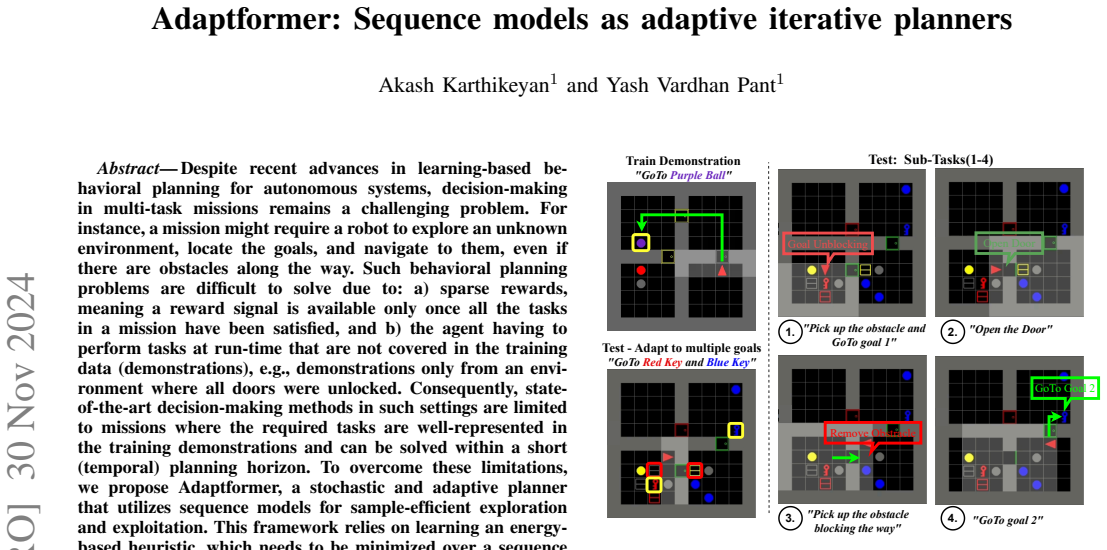
The paper introduces Adaptformer, a stochastic and adaptive planner that frames planning as iterative minimization of a learned energy function over sequences of actions. Rather than conditioning on an oracle-provided final goal, Adaptformer learns a goal-augmentation module that proposes intrinsic sub-goals from the current state, instruction, and image embedding; a state discriminator encourages the generated state sequences to stay in-distribution while exploring diverse paths; and an entropy constraint keeps the policy stochastic enough to escape loops and discover new skills. The combination, trained by alternating policy and discriminator updates on offline demonstrations, lets the model plan over horizons longer than its training trajectories and take actions—such as unblocking a path or opening a door—that never appeared in the demonstrations. Empirically, Adaptformer outperforms the LEAP baseline by up to 25% in multi-goal maze tasks, and in a multi-room instruction-completion setting it succeeds where LEAP fails completely.
Load-bearing premise
The goal-augmentation module, trained only on single-goal demonstrations, is assumed to propose useful sub-goals for multi-goal missions with goals it never saw; if that transfer fails, the policy navigates toward irrelevant waypoints and the generalization claim collapses.
Editorial extensions
If this is right
- Long-horizon missions can be solved with the same model that was trained on short single-goal demonstrations, because the learned sub-goal curriculum decomposes the mission into achievable pieces.
- Agents can exhibit skills that were never demonstrated, such as moving an obstacle or opening a door, when the stochastic policy and in-distribution sub-goals induce those actions.
- The margin over LEAP grows with environment size and complexity, suggesting the approach scales better to larger maps.
- Training on random-walk trajectories is sufficient for simple exploration tasks, which removes the requirement for optimal demonstrations in those settings.
- The ablation study shows each component—goal conditioning, discriminator, and entropy regularization—contributes about a 7–10% success-rate drop when removed.
Reading between the lines
- The goal-augmentation module is the linchpin: if its sub-goal proposals do not transfer to goal configurations outside the training distribution, the whole generalization story collapses, so ablating or probing this module on unseen goal layouts is the most direct stress test.
- Because the policy is trained on fully observable images, the method's success under partial observability is unresolved; the same energy-minimization machinery might be combined with a belief-state encoder to handle limited field-of-view missions.
- The reported 71%-vs-0% result on random-walk training hints that stochastic exploration alone can compensate for poor demonstration quality in simple environments, which could open the door to learning from suboptimal human teleoperation data if the same holds in messy real-world scenes.
- Applying the same masked-energy planning loop to continuous control or manipulation tasks would test whether the sub-goal curriculum generalizes beyond gridworld navigation.
Editorial analysis
A structured set of objections, weighed in public.
Referee Report
Summary. The paper proposes Adaptformer, an offline sequence-model planner that learns an energy-based heuristic over trajectories, augments goal conditioning with a learned Goal Augmentation (GA) module and a state discriminator that produces sub-goals, and performs planning via iterative Gibbs-style energy minimization with a deliberately stochastic policy. The authors claim up to 25% improvement over LEAP in multi-goal maze reachability, successful transfer from single-goal demonstrations to multi-goal missions, and the emergence of skills such as door opening and obstacle unblocking that were absent from the training demonstrations. Evaluation is conducted in BabyAI/Minigrid environments plus a hardware deployment on an AGILEX robot, with ablations and a random-demonstration experiment.
Significance. If the central claims are established, the paper would make a useful contribution to offline behavioral planning: the stochastic energy-minimization formulation and the idea of learning an intrinsic sub-goal curriculum are both interesting, and the reported generalization from single-goal training to multi-goal test missions would be a meaningful step beyond the deterministic, oracle-conditioned planning of LEAP. The paper deserves credit for including ablations, a LEAP-without-goal-conditioning baseline, a random-demonstration experiment, and a real-robot deployment. However, the main generalization claim currently rests on an underspecified Goal Augmentation module and on high-variance empirical results without statistical testing, so the significance is promising rather than conclusive.
major comments (4)
- [Section IV-B/E, Algorithm 1] Equation (3) defines a training objective for the Goal Augmentation module, max_ω log P(Ĝ|G_train; π_ω), but Algorithm 1 contains no term corresponding to this objective; the only updates are Lπ(θ) and LD(ϕ). The statement that "ω is contained in θ" does not explain how gradients from Eq. (5a) reach the GA, because L_NLL conditions on S_g rather than on the GA's proposals Ĝ. Since the multi-goal and out-of-distribution claims depend on the GA proposing correct waypoints at test time, the paper must specify the GA training signal and provide evidence that the learned proposals transfer to unseen goal configurations.
- [Section V-D and Table I] The discussion states that "our model demonstrates goal-unblocking capabilities and adapts to environments with closed doors, even without explicit demonstrations of door-opening actions," but this is contradicted by the KeyCorridorS3R3 row of Table I, where Adaptformer scores 18% versus LEAP's 21% and LEAP⊖GC's 16%. The authors should reconcile this contradiction or restrict the claim to the environments in which the numbers actually support it.
- [Table I and Section V-A] Success rates are reported as mean ± variance, but no confidence intervals or significance tests are provided; for example, GoToObjMazeS4G2 (53±16% versus 37±29%) and GoToObjMazeS4G2Close (48±18% versus 23±20%) have overlapping or very wide error ranges, so the "up to 25% improvement" claim is not statistically supported as reported. The authors should report standard errors or confidence intervals and, where possible, paired tests across the 50 maps and 150 runs.
- [Section V-B (Randomly Collected Trajectory, Table I)] The MultiRoomN2S4 row supporting the "learning from random trajectories" claim reports 71% versus 0% but gives no variance, no number of random demonstrations, no description of how many seeds were used, and no explanation of how a 100-step random walk without open/pickup/drop actions leads to a policy with 71% success. Because this row is the sole evidence for the sub-optimal-demonstration claim, the full protocol and repeated-seed statistics are needed.
minor comments (5)
- [Algorithm 1, line 13] The λ1 update is written without an expectation over the dataset; it should average the entropy constraint violation over trajectories, rather than using a single timestep's entropy.
- [Section IV-B] The notation "{g_i}_{i=1}^N ∈ G_train ∼ T" is confusing; the goal samples should be described as drawn from the goal sets appearing in the offline trajectories T.
- [Section IV-F and Algorithm 2] Algorithm 2 says "a, s ∼ Eθ(T_i\I)" even though Eθ is a scalar energy, not a distribution; this should be "a, s ∼ πθ(·|T_i\I, S_g)" or otherwise clarified.
- [Section IV-D and Algorithm 2] The energy function in Algorithm 2 adds the entropy term −λ1H(πθ) to the negative log-likelihood, whereas Section IV-D defines the energy as the sum of negative log-likelihoods only; the relationship between the constrained objective in Eq. (4) and the inference-time energy should be stated explicitly.
- [General reproducibility] The paper does not report values for the key hyperparameters λ1, λ2, β, planning horizon H, Gibbs iterations K, or the upper bound on goal proposals; these should be given in the text or an appendix to make the experiments reproducible.
Circularity Check
No significant circularity: the empirical comparison is external and no load-bearing step reduces to its own inputs.
full rationale
The paper's central claims are empirical: Adaptformer is evaluated on held-out maps and tasks (Section V) against LEAP and against its own ablations (Table II). The 'energy' E_theta is defined as the policy negative log-likelihood (Section IV-D), so minimizing it at inference via Gibbs sampling (Algorithm 2) is optimizing the learned objective; this is a modeling choice rather than a derivation that assumes its own conclusion. No load-bearing self-citations appear: the cited prior work (LEAP, Decision Transformer, Waypoint Transformer, DINOv2, etc.) is external, and no uniqueness or impossibility theorem is imported from the present authors' own prior work. The Goal Augmentation objective in Eq. (3) is not explicitly included in Algorithm 1, and its transfer to unseen goal configurations is an unsupported inductive assumption; however, that is a completeness or correctness gap, not a circular reduction, because the multi-goal test results are not constructed from the training labels. The ablation showing that removing goal conditioning lowers success rates is empirical sensitivity analysis, not a circular step. Overall, the derivation chain is self-contained with respect to circularity and the score is therefore 0.
Assumptions & free parameters
free parameters (6)
- lambda_1 =
not reported (updated by gradient descent in Algorithm 1)
- lambda_2 =
not reported
- beta =
not reported
- Planning horizon H =
not reported (set equal to sequence length for complex tasks)
- Gibbs sampling iterations K =
not reported
- Upper bound on number of goal proposals =
not reported
assumptions (5)
- standard math The pseudo-likelihood energy function E_theta(T) = sum_t -log pi_theta(a_t | T\t, S_g) represents trajectory quality.
- domain assumption Gibbs sampling with K random mask updates converges to a low-energy plan.
- domain assumption The state discriminator drives the policy to produce state sequences that are diverse yet in-distribution.
- ad hoc to paper The goal augmentation MLP trained on single-goal instructions generalizes to multi-goal test instructions.
- domain assumption The policy is Gaussian with diagonal covariance, so entropy is computable.
Cite this review
Pith. "Pith review of Adaptformer: Sequence models as adaptive iterative planners." pith.science (2026). https://pith.science/paper/WUNXIEJD
@misc{pith2026241200293,
  author       = {Pith},
  title        = {Pith review of: Adaptformer: Sequence models as adaptive iterative planners},
  year         = {2026},
  howpublished = {\url{https://pith.science/paper/WUNXIEJD}},
  note         = {Machine review of arXiv:2412.00293}
}
read the original abstract
Despite recent advances in learning-based behavioral planning for autonomous systems, decision-making in multi-task missions remains a challenging problem. For instance, a mission might require a robot to explore an unknown environment, locate the goals, and navigate to them, even if there are obstacles along the way. Such problems are difficult to solve due to: a) sparse rewards, meaning a reward signal is available only once all the tasks in a mission have been satisfied, and b) the agent having to perform tasks at run-time that are not covered in the training data, e.g., demonstrations only from an environment where all doors were unlocked. Consequently, state-of-the-art decision-making methods in such settings are limited to missions where the required tasks are well-represented in the training demonstrations and can be solved within a short planning horizon. To overcome these limitations, we propose Adaptformer, a stochastic and adaptive planner that utilizes sequence models for sample-efficient exploration and exploitation. This framework relies on learning an energy-based heuristic, which needs to be minimized over a sequence of high-level decisions. To generate successful action sequences for long-horizon missions, Adaptformer aims to achieve shorter sub-goals, which are proposed through an intrinsic sub-goal curriculum. Through these two key components, Adaptformer allows for generalization to out-of-distribution tasks and environments, i.e., missions that were not a part of the training data. Empirical results in multiple simulation environments demonstrate the effectiveness of our method. Notably, Adaptformer not only outperforms the state-of-the-art method by up to 25% in multi-goal maze reachability tasks but also successfully adapts to multi-task missions that the state-of-the-art method could not complete, leveraging demonstrations from single-goal-reaching tasks.
Figures


Figures from the paper (3 more)


Reference graph
Works this paper leans on
-
[1]
R. S. Sutton and A. G. Barto, Reinforcement learning: An introduction. MIT Press, 2018
work page 2018
-
[2]
Deadly triad matters for offline reinforcement learning,
Z. Peng, Y . Liu, and Z. Zhou, “Deadly triad matters for offline reinforcement learning,” Knowledge-Based Systems , vol. 284, p. 111341, 2024. [Online]. Available: https://www.sciencedirect.com/ science/article/pii/S0950705123010894
work page 2024
-
[3]
Goal-conditioned reinforcement learning: Problems and solutions,
M. Liu, M. Zhu, and W. Zhang, “Goal-conditioned reinforcement learning: Problems and solutions,” in Proceedings of the Thirty-First International Joint Conference on Artificial Intelligence, IJCAI-22 , L. D. Raedt, Ed. International Joint Conferences on Artificial Intelligence Organization, 7 2022, pp. 5502–5511, survey Track. [Online]. Available: https:/...
-
[4]
Decision transformer: Re- inforcement learning via sequence modeling,
L. Chen, K. Lu, A. Rajeswaran, K. Lee, A. Grover, M. Laskin, P. Abbeel, A. Srinivas, and I. Mordatch, “Decision transformer: Re- inforcement learning via sequence modeling,” in Advances in Neural Information Processing Systems , vol. 34, 2021, pp. 15 084–15 097
work page 2021
-
[5]
Planning with sequence models through iterative energy minimization,
H. Chen, Y . Du, Y . Chen, J. B. Tenenbaum, and P. A. Vela, “Planning with sequence models through iterative energy minimization,” inICLR, 2023
work page 2023
-
[6]
Offline reinforcement learning: Tutorial, review, and perspectives on open problems,
S. Levine, A. Kumar, G. Tucker, and J. Fu, “Offline reinforcement learning: Tutorial, review, and perspectives on open problems,” 2020
work page 2020
-
[7]
Off-policy deep reinforcement learning without exploration,
S. Fujimoto, D. Meger, and D. Precup, “Off-policy deep reinforcement learning without exploration,” in International Conference on Machine Learning, 2019, pp. 2052–2062
work page 2019
-
[8]
Stabilizing off-policy q-learning via bootstrapping error reduction,
A. Kumar, J. Fu, M. Soh, G. Tucker, and S. Levine, “Stabilizing off-policy q-learning via bootstrapping error reduction,” Advances in Neural Information Processing Systems , vol. 32, 2019
work page 2019
Show all 28 references
-
[9]
A minimalist approach to offline reinforce- ment learning,
S. Fujimoto and S. S. Gu, “A minimalist approach to offline reinforce- ment learning,” Advances in neural information processing systems , vol. 34, pp. 20 132–20 145, 2021
2021
-
[10]
Conservative q- learning for offline reinforcement learning,
A. Kumar, A. Zhou, G. Tucker, and S. Levine, “Conservative q- learning for offline reinforcement learning,” Advances in Neural In- formation Processing Systems , vol. 33, pp. 1179–1191, 2020
2020
-
[11]
Long short-term memory,
S. Hochreiter and J. Schmidhuber, “Long short-term memory,” Neural computation, vol. 9, no. 8, pp. 1735–1780, 1997
1997
-
[12]
Bert: Pre-training of deep bidirectional transformers for language understanding,
J. Devlin, M.-W. Chang, K. Lee, and K. Toutanova, “Bert: Pre-training of deep bidirectional transformers for language understanding,” arXiv preprint arXiv:1810.04805, 2018
2018 arXiv
-
[13]
Offline Reinforcement Learning as One Big Sequence Modeling Problem,
M. Janner, Q. Li, and S. Levine, “Offline Reinforcement Learning as One Big Sequence Modeling Problem,” Jun. 2021
2021
-
[14]
Generalized decision transformer for offline hindsight information matching,
H. Furuta, Y . Matsuo, and S. S. Gu, “Generalized decision transformer for offline hindsight information matching,” in International Confer- ence on Learning Representations , 2022
2022
-
[15]
You Can’t Count on Luck: Why Decision Transformers and RvS Fail in Stochastic Environments,
K. Paster, S. A. McIlraith, and J. Ba, “You Can’t Count on Luck: Why Decision Transformers and RvS Fail in Stochastic Environments,” in ICLR, May 2022
2022
-
[16]
Maximum entropy gain exploration for long horizon multi-goal reinforcement learning,
S. Pitis, H. Chan, S. Zhao, B. Stadie, and J. Ba, “Maximum entropy gain exploration for long horizon multi-goal reinforcement learning,” in Proceedings of the 37th International Conference on Machine Learning, ser. Proceedings of Machine Learning Research, vol. 119, 2020, pp. ...
2020
-
[17]
Rvs: What is essential for offline rl via supervised learning?
S. Emmons, B. Eysenbach, I. Kostrikov, and S. Levine, “Rvs: What is essential for offline rl via supervised learning?” arXiv preprint arXiv:2112.10751, 2021
2021 arXiv
-
[18]
Waypoint transformer: Reinforcement learning via supervised learning with intermediate targets,
A. Badrinath, Y . Flet-Berliac, A. Nie, and E. Brunskill, “Waypoint transformer: Reinforcement learning via supervised learning with intermediate targets,” in NeurIPS, 2023
2023
-
[19]
Dinov2: Learning robust visual features without supervision,
M. Oquab, T. Darcet, T. Moutakanni, H. V . V o, M. Szafraniec, V . Khalidov, P. Fernandez, D. Haziza, F. Massa, A. El-Nouby, R. Howes, P.-Y . Huang, H. Xu, V . Sharma, S.-W. Li, W. Galuba, M. Rabbat, M. Assran, N. Ballas, G. Synnaeve, I. Misra, H. Jegou, J. Mairal, P. Labatut,...
2023
-
[20]
Generative adversarial networks,
I. J. Goodfellow, J. Pouget-Abadie, M. Mirza, B. Xu, D. Warde- Farley, S. Ozair, A. Courville, and Y . Bengio, “Generative adversarial networks,” 2014
2014
-
[21]
Model-based of- fline policy optimization with adversarial network,
J. Yang, X. Chen, S. Wang, and B. Zhang, “Model-based of- fline policy optimization with adversarial network,” arXiv preprint arXiv:2309.02157, 2023
2023 arXiv
-
[22]
Exposing the implicit energy networks behind masked language models via metropolis– hastings,
K. Goyal, C. Dyer, and T. Berg-Kirkpatrick, “Exposing the implicit energy networks behind masked language models via metropolis– hastings,” arXiv preprint arXiv:2106.02736 , 2021
2021 arXiv
-
[23]
Online decision transformer,
Q. Zheng, A. Zhang, and A. Grover, “Online decision transformer,” in International Conference on Machine Learning . PMLR, 2022
2022
-
[24]
Soft actor- critic algorithms and applications,
T. Haarnoja, A. Zhou, K. Hartikainen, G. Tucker, S. Ha, J. Tan, V . Kumar, H. Zhu, A. Gupta, P. Abbeel, and S. Levine, “Soft actor- critic algorithms and applications,” ArXiv, vol. abs/1812.05905, 2018
2018 arXiv
-
[25]
Soft actor-critic: Off- policy maximum entropy deep reinforcement learning with a stochastic actor,
T. Haarnoja, A. Zhou, P. Abbeel, and S. Levine, “Soft actor-critic: Off- policy maximum entropy deep reinforcement learning with a stochastic actor,” 2018
2018
-
[26]
BabyAI: First steps towards grounded language learning with a human in the loop,
M. Chevalier-Boisvert, D. Bahdanau, S. Lahlou, L. Willems, C. Sa- haria, T. H. Nguyen, and Y . Bengio, “BabyAI: First steps towards grounded language learning with a human in the loop,” inInternational Conference on Learning Representations , 2019
2019
-
[27]
Minigrid & miniworld: Modular & customizable reinforcement learning environments for goal-oriented tasks,
M. Chevalier-Boisvert, B. Dai, M. Towers, R. de Lazcano, L. Willems, S. Lahlou, S. Pal, P. S. Castro, and J. Terry, “Minigrid & miniworld: Modular & customizable reinforcement learning environments for goal-oriented tasks,” 2023
2023
-
[28]
Offline reinforcement learning with implicit q-learning,
I. Kostrikov, A. Nair, and S. Levine, “Offline reinforcement learning with implicit q-learning,” arXiv preprint arXiv:2110.06169 , 2021
2021 arXiv
Reviewed August 12, 2026 · model on record in the stance chip above.
Discussion (0). Continue with ORCID to comment.