Running Vacuum in the expanding Universe: a unified QFT paradigm for Inflation and Dark Energy
Pith reviewed 2026-06-28 04:57 UTC · model grok-4.3
The pith
Quantum effects from QFT in curved spacetime induce an evolving vacuum energy that drives both inflation and dark energy in a unified framework.
A machine-rendered reading of the paper's core claim, the machinery that carries it, and where it could break.
Core claim
In the running vacuum model, quantum fluctuations induce a vacuum energy density ρ_vac depending on H and its time derivatives, with ~H^4 terms triggering inflation at early times and ~H^2 terms driving dark energy at late times, while G evolves as G(ln H), providing a unified QFT paradigm without additional fields.
What carries the argument
The running vacuum energy density ρ_vac(H, Ḣ, Ḧ, ...) induced by QFT in curved spacetime, which evolves with the expansion rate.
If this is right
- Dynamical vacuum energy replaces the fixed Lambda term and fits DESI data preferring evolving dark energy.
- Inflation arises purely from vacuum fluctuations at high H without requiring an inflaton scalar field.
- Newton's constant G evolves logarithmically with H, implying mild time variation of fundamental constants.
- The model unifies early and late universe acceleration in one QFT-based description.
Where Pith is reading between the lines
- If the RVM holds, it could resolve current cosmological tensions by allowing dynamical dark energy.
- Similar running effects might appear in other contexts involving QFT on dynamical backgrounds.
- Future measurements of varying constants or precise DE evolution could test the predicted forms of ρ_vac.
Load-bearing premise
Quantum field theory calculations in curved spacetime directly yield vacuum energy densities with powers of the Hubble rate large enough to dominate the expansion at the required epochs.
What would settle it
Detection of a strictly constant vacuum energy density throughout cosmic history or no evidence for any evolution in G would contradict the model's predictions.
Figures
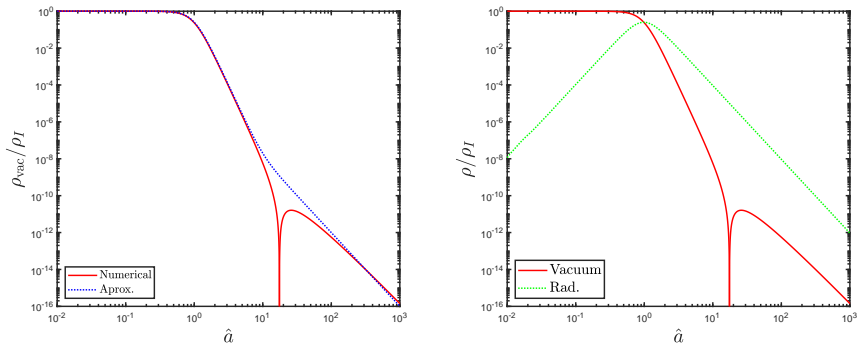
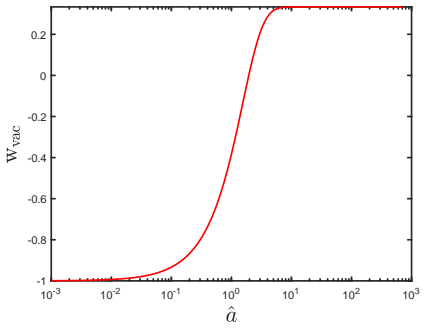
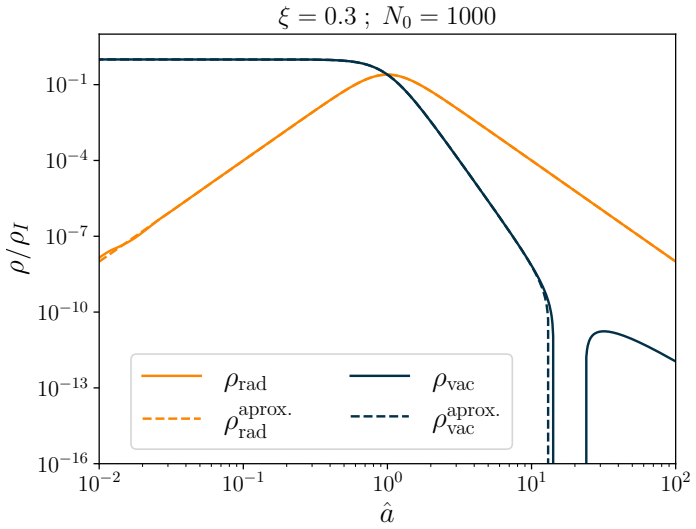
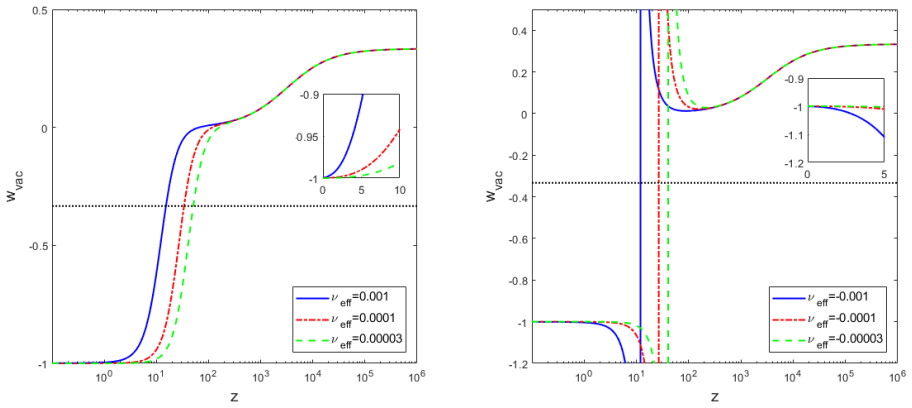
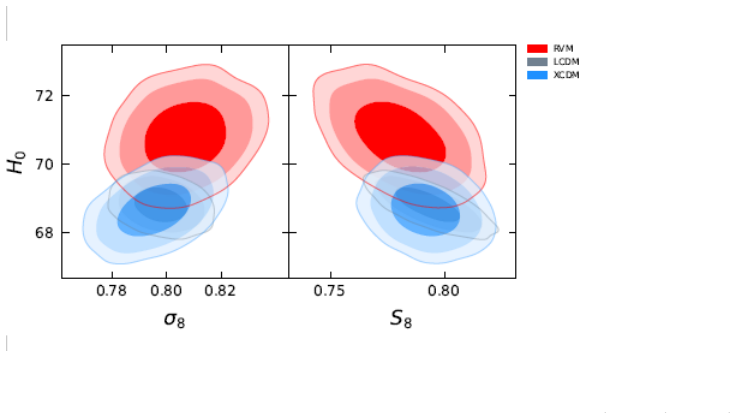
read the original abstract
The concordance $\Lambda$CDM model, based on a rigid $\Lambda$-term for the entire cosmic history, has been in crisis for a long time. In our expanding Universe, an evolving $\Lambda$ with the expansion is intuitively much more reasonable. In the running vacuum model (RVM) framework, based on quantum field theory (QFT) in curved spacetime, quantum effects induce a vacuum energy density (VED) $\rho_{\rm vac}=\Lambda/(8\pi G)$ which is a function of the Hubble rate $H$ and its time derivatives, $\rho_{\rm vac}=\rho_{\rm vac}(H, \dot{H},\ddot{H},\dots)$. Currently, $\rho_{\rm vac}$ evolves very slowly with the expansion, $\delta\rho_{\rm vac}\sim {\cal O}(m_{Pl} ^2 H^2)$, and this fact provides a possible fundamental origin of dark energy (DE), conceived as dynamical vacuum energy. In the RVM, Newton's $G$ is also evolving, but much more slowly (logarithmically with $H$): $G=G(\ln H)$. In the very early universe, the vacuum fluctuations induce higher (even) powers, e.g. $\sim H^4$, capable of triggering fast inflation in a very short period, in which $H$ is very large and approximately constant. This is the mechanism of `RVM-inflation'. It does not require an `inflaton' field since inflation is brought about by pure QFT effects on the dynamical background. It differs from Starobinsky's inflation, where $H$ is never constant. Furthermore, the dynamics of $\rho_{\rm vac}(H)$ and $G(H)$ can also have implications on the frequently discussed possibility that the fundamental `constants' of Nature can be mildly evolving with the cosmic expansion. Putting things together, a unified QFT framework of dark energy and inflation ensues as a realistic theory for the description of the universe as a whole on fundamental grounds. In it, dynamical VED is predicted and is much welcomed, since it fits in with current DESI measurements, preferring dynamical DE over a rigid $\Lambda$ term.
Editorial analysis
A structured set of objections, weighed in public.
Referee Report
Summary. The manuscript claims that within the running vacuum model (RVM) based on QFT in curved spacetime, the vacuum energy density takes the form ρ_vac = ρ_vac(H, Ḣ, Ḧ, …) with higher even powers such as H^4 inducing inflation in the early universe without an inflaton field, while the term O(m_Pl² H²) provides the dynamical dark energy at late times. Newton's constant is also running as G = G(ln H). This framework is presented as a unified QFT paradigm for inflation and dark energy that is consistent with DESI measurements favoring dynamical DE over a rigid Λ.
Significance. Should the QFT derivation of the specific functional form and coefficients hold without additional assumptions, this would represent a significant advance by providing a single mechanism rooted in quantum effects on curved spacetime for both the inflationary epoch and the current accelerated expansion. It would eliminate the need for an inflaton field and offer a dynamical origin for the vacuum energy, potentially resolving aspects of the cosmological constant problem. The logarithmic running of G adds implications for varying constants.
major comments (2)
- Abstract: The central claim that quantum effects induce ρ_vac with the specific powers H^4 (early universe) and O(m_Pl² H²) (late universe) dominating the dynamics at the required epochs is asserted but not derived in the provided text; the coefficients multiplying these terms are not shown to emerge parameter-free from a renormalization calculation in curved spacetime, which is load-bearing for the 'unified QFT paradigm' without additional mechanisms or tuning.
- Section on RVM-inflation: The statement that H is approximately constant during RVM-inflation due to the H^4 term, differing from Starobinsky inflation, lacks an explicit dynamical analysis or solution of the modified Friedmann equations showing the required slow-roll parameters or number of e-folds from the QFT-induced terms alone.
minor comments (2)
- The abstract mentions consistency with DESI measurements but does not include explicit data comparison or fit results.
- Notation for m_Pl and the precise definition of the functional dependence should be clarified with references to the underlying QFT computation.
Simulated Author's Rebuttal
We thank the referee for the careful reading and constructive comments on our manuscript. We address the major comments point by point below.
read point-by-point responses
-
Referee: Abstract: The central claim that quantum effects induce ρ_vac with the specific powers H^4 (early universe) and O(m_Pl² H²) (late universe) dominating the dynamics at the required epochs is asserted but not derived in the provided text; the coefficients multiplying these terms are not shown to emerge parameter-free from a renormalization calculation in curved spacetime, which is load-bearing for the 'unified QFT paradigm' without additional mechanisms or tuning.
Authors: The functional form ρ_vac=ρ_vac(H,Ḣ,Ḧ,…) with the indicated even powers follows from the standard renormalization of the vacuum energy in QFT on curved spacetime, as established in the RVM literature cited in the manuscript. The coefficients are fixed by the renormalization conditions rather than introduced by hand. To make the presentation fully self-contained, we will add a concise outline of the relevant renormalization steps (including how the H^4 and m_Pl²H² terms arise) in a new subsection of the revised manuscript. revision: yes
-
Referee: Section on RVM-inflation: The statement that H is approximately constant during RVM-inflation due to the H^4 term, differing from Starobinsky inflation, lacks an explicit dynamical analysis or solution of the modified Friedmann equations showing the required slow-roll parameters or number of e-folds from the QFT-induced terms alone.
Authors: We agree that an explicit solution of the modified Friedmann equations would strengthen the section. In the revised manuscript we will provide the dynamical analysis, solve the equations with the leading H^4 term, verify that H remains approximately constant, compute the slow-roll parameters, and estimate the number of e-folds generated by the QFT-induced vacuum energy alone. This will also make the contrast with Starobinsky inflation explicit. revision: yes
Circularity Check
No significant circularity; framework presented as QFT-derived
full rationale
The abstract and description frame ρ_vac(H,Ḣ,...) and the H^4/H² powers as induced by QFT in curved spacetime on FLRW, with G(ln H) running as a separate slow effect. No equations are exhibited that define the target quantities in terms of themselves or rename fitted coefficients as predictions. The load-bearing step is the external QFT computation itself rather than an internal reduction or self-citation chain within this manuscript. This is the common case of a self-contained presentation against an external benchmark (QFT effective action), warranting score 0.
Axiom & Free-Parameter Ledger
axioms (1)
- domain assumption QFT in curved spacetime induces vacuum energy density as a function of the Hubble rate H and its time derivatives
Reference graph
Works this paper leans on
-
[1]
Einstein,Kosmologische Betrachtungen zur allgemeinen Relativit¨ atstheorie, Sitzungsber
A. Einstein,Kosmologische Betrachtungen zur allgemeinen Relativit¨ atstheorie, Sitzungsber. K¨ onigl. Preuss. Akad. Wiss., phys.-math. Klasse VI (1917) 142
1917
-
[2]
Einstein,Zum kosmologischen Problem der allgemeinen Relativit¨ atstheorie, Sitzungsber
A. Einstein,Zum kosmologischen Problem der allgemeinen Relativit¨ atstheorie, Sitzungsber. K¨ onigl. Preuss. Akad. Wiss., phys.-math. Klasse, XII, (1931) 235
1931
-
[3]
Hubble,A relation between distance and radial velocity among extra-galactic nebulae, Proc.Nat.Acad.Sci.15(1929) 168
E. Hubble,A relation between distance and radial velocity among extra-galactic nebulae, Proc.Nat.Acad.Sci.15(1929) 168
1929
-
[4]
Adam G. Riesset al.,Observational evidence from supernovae for an accelerating universe and a cosmological constant, Astron.J.116(1998) 1009 [arXiv:astro-ph/9805201]; S. Perlmutter et al.,Measurements ofΩandΛfrom 42 High Redshift Supernovae, Astrophys.J.517(1999) 565 [arXiv:astro-ph/9812133]
Pith/arXiv arXiv 1998
-
[5]
Aghanimet al.(Planck Collaboration),Planck 2018 results
N. Aghanimet al.(Planck Collaboration),Planck 2018 results. VI. Cosmological parameters, Astron. Astrophys.641(2020) A6 [arXiv:1807.06209]
Pith/arXiv arXiv 2018
-
[6]
P. J. E. Peebles,Principles of physical cosmology, Princeton University Press, 1993
1993
-
[7]
Turner,The Road to Precision Cosmology, Annu
M.S. Turner,The Road to Precision Cosmology, Annu. Rev. Nucl. Part. Sci.72(2022) 1 [arXiv:2201.04741]
arXiv 2022
-
[8]
Lemaˆ ıtreEvolution of the expanding universe, Proc.Nat.Acad.Sci.,20, 1 (1934) 12
G. Lemaˆ ıtreEvolution of the expanding universe, Proc.Nat.Acad.Sci.,20, 1 (1934) 12
1934
-
[9]
Zel’dovich,The cosmological constant and the theory of elementary particles, Sov
Y. Zel’dovich,The cosmological constant and the theory of elementary particles, Sov. Phys. Ups.11(1968) 381;Cosmological constant and elementary particles, Sov. Phys. JETP. Lett. 6(1967) 3167
1968
-
[10]
Weinberg,The Cosmological Constant Problem, Rev
S. Weinberg,The Cosmological Constant Problem, Rev. Mod. Phys.,61(1989) 1. 92
1989
-
[11]
Sol` a,Cosmological constant and vacuum energy: old and new ideas, J
J. Sol` a,Cosmological constant and vacuum energy: old and new ideas, J. Phys. Conf. Ser. 453(2013) 012015 [arXiv:1306.1527]
Pith/arXiv arXiv 2013
-
[12]
S.J. Brodsky and R. Shrock,Condensates in Quantum Chromodynamics and the Cosmological Constant, Proc. Nat. Acad. Sci.108(2011) 45 [arXiv:0905.1151]
Pith/arXiv arXiv 2011
-
[13]
Brodsky, C
S.J. Brodsky, C. Roberts, and A. Deur,Artificial dynamical effects in quantum field theory, Nature Rev.Phys.4(2022) 7, 489
2022
-
[14]
J. Sol` a Peracaula,The cosmological constant problem and running vacuum in the expanding universe,” Phil. Trans. Roy. Soc. Lond. A380(2022) 20210182 [arXiv:2203.13757]
arXiv 2022
-
[15]
V. Sahni and A.A. Starobinsky,The Case for a Positive Cosmological Lambda-term, Int. J. Mod. Phys.D9(2000) 373 [astro-ph/9904398]
Pith/arXiv arXiv 2000
-
[16]
Carroll,The Cosmological Constant, Living Rev.Rel.4(2001) 1 [astro-ph/0004075]
S.M. Carroll,The Cosmological Constant, Living Rev.Rel.4(2001) 1 [astro-ph/0004075]
Pith/arXiv arXiv 2001
-
[17]
P.J.E. Peebles and B. Ratra,The cosmological constant and dark energy, Rev. Mod. Phys.75 (2003) 559 [arXiv:astro-ph/0207347]
Pith/arXiv arXiv 2003
-
[18]
Padmanabhan,Cosmological constant—the weight of the vacuum, Phys
T. Padmanabhan,Cosmological constant—the weight of the vacuum, Phys. Rept.380(2003) 235 [arXiv:hep-th/0212290]
Pith/arXiv arXiv 2003
-
[19]
S. Nobbenhuis,Categorizing Different Approaches to the Cosmological Constant Problem, Found.Phys.36(2006) 613 [arXiv:gr-qc/0411093]
Pith/arXiv arXiv 2006
-
[20]
E.J. Copeland, M. Sami and S. Tsujikawa,Dynamics of dark energy, Int. J. Mod. Phys. D15 (2006) 1753 [arXiv:hep-th/0603057]
Pith/arXiv arXiv 2006
-
[21]
I. J. R. Aitchison,Nothing’s plenty. The vacuum in modern quantum field theory. Contempo- rary Physics50, 1 (2009) 261
2009
-
[22]
F. Bauer, J. Sol` a and H. Stefancic,Dynamically avoiding fine-tuning the cosmological constant: the ‘Relaxed Universe’, JCAP12(2010) 029 [arXiv:1006.3944];The Relaxed Universe: towards solving the cosmological constant problem dynamically from an effective action functional of gravity, Phys.Lett.B688(2010) 269 [arXiv:0912.0677]
Pith/arXiv arXiv 2010
-
[23]
C.P. Burgess,The Cosmological Constant Problem: Why it’s hard to get Dark Energy from Micro-physics, Contribution to: 100e Ecole d’Ete de Physique: Post-Planck Cosmology, 149 [arXiv:1309.4133]
-
[24]
Weinberg,Anthropic Bound on the Cosmological Constant, Phys.Rev.Lett.59(1987) 2607
S. Weinberg,Anthropic Bound on the Cosmological Constant, Phys.Rev.Lett.59(1987) 2607
1987
-
[25]
Dolgov,An attempt to get rid of the cosmological constant, Nuffield Workshop on the Very Early Universe, pp 449-458
A.D. Dolgov,An attempt to get rid of the cosmological constant, Nuffield Workshop on the Very Early Universe, pp 449-458. Ed. G. Gibbons, S.W. Hawking, S.T. Tiklos (Cambridge U., 1982). 93
1982
-
[26]
Abbott,A Mechanism for Reducing the Value of the Cosmological Constant, Phys
L. Abbott,A Mechanism for Reducing the Value of the Cosmological Constant, Phys. Lett. B150(1985) 427
1985
-
[27]
Banks,T C P, Quantum Gravity, the Cosmological Constant and All That...,Nucl.Phys
T. Banks,T C P, Quantum Gravity, the Cosmological Constant and All That...,Nucl.Phys. B249(1985) 332
1985
-
[28]
Ford,Cosmological Constant Damping by Scalar Fields, Phys.Rev
L.H. Ford,Cosmological Constant Damping by Scalar Fields, Phys.Rev. D (1987) 2339
1987
-
[29]
Sol` a,The Cosmological Constant and the Fate of the Cosmon in Weyl Conformal Gravity, Phys
J. Sol` a,The Cosmological Constant and the Fate of the Cosmon in Weyl Conformal Gravity, Phys. Lett. B228(1989) 317;Scale gauge symmetry and the standard model, Int.J. Mod. Phys. A5(1990) 4225
1989
-
[30]
R. D. Peccei, J. Sol` a, and C. Wetterich,Adjusting the Cosmological Constant Dynamically: Cosmons and a New Force Weaker Than Gravity, Phys. Lett. B195(1987) 183
1987
-
[31]
Oda,Weinberg’s no go theorem in quantum gravity, Phys.Rev.D96(2017) 124012 [arXiv:1706.05804]
I. Oda,Weinberg’s no go theorem in quantum gravity, Phys.Rev.D96(2017) 124012 [arXiv:1706.05804]
Pith/arXiv arXiv 2017
-
[32]
J. Sol` a Peracaula (invited contribution prepared for the public in Cosmoverse website): Quantum vacuum: the cosmological constant problem,https://cosmoversetensions.eu/ learn-cosmology/quantum-vacuum-the-cosmological-constant-problem/
-
[33]
C. Moreno-Pulido and J. Sol` a,Running vacuum in quantum field theory in curved spacetime: renormalizingρ vac without∼m 4 terms, Eur. Phys. J. C80(2020) 692. [arXiv:2005.03164]
arXiv 2020
-
[34]
C. Moreno-Pulido and J. Sol` a Peracaula,Renormalizing the vacuum energy in cosmological spacetime: implications for the cosmological constant problem, Eur. Phys. J. C82(2022) 551 [arXiv:2201.05827]
arXiv 2022
-
[35]
C. Moreno-Pulido and J. Sol` a Peracaula,Equation of state of the running vacuum, Eur. Phys. J. C82(2022) 1137 [arXiv:2207.07111]
arXiv 2022
-
[36]
C. Moreno-Pulido, J. Sol` a Peracaula, and S. Cheraghchi,Running vacuum in QFT in FLRW spacetime: the dynamics ofρ vac(H)from the quantized matter fields, Eur. Phys. J. C83637, (2023) 637 [arXiv:2301.05205]
arXiv 2023
-
[37]
A. G. Adame et al. [DESI],DESI 2024 VI cosmological constraints from the measurements of baryon acoustic oscillations, JCAP 02 (2025), 021 [arXiv:2404.03002]
Pith/arXiv arXiv 2024
-
[38]
R. Calder´ on et al. (DESI),DESI 2024: reconstructing dark energy using crossing statistics with DESI DR1 BAO data, JCAP10(2024) 048, [arXiv:2405.04216]
arXiv 2024
-
[39]
M. Abdul Karim et al. [DESI],DESI DR2 Results II Measurements of Baryon Acoustic Os- cillations and Cosmological Constraints, Phys.Rev.D112(2025) 083515 [arXiv:2503.14738]
Pith/arXiv arXiv 2025
-
[40]
K. Lodha et al. (DESI),Extended dark energy analysis using DESI DR2 BAO measurements, Phys. Rev. D112(2025) 083511, [arXiv:2503.14743]. 94
Pith/arXiv arXiv 2025
-
[41]
I. Shapiro and J. Sol` a,On the scaling behavior of the cosmological constant and the possi- ble existence of new forces and new light degrees of freedom, Phys.Lett. B475(2000) 236 [arXiv:hep-ph/9910462]
Pith/arXiv arXiv 2000
-
[42]
I. Shapiro and J. Sol` a,Scaling behavior of the cosmological constant: Interface between quan- tum field theory and cosmology, JHEP,02(2000) 6 [arXiv:hep-th/0012227]
Pith/arXiv arXiv 2000
-
[43]
I.L. Shapiro, J. Sol` a and H. Stefancic,Running G and Lambda at low energies from physics at MX: Possible cosmological and astrophysical implications, JCAP01(2005) 012 [arXiv:hep- ph/0410095]
arXiv 2005
-
[44]
Sol` a,Dark energy: A Quantum fossil from the inflationary Universe?, J
J. Sol` a,Dark energy: A Quantum fossil from the inflationary Universe?, J. Phys. A41(2008) 164066 [arXiv:0710.4151]
Pith/arXiv arXiv 2008
-
[45]
I. Shapiro and J. Sol` a,On the possible running of the cosmological ’constant’, Phys.Lett. B682 (2009) 105 [arXiv:0910.4925]
Pith/arXiv arXiv 2009
-
[46]
A. Babic, B. Guberina, R. Horvat and H. Stefancic,Renormalization group running of the cosmological constant and its implication for the Higgs boson mass in the standard model, Phys.Rev. D65(2002) 085002 [arXiv:hep-ph/0111207]
Pith/arXiv arXiv 2002
-
[47]
B. Guberina, R. Horvat, H. Stefancic,Renormalization group running of the cosmological constant and the fate of the universe, Phys.Rev. D67(2003) 083001 [arXiv:hep-ph/0211184]
Pith/arXiv arXiv 2003
-
[48]
A. Babic, B. Guberina, R. Horvat and H. Stefancic,Renormalization-group running cosmolo- gies. A Scale-setting procedure, Phys.Rev. D71(2005) 124041 [arXiv:astro-ph/0407572]
Pith/arXiv arXiv 2005
-
[49]
Nelson and P
B.L. Nelson and P. Panangaden,Scaling behavior of interacting quantum fields in curved spacetime, Phys.Rev.D25(1982) 1019
1982
-
[50]
Sol` a,Cosmologies with a time dependent vacuum, J.Phys.Conf.Ser.283(2011) 012033 [arXiv:1102.1815]
J. Sol` a,Cosmologies with a time dependent vacuum, J.Phys.Conf.Ser.283(2011) 012033 [arXiv:1102.1815]
Pith/arXiv arXiv 2011
-
[51]
Tsujikawa,Quintessence: A Review, Class.Quant.Grav.30(2013) 214003 [arXiv:1304.1961]
S. Tsujikawa,Quintessence: A Review, Class.Quant.Grav.30(2013) 214003 [arXiv:1304.1961]
Pith/arXiv arXiv 2013
-
[52]
Amendola and S
L. Amendola and S. Tsujikawa,Dark Energy: Theory and Observations, Cambridge U. Press (2010) & (2015), and references therein
2010
-
[53]
O. Avsajanishvili, G. Y. Chitov, T. Kahniashvili, S. Mandal and L. Samushia,Observational Constraints on Dynamical Dark Energy Models, Universe10(2024) 3, 122 [arXiv:2310.16911]
arXiv 2024
-
[54]
Ozer and M.O
M. Ozer and M.O. Taha,A Model of the Universe with Time Dependent Cosmological Con- stant Free of Cosmological Problems, Nucl.Phys.B287(1987) 776;A Solution to the Main Cosmological Problems, Phys.Lett. B171(1986) 363. 95
1987
-
[55]
Freese, F
K. Freese, F. C. Adams, J. A. Frieman and E. Mottola,Cosmology with Decaying Vacuum Energy, Nucl. Phys. B287(1987) 797
1987
-
[56]
J. C. Carvalho, J. A. S. Lima and I. Waga,Cosmological consequences of a time-dependentΛ term, Phys.Rev. D46(1992) 2404
1992
-
[57]
J. M. Overduin and F. I. Cooperstock,Evolution of the Scale Factor with a Variable Cosmo- logical Term, Phys.Rev.D58(1998) 043506 [arXiv:astro-ph/9805260]
Pith/arXiv arXiv 1998
-
[58]
H. A. P. Macedo, L. S. Brito, J. F. Jesus, and M. E. S. Alves,Cosmological constraints on Λ(t)CDM models, Eur. Phys. J. C83(2023) 1144 [arXiv:2305.18591]
arXiv 2023
-
[59]
H. Chaudhary, R. Mandal, M. Bashir, V. Kumar Sharma and U. Debnath, Λ(t)model: Cos- mological Implications and Dynamical System Analysis, Chin.Phys. C50(2026) 045103 [arXiv:2602.14269]
arXiv 2026
-
[60]
O. Avsajanishvili,Background dynamics and observational constraints of flat and non-flat Λ(t)CDM models fromH(z)and DESI DR2 BAO measurements, arXiv:2603.03468
-
[61]
I. Shapiro and J. Sol` a,Massive fields temper anomaly induced inflation, Phys.Lett. B530 (2002) 10 [arXiv:hep-ph/0104182]
Pith/arXiv arXiv 2002
-
[62]
S. Basilakos, J. A. S. Lima and J. Sol` a,Expansion History with Decaying Vacuum: A Complete Cosmological Scenario, Mon.Not.Roy.Astron.Soc.431(2013) 923 [arXiv:1209.2802]
Pith/arXiv arXiv 2013
-
[63]
E. L. D. Perico, J. A. S. Lima, S. Basilakos and J. Sol` a,Complete Cosmic History with a dynamicalΛ(H)term, Phys.Rev.D 88 (2013) 063531 [arXiv:1306.0591]
Pith/arXiv arXiv 2013
-
[64]
S. Basilakos, J. A. S. Lima and J. Sol` a,From inflation to dark energy through a dynamical Lambda: an attempt at alleviating fundamental cosmic puzzles, Int.J.Mod.Phys.D22(2013) 1342008 [arXiv:1307.6251]
Pith/arXiv arXiv 2013
-
[65]
Sol` a,Vacuum energy and cosmological evolution, AIP Conf
J. Sol` a,Vacuum energy and cosmological evolution, AIP Conf. Proc.1606(2015) 19 [arXiv:1402.7049]
Pith/arXiv arXiv 2015
-
[66]
J. A. S. Lima, S. Basilakos and J. Sol` a,Nonsingular Decaying Vacuum Cosmology and Entropy Production, Gen.Rel.Grav.47(2015) 40 [arXiv:1412.5196]
Pith/arXiv arXiv 2015
-
[67]
J. Sol` a and A. G´ omez-Valent,The¯ΛCDMcosmology: From inflation to dark energy through runningΛ, Int. J. Mod. Phys.D 24(2015) 1541003 [arXiv:1501.03832]
Pith/arXiv arXiv 2015
-
[68]
J. Sol` a,The cosmological constant and entropy problems: mysteries of the present with pro- found roots in the past, Int.J.Mod.Phys.D24(2015) 12, 1544027 [arXiv:1505.05863]
Pith/arXiv arXiv 2015
-
[69]
J. A. S. Lima, S. Basilakos and J. Sol` a,,Thermodynamical aspects of running vacuum models, Eur.Phys.J.C76(2016) 228 [arXiv:1509.00163]. 96
Pith/arXiv arXiv 2016
-
[70]
J. Sol` a Peracaula and H. Yu,Particle and entropy production in the Running Vacuum Uni- verse, Gen. Rel. Grav.52(2020) 17 [arXiv:1910.01638]
arXiv 2020
-
[71]
J. Sol` a Peracaula, C. Moreno-Pulido and A. Gonz´ alez-Fuentes,Running Vacuum andH 4 Inflation, Universe11(2025) 4, 118 [arXiv:2503.01041]
arXiv 2025
-
[72]
J. Sol` a Peracaula, C. Moreno-Pulido and A. Gonz´ alez-Fuentes,Towards a unified quantum field theory of dark energy and inflation: unstable de Sitter vacuum and running vacuum [arXiv:2601.05218]
-
[73]
J. Sol` a Peracaula, A. G´ omez-Valent, J. de Cruz P´ erez, and C. Moreno-Pulido,Running vacuum against theH 0 andσ 8 tensions, EPL134(2021) 19001 [arXiv:2102.12758]
arXiv 2021
-
[74]
J. Sol` a Peracaula, A. Gomez-Valent, J. de Cruz P´ erez, and C. Moreno-Pulido,Running Vacuum in the Universe: Phenomenological Status in Light of the Latest Observations, and Its Impact on theσ 8 and H0 Tensions, Universe9(2023) no.6, 262 [arXiv:2304.11157]
arXiv 2023
-
[75]
J. de Cruz P´ erez, A. G´ omez-Valent and J. Sol` a Peracaula,Dynamical dark energy models in light of the latest observations, Phys.Rev.D113(2026) 083521 [arXiv:2512.20616]
arXiv 2026
-
[76]
H. Fritzsch and J. Sol` a,Matter Non-conservation in the Universe and Dynamical Dark Energy, Class. Quant. Grav.29(2012) 215002 [arXiv:1202.5097]
Pith/arXiv arXiv 2012
-
[77]
H. Fritzsch and J. Sol` a,Fundamental constants and cosmic vacuum: the micro and macro connection, Mod. Phys. Lett. A30(2015) 22, 1540034 [arXiv:1502.01411]
Pith/arXiv arXiv 2015
-
[78]
H. Fritzsch, J. Sol` a and R. Nunes,Running vacuum in the Universe and the time variation of the fundamental constants of Nature, Eur. Phys. J. C77no. 3 (2017) 193 [arXiv:1605.06104]
Pith/arXiv arXiv 2017
-
[79]
Brans and R
C. Brans and R. H. Dicke,Mach’s principle and a relativistic theory of gravitation, Phys.Rev. 124(1961) 925
1961
-
[80]
Uzan,Varying Constants, Gravitation and Cosmology, Living Rev
J.-P. Uzan,Varying Constants, Gravitation and Cosmology, Living Rev. Rel.14(2011) 2 [arXiv:1009.5514]
Pith/arXiv arXiv 2011
discussion (0)
Sign in with ORCID, Apple, or X to comment. Anyone can read and Pith papers without signing in.