REVIEW 3 major objections 4 minor 2 cited by
From Non-interacting to Interacting Picture of Quark Gluon Plasma in presence of magnetic field and its fluid property
T0 review · 3 major / 4 minor · reviewed 2026-08-14 · deepseek-v4-flash
Pith's one-line read This paper attempts to map lattice-QCD thermodynamics and quark condensate data at finite temperature and magnetic field onto a quasi-particle parametrization, then claims that magnetic field and QCD interaction are the two dominant…
desk verdict Useful heuristic extension of the authors' B=0 quasi-particle mapping to finite B, but a 4/3 normalization error in the shear-viscosity expression undermines the reported suppression percentages. read the letter →
The pith
A machine-rendered reading of the paper's core claim, the machinery that carries it, and where it could break.
The reading
What carries the argument
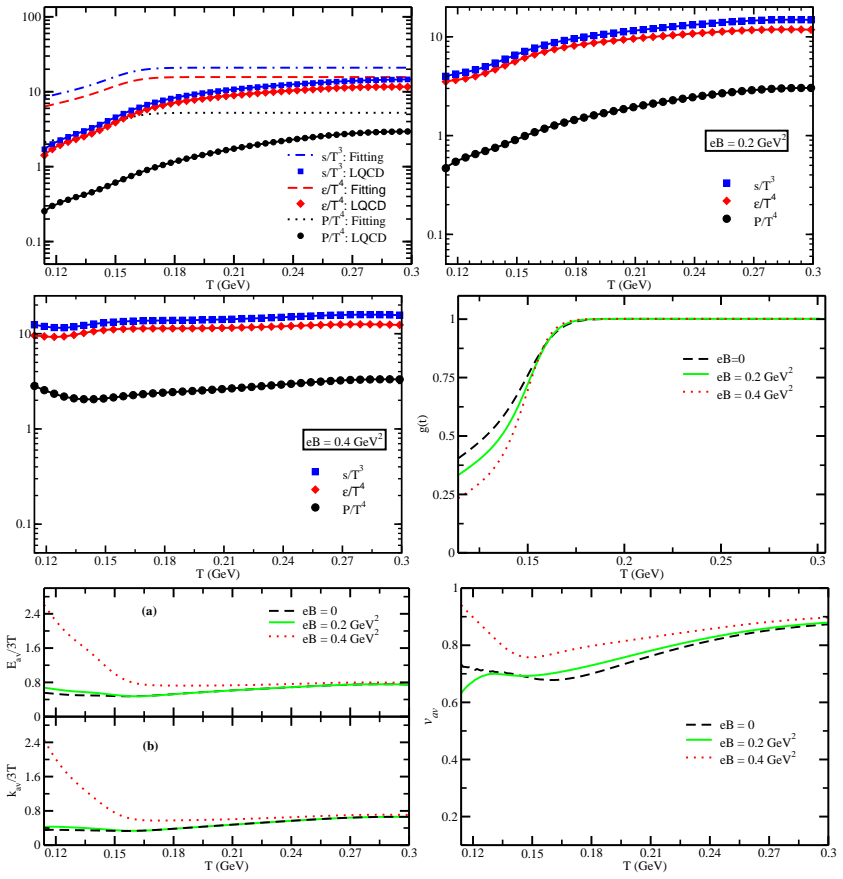
The load-bearing mechanism is the fitted set of quasi-particle parameters $g(T,B)$, $f_E(T,B)$, $f_k(T,B)$, and $v_{\rm av}(T,B)$, defined so that average energy and momentum are $E_{\rm av}=3T f_E$ and $k_{\rm av}=3T f_k$ with $k_{\rm av}=v_{\rm av}E_{\rm av}$. These parameters map the non-interacting massless Stefan-Boltzmann picture onto the interacting lattice picture by matching pressure, energy density, entropy density, and a number density built from the lattice quark condensate via $M=(M_N/3)\langle\bar q q\rangle$. Eq. (31) then carries these parameters into the transport coefficients, multiplying the massless $\eta$ and $\sigma$ by the interaction factors and by the magnetic denominators, so the equilibrium fit directly determines how much transport is suppressed in the magnetized plasma.
What would settle it
A direct lattice calculation of the total number density $n/T^3$ at finite $B$ would settle the mapping without the condensate proxy: if the $g(T,B)$ extracted from the condensate differs from the one obtained directly from $n$, the transport chain collapses. A second check is to test the magnetic-field functional form itself: for fixed $T$, $\eta_\perp$ should fall as $1/[1+(\tau_c/\tau_B)^2]$ and $\eta_\parallel$ as $1/[1+4(\tau_c/\tau_B)^2]$ when $B$ is varied, which a kinetic simulation can verify.
Extended reading notes
Core claim
The paper's central claim is that the same factors used to map lattice QCD thermodynamics—a degeneracy factor $g(T,B)$, average energy $E_{\rm av}=3T f_E(T,B)$, average momentum $k_{\rm av}=3T f_k(T,B)$ and average velocity $v_{\rm av}=f_k/f_E$—can be inserted into kinetic-theory expressions for the shear viscosity and electrical conductivity. In the resulting formulas, Eqs. (31), interaction enters as multiplicative factors $v_{\rm av}^2 f_k^2 g$ for $\eta$ and $v_{\rm av}^2 g$ for $\sigma$, while the magnetic field enters through the denominators $1/[1+(\tau_c/\tau_B)^2]$ and $1/[1+4(\tau_c/\tau_B)^2]$, where $\tau_B=E_{\rm av}/(qB)$ is the inverse synchrotron frequency. The two suppression mechanisms act independently: the magnetic field shortens the effective relaxation time, and the interaction shrinks the thermodynamic phase space. With both included, the anisotropic components satisfy $\eta_\parallel>\eta_\perp$ and $\sigma_\parallel>\sigma_\perp$, all suppressed relative to the free massless values.
Load-bearing premise
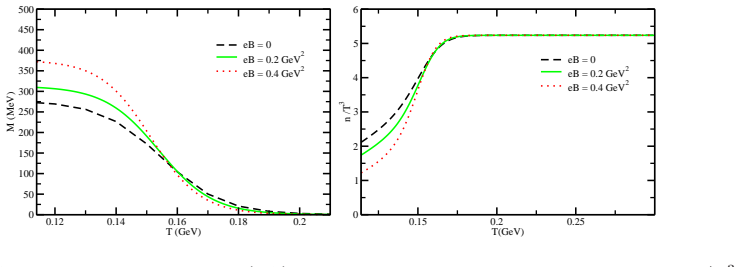
The entire suppression chain rests on treating the lattice quark condensate as a constituent quark mass through $M=(M_N/3)\langle\bar q q\rangle$ and then requiring the resulting number density to equal $g(T,B)\times 5.23\,T^3$; if that linear proxy misrepresents the finite-$B$ lattice data, every reported reduction of $\eta$ and $\sigma$ changes.
Editorial extensions
If this is right
- Heavy-ion fluid simulations that take the model at face value should use strongly reduced, anisotropic viscosities and conductivities, especially near the transition temperature where suppression is largest.
- The inequality $\eta_\parallel>\eta_\perp$ and $\sigma_\parallel>\sigma_\perp$ means charge and momentum transport are faster along the magnetic field than across it, so magneto-hydrodynamic descriptions require separate longitudinal and transverse coefficients rather than one scalar value.
- Because the suppression grows with magnetic field strength, the model predicts that the plasma's fluid behavior becomes more dissipative in the direction transverse to the field at large $eB$.
- The same $T,B$-dependent parameters can be reused to estimate other QGP observables—strangeness enhancement, thermal dilepton and photon rates, heavy-quark diffusion, jet quenching—giving quick non-perturbative approximations.
Reading between the lines
- If the condensate-to-mass proxy is trustworthy, then $g(T,B)$ can be read as an effective number of available degrees of freedom; a natural cross-check would be to extract $g(T,B)$ from the lattice entropy density alone and compare it with the value obtained from the condensate route.
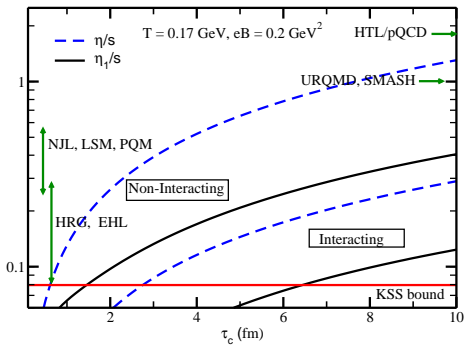
- Since the paper leaves $\tau_c$ free, one could turn its $\eta/s$ curves into a prediction for a temperature-dependent $\tau_c(T,B)$ by fixing $\eta/s$ near the KSS bound, a concrete input that magneto-hydrodynamic simulations could test.
- The authors note that inverse magnetic catalysis is faint in $\eta$ and $\sigma$ because the thermal distribution suppresses the mass effect; the natural place to look for the IMC signal is the interaction measure $\epsilon-3P$ or the bulk viscosity, where a peak shift with $eB$ should appear.
Signed reviews
Editorial analysis
A structured set of objections, weighed in public.
Referee Report
Summary. The manuscript proposes a quasi-particle model of the quark-gluon plasma in a finite magnetic field, in which the interaction is encoded through temperature- and magnetic-field-dependent factors: an effective degeneracy factor g(T,B), an average-energy rescaling f_E(T,B), an average-momentum rescaling f_k(T,B), and an average velocity v_av(T,B). These factors are tuned so that the model reproduces LQCD results for the number density, pressure, energy density, and entropy density at eB = 0, 0.2, and 0.4 GeV^2. The tuned factors are then inserted into relaxation-time-approximation expressions for the shear viscosity and electrical conductivity, producing parallel and perpendicular components in a magnetic field. The paper's central quantitative claim is that both the magnetic field and the QCD interaction are dominant sources of reduction of these transport coefficients, with reported reductions of 50-98.5% for shear viscosity and 30-90% for electrical conductivity in the temperature range studied.
Significance. If the central claim survived scrutiny, the paper would offer a simple, analytic way to translate LQCD-matched thermodynamics into anisotropic transport coefficients for magnetized QGP, which could be useful for magnetohydrodynamic simulations and for quick phenomenological estimates. The authors are transparent about the heuristic nature of the model, and they compare their results with HRG and NJL estimates, which helps place the work in context. However, the quantitative claim is currently weakened by a normalization mismatch in the shear-viscosity expression and by the fact that the transport suppression is largely inherited from the fitted thermodynamic factors rather than emerging from an independent transport calculation. The paper therefore has value as a rough parametric tool, but its headline percentages and the statement that interaction is a 'dominating source' need to be reformulated or supported by additional analysis.
major comments (3)
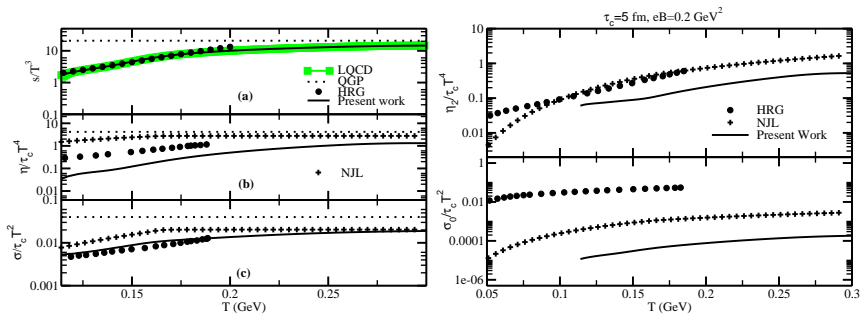
- [§3, Eqs. (23), (25), (29), and Fig. 3] The claim that Eq. (29) reduces to the non-interacting baseline Eq. (23) is not correct for shear viscosity. Setting v_av = f_k = g = 1 in Eq. (29) gives η = (g_g + g_Q) 3 T^4 / (5π^2) τ_c, whereas Eq. (23) gives η = (g_g + g_Q) 4 T^4 / (5π^2) τ_c. The discrepancy is a factor 3/4 and originates from replacing the second moment ⟨k^2⟩ = 12T^2 with k_av^2 = (3T)^2 in the k^4/E^2 weight. Because Eq. (31) multiplies η_parallel, η_perp, and hence η/s by the same prefactor, the 'Int./Non-Int.' ratios in the lower panels of Fig. 3 do not isolate the interaction effect; they contain a spurious normalization factor. The quoted 50-98.5% reductions are therefore not trustworthy until this normalization is corrected.
- [§2, Eqs. (14), (18), (20) and §3, Eqs. (29), (31)] The factors g(T,B), v_av(T,B), and f_k(T,B) are obtained by requiring that Eqs. (14) and (20) reproduce n_LQCD, P_LQCD, and ε_LQCD point by point. Inserting these same fitted functions into Eqs. (29) and (31) means that the reported suppression of η and σ relative to the Stefan-Boltzmann limits is largely a restatement of the fitted suppression of the thermodynamic quantities. The abstract's statement that 'magnetic field and interaction both are two dominating sources' reducing transport coefficients is therefore, at present, partly a consequence of the construction rather than a falsifiable prediction of the transport calculation. The authors should either demonstrate that some feature of the result is not determined by the fitted factors (for example, the specific interplay between the τ_B denominators and the f_k, v_av factors) or explicitly reframe the claim as an estimate inherited from LQCD-matched thermodynamics.
- [§2, Eqs. (13)-(14)] The conversion from the LQCD quark condensate to a constituent quark mass, M(T,B) = (M_N/3)⟨q̄q⟩_T, is a heuristic assumption motivated only by analogy to an NJL gap equation with zero current quark mass. No normalization of the condensate or derivation of the factor M_N/3 is provided. This relation determines g(T,B) through Eq. (14), and g(T,B) enters every transport coefficient in Eq. (31), so the quantitative reductions reported in the paper hinge on this assumption. The authors should test the sensitivity of their results to this choice, for example by varying the proportionality constant over a range typical of NJL/PNJL models, and should state clearly that the condensate-to-mass mapping is an unvalidated assumption rather than a QCD-derived relation.
minor comments (4)
- [§3.2] The sentence 'Eav(T, B = 0) < 1' is dimensionally inconsistent; the text should say E_av(T, B = 0) < 3T, as is stated correctly for k_av.
- [§3.1] The reference 'as shown in the right panel of Fig. (2)' appears to point to the wrong figure; the comparison with HRG and NJL results is displayed in Fig. (4), not Fig. (2).
- [Fig. 3 caption and legend] The notation η1, η2, σ0 is used without explicit identification with η_parallel, η_perp, and σ_parallel/σ_perp from Eq. (31); the caption should define these symbols to avoid confusion.
- [General presentation] There are several typographical errors, including 'coppied' in §2 and 'Completely vanished' in the Summary; the manuscript would benefit from a careful proofreading pass.
Circularity Check
The interaction-driven suppression of eta and sigma is the LQCD thermodynamic fit carried into transport by construction, so the central 'interaction reduces transport' claim is partly circular; the magnetic-field suppression is independent.
-
fitted input called prediction
[Sec. 3, Eqs. (20), (29), and Abstract]
"P_LQCD = v_av^2 f_E g × 5.23T^4; ǫ_LQCD = f_E g × 15.69T^4; ... σ = [v_av^2(T)g(T)] g_Q T^2/(9π^2) τ_c Σ_f q_f^2. ... magnetic field and interaction both are two dominating sources, for which the values of transport coefficients can be reduced."
Combining Eq. (20) gives v_av^2 g = P_LQCD/(f_E × 5.23T^4) = 3P_LQCD/ǫ_LQCD, since ǫ_LQCD = f_E g × 15.69T^4. Inserting this into Eq. (29) yields σ_int/σ_free = 3P_LQCD/ǫ_LQCD. Thus the conductivity suppression displayed as an interaction effect is exactly the lattice pressure-to-energy ratio already fitted into the model; it is the input thermodynamic fit, not an independent transport prediction. The shear-viscosity suppression factor v_av^2 f_k^2 g is likewise the same set of fitted parameters g, v_av, and f_k coming from Eqs. (14), (18), and (20), so the qualitative statement that interaction reduces η and σ is forced by the construction of the quasi-particle factors. The magnetic-field denominators in Eq.
full rationale
The one genuine circular step is the interaction-suppression of transport. The paper fits g, f_E, and v_av pointwise to LQCD thermodynamics in Eqs. (14), (18), and (20), and then Eq. (29) multiplies the free transport coefficients by products of those same fitted factors. Algebraically, the conductivity ratio becomes exactly 3P_LQCD/ǫ_LQCD, so the abstract's statement that interaction reduces the transport coefficients is a restatement of the lattice equation of state rather than a transport-derived result. However, the magnetic-field dependence is not circular: the denominators 1/[1+(τ_c/τ_B)^2] follow from the RTA Boltzmann-equation solution in the appendix and would be present independently of the LQCD fit. The self-citation to Ref. [66] is also not load-bearing in a circular way, because the present paper refits the parameters to LQCD data rather than relying solely on that earlier work. A separate internal inconsistency—Eq. (29) with v_av=f_k=g=1 gives a coefficient 3/(5π^2) instead of Eq. (23)'s 4/(5π^2), so the stated reduction to the non-interacting limit is not exact—is a correctness problem rather than a circularity and is not scored here. Overall, the central interaction-reduction claim is partly circular by construction, while the magnetic-field part retains independent content.
Assumptions & free parameters
free parameters (4)
- g(T,B): effective degeneracy factor =
pointwise function of T and B, approximately 0.1 to 1 in Fig. 2
- fE(T,B): average energy rescaling =
pointwise function, with E_av/3T roughly 0.8 to 2.4 in Fig. 2
- vav(T,B): average velocity =
pointwise function, approximately 0.2 to 1 in Fig. 2
- tau_c: relaxation time =
free parameter; set to 5 fm in the numerical plots
assumptions (4)
- domain assumption LQCD thermodynamics in a magnetic field can be represented as a massless ideal gas with rescaled degeneracy, average energy, and average velocity factors.
- ad hoc to paper The LQCD quark condensate maps linearly to a constituent quark mass via M = (M_N/3) times the condensate.
- domain assumption Magnetic-field transport is captured by the relaxation time approximation with tau_B = E_av/(qB) and the standard denominators 1/(1+(tau_c/tau_B)^2), with Landau quantization neglected.
- domain assumption In a magnetic field, the relevant thermodynamic pressure is the longitudinal pressure P_z, so s = (epsilon + P_z)/T holds.
Cite this review
Pith. "Pith review of From Non-interacting to Interacting Picture of Quark Gluon Plasma in presence of magnetic field and its fluid property." pith.science (2026). https://pith.science/paper/WVFKSMYB
@misc{pith2026190804335,
  author       = {Pith},
  title        = {Pith review of: From Non-interacting to Interacting Picture of Quark Gluon Plasma in presence of magnetic field and its fluid property},
  year         = {2026},
  howpublished = {\url{https://pith.science/paper/WVFKSMYB}},
  note         = {Machine review of arXiv:1908.04335}
}
read the original abstract
We have attempted to build a parametric based simplified and analytical model to map the interaction of quarks and gluons in presence of magnetic field, which has been constrained by quark condensate and thermodynamical quantities like pressure, energy density etc., obtained from the calculation of lattice quantum chromodynamics. To fulfill that mapping, we have assumed a parametric temperature and magnetic field dependent degeneracy factor, average energy, momentum and velocity of quarks and gluons. Implementing this QCD interaction in calculation of transport coefficient at finite magnetic field, we have noticed that magnetic field and interaction both are two dominating sources, for which the values of transport coefficients can be reduced. Though the methodology is not so robust, but with the help of its simple parametric expressions, one can get a quick rough estimation of any phenomenological quantity, influenced by temperature and magnetic field dependent QCD interaction.
Figures

Figures from the paper (2 more)
Forward citations
Cited by 2 Pith papers
-
Causality and stability of magnetohydrodynamics for an ultrarelativistic locally neutral two-component gas
Linear stability and causality of the second-order magnetohydrodynamics from Ref. [64] are verified for any magnetic field in a locally neutral two-component massless plasma.
-
Effect of Coriolis Force on Diffusion of D Meson
D meson spatial diffusion in a rotating hadron gas becomes anisotropic, with perpendicular and Hall components controlled by the Coriolis force and the ratio of relaxation time to rotation time.
Reference graph
Works this paper leans on
-
[1]
T.Vachaspati, Magnetic fields from cosmological phase transitions , Phys. Lett. B 265 (1991) 258–261
1991
-
[2]
R. C. Duncan and C. Thompson, Formation of Very Strongly Magnetized Neutron Stars: Im- plications for Gamma-Ray Bursts , Astrophys. J. 392 (1992) L9
1992
-
[3]
I. A. Shovkovy, Lect. Notes Phys. 871, 13 (2013), arXiv:1207.5081 [hep-ph]
arXiv 2013
-
[4]
Kenji Fukushima, Dmitri E. Kharzeev, Harmen J. Warringa, Chiral magnetic effect , Phys. Rev. D 78 074033 (2008), [arXiv:0808.3382 [hep-ph]]
arXiv 2008
-
[5]
G.S. Bali, F. Bruckmann, G. Endrodi, Z. Fodor, S.D. Katz, and A. S chafer, QCD quark con- densate in external magnetic fields , Phys. Rev. D 86 , 071502(R), 2012
work page 2012
-
[6]
G.S. Bali, F. Bruckmann, G. Endrodi, S.D. Katz, A. Schafer, The QCD equation of state in background magnetic fields J. High Energ. Phys. 1408 (2014) 177
work page 2014
-
[7]
K. Tuchin, Particle production in strong electromagnetic fields in rel ativistic heavy-ion collisions, Adv. High Energy Phys. 2013, 490495 (2013) doi:10.1155/2013/490495 [arXiv:1301.0099 [hep- ph]]
arXiv 2013
-
[8]
W. T. Deng and X. G. Huang, Event-by-event generation of electromagnetic fields in hea vy-ion collisions, Phys. Rev. C 85, 044907 (2012) doi:10.1103/PhysRevC.85.044907 [arXiv:1201.5108 [nucl-th]]
arXiv 2012
Show all 82 references
-
[9]
Satow, Nonlinear electromagnetic response in quark-gluon plasma , Phys
D. Satow, Nonlinear electromagnetic response in quark-gluon plasma , Phys. Rev. D 90, no. 3, 034018 (2014) doi:10.1103/PhysRevD.90.034018 [arXiv:1406.7032 [he p-ph]]. 21
2014 arXiv
-
[10]
Skokov, A
V. Skokov, A. Illarionov and V. Toneev, ESTIMATE OF THE MAGNETIC FIELD STRENGTH IN HEAVY-ION COLLISIONS , Int. J. Mod. Phys. A 24 , 5925 (2009)
2009
-
[11]
V. Roy, S. Pu, L. Rezzolla and D. Rischke, Analytic Bjorken flow in one-dimensional relativis- tic magnetohydrodynamics , Phys. Lett. B 750, 45 (2015) doi:10.1016/j.physletb.2015.08.046 [arXiv:1506.06620 [nucl-th]]
2015 arXiv
-
[12]
S. Pu, V. Roy, L. Rezzolla and D. H. Rischke, Bjorken flow in one-dimensional rela- tivistic magnetohydrodynamics with magnetization , Phys. Rev. D 93, no. 7, 074022 (2016) doi:10.1103/PhysRevD.93.074022 [arXiv:1602.04953 [nucl-th]]
2016 arXiv
-
[13]
Hongo, Y
M. Hongo, Y. Hirono and T. Hirano, Anomalous-hydrodynamic analysis of charge-dependent elliptic flow in heavy-ion collisions , arXiv:1309.2823 [nucl-th]
-
[14]
Inghirami, L
G. Inghirami, L. Del Zanna, A. Beraudo, M. H. Moghaddam, F. B ecattini and M. Bleicher, Numerical magneto-hydrodynamics for relativistic nuclea r collisions , Eur. Phys. J. C 76, no. 12, 659 (2016) doi:10.1140/epjc/s10052-016-4516-8 [arXiv:1609 .03042 [hep-ph]]
2016 doi
-
[15]
S. K. Das, S. Plumari, S. Chatterjee, J. Alam, F. Scardina and V . Greco, Directed Flow of Charm Quarks as a Witness of the Initial Strong Magnetic Fiel d in Ultra-Relativistic Heavy Ion Collisions, Phys. Lett. B 768, 260 (2017) doi:10.1016/j.physletb.2017.02.046 [arXiv:1608.0...
2017 arXiv
-
[16]
Lifshitz and L.P
E.M. Lifshitz and L.P. Pitaevskii, 1987 Physical kinetics , Pergamon Press, U.K
1987
-
[17]
Tuchin, On viscous flow and azimuthal anisotropy of the quark–gluon p lasma in a strong magnetic field J
K. Tuchin, On viscous flow and azimuthal anisotropy of the quark–gluon p lasma in a strong magnetic field J. Phys. G: Nucl. Part. Phys. 39 (2012) 025010
2012
-
[18]
Li, H-U Yee, Shear Viscosity of Quark-Gluon Plasma in Weak Magnetic Fiel d in Perturbative QCD: Leading Log Phys
S. Li, H-U Yee, Shear Viscosity of Quark-Gluon Plasma in Weak Magnetic Fiel d in Perturbative QCD: Leading Log Phys. Rev. D 97 , 056024 (2018)
2018
-
[19]
Mohanty, A
P. Mohanty, A. Dash, V. Roy, One particle distribution function and shear viscosity in m agnetic field: A relaxation time approach , Eur. Phys. J. A 55 (2019) 35
2019
-
[20]
Satapathy, P
J Dey, S. Satapathy, P. Murmu, S. Ghosh Shear viscosity and electrical conductivity of relativistic fluid in presence of magnetic field: a massless case , arXiv:1907.11164 [hep-ph]
1907 arXiv
-
[21]
Ghosh, B
S. Ghosh, B. Chatterjee, P. Mohanty, A. Mukharjee, H. Mish ra Impact of magnetic field on shear viscosity of quark matter in Nambu–Jona-Lasinio model , Phys. Rev. D 100 (2019) 034024
2019
-
[22]
Nam and C-W Kao, Shear viscosity of quark matter at finite temperature under a n external magnetic field , Phys
S. Nam and C-W Kao, Shear viscosity of quark matter at finite temperature under a n external magnetic field , Phys. Rev. D 87 , 114003 (2013)
2013
-
[23]
A. Dash, S. Samanta, J. Dey, U. Gangopadhyaya, S. Ghosh, V . Roy, Anisotropic transport properties of Hadron Resonance Gas in magnetic field , arxiv: 2002.08781 [nucl-th]
2002 arXiv
-
[24]
Z. Chen, C. Greiner, A. Huang, Z. Xu, Calculation of anisotropic transport coefficients for an ultrarelativistic Boltzmann gas in a magnetic field within a kinetic approach, Phys. Rev. D 101 (2020) 056020
2020
-
[25]
A. Das, H. Mishra, R. K. Mohapatra, Transport coefficients of hot and dense hadron gas in a magnetic field: a relaxation time approach Phys. Rev. D 100 (2019) 114004. 22
2019
-
[26]
G. S. Denicol, X. G. Huang, E. Moln´ ar, G. M. Monteiro, H. Niemi, J . Noronha, D. H. Rischke, and Q. Wang, Nonresistive dissipative magnetohydrodynamics from the B oltzmann equation in the 14-moment approximation , Phys. Rev. D 98 , 076009 (2018)
2018
-
[27]
Harutyunyan and A
A. Harutyunyan and A. Sedrakian, Electrical conductivity of a warm neutron star crust in magnetic fields , Phys. Rev. C 94, no. 2, 025805 (2016) doi:10.1103/PhysRevC.94.025805 [arXiv:1605.07612 [astro-ph.HE]]
2016 arXiv
-
[28]
B. O. Kerbikov and M. A. Andreichikov, Electrical Conductivity of Dense Quark Matter with Fluctuations and Magnetic Field Included , Phys. Rev. D 91, no. 7, 074010 (2015) doi:10.1103/PhysRevD.91.074010 [arXiv:1410.3413 [hep-ph]]
2015 arXiv
-
[29]
S. i. Nam, Electrical conductivity of quark matter at finite T und er external magnetic field, Phys. Rev. D 86, 033014 (2012) doi:10.1103/PhysRevD.86.033014 [arXiv:1207.3172 [hep-ph]]
2012 arXiv
-
[30]
X. G. Huang, A. Sedrakian and D. H. Rischke, Kubo formulae for relativistic fluids in strong magnetic fields , Annals Phys. 326, 3075 (2011) doi:10.1016/j.aop.2011.08.001 [arXiv:1108.0602 [astro-ph.HE]]
2011 arXiv
-
[31]
Hattori, S
K. Hattori, S. Li, D. Satow and H. U. Yee, Longitudinal Conductivity in Strong Magnetic Field in Perturbative QCD: Complete Leading Order , Phys. Rev. D 95, no. 7, 076008 (2017) doi:10.1103/PhysRevD.95.076008 [arXiv:1610.06839 [hep-ph]]
2017 arXiv
-
[32]
Kurian, S
M. Kurian, S. Mitra, S. Ghosh, V. Chandra, Transport coefficients of hot magnetized QCD matter beyond the lowest Landau level approximation Eur. Phys. J. C 79 (2019) 134
2019
-
[33]
Kurian, V
M. Kurian, V. Chandra, Effective description of hot QCD medium in strong magnetic fie ld and longitudinal conductivity Phys. Rev. D 96 (2017) 114026
2017
-
[34]
Feng, Electric conductivity and Hall conductivity of the QGP in a m agnetic field Phys
B. Feng, Electric conductivity and Hall conductivity of the QGP in a m agnetic field Phys. Rev. D 96 , 036009 (2017)
2017
-
[35]
Fukushima, Y
K. Fukushima, Y. Hidaka, Electric conductivity of hot and dense quark matter in a magn etic field with Landau level resummation via kinetic equations Phys. Rev. Lett. 120, 162301 (2018)
2018
-
[36]
A. Das, H. Mishra, R. K. Mohapatra, Electrical conductivity and Hall conductivity of a hot and dense hadron gas in a magnetic field: A relaxation time app roach Phys. Rev. D 99 (2019) 094031
2019
-
[37]
A. Das, H. Mishra, R. K. Mohapatra Electrical conductivity and Hall conductivity of hot and dense quark gluon plasma in a magnetic field: a quasi particle approach, Phys. Rev. D 101 (2020) 034027
2020
-
[38]
Ghosh, A
S. Ghosh, A. Bandyopadhyay, R.L.S. Farias, J. Dey, G. Krein, NJL model estimation of anisotropic electrical conductivity for quark matter in pr esence of magnetic field , arXiv: 1911.10005 [hep-ph]
1911 arXiv
-
[39]
S. Rath, B. K. Patra, Revisit to electrical and thermal conductivities, Lorenz a nd Knudsen numbers in thermal QCD in a strong magnetic field , Phys. Rev. D 100 (2019) 016009; Effect of magnetic field on the charge and thermal transport propert ies of hot and dense QCD matter , a...
2019 arXiv
-
[40]
Thakur, P.K
L. Thakur, P.K. Srivastava, Electrical conductivity of a hot and dense QGP medium in a mag - netic field Phys. Rev. D 100 (2019) 076016
2019
-
[41]
Chatterjee, R
B. Chatterjee, R. Rath, G. Sarwar, R. Sahoo, Centrality dependence of Electrical and Hall conductivity at RHIC and LHC energies for a Quark-Gluon Plas ma Phase arXiv: 1908.01121 [hep-ph]
1908 arXiv
-
[42]
Kurian, Thermal transport in a weakly magnetized hot QCD medium , arXiv:2005.04247 [nucl-th]
M. Kurian, Thermal transport in a weakly magnetized hot QCD medium , arXiv:2005.04247 [nucl-th]
2005 arXiv
-
[43]
Samanta, J
S. Samanta, J. Dey, S. Satapathy, S Ghosh, Quantum expression of electrical conductivity from massless quark matter to hadron resonance gas in presence of magnetic field , arXiv: 2002.04434 [nucl-th]
2002 arXiv
-
[44]
Hattori, X
K. Hattori, X. G. Huang, D. H. Rischke and D. Satow, Bulk Viscosity of Quark-Gluon Plasma in Strong Magnetic Fields arXiv:1708.00515 [hep-ph]
-
[45]
Huang, D
X-G Huang, M. Huang, D. H. Rischke, A. Sedrakian, Anisotropic hydrodynamics, bulk viscosi- ties, and r-modes of strange quark stars with strong magneti c fields Phys. Rev. D 81 , 045015 (2010)
2010
-
[46]
Agasian, Bulk viscosity of quark-gluon matter in a magnetic field , Phys
N.O. Agasian, Bulk viscosity of quark-gluon matter in a magnetic field , Phys. Atom. Nucl. 76 (2013) 1382
2013
-
[47]
Agasian, Low-energy theorems of QCD and bulk viscosity at finite tempe rature and baryon density in a magnetic field , JETP Lett
N.O. Agasian, Low-energy theorems of QCD and bulk viscosity at finite tempe rature and baryon density in a magnetic field , JETP Lett. 95 (2012) 171
2012
-
[48]
Kurian, V
M. Kurian, V. Chandra, Bulk viscosity of a hot QCD medium in a strong magnetic field wi thin the relaxation-time approximation Phys. Rev. D 97 (2018) 116008
2018
-
[49]
Kurian, S
M. Kurian, S. K. Das, V. Chandra Heavy quark dynamics in a hot magnetized QCD medium arXiv:1907.09556 [nucl-th]
1907 arXiv
-
[50]
Singh, L
B. Singh, L. Thakur, H. Mishra Heavy quark complex potential in a strongly magnetized hot QGP medium Phys. Rev. D 97 (2018) 096011
2018
-
[51]
Gorenstein, Shin Nan Yang, Gluon plasma with a medium-dependent dispersion relation , Phys
Mark I. Gorenstein, Shin Nan Yang, Gluon plasma with a medium-dependent dispersion relation , Phys. Rev. D 52 , 5206 (1995)
1995
-
[52]
Pavlenko, G
A.Peshier, B.Kampfer, O.P. Pavlenko, G. Soff, Massive quasiparticle model of the SU(3) gluon plasma Phys. Rev. D 54 (1996)
1996
-
[53]
Levai and U
P. Levai and U. W. Heinz, Massive gluons and quarks and the equation of state obtained from SU(3) lattice QCD Phys. Rev. C 57, 1879 (1998)
1998
-
[54]
Bluhm, B
M. Bluhm, B. K¨ ampfer, and G. Soff, The QCD equation of state near Tc within a quasi-particle model Phys. Lett. B 620, 131 (2005)
2005
-
[55]
Bannur, Self-consistent quasiparticle model for quark-gluon plas ma Phys
V.M. Bannur, Self-consistent quasiparticle model for quark-gluon plas ma Phys. Rev. C 75 , 044905 (2007)
2007
-
[56]
Alberico, Vincenzo Greco, Claudia Ra tti, Recent thermodynamic results from lattice QCD analyzed within a quasiparticle mo del Phys
Salvatore Plumari, Wanda M. Alberico, Vincenzo Greco, Claudia Ra tti, Recent thermodynamic results from lattice QCD analyzed within a quasiparticle mo del Phys. Rev. 84, 094004 (2011). 24
2011
-
[57]
P. N. Meisinger, M. C. Ogilvie, and T. R. Miller, Gluon Quasiparticles and the Polyakov Loop Phys. Lett. B 585, 149 (2004)
2004
-
[58]
Ruggieri, P
M. Ruggieri, P. Alba, P. Castorina, S. Plumari, C. Ratti, V. Greco , Polyakov loop and gluon quasiparticles in Yang-Mills thermodynamics Phys. Rev. D 86 , 054007 (2012)
2012
-
[59]
Chandra, R
V. Chandra, R. Kumar, V. Ravishankar, Hot QCD equations of state and relativistic heavy ion collisions Phys. Rev. C 76 (2007) 054909
2007
-
[60]
Ravishankar, Quasi-particle model for lattice QCD: Quark-gluon plasma i n heavy ion collisions , Eur
Vinod Chandra, V. Ravishankar, Quasi-particle model for lattice QCD: Quark-gluon plasma i n heavy ion collisions , Eur. Phys. J. C 64 (2009) 63
2009
-
[61]
Chandra, V
V. Chandra, V. Ravishankar, A quasi-particle description of (2+1)- flavor lattice QCD eq uation of state Phys. Rev. D 84 , 074013 (2011)
2011
-
[62]
X. Li, W. Fu, Y. Liu, Thermodynamics of 2+1 Flavor Polyakov-Loop Quark-Meson Mo del under External Magnetic Field Phys. Rev. D 99 (2019) 074029
2019
-
[63]
Tawfik, A.M
A.N. Tawfik, A.M. Diab, M.T. Hussein, Quark–hadron phase structure, thermodynamics, and magnetization of QCD matter J. Phys. G 45 (2018) 055008
2018
-
[64]
Tawfik, A.M
A.N. Tawfik, A.M. Diab, N. Ezzelarab, A.G. Shalaby, QCD thermodynamics and magnetization in nonzero magnetic field Adv. High Energy Phys. 2016 (2016) 1381479
2016
-
[65]
Farias, V.S
R.L.S. Farias, V.S. Timoteo, S.S. Avancini, M.B. Pinto, G. Krein, Thermo-magnetic effects in quark matter: Nambu–Jona-Lasinio model constrained by l attice QCD Eur. Phys. J. A 53 (2017) 101
2017
-
[66]
Satapathy, S
S. Satapathy, S. Paul, A. Anand, R. Kumar, S. Ghosh, From Non-interacting to Interacting Picture of Thermodynamics and Transport Coefficients for Qua rk Gluon Plasma J. Phys. G 47 (2020) 045201
2020
-
[67]
Kovtun, D.T
P. Kovtun, D.T. Son, A.O. Starinets, Viscosity in Strongly Interacting Quantum Field Theories from Black Hole Physics , Phys. Rev. Lett. 94 (2005) 111601
2005
-
[68]
P. B. Arnold, G. D. Moore, and L. G. Yaffe, J. High Energy Phys. 11 (2000) 001
2000
-
[69]
Marty, E
R. Marty, E. Bratkovskaya, W. Cassing, J. Aichelin, and H. Ber rehrah, Phys. Rev. C 88, 045204 (2013)
2013
-
[70]
Sasaki and K
C. Sasaki and K. Redlich, Nucl.Phys. A 832 (2010) 62
2010
-
[71]
Ghosh, T
S. Ghosh, T. C. Peixoto, V. Roy, F. E. Serna, G. Krein, Phys. R ev. C 93 (2016) 045205
2016
-
[72]
P. Deb, G. Kadam, H. Mishra, Phys. Rev. D 94 (2016) 094002
2016
-
[73]
Chakraborty and J
P. Chakraborty and J. I. Kapusta, Phys. Rev. C 83, 014906 (2011)
2011
-
[74]
Singha, A
P. Singha, A. Abhishek, G. Kadam, S. Ghosh, H. Mishra, J. Phys . G 46 (2019) 015201
2019
-
[75]
Demir and S.A
N. Demir and S.A. Bass, Phys. Rev. Lett. 102, 172302 (2009)
2009
-
[76]
J.-B. Rose, J. M. Torres-Rincon, A. Sch¨ afer, D. R. Oliinychen ko and H. Petersen, Phys. Rev. C 97, no. 5, 055204 (2018). 25
2018
-
[77]
Fernandez-Fraile and A
D. Fernandez-Fraile and A. Gomez Nicola, Eur. Phys. J. C 62, 37 (2009)
2009
-
[78]
Ghosh, G
S. Ghosh, G. Krein, S. Sarkar Phys. Rev. C89 (2014) 045201; S. Ghosh, Phys. Rev. C90 (2014) 025202; Braz. J. Phys. 45 (2015) 687; M. Rahaman, S. Ghosh, S. Ghosh, S. Sarkar, J. Alam, Phys. Rev. C 97 (2018) 035201
2014
-
[79]
Kalikotaya, N
P. Kalikotaya, N. Chaudhuri, S. Ghosh, U. Gangopadhyayab, S . Sarkar arXiv:1908.02933 [nucl- th]
1908 arXiv
-
[80]
Ghosh, S
S. Ghosh, S. Samanta, S. Ghosh, H. Mishra, Int. J. Mod. Phys . E 28 (2019) 1950036; S. Ghosh, S. Ghosh, S. Bhattacharyya, Phys. Rev. C 98 (2018) 045202
2019
-
[81]
Samanta, B
A Dash, S. Samanta, B. Mohanty, Phys. Rev. D 100 , 014025 (2019)
2019
-
[82]
Kadam, S
G. Kadam, S. Pawar, H. Mishra, J. Phys. G 46 (2019) 015102. 26
2019
Reviewed August 14, 2026 · model on record in the stance chip above.
Discussion (0). Continue with ORCID to comment.