Spin qubit operations by conveyor-mode shuttling
Pith reviewed 2026-06-26 13:25 UTC · model grok-4.3
The pith
Conveyor-mode shuttling performs coherent single- and two-qubit control on spin qubits by motion through field gradients and axis tilts.
A machine-rendered reading of the paper's core claim, the machinery that carries it, and where it could break.
Core claim
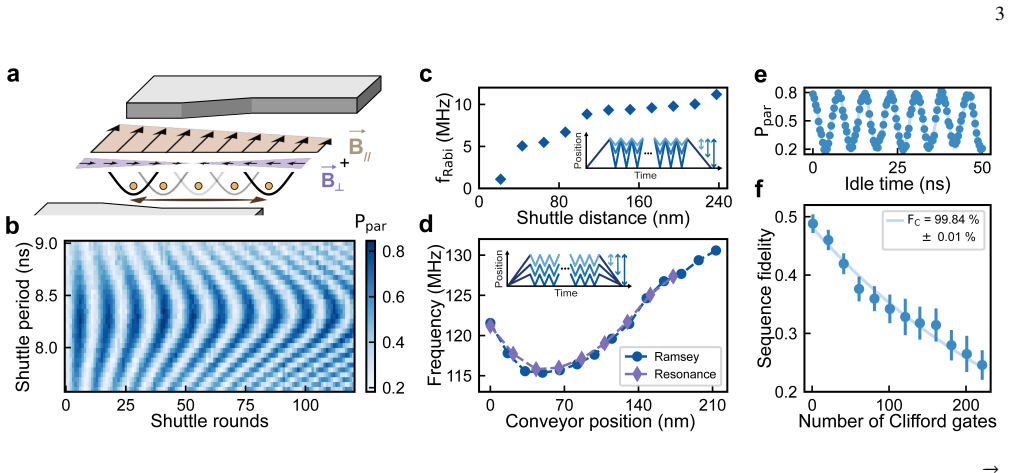
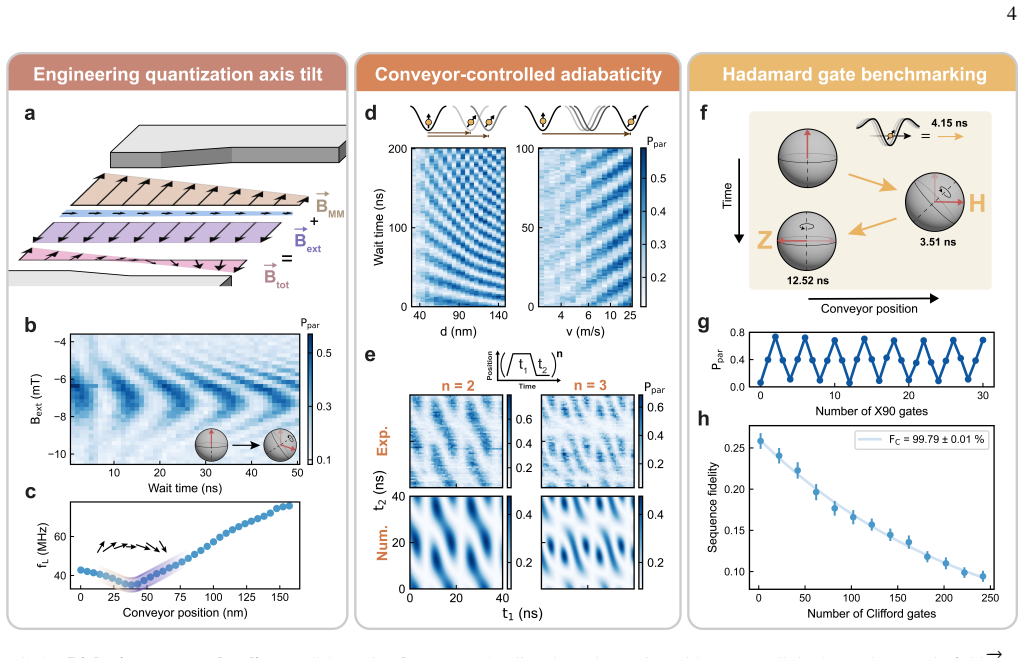
Conveyor electric-dipole spin resonance achieves high-fidelity rotations by resonantly shuttling spins through transverse magnetic-field gradients at their mean Larmor frequency, while conveyor diabatic gates exploit quantization-axis tilts for tunable bang-bang control; combining diabatic conveyor transport with exchange activation controlled by the motion directly yields a variety of effective two-qubit interactions selectable via the shuttling speed and distance.
What carries the argument
Conveyor-mode shuttling using traveling-wave potentials that move charge carriers while the induced motion through gradients or tilts supplies the coherent control.
If this is right
- Single-qubit rotations become possible solely by resonant shuttling without additional microwave drives.
- Two-qubit interactions become tunable by choosing shuttling speed and distance during exchange activation.
- Qubit routing and gate operations can be performed by the same conveyor mechanism in one device.
- Semiconductor processors gain reconfigurability where connections are set dynamically by transport paths.
Where Pith is reading between the lines
- The approach may reduce wiring density by moving qubits to shared interaction regions instead of routing control signals to fixed locations.
- Different conveyor velocities could be tested to separate coherent motion effects from velocity-dependent noise sources.
- Integration with existing quantum-dot arrays might allow conveyor segments to act as both highways and gate zones without new fabrication layers.
Load-bearing premise
Traveling-wave conveyor potentials preserve spin state with high fidelity during shuttling so motion-induced gradients and tilts can produce coherent control without dominant decoherence.
What would settle it
Failure to observe the predicted rotation angles or two-qubit interaction strengths when shuttling at the mean Larmor frequency through calibrated gradients, with coherence times instead limited by the transport itself.
Figures

read the original abstract
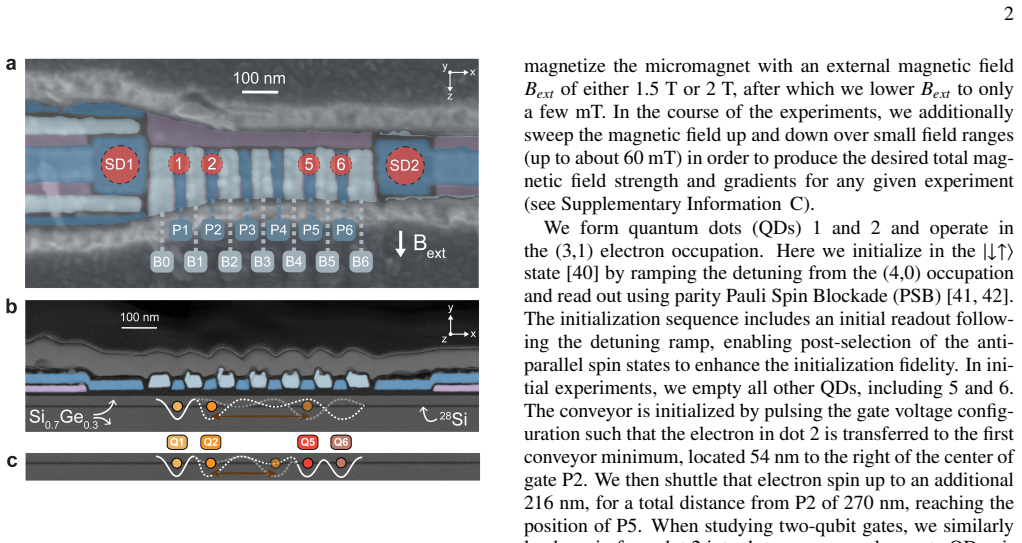
Dynamic qubit routing is emerging as a promising architectural path for semiconductor quantum processors. Charge carriers can be rapidly moved around on a chip using traveling-wave potentials known as conveyors, preserving the spin state with high fidelity. Originally developed for spin transport, conveyor-mode shuttling may also offer opportunities for performing qubit operations directly controlled by the motion itself. Here, we demonstrate coherent single- and two-qubit control by conveyor-mode electron shuttling, using two conceptually different approaches. First, conveyor electric-dipole spin resonance (conveyor EDSR) achieves high-fidelity rotations by resonantly shuttling spins through transverse magnetic-field gradients at their mean Larmor frequency. Second, conveyor diabatic gates exploit quantization-axis tilts for tunable bang-bang control. Combining diabatic conveyor transport with exchange activation controlled by the motion directly yields a variety of effective two-qubit interactions selectable via the shuttling speed and distance. These experimental results motivate an architectural paradigm of reconfigurable and transport-driven spin qubits.
Editorial analysis
A structured set of objections, weighed in public.
Referee Report
Summary. The manuscript claims to experimentally demonstrate coherent single- and two-qubit control via conveyor-mode electron shuttling in two approaches: conveyor EDSR, which uses resonant shuttling through transverse magnetic gradients at the mean Larmor frequency for high-fidelity rotations, and conveyor diabatic gates, which exploit quantization-axis tilts for tunable bang-bang control; the latter is combined with motion-controlled exchange to produce selectable two-qubit interactions.
Significance. If the experimental results hold, the work would be significant for semiconductor spin-qubit architectures by showing that traveling-wave conveyor potentials can be used not only for transport but also to directly implement coherent operations, potentially enabling reconfigurable, motion-driven qubit routing with reduced static control overhead.
major comments (2)
- [Abstract] Abstract: the central experimental claim of 'high-fidelity rotations' and 'coherent single- and two-qubit control' is stated without any fidelity numbers, error bars, raw data, or methods details, rendering the claim unverifiable from the manuscript text.
- [Abstract] Abstract: the load-bearing premise that 'traveling-wave potentials known as conveyors, preserving the spin state with high fidelity' is asserted as background without independent shuttling-fidelity or transport-T2 measurements that would separate spin preservation from the claimed motion-induced control effects.
Simulated Author's Rebuttal
We thank the referee for their constructive comments on the abstract. We address each point below and have revised the manuscript accordingly to improve the verifiability of our claims while respecting length constraints.
read point-by-point responses
-
Referee: [Abstract] Abstract: the central experimental claim of 'high-fidelity rotations' and 'coherent single- and two-qubit control' is stated without any fidelity numbers, error bars, raw data, or methods details, rendering the claim unverifiable from the manuscript text.
Authors: We agree that the abstract would benefit from quantitative support. The main text (Sections III and IV) and figures report specific fidelities with error bars (e.g., from randomized benchmarking and Ramsey experiments) along with raw data traces. We have revised the abstract to include key fidelity values and a brief reference to the experimental methods used. revision: yes
-
Referee: [Abstract] Abstract: the load-bearing premise that 'traveling-wave potentials known as conveyors, preserving the spin state with high fidelity' is asserted as background without independent shuttling-fidelity or transport-T2 measurements that would separate spin preservation from the claimed motion-induced control effects.
Authors: This background statement is drawn from our prior experimental characterization of conveyor transport (cited in the manuscript), which separately quantified shuttling fidelity and transport-induced dephasing via T2 measurements. To address the concern, we have added an explicit citation to those independent measurements directly in the revised abstract. revision: yes
Circularity Check
No circularity: experimental claims rest on measurements, not derivations or self-referential fits
full rationale
The paper reports experimental demonstrations of coherent single- and two-qubit operations via conveyor-mode shuttling. No equations, derivations, fitted parameters renamed as predictions, or load-bearing self-citations appear in the provided abstract or described content. The central claims are supported by new measurements of rotations and interactions, with the spin-preservation premise treated as a background experimental condition rather than a result derived from the control effects themselves. This is the expected non-finding for an experimental methods paper without theoretical reduction steps.
Axiom & Free-Parameter Ledger
axioms (1)
- standard math Standard quantum mechanics and semiconductor physics assumptions for electron spin in quantum dots and magnetic gradients
Reference graph
Works this paper leans on
-
[1]
Vandersypen, L. M. K. & Eriksson, M. A. Quantum computing with semiconductor spins.Physics Today72, 38–45 (2019)
2019
-
[2]
Maurand, R.et al.A CMOS silicon spin qubit.Nature Com- munications7, 13575 (2016)
2016
-
[3]
Zwerver, A. M. J.et al.Qubits made by advanced semiconduc- tor manufacturing.Nature Electronics5, 184–190 (2022)
2022
-
[4]
Steinacker, P.et al.Industry-compatible silicon spin-qubit unit cells exceeding 99% fidelity.Nature646, 81–87 (2025). 8
2025
-
[5]
C.et al.12-Spin-Qubit Arrays Fabricated on a 300 mm Semiconductor Manufacturing Line.Nano Letters25, 793– 799 (2025)
George, H. C.et al.12-Spin-Qubit Arrays Fabricated on a 300 mm Semiconductor Manufacturing Line.Nano Letters25, 793– 799 (2025)
2025
-
[6]
Neyens, S.et al.Probing single electrons across 300-mm spin qubit wafers.Nature629, 80–85 (2024)
2024
-
[7]
Yoneda, J.et al.A quantum-dot spin qubit with coherence lim- ited by charge noise and fidelity higher than 99.9%.Nature Nanotechnology13, 102–106 (2018)
2018
-
[8]
H.et al.Silicon qubit fidelities approaching incoherent noise limits via pulse engineering.Nature Electronics2, 151– 158 (2019)
Yang, C. H.et al.Silicon qubit fidelities approaching incoherent noise limits via pulse engineering.Nature Electronics2, 151– 158 (2019)
2019
-
[9]
Lawrie, W. I. L.et al.Simultaneous single-qubit driving of semiconductor spin qubits at the fault-tolerant threshold.Na- ture Communications14, 3617 (2023)
2023
-
[11]
A digitally controlled silicon quantum processing unit
Members of the HRL Quantum Team and Collaborators. A digitally controlled silicon quantum processing unit (2026). arXiv:2604.16216
work page internal anchor Pith review Pith/arXiv arXiv 2026
-
[12]
T.et al.Operating two exchange-only qubits in parallel.Nature647, 870–875 (2025)
M˛ adzik, M. T.et al.Operating two exchange-only qubits in parallel.Nature647, 870–875 (2025)
2025
-
[13]
Xue, X.et al.Quantum logic with spin qubits crossing the surface code threshold.Nature601, 343–347 (2022)
2022
-
[14]
Noiri, A.et al.Fast universal quantum gate above the fault- tolerance threshold in silicon.Nature601, 338–342 (2022)
2022
-
[15]
R.et al.Two-qubit silicon quantum processor with operation fidelity exceeding 99%.Science Advances8, 5130 (2022)
Mills, A. R.et al.Two-qubit silicon quantum processor with operation fidelity exceeding 99%.Science Advances8, 5130 (2022)
2022
-
[16]
Tanttu, T.et al.Assessment of the errors of high-fidelity two- qubit gates in silicon quantum dots.Nature Physics20, 1–6 (2024)
2024
-
[17]
Vandersypen, L. M. K.et al.Interfacing spin qubits in quan- tum dots and donors—hot, dense, and coherent.npj Quantum Information3, 34 (2017)
2017
-
[18]
M.et al.Fault-tolerant architecture for quantum com- putation using electrically controlled semiconductor spins.Na- ture Physics1, 177–183 (2005)
Taylor, J. M.et al.Fault-tolerant architecture for quantum com- putation using electrically controlled semiconductor spins.Na- ture Physics1, 177–183 (2005)
2005
-
[19]
Seidler, I.et al.Conveyor-mode single-electron shuttling in Si/SiGe for a scalable quantum computing architecture.npj Quantum Information8, 1–7 (2022)
2022
-
[20]
Xue, R.et al.Si/SiGe QuBus for single electron information- processing devices with memory and micron-scale connectivity function.Nature Communications15, 2296 (2024)
2024
-
[21]
Struck, T.et al.Spin-EPR-pair separation by conveyor-mode single electron shuttling in Si/SiGe.Nature Communications 15, 1325 (2024)
2024
-
[22]
Ademi, Z.et al.Distributing entanglement between distant semiconductor qubit registers using a shared-control shuttling link (2025). arXiv:2510.26860
-
[23]
Nature Nanotechnology20, 866–872 (2025)
De Smet, M.et al.High-fidelity single-spin shuttling in silicon. Nature Nanotechnology20, 866–872 (2025)
2025
-
[24]
Undseth, B.et al.Weight-four parity checks with silicon spin qubits (2026). arXiv:2601.23267
-
[25]
& Benjamin, S
Cai, Z., Siegel, A. & Benjamin, S. Looped Pipelines Enabling Effective 3D Qubit Lattices in a Strictly 2D Device.PRX Quan- tum4, 020345 (2023)
2023
-
[26]
Künne, M.et al.The SpinBus architecture for scaling spin qubits with electron shuttling.Nature Communications15, 4977 (2024)
2024
-
[27]
Matsumoto, Y .et al.Two-qubit logic and teleportation with mobile spin qubits in silicon (2025). arXiv:2503.15434
-
[28]
& Platero, G
Fernández-Fernández, D., Ban, Y . & Platero, G. Flying Spin Qubits in Quantum Dot Arrays Driven by Spin-Orbit Interac- tion.Quantum8, 1533 (2024)
2024
-
[29]
& Loss, D
Bosco, S., Zou, J. & Loss, D. High-Fidelity Spin Qubit Shuttling via Large Spin-Orbit Interactions.PRX Quantum5, 020353 (2024)
2024
-
[30]
A.et al.Spintronics: A Spin-Based Electronics Vision for the Future.Science294, 1488–1495 (2001)
Wolf, S. A.et al.Spintronics: A Spin-Based Electronics Vision for the Future.Science294, 1488–1495 (2001)
2001
-
[31]
M.et al.Large spin-shuttling oscillations en- abling high-fidelity single-qubit gates.Physical Review Applied 24, 034029 (2025)
Pazhedath, A. M.et al.Large spin-shuttling oscillations en- abling high-fidelity single-qubit gates.Physical Review Applied 24, 034029 (2025)
2025
-
[32]
N., Borhani, M
Golovach, V . N., Borhani, M. & Loss, D. Electric-dipole- induced spin resonance in quantum dots.Physical Review B 74, 165319 (2006)
2006
-
[33]
Physical Review Research2, 012006 (2020)
Croot, X.et al.Flopping-mode electric dipole spin resonance. Physical Review Research2, 012006 (2020)
2020
-
[34]
Wang, C.-A.et al.Operating semiconductor quantum proces- sors with hopping spins.Science385, 447–452 (2024)
2024
-
[35]
K.et al.Baseband control of single-electron sili- con spin qubits in two dimensions.Nature Communications 16, 5605 (2025)
Unseld, F. K.et al.Baseband control of single-electron sili- con spin qubits in two dimensions.Nature Communications 16, 5605 (2025)
2025
- [36]
-
[37]
Meunier, T., Calado, V . E. & Vandersypen, L. M. K. Efficient controlled-phase gate for single-spin qubits in quantum dots. Physical Review B83, 121403 (2011)
2011
-
[38]
D., Pan, A., Nichol, J
Burkard, G., Ladd, T. D., Pan, A., Nichol, J. M. & Petta, J. R. Semiconductor spin qubits.Reviews of Modern Physics95, 025003 (2023)
2023
-
[39]
Physical Review B81, 085317 (2010)
Obata, T.et al.Coherent manipulation of individual electron spin in a double quantum dot integrated with a micromagnet. Physical Review B81, 085317 (2010)
2010
-
[40]
R.et al.Coherent Manipulation of Coupled Electron Spins in Semiconductor Quantum Dots.Science309, 2180– 2184 (2005)
Petta, J. R.et al.Coherent Manipulation of Coupled Electron Spins in Semiconductor Quantum Dots.Science309, 2180– 2184 (2005)
2005
-
[41]
G., Tokura, Y
Ono, K., Austing, D. G., Tokura, Y . & Tarucha, S. Current Rectification by Pauli Exclusion in a Weakly Coupled Double Quantum Dot System.Science297, 1313–1317 (2002)
2002
-
[42]
C., Petta, J
Johnson, A. C., Petta, J. R., Marcus, C. M., Hanson, M. P. & Gossard, A. C. Singlet-triplet spin blockade and charge sensing in a few-electron double quantum dot.Physical Review B72, 165308 (2005)
2005
-
[43]
PRX Quantum2, 030331 (2021)
Mortemousque, P.-A.et al.Enhanced spin coherence while dis- placing electron in a two-dimensional array of quantum dots. PRX Quantum2, 030331 (2021)
2021
-
[44]
Langrock, V .et al.Blueprint of a scalable spin qubit shut- tle device for coherent mid-range qubit transfer in disordered Si/SiGe/SiO2.PRX Quantum4, 020305 (2023)
2023
-
[45]
A.et al.Coherence Protection for Mobile Spin Qubits in Silicon (2026)
Krzywda, J. A.et al.Coherence Protection for Mobile Spin Qubits in Silicon (2026). arXiv:2602.09179
-
[46]
& Whaley, K
Zhang, J., Vala, J., Sastry, S. & Whaley, K. B. Geometric the- ory of nonlocal two-qubit operations.Physical Review A67, 042313 (2003)
2003
-
[47]
Tucci, R. R. An Introduction to Cartan’s KAK Decomposition for QC Programmers (2005). arXiv:quant-ph/0507171
work page internal anchor Pith review Pith/arXiv arXiv 2005
-
[48]
Calderon-Vargas, F. A. & Kestner, J. P. Directly accessible entangling gates for capacitively coupled singlet-triplet qubits. Physical Review B91, 035301 (2015)
2015
-
[49]
Benito, M.et al.Electric-field control and noise protection of the flopping-mode spin qubit.Physical Review B100, 125430 (2019)
2019
-
[50]
Degli Esposti, D.et al.Low disorder and high valley splitting in silicon.npj Quantum Information10, 1–9 (2024)
2024
-
[51]
Degli Esposti, D.et al.Wafer-scale low-disorder 2DEG in 28Si/SiGe without an epitaxial Si cap.Applied Physics Letters 9 120, 184003 (2022)
2022
-
[52]
Xue, X.et al.Benchmarking gate fidelities in a Si/SiGe two- qubit device.Phys. Rev. X9, 021011 (2019)
2019
-
[53]
S.et al.Scaling of silicon spin qubits under correlated noise (2026)
Rojas-Arias, J. S.et al.Scaling of silicon spin qubits under correlated noise (2026). arXiv:2603.03051
-
[54]
& Coliado Bandeira, L
Ortner, M. & Coliado Bandeira, L. G. Magpylib: A free Python package for magnetic field computation.SoftwareX11, 100466 (2020)
2020
-
[55]
& Leijon, M
Mörée, G. & Leijon, M. Review of hysteresis models for mag- netic materials.Energies16, 3908 (2023)
2023
-
[56]
C.et al.Site-resolved magnon and triplon dy- namics on a programmable quantum dot spin ladder (2025)
Fariña, P. C.et al.Site-resolved magnon and triplon dy- namics on a programmable quantum dot spin ladder (2025). arXiv:2506.08663
-
[57]
Nature Nanotechnology20, 209–215 (2025)
Zhang, X.et al.Universal control of four singlet–triplet qubits. Nature Nanotechnology20, 209–215 (2025)
2025
-
[58]
Capannelli, K.et al.Tracking spin qubit frequency variations over 912 days.npj Quantum Information11, 192 (2025)
2025
-
[59]
Burkard, G., Loss, D., DiVincenzo, D. P. & Smolin, J. A. Phys- ical optimization of quantum error correction circuits.Physical Review B60, 11404–11416 (1999). METHODS
1999
-
[60]
A 1.5µm linearly graded Si 1–xGex buffer layer is grown on a silicon wafer, followed by a relaxed 300 nm Si 0.7Ge0.3 spacer
Device fabrication The device is fabricated on an isotopically purified 28Si/SiGe heterostructure. A 1.5µm linearly graded Si 1–xGex buffer layer is grown on a silicon wafer, followed by a relaxed 300 nm Si 0.7Ge0.3 spacer. A tensile-strained 7 nm 28Si quantum well with a residual 29Si concentration of 800 ppm is then grown [50], separated from the gate s...
-
[61]
Each gate in the conveyor, therefore, receives two sinusoidal pulses, given by Vn(t)=V DC n + An 2 sin(2πf t−ϕ n) +sin (πf t−θ n)
Two-tone conveyor shuttling In the main text of this work, we employ a two-tone con- veyor [23] to shuttle qubit 2 or qubit 5. Each gate in the conveyor, therefore, receives two sinusoidal pulses, given by Vn(t)=V DC n + An 2 sin(2πf t−ϕ n) +sin (πf t−θ n) . Here, the DC voltageV DC n is tuned individually for each gate, while the amplitudesA n are shared...
-
[62]
2f was performed using the X/Z compilation (Table II in [52])
Single-qubit RB gateset Randomized benchmarking of the conveyor EDSR gate in Fig. 2f was performed using the X/Z compilation (Table II in [52]). The baseband control of spin qubits performed in this work natively uses only positive X and Z rotations [34, 35]. Given the Larmor frequencies at the conveyor EDSR condi- tion (Fig. 2d), theZ 90 gate duration fa...
-
[63]
A simple estimate of the resulting infidelity 1−F≈ ⟨δϕ 2⟩/6=9×10 −5 shows that these phase errors are an order of magnitude smaller than theX90 shuttling gate error, supporting the conclusion from the interleaved ran- domized benchmarking measurements. FIG. S9.Conveyor EDSR subharmonics when shuttling with a block-like motion profile.The one-way shuttle t...
-
[64]
The left qubit is shuttled towards the right qubit, which remains static
Model Hamiltonian The starting point is a minimal Hamiltonian for two electron-spin qubits subject to a spatially varying magnetic field vector, resulting from the vector sum of the externally ap- plied magnetic field and the stray magnetic field from the mi- cromagnet. The left qubit is shuttled towards the right qubit, which remains static. We set thez-...
-
[65]
We therefore analyze a single electron-spin qubit shuttled along a one-dimensional channel in the presence of the total magnetic field ⃗B
Single-qubit calibration The calibration begins in the simplest regime, where ex- change is absent, and the magnetic-field profile can be probed directly. We therefore analyze a single electron-spin qubit shuttled along a one-dimensional channel in the presence of the total magnetic field ⃗B. In this step, the left qubit is initial- ized in |↑⟩, shuttled ...
-
[66]
The Hamiltonian is still given by Eq
Two-qubit calibration Having fixed the field sampled by the moving qubit, we now turn to the interacting two-qubit system. The Hamiltonian is still given by Eq. (S2), but the magnetic field at the position of the left qubit is now fixed by the single-qubit reconstruction. The remaining unknowns are the exchange couplingJ(d) and the magnitude and polar ang...
-
[67]
Predicted Two-Qubit Gate Set We now use the calibrated Hamiltonian to assess which two-qubit gates the model predicts are accessible with the shuttling protocol. Because the magnetic field shows some dataset-to-dataset variability, we fix the global shift to∆x=2 nm and the right-qubit Larmor frequency to fR =102.2 MHz, i.e., the values extracted from the ...
discussion (0)
Sign in with ORCID, Apple, or X to comment. Anyone can read and Pith papers without signing in.