REVIEW 2 major objections 5 minor 72 references
Bosonization and Kramers-Wannier dualities in general dimensions
T0 review · 2 major / 5 minor · reviewed 2026-08-05 · deepseek-v4-flash
Pith's one-line read Exact bosonization maps any parity-even fermionic lattice to a gauged spin system, and minimal translations become higher-dimensional KW dualities.
desk verdict The 2D bosonization and KW duality results are solid and worth engaging with, but the abstract overclaims the higher-dimensional spin-structure dependence, which is only conjectural beyond triangulations. read the letter →
The pith
A machine-rendered reading of the paper's core claim, the machinery that carries it, and where it could break.
The reading
What carries the argument
The load-bearing object is the disentangling unitary U = ∏_e (P^+_e + P^-_e S_e), where e runs over the gauge-spin-carrying edges (2D) or faces (3D), P^±_e project onto the spin state, and S_e is a Majorana bilinear assigned to the two neighboring cells sharing e; each factor is a controlled parity flip. Equally load-bearing is the flatness condition ∏_{e⊃v} X_e = 1 in 2D (and ∏_{f⊃e} X_f = 1 in 3D), which excludes gauge flux and, after conjugation by U, becomes the Gauss law of the bosonized spin system. A third ingredient is the Kasteleyn orientation — an orientation of the dual graph in which every dual face has an odd number of clockwise edges — which fixes the signs in the Gauss law and
What would settle it
On a small periodic square lattice (say 4×4), construct the bosonized KW operator D_KW = T^b_x ∏_m (U^x_m + 1)/2 and test whether it implements the advertised maps W_f → X_{e^x_f} → W_{f+a_x} in every sector where a 1-form symmetry generator has eigenvalue −1; a single sector where the projection forces an inconsistent or nonlocal image would refute the explicit duality formula.
Extended reading notes
Core claim
The central discovery is that the 1D fact 'Majorana chain = transverse-field Ising model' is the tip of a general construction. For a parity-even fermionic system on any polyhedral decomposition, the paper puts Z2 gauge spins on the codimension-one cells and imposes the Gauss law that the fermion parity on each cell is tied to the surrounding spins. A unitary U = ∏_e [P^+_e + P^-_e S_e] — a product over edges/faces of controlled local parity flips S_e — disentangles the fermions from the spins while preserving gauge invariance. Imposing the flatness condition ∏ X = 1 on the gauge field makes the gauged system equivalent to the original ungauged one; after U, that condition becomes the Gauss
Load-bearing premise
The duality between the original fermion system and the gauged spin system holds only after imposing flatness of the gauge field by hand, and the paper does not analyze what happens in configurations with nonzero gauge flux.
Editorial extensions
If this is right
- Any parity-even fermionic lattice system—interacting or free, on any polyhedral decomposition—acquires an exact bosonized dual as a gauged spin model with a Gauss law.
- Minimal translations of a translationally invariant Majorana lattice become KW dualities of the spin model; with two fermion copies the dualities run along several lattice directions and exchange U(1) charges at self-dual points.
- In 2D the KW duality operator is explicitly D_KW = T^b_x ∏_m (U^x_m + 1)/2, so the duality is non-invertible because of projections onto 1-form symmetry sectors.
- The bosonized Gauss law is modified by plaquette and vertex terms whose signs depend on the discrete spin structure, so the spin dual remembers the fermionic spin structure.
- In 3D and higher the same construction yields 2-form Gauss laws and higher-form symmetry projections, extending KW dualities beyond one dimension.
Reading between the lines
- If the flatness condition is relaxed, the same disentangling unitary may still describe a gauged fermion system coupled to a fluctuating Z2 gauge field; the flux sectors could be interpreted as anyonic excitations, turning the construction into a map between a fermion theory and a gauge theory with topological order rather than a pure bosonization.
- The anisotropic, direction-dependent form of the 2D KW dualities suggests that continuum descriptions of these dualities cannot be obtained by gauging a single higher-form symmetry; a field-theoretic realization would need to keep track of the chosen lattice direction or cycle.
- On a torus, the modified Gauss laws and the 1-form symmetry projections can be probed by computing the ground-state degeneracy and entanglement spectrum of the gauged spin model; a nontrivial degeneracy matching the fermionic sectors would confirm the duality beyond the infinite-plane case.
- The same construction could be run with rotations or other crystalline symmetries replacing translations, producing non-invertible duality defects from fermionic crystalline symmetries; the paper mentions this as future work.
Editorial analysis
A structured set of objections, weighed in public.
Referee Report
Summary. The paper develops an exact lattice bosonization framework in two and higher dimensions. The main construction starts from a parity-gauged fermionic system on a polyhedral decomposition, builds a disentangling unitary from edge/face assignment data, and then imposes a flatness condition on the gauge field to obtain a duality between the original ungauged fermionic system and a gauged spin system with a Gauss law. The authors emphasize the dependence of the resulting Gauss law on Kasteleyn orientations and discrete spin structures, and apply the framework to translationally invariant Majorana lattices to derive higher-dimensional Kramers-Wannier dualities, including the explicit non-invertible operator in Eq. (70). The paper also shows how the construction subsumes the Bravyi–Kitaev and Chen–Kapustin bosonization schemes.
Significance. If the claims are correct, the paper provides a useful and systematic algebraic framework that unifies several known exact bosonization methods and gives explicit higher-dimensional KW dualities. The parameter-free construction, the direct derivation of Eqs. (24), (27), (31), (45), and (70), and the cross-checks against the Bravyi–Kitaev and Chen–Kapustin methods are notable strengths. The 2D square- and honeycomb-lattice examples, including the non-invertible KW duality operator Eq. (70), are concrete and do not depend on the more speculative higher-dimensional conjecture. The paper is therefore of significant interest to the condensed-matter lattice-model community, provided the scope of the general-dimensional claims is brought in line with what is actually proven.
major comments (2)
- [Sec. II E 2] The headline claim of an explicit bosonization prescription on arbitrary polyhedral decompositions in arbitrary dimensions is not fully supported. Section IV B states that generalizations to arbitrary regular decompositions in dimensions higher than two are lacking, and the relation between generalized Kasteleyn orientations and spin structures is posed as a conjecture. This relation is exactly what fixes the phase in the image of the flatness condition and hence the explicit form of the Gauss law Ge=1 after Eq. (98). For non-triangulated D>=3 decompositions, the signs in the Gauss law are therefore not determined by the discrete spin structure. The 2D results and Eq. (70) are unaffected, but the abstract and introduction overreach. The authors should either prove the conjecture for the claimed class of decompositions or explicitly restrict the general-dimensional statement to triangulat
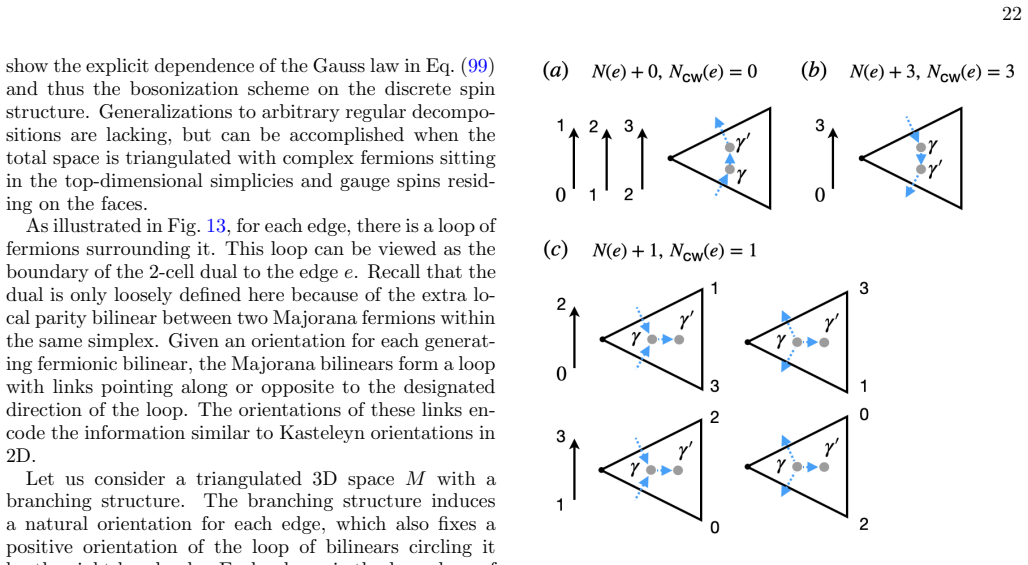
- [Sec. II E 2] The extension of the Kasteleyn/spin-structure relation from triangulations to arbitrary 2D surface graphs contains a gap. The proof requires that the arrows formed by the fermion bilinears form an embedded dual surface graph, and crossings such as Fig. 7(a) are excluded ('This type of configuration should be ruled out'). The text does not prove that such an assignment can always be chosen for an arbitrary polyhedral decomposition, nor that the 'hidden edge' enumeration is exhaustive and valid in all cases. Since the advertised dependence of the Gauss law on spin structures for general surface graphs rests on this argument, this point should be turned into an explicit lemma with a proof, or the statement should be formulated as a condition on the assignment.
minor comments (5)
- [Eq. (43)] Equation (43) appears to be missing a factor (-1)^{n_cw(v)}. The text correctly states that flipping one edge orientation flips the sign, and Eq. (44) then uses (-1); as displayed, Eq. (43) should read i^{q_v}(-1)^{n_cw(v)}.
- [Sec. II C 2] The sentence 'each factor contains extensively many Majorana fermions and spins' is confusing: each factor [P^+_e + P^-_e S_e] in Eq. (19) is a local operator involving one spin and one Majorana bilinear. Presumably the intended meaning is that the factors cannot be grouped into disjoint local blocks. Please rephrase.
- [Eq. (81)] The third displayed equation in Eq. (81) repeats Q_{b,x}; the second one should be Q_{b,y}.
- [Sec. IV B] The notation t_{\pm}(f) and \gamma'_{t_-(f)} is introduced without an explicit definition of how the two neighboring 3-simplices are ordered relative to the positive normal direction. Please clarify.
- [General] The unusual product notation \fY is not defined in the main text before first use. It is explained in words, but a formal definition would improve readability.
Circularity Check
No significant circularity: the derivation is a parameter-free algebraic construction; the only higher-dimensional gap is an explicitly labeled conjecture, not a circular step.
full rationale
The paper's central derivation is an explicit, parameter-free algebraic map: parity-gauged fermionic algebras are unitarily transformed to spin algebras, the flatness condition is mapped to a Gauss law, and minimal Majorana translations are mapped to KW-type duality operators. None of these steps fits a parameter to data and then re-predicts it, and no load-bearing premise is justified by a self-citation. The Kasteleyn-orientation/spin-structure correspondence is cited to external mathematical work (Ref. [47]) and also argued directly in Sec. II E. The only gap in the higher-dimensional generalization is explicitly stated: Sec. IV B says 'Generalizations to arbitrary regular decompositions are lacking' and frames the higher-dimensional Kasteleyn/spin-structure connection as a conjecture. That is a correctness/scope limitation, not circularity. The 2D results and Eq. (70) are self-contained derivations from the stated operator algebra, so no circular step is exhibited.
Assumptions & free parameters
assumptions (6)
- domain assumption The fermionic Hamiltonian is parity-even.
- domain assumption Flatness of the gauge field: Q_{e⊃v} X_e = 1 in 2D and Q_{f⊃e} X_f = 1 in 3D.
- standard math Existence of Kasteleyn orientations on surface graphs with an even number of vertices.
- standard math One-to-one correspondence between equivalence classes of Kasteleyn orientations and spin structures.
- standard math Poincaré duality and simplicial cohomology tools.
- ad hoc to paper Generalized Kasteleyn orientations determine spin structures for arbitrary polyhedral decompositions in dimensions >2.
Cite this review
Pith. "Pith review of Bosonization and Kramers-Wannier dualities in general dimensions." pith.science (2026). https://pith.science/paper/WYHSHXUG
@misc{pith2026250820167,
  author       = {Pith},
  title        = {Pith review of: Bosonization and Kramers-Wannier dualities in general dimensions},
  year         = {2026},
  howpublished = {\url{https://pith.science/paper/WYHSHXUG}},
  note         = {Machine review of arXiv:2508.20167}
}
read the original abstract
It is well known that the noninteracting Majorana chain is dual to the one-dimensional transverse-field Ising model, either through the Jordan-Wigner transformation or by gauging fermion parity. In this correspondence, the minimal translation of the Majorana chain maps to the celebrated Kramers-Wannier (KW) duality of the spin model, with the critical point mapped to the self-dual point. In this work, we generalize this mapping to two and higher dimensions by constructing a unitary equivalence between the parity-gauged fermionic system and a spin system defined on arbitrary polyhedral decompositions of space. Imposing the flatness condition on the gauge field yields a bosonization duality between the original (ungauged) fermionic system and a gauged spin system obeying a Gauss law. The dependence of the Gauss law in the spin system on the Kasteleyn orientation (and the discrete spin structure) of the fermionic system is made explicit. Applying this bosonization to one or two copies of Majorana fermions on translationally invariant lattices, we derive higher-dimensional analogs of KW (self-)dualities in spin systems arising from fermionic minimal translations. The KW (self-)dualities are non-invertible due to projections onto eigenspaces of higher-form symmetries in the associated symmetry operators. The bosonization framework we present is intuitive, general, and systematic, encompassing other known exact bosonization methods while offering a novel approach to establish new connections between fermionic and spin systems in arbitrary dimensions.
Figures



Figures from the paper (11 more)



Reference graph
Works this paper leans on
-
[1]
Square lattice We first consider the case on the square lattice. Com- pared to Eq. (55), we modify the bilinear couplings in the horizontal direction by changing nearest-neighbor couplings (as shown in Fig. 8) to next-nearest-neighbor couplings. To illustrate it, we redraw the schematic in Fig. 10(a). Two Majorana fermions on each face are slightly displa...
-
[2]
The Hamil- tonian is exactly solvable and the dispersion relation is given by ε(kx, ky) = ± q t2 1 + t2 2 − 2t1t2 cos 2kx + 2t′ sin ky. (57) The first term corresponds to the dispersion relation of the 1D Majorana chain, and the second term is due to couplings along the transverse direction to the neighbor- ing chains. The dispersion relation remains inva...
-
[3]
becomes H(t2, t1, t′ 2, t′
-
[4]
Thus, there are also two types of KW duality transfor- mations
under the transformation T 1/2 x and T 1/2 y . Thus, there are also two types of KW duality transfor- mations. In the horizontal direction, the duality KW x maps A′ f → Af → A′ f +ax , B ′ f → Bf → B′ f +ax . (82) In the vertical direction, the duality KW y maps A′ f → Af → A′ f +ay , B ′ f → Bf → B′ f +ay . (83) The Hamiltonian H(t1, t2, t′ 1, t′
-
[5]
is self-dual at t1 = t2 and t′ 1 = t′
-
[6]
For the charges, KW x maps Qb → Qb,x → Qb (84) and KW y maps Qb → Qb,y → Qb. (85) These are essentially the KW duality for one copy of free Majorana fermions discussed in the last section where these charges are terms in the Hamiltonian. Once again, the dualities hold as long as the Gauss law constraints Gv = 1 are imposed for all v. The 1-form symmetry g...
-
[7]
Honeycomb lattice We can also consider the case on the honeycomb lattice as in Fig. 10(b). In this case, the dual lattice is a triangu- lar/hexagonal lattice. Each triangular face contains two Majorana fermions, and a unit cell contains two trian- gles. It is easy to see that the honeycomb lattice with nearest-neighbor couplings can be viewed as a deforme...
-
[8]
Operator isomorphism In the main text, we discussed how bosonization maps the parity-even fermionic algebra to the algebra gener- ated by the corresponding spin operators modulo the Gauss law. From an algebraic point of view, this is an isomorphism of operator algebras when the space M is simply connected. To have a better sense of the isomor- phism, let ...
Show all 72 references
-
[9]
Let H be a Hilbert space, and let B(H) denote the algebra of bounded operators on H
Bond algebras There is a close relation between isomorphisms of bond algebras and dualities [32]. Let H be a Hilbert space, and let B(H) denote the algebra of bounded operators on H. If S ⊂ B(H) is an arbitrary subset, its commutant (or centralizer) S ′ ∈ B(H) is the subalgebr...
-
[10]
Unital: A contains the identity operator, 1 ∈ A. 26
-
[11]
Self-adjoint: A is closed under the adjoint opera- tion, O 7→ O†
-
[12]
A map Φ : A1 → A2 between von Neumann algebras is a homomorphism if it preserves algebraic operations and the adjoint, i.e., Φ(O†) = Φ(O)†
Double commutant property: A is equal to its bi- commutant, A = A′′. A map Φ : A1 → A2 between von Neumann algebras is a homomorphism if it preserves algebraic operations and the adjoint, i.e., Φ(O†) = Φ(O)†. If Φ is a bijection, then it is an isomorphism. We then have the fol...
-
[13]
Here, 0-simplices are vertices, 1-simplices are edges, and 2-simplices are triangles, and higher-dimensional simplices follow similarly
Homology and cohomology groups A free abelian group (or a formal sum) generated by the p-simplices of the triangulated n-dimensional mani- fold M , with coefficients in Z2, is called a Z2 (simplicial) p-chain group Cp(M, Z2). Here, 0-simplices are vertices, 1-simplices are edg...
-
[14]
The structure group can be taken to be SO(n)
Spin structures Consider the tangent bundle of a (smooth) n- dimensional orientable manifold M . The structure group can be taken to be SO(n). There is an SO(n) frame bun- dle associated with the tangent bundle. Let {Ui} be an open cover of M . The transition functions tij : U...
-
[15]
D. C. Mattis and E. H. Lieb, Exact solution of a many- fermion system and its associated boson field, J. Math. Phys. 6, 304 (1965)
1965
-
[16]
Coleman, Quantum sine-Gordon equation as the mas- sive Thirring model, Phys
S. Coleman, Quantum sine-Gordon equation as the mas- sive Thirring model, Phys. Rev. D 11, 2088 (1975)
-
[17]
Jordan and E
P. Jordan and E. Wigner, ¨Uber das paulische ¨ aquivalenzverbot, Z. Physik47, 631 (1928)
1928
-
[18]
Wosiek, A local representation for fermions on a lat- tice, Tech
J. Wosiek, A local representation for fermions on a lat- tice, Tech. Rep. (Univ., Physics Department, 1981)
1981
-
[19]
A. M. Szczerba, Spins and fermions on arbitrary lattices, Commun. Math. Phys. 98, 513 (1985)
1985
-
[20]
Fradkin, Jordan-Wigner transformation for quantum- spin systems in two dimensions and fractional statistics, Phys
E. Fradkin, Jordan-Wigner transformation for quantum- spin systems in two dimensions and fractional statistics, Phys. Rev. Lett. 63, 322 (1989)
1989
-
[21]
S. B. Bravyi and A. Y. Kitaev, Fermionic quantum com- putation, Ann. Phys. 298, 210 (2002)
2002
-
[22]
Kitaev, Anyons in an exactly solved model and be- yond, Ann
A. Kitaev, Anyons in an exactly solved model and be- yond, Ann. Phys. 321, 2 (2006)
2006
-
[23]
Verstraete and J
F. Verstraete and J. I. Cirac, Mapping local Hamiltonians of fermions to local Hamiltonians of spins, J. Stat. Mech.: Theory Exp. 2005 (09), P09012
2005
-
[24]
R. C. Ball, Fermions without fermion fields, Phys. Rev. Lett. 95, 176407 (2005)
2005
-
[25]
Nussinov, G
Z. Nussinov, G. Ortiz, and E. Cobanera, Arbitrary di- mensional Majorana dualities and architectures for topo- logical matter, Phys. Rev. B 86, 085415 (2012)
2012
-
[26]
J. T. Seeley, M. J. Richard, and P. J. Love, The Bravyi- Kitaev transformation for quantum computation of elec- tronic structure, J. Chem. Phys. 137 (2012)
2012
-
[27]
Havl ´ ıˇ cek, M
V. Havl ´ ıˇ cek, M. Troyer, and J. D. Whitfield, Operator locality in the quantum simulation of fermionic models, Phys. Rev. A 95, 032332 (2017)
2017
-
[28]
Zohar and J
E. Zohar and J. I. Cirac, Eliminating fermionic matter fields in lattice gauge theories, Phys. Rev. B 98, 075119 (2018)
2018
-
[29]
Y.-A. Chen, A. Kapustin, and D. Radiˇ cevi´ c, Exact bosonization in two spatial dimensions and a new class of lattice gauge theories, Ann. Phys. 393, 234 (2018)
2018
-
[30]
Chen and A
Y.-A. Chen and A. Kapustin, Bosonization in three spa- tial dimensions and a 2-form gauge theory, Phys. Rev. B 100, 245127 (2019)
2019
-
[31]
Setia, S
K. Setia, S. Bravyi, A. Mezzacapo, and J. D. Whitfield, Superfast encodings for fermionic quantum simulation, Phys. Rev. Res. 1, 033033 (2019)
2019
-
[32]
Jiang, J
Z. Jiang, J. McClean, R. Babbush, and H. Neven, Majorana loop stabilizer codes for error mitigation in fermionic quantum simulations, Phys. Rev. Appl. 12, 064041 (2019)
2019
-
[33]
Steudtner and S
M. Steudtner and S. Wehner, Quantum codes for quan- tum simulation of fermions on a square lattice of qubits, Phys. Rev. A 99, 022308 (2019)
2019
-
[34]
Chen, Exact bosonization in arbitrary dimensions, Phys
Y.-A. Chen, Exact bosonization in arbitrary dimensions, Phys. Rev. Res. 2, 033527 (2020)
2020
-
[35]
Tantivasadakarn, Jordan-Wigner dualities for translation-invariant Hamiltonians in any dimension: Emergent fermions in fracton topological order, Phys
N. Tantivasadakarn, Jordan-Wigner dualities for translation-invariant Hamiltonians in any dimension: Emergent fermions in fracton topological order, Phys. Rev. Res. 2, 023353 (2020)
2020
-
[36]
S. K. Shukla, T. D. Ellison, and L. Fidkowski, Tensor net- work approach to two-dimensional bosonization, Phys. Rev. B 101, 155105 (2020)
2020
-
[37]
Bochniak and B
A. Bochniak and B. Ruba, Bosonization based on Clifford algebras and its gauge theoretic interpretation, J. High Energy Phys. 2020 (12), 1
2020
-
[38]
Derby, J
C. Derby, J. Klassen, J. Bausch, and T. Cubitt, Compact fermion to qubit mappings, Phys. Rev. B 104, 035118 (2021)
2021
-
[39]
Li and H
K. Li and H. C. Po, Higher-dimensional Jordan-Wigner transformation and auxiliary Majorana fermions, Phys. 30 Rev. B 106, 115109 (2022)
2022
-
[40]
Chiew and S
M. Chiew and S. Strelchuk, Discovering optimal fermion- qubit mappings through algorithmic enumeration, Quan- tum 7, 1145 (2023)
2023
-
[41]
O’Brien and S
O. O’Brien and S. Strelchuk, Ultrafast hybrid fermion- to-qubit mapping, Phys. Rev. B 109, 115149 (2024)
2024
-
[42]
O’Brien, L
O. O’Brien, L. Lootens, and F. Verstraete, Local Jordan- Wigner transformations and topological sectors on the torus, Phys. Rev. B 111, 115126 (2025)
2025
-
[43]
Gaiotto and A
D. Gaiotto and A. Kapustin, Spin TQFTs and fermionic phases of matter, Int. J. Mod. Phys. A 31, 1645044 (2016)
2016
-
[44]
Chen and Y
Y.-A. Chen and Y. Xu, Equivalence between fermion-to- qubit mappings in two spatial dimensions, PRX Quan- tum 4, 010326 (2023)
2023
-
[45]
H. A. Kramers and G. H. Wannier, Statistics of the Two- Dimensional Ferromagnet. Part I, Phys. Rev. 60, 252 (1941)
1941
-
[46]
Cobanera, G
E. Cobanera, G. Ortiz, and Z. Nussinov, The bond- algebraic approach to dualities, Adv. Phys. 60, 679 (2011)
2011
-
[47]
Lootens, C
L. Lootens, C. Delcamp, G. Ortiz, and F. Verstraete, Du- alities in one-dimensional quantum lattice models: sym- metric Hamiltonians and matrix product operator inter- twiners, PRX Quantum 4, 020357 (2023)
2023
-
[48]
Sch¨ afer-Nameki, ICTP lectures on (non-) invertible generalized symmetries, Phys
S. Sch¨ afer-Nameki, ICTP lectures on (non-) invertible generalized symmetries, Phys. Rep. 1063, 1 (2024)
2024
-
[49]
Shao, What’s done cannot be undone: TASI lectures on non-invertible symmetry, arXiv:2308.00747 (2023)
S.-H. Shao, What’s done cannot be undone: TASI lectures on non-invertible symmetry, arXiv:2308.00747 (2023)
2023 arXiv
-
[50]
Gaiotto, A
D. Gaiotto, A. Kapustin, N. Seiberg, and B. Willett, Gen- eralized global symmetries, J. High Energ. Phys. 2015 (2), 172
2015
-
[51]
Kaidi, K
J. Kaidi, K. Ohmori, and Y. Zheng, Kramers-Wannier- like duality defects in (3 + 1)d gauge theories, Phys. Rev. Lett. 128, 111601 (2022)
2022
-
[52]
Y. Choi, C. C´ ordova, P.-S. Hsin, H. T. Lam, and S.-H. Shao, Noninvertible duality defects in 3 + 1 dimensions, Phys. Rev. D 105, 125016 (2022)
2022
-
[53]
Seiberg and S.-H
N. Seiberg and S.-H. Shao, Majorana chain and Ising model - (non-invertible) translations, anomalies, and em- anant symmetries, SciPost Phys. 16, 064 (2024)
2024
-
[54]
Seiberg, S
N. Seiberg, S. Seifnashri, and S.-H. Shao, Non-invertible symmetries and LSM-type constraints on a tensor prod- uct Hilbert space, SciPost Phys. 16, 154 (2024)
2024
-
[55]
Chatterjee, S
A. Chatterjee, S. D. Pace, and S.-H. Shao, Quantized axial charge of staggered fermions and the chiral anomaly, Phys. Rev. Lett. 134, 021601 (2025)
2025
-
[56]
S. D. Pace, A. Chatterjee, and S.-H. Shao, Lattice T- duality from non-invertible symmetries in quantum spin chains, SciPost Phys. 18, 121 (2025)
2025
-
[57]
Su, Z2 gauging and self-dualities of the XX model and its cousins, Phys
L. Su, Z2 gauging and self-dualities of the XX model and its cousins, Phys. Rev. B 112, 035105 (2025)
2025
-
[58]
Hatcher, Algebraic Topology (Cambridge University Press, 2002)
A. Hatcher, Algebraic Topology (Cambridge University Press, 2002)
2002
-
[59]
Thorngren, Anomalies and bosonization, Commun
R. Thorngren, Anomalies and bosonization, Commun. Math. Phys. 378, 1775 (2020)
2020
-
[60]
Y.-A. Chen, T. D. Ellison, and N. Tantivasadakarn, Dis- entangling supercohomology symmetry-protected topo- logical phases in three spatial dimensions, Phys. Rev. Res. 3, 013056 (2021)
2021
-
[61]
Cimasoni and N
D. Cimasoni and N. Reshetikhin, Dimers on surface graphs and spin structures. I, Commun. Math. Phys. 275, 187 (2007)
2007
-
[62]
Wang and Z.-C
Q.-R. Wang and Z.-C. Gu, Towards a complete classifica- tion of symmetry-protected topological phases for inter- acting fermions in three dimensions and a general group supercohomology theory, Phys. Rev. X 8, 011055 (2018)
2018
-
[63]
Tarantino and L
N. Tarantino and L. Fidkowski, Discrete spin structures and commuting projector models for two-dimensional fermionic symmetry-protected topological phases, Phys. Rev. B 94, 115115 (2016)
2016
-
[64]
S. Tata, R. Kobayashi, D. Bulmash, and M. Barkeshli, Anomalies in (2+1)D fermionic topological phases and (3+1)D path integral state sums for fermionic SPTs, Commun. Math. Phys. 397, 199 (2023)
2023
-
[65]
S. D. Pace, M. L. Kim, A. Chatterjee, and S.-H. Shao, Parity anomaly from LSM: exact valley symmetries on the lattice, arXiv:2505.04684 (2025)
2025
-
[66]
A. N. Redlich, Gauge noninvariance and parity noncon- servation of three-dimensional fermions, Phys. Rev. Lett. 52, 18 (1984)
1984
-
[67]
Chen, Z.-C
X. Chen, Z.-C. Gu, Z.-X. Liu, and X.-G. Wen, Symmetry protected topological orders and the group cohomology of their symmetry group, Phys. Rev. B 87, 155114 (2013)
2013
-
[68]
Kapustin, Symmetry protected topological phases, anomalies, and cobordisms: beyond group cohomology, arXiv:1403.1467 (2014)
A. Kapustin, Symmetry protected topological phases, anomalies, and cobordisms: beyond group cohomology, arXiv:1403.1467 (2014)
2014 arXiv
-
[69]
Cheng and N
M. Cheng and N. Seiberg, Lieb-Schultz-Mattis, Lut- tinger, and ’t Hooft - anomaly matching in lattice sys- tems, SciPost Phys. 15, 051 (2023)
2023
-
[70]
Gioia and R
L. Gioia and R. Thorngren, Exact chiral symmetries of 3+ 1D Hamiltonian lattice fermions, arXiv:2503.07708 (2025)
2025 arXiv
-
[71]
Nakahara, Geometry, Topology and Physics (CRC press, 2018)
M. Nakahara, Geometry, Topology and Physics (CRC press, 2018)
2018
-
[72]
R. Z. Goldstein and E. C. Turner, A formula for Stiefel- Whitney homology classes, Proc. Amer. Math. Soc. 58, 339 (1976)
1976
Reviewed August 5, 2026 · model on record in the stance chip above.
Discussion (0). Continue with ORCID to comment.