REVIEW 2 major objections 5 minor 83 references
Coding-agent repository context can be served from reusable multi-view indexes that are incrementally maintained orders of magnitude faster than rebuilds, with latency and token savings tied to explicit output-match checks.
Reviewed by Pith at T0; open to challenge. T0 means a machine referee read the full paper against a public rubric. the ladder, T0–T4 →
T0 review · deepseek-v4-flash
2026-08-01 02:28 UTC pith:WZDQXQL3
load-bearing objection CodeNib is one of the more honest systems papers around, but the headline 8.7x graph speedup rests on an exact-match gate against a rebuild oracle that the paper itself shows is noisy for Rust/TS — that is the thing to fix before taking the number at face value. the 2 major comments →
CodeNib: A Multi-View Data System for Serving Repository Context to Coding Agents
The pith
A machine-rendered reading of the paper's core claim, the machinery that carries it, and where it could break.
Core claim
CodeNib's claim is that a multi-view repository serving system can make coding-agent context reuse measurable and economical. The key mechanism is the repository manifest M_c, which binds lexical (BM25/trigram), dense (embedding), and structural (symbol graph) views to a commit and to repository-relative source addresses, while leaving each view its own physical layout and update path. On the maintenance side, LSP-assisted graph repair and content-addressed vector reuse are compared offline against independent rebuilds, and speedups are reported only when the outputs match (Eqs. 1-2). On the serving side, static navigation is compared against live language servers on normalized path/start-li
What carries the argument
The central object is the repository manifest M_c and the multi-view materialization it controls: a lexical view (BM25/trigram), a dense view (FAISS embeddings), and a structural view (typed symbol graph with occurrence records), all aligned to repository-relative source ranges. The manifest records per-artifact status, commit, configuration, and capabilities, making stored state discoverable without a shared storage engine. The argument's load-bearing mechanism is the conditional output-match gate: incremental maintenance results (Eqs. 1-2) and static/live navigation equality (projection N) are verified offline against independent rebuilds or live servers, so reported speedups and latency s
Load-bearing premise
The whole maintenance-speedup argument rests on treating an independent fresh rebuild as the deterministic ground truth for what incremental output should be; the paper's own audit shows fresh rebuilds are not exactly reproducible for Rust and TypeScript/JavaScript, so speedups are measured against a reference that is itself noisy for 2 of the 4 language groups.
What would settle it
Rebuild the same eight repositories with a pinned compiler/language-server toolchain and run the incremental maintenance; if the Rust and TypeScript/JavaScript fresh-rebuild outputs are not bitwise reproducible across identical runs (as Appendix F's 3/4 changed-scope exactness suggests), then the 8.7x/25.4x conditional speedups cannot be attributed to the maintenance path alone. Conversely, if the match rate on a new, larger request sample for Q3 stays around 63% with the same per-language definition/reference split, the static provider's conditional latency advantage would be confirmed as a s
If this is right
- Incremental graph repair and vector reuse can make repository-context maintenance an order of magnitude cheaper than full rebuilds on transitions where outputs match (8.7x/25.4x median).
- Static symbol navigation can absorb a majority of definition requests (80-99% match per language) and some references at 4.7x lower median latency, but references match only 22-73%, so live servers remain necessary.
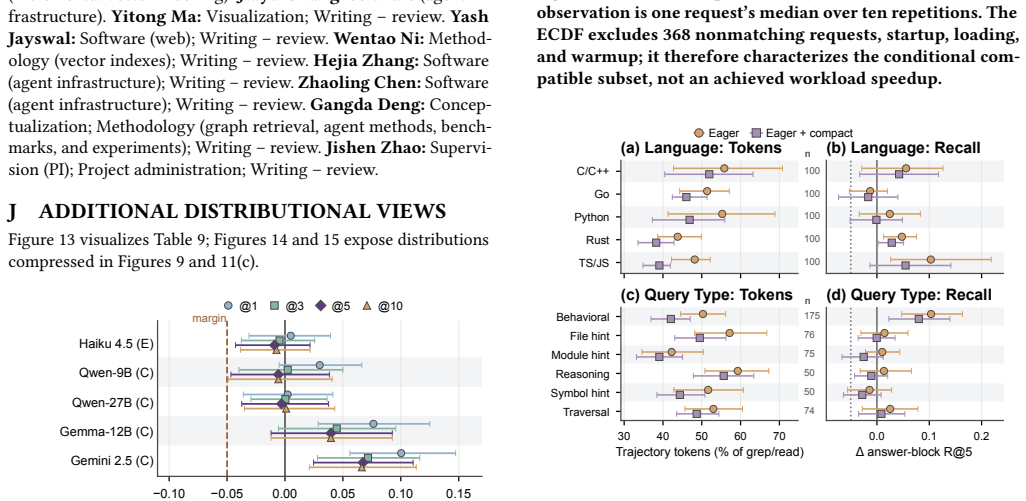
- Context policies with eager top-10 candidate injection plus one-time compaction preserve the localization margin at 50-87% fewer provider-reported trajectory tokens across five models.
- The manifest's capability-driven loading lets one failed view (e.g., vector build) not invalidate successful siblings, so partial availability is explicit.
- Operation-specific validity boundaries prevent conflating exact maintenance with projection-compatible navigation with policy-dependent delivery.
Where Pith is reading between the lines
- If the conditional speedups hold in production, a practical recipe is to run incremental maintenance and fall back to rebuild when the offline match gate fails, combining 25x typical speedups with guaranteed exactness.
- The 63% static/live match rate suggests a hybrid navigation service: route requests whose normalized location sets are predictable (e.g., definitions) to the static provider and keep live LSP for references; the workload-level latency saving would then depend on the request mix, not the conditional 4.7x.
- The one-time compaction policy's model-dependent effect (123% tokens on Haiku vs 28% on Gemma) hints that context delivery should be per-model tuned rather than globally optimized — a claim the paper leaves open.
- The same-commit rebuild audit (99.75% edge F1, but Rust/TS failures) suggests that the incremental-maintenance speedup numbers could shift if ground truth were measured against a more deterministic oracle; an editor would like to see the speedups re-reported on the subset of repositories where fresh rebuilds are exactly reproducible.
Editorial analysis
A structured set of objections, weighed in public.
Referee Report
Summary. CodeNib is a multi-view repository-context data system that materializes lexical, dense, and structural views per commit, maintains selected views incrementally, and serves ranked retrieval, symbol navigation, and bounded context to coding agents through a manifest-mediated runtime. The paper's main contributions are: (C1) a view compiler that links heterogeneous artifacts to repository-relative source ranges; (C2) view-specific incremental maintenance whose speedups are reported only when the updated artifact exactly matches an independently rebuilt target; and (C3) a cost-visible agent runtime with evaluated context-delivery policies. Across 100 snapshots and five evaluation questions, the headline results are: 8.7x/25.4x median graph/vector update speedups on matching transitions, a 4.72x median live/static latency ratio on the 63% of navigation requests whose normalized locations match, and 50–87% token reductions with localization preserved for selected policies across five agent models. The paper is notable for reporting null results (graph expansion), conditional claims (static/live compatibility), and explicit validity boundaries throughout.
Significance. If the results hold, CodeNib provides a principled data-systems blueprint for repository-context serving that separates ranked candidates, source locations, and prompt history instead of collapsing them into one abstraction. The paper is unusually careful in distinguishing quality, compatibility, update fidelity, latency, and token usage, and it reports conditional speedups only where output equality is verified offline. It also ships code/data with frozen dataset IDs and includes a same-commit rebuild audit, which strengthens reproducibility. The main quantitative claim—exact-output incremental maintenance with large speedups—is defensible in principle, but its central Q4 evidence depends on the stability of an independent-rebuild oracle that the paper itself shows to be nondeterministic for Rust and TS/JS. The Q5 'preserve localization' claim similarly rests on an operational margin that is a reporting threshold rather than an externally justified equivalence bound. These two points are the key risk to the paper's headline contributions.
major comments (2)
- [§4.2, §9.5, Appendix F, Table 8] The conditional graph speedup claim (8.67x median, 15/33 transitions) depends on the independent rebuild in Eqs. (1)–(2) being a deterministic oracle. Appendix F's same-commit audit reports fresh-vs-fresh edge F1 of 99.75% and serving agreement of 99.35%, with changed-scope exactness on only 3/4 cases, and all 18 Rust and TS/JS graph transitions fail the exact checks. Thus the 15/33 match count and the median are measured against a single draw of a nondeterministic reference; a different fresh rebuild could yield different matches and a different median. The paper honestly reports this limitation, but the abstract still presents the conditional speedup as the headline without noting that, for graph maintenance, the matched transitions are entirely Go/Python. Please (i) run multiple independent rebuilds and require equality with all (or report the distribution across rebuild draws), or (i
- [§4.3, §9.7] The Q5 claim that selected context policies 'preserve localization' with 50–87% fewer tokens rests on the operational margin ε=0.05 applied to the lower bound of a paired 95% CI. This is a reporting threshold, not a pre-registered equivalence margin, as the paper acknowledges. However, the selection is margin-sensitive: for Haiku, the selected Eager arm has ΔAR@5 = −0.009 with lower bound −0.043, so a slightly stricter margin (e.g., ε=0.04) would change the selection. The headline token reduction is therefore contingent on a non-justified threshold. I recommend either justifying ε from an external operational requirement or presenting the results as a token–quality frontier and softening the 'preserve localization' wording in the abstract and conclusion.
minor comments (5)
- [Figure 10(c)] The panel appears twice in the submitted text (duplicate caption and identical plot). Please check the figure assembly.
- [Appendix F] The phrase 'Reported protocols are 21/4' is ambiguous. Please spell out which protocol numbers are pooled and which are excluded, and why.
- [§9.1] The sentence 'Qwen-4B/8B score means use n=99/98 at k′=30/50' could be clarified: state why the sample sizes differ for those operating points.
- [§9.1] The description of the lifecycle trace (20 sessions, 42 requests) is clear, but the initial paragraph says 'Materialize/load/mixed trace; isolated/resident' in Table 2; consider adding a cross-reference to §9.6 for the derived request count.
- [§7.4] The transition in Eq. (4) is well defined, but the claim that 'invocation j+1 consumes Ĥ_j' should be stated even more explicitly to avoid implying the rewrite is visible to the model before the next call; the surrounding text does clarify this, but a one-sentence restatement would help.
Circularity Check
No significant circularity: headline results are measured against external references or explicit conditional gates, and self-citations are background-only.
full rationale
CodeNib's central quantitative claims are all anchored to external references rather than to the paper's own outputs. Q1 targets come from developer patches in SWE-Bench Verified/Multilingual; Q2 compares approximate ANN indexes against exact Flat search; Q3 compares static serving against live LSP providers on a normalized-location equality predicate; Q4 compares incremental updates against independently rebuilt targets; Q5 compares against paired grep/read trajectories under a pre-specified localization margin. In each case the reference is an independent measurement, not a parameter fitted from the result being claimed. The Q4 speedups are explicitly conditional on Eqs. (1)-(2) matching an independent rebuild, and the paper reports non-matching transitions openly, excluding them from the conditional summary but retaining raw ratios. The Appendix F audit showing that fresh rebuilds are not fully deterministic for Rust/TS is a genuine validity caveat, but it does not make the claim circular: an incremental output is not defined as 'whatever the rebuild returns,' and the comparison is performed after timing on a separate path. The same applies to Q3, where the matched subset is a compatibility gate, not a construct that defines the latency advantage into existence. The only self-citations ([7] LocAgent and [72] OrcaLoca) appear in related-work positioning and are not load-bearing; no uniqueness theorem, ansatz, or design choice is imported from them. Accordingly, no derivation step reduces by construction to its own inputs, and the paper's explicit limitation statements are properly treated as threats to validity rather than circularity.
Axiom & Free-Parameter Ledger
free parameters (6)
- graph fusion weight w_g =
0.5
- operational margin epsilon = 0.05 =
0.05
- AnswerRecall@5 cutoff and zero-recall rule =
k=5; zero for answers with no committed span
- RRF constant kappa=60 with w_d=1 =
kappa=60, w_d=1
- 0.95 Neighbor Recall bar for ANN selection =
mean overlap >= 0.95
- Navigation and lifecycle probe selection =
5 evenly spaced positions/snapshot; 8 def/40 ref limits
axioms (6)
- domain assumption A fresh, independent rebuild of a view is a deterministic, valid correctness oracle for incremental output (Eqs. 1-2, Sec. 4.2).
- domain assumption Pre-patch source units that overlap the developer patch are a valid localization ground truth (Sec. 4.2, Appendix A).
- domain assumption Normalized path/start-line set equality is a sufficient compatibility contract for navigation (Sec. 4.2, Sec. 9.4).
- domain assumption Provider-reported prompt+completion token sums, charged on every re-appearance, are a faithful cross-model cost measure (Sec. 4.3, Eq. 5).
- domain assumption Warm-host, single-trajectory, quiescent-checkout measurements represent agent and lifecycle costs (Sec. 9.1, Appendix G).
- standard math Clustered bootstrap percentile intervals are valid under the study's sampling design (Sec. 9.1).
read the original abstract
Coding agents repeatedly search, navigate, and retain context from evolving repositories, but disconnected indexes, language servers, and task-local histories force repeated discovery and obscure lifecycle costs. CodeNib builds reusable lexical, dense, and structural views per repository commit, maps outputs to repository-relative source ranges, maintains selected views across edits, and serves ranked search, symbol navigation, and bounded context through one runtime. Across 100 snapshots, we map quality-cost frontiers across the repository-context lifecycle. When outputs match an independent rebuild, graph and vector updates are $8.7\times$ and $25.4\times$ faster at the median. On the static-navigation subset matching normalized live-server locations (63% of 1,000 requests), the median per-request live/static latency ratio is $4.7\times$. Across five models, selected context policies preserve localization with 50--87% fewer trajectory tokens than paired grep/read. Together, these results support multi-view repository-context serving with explicit, operation-specific validity boundaries.
Figures


Reference graph
Works this paper leans on
-
[1]
Anomaly. 2025. OpenCode: The open source coding agent. https://opencode.ai/ docs/tools. Accessed 2026-07-25; LSP integration is experimental
2025
-
[2]
Anthropic. 2024. Model Context Protocol: Transport Specification. https:// modelcontextprotocol.io/specification/2024-11-05/basic/transports. Version 2024-11-05; accessed 2026-07-25
2024
-
[3]
Anthropic. 2025. Introducing Claude Haiku 4.5. https://www.anthropic.com/ news/claude-haiku-4-5
2025
-
[4]
Anthropic. 2026. Model IDs and Versioning. https://platform.claude.com/docs/ en/about-claude/models/model-ids-and-versions Accessed 2026-07-25
2026
-
[5]
Ishaan Bhola, Adithyan Krishnan, Sravanth Kurmala, and Mukunda NS. 2026. Code Isn’t Memory: A Structural Codebase Index Inside a Coding Agent. arXiv:2606.22417. https://arxiv.org/abs/2606.22417
Pith/arXiv arXiv 2026
-
[6]
Shravan Chaudhari, Rahul Thomas Jacob, Mononito Goswami, Jiajun Cao, Shihab Rashid, and Christian Bock. 2025. SpIDER: Spatially Informed Dense Embedding Retrieval for Software Issue Localization. arXiv:2512.16956. https://arxiv.org/ abs/2512.16956
arXiv 2025
-
[7]
Zhaoling Chen, Robert Tang, Gangda Deng, Fang Wu, Jialong Wu, Zhiwei Jiang, Viktor Prasanna, Arman Cohan, and Xingyao Wang. 2025. LocAgent: Graph- Guided LLM Agents for Code Localization. InProceedings of the 63rd Annual Meeting of the Association for Computational Linguistics (Volume 1: Long Papers). Association for Computational Linguistics, Vienna, Aus...
-
[8]
Tsvi Cherny-Shahar and Amiram Yehudai. 2026. Repository Intelligence Graph: Deterministic Architectural Map for LLM Code Assistants. arXiv:2601.10112. https://arxiv.org/abs/2601.10112
arXiv 2026
-
[9]
CocoIndex contributors. 2025. CocoIndex. Incremental data-transformation framework. https://cocoindex.io/docs-v0/ Accessed 2026-07-25
2025
-
[10]
Gheorghe Comanici, Eric Bieber, Mike Schaekermann, Ice Pasupat, Noveen Sachdeva, Inderjit Dhillon, et al. 2025. Gemini 2.5: Pushing the Frontier with Advanced Reasoning, Multimodality, Long Context, and Next Generation Agentic Capabilities. arXiv:2507.06261. https://arxiv.org/abs/2507.06261
Pith/arXiv arXiv 2025
-
[11]
Gordon V. Cormack, Charles L. A. Clarke, and Stefan Büttcher. 2009. Reciprocal rank fusion outperforms condorcet and individual rank learning methods. In Proceedings of the 32nd International ACM SIGIR Conference on Research and Devel- opment in Information Retrieval (SIGIR). Association for Computing Machinery, New York, NY, USA, 758–759. https://doi.org...
arXiv 2009
-
[12]
Creager and Hendrik van Antwerpen
Douglas A. Creager and Hendrik van Antwerpen. 2023. Stack Graphs: Name Resolution at Scale. InEvolution, Originality, and Community in Computer Science (EVCS) (OpenAccess Series in Informatics (OASIcs)), Vol. 109. 8:1–8:12. https: //doi.org/10.4230/OASIcs.EVCS.2023.8
-
[13]
Jennie Duggan, Aaron J. Elmore, Michael Stonebraker, Magdalena Balazinska, Bill Howe, Jeremy Kepner, Samuel Madden, David Maier, Tim Mattson, and Stanley B. Zdonik. 2015. The BigDAWG Polystore System.ACM SIGMOD Record 44, 2 (2015), 11–16. https://doi.org/10.1145/2814710.2814713
arXiv 2015
-
[14]
Fabio James Fehr, Prabhu Teja S, Luca Franceschi, and Giovanni Zappella. 2025. CoRet: Improved Retriever for Code Editing. InProceedings of the 63rd Annual Meeting of the Association for Computational Linguistics (Volume 2: Short Papers). Association for Computational Linguistics, Vienna, Austria, 775–789. https: //doi.org/10.18653/v1/2025.acl-short.62
-
[15]
Jia Feng, Zhanyue Qin, Cuiyun Gao, Ruiqi Wang, Chaozheng Wang, Yingwei Ma, and Xiaoyuan Xie. 2026. On the Effectiveness of Context Compression for Repository-Level Tasks: An Empirical Investigation. arXiv:2604.13725. https: //arxiv.org/abs/2604.13725 Work in progress
Pith/arXiv arXiv 2026
-
[16]
Zhangyin Feng, Daya Guo, Duyu Tang, Nan Duan, Xiaocheng Feng, Ming Gong, Linjun Shou, Bing Qin, Ting Liu, Daxin Jiang, and Ming Zhou. 2020. CodeBERT: A pre-trained model for programming and natural languages. InFindings of the Association for Computational Linguistics: EMNLP 2020. Association for Computa- tional Linguistics, Online, 1536–1547. https://doi...
-
[17]
Paul Gauthier and Aider contributors. 2024. Aider: Repository map. https: //aider.chat/docs/repomap.html. Accessed 2026-05-12
2024
-
[18]
Gemma Team. 2026. Gemma 4 Technical Report. arXiv:2607.02770. https: //arxiv.org/abs/2607.02770
Pith/arXiv arXiv 2026
-
[19]
Thibaud Gloaguen, Niels Mündler, Mark Müller, Veselin Raychev, and Martin Vechev. 2026. Evaluating AGENTS.md: Are Repository-Level Context Files Helpful for Coding Agents? arXiv:2602.11988. https://arxiv.org/abs/2602.11988
Pith/arXiv arXiv 2026
-
[20]
Goetz Graefe and William J. McKenna. 1993. The Volcano Optimizer Generator: Extensibility and Efficient Search. InProceedings of the 9th International Confer- ence on Data Engineering. IEEE Computer Society Press, Los Alamitos, CA, USA, 209–218. https://doi.org/10.1109/ICDE.1993.344061
arXiv 1993
-
[21]
Daya Guo, Shuai Lu, Nan Duan, Yanlin Wang, Ming Zhou, and Jian Yin. 2022. UniXcoder: Unified cross-modal pre-training for code representation. InProceed- ings of the 60th Annual Meeting of the Association for Computational Linguistics (ACL). Association for Computational Linguistics, Dublin, Ireland, 7212–7225. https://doi.org/10.18653/v1/2022.acl-long.499
-
[22]
Clement, Dawn Drain, Neel Sundaresan, Jian Yin, Daxin Jiang, and Ming Zhou
Daya Guo, Shuo Ren, Shuai Lu, Zhangyin Feng, Duyu Tang, Shujie Liu, Long Zhou, Nan Duan, Alexey Svyatkovskiy, Shengyu Fu, Michele Tufano, Shao Kun Deng, Colin B. Clement, Dawn Drain, Neel Sundaresan, Jian Yin, Daxin Jiang, and Ming Zhou. 2021. GraphCodeBERT: Pre-training Code Representations with Data Flow. InInternational Conference on Learning Represent...
2021
-
[23]
Ashish Gupta, Inderpal Singh Mumick, and V. S. Subrahmanian. 1993. Maintain- ing Views Incrementally. InProceedings of the 1993 ACM SIGMOD International Conference on Management of Data. Association for Computing Machinery, New York, NY, USA, 157–166. https://doi.org/10.1145/170035.170066
arXiv 1993
-
[24]
Gwihwan Go, Quan Zhang, Chijin Zhou, Zhao Wei, and Yu Jiang. 2026. LSPRAG: LSP-Guided RAG for Language-Agnostic Real-Time Unit Test Generation. InProceedings of the 48th International Conference on Software Engineering (Rio de Janeiro, Brazil)(ICSE ’26). Association for Computing Machinery, New York, NY, USA. https://conf.researchr.org/details/icse-2026/i...
arXiv 2026
-
[25]
Yu Huo, Kun Zeng, Siyu Zhang, Yuquan Lu, Cheng Yang, Yifu Guo, and Xiaoying Tang. 2026. RepoShapley: Shapley-Enhanced Context Filtering for Repository- Level Code Completion. InFindings of the Association for Computational Linguis- tics: ACL 2026. Association for Computational Linguistics, San Diego, California, United States, 10390–10412. https://doi.org...
-
[26]
Zhonghao Jiang, Xiaoxue Ren, Meng Yan, Wei Jiang, Yong Li, and Zhongxin Liu
-
[27]
Jimenez, John Yang, Alexander Wettig, Shunyu Yao, Kexin Pei, Ofir Press, and Karthik Narasimhan
Carlos E. Jimenez, John Yang, Alexander Wettig, Shunyu Yao, Kexin Pei, Ofir Press, and Karthik Narasimhan. 2024. SWE-bench: Can language models resolve real-world GitHub issues?. InInternational Conference on Learning Representations (ICLR)
2024
-
[28]
Jeff Johnson, Matthijs Douze, and Hervé Jégou. 2021. Billion-Scale Similarity Search with GPUs.IEEE Transactions on Big Data7, 3 (July 2021), 535–547. https://doi.org/10.1109/TBDATA.2019.2921572
arXiv 2021
-
[29]
Jimenez, Ofir Press, and John Yang
Kabir Khandpur, Kilian Lieret, Carlos E. Jimenez, Ofir Press, and John Yang
-
[30]
Myeongsoo Kim, Chao-Chun Hsu, Dingmin Wang, Shweta Garg, Varun Ku- mar, and Murali Krishna Ramanathan. 2026. CODESTRUCT: Code Agents over Structured Action Spaces. InProceedings of the 64th Annual Meeting of the As- sociation for Computational Linguistics (Volume 1: Long Papers). Association for Computational Linguistics, San Diego, California, United Sta...
-
[31]
SWE-bench benchmark release
SWE-bench Multilingual. SWE-bench benchmark release. https://www. swebench.com/multilingual.html Accessed 2026-07-25
2026
-
[32]
Barr, Federica Sarro, Zhaoyang Chu, and He Ye
Han Li, Letian Zhu, Bohan Zhang, Rili Feng, Jiaming Wang, Yue Pan, Earl T. Barr, Federica Sarro, Zhaoyang Chu, and He Ye. 2026. ContextBench: A Benchmark for Context Retrieval in Coding Agents. arXiv:2602.05892. https://arxiv.org/abs/ 2602.05892
arXiv 2026
-
[33]
Daria Kryvosheieva, Saba Sturua, Michael Günther, Scott Martens, and Han Xiao. 2025. Efficient Code Embeddings from Code Generation Models. InFourth Workshop on Deep Learning for Code (DL4Code), NeurIPS. https://openreview. net/forum?id=smR7RPdWZs arXiv:2508.21290
Pith/arXiv arXiv 2025
-
[34]
Zhuofeng Li, Haoxiang Zhang, Cong Wei, Pan Lu, Ping Nie, Yi Lu, Yuyang Bai, Shangbin Feng, Hangxiao Zhu, Ming Zhong, Yuyu Zhang, Jianwen Xie, Yejin Choi, James Zou, Jiawei Han, Wenhu Chen, Jimmy Lin, Dongfu Jiang, and Yu Zhang. 2026. Beyond Semantic Similarity: Rethinking Retrieval for Agentic Search via Direct Corpus Interaction. arXiv:2605.05242. https:...
Pith/arXiv arXiv 2026
-
[35]
Yichen Li, Qiye Lin, Yun Peng, Zhihan Jiang, Jinyang Liu, Chaozheng Wang, Yintong Huo, and Cuiyun Gao. 2026. One Size Does Not Fit All: Revisiting Code Context Engineering for Repository-Level Code Generation.Proceedings of the ACM on Software Engineering3, FSE (2026), 2952–2975. https://doi.org/10.1145/ 3808138
2026
-
[36]
Tobias Lindenbauer, Igor Slinko, Ludwig Felder, Egor Bogomolov, and Yaroslav Zharov. 2025. The Complexity Trap: Simple Observation Masking Is as Efficient as LLM Summarization for Agent Context Management. InFourth Workshop on Deep Learning for Code (DL4Code), NeurIPS. https://openreview.net/forum?id= OHVzruJl5k arXiv:2508.21433
arXiv 2025
-
[37]
Zhihao Lin, Mingyi Zhou, Yizhuo Yang, and Li Li. 2026. How Much Static Structure Do Code Agents Need? A Study of Deterministic Anchoring. To appear in the 35th ACM SIGSOFT International Symposium on Software Testing and Analysis (ISSTA). https://arxiv.org/abs/2606.26979 arXiv:2606.26979
Pith/arXiv arXiv 2026
-
[38]
Shukai Liu, Bo Jiang, Jian Yang, Yizhi Li, Jinyang Guo, Xianglong Liu, and Bryan Dai. 2026. Context as a Tool: Context Management for Long-Horizon SWE- Agents. InFindings of the Association for Computational Linguistics: ACL 2026. Association for Computational Linguistics, San Diego, California, United States, 16 CodeNib: A Multi-View Data System for Serv...
-
[39]
Jinshi Liu, Hanying Zuo, Congyin Cao, Anran Zhang, Yixuan Liu, and Xinzhou Xie. 2026. AOCI: Symbolic–Semantic Indexing for Practical Repository-Scale Code Understanding with LLMs. arXiv:2605.02421. https://arxiv.org/abs/2605. 02421
Pith/arXiv arXiv 2026
-
[40]
George Ma, Anurag Koul, Qi Chen, Yawen Wu, Sachit Kuhar, Yu Yu, Aritra Sen- gupta, Varun Kumar, and Murali Krishna Ramanathan. 2026. SpecAgent: A Spec- ulative Retrieval and Forecasting Agent for Code Completion. InProceedings of the 64th Annual Meeting of the Association for Computational Linguistics (Volume 1: Long Papers). Association for Computational...
-
[41]
Xiangyan Liu, Bo Lan, Zhiyuan Hu, Yang Liu, Zhicheng Zhang, Fei Wang, Michael Qizhe Shieh, and Wenmeng Zhou. 2025. CodexGraph: Bridging Large Language Models and Code Repositories via Code Graph Databases. InPro- ceedings of the 2025 Conference of the Nations of the Americas Chapter of the Association for Computational Linguistics: Human Language Technolo...
-
[42]
Simon Marlow. 2022. Incremental indexing with Glean. Glean documentation, https://glean.software/blog/incremental/. Accessed 2026-07-15
2022
-
[43]
Yu A. Malkov and D. A. Yashunin. 2020. Efficient and robust approximate nearest neighbor search using hierarchical navigable small world graphs.IEEE Transactions on Pattern Analysis and Machine Intelligence42, 4 (2020), 824–836. https://doi.org/10.1109/TPAMI.2018.2889473
arXiv 2020
-
[44]
Microsoft. 2022. LSIF: Language Server Index Format specification, v0.6.0. https://microsoft.github.io/language-server-protocol/specifications/lsif/0. 6.0/specification/. Accessed 2026-05-12
2022
-
[45]
Meta Engineering. 2024. Indexing code at scale with Glean. https://engineering.fb. com/2024/12/19/developer-tools/glean-open-source-code-indexing/. Accessed 2026-07-15
2024
-
[46]
Han-Wen Nienhuys and Sourcegraph contributors. 2024. Zoekt: Fast trigram- based code search. https://github.com/sourcegraph/zoekt. Accessed 2026-05-12
2024
-
[47]
Microsoft. 2024. Language Server Protocol Specification. https://microsoft.github. io/language-server-protocol/. Accessed 2026-05-12
2024
-
[48]
Oraios AI. 2026. Serena: The IDE for Your Coding Agent. Software, version 1.6.1. https://github.com/oraios/serena/tree/v1.6.1 Accessed 2026-07-25; MIT License
2026
-
[49]
OpenAI. 2024. Introducing SWE-bench Verified. https://openai.com/index/ introducing-swe-bench-verified/. Accessed 2026-05-12
2024
-
[50]
Junsong Pu, Yichen Li, and Zhuangbin Chen. 2026. TypeScript Repository Indexing for Code Agent Retrieval. arXiv:2604.18413. https://arxiv.org/abs/2604. 18413 Tool demonstration; unrefereed preprint
Pith/arXiv arXiv 2026
-
[51]
Siru Ouyang, Wenhao Yu, Kaixin Ma, Zilin Xiao, Zhihan Zhang, Mengzhao Jia, Jiawei Han, Hongming Zhang, and Dong Yu. 2025. RepoGraph: Enhancing AI Software Engineering with Repository-level Code Graph. InInternational Conference on Learning Representations (ICLR). https://openreview.net/forum? id=dw9VUsSHGB
2025
-
[52]
Revanth Gangi Reddy, Tarun Suresh, JaeHyeok Doo, Ye Liu, Xuan Phi Nguyen, Yingbo Zhou, Semih Yavuz, Caiming Xiong, Heng Ji, and Shafiq Joty. 2026. SweRank: Software issue localization with code ranking. InInternational Con- ference on Learning Representations (ICLR). https://arxiv.org/abs/2505.07849 arXiv:2505.07849
Pith/arXiv arXiv 2026
-
[53]
Qwen Team. 2026. Qwen3.5-9B and Qwen3.5-27B. Official model cards at https://huggingface.co/Qwen/Qwen3.5-9B and https://huggingface.co/Qwen/ Qwen3.5-27B. Accessed 2026-07-25
2026
-
[54]
Brian Sam-Bodden. 2026. What Context Does a Coding Agent Actually Need to Act? arXiv:2607.09691. https://arxiv.org/abs/2607.09691
Pith/arXiv arXiv 2026
-
[55]
Stephen Robertson and Hugo Zaragoza. 2009. The probabilistic relevance frame- work: BM25 and beyond.Foundations and Trends in Information Retrieval3, 4 (2009), 333–389. https://doi.org/10.1561/1500000019
-
[56]
Chuanqi Shi, Miao Gao, and Zhiqiang Gao. 2026. AIRCoder: Adaptive Integration of Multi-dimensional Retrieval for Repository-level Code Completion. InProceed- ings of the 64th Annual Meeting of the Association for Computational Linguistics (Volume 1: Long Papers). Association for Computational Linguistics, San Diego, California, United States, 25458–25470....
-
[57]
SCIP contributors. 2026. SCIP: A Language-Agnostic Protocol for Indexing Source Code. Protocol specification and software, version 0.9.0. https://github.com/scip- code/scip/tree/v0.9.0 Accessed 2026-07-25
2026
-
[58]
Weiwei Sun, Lingyong Yan, Xinyu Ma, Shuaiqiang Wang, Pengjie Ren, Zhumin Chen, Dawei Yin, and Zhaochun Ren. 2023. Is ChatGPT good at search? In- vestigating large language models as re-ranking agents. InProceedings of the 2023 Conference on Empirical Methods in Natural Language Processing (EMNLP). Association for Computational Linguistics, Singapore, 1491...
-
[59]
Sourcegraph. 2024. Sourcegraph: Code search and intelligence. https:// sourcegraph.com/. Accessed 2026-05-12
2024
-
[60]
The Cognition Team. 2025. DeepWiki: AI docs for any repo. https://cognition. com/blog/deepwiki. Accessed 2026-05-13; public, no-login wiki for any GitHub repository, powered by Devin
2025
-
[61]
Tamás Szabó. 2023. Incrementalizing Production CodeQL Analyses. InProceed- ings of the 31st ACM Joint European Software Engineering Conference and Sympo- sium on the Foundations of Software Engineering (ESEC/FSE ’23). Association for Computing Machinery, 1716–1726. https://doi.org/10.1145/3611643.3613860
arXiv 2023
-
[62]
Martin Vogel, Falk Meyer-Eschenbach, Severin Kohler, Elias Grünewald, and Felix Balzer. 2026. Codebase-Memory: Tree-Sitter-Based Knowledge Graphs for LLM Code Exploration via MCP. arXiv:2603.27277. https://arxiv.org/abs/2603.27277
arXiv 2026
-
[63]
Tree-sitter contributors. 2026. Tree-sitter Parser and Node Documentation. https: //tree-sitter.github.io/tree-sitter/using-parsers/1-getting-started.html. Accessed 2026-07-25
2026
-
[64]
Xu, Xiangru Tang, Mingchen Zhuge, Jiayi Pan, Yueqi Song, Bowen Li, Jaskirat Singh, Hoang H
Xingyao Wang, Boxuan Li, Yufan Song, Frank F. Xu, Xiangru Tang, Mingchen Zhuge, Jiayi Pan, Yueqi Song, Bowen Li, Jaskirat Singh, Hoang H. Tran, Fuqiang Li, Ren Ma, Mingzhang Zheng, Bill Qian, Yanjun Shao, Niklas Muennighoff, Yizhe Zhang, Binyuan Hui, Junyang Lin, Robert Brennan, Hao Peng, Heng Ji, and Graham Neubig. 2025. OpenHands: An open platform for A...
2025
-
[65]
Peiding Wang, Li Zhang, Fang Liu, Chongyang Tao, and Yinghao Zhu. 2026. CodeMEM: AST-Guided Adaptive Memory for Repository-Level Iterative Code Generation. InFindings of the Association for Computational Linguistics: ACL
2026
-
[66]
Di Wu, Wasi Uddin Ahmad, Dejiao Zhang, Murali Krishna Ramanathan, and Xiaofei Ma. 2024. Repoformer: Selective Retrieval for Repository-Level Code Completion. InProceedings of the 41st International Conference on Machine Learn- ing (Proceedings of Machine Learning Research), Vol. 235. PMLR, 53270–53290. https://proceedings.mlr.press/v235/wu24a.html
2024
-
[67]
Scott Wu and Cognition Labs. 2024. Introducing Devin, the first AI software engineer. https://cognition.com/blog/introducing-devin. Accessed 2026-05-12
2024
-
[68]
Yuhang Wang, Yuling Shi, Mo Yang, Rongrui Zhang, Shilin He, Heng Lian, Yuting Chen, Siyu Ye, Kai Cai, and Xiaodong Gu. 2026. SWE-Pruner: Self-Adaptive Context Pruning for Coding Agents. arXiv:2601.16746. https://arxiv.org/abs/ 2601.16746
Pith/arXiv arXiv 2026
-
[69]
Yuan-An Xiao, Pengfei Gao, Chao Peng, and Yingfei Xiong. 2026. Reducing Cost of LLM Agents with Trajectory Reduction.Proceedings of the ACM on Software Engineering3, FSE (June 2026), 1241–1263. https://doi.org/10.1145/3797084
doi:10.1145/3797084 2026
-
[70]
Jimenez, Alexander Wettig, Kilian Lieret, Shunyu Yao, Karthik Narasimhan, and Ofir Press
John Yang, Carlos E. Jimenez, Alexander Wettig, Kilian Lieret, Shunyu Yao, Karthik Narasimhan, and Ofir Press. 2024. SWE-agent: Agent–computer inter- faces enable automated software engineering. InAdvances in Neural Information Processing Systems (NeurIPS), Vol. 37. Neural Information Processing Systems Foundation, 50528–50652. https://doi.org/10.52202/07...
-
[71]
Chunqiu Steven Xia, Yinlin Deng, Soren Dunn, and Lingming Zhang. 2025. Demystifying LLM-Based Software Engineering Agents.Proceedings of the ACM on Software Engineering2, FSE (2025), 801–824. https://doi.org/10.1145/3715754
doi:10.1145/3715754 2025
-
[72]
Zhongming Yu, Hejia Zhang, Yujie Zhao, Hanxian Huang, Matrix Yao, Ke Ding, and Jishen Zhao. 2025. OrcaLoca: An LLM Agent Framework for Software Issue Localization. InProceedings of the 42nd International Conference on Machine Learning (Proceedings of Machine Learning Research), Vol. 267. PMLR, 73416– 73436. https://proceedings.mlr.press/v267/yu25x.html
2025
-
[73]
Fengji Zhang, Bei Chen, Yue Zhang, Jacky Keung, Jin Liu, Daoguang Zan, Yi Mao, Jian-Guang Lou, and Weizhu Chen. 2023. RepoCoder: Repository-level code completion through iterative retrieval and generation. InProceedings of the 2023 Conference on Empirical Methods in Natural Language Processing (EMNLP). Association for Computational Linguistics, 2471–2484....
2023
-
[74]
Narasimhan, and Yuan Cao
Shunyu Yao, Jeffrey Zhao, Dian Yu, Nan Du, Izhak Shafran, Karthik R. Narasimhan, and Yuan Cao. 2023. ReAct: Synergizing Reasoning and Acting in Language Models. InInternational Conference on Learning Representations (ICLR). https://openreview.net/forum?id=WE_vluYUL-X
2023
-
[75]
Yanzhao Zhang, Mingxin Li, Dingkun Long, Xin Zhang, Huan Lin, Baosong Yang, Pengjun Xie, An Yang, Dayiheng Liu, Junyang Lin, Fei Huang, and Jingren Zhou
-
[76]
Yuntong Zhang, Haifeng Ruan, Zhiyu Fan, and Abhik Roychoudhury. 2024. AutoCodeRover: Autonomous Program Improvement. InProceedings of the 33rd ACM SIGSOFT International Symposium on Software Testing and Analysis (ISSTA). ACM, 1592–1604. https://doi.org/10.1145/3650212.3680384
arXiv 2024
-
[77]
Shaoqiu Zhang, Yuhang Wang, Jialiang Liang, Yuling Shi, Wenhao Zeng, Mao- quan Wang, Shilin He, Ningyuan Xu, Siyu Ye, Kai Cai, and Xiaodong Gu
-
[78]
SWE-Explore: Benchmarking How Coding Agents Explore Repositories. arXiv:2606.07297. https://arxiv.org/abs/2606.07297
-
[80]
Qwen3 Embedding: Advancing Text Embedding and Reranking Through Foundation Models. arXiv:2506.05176. https://arxiv.org/abs/2506.05176
-
[82]
Zelin Zhao, Xizao Wang, Zhaogui Xu, Zhenhao Tang, Yongchao Li, and Peng Di
discussion (0)
Sign in with ORCID, Apple, or X to comment. Anyone can read and Pith papers without signing in.