REVIEW 1 major objections 1 minor 1 cited by
Static structure disciplines LLM code agents by providing deterministic anchors that reduce stochastic navigation.
Reviewed by Pith at T0; open to challenge. T0 means a machine referee read the full paper against a public rubric. the ladder, T0–T4 →
T0 review · grok-4.3
2026-07-03 22:47 UTC pith:3WADDG5I
load-bearing objection The anchoring claim is plausible but the length confound is still live. the 1 major comments →
How Much Static Structure Do Code Agents Need? A Study of Deterministic Anchoring
The pith
A machine-rendered reading of the paper's core claim, the machinery that carries it, and where it could break.
Core claim
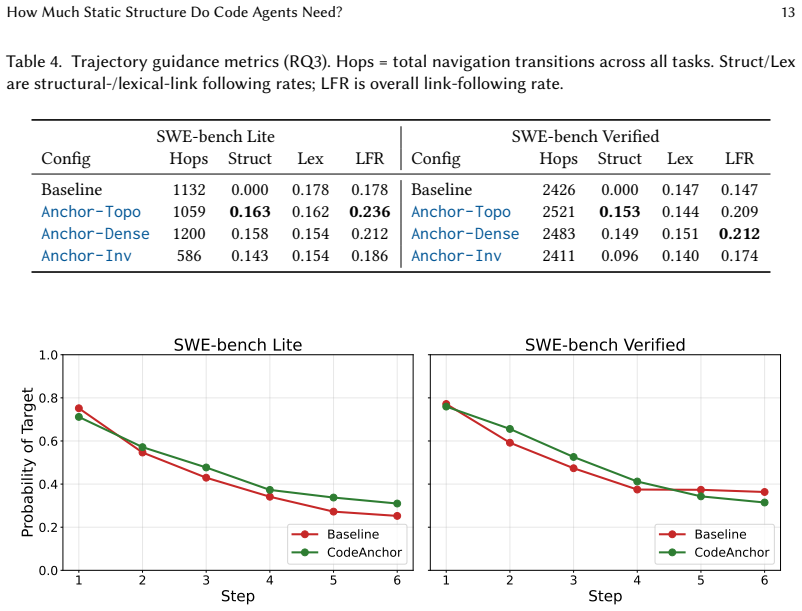
The deterministic anchoring effect shows that static structure helps agents less by making them smarter and more by making their navigation disciplined and reproducible. Lightweight call and inheritance topology raises Func@5 by 2.2 points, cuts trajectory length by 1.6 rounds, raises link-following rate from 0.15-0.18 to 0.21-0.24, and halves variance while lifting Pass@1 by 3.4 points on medium repositories, at the cost of about 10 percent more tokens. Gains are scale-sensitive: denser tags yield diminishing returns and hub-heavy projects benefit from inverse-only links.
What carries the argument
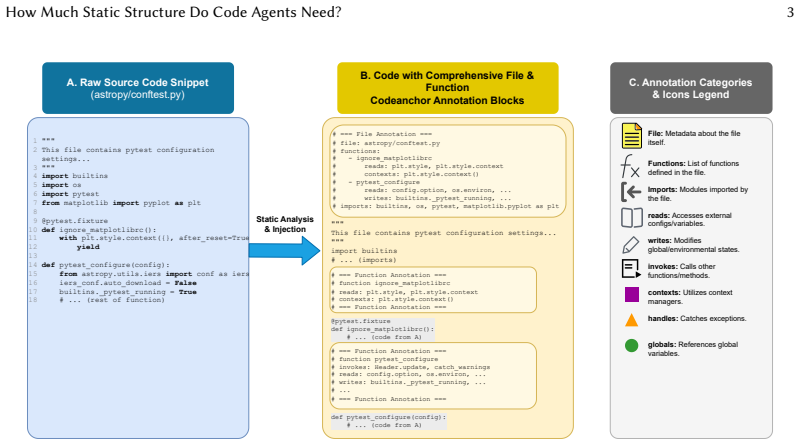
Deterministic anchoring effect, produced by injecting lightweight call/inheritance topology as plain-text comments that constrain probabilistic exploration.
Load-bearing premise
The measured gains in localization, trajectory length, and variance are produced by the structural annotations functioning as anchors rather than by changes in prompt length or comment density.
What would settle it
An ablation that holds total prompt length and comment density fixed while removing the topology information and observes whether the localization, trajectory, and variance improvements disappear.
If this is right
- Lightweight call/inheritance topology improves localization accuracy and shortens agent trajectories.
- Optimal annotation granularity and directionality vary with repository size and hub density.
- Structural tags raise link-following consistency and cut run-to-run variance on medium-scale repositories.
- Forward edges can be pruned in large repositories without losing the stability benefit.
Where Pith is reading between the lines
- The same anchoring principle could be tested in non-code agent domains that rely on graph-like navigation.
- Repositories with many implicit dependencies may require denser tags even when the paper's default recommendation is lightweight topology.
- Future agents could dynamically request specific anchor types rather than receiving them statically in the prompt.
Editorial analysis
A structured set of objections, weighed in public.
Referee Report
Summary. The manuscript reports an empirical study of LLM code agents (starting from Codex) navigating repositories via keyword search. It claims that injecting lightweight static-analysis facts (call graphs, inheritance hierarchies) as plain-text comments provides 'deterministic anchors' that discipline navigation rather than increase agent intelligence. Reported effects include +2.2 pp Func@5 localization, -1.6 interaction rounds, link-following rates rising from 0.15-0.18 to 0.21-0.24, roughly halved run-to-run variance, and +3.4 pp Pass@1 on medium-scale repositories, at ~10% extra token cost; the study also finds scale-sensitive optimal granularity and directionality and offers practical guidelines.
Significance. If the attribution to structural topology can be isolated from prompt-length and comment-density confounds, the work would supply concrete, low-overhead guidance for improving reproducibility of code agents and would shift emphasis from semantic enrichment to deterministic constraints in agent design.
major comments (1)
- [Methods / Experimental Setup] Methods / Experimental Setup (referenced in abstract): the study reports gains after injecting annotations that increase token count by ~10% and alter comment density, yet provides no length-matched or density-matched control conditions that inject equivalent non-structural text. Without such controls the central claim that improvements arise from 'deterministic anchoring' by topology (rather than incidental prompt changes) remains untested and directly affects the interpretation of all three observations.
minor comments (1)
- [Abstract] Abstract and study description omit repository selection criteria, number of repositories, statistical tests used for the reported deltas, and any baseline fairness checks for prompt length.
Simulated Author's Rebuttal
We thank the referee for highlighting the need to isolate structural topology effects from prompt-length and density confounds. This is a substantive methodological concern that directly bears on the interpretation of our results. We address it below and commit to revisions that strengthen the causal attribution.
read point-by-point responses
-
Referee: [Methods / Experimental Setup] Methods / Experimental Setup (referenced in abstract): the study reports gains after injecting annotations that increase token count by ~10% and alter comment density, yet provides no length-matched or density-matched control conditions that inject equivalent non-structural text. Without such controls the central claim that improvements arise from 'deterministic anchoring' by topology (rather than incidental prompt changes) remains untested and directly affects the interpretation of all three observations.
Authors: We agree that the current experimental design does not include explicit length-matched or density-matched controls that inject equivalent volumes of non-structural text. This leaves open the possibility that some portion of the reported gains (+2.2 pp Func@5, -1.6 rounds, halved variance) could arise from changes in input length or comment density rather than the topological content. While the scale-sensitive granularity and directionality findings (e.g., inverse-only links benefiting hub-heavy projects) are difficult to attribute solely to length, these patterns do not fully rule out the confound. In the revised manuscript we will add two control conditions on the medium-scale repositories: (1) random non-topological comments matched for token count, and (2) generic descriptive text without call/inheritance facts. We will re-run the localization, trajectory, and variance analyses and report the differential effects. This will allow readers to assess how much of the deterministic anchoring effect is topology-specific versus incidental prompt modification. revision: yes
Circularity Check
Empirical measurement study with no derivation chain or fitted predictions
full rationale
The paper reports direct experimental measurements of injecting static annotations into prompts and observing changes in agent behavior metrics (Func@5, trajectory length, variance, Pass@1). No equations, first-principles derivations, parameter fitting, or predictions are claimed. The central observations are empirical outcomes from controlled injections rather than quantities defined in terms of the authors' own modeling choices. No self-citation load-bearing steps appear in the provided text. This is the expected finding for a measurement study whose results are not constructed from its inputs.
Axiom & Free-Parameter Ledger
read the original abstract
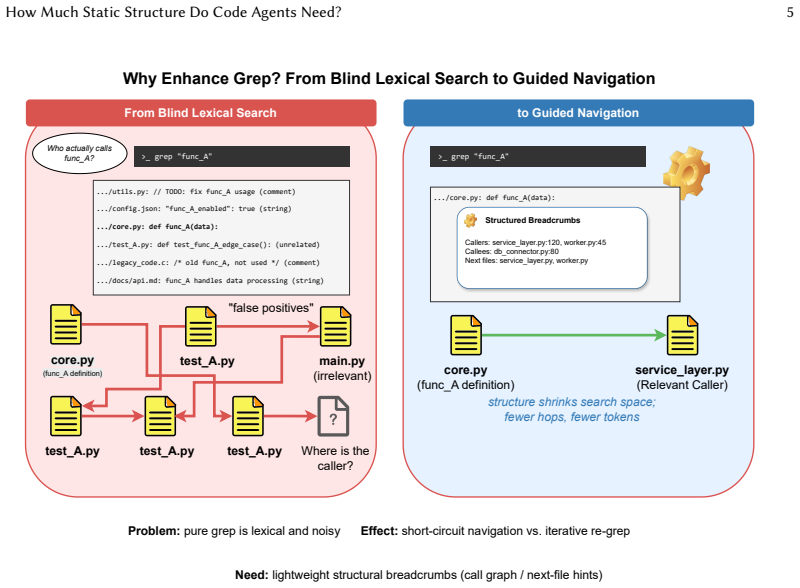
LLM-based code agents navigate repositories through keyword search but miss the structural relationships, such as call graphs, inheritance hierarchies, and configuration dependencies, that define how software actually works. This makes agent navigation stochastic and difficult to reproduce across runs. We investigate whether lightweight static analysis can provide deterministic anchors for these agents: stable structural facts injected as plain-text comments that constrain probabilistic exploration and make navigation more predictable. Starting from a strong baseline, Codex from OpenAI, we systematically inject varying granularities of structural annotations and measure their effects on localization, trajectory behavior, and run-to-run stability. Our study identifies what we call the deterministic anchoring effect: static structure helps less by making agents "smarter" and more by making their navigation disciplined and reproducible. Three observations support this finding: (1) Anchoring works: lightweight call/inheritance topology improves function-level localization (+2.2pp Func@5) and shortens trajectories (-1.6 interaction rounds); (2) Anchoring is scale-sensitive: the optimal granularity and directionality depend on repository characteristics, where denser semantics show diminishing returns and hub-heavy projects benefit from inverse-only links that expose "who-calls-me" without forward edges; (3) Anchoring stabilizes: tags raise link-following rate from 0.15-0.18 to 0.21-0.24, roughly halve run-to-run variance, and improve single-run reliability (Pass@1 +3.4 pp) on medium-scale repositories, at the cost of roughly 10% more input tokens. These observations suggest practical guidelines: default to lightweight topology on medium projects, prune forward edges in large repositories, and reserve dense tags for implicit-dependency cases.
Figures
Forward citations
Cited by 1 Pith paper
-
CodeNib: A Multi-View Data System for Serving Repository Context to Coding Agents
A per-commit multi-view repository-index system with incremental updates that match independent rebuilds at 8.7x/25.4x median speedups, and context policies that cut agent trajectory tokens 50-87% while holding locali...
Reference graph
Works this paper leans on
-
[1]
Rui Abreu, Peter Zoeteweij, and Arjan JC Van Gemund. 2007. On the accuracy of spectrum-based fault localization. In Testing: Academic and Industrial Conference Practice and Research Techniques (TAIC PART-MUTATION). IEEE, 89–98
work page 2007
-
[2]
Hiralal Agrawal and Joseph R Horgan. 1990. Dynamic program slicing.ACM SIGPlan Notices25, 6, 246–256
work page 1990
-
[3]
Aider AI. 2024. Aider RepoMap: Using a map of your codebase.https://aider.chat/docs/repomap.html. Accessed: 2024
work page 2024
-
[4]
Reem Aleithan. 2025. Revisiting SWE-Bench: On the Importance of Data Quality for LLM-Based Code Models. In2025 IEEE/ACM 47th International Conference on Software Engineering: Companion Proceedings (ICSE-Companion). IEEE, 235–236. doi:10.1109/icse-companion66252.2025.00075
-
[5]
Uri Alon, Meital Zilberstein, Omer Levy, and Eran Yahav. 2019. code2vec: Learning distributed representations of code. InProceedings of the ACM on Programming Languages, Vol. 3. 1–29
work page 2019
-
[6]
Florian Angermeir, Maximilian Amougou, Mark Kreitz, Andreas Bauer, Matthias Linhuber, Davide Fucci, Daniel Mendez, Tony Gorschek, et al. 2025. Reflections on the Reproducibility of Commercial LLM Performance in Empirical Software Engineering Studies. How Much Static Structure Do Code Agents Need? 19
work page 2025
-
[7]
Anthropic. 2025. Claude Code. https://code.claude.com/docs Agentic coding assistant with repository search and file inspection
work page 2025
-
[8]
1996.Software change impact analysis
Robert S Arnold. 1996.Software change impact analysis. IEEE Computer Society Press
work page 1996
-
[9]
Sebastian Baltes, Florian Angermeir, Chetan Arora, Marvin Muñoz Barón, Chunyang Chen, Lukas Böhme, Fabio Calefato, Neil Ernst, Davide Falessi, Brian Fitzgerald, Davide Fucci, Marcos Kalinowski, Stefano Lambiase, Daniel Russo, Mircea Lungu, Lutz Prechelt, Paul Ralph, Rijnard van Tonder, Christoph Treude, and Stefan Wagner. 2025. Guidelines for Empirical St...
work page internal anchor Pith review Pith/arXiv arXiv 2025
-
[10]
David Binkley. 1998. The application of program slicing to regression testing.Information and software technology40, 11-12 (1998), 583–594
work page 1998
-
[11]
Eric Bodden, Andreas Sewe, Jan Sinschek, Hela Oueslati, and Mira Mezini. 2011. Taming reflection: Aiding static analysis in the presence of reflection and custom class loaders. InProceedings of the 33rd International Conference on Software Engineering. 241–250
work page 2011
-
[12]
Markus Borg, Emil Alégroth, and Per Runeson. 2017. Software engineers’ information seeking behavior in change impact analysis-an interview study. In2017 IEEE/ACM 25th International Conference on Program Comprehension (ICPC). IEEE, 12–22
work page 2017
-
[13]
Bei Chen, Fengji Zhang, Anh Nguyen, Daoguang Zan, Zeqi Lin, Jian-Guang Lou, and Weizhu Chen. 2022. Codet: Code generation with generated tests.arXiv preprint arXiv:2207.10397(2022)
work page internal anchor Pith review Pith/arXiv arXiv 2022
-
[15]
Mark Chen, Jerry Tworek, Heewoo Jun, Qiming Yuan, Henrique Ponde de Oliveira Pinto, Jared Kaplan, Harri Edwards, Yuri Burda, Nicholas Joseph, Greg Brockman, et al. 2021. Evaluating Large Language Models Trained on Code.arXiv preprint arXiv:2107.03374(2021)
work page internal anchor Pith review Pith/arXiv arXiv 2021
-
[16]
Zhaoling Chen, Robert Tang, Gangda Deng, Fang Wu, Jialong Wu, Zhiwei Jiang, Viktor Prasanna, Arman Cohan, and Xingyao Wang. 2025. LocAgent: Graph-Guided LLM Agents for Code Localization. InProceedings of the 63rd Annual Meeting of the Association for Computational Linguistics (Volume 1: Long Papers). Association for Computational Linguistics, Vienna, Aust...
-
[17]
WALA Contributors. 2024. WALA: T. J. Watson Libraries for Analysis. https://github.com/wala/WALA. Accessed: 2026
work page 2024
-
[18]
Patrick Cousot and Radhia Cousot. 1977. Abstract Interpretation: A Unified Lattice Model for Static Analysis of Programs by Construction or Approximation of Fixpoints. InProceedings of the 4th ACM Symposium on Principles of Programming Languages (POPL). ACM, 238–252. doi:10.1145/512950.512973
-
[19]
Michael D Ernst. 2003. Static and dynamic analysis: synergy and duality.WODA 2003: ICSE Workshop on Dynamic Analysis(2003), 24–27
work page 2003
-
[20]
GitHub. 2024. GitHub Copilot Workspace. https://github.blog/news-insights/product-news/github- copilot-workspace/Agentic workflow for repository-level tasks
work page 2024
-
[21]
Google. 2024. Gemini Code Assist. https://docs.cloud.google.com/gemini/docs/codeassist/overview Repository-aware coding assistant for IDEs and CI workflows
work page 2024
-
[22]
Alex Gyori, Shuvendu K Lahiri, and Nimrod Partush. 2017. Refining interprocedural change-impact analysis using equivalence relations. InProceedings of the 26th ACM SIGSOFT international symposium on software testing and analysis. 318–328
work page 2017
-
[23]
Vincent J Hellendoorn, Charles Sutton, Rishabh Singh, Petros Maniatis, and David Bieber. 2019. Global relational models of source code. InInternational conference on learning representations
work page 2019
-
[24]
Susan Horwitz, Thomas W. Reps, and David W. Binkley. 1990. Interprocedural Slicing Using Dependence Graphs. ACM Transactions on Programming Languages and Systems12, 1 (1990), 26–60. doi:10.1145/77606.77608
-
[25]
Xinyi Hou, Yanjie Zhao, Yue Liu, Zhou Yang, Kailong Wang, Li Li, Xiapu Luo, David Lo, John Grundy, and Haoyu Wang. 2024. Large language models for software engineering: A systematic literature review.ACM Transactions on Software Engineering and Methodology33, 8 (2024), 1–79
work page 2024
-
[26]
SWE-bench: Can Language Models Resolve Real-World GitHub Issues?
Carlos E. Jimenez, John Yang, Alexander Wettig, Shunyu Yao, Kexin Pei, Ofir Press, and Karthik Narasimhan. 2024. SWE- bench: Can Language Models Resolve Real-World GitHub Issues?. InProceedings of the 12th International Conference on Learning Representations (ICLR).https://www.swebench.com/arXiv:2310.06770
work page internal anchor Pith review Pith/arXiv arXiv 2024
-
[27]
James A Jones, Mary Jean Harrold, and John Stasko. 2002. Visualization of test information to assist fault localization. InProceedings of the 24th International Conference on Software Engineering (ICSE). ACM, 467–477
work page 2002
-
[28]
Maria Kretsou, Elvira-Maria Arvanitou, Apostolos Ampatzoglou, Ignatios Deligiannis, and Vassilis C Gerogiannis
-
[29]
Change impact analysis: A systematic mapping study.Journal of systems and software174 (2021), 110892
work page 2021
-
[30]
Chris Lattner and Vikram S. Adve. 2004. LLVM: A Compilation Framework for Lifelong Program Analysis and Transformation. In2nd IEEE/ACM International Symposium on Code Generation and Optimization (CGO). IEEE Computer Society, 75–88. doi:10.1109/CGO.2004.1281665 20 Lin et al
-
[31]
Patrick Lewis, Ethan Perez, Aleksandra Piktus, Fabio Petroni, Vladimir Karpukhin, Naman Goyal, Heinrich Küttler, Mike Lewis, Wen-tau Yih, Tim Rocktäschel, et al. 2020. Retrieval-augmented generation for knowledge-intensive nlp tasks.Advances in neural information processing systems33, 9459–9474
work page 2020
-
[32]
Bixin Li, Xiaobing Sun, Hareton Leung, and Sai Zhang. 2013. A survey of code-based change impact analysis techniques. Software Testing, Verification and Reliability23, 8 (2013), 613–646
work page 2013
-
[33]
Fengjie Li, Jiajun Jiang, Jiajun Sun, and Hongyu Zhang. 2025. Hybrid Automated Program Repair by Combining Large Language Models and Program Analysis.ACM Transactions on Software Engineering and Methodology34, 7, Article 202 (August 2025), 28 pages. doi:10.1145/3715004
-
[34]
Xia Li, Wei Li, Yuqun Zhang, and Lingming Zhang. 2019. DeepFL: Integrating multiple fault diagnosis dimensions for deep fault localization. InProceedings of the 28th ACM SIGSOFT International Symposium on Software Testing and Analysis (ISSTA). ACM, 169–180
work page 2019
- [35]
-
[36]
Yiling Lou, Qihao Zhu, Jinhao Dong, Xia Li, Zeyu Sun, Dan Hao, Lu Zhang, and Lingming Zhang. 2021. Boosting coverage-based fault localization via graph-based representation learning. InProceedings of the 29th ACM Joint European Software Engineering Conference and Symposium on the Foundations of Software Engineering (ESEC/FSE). ACM, 664–676
work page 2021
-
[37]
Microsoft. 2016. Language Server Protocol. https://microsoft.github.io/language-server-protocol/ . Ac- cessed: 2026
work page 2016
-
[38]
Microsoft. 2019. CodeQL: The libraries and queries that power security researchers around the world. https: //github.com/github/codeql
work page 2019
-
[39]
Seokhyeon Moon, Yunho Kim, Moonzoo Kim, and Shin Yoo. 2014. Ask the mutants: Mutating faulty programs for fault localization. In2014 IEEE Seventh International Conference on Software Testing, Verification and Validation (ICST). IEEE, 153–162
work page 2014
-
[40]
OpenAI. 2023. GPT-4 Technical Report. arXiv:2303.08774 [cs.CL]https://arxiv.org/abs/2303.08774
work page internal anchor Pith review Pith/arXiv arXiv 2023
-
[41]
Alessandro Orso, Taweesup Apiwattanapong, and Mary Jean Harrold. 2003. Leveraging field data for impact analysis and regression testing.ACM SIGSOFT Software Engineering Notes28, 5, 128–137
work page 2003
- [42]
-
[43]
Jiayi Pan, Xingyao Wang, Graham Neubig, Navdeep Jaitly, Heng Ji, Alane Suhr, and Yizhe Zhang. 2025. Training Software Engineering Agents and Verifiers with SWE-Gym. InForty-second International Conference on Machine Learning (ICML). OpenReview.net. arXiv:2412.21139 [cs.SE]https://openreview.net/forum?id=Cq1BNvHx74
work page internal anchor Pith review Pith/arXiv arXiv 2025
-
[44]
Mike Papadakis and Yves Le Traon. 2015. Metallaxis-FL: Mutation-based fault localization.Software Testing, Verification and Reliability25, 5-7 (2015), 605–628
work page 2015
-
[45]
r2c. 2020. Semgrep: Lightweight static analysis for many languages.https://semgrep.dev/
work page 2020
-
[46]
Stephen E. Robertson and Hugo Zaragoza. 2009. The Probabilistic Relevance Framework: BM25 and Beyond.Founda- tions and Trends in Information Retrieval3, 4 (2009), 333–389. doi:10.1561/1500000019
-
[47]
Barbara G Ryder. 2003. Dimensions of precision in reference analysis of object-oriented programming languages. In International Conference on Compiler Construction. Springer, 126–137
work page 2003
-
[48]
Saha, Matthew Lease, Sarfraz Khurshid, and Dewayne E
Ripon K. Saha, Matthew Lease, Sarfraz Khurshid, and Dewayne E. Perry. 2013. Improving bug localization using structured information retrieval. In2013 28th IEEE/ACM International Conference on Automated Software Engineering, ASE 2013, Silicon Valley, CA, USA, November 11-15, 2013, Ewen Denney, Tevfik Bultan, and Andreas Zeller (Eds.). IEEE, 345–355. doi:10...
-
[49]
Vitalis Salis, Thodoris Sotiropoulos, Panos Louridas, Diomidis Spinellis, and Dimitris Mitropoulos. 2021. PyCG: Practical Call Graph Generation in Python. In43rd IEEE/ACM International Conference on Software Engineering (ICSE). IEEE, 1646–1657. doi:10.1109/ICSE43902.2021.00146arXiv:2103.00587
work page doi:10.1109/icse43902.2021.00146arxiv:2103.00587 2021
-
[50]
Timo Schick, Jane Dwivedi-Yu, Roberto Dessi, Roberta Raileanu, Maria Lomeli, Eric Hambro, Luke Zettlemoyer, Nicola Cancedda, and Thomas Scialom. 2023. Toolformer: Language Models Can Teach Themselves to Use Tools. InAdvances in Neural Information Processing Systems 36 (NeurIPS). http://papers.nips.cc/paper_files/paper/2023/hash/ d842425e4bf79ba039352da0f6...
work page internal anchor Pith review Pith/arXiv arXiv 2023
- [51]
-
[52]
Yifan Song, Da Yin, Xiang Yue, Jie Huang, Sujian Li, and Bill Yuchen Lin. 2024. Trial and Error: Exploration- Based Trajectory Optimization for LLM Agents. InProceedings of the 62nd Annual Meeting of the Association for Computational Linguistics (Volume 1: Long Papers). Association for Computational Linguistics, Bangkok, Thailand, How Much Static Structur...
work page 2024
-
[53]
Frank Tip. 1994. A survey of program slicing techniques. (1994)
work page 1994
-
[54]
Tree-sitter Contributors. 2018. Tree-sitter: An incremental parsing system for programming tools. https://github. com/tree-sitter/tree-sitter. Accessed: 2024
work page 2018
-
[55]
Raja Vallée-Rai, Phong Co, Etienne Gagnon, Laurie Hendren, Patrick Lam, and Vijay Sundaresan. 2010. Soot: A Java bytecode optimization framework. InCASCON First Decade High Impact Papers. 214–224
work page 2010
-
[56]
Shaowei Wang and David Lo. 2015. Amalgam+: Composing rich information sources for accurate bug localization. In Journal of Software: Evolution and Process, Vol. 27. Wiley, 921–942
work page 2015
-
[57]
Xingyao Wang, Yangyi Chen, Lifan Yuan, Yizhe Zhang, Yunzhu Li, Hao Peng, and Heng Ji. 2024. Executable code actions elicit better llm agents. InForty-first International Conference on Machine Learning
work page 2024
-
[58]
Mark Weiser. 1984. Program Slicing .IEEE Transactions on Software Engineering10, 04 (July 1984), 352–357. doi:10.1109/TSE.1984.5010248
-
[59]
Chunqiu Steven Xia and Lingming Zhang. 2022. Less training, more repairing please: revisiting automated program repair via zero-shot learning. InProceedings of the 30th ACM Joint European Software Engineering Conference and Symposium on the Foundations of Software Engineering (ESEC/FSE). ACM, 959–971. doi: 10.1145/3540250.3549101 arXiv:2207.08281
-
[60]
TheAgentCompany: Benchmarking LLM Agents on Consequential Real World Tasks
Frank F. Xu, Yufan Song, Boxuan Li, Yuxuan Tang, Kritanjali Jain, Mengxue Bao, Zora Z. Wang, Xuhui Zhou, Zhitong Guo, Murong Cao, Mingyang Yang, Hao Yang Lu, Amaad Martin, Zhe Su, Leander Maben, Raj Mehta, Wayne Chi, Lawrence Jang, Yiqing Xie, Shuyan Zhou, and Graham Neubig. 2024. TheAgentCompany: Benchmarking LLM Agents on Consequential Real World Tasks....
work page internal anchor Pith review Pith/arXiv arXiv 2024
-
[61]
Yang, Claire Le Goues, Ruben Martins, and Vincent J
Aidan Z.H. Yang, Claire Le Goues, Ruben Martins, and Vincent J. Hellendoorn. 2024. Large Language Models for Test-Free Fault Localization. InProceedings of the IEEE/ACM 46th International Conference on Software Engineering (ICSE). 165–176. doi:10.1145/3597503.3623342
-
[62]
Jimenez, Alexander Wettig, Kilian Lieret, Shunyu Yao, Karthik Narasimhan, and Ofir Press
John Yang, Carlos E. Jimenez, Alexander Wettig, Kilian Lieret, Shunyu Yao, Karthik Narasimhan, and Ofir Press
-
[63]
SWE-agent: Agent-Computer Interfaces Enable Automated Software Engineering
SWE-agent: Agent-Computer Interfaces Enable Automated Software Engineering. InAdvances in Neu- ral Information Processing Systems 38 (NeurIPS). http://papers.nips.cc/paper_files/paper/2024/hash/ 5a7c947568c1b1328ccc5230172e1e7c-Abstract-Conference.htmlarXiv:2405.15793
work page internal anchor Pith review Pith/arXiv arXiv 2024
-
[64]
Shunyu Yao, Jeffrey Zhao, Dian Yu, Nan Du, Izhak Shafran, Karthik R Narasimhan, and Yuan Cao. 2022. React: Syner- gizing reasoning and acting in language models. InThe eleventh international conference on learning representations
work page 2022
- [65]
-
[66]
Boxi Yu, Yuxuan Zhu, Pinjia He, and Daniel Kang. 2025. UTBoost: Rigorous Evaluation of Coding Agents on SWE- Bench. InProceedings of the 63rd Annual Meeting of the Association for Computational Linguistics (Volume 1: Long Papers). Association for Computational Linguistics, Vienna, Austria, 3762–3774. doi:10.18653/v1/2025.acl-long.189
- [67]
-
[68]
Daoguang Zan, Zhirong Huang, Ailun Yu, Shaoxin Lin, Yifan Shi, Wei Liu, Dong Chen, Zongshuai Qi, Hao Yu, Lei Yu, Dezhi Ran, Muhan Zeng, Bo Shen, Guangtai Liang, Bei Guan, Pengjie Huang, Tao Xie, and Yongji Wang. 2024. SWE-bench-java: A GitHub Issue Resolving Benchmark for Java.arXiv preprint arXiv:2408.14354(2024)
- [69]
-
[70]
Jian Zhou, Hongyu Zhang, and David Lo. 2012. Where should the bugs be fixed? More accurate information retrieval- based bug localization based on bug reports. In34th International Conference on Software Engineering, ICSE 2012, June 2-9, 2012, Zurich, Switzerland, Martin Glinz, Gail C. Murphy, and Mauro Pezzè (Eds.). IEEE Computer Society, 14–24. doi:10.11...
discussion (0)
Sign in with ORCID, Apple, or X to comment. Anyone can read and Pith papers without signing in.