REVIEW 4 major objections 5 minor 8 cited by
On Statistical Rates of Conditional Diffusion Transformers: Approximation, Estimation and Minimax Optimality
T0 review · 4 major / 5 minor · reviewed 2026-08-12 · deepseek-v4-flash
Pith's one-line read Conditional diffusion transformers can be minimax-optimal estimators of smooth densities.
desk verdict Solid approximation and estimation rates for conditional DiTs, but the minimax optimality claim rests on an unjustified constant-setting and should not survive as stated. read the letter →
The pith
A machine-rendered reading of the paper's core claim, the machinery that carries it, and where it could break.
The reading
What carries the argument
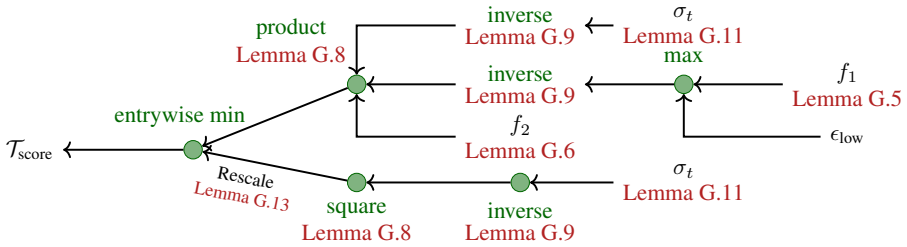
The engine is a two-stage approximation: discretize the input and label domains into $N^{d_x+d_y}$ infinitesimal hypercubes and perform a term-by-term Taylor expansion of the Gaussian-smoothed conditional density $p_t(x|y)=\int p(x_0|y)\exp(-\|x-\alpha_t x_0\|^2/(2\sigma_t^2))\,dx_0$. This turns the score $\nabla p_t/p_t$ into polynomial pieces and algebraic operators (product, inverse, square root of the noise schedule) that single-layer self-attention transformers can approximate with controlled error. Under the stronger assumption that $p(x_0|y)=e^{-C_2\|x_0\|^2/2}f(x_0,y)$ with $f\ge C>0$, the score splits into a linear term plus a well-behaved ratio $\nabla h/h$, removing the threshold that causes extra log factors in the generic case.
What would settle it
Take a smooth density of the form $e^{-C_2\|x\|^2/2}f(x)$ with $f\in H^\beta$ but $f=0$ on a small ball, sample $n$ points, and measure the total-variation error of a trained unconditional DiT; if it still achieves $n^{-\beta/(d_x+2\beta)}$, the positivity lower bound is unnecessary, while a degraded error exponent would confirm that the minimax claim relies on it.
Extended reading notes
Core claim
Under the paper's assumptions, a conditional DiT score network can approximate the conditional score $\nabla\log p_t(x|y)$ with error scaling like $N^{-\beta/(d_x+d_y)}$ under generic Hölder smoothness and $N^{-2\beta/(d_x+d_y)}$ under the stronger factored-density assumption; converting the grid resolution $N$ into sample size $n$ gives score-estimation and total-variation distribution-estimation bounds. When the conditioning label is removed ($d_y=0$) and the constants are tuned, the total-variation rate becomes $n^{-\beta/(d_x+2\beta)}$, exactly matching the minimax lower bound for estimating a smooth density. The latent version, with intrinsic dimension $d_0 \le d_x$, replaces $d_x$ by $d_0$ in these rates, so the latent unconditional DiT is also minimax optimal under the same assumptions.
Load-bearing premise
The load-bearing premise is Assumption 3.2: after factoring out a Gaussian, the conditional density must stay bounded below by $C>0$ everywhere; if the data has empty or low-density holes, the score function can blow up and the tight rates and minimax matching no longer follow.
Editorial extensions
If this is right
- Score approximation error improves from $O((\log(1/\epsilon))^{d_x}/\sigma_t^4)$ under generic Hölder smoothness to $(\log(1/\epsilon))^{O(1)}/\sigma_t^2$ under the stronger factored-density assumption.
- A tuned unconditional DiT is minimax-optimal in total variation for densities of the form $e^{-C_2\|x\|^2/2}f(x)$ with $f\in H^\beta$ and $f\ge C$, achieving the rate $n^{-\beta/(d_x+2\beta)}$.
- Latent conditional DiTs inherit the same rates with the latent dimension $d_0$ in place of $d_x$, and the latent unconditional DiT matches the corresponding lower bound $n^{-\beta_0/(d_0+2\beta_0)}$.
- The recommended early-stopping time $t_0=n^{-\beta/(d_x+d_y+\beta)}$ and terminal time $T\sim \log n$ are explicit enough to serve as practical guidance for choosing diffusion schedules.
Reading between the lines
- The conditional model's own minimax optimality is not established; if the same lower-bound technique were extended to the conditional problem, the conditional DiT would likely be minimax as well, but that step is not in the paper.
- The grid-and-Taylor technique should transfer to other transformer conditioning mechanisms, such as cross-attention, once a universal approximation theorem for those architectures is available; the paper explicitly leaves cross-attention and adaptive layer-norm variants unanalyzed.
- A testable prediction is that datasets with low-density holes or rough conditional densities will need noticeably more samples than the Hölder-exponent formula suggests, since the tighter rates rely on $f$ staying bounded below by a positive constant.
- The score decomposition that isolates the linear term also explains why Gaussian-like tails stabilize score matching: the remaining ratio term is bounded, so the network does not need to fit near-singular denominators.
Signed reviews
Editorial analysis
A structured set of objections, weighed in public.
Referee Report
Summary. The paper derives approximation, score-estimation, and distribution-estimation rates for conditional diffusion transformers (DiTs) in the in-context conditioning architecture, under generic and stronger Hölder smoothness assumptions, and extends the analysis to latent conditional DiTs under a linear subspace assumption. The main technical engine is a term-by-term Taylor expansion of the conditional score on a discretized grid, combined with a universal-approximation theorem for one-layer transformers. The headline claim is that, by reducing the conditional analysis to the unconditional setting, unconditional DiTs achieve the minimax optimal total-variation rate n^{-\beta/(dx+2\beta)}, with a parallel claim for latent unconditional DiTs.
Significance. If the central claims were fully established, the paper would make a substantial contribution: it would provide the first exact minimax optimality result for diffusion transformers, together with explicit parameter-norm bounds and sample-complexity rates for conditional and latent DiTs. The appendix contains an extensive proof apparatus, including transformer universal approximation lemmas with quantitative parameter bounds, covering-number arguments, and a careful treatment of score blow-up via truncation. These are genuine strengths. However, the minimax optimality step rests on an unsupported constant-setting assertion, and this is load-bearing for the paper's headline contribution. The estimation-rate theorems may still be of interest, but the exact-optimality claim is not established as written.
major comments (4)
- [Section 3.4] The minimax matching is asserted rather than derived. The text states: 'By setting 2*nu3 = 1, we show that the unconditional DiT is the minimax optimal distribution estimator.' But nu3 is defined in Theorem 3.3 as nu3 = 4(12*beta*dx + 31*beta*d + 6*beta)/(d*(dx+dy)) + 12*(12*C_alpha*dx + 25*C_alpha*d + 6*C_alpha)/d + 72*C_sigma, and Theorem 3.4 has already fixed C_alpha = 2*beta/(dx+dy+2*beta) and C_sigma = beta/(dx+dy+beta). With dy = 0, nu3 is a concrete function of beta, dx, and d (with d = dx/L and L >= 2), and it is generally much larger than 1/2. The upper bound in Theorem 3.4 has exponent -(1/(2*nu3))*beta/(dx+dy+2*beta); matching the lower bound n^{-beta/(dx+2*beta)} requires nu3 = 1/2. No argument is given for this equality, and the paper's own definitions make it false in typical regimes. This is not a presentation issue: it is the only step that supports the abstract's and Section 3.4's minimax-optimality claim.
- [Remark 4.3 / Section 4] The same flaw appears in the latent result. Remark 4.3 states 'Setting 2*e_nu3 = 1, we obtain the minimax optimality of latent unconditional DiT.' The constant e_nu3 in Theorem 4.2 is again a fixed function of beta0, d0, ed, dy, C_alpha, and C_sigma, with C_alpha and C_sigma already chosen. The equality 2*e_nu3 = 1 is not derived from the preceding bounds; it is imposed to force the upper bound to meet the lower bound. Consequently, the latent minimax claim is unsupported for the same reason as the unconditional claim.
- [Section 3.4 and Corollary 3.4.2] Even if nu3 were treated as a free constant, imposing nu3 = 1/2 after the fact is circular. The quantity nu3 enters the proof through the choices t0 = N^{-C_sigma}, T = C_alpha log n, and through the covering-number and approximation bounds used to obtain Theorem 3.4. Changing nu3 to force the matching would change those choices and therefore change the very bound that is being matched. A valid minimax argument must either prove that nu3 = 1/2 under the stated assumptions or show that the exponents can be optimized independently; the paper does neither.
- [Corollary 3.4.2] The lower-bound class in Corollary 3.4.2 is stated as P = {p(x) = f(x) exp(-C2 ||x||^2/2) : f in H^beta(R^dx, B), f(x) >= C >= 0}. The upper bound in Theorem 3.4 is established under Assumption 3.2, which requires f(x,y) >= C for a positive constant C. Since the lower bound is stated for a potentially larger class (with f >= C >= 0, allowing C = 0), a lower bound on that larger class does not by itself transfer to a lower bound on the smaller class used by the upper bound. The relation between the two classes needs to be stated precisely; as written, the exact minimax conclusion does not follow from the cited lower bound.
minor comments (5)
- [Table 1] The 'Minimax Optimality' column contains the string '/reve' in the first and third rows; this appears to be a typo and should be fixed.
- [Section 3.4] The text says 'the distribution estimation error becomes eO(epsilon^{-1/(2*nu3)*beta/(dx+2*beta)})'; since the theorem is stated in terms of sample size n, this should likely read n, not epsilon.
- [Lemma D.3] The lemma statement begins 'Suppose Assumption Assumption D.3 holds'; the duplicated word should be removed.
- [Appendix G] After equation (G.21), the text begins with 'dk Applying the light tail property'; the stray 'dk' appears to be an editing artifact.
- [Theorem C.2] The theorem title reads 'under Generic Hölder Assumption' but the theorem is stated under Assumption 3.2 (the stronger Hölder assumption); the title appears mismatched.
Circularity Check
Minimax optimality rests on the bare assertion 'By setting 2ν3=1'; the non-minimax rate results are otherwise self-contained.
-
fitted input called prediction
[Section 3.4 (Minimax Optimal Estimation of Unconditional DiTs), after Theorem 3.4]
"Then the distribution estimation error becomes eO(ϵ− 1 2ν3 β dx+2β ) under Assumption 3.2. Here eO(·) ignores the term aboutlog n. By setting 2ν3 = 1, we show that the unconditional DiT is the minimax optimal distribution estimator."
The upper bound in Theorem 3.4 under Assumption 3.2 is O(n^{-(1/(2ν3))·β/(dx+2β)}) after removing the condition y (dy=0). The lower bound quoted in Corollary 3.4.2 is Ω(n^{-β/(dx+2β)}). These two bounds match only if 2ν3=1. But ν3 is not a free constant: it is defined in Theorem 3.3 as a fixed expression in β, dx, d, Cα, and Cσ, and Theorem 3.4 fixes Cα = 2β/(dx+dy+2β) and the early-stopping time. No derivation, parameter-selection argument, or feasibility check is given for the equality 2ν3=1; the paper simply imposes it after the bounds have been obtained. Thus the headline exact-minimax claim is the act of tuning a derived constant to meet the lower bound, rather than a consequence of the estimation analysis.
-
fitted input called prediction
[Section 4, Remark 4.3 (Minimax Optimal Estimation)]
"Specifically, by applying Corollary 3.4.2 and substituting p(x|y) and dx by ph t (h|y) and d0 respectively in Assumption 3.2, we establish a distribution estimation lower bound of O(n−β0/(d0+2β0)). Setting 2eν3 = 1, we obtain the minimax optimality of latent unconditional DiT."
The same post-hoc normalization is repeated for the latent case. The latent distribution estimation upper bound in Theorem 4.2 has exponent -(1/(2eν3))·β0/(d0+2β0), and equality with the lower bound Ω(n^{-β0/(d0+2β0)}) is achieved only by the asserted condition 2eν3=1. The quantity eν3 is a fixed combination of β0, d0, ed, Cα, and Cσ defined in Theorem 4.2; the paper supplies no derivation that this combination equals 1/2. Therefore the latent minimax optimality claim also reduces to an imposed equality between a derived constant and the value needed to match the external lower bound, rather than being established by the preceding approximation and estimation bounds.
full rationale
The paper's core approximation and estimation theorems (Theorems 3.1, 3.2, 3.3, 4.1, 4.2 and their corollaries) are derived from a detailed score-decomposition, Taylor-expansion, and transformer-universal-approximation argument; those rate results are not circular and stand on their own. The circularity is confined to the minimax-optimality claims. In Section 3.4, the unconditional DiT upper bound is O(n^{-(1/(2ν3))·β/(dx+2β)}), while the lower bound quoted from Fu et al. [2024b] is Ω(n^{-β/(dx+2β)}); the paper's only bridge is the sentence 'By setting 2ν3 = 1'. However, ν3 is an explicit function of the already-chosen constants β, dx, d, Cα, Cσ, and Theorem 3.4 fixes Cα and t0. The equality 2ν3=1 is never derived and is generally inconsistent with the stated choices; it is instead an imposed normalization that makes the upper exponent equal to the lower exponent. Remark 4.3 repeats the same move for the latent model with 'Setting 2eν3 = 1'. Because the central 'exact minimax optimality' headline therefore reduces to a fitted constant rather than to the proved bounds, the paper is partially circular. The score approximation, score estimation, and distribution estimation rates (without the minimax identification) are independent and self-contained, so the score is 6 rather than higher.
Assumptions & free parameters
free parameters (4)
- C_alpha =
2*beta/(dx+dy+2*beta) in Theorem 3.4
- C_sigma =
beta/(dx+dy+beta) in Theorem 3.4
- N =
n^(1/nu1 * (dx+dy)/(beta+dx+dy)) in estimation theorems
- t0, T =
N^(-C_sigma), C_alpha * log N
assumptions (7)
- standard math Taylor expansion with Holder remainder on discretized domains
- standard math Universal approximation theorem for one-layer single-head transformers (Kajitsuka and Sato 2024, Theorem F.2)
- domain assumption Assumption 3.1: conditional density is Holder smooth and light-tailed
- domain assumption Assumption 3.2: density factors as exp(-C2*||x||^2/2) * f(x,y) with f >= C > 0
- domain assumption Assumption 4.1: x = U h with orthonormal U and h in R^(d0)
- domain assumption KL(P0(.|y) || N(0,I)) <= c and finite latent KL in distribution estimation
- ad hoc to paper In-context conditional DiT architecture with concatenated label and time embeddings and latent encoder-decoder (Figures 1 and 3)
Cite this review
Pith. "Pith review of On Statistical Rates of Conditional Diffusion Transformers: Approximation, Estimation and Minimax Optimality." pith.science (2026). https://pith.science/paper/WZO5S3VF
@misc{pith2026241117522,
  author       = {Pith},
  title        = {Pith review of: On Statistical Rates of Conditional Diffusion Transformers: Approximation, Estimation and Minimax Optimality},
  year         = {2026},
  howpublished = {\url{https://pith.science/paper/WZO5S3VF}},
  note         = {Machine review of arXiv:2411.17522}
}
read the original abstract
We investigate the approximation and estimation rates of conditional diffusion transformers (DiTs) with classifier-free guidance. We present a comprehensive analysis for ``in-context'' conditional DiTs under four common data assumptions. We show that both conditional DiTs and their latent variants lead to the minimax optimality of unconditional DiTs under identified settings. Specifically, we discretize the input domains into infinitesimal grids and then perform a term-by-term Taylor expansion on the conditional diffusion score function under H\"older smooth data assumption. This enables fine-grained use of transformers' universal approximation through a more detailed piecewise constant approximation and hence obtains tighter bounds. Additionally, we extend our analysis to the latent setting under the linear latent subspace assumption. We not only show that latent conditional DiTs achieve lower bounds than conditional DiTs both in approximation and estimation, but also show the minimax optimality of latent unconditional DiTs. Our findings establish statistical limits for conditional and unconditional DiTs, and offer practical guidance toward developing more efficient and accurate DiT models.
Figures


Figures from the paper (2 more)


Forward citations
Cited by 8 Pith papers
-
Curse of Attention: A Kernel-Based Perspective for Why Transformers Fail to Generalize on Time Series Forecasting and Beyond
A theoretical analysis claims attention networks fail to learn residual features when time series steps have opposite signs, giving a possible explanation for the known advantage of linear residual models.
-
The Computational Limits of State-Space Models and Mamba via the Lens of Circuit Complexity
Mamba and state-space models with constant depth and poly(n) precision are shown to lie in DLOGTIME-uniform TC0, the same circuit class as Transformers, so their expressiveness is bounded unless TC0=NC1.
-
Force Matching with Relativistic Constraints: A Physics-Inspired Approach to Stable and Efficient Generative Modeling
Force Matching replaces velocity matching in flow-based generative models with a relativistic force objective, but the toy experiments are designed so the model class matches the data generator exactly.
-
Universal Approximation of Visual Autoregressive Transformers
The paper's headline claim that VAR transformers universally approximate all Lipschitz image maps is not supported, because the theorem restricts the target class and its key lemma has an invalid linearity step.
-
High-Order Matching for One-Step Shortcut Diffusion Models
HOMO extends shortcut diffusion with acceleration and jerk supervision, but the proof of superior approximation is not supported and experiments lack error bars.
-
On Computational Limits and Provably Efficient Criteria of Visual Autoregressive Models: A Fine-Grained Complexity Analysis
Under SETH, the paper claims VAR models cannot be approximated faster than O(n^4) when attention entries are Theta(sqrt(log n)), but can be approximated in O(n^{2+o(1)}) when entries are o(sqrt(log n)).
-
Circuit Complexity Bounds for Visual Autoregressive Model
The authors show that a simplified formalization of the VAR image generation model lies in DLOGTIME-uniform TC0, meaning it can be simulated by constant-depth threshold circuits with polynomial size and precision.
-
RichSpace: Enriching Text-to-Video Prompt Space via Text Embedding Interpolation
Picking an interpolated text embedding with cosine similarity to a perpendicular foot can make a text-to-video model generate composite-feature videos that direct prompts miss.
Reference graph
Works this paper leans on
-
[1]
Sumformer: Universal approxima- tion for efficient transformers
Silas Alberti, Niclas Dern, Laura Thesing, and Gitta Kutyniok. Sumformer: Universal approxima- tion for efficient transformers. In Topological, Algebraic and Geometric Learning Workshops 2023, pages 72–86. PMLR,
work page 2023
-
[5]
Theory of consistency diffusion models: Distribution estimation meets fast sampling
Zehao Dou, Minshuo Chen, Mengdi Wang, and Zhuoran Yang. Theory of consistency diffusion models: Distribution estimation meets fast sampling. In Forty-first International Conference on Machine Learning, 2024a. Zehao Dou, Subhodh Kotekal, Zhehao Xu, and Harrison H Zhou. From optimal score matching to optimal sampling. arXiv preprint arXiv:2409.07032, 2024b....
-
[6]
Diffusion Transformer Captures Spatial-Temporal Dependencies: A Theory for Gaussian Process Data
Hengyu Fu, Zehao Dou, Jiawei Guo, Mengdi Wang, and Minshuo Chen. Diffusion transformer captures spatial-temporal dependencies: A theory for gaussian process data. arXiv preprint arXiv:2407.16134, 2024a. Hengyu Fu, Zhuoran Yang, Mengdi Wang, and Minshuo Chen. Unveil conditional diffusion mod- els with classifier-free guidance: A sharp statistical theory. a...
-
[7]
Jiuxiang Gu, Chenyang Li, Yingyu Liang, Zhenmei Shi, and Zhao Song. Exploring the frontiers of softmax: Provable optimization, applications in diffusion model, and beyond.arXiv preprint arXiv:2405.03251,
-
[8]
Gradient guidance for diffusion models: An optimization perspective
Yingqing Guo, Hui Yuan, Yukang Yang, Minshuo Chen, and Mengdi Wang. Gradient guidance for diffusion models: An optimization perspective. arXiv preprint arXiv:2404.14743,
-
[10]
Fun- damental limits of prompt tuning transformers: Universality, capacity and efficiency
171 Jerry Yao-Chieh Hu, Wei-Po Wang, Ammar Gilani, Chenyang Li, Zhao Song, and Han Liu. Fun- damental limits of prompt tuning transformers: Universality, capacity and efficiency. arXiv preprint arXiv:2411.16525, 2024a. Jerry Yao-Chieh Hu, Weimin Wu, Zhuoru Li, Sophia Pi, , Zhao Song, and Han Liu. On statistical rates and provably efficient criteria of lat...
-
[11]
Accelerating con- vergence of score-based diffusion models, provably
Gen Li, Yu Huang, Timofey Efimov, Yuting Wei, Yuejie Chi, and Yuxin Chen. Accelerating con- vergence of score-based diffusion models, provably. arXiv preprint arXiv:2403.03852, 2024a. Gen Li, Yuting Wei, Yuxin Chen, and Yuejie Chi. Towards non-asymptotic convergence for diffusion-based generative models. In The Twelfth International Conference on Learning...
-
[12]
Scalable diffusion models with transformers
William S Peebles and Saining Xie. Scalable diffusion models with transformers. 2023 ieee. In CVF International Conference on Computer Vision (ICCV), volume 4172,
work page 2023
Show all 16 references
-
[13]
Linear convergence of diffusion models under the manifold hypothesis
Peter Potaptchik, Iskander Azangulov, and George Deligiannidis. Linear convergence of diffusion models under the manifold hypothesis. arXiv preprint arXiv:2410.09046,
-
[14]
Nonparametric regression using deep neural networks with relu acti- vation function
Johannes Schmidt-Hieber. Nonparametric regression using deep neural networks with relu acti- vation function. The Annals of Statistics, 2020,
2020
-
[16]
Medsegdiff-v2: Diffusion- based medical image segmentation with transformer
Junde Wu, Wei Ji, Huazhu Fu, Min Xu, Yueming Jin, and Yanwu Xu. Medsegdiff-v2: Diffusion- based medical image segmentation with transformer. In Proceedings of the AAAI Conference on Artificial Intelligence, volume 38, pages 6030–6038, 2024a. Yuchen Wu, Minshuo Chen, Zihao Li, ...
-
[2020]
doi: 10.1016/j.neunet.2019.12.014
ISSN 0893-6080. doi: 10.1016/j.neunet.2019.12.014. Jonathan Ho and Tim Salimans. Classifier-free diffusion guidance. arXiv preprint arXiv:2207.12598,
2019 arXiv
-
[2021]
Score-based diffusion models via stochastic differential equations–a technical tutorial
173 Wenpin Tang and Hanyang Zhao. Score-based diffusion models via stochastic differential equations–a technical tutorial. arXiv preprint arXiv:2402.07487,
-
[2022]
PLOT: Prompt learning with optimal transport for vision-language models
Guangyi Chen, Weiran Yao, Xiangchen Song, Xinyue Li, Yongming Rao, and Kun Zhang. PLOT: Prompt learning with optimal transport for vision-language models. In The Eleventh Interna- tional Conference on Learning Representations (ICLR), 2023a. Hongrui Chen, Holden Lee, and Jianfe...
-
[2023]
Conditional image generation with score-based diffusion models
Georgios Batzolis, Jan Stanczuk, Carola-Bibiane Schönlieb, and Christian Etmann. Conditional image generation with score-based diffusion models. arXiv preprint arXiv:2111.13606,
-
[2024]
A short note on an inequality between kl and tv
Clément L Canonne. A short note on an inequality between kl and tv. arXiv preprint arXiv:2202.07198,
Reviewed August 12, 2026 · model on record in the stance chip above.
Discussion (0). Continue with ORCID to comment.