Towards improved synchrotron self absorption energy estimates: accounting for inhomogeneous and non-spherical emitting regions
Pith reviewed 2026-06-27 11:58 UTC · model grok-4.3
The pith
Traditional SSA methods underestimate minimum energy and source size by over an order of magnitude when the emitting region is inhomogeneous.
A machine-rendered reading of the paper's core claim, the machinery that carries it, and where it could break.
Core claim
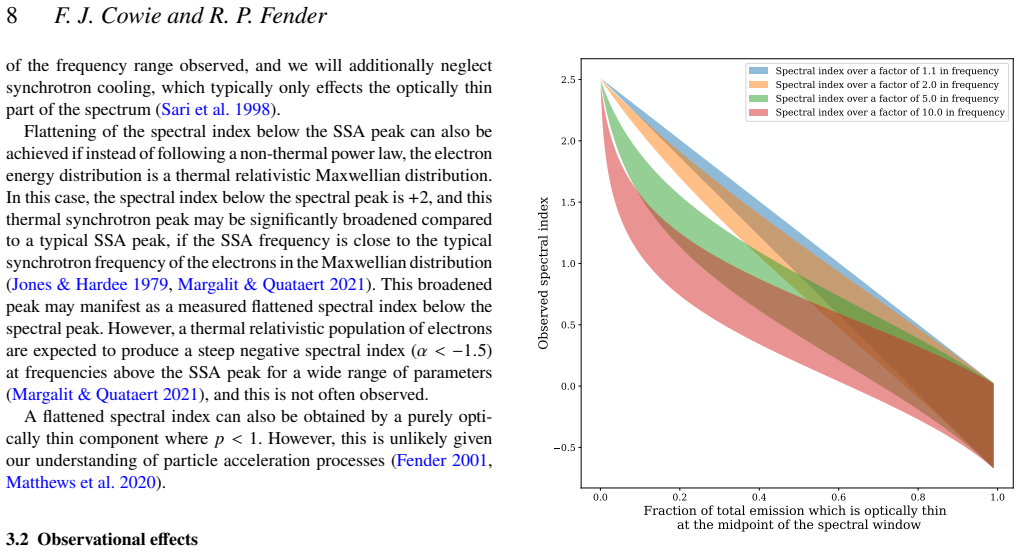
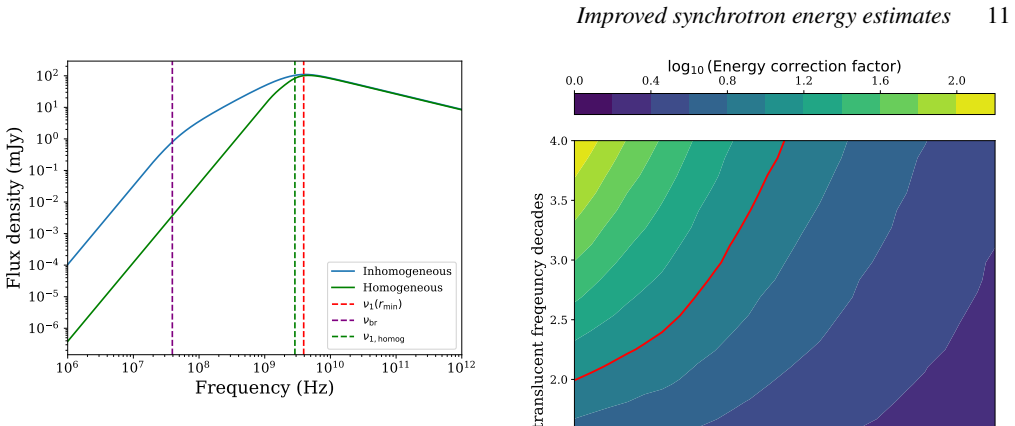
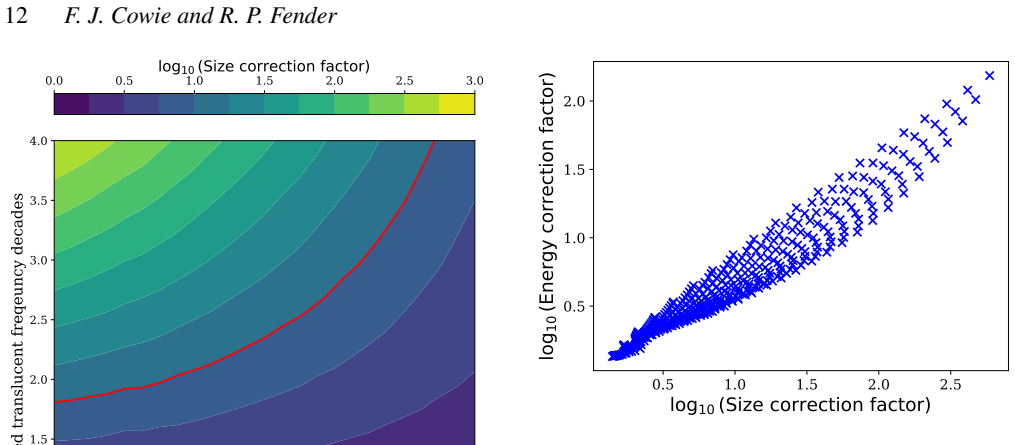
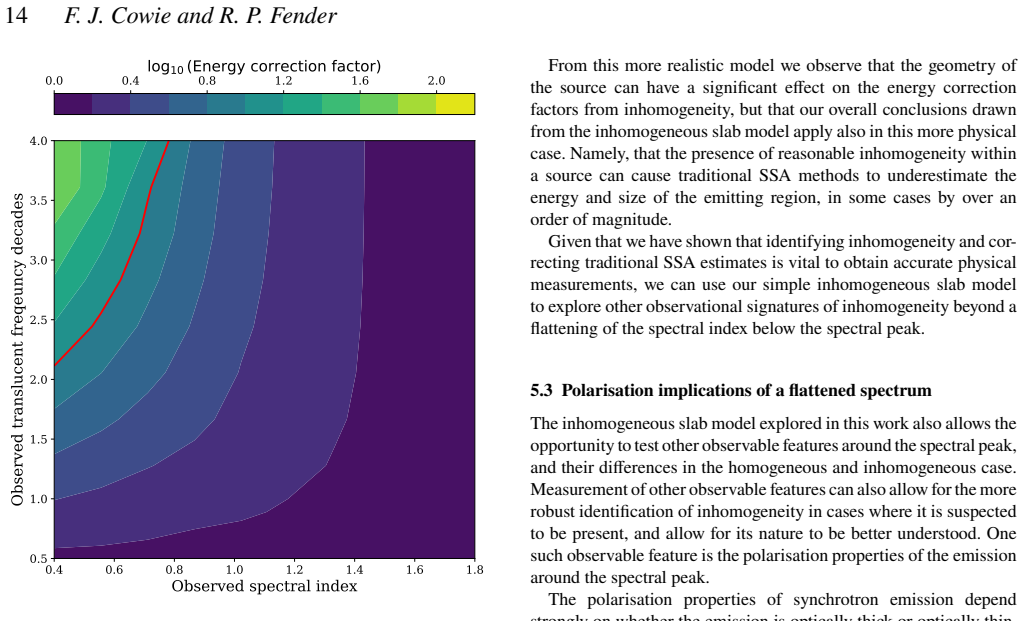
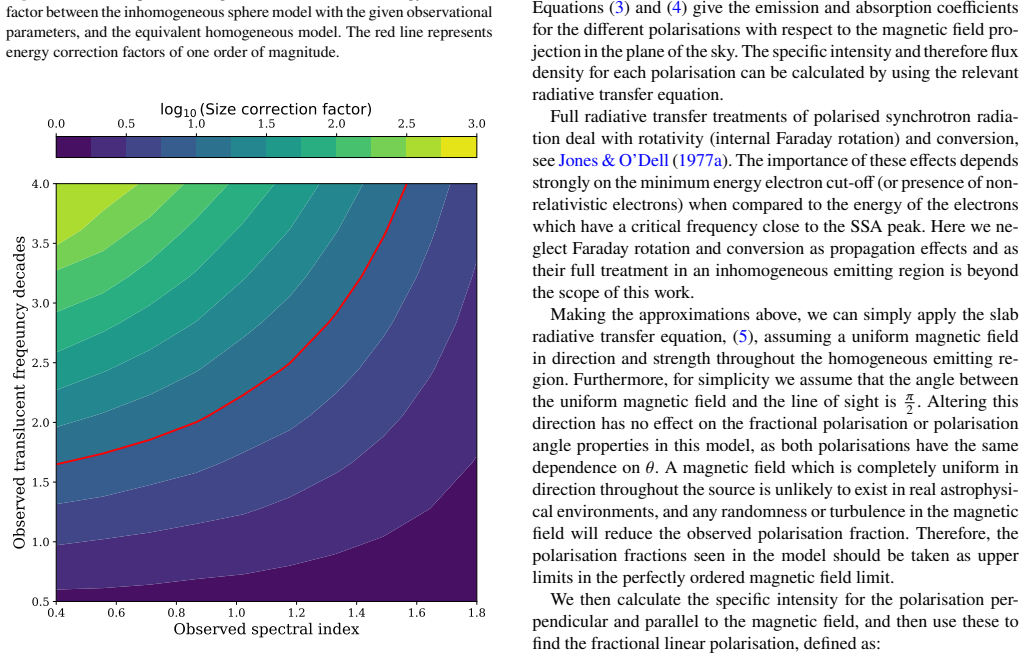
Traditional SSA parameter estimates assume a quasi-spherical and homogeneous emitting region. However, many observations show a spectral index below the peak less than the expected +2.5 (non-thermal) or +2 (thermal). Using power law inhomogeneous cylindrical slab and broken power law inhomogeneous sphere models, it is found that inhomogeneity leads to underestimation of minimum energy and size by over an order of magnitude in some cases. Quantitative correction factors are provided based on the observed flattened spectral index and frequency range. Correction factors for non-spherical homogeneous regions are also derived.
What carries the argument
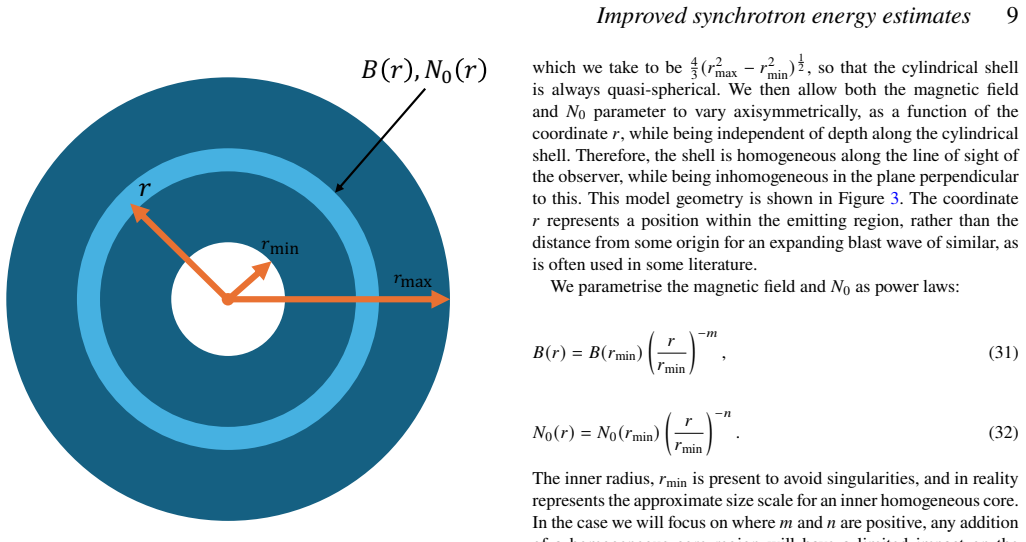
Power-law inhomogeneous cylindrical slab and broken power-law inhomogeneous sphere models that map the degree of spectral flattening to multiplicative corrections on traditional SSA energy and size estimates.
If this is right
- Quantitative correction factors can be applied to existing SSA estimates once the flattened spectral index and the frequency range of the observation are known.
- Simple multiplicative corrections also exist for non-spherical but still homogeneous sources.
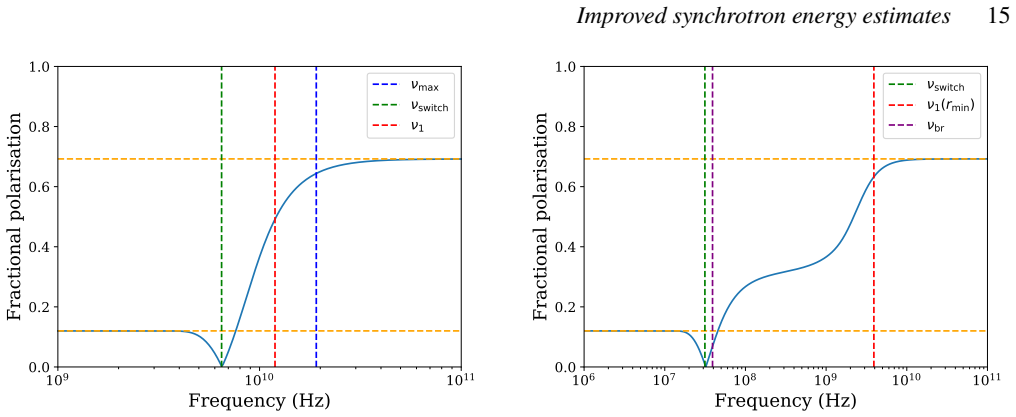
- Inhomogeneity changes the expected polarisation behaviour near the spectral peak.
- Light curves of expanding sources are altered when the emitting region is inhomogeneous.
Where Pith is reading between the lines
- Energy budgets previously derived for radio transients and jets may need to be revised upward once the corrections are applied.
- Wide-band spectra that measure the exact frequency interval of flattening will give tighter constraints on the correction factor than narrow-band data.
- The same modelling approach could be extended to other absorption features where spatial structure affects the observed spectrum.
Load-bearing premise
The observed flattening of the spectrum below the SSA peak is caused primarily by inhomogeneity rather than by non-uniform magnetic fields or multiple distinct emitting components.
What would settle it
High-resolution imaging that shows an emitting region to be spatially homogeneous yet still produces a spectral index flatter than +2 below the turnover frequency would falsify the main correction.
Figures


read the original abstract
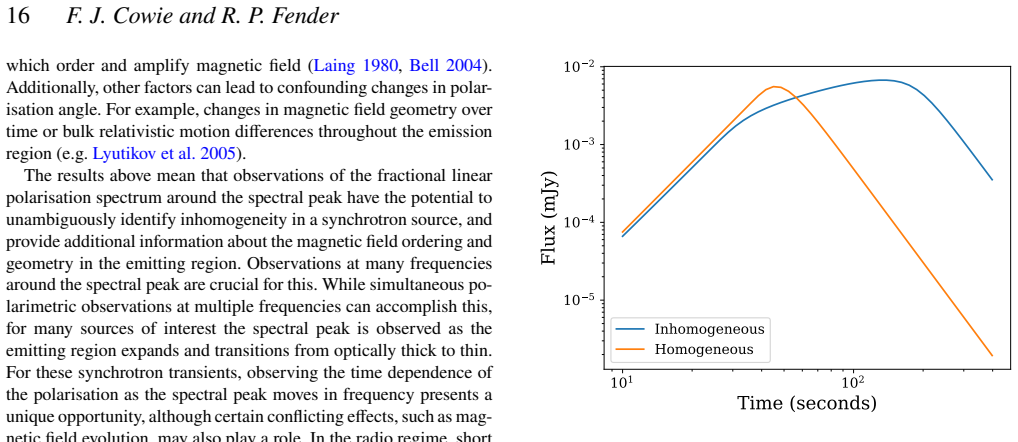
Synchrotron self absorption (SSA) is seen across a variety of astrophysical sources, and observation of an SSA peak in the spectrum is a powerful tool for estimating the physical conditions and the minimum energy of the emitting region. We begin with the (re)derivation of the usual SSA parameter estimates, carefully considering dependencies and assumptions, obtaining the most accurate traditional SSA minimum energy equations currently available. Traditional methods rely on the assumption that the emitting region is quasi-spherical and homogeneous. However, many observations of SSA show that the spectral index at frequencies below the peak is less than the expected $+2.5$ (non-thermal) or $+2$ (thermal). We argue that an inhomogeneous emitting region is the most likely explanation in many cases. Power law inhomogeneous cylindrical slab and broken power law inhomogeneous sphere models are used to investigate how the presence of inhomogeneity affects parameter estimates using traditional SSA methods. We find that in some cases inhomogeneity can lead to traditional SSA methods underestimating the minimum energy and the size of the emitting region by over an order of magnitude. Quantitative correction factors are found which can be applied to traditional estimates to correct for inhomogeneity, depending on the value of the observed flattened spectral index and the range in frequency over which this value is observed. Furthermore, we derive simple correction factors for non-spherical homogeneous emitting regions. Finally, we explore the effects of inhomogeneity on measurements of polarisation around the spectral peak, and on lightcurves for expanding emitting regions.
Editorial analysis
A structured set of objections, weighed in public.
Referee Report
Summary. The paper re-derives standard SSA minimum-energy and size estimates under the usual homogeneous quasi-spherical assumption, then argues that observed spectral indices flatter than +2 or +2.5 below the turnover are most often produced by inhomogeneity. It constructs power-law inhomogeneous cylindrical-slab and broken-power-law inhomogeneous-sphere models, shows that traditional formulae can underestimate energy and radius by more than an order of magnitude, and supplies numerical correction factors that depend on the measured low-frequency index and the frequency interval over which it is measured. Additional corrections for homogeneous but non-spherical geometries are given, together with brief explorations of polarization and light-curve effects.
Significance. If the attribution to inhomogeneity is robust and the correction factors are observationally validated, the work would materially improve minimum-energy estimates for a wide range of compact synchrotron sources (jets, GRB afterglows, supernovae, etc.). The provision of explicit, index-dependent correction tables is a concrete practical advance.
major comments (2)
- [Abstract, §3–4] Abstract and §3–4: the statement that inhomogeneity is “the most likely explanation in many cases” is not supported by any quantitative comparison showing that non-uniform B-fields, multiple distinct components, or optical-depth gradients cannot produce the same flattened index and turnover parameters. Because the correction factors map observed index directly to energy/size bias, this attribution is load-bearing; without it the factors cannot be applied unambiguously.
- [§4.2–4.3] §4.2–4.3: the derived correction factors are obtained exclusively from the two specific inhomogeneous geometries; no test is shown that the same observed index produced by an alternative mechanism would yield a different bias, leaving the headline “over an order of magnitude” claim model-dependent.
minor comments (2)
- [§4] Notation for the inhomogeneity power-law index and the frequency-range parameter should be defined once in a table or equation list for easy reference when applying the corrections.
- [Figures 3–6] Figure captions should explicitly state the frequency interval used to measure the flattened index for each model curve.
Simulated Author's Rebuttal
We thank the referee for the constructive report. We respond point-by-point to the major comments below, proposing targeted revisions to address the concerns while preserving the core results.
read point-by-point responses
-
Referee: [Abstract, §3–4] Abstract and §3–4: the statement that inhomogeneity is “the most likely explanation in many cases” is not supported by any quantitative comparison showing that non-uniform B-fields, multiple distinct components, or optical-depth gradients cannot produce the same flattened index and turnover parameters. Because the correction factors map observed index directly to energy/size bias, this attribution is load-bearing; without it the factors cannot be applied unambiguously.
Authors: We agree that the manuscript does not contain a quantitative side-by-side comparison of all alternative mechanisms that could flatten the low-frequency index. Our argument for inhomogeneity as the most likely explanation rests on the prevalence of sources (jets, expanding shells) whose geometry and structure naturally produce the observed flattening without additional fine-tuning. To strengthen the presentation, we will revise the abstract and §§3–4 to replace “most likely explanation in many cases” with “a common and physically motivated explanation in many cases,” and we will insert a short paragraph noting that while other mechanisms remain possible, the derived corrections apply specifically when the flattening arises from the inhomogeneous models considered. This makes the practical use of the factors conditional on the adopted physical interpretation. revision: partial
-
Referee: [§4.2–4.3] §4.2–4.3: the derived correction factors are obtained exclusively from the two specific inhomogeneous geometries; no test is shown that the same observed index produced by an alternative mechanism would yield a different bias, leaving the headline “over an order of magnitude” claim model-dependent.
Authors: The correction factors and the “over an order of magnitude” statement are indeed obtained from the cylindrical-slab and broken-power-law sphere models presented in §§4.2–4.3. These geometries were chosen because they are representative of many compact synchrotron sources. The corrections are expressed as functions of the observed spectral index, which is the directly measurable quantity. We will add an explicit statement in §4.2–4.3 clarifying that the numerical factors and the magnitude of the bias are specific to the inhomogeneous models explored, and that users should apply them when inhomogeneity is the favored explanation for the observed index. This does not alter the utility of the tabulated corrections within the stated modeling framework. revision: partial
Circularity Check
Derivation self-contained; corrections computed from explicit models without reduction to inputs
full rationale
The paper first re-derives the standard SSA minimum-energy expressions from the synchrotron emissivity and absorption coefficients, then constructs forward models (power-law inhomogeneous cylindrical slab; broken-power-law inhomogeneous sphere) whose emergent spectra are computed directly. The correction factors are obtained by comparing the traditional estimator applied to the model spectra against the known model parameters; this is a standard forward-model bias calculation, not a fit to the same data or a self-definition. No self-citation chain, uniqueness theorem, or ansatz smuggling is used to justify the central mapping from observed index to energy/size correction. The claim that inhomogeneity is 'most likely' is an interpretive argument outside the quantitative derivation.
Axiom & Free-Parameter Ledger
axioms (1)
- domain assumption Standard synchrotron emission and absorption theory holds for the models used.
Reference graph
Works this paper leans on
-
[1]
, keywords =
Compton and synchrotron processes in spherically-symmetric non-thermal sources. , keywords =
-
[2]
, year = 1973, month = dec, volume =
Synchrotron Spectra of Non-uniform Compact Sources. , year = 1973, month = dec, volume =
1973
-
[3]
, keywords =
Radio spectra of non-uniform synchrotron sources with internal absorption. , keywords =
-
[4]
Nonthermal processes in galactic and extragalactic sources
Radio astrophysics. Nonthermal processes in galactic and extragalactic sources
-
[5]
Rocking the BOAT: the ups and downs of the long-term radio light curve for GRB 221009A. , keywords =. doi:10.1093/mnras/stae2050 , archivePrefix =. 2408.16637 , primaryClass =
-
[6]
The Synchrotron Spectrum of Fast Cooling Electrons Revisited
The Synchrotron Spectrum of Fast Cooling Electrons Revisited. , keywords =. doi:10.1086/312661 , archivePrefix =. astro-ph/0001160 , primaryClass =
work page internal anchor Pith review Pith/arXiv arXiv doi:10.1086/312661
-
[7]
Synchrotron Self-Absorption in Radio Supernovae. , keywords =. doi:10.1086/305676 , adsurl =
-
[8]
2001, MNRAS, 322, 231, doi: 10.1046/j.1365-8711.2001.04022.x
Powerful jets from black hole X-ray binaries in low/hard X-ray states. , keywords =. doi:10.1046/j.1365-8711.2001.04080.x , archivePrefix =. astro-ph/0008447 , primaryClass =
-
[9]
GRB 160625B: Evidence for a Gaussian-shaped Jet. , keywords =. doi:10.3847/1538-4357/abc2cd , archivePrefix =. 2009.00579 , primaryClass =
-
[10]
Spectra and Light Curves of Gamma-Ray Burst Afterglows
Spectra and Light Curves of Gamma-Ray Burst Afterglows. , keywords =. doi:10.1086/311269 , archivePrefix =. astro-ph/9712005 , primaryClass =
work page internal anchor Pith review Pith/arXiv arXiv doi:10.1086/311269
-
[11]
Synchrotron self-absorption and the minimum energy of optically thick radio flares from stellar mass black holes. , keywords =. doi:10.1093/mnras/stz2000 , archivePrefix =. 1907.07463 , primaryClass =
-
[12]
The low-frequency structure of powerful radio sources and limits to departures from equipartition. , keywords =. doi:10.1093/mnras/180.4.539 , adsurl =
-
[13]
Radius constraints and minimal equipartition energy of relativistically moving synchrotron sources
Radius Constraints and Minimal Equipartition Energy of Relativistically Moving Synchrotron Sources. , keywords =. doi:10.1088/0004-637X/772/1/78 , archivePrefix =. 1301.6759 , primaryClass =
work page internal anchor Pith review Pith/arXiv arXiv doi:10.1088/0004-637x/772/1/78
-
[14]
, year = 1971, month = mar, volume =
Reabsorption of Synchrotron Radiation in an Inhomogeneous Source. , year = 1971, month = mar, volume =
1971
-
[15]
The synchrotron-self-Compton process in spherical geometries. I - Theoretical framework. , keywords =. doi:10.1086/163593 , adsurl =
-
[16]
Relativistic jets as compact radio sources. , keywords =. doi:10.1086/157262 , adsurl =
-
[17]
Effects of Nonuniform Structure in Compact Synchrotron Sources
-
[18]
A very luminous jet from the disruption of a star by a massive black hole. , keywords =. doi:10.1038/s41586-022-05465-8 , archivePrefix =. 2211.16530 , primaryClass =
-
[19]
A Reverse Shock in GRB 130427A
A Reverse Shock in GRB 130427A. , keywords =. doi:10.1088/0004-637X/776/2/119 , archivePrefix =. 1305.2453 , primaryClass =
work page internal anchor Pith review Pith/arXiv arXiv doi:10.1088/0004-637x/776/2/119
-
[20]
A Reverse Shock in GRB 181201A. , keywords =. doi:10.3847/1538-4357/ab40ce , archivePrefix =. 1907.13128 , primaryClass =
-
[21]
Precise measurements of self-absorbed rising reverse shock emission from gamma-ray burst 221009A. Nature Astronomy , keywords =. doi:10.1038/s41550-023-01997-9 , archivePrefix =. 2303.13583 , primaryClass =
-
[22]
AT2018cow: A Luminous Millimeter Transient. , keywords =. doi:10.3847/1538-4357/aaf473 , archivePrefix =. 1810.10880 , primaryClass =
-
[23]
AT2019azh: an unusually long-lived, radio-bright thermal tidal disruption event. , keywords =. doi:10.1093/mnras/stac333 , archivePrefix =. 2201.03744 , primaryClass =
-
[24]
The dense and non-homogeneous circumstellar medium revealed in radio wavelengths around the Type Ib SN 2019oys. , keywords =. doi:10.1051/0004-6361/202348761 , archivePrefix =. 2312.00131 , primaryClass =
-
[25]
Comprehensive coverage of particle acceleration and kinetic feedback from the stellar mass black hole V404 Cygni. , keywords =. doi:10.1093/mnras/stac1836 , archivePrefix =. 2206.09831 , primaryClass =
-
[26]
Generalized equipartition method from an arbitrary viewing angle. , keywords =. doi:10.1093/mnras/stad1269 , archivePrefix =. 2211.10051 , primaryClass =
-
[27]
Thermal Electrons in Mildly Relativistic Synchrotron Blast Waves. , keywords =. doi:10.3847/2041-8213/ac3d97 , archivePrefix =. 2111.00012 , primaryClass =
-
[28]
A deep/wide 1-2 GHz snapshot survey of SDSS Stripe 82 using the Karl G. Jansky Very Large Array in a compact hybrid configuration. , keywords =. doi:10.1093/mnras/stw1250 , archivePrefix =. 1605.09079 , primaryClass =
work page internal anchor Pith review Pith/arXiv arXiv doi:10.1093/mnras/stw1250
-
[29]
, year = 1956, month = sep, volume =
On Synchrotron Radiation from Messier 87. , year = 1956, month = sep, volume =. doi:10.1086/146237 , adsurl =
-
[30]
Effects of nonuniform structure on the derived physical parameters of compact synchrotron sources. , keywords =. doi:10.1086/155467 , adsurl =
-
[31]
and Ternov, I.M
Sokolov, A.A. and Ternov, I.M. and Schmutzer, E. , year =. Synchrotron
-
[32]
and Haberland, Matt and Reddy, Tyler and Cournapeau, David and Burovski, Evgeni and Peterson, Pearu and Weckesser, Warren and Bright, Jonathan and
Virtanen, Pauli and Gommers, Ralf and Oliphant, Travis E. and Haberland, Matt and Reddy, Tyler and Cournapeau, David and Burovski, Evgeni and Peterson, Pearu and Weckesser, Warren and Bright, Jonathan and. Nature Methods , year =
-
[33]
Transfer of polarized radiation in self-absorbed synchrotron sources. I. Results for a homogeneous source. , keywords =. doi:10.1086/155278 , adsurl =
-
[34]
Transfer of polarized radiation in self-absorbed synchrotron sources. II. Treatment of inhomogeneous media and calculation of emergent polarization. , keywords =. doi:10.1086/155353 , adsurl =
-
[35]
, year = 1969, month = jan, volume =
Developments in the Theory of Synchrotron Radiation and its Reabsorption. , year = 1969, month = jan, volume =. doi:10.1146/annurev.aa.07.090169.002111 , adsurl =
-
[36]
On the transfer of polarized radiation in inhomogeneous media. , keywords =. doi:10.1093/mnras/192.4.787 , adsurl =
-
[37]
Radio polarimetry as a probe of unresolved jets: the 2013 outburst of XTE J1908+094
Radio polarimetry as a probe of unresolved jets: the 2013 outburst of XTE J1908+094. , keywords =. doi:10.1093/mnras/stv1252 , archivePrefix =. 1506.01141 , primaryClass =
work page internal anchor Pith review Pith/arXiv arXiv doi:10.1093/mnras/stv1252 2013
-
[38]
2006, MNRAS, 365, 1333, doi: 10.1111/j.1365-2966.2005.09824.x
Polarization and structure of relativistic parsec-scale AGN jets. , keywords =. doi:10.1111/j.1365-2966.2005.08954.x , archivePrefix =. astro-ph/0406144 , primaryClass =
-
[39]
MAXI J1848-015: The First Detection of Relativistically Moving Outflows from a Globular Cluster X-Ray Binary. , keywords =. doi:10.3847/2041-8213/accde1 , archivePrefix =. 2305.03764 , primaryClass =
-
[40]
Gasdynamics of Relativistically Expanding Gamma-Ray Burst Sources: Kinematics, Energetics, Magnetic Fields, and Efficiency. , keywords =. doi:10.1086/173154 , archivePrefix =. astro-ph/9301007 , primaryClass =
work page internal anchor Pith review Pith/arXiv arXiv doi:10.1086/173154
-
[41]
Extreme Jet Ejections from the Black Hole X-ray Binary V404 Cygni
Extreme jet ejections from the black hole X-ray binary V404 Cygni. , keywords =. doi:10.1093/mnras/stx1048 , archivePrefix =. 1704.08726 , primaryClass =
work page internal anchor Pith review Pith/arXiv arXiv doi:10.1093/mnras/stx1048
-
[42]
Flaring Activity of Sgr A* at 43 and 22 GHz: Evidence for Expanding Hot Plasma
Flaring Activity of Sagittarius A* at 43 and 22 GHz: Evidence for Expanding Hot Plasma. , keywords =. doi:10.1086/506375 , archivePrefix =. astro-ph/0603685 , primaryClass =
work page internal anchor Pith review Pith/arXiv arXiv doi:10.1086/506375
-
[43]
, year = 1966, month = sep, volume =
A Model for Variable Extragalactic Radio Sources. , year = 1966, month = sep, volume =. doi:10.1038/2111131a0 , adsurl =
-
[44]
The Radio and X-ray Luminous Type Ibc Supernova 2003L
The Radio and X-Ray-Luminous Type Ibc Supernova 2003L. , keywords =. doi:10.1086/427649 , archivePrefix =. astro-ph/0410163 , primaryClass =
work page internal anchor Pith review Pith/arXiv arXiv doi:10.1086/427649
-
[45]
Inhomogeneities and the modeling of radio supernovae
Inhomogeneities and the Modeling of Radio Supernovae. , keywords =. doi:10.3847/1538-4357/aa6cad , archivePrefix =. 1704.05283 , primaryClass =
work page internal anchor Pith review Pith/arXiv arXiv doi:10.3847/1538-4357/aa6cad
-
[46]
Comprehensive Radio Monitoring of the Black Hole X-Ray Binary Swift J1727.8‑1613 during Its 2023 2024 Outburst. , keywords =. doi:10.3847/1538-4357/ade2e6 , archivePrefix =. 2506.07798 , primaryClass =
-
[47]
Implications of the Low-frequency Turnover in the Spectrum of Radio Knot C in DG Tau. , keywords =. doi:10.3847/1538-4357/ac2b26 , archivePrefix =. 2110.03322 , primaryClass =
-
[48]
Maxwellian synchrotron sources. , keywords =. doi:10.1086/156843 , adsurl =
-
[49]
Particle acceleration in astrophysical jets. , keywords =. doi:10.1016/j.newar.2020.101543 , archivePrefix =. 2003.06587 , primaryClass =
-
[50]
Relativistic precessing jets powered by an accreting neutron star. , keywords =. doi:10.1093/mnrasl/slaf097 , archivePrefix =. 2509.08951 , primaryClass =
-
[51]
Flaremodel: An open-source Python package for one-zone numerical modelling of synchrotron sources. , keywords =. doi:10.1051/0004-6361/202142458 , archivePrefix =. 2111.15273 , primaryClass =
-
[52]
A subroutine package for automatic integration
Quadpack. A subroutine package for automatic integration
-
[53]
The Radio Counterpart to the Fast X-Ray Transient EP240414a. , keywords =. doi:10.3847/1538-4357/adaaef , archivePrefix =. 2409.19055 , primaryClass =
-
[54]
A model for the magnetic-field structure in extended radio sources. , keywords =. doi:10.1093/mnras/193.3.439 , adsurl =
-
[55]
2004, MNRAS, 354, 1020, doi: 10.1111/j.1365-2966.2004.08261.x
Turbulent amplification of magnetic field and diffusive shock acceleration of cosmic rays. , keywords =. doi:10.1111/j.1365-2966.2004.08097.x , adsurl =
-
[56]
polkat: Semi-automate full polarization of MeerKAT observations
-
[57]
Short time-scale evolution of the polarized radio jet during V404 Cygni's 2015 outburst. , keywords =. doi:10.1093/mnras/stad396 , archivePrefix =. 2301.13281 , primaryClass =
-
[58]
Relativistic ejecta from stellar mass black holes: insights from simulations and synthetic radio images. , keywords =. doi:10.1093/mnras/staf739 , archivePrefix =. 2504.20914 , primaryClass =
-
[59]
Type Ib Supernova Master OT J120451.50+265946.6: Radio-emitting Shock with Inhomogeneities Crossing through a Dense Shell. , keywords =. doi:10.3847/1538-4357/ab1900 , archivePrefix =. 1904.06392 , primaryClass =
work page internal anchor Pith review Pith/arXiv arXiv doi:10.3847/1538-4357/ab1900 1904
-
[60]
A Multi-wavelength Investigation of the Radio-loud Supernova PTF11qcj and its Circumstellar Environment. , keywords =. doi:10.1088/0004-637X/782/1/42 , archivePrefix =. 1307.2366 , primaryClass =
work page internal anchor Pith review Pith/arXiv arXiv doi:10.1088/0004-637x/782/1/42
-
[61]
Radio Emission from SN 1994I in NGC 5194 (M 51) - The Best Studied Type Ib/c Radio Supernova
Radio Emission from SN 1994I in NGC 5194 (M 51): The Best-studied Type Ib/c Radio Supernova. , keywords =. doi:10.1088/0004-637X/740/2/79 , archivePrefix =. 1108.2692 , primaryClass =
work page internal anchor Pith review Pith/arXiv arXiv doi:10.1088/0004-637x/740/2/79
-
[62]
2004, MNRAS, 354, 1020, doi: 10.1111/j.1365-2966.2004.08261.x
Towards a unified model for black hole X-ray binary jets. , keywords =. doi:10.1111/j.1365-2966.2004.08384.x , archivePrefix =. astro-ph/0409360 , primaryClass =
-
[63]
The varying kinematics of multiple ejecta from the black hole X-ray binary MAXI J1820 + 070. , keywords =. doi:10.1093/mnras/stab1479 , archivePrefix =. 2105.09529 , primaryClass =
-
[64]
Resolved, expanding jets in the Galactic black hole candidate XTE J1908+094
Resolved, expanding jets in the Galactic black hole candidate XTE J1908+094. , keywords =. doi:10.1093/mnras/stx526 , archivePrefix =. 1703.02110 , primaryClass =
work page internal anchor Pith review Pith/arXiv arXiv doi:10.1093/mnras/stx526
-
[65]
LOFAR: The LOw-Frequency ARray
LOFAR: The LOw-Frequency ARray. , keywords =. doi:10.1051/0004-6361/201220873 , archivePrefix =. 1305.3550 , primaryClass =
work page internal anchor Pith review Pith/arXiv arXiv doi:10.1051/0004-6361/201220873
-
[66]
SCUBA-2: The 10000 pixel bolometer camera on the James Clerk Maxwell Telescope
SCUBA-2: the 10 000 pixel bolometer camera on the James Clerk Maxwell Telescope. , keywords =. doi:10.1093/mnras/sts612 , archivePrefix =. 1301.3650 , primaryClass =
work page internal anchor Pith review Pith/arXiv arXiv doi:10.1093/mnras/sts612
-
[67]
Unified Schemes for Radio-Loud Active Galactic Nuclei
Unified Schemes for Radio-Loud Active Galactic Nuclei. , keywords =. doi:10.1086/133630 , archivePrefix =. astro-ph/9506063 , primaryClass =
work page internal anchor Pith review Pith/arXiv arXiv doi:10.1086/133630
-
[68]
Distance measures in cosmology
Distance measures in cosmology. arXiv e-prints , keywords =. doi:10.48550/arXiv.astro-ph/9905116 , archivePrefix =. astro-ph/9905116 , primaryClass =
work page internal anchor Pith review Pith/arXiv arXiv doi:10.48550/arxiv.astro-ph/9905116
-
[69]
Dynamic shocks powered by a wide, relativistic, super-Eddington outflow launched by an accreting neutron star in the mid-20th century. , keywords =. doi:10.1093/mnras/stag163 , archivePrefix =. 2601.15400 , primaryClass =
-
[70]
Physics of Fluids , keywords =
Fluid dynamics of relativistic blast waves. Physics of Fluids , keywords =. doi:10.1063/1.861619 , adsurl =
-
[71]
Gamma-Ray Burst Jets and their Radio Observations. , keywords =. doi:10.1017/pasa.2013.44 , adsurl =
-
[72]
A rapidly-changing jet orientation in the stellar-mass black hole V404 Cygni
A rapidly changing jet orientation in the stellar-mass black-hole system V404 Cygni. , keywords =. doi:10.1038/s41586-019-1152-0 , archivePrefix =. 1906.05400 , primaryClass =
work page internal anchor Pith review Pith/arXiv arXiv doi:10.1038/s41586-019-1152-0 1906
-
[73]
A tidal disruption event coincident with a high-energy neutrino. Nature Astronomy , keywords =. doi:10.1038/s41550-020-01295-8 , archivePrefix =. 2005.05340 , primaryClass =
-
[74]
An Embedded X-Ray Source Shines through the Aspherical AT 2018cow: Revealing the Inner Workings of the Most Luminous Fast-evolving Optical Transients. , keywords =. doi:10.3847/1538-4357/aafa01 , archivePrefix =. 1810.10720 , primaryClass =
work page internal anchor Pith review Pith/arXiv arXiv doi:10.3847/1538-4357/aafa01
-
[75]
uGMRT Observations of a Fast and Blue Optical Transient AT 2018cow. , keywords =. doi:10.3847/2041-8213/abed55 , archivePrefix =. 2103.06008 , primaryClass =
-
[76]
The Most Luminous Known Fast Blue Optical Transient AT 2024wpp: Unprecedented Evolution and Properties in the X-Rays and Radio. , keywords =. doi:10.3847/2041-8213/ae0b4d , archivePrefix =. 2509.00952 , primaryClass =
-
[77]
Luminous Millimeter, Radio, and X-Ray Emission from ZTF 20acigmel (AT 2020xnd). , keywords =. doi:10.3847/1538-4357/ac4e97 , archivePrefix =. 2110.05490 , primaryClass =
discussion (0)
Sign in with ORCID, Apple, or X to comment. Anyone can read and Pith papers without signing in.