REVIEW 3 major objections 5 minor 84 references
Imagine, Verify, Execute: Memory-guided Agentic Exploration with Vision-Language Models
T0 review · 3 major / 5 minor · reviewed 2026-08-15 · deepseek-v4-flash
Pith's one-line read A vision-language loop can replace rewards and demonstrations as the driver of robotic exploration.
desk verdict The closed-loop architecture is worth a look, but the paper's headline 4.1–7.8x entropy claim is contradicted by its own Table 1, and the authors need to fix that before the results can be trusted. read the letter →
The pith
A machine-rendered reading of the paper's core claim, the machinery that carries it, and where it could break.
The reading
What carries the argument
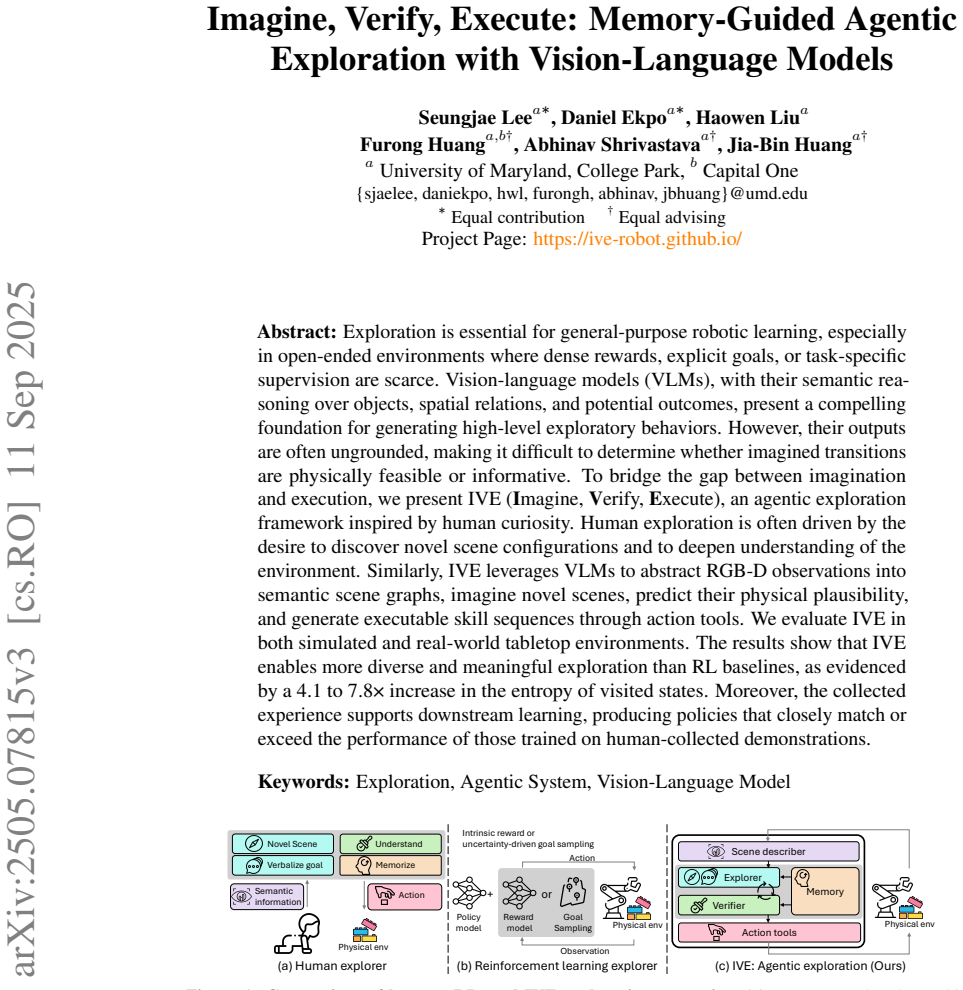
The load-bearing object is the scene graph, a small typed graph whose nodes are object names and whose edges are relations such as Stacked on and Near. A scene-describer VLM builds this graph from a single observation; an explorer VLM imagines a desired future graph and a skill sequence; a verifier VLM simulates the outcome, checks stability and feasibility, and returns feedback; and a memory module stores every graph encountered, retrieving structurally similar ones by edit-based graph distance to guide novelty. Action tools translate each skill into concrete pick-and-place commands with RGB-D perception, so the imagined transition becomes a real interaction whose outcome is recorded back into memory. The closed loop of imagination, verification, execution, and memory is what converts semantic imagination into physically grounded experience.
What would settle it
The decisive check is to measure both perceptual and verification quality directly: annotate a held-out set of scenes with ground-truth object relations and compute precision and recall of the scene describer, and record how often plans the verifier accepts actually fail during execution. If accepted plans fail at high rates or the graphs systematically mislabel relations, the reported entropy and diversity gains would be artifacts of the graph representation rather than evidence of grounded exploration.
Extended reading notes
Core claim
The discovery is that semantic abstraction plus memory is enough to turn a VLM's imagination into grounded exploration data. IVE represents each observation as a typed scene graph of objects and relations; an edit-distance retrieval from memory pushes the imagined next graph toward configurations that have not been seen before; and a verifier over the same VLM class rejects plans that are unstable or physically infeasible before any action is executed. The reported consequence is a 4.1 to 7.8 times increase in state entropy over intrinsic-reward RL baselines, 82 to 122 percent of expert-human scene diversity, and behavior-cloning and world-model performance on par with or better than training on human demonstrations. The paper attributes this to planning over graphs instead of pixels: pixel-level novelty chasing is replaced by semantic novelty that is checked against physical feasibility and memory.
Load-bearing premise
The load-bearing premise is that the VLM's scene graphs and feasibility judgments are accurate enough that the imagined transition matches what actually happens when the robot executes it; the paper does not report separate accuracy numbers for the scene describer or the verifier, so if either silently fails, the recorded experience is imagined diversity rather than grounded interaction.
Editorial extensions
If this is right
- The method removes the need for hand-designed rewards or goal distributions in tabletop exploration, because the VLM's imagination and the verifier's rejection loop supply direction.
- Data collected by IVE is directly usable for imitation-style policy learning: a visuomotor diffusion policy trained on it matches or exceeds policies trained on human demonstrations.
- World models trained on IVE data predict subsequent frames nearly as well as models trained on human data, indicating the collected transitions reflect actual physical dynamics.
- Removing memory or replacing the learned explorer with a rule-based one lowers the number of unique scenes discovered, so memory-guided novelty is a measurable source of the diversity gain.
- Because the pipeline is automated, interaction data can be scaled up without human supervision or manual teleoperation, provided the action-tool library covers the behaviors of interest.
Reading between the lines
- Because the evaluation quantizes state into scene graphs, the reported entropy gain may undercount fine-grained continuous diversity; comparing against pose-based or pixel-based state metrics would test whether the advantage survives at the level of exact object configurations.
- The verifier is the main grounding bottleneck: with a stronger or more conservative verifier, the same explorer could attempt more ambitious rearrangements, while a weaker verifier would decouple imagined novelty from executed reality.
- The same architecture should transfer beyond tabletops if the fixed action-tool library were replaced by learned or more general skills; longer-horizon behaviors would then exercise memory and verification in settings the authors did not test.
- A testable prediction is that exploration quality tracks the underlying VLM's perceptual accuracy: with identical memory and action tools, more accurate scene descriptions should produce more novel graphs and fewer rejected plans.
Signed reviews
Editorial analysis
A structured set of objections, weighed in public.
Referee Report
Summary. IVE is a VLM-driven exploration framework that abstracts RGB-D observations into scene graphs, uses an Explorer to imagine novel scene configurations, a Verifier to filter plans for physical feasibility, a memory of past scene graphs to encourage novelty, and action tools to execute skills. The paper evaluates exploration diversity via unique scene graph counts and state entropy, compares against RND, RE3, and human explorers, and tests downstream behavior cloning and world-model learning in VIMA Bench and on a real UR5e tabletop. The central claimed result is a 4.1 to 7.8x increase in state entropy over RL baselines and 82% to 122% of human scene diversity, with downstream policies that roughly match or exceed those trained on human demonstrations.
Significance. The paper addresses a timely problem—autonomous reward-free data collection for robotic manipulation—and the pipeline is clearly specified, including full prompts and action-tool implementation details that are valuable for reproducibility. If the quantitative claims were validated, the system would be a practical contribution to using VLMs for structured exploration. However, the headline entropy claim is not supported by the paper's own Table 1, and the accuracy of the Scene Describer and Verifier is unmeasured, so the strength of the central contribution is currently unclear. The downstream BC and world-model experiments, the ablation analysis, and the real-world implementation remain useful assets even if the stated entropy factors are corrected.
major comments (3)
- [Abstract / Section 1 / Section 4.2 / Table 1] The stated 4.1 to 7.8x increase in state entropy over RL baselines is contradicted by the only entropy values given in Table 1. In the 5-object VIMA setting, IVE's entropy is 2.283 versus 1.907 for SAC+RND and 1.754 for SAC+RE3, corresponding to ratios of about 1.20x and 1.30x; in the 4-object setting, IVE's entropy is 1.528 versus 1.907 and 1.959, corresponding to ratios of about 0.80x and 0.78x, i.e., lower entropy than either RL baseline. The repeated 1.907 value for SAC+RND in both environments also suggests a copy or metric-definition error. If the Entropy column is not the same state-entropy quantity defined in Appendix A, the paper must define it; if it is the same quantity, the abstract, Section 1, and Section 4.2 must be corrected to report the actual ratios, and the evaluation horizon used for the claimed factors in Figure 5 must be stated so that the 4.1 to 7.8x numbers are reproducible.
- [Section 3.1 / Section 3.3 / Appendix F] The manuscript reports no quantitative evaluation of either the Scene Describer or the Verifier, despite both being load-bearing for the claim that IVE produces physically grounded exploration. No precision or recall for scene-graph relation extraction versus ground truth is reported, even though VIMA provides ground-truth object positions for exactly this check; no acceptance/rejection accuracy for the Verifier is reported, and there is no analysis of whether rejected plans would actually have failed in execution. Because the same VLM class (GPT-4o) generates and evaluates plans, an unmeasured systematic bias in the Verifier could make the reported exploration reflect imagined rather than executed diversity. I ask the authors to report scene-graph accuracy in simulation, verifier decision accuracy against actual execution outcomes, and the plan rejection rate during exploration.
- [Section 4.2 / Appendix A] The primary exploration metric is aligned with the system's own optimization target by construction: IVE's Explorer is explicitly tasked with discovering novel scene graphs, and the top-line evaluation counts unique scene graphs and computes their visitation entropy. Although Appendix A states that evaluation scene graphs are produced with a separate quantization pipeline, the metric is still scene-graph diversity, so the comparison partly measures how well IVE optimizes the evaluation criterion. To support the broader claim of diverse state-space exploration, the paper should add at least one independent diversity measure (e.g., object-pose coverage, action-state coverage, or pixel-level state entropy) or else empirically show that scene-graph diversity is predictive of the reported downstream gains beyond this alignment.
minor comments (5)
- [Figure 5] The caption is incomplete: the final clause 'and 4.2 for baseline details' should read 'and Section 4.2 for baseline details,' and the closing parenthesis should be supplied.
- [Section 3.4, Eq. (1)] The retrieval threshold tau is introduced without a specified value or sensitivity analysis; please state how tau was chosen and whether the main results are stable across a reasonable range of thresholds.
- [Appendix A] The entropy formula should specify the base of the logarithm and the exact state set over which p(s) is normalized; the current summation domain is implicit.
- [Section 4.4] The phrase 'up to +58% in task success' is ambiguous between absolute percentage-point gains and relative gains; please clarify using the underlying rates in Table 1.
- [Section 4.3] The reported '22% and 27% drop in unique scenes discovered' for the memory and explorer ablations should state whether these are relative or absolute drops and should report the corresponding raw counts for each ablation.
Circularity Check
Headline scene-graph diversity metric is the same novelty objective the Explorer is prompted to optimize; downstream BC/WM results are independent.
-
self definitional
[Section 3.2 (Explorer), Appendix A (Evaluation Metrics), Appendix F.2 (Explorer prompt)]
"To promote novelty and avoid redundancy, the Explorer compares ˆGt+1 with retrieved scene graphs from memory, encouraging transitions that are diverse and previously unseen. [Explorer prompt:] generate a sequence of actions that discover a new scene configuration - one that has not been seen before. ... Unique Scene Graphs: The number of distinct scene graphs encountered during exploration. A higher count reflects greater semantic diversity."
IVE's exploration objective is defined as producing novel scene graphs: the Explorer is prompted to imagine a future scene graph not present in memory and to avoid previously seen configurations. The headline evaluation then defines the state space as a discrete set of scene graphs and measures exploration by the number and entropy of distinct scene graphs visited. Consequently, the central diversity claims (4.1-7.8x entropy gain over RL, 82-122% of human scene diversity) largely re-measure the system's own prompting target. Beating pixel-novelty RL baselines on this metric is partly guaranteed by construction rather than an emergent external property.
full rationale
The paper's derivation chain is mostly empirical rather than deductive, and the only notable circularity is the alignment between the Explorer's objective and the headline metric. The Explorer explicitly uses memory of past scene graphs to propose configurations 'not been seen before,' while Appendix A scores exploration as the number and entropy of distinct scene graphs; hence the system is being graded on the same symbolic quantity it is instructed to diversify. That is a self-definitional element, though not a fitted-parameter or equation-level reduction. The paper takes some precaution by using a separate quantization/evaluation pipeline and by comparing to humans and RL baselines that do not share the scene-graph objective. The self-citation [50] (VeriGraph) is not load-bearing: it only motivates scene graphs as an intermediate representation, alongside non-self citations. The limitations section acknowledges manual action tools and detection failures, but does not report verifier accuracy; that is a grounding/correctness risk, not circularity. The abstract's 4.1-7.8x factor is not supported by the Entropy column of Table 1 if that column is state entropy, but the discrepancy is a reporting/consistency concern rather than a definitional reduction. Overall: the central exploration-diversity claim is partially circular because it measures the objective the system was built to maximize, yet the downstream BC and WM evaluations provide independent content, warranting a score of 4.
Assumptions & free parameters
free parameters (3)
- memory retrieval threshold tau =
not reported
- placement offsets =
0.08 m relational offsets, 0.01 m drop offset
- action sequence length limit =
NUM_STEPS_HERE, not stated
assumptions (4)
- domain assumption The scene graph with object nodes and Stacked On / Near edges is a sufficient abstraction of task-relevant state.
- domain assumption GPT-4o physical commonsense is accurate enough for the Verifier to predict stability and feasibility from language history.
- domain assumption The Action Tools library can realize the skill sequences produced by the Explorer.
- domain assumption VimaBench simulation dynamics are a faithful proxy for real tabletop physics.
Cite this review
Pith. "Pith review of Imagine, Verify, Execute: Memory-guided Agentic Exploration with Vision-Language Models." pith.science (2026). https://pith.science/paper/X4WFJAYB
@misc{pith2026250507815,
  author       = {Pith},
  title        = {Pith review of: Imagine, Verify, Execute: Memory-guided Agentic Exploration with Vision-Language Models},
  year         = {2026},
  howpublished = {\url{https://pith.science/paper/X4WFJAYB}},
  note         = {Machine review of arXiv:2505.07815}
}
read the original abstract
Exploration is essential for general-purpose robotic learning, especially in open-ended environments where dense rewards, explicit goals, or task-specific supervision are scarce. Vision-language models (VLMs), with their semantic reasoning over objects, spatial relations, and potential outcomes, present a compelling foundation for generating high-level exploratory behaviors. However, their outputs are often ungrounded, making it difficult to determine whether imagined transitions are physically feasible or informative. To bridge the gap between imagination and execution, we present IVE (Imagine, Verify, Execute), an agentic exploration framework inspired by human curiosity. Human exploration is often driven by the desire to discover novel scene configurations and to deepen understanding of the environment. Similarly, IVE leverages VLMs to abstract RGB-D observations into semantic scene graphs, imagine novel scenes, predict their physical plausibility, and generate executable skill sequences through action tools. We evaluate IVE in both simulated and real-world tabletop environments. The results show that IVE enables more diverse and meaningful exploration than RL baselines, as evidenced by a 4.1 to 7.8x increase in the entropy of visited states. Moreover, the collected experience supports downstream learning, producing policies that closely match or exceed the performance of those trained on human-collected demonstrations.
Figures


Figures from the paper (7 more)


Reference graph
Works this paper leans on
-
[1]
A. Ten, P. Kaushik, P.-Y . Oudeyer, and J. Gottlieb. Humans monitor learning progress in curiosity-driven exploration.Nature communications, 2021
2021
-
[2]
Modirshanechi, K
A. Modirshanechi, K. Kondrakiewicz, W. Gerstner, and S. Haesler. Curiosity-driven exploration: foundations in neuroscience and computational modeling.Trends in Neurosciences, 2023
2023
-
[3]
A. Lidayan, Y . Du, E. Kosoy, M. Rufova, P. Abbeel, and A. Gopnik. Intrinsically-motivated humans and agents in open-world exploration.arXiv preprint arXiv:2503.23631, 2025
arXiv 2025
-
[4]
Aubret, L
A. Aubret, L. Matignon, and S. Hassas. An information-theoretic perspective on intrinsic motivation in reinforcement learning: A survey.Entropy, 25(2), 2023
2023
-
[5]
S. Lee, D. Cho, J. Park, and H. J. Kim. Cqm: Curriculum reinforcement learning with a quantized world model.Advances in Neural Information Processing Systems, 2023
2023
-
[6]
B. Sukhija, S. Coros, A. Krause, P. Abbeel, and C. Sferrazza. MaxinfoRL: Boosting exploration in reinforcement learning through information gain maximization. InInternational Conference on Learning Representations, 2025
work page 2025
-
[7]
G.-C. Anthony, K. Marino, and R. Fergus. Efficient exploration and discriminative world model learning with an object-centric abstraction. InInternational Conference on Learning Representations, 2024
work page 2024
- [8]
Show all 84 references
-
[9]
Mendonca, O
R. Mendonca, O. Rybkin, K. Daniilidis, D. Hafner, and D. Pathak. Discovering and achieving goals via world models.Advances in Neural Information Processing Systems, 2021
2021
-
[10]
Y . Seo, L. Chen, J. Shin, H. Lee, P. Abbeel, and K. Lee. State entropy maximization with random encoders for efficient exploration. InInternational Conference on Machine Learning, volume 139, 2021
2021
-
[11]
V . H. Pong, M. Dalal, S. Lin, A. Nair, S. Bahl, and S. Levine. Skew-fit: state-covering self-supervised reinforcement learning. InInternational Conference on Machine Learning, 2020. 9
2020
-
[12]
E. S. Hu, R. Chang, O. Rybkin, and D. Jayaraman. Planning goals for exploration. In International Conference on Learning Representations, 2023
2023
-
[13]
Huang, C
W. Huang, C. Wang, R. Zhang, Y . Li, J. Wu, and L. Fei-Fei. V oxposer: Composable 3d value maps for robotic manipulation with language models. InConference on Robot Learning, 2023
2023
-
[14]
D. Shah, B. Osi´nski, S. Levine, et al. Lm-nav: Robotic navigation with large pre-trained models of language, vision, and action. InConference on Robot Learning, 2023
2023
-
[15]
Etukuru, N
H. Etukuru, N. Naka, Z. Hu, S. Lee, C. Paxton, S. Chintala, L. Pinto, and N. M. M. Shafiullah. Robot utility models: General policies for zero-shot deployment in new environments. InCORL Workshop, 2024
2024
-
[16]
A. H. Tan, A. Fung, H. Wang, and G. Nejat. Mobile robot navigation using hand-drawn maps: A vision language model approach.arXiv preprint arXiv:2502.00114, 2025
2025 arXiv
-
[17]
Kuang, H
Y . Kuang, H. Lin, and M. Jiang. Openfmnav: Towards open-set zero-shot object navigation via vision-language foundation models. InICLR Workshop, 2024
2024
-
[18]
Jiang, B
W. Jiang, B. Lei, K. Ashton, and K. Daniilidis. Multimodal llm guided exploration and active mapping using fisher information.arXiv preprint arXiv:2410.17422, 2024
2024 arXiv
-
[19]
Jiang, B
H. Jiang, B. Huang, R. Wu, Z. Li, S. Garg, H. Nayyeri, S. Wang, and Y . Li. RoboEXP: Action- conditioned scene graph via interactive exploration for robotic manipulation. InConference on Robot Learning, 2024
2024
-
[20]
Sancaktar, C
C. Sancaktar, C. Gumbsch, A. Zadaianchuk, P. Kolev, and G. Martius. SENSEI: Semantic exploration guided by foundation models to learn versatile world models. InWorkshop on Training Agents with Foundation Models at RLC, 2024
2024
-
[21]
L. Li, J. Xu, Q. Dong, C. Zheng, X. Sun, L. Kong, and Q. Liu. Can language models understand physical concepts? InConference on Empirical Methods in Natural Language Processing, 2023
2023
-
[22]
Y . Hu, F. Lin, T. Zhang, L. Yi, and Y . Gao. Look before you leap: Unveiling the power of gpt-4v in robotic vision-language planning. InICRA Workshop, 2024
2024
-
[23]
Elnoor, K
M. Elnoor, K. Weerakoon, G. Seneviratne, R. Xian, T. Guan, M. K. M. Jaffar, V . Rajagopal, and D. Manocha. Robot navigation using physically grounded vision-language models in outdoor environments.CoRR, 2024
2024
-
[24]
Gaven, T
L. Gaven, T. Carta, C. Romac, C. Colas, S. Lamprier, O. Sigaud, and P.-Y . Oudeyer. Magellan: Metacognitive predictions of learning progress guide autotelic llm agents in large goal spaces. InInternational Conference on Machine Learning. Proceedings of Machine Learning Research, 2025
2025
-
[25]
Colas, T
C. Colas, T. Karch, O. Sigaud, and P.-Y . Oudeyer. Autotelic agents with intrinsically motivated goal-conditioned reinforcement learning: a short survey.Journal of Artificial Intelligence Research, 74, 2022
2022
-
[26]
Burda, H
Y . Burda, H. Edwards, A. Storkey, and O. Klimov. Exploration by random network distillation. InInternational Conference on Learning Representations, 2019
2019
-
[27]
D. Kim, J. Shin, P. Abbeel, and Y . Seo. Accelerating reinforcement learning with value- conditional state entropy exploration.Advances in Neural Information Processing Systems, 2023
2023
-
[28]
Martin, S
J. Martin, S. S. Narayanan, T. Everitt, and M. Hutter. Count-based exploration in feature space for reinforcement learning. InInternational Joint Conference on Artificial Intelligence, 2017. 10
2017
-
[29]
Shahidzadeh, S
A.-H. Shahidzadeh, S. J. Yoo, P. Mantripragada, C. D. Singh, C. Fermüller, and Y . Aloimonos. Actexplore: Active tactile exploration on unknown objects. InInternational Conference on Robotics and Automation, 2024
2024
-
[30]
Durugkar, S
I. Durugkar, S. S. Hansen, S. Spencer, and V . Mnih. Wasserstein distance maximizing intrinsic control. InNeurIPS Workshop, 2021
2021
-
[31]
Klissarov and M
M. Klissarov and M. C. Machado. Deep laplacian-based options for temporally-extended exploration. InInternational Conference on Machine Learning, 2023
2023
-
[32]
J. Bae, K. Park, and Y . Lee. Tldr: Unsupervised goal-conditioned rl via temporal distance-aware representations. InConference on Robot Learning, 2024
2024
-
[33]
D. Cho, S. Lee, and H. J. Kim. Outcome-directed reinforcement learning by uncertainty \& temporal distance-aware curriculum goal generation. InInternational Conference on Learning Representations, 2023
2023
-
[34]
Pitis, H
S. Pitis, H. Chan, S. Zhao, B. Stadie, and J. Ba. Maximum entropy gain exploration for long horizon multi-goal reinforcement learning. InInternational Conference on Machine Learning, 2020
2020
-
[35]
Yarats, R
D. Yarats, R. Fergus, A. Lazaric, and L. Pinto. Reinforcement learning with prototypical representations. InInternational Conference on Machine Learning. Proceedings of Machine Learning Research, 2021
2021
-
[36]
S. V . Mahankali, Z.-W. Hong, A. Sekhari, A. Rakhlin, and P. Agrawal. Random latent explo- ration for deep reinforcement learning. InInternational Conference on Machine Learning, 2024
2024
-
[37]
M. Ahn, A. Brohan, N. Brown, Y . Chebotar, O. Cortes, B. David, C. Finn, C. Fu, K. Gopalakr- ishnan, K. Hausman, et al. Do as i can, not as i say: Grounding language in robotic affordances. arXiv preprint arXiv:2204.01691, 2022
2022 arXiv
-
[38]
Z. Zhou, P. Atreya, A. Lee, H. R. Walke, O. Mees, and S. Levine. Autonomous improvement of instruction following skills via foundation models. InConference on Robot Learning, 2024
2024
-
[39]
Z. Zhou, P. Atreya, Y . L. Tan, K. Pertsch, and S. Levine. Autoeval: Autonomous evaluation of generalist robot manipulation policies in the real world. InCORL Workshop, 2025
2025
-
[40]
R. Shah, A. Yu, Y . Zhu, Y . Zhu, and R. Martín-Martín. Bumble: Unifying reasoning and acting with vision-language models for building-wide mobile manipulation.arXiv preprint arXiv:2410.06237, 2024
2024 arXiv
-
[41]
Johnson, R
J. Johnson, R. Krishna, M. Stark, L.-J. Li, D. Shamma, M. Bernstein, and L. Fei-Fei. Image retrieval using scene graphs. InIEEE Conference on Computer Vision and Pattern Recognition, 2015
2015
-
[42]
Krishna, Y
R. Krishna, Y . Zhu, O. Groth, J. Johnson, K. Hata, J. Kravitz, S. Chen, Y . Kalantidis, L.-J. Li, D. A. Shamma, et al. Visual genome: Connecting language and vision using crowdsourced dense image annotations.International Journal on Computer Vision, 123, 2017
2017
-
[43]
J. Ji, R. Krishna, L. Fei-Fei, and J. C. Niebles. Action genome: Actions as compositions of spatio-temporal scene graphs. InIEEE Conference on Computer Vision and Pattern Recognition, 2020
2020
-
[44]
Johnson, A
J. Johnson, A. Gupta, and L. Fei-Fei. Image generation from scene graphs. InIEEE Conference on Computer Vision and Pattern Recognition, 2018
2018
-
[45]
Ashual and L
O. Ashual and L. Wolf. Specifying object attributes and relations in interactive scene generation. International Conference Computer Vision, 2019. 11
2019
-
[46]
Dhamo, A
H. Dhamo, A. Farshad, I. Laina, N. Navab, G. Hager, F. Tombari, and C. Rupprecht. Semantic image manipulation using scene graphs. InIEEE Conference on Computer Vision and Pattern Recognition, 2020
2020
-
[47]
Herzig, A
R. Herzig, A. Bar, H. Xu, G. Chechik, T. Darrell, and A. Globerson. Learning canonical representations for scene graph to image generation. InEuropean Conference on Computer Vision, 2020
2020
-
[48]
K. Rana, J. Haviland, S. Garg, J. Abou-Chakra, I. Reid, and N. Suenderhauf. Sayplan: Ground- ing large language models using 3d scene graphs for scalable robot task planning. InConference on Robot Learning, 2023
2023
-
[49]
Z. Ni, X. Deng, C. Tai, X. Zhu, Q. Xie, W. Huang, X. Wu, and L. Zeng. Grid: Scene-graph-based instruction-driven robotic task planning. InInternational Conference on Intelligent Robots and Systems, 2024
2024
-
[50]
D. Ekpo, M. Levy, S. Suri, C. Huynh, and A. Shrivastava. Verigraph: Scene graphs for execution verifiable robot planning.arXiv preprint arXiv:2411.10446, 2024
2024 arXiv
-
[51]
Q. Gu, A. Kuwajerwala, S. Morin, K. M. Jatavallabhula, B. Sen, A. Agarwal, C. Rivera, W. Paul, K. Ellis, R. Chellappa, et al. Conceptgraphs: Open-vocabulary 3d scene graphs for perception and planning. InInternational Conference on Robotics and Automation, 2024
2024
-
[52]
Ravichandran, L
Z. Ravichandran, L. Peng, N. Hughes, J. D. Griffith, and L. Carlone. Hierarchical representations and explicit memory: Learning effective navigation policies on 3d scene graphs using graph neural networks. InInternational Conference on Robotics and Automation, 2022
2022
-
[53]
G. Zhai, X. Cai, D. Huang, Y . Di, F. Manhardt, F. Tombari, N. Navab, and B. Busam. Sg-bot: Object rearrangement via coarse-to-fine robotic imagination on scene graphs. InInternational Conference on Robotics and Automation, 2024
2024
-
[54]
Amiri, K
S. Amiri, K. Chandan, and S. Zhang. Reasoning with scene graphs for robot planning under partial observability.IEEE Robotics and Automation Letters, 2022
2022
-
[55]
Jiang, A
Y . Jiang, A. Gupta, Z. Zhang, G. Wang, Y . Dou, Y . Chen, L. Fei-Fei, A. Anandkumar, Y . Zhu, and L. Fan. Vima: General robot manipulation with multimodal prompts. InInternational Conference on Machine Learning, 2023
2023
-
[56]
Gpt-4o: Openai’s new multimodal model
OpenAI. Gpt-4o: Openai’s new multimodal model. https://openai.com/index/gpt-4o,
-
[57]
H.-S. Fang, C. Wang, H. Fang, M. Gou, J. Liu, H. Yan, W. Liu, Y . Xie, and C. Lu. Anygrasp: Robust and efficient grasp perception in spatial and temporal domains.IEEE Transactions on Robotics, 2023
2023
-
[58]
Medeiros
L. Medeiros. Lang segment anything. https://github.com/luca-medeiros/ lang-segment-anything, 2023
2023
-
[59]
P. Liu, Z. Guo, M. Warke, S. Chintala, C. Paxton, N. M. M. Shafiullah, and L. Pinto. Dynamem: Online dynamic spatio-semantic memory for open world mobile manipulation. InCORL Workshop, 2024
2024
-
[60]
P. Liu, Y . Orru, J. Vakil, C. Paxton, N. M. M. Shafiullah, and L. Pinto. Ok-robot: What really matters in integrating open-knowledge models for robotics. InICRA Workshop, 2024
2024
-
[61]
Haarnoja, A
T. Haarnoja, A. Zhou, P. Abbeel, and S. Levine. Soft actor-critic: Off-policy maximum entropy deep reinforcement learning with a stochastic actor. InInternational Conference on Machine Learning, 2018. 12
2018
-
[62]
G. Zhou, H. Pan, Y . LeCun, and L. Pinto. Dino-wm: World models on pre-trained visual features enable zero-shot planning.arXiv preprint arXiv:2411.04983, 2024
2024 arXiv
-
[63]
C. Chi, Z. Xu, S. Feng, E. Cousineau, Y . Du, B. Burchfiel, R. Tedrake, and S. Song. Diffusion policy: Visuomotor policy learning via action diffusion.The International Journal of Robotics Research, 2023. 13 A Evaluation Metrics for Exploration Capability To quantitatively eva...
2023
-
[65]
To the left of,
Relation-Based Placement Tools:Execute relational actions that position objects with respect to others (e.g., “To the left of,” “Stacked on”) as shown in Figure 4
-
[66]
Region-Based Placement Tools:Place objects at specific locations on a predefined 2D layout (e.g., grid cells)
-
[67]
Arranger Tool:Manages workspace cleanliness by moving unreferenced or obstructive objects to free, uncovered regions, enabling subsequent actions. Modularity.The design of the Action Tools module is deliberately modular and extensible—new primitives or skills can be incorporat...
-
[68]
Begin with one object
-
[69]
Add one new object at a time , to your partial scene graph
-
[70]
- ** Use only ** the Allowed Re lat io ns in the scene graph
For each newly added object : - D et er min e its spatial relation ( s ) to the objects already in the scene graph . - ** Use only ** the Allowed Re lat io ns in the scene graph . - Do not assign more than one relation for the same object pair ‘( new_object , e x i s t i n g _...
-
[71]
- ** List all verified re la ti on s ** between pairs of objects , using the Allowed Re la ti on s in the scene graph
** Once all objects ** have been i n t r o d u c e d and verified , compile a ** complete scene graph **: - ** List all nodes ** ( the objects in the final scene ) . - ** List all verified re la ti on s ** between pairs of objects , using the Allowed Re la ti on s in the scene graph
-
[72]
Global Object Names
** Use only ** objects from the " Global Object Names ."
-
[73]
--- ## Scene Graph R e p r e s e n t a t i o n - Nodes : Objects present in the scene
Even if there ’ s missing nodes or edges in a final scene graph ( because at least one object is missing ) , you must still provide a complete ** scratch pad ** and ** scene graph ** with existing r ela ti on s . --- ## Scene Graph R e p r e s e n t a t i o n - Nodes : Objects...
-
[74]
Order Matters : Plan your actions so that p r e c o n d i t i o n s are s ati sf ie d before you move an object
-
[75]
Scene B o u n d a r i e s : If an object is near the scene boundary , avoid pushing it further toward the edge or placing new objects in a risky position
-
[76]
- In c lut te re d areas , an attempt to move one object may cause u n i n t e n d e d c o l l i s i o n s or shifts in n e i g h b o r i n g objects
M a n i p u l a t i o n ( Suction ) C o n s t r a i n t s : - The suction can only reliably pick the topmost exposed surface . - In c lut te re d areas , an attempt to move one object may cause u n i n t e n d e d c o l l i s i o n s or shifts in n e i g h b o r i n g objects ...
-
[77]
Desired Scene Graph should use re la ti on s among < S C E N E G R A P H _ R E L A T I O N S > only , same as other Scene Graphs
Note : The list of allowed r el at io ns in Action Types and the r ela ti on s used in Scene Graph R e p r e s e n t a t i o n ([ Stacked On , Near ]) may differ . Desired Scene Graph should use re la ti on s among < S C E N E G R A P H _ R E L A T I O N S > only , same as oth...
-
[78]
‘ move ( obj_a , RELATION , obj_b ) ’ e . g . , ‘ move ( white cup , Stacked On , red plate ) ’ - Moves one object to a position relative to another . - Allowed RELATION list : ‘[ In Front Of , Behind , To The Left Of , To The Right Of , Stacked On ] ’
-
[79]
A1 " ,
‘ move ( obj_a , GRID_ID ) ’ e . g . , ‘ move ( blue ball , B3 ) ’ - Moves an object to a grid location on the image . ( ‘[" A1 " , " B3 " , ... , " E10 "] ’) 3 , ‘ arrange ( obj_a ) ’ e . g . , ‘ arrange ( red block ) ’ - Pick up the objects and organize them in a clear area ...
-
[80]
** Simulate ** the effect of the action sequence from the current scene
-
[81]
** Predict ** the r es ult in g scene graph
-
[82]
** Compare ** the p re dic te d graph with the desired one
-
[83]
** Evaluate physical f e a s i b i l i t y and e xec ut io n s ta bi li ty **
-
[84]
move obj_A before c o n t i n u i n g
** Provide a judgment **: - Valid and feasible 21 - Invalid ( with reason ) - Valid but risky ( suggest a targeted fix ) - Too unstable to proceed ( re co mme nd d ecl ut te r mode ) --- < ACTION_TYPES > --- ## T r a n s i t i o n History A sequence of a l t e r n a t i n g sc...
-
[2024]
Accessed: 2024-04-30
2024
Reviewed August 15, 2026 · model on record in the stance chip above.
Discussion (0). Continue with ORCID to comment.